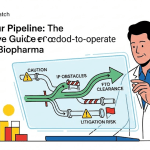
Settling a Paragraph IV patent case feels like the safe choice. It ends the uncertainty, it gets a launch date on the calendar, and it lets both legal teams stop billing hours on a case that could otherwise run for years. That is exactly why 75 to 80 percent of Hatch-Waxman patent suits end in settlement rather than a verdict.
But “safe” and “optimal” are not the same thing. A settlement locks in an outcome before anyone knows what a judge or jury would have done, and the party with the weaker patent portfolio has every incentive to settle early, before the other side finds out how weak it is. For a generic or biosimilar challenger sitting on a genuinely strong invalidity or non-infringement argument, a reflexive settlement can mean giving up years of exclusive revenue. For a brand company with a fragile secondary patent, a reflexive settlement can mean paying a competitor to delay a fight the brand would have lost anyway, which is precisely the conduct the Federal Trade Commission (FTC) has spent two decades trying to stop.
This piece walks through the real financial and legal math behind the litigate-versus-settle decision, using verified cases: Plavix, Provigil, Humira, Enbrel, Copaxone, Restasis, and Lipitor. Some of these are stories about settlement working exactly as intended. Others are cautionary tales about what happens when a company settles a case it should have fought, or fights a case it should have settled. DrugPatentWatch’s litigation and Orange Book data underpins a lot of the pattern recognition here, because knowing where your specific patent sits relative to these historical outcomes is what turns this from a legal exercise into a financial forecast.
What Is a Drug Patent Settlement, and Why Do Most Hatch-Waxman Cases End in One?
Short answer: A drug patent settlement is an agreement, reached during Paragraph IV litigation under the Hatch-Waxman Act, that sets a specific date on which a generic or biosimilar can enter the market, in exchange for the challenger dropping its patent invalidity or non-infringement claims. Most cases settle because litigation is expensive, slow, and binary, while a settlement lets both sides convert an uncertain outcome into a known one.
Every Paragraph IV certification is technically an act of patent infringement under federal law. It has to be, because that is the legal mechanism that lets a brand company sue a generic maker before a single pill has actually been sold. Once that lawsuit is filed, the case follows one of three paths: the parties litigate to a verdict, the generic company drops its challenge and waits out the patent, or the two sides negotiate a settlement that fixes an entry date somewhere between the day the case was filed and the day the patent would have expired anyway.
The 75-80 Percent Settlement Rate: What the Data Actually Shows
Settlement dominates the outcome data for one structural reason: litigating a case all the way to trial is expensive and risky for both sides, and a negotiated entry date removes that risk for both parties at once. A 2010 analysis by RBC Capital Markets, which reviewed more than 370 Paragraph IV court rulings dating back to 2000, found that generics achieved a favorable “success rate” of 76 percent, but that figure counted settlements and dropped cases as wins for the generic side, not just outright court victories[1]. That distinction matters. A settlement being counted as a generic “success” tells you almost nothing about who actually had the stronger patent case. It tells you that the generic company got some entry date earlier than full patent expiration, which is true in the overwhelming majority of negotiated settlements regardless of how strong or weak the underlying patents were.
The practical implication is that settlement rate statistics are a poor proxy for litigation strength. A brand company with a rock-solid compound patent will still settle plenty of cases, because litigating every single Paragraph IV filer to verdict is not a rational use of legal spend even when the brand is confident it would win. The settlement rate tells you about negotiating behavior, not about patent validity.
Reverse Payment Settlements vs. Compromise Entry-Date Settlements
Not all settlements are structured the same way, and the difference matters both legally and financially.
Compromise entry-date settlement: The generic simply agrees to enter the market on a specific date earlier than the patent’s expiration, with no cash changing hands from the brand to the generic. This is the more common and legally safer structure.
Reverse payment settlement: The brand pays the generic challenger, whether in cash, a side deal, or a promotion agreement, in exchange for the generic delaying its entry date. Because the money flows from the plaintiff to the defendant, the opposite direction of how litigation payments normally work, these deals draw direct antitrust scrutiny.
Example: A Typical Entry-Date-Only Settlement
The Pfizer-Ranbaxy settlement over Lipitor (atorvastatin) is the clearest large-scale example of the compromise structure. In June 2008, Pfizer and Ranbaxy Laboratories settled patent litigation that had run since 2003, with Ranbaxy receiving a license to sell generic Lipitor in the United States starting November 30, 2011, the date Lipitor’s core compound patent expired, while Pfizer’s later-filed crystalline and process patents would have otherwise run until 2016 or 2017[2]. Pfizer stated publicly that the deal involved no payment that would concern the FTC, and Ranbaxy received the standard 180-day first-filer exclusivity window starting from that date[2]. This remains the largest single generic drug launch in U.S. history, and it is a settlement built entirely around a date, not a payment.
The Litigation Math: What It Actually Costs to Fight a Paragraph IV Case
Short answer: The American Intellectual Property Law Association’s biennial Economic Survey puts the median cost of a pharmaceutical patent case with more than $25 million at risk at roughly $4 million through trial and appeal, with Hatch-Waxman (ANDA) litigation specifically running to a median of about $5 million[3].
AIPLA Benchmark Numbers for Hatch-Waxman Litigation
Litigation cost scales with the money at stake, and pharmaceutical cases are almost always in the highest tier the AIPLA survey tracks. For cases with less than $1 million at risk, median total cost can still run to roughly $900,000. For cases between $1 million and $10 million at risk, median cost rises to around $2 million. For cases with more than $25 million at risk, the tier virtually every branded pharmaceutical case falls into, median cost through discovery alone runs about $3 million, with total cost through trial and appeal reaching roughly $5.5 million in a fully litigated case involving multiple patents[3]. Other industry estimates put the average pharmaceutical patent lawsuit cost in the $2.3 million to $4 million range, driven primarily by discovery, expert witness fees, and elite patent litigation counsel billing $400 to $1,200 or more per hour[3].
Those numbers are per case, not per patent family, and a brand company defending a blockbuster often faces multiple simultaneous ANDA filers, each requiring its own litigation track even when the underlying patents are identical. A brand with ten Paragraph IV filers on the same drug is not looking at one $5 million litigation bill. It is looking at a legal spend that can multiply toward $15 million or more once parallel Inter Partes Review (IPR) proceedings at the Patent Trial and Appeal Board (PTAB) are added in.
Settlement Cost vs. Litigation Cost: A Side-by-Side Comparison
Path
Typical direct legal cost
Typical time to resolution
Outcome certainty
Who bears the downside
Compromise settlement
Low; case ends before trial
Months to 1-2 years
High; entry date is fixed by contract
Both sides give up upside (brand loses possible full-term protection; generic loses possible earlier win)
Full litigation, brand wins
$4M-$5.5M+ median for cases over $25M at risk
2-4 years, often longer with appeal
High once final; injunction blocks entry
Generic absorbs sunk legal cost and lost time-to-market
Full litigation, generic wins
$4M-$5.5M+ median
2-4 years, often longer with appeal
High once final; patent invalidated or found not infringed
Brand loses remaining patent term and faces immediate multi-generic entry
At-risk launch
Legal cost plus potential damages exposure
Launch is immediate; damages phase can run years longer
Low until damages trial concludes
Generic risks damages up to lost brand profit if it ultimately loses
When the $5 Million Litigation Bill Is Cheaper Than the Settlement
The comparison that actually matters is not settlement cost versus litigation cost in isolation. It is litigation cost versus the value of the exclusivity period a settlement would give up. If a brand’s remaining patent term is worth $200 million a year in protected sales, and outside counsel assesses even a 40 percent chance of a full-term win at trial, a $5 million litigation bill is a rounding error next to the expected value of fighting. The same logic runs in reverse for a generic challenger sitting on a strong invalidity argument against a secondary formulation patent: giving up two extra years of 180-day exclusivity, worth potentially hundreds of millions on a blockbuster molecule, to avoid a $5 million legal bill is not a rational trade if the challenger’s odds of winning are genuinely above even money.
Who Actually Wins When Paragraph IV Cases Go to Trial?
Short answer: Brand manufacturers prevail in roughly 50 to 65 percent of fully litigated Paragraph IV cases across all patent types, but that average hides a large split by patent type: brands win compound patent cases more than 70 percent of the time, while generics win formulation and method-of-use patent cases more than 55 percent of the time.
Brand Win Rates by Patent Type: Compound vs. Formulation vs. Method-of-Use
Research building on economist Henry Hollis’s early work and later academic studies has documented that patent type is the single strongest predictor of litigation outcome in Hatch-Waxman cases. Compound patents, the ones covering the core active ingredient molecule itself, are the hardest for a generic to invalidate and the easiest for a brand to defend, with brand win rates above 70 percent in fully litigated cases. Formulation patents and method-of-use patents, which tend to be filed later in a product’s life cycle to extend exclusivity beyond the compound patent’s expiration, are considerably weaker, with generic win rates above 55 percent in cases that actually reach a verdict.
This is not a minor distinction. It means the strategic calculus for “should we settle or fight” should look completely different depending on which category of patent is actually being asserted. A brand defending its core compound patent has real leverage to hold out for a later entry date or push the case to trial. A brand relying primarily on a secondary formulation patent, the kind of patent most associated with the “evergreening” practices the Hatch-Waxman Act’s Paragraph IV mechanism was specifically designed to test, is fighting from a statistically weaker position and should weigh settlement more seriously, particularly if a payment-free settlement is on the table.
The RBC Capital Markets 76 Percent “Success Rate” Study, and Why That Number Is Misleading
Coming back to the RBC study cited earlier, the 76 percent figure gets quoted often in industry commentary as evidence that generics almost always win Paragraph IV challenges. That is a misreading. The study’s authors explicitly counted settlements and dropped cases as generic successes, on the theory that any entry date earlier than full patent expiration counts as a win for the challenger[1]. Under that definition, a generic that settles for an entry date one month before patent expiration, having achieved essentially nothing beyond what patent law already guaranteed, still counts as a “success.” Strip out settlements and dropped cases and look only at fully adjudicated verdicts, and the picture flips toward brand-favorable, particularly for compound patents.
Why Settlement Counts as “Success” in Industry Studies
The logic behind counting settlements as wins comes from the first-to-file incentive structure itself. Because 180-day exclusivity goes to the first generic filer regardless of whether the case settles or goes to verdict, a generic that settles for any date earlier than the patent’s natural expiration has still captured commercial value it would not otherwise have had. That is a legitimate business win. It is just not evidence about who had the stronger legal argument, which is the number strategy teams actually need when deciding whether to litigate the next case.
2024 Snapshot: How Rare Contested Litigation Has Become
The most recent data shows just how far the mix has shifted toward negotiated outcomes over adjudicated ones. Among Hatch-Waxman litigations that terminated in 2024, innovator companies prevailed on contested issues in approximately 20 percent of cases, while generic challengers prevailed in only about 2 percent of cases that did not end in settlement or a procedural dismissal. The overwhelming majority of filings never reach that stage at all, resolving instead through settlement or dismissal before a court ever rules on validity or infringement. That imbalance, with contested generic wins now a small single-digit share of all terminated cases, is itself a signal: fully litigated cases that do reach a verdict increasingly represent situations where the brand’s patent position was strong enough that the generic had no better option than to roll the dice at trial, which naturally skews the verdict data toward brand wins relative to the broader population of all filed cases.
FTC v. Actavis and the Legal Limits on Settling Your Way Out
Short answer: The 2013 Supreme Court decision in FTC v. Actavis held that reverse payment patent settlements, where a brand company pays a generic challenger to delay market entry, are not automatically legal just because the delay falls within the patent’s nominal term. Courts must instead evaluate these deals under antitrust law’s “rule of reason,” weighing the size of the payment against the settlement’s competitive effects.
What “Reverse Payment” Actually Means Under the Rule of Reason
Justice Breyer’s majority opinion described the basic pattern plainly: Company A sues Company B for patent infringement, and the two settle on terms where B agrees not to sell its product until the patent expires while A pays B millions of dollars, an arrangement that inverts the usual direction of settlement payments and is called a “reverse payment” for exactly that reason[4]. Before Actavis, the Eleventh Circuit had held that these settlements were essentially immune from antitrust review as long as the anticompetitive effects stayed within the “scope of the patent,” meaning no worse than what the patent holder could have achieved by winning the underlying case outright[5]. The Supreme Court rejected that test in a 5-3 decision, ruling instead that a large, unexplained payment from patent holder to challenger can itself be evidence of an anticompetitive purpose, regardless of whether the delay technically stayed inside the patent’s term[5].
The AndroGel Settlement That Triggered the Supreme Court Fight
The underlying case involved AndroGel, Solvay Pharmaceuticals’ testosterone replacement therapy. After generic challengers Actavis and Paddock filed Paragraph IV certifications against Solvay’s patent, Solvay settled with each of them separately: Actavis received payments of $19 million to $30 million annually for nine years, and Paddock received $12 million, in exchange for both companies agreeing to delay their generic launches and, notably, agreeing to help promote AndroGel to physicians[6]. A third company, Par, made a similar arrangement receiving $60 million[6]. The FTC’s complaint alleged that Solvay had effectively paid three separate would-be competitors to prevent a nine-year delay in generic competition, ending in 2015[7]. The Supreme Court’s June 2013 ruling did not declare the AndroGel deal automatically illegal. It sent the case back down to be evaluated under the rule of reason, but it fundamentally changed the legal landscape for every reverse payment settlement negotiated afterward.
The Cephalon Playbook: How a Pay-for-Delay Win Became a $1.2 Billion Loss
Short answer: Cephalon paid four generic drug makers more than $200 million combined to delay generic versions of its narcolepsy drug Provigil by roughly six years. The delay generated years of protected monopoly revenue, but it also produced the largest monetary settlement in FTC history: $1.2 billion, paid by Teva Pharmaceutical Industries after it acquired Cephalon in 2012.
The Provigil Timeline: Six Years of Delay, Four Generic Companies Paid Off
Cephalon’s underlying patent position on Provigil (modafinil) was not strong to begin with. As the compound patent and regulatory exclusivity protecting Provigil neared expiration, Cephalon obtained an additional patent through what a court later found involved misrepresentations to the Patent and Trademark Office, a patent a court subsequently deemed invalid and unenforceable[8]. Rather than let that weak patent be tested at trial, Cephalon sued all four companies preparing to launch generic modafinil and then settled with each of them in late 2005 and early 2006, paying them collectively more than $200 million to hold their generics off the market until April 2012[9]. Provigil generated roughly $475 million in U.S. sales in 2005, doubling to nearly $1 billion by 2007, and represented about half of Cephalon’s total business during the delay period[9].
What the FTC’s Landmark Settlement Changed for Every Brand Company After It
The FTC sued Cephalon in 2008, and the case was headed to trial in the Eastern District of Pennsylvania in June 2015 when Teva, which had acquired Cephalon in 2012, settled five days before trial for $1.2 billion, the largest monetary settlement the FTC had ever obtained in a pay-for-delay case[10]. The money went into a fund to compensate drug wholesalers, pharmacies, and insurers who had overpaid for Provigil during the delay, and Teva also agreed to a permanent injunction against entering similar reverse payment settlements across its entire U.S. generics business, the largest in the world[11]. FTC Chairwoman Edith Ramirez called it a landmark step in the agency’s effort to protect consumers from the billions of dollars in higher drug costs that pay-for-delay settlements had historically produced[11].
An FTC staff study found that pay-for-delay patent settlements between brand and generic drug makers cost American consumers an estimated $3.5 billion a year in delayed access to lower-cost generics[12].
That $3.5 billion figure, first published by the FTC in 2010, has been the industry’s reference point for the aggregate cost of reverse payment deals for more than a decade. A 2022 Columbia Science and Technology Law Review analysis applying six different methodologies to data from 2006 to 2017 found the true cost was likely far higher, ranging from a conservative $6.2 billion a year up to as much as $37 billion a year under the most aggressive methodology, roughly double to ten times the FTC’s original figure[13].
What Happens When You Launch at Risk Instead of Settling: The Plavix Case
Short answer: An “at-risk launch” is when a generic company sells its product before patent litigation is fully resolved, betting that it will ultimately win. If it loses, it can owe the brand company damages calculated from the profits it made during the unauthorized sales window. Apotex’s 2006 at-risk launch of generic Plavix is the clearest cautionary example: it ultimately paid $444 million in damages after a launch that generated roughly $880 million in sales.
Apotex’s 2006 At-Risk Launch, Explained
Sanofi-aventis and Bristol-Myers Squibb had been litigating Plavix (clopidogrel bisulfate) patent claims against Apotex since 2002. On August 8, 2006, with the litigation still unresolved and settlement talks having broken down, Apotex launched its generic version anyway, flooding U.S. distribution channels with product before any court had ruled on validity or infringement[14]. Bristol-Myers Squibb’s own securities filings show the scale of the disruption: Plavix’s U.S. net sales fell from $988 million in the second quarter of 2006 to $474 million in the third quarter and $343 million in the fourth quarter, even as total prescription demand for clopidogrel, branded plus generic, increased 14 percent for the year[15]. The court granted a preliminary injunction on August 31, 2006, roughly three weeks after the launch, but by then the generic product already in the distribution channel could satisfy a large share of U.S. demand well into 2007[16].
The Math Behind the $444 Million Judgment
The litigation dragged on for years after the injunction. A U.S. judge upheld Sanofi’s patent and found Apotex had infringed it in 2007, and the case continued through appeals until the Federal Circuit affirmed a damages award in October 2011[17]. Apotex’s generic version had generated more than $880 million in sales during its brief time on the market before the injunction took hold. Sanofi and Bristol-Myers Squibb sought half of that figure in damages, and the court agreed, under a prior arrangement between the parties that capped any award at half of Apotex’s Plavix sales[17]. Apotex ultimately paid $442,209,362 in damages plus $1,258,682 in post-judgment interest and $900,000 in costs, a total of roughly $444 million, in February 2012, closing out a patent fight that had run for nearly ten years[18].
At-Risk Launch vs. Settlement vs. Full Litigation: Three Different Bets
The Plavix case is instructive precisely because it shows what an at-risk launch actually is: not a fourth strategic option distinct from litigation, but a bet placed in the middle of litigation that is still ongoing. Apotex did not avoid the litigation costs of fighting Sanofi and Bristol-Myers Squibb in court. It absorbed those costs and added a second, larger risk on top: the possibility that the roughly $880 million in generic revenue it earned during the unauthorized window would later have to be disgorged in whole or in part. A company deciding whether an at-risk launch makes sense needs a genuinely strong view on its odds of eventually winning the underlying patent case, because the downside is not capped at legal fees the way a straightforward settlement is.
When Settlement Wins: The Humira Patent Thicket Case Study
Short answer: AbbVie built a portfolio of roughly 136 patents around Humira (adalimumab), covering formulations, manufacturing processes, and dosing regimens well beyond the core compound patent. Rather than litigate that entire thicket, every major biosimilar maker chose to settle, agreeing to delay U.S. launches until 2023, about 11 years after Humira’s original compound patent would have expired on its own.
Why AbbVie’s 136 Patents Made Litigation the Losing Bet
Humira’s basic compound patent expired years before any biosimilar actually reached the U.S. market. What kept competitors out was the surrounding thicket: AbbVie had assembled and defended a portfolio covering formulation, dosing, and manufacturing method patents that, collectively, made it functionally impossible for a challenger to clear every legal obstacle through litigation alone. A federal court reviewing antitrust claims against AbbVie’s strategy found that the existence of even one valid, infringed patent among the 136 would have been enough to keep biosimilars out of the U.S. market before 2023, and dismissed claims that the strategy itself was unlawful, while noting that AbbVie’s settlements with biosimilar makers did not meet the legal standard for an anticompetitive reverse payment because AbbVie was not paying the challengers, they were paying AbbVie in royalties[19].
That last detail is the key difference from Cephalon and AndroGel. These were not pay-for-delay deals in the FTC v. Actavis sense. They were licenses: biosimilar makers agreed to pay AbbVie royalties in exchange for a guaranteed, uncontested date to enter the market, rather than gambling years of litigation against a patent estate large enough that “batting a thousand” against every single patent was not a realistic outcome for any challenger[20].
Timeline: How Eight Biosimilar Makers Settled Into a Single 2023 Launch Date
2017: Amgen becomes the first biosimilar maker to settle, securing a U.S. launch date of January 31, 2023 for Amjevita, while gaining European market access starting in October of that year.
April 2018: Samsung Bioepis reaches a “global resolution” ending all patent litigation over its biosimilar Imraldi, with U.S. entry set for June 30, 2023 and European entry beginning October 2018[21].
2018-2019: Additional biosimilar makers, including Mylan and Pfizer, settle on similar 2023 U.S. entry terms, each paying AbbVie royalties once their products launch.
May 2019: Boehringer Ingelheim, the last major holdout that had fought AbbVie’s patents directly, settles for a July 1, 2023 U.S. entry date, ending what the company itself described as an assessment that continued litigation carried too much cost, delay, and unpredictability relative to the settlement’s certainty[22].
By the time Boehringer settled, eight companies had reached agreements with AbbVie, all clustering around a mid-2023 U.S. entry window, more than three years after European biosimilar competition had already begun and roughly 11 years before Humira’s full patent estate would have naturally expired[20]. AbbVie’s general counsel described the pattern as a reflection of the “strength and breadth” of the company’s intellectual property position[23].
Boehringer Ingelheim’s Failed Attempt to Hold Out
Boehringer’s experience is the clearest evidence that the settlement strategy was rational rather than merely risk-averse. Boehringer fought longer and harder than any other Humira biosimilar challenger, suing AbbVie back and arguing the company had pursued overlapping, non-inventive patents specifically to build an unbeatable thicket[24]. After years of contested discovery, Boehringer still ended up settling on essentially the same 2023 timeline as companies that had never fought at all, only securing a marginally earlier entry date within that window as a consolation for having held out the longest[22]. The lesson for strategy teams facing a genuine patent thicket, as opposed to a single vulnerable patent, is that litigation cost and delay can erode the challenger’s negotiating position over time rather than improving it.
When Fighting Wins: The Enbrel Verdict That Bought Amgen a Decade
Short answer: Unlike AbbVie, Amgen chose to litigate its Enbrel (etanercept) patents against biosimilar challengers Sandoz and Samsung Bioepis rather than settle. It won decisively in both cases, and federal courts blocked both companies’ biosimilars from the U.S. market until 2029, roughly a decade after Enbrel’s original compound patent had already expired.
Immunex v. Sandoz: How Two Patents Blocked Two Biosimilars Until 2029
Enbrel’s primary compound patent expired in 2010, but Amgen, along with patent owner Roche and exclusive licensee Immunex, held two later patents covering the etanercept molecule and its manufacturing process, patents Sandoz argued were invalid[25]. Sandoz’s biosimilar Erelzi had actually received FDA approval back in 2016, but the company could not launch it commercially because of the ongoing litigation[26]. In August 2019, the U.S. District Court for the District of New Jersey ruled in Amgen’s favor, upholding U.S. Patent Nos. 8,063,182 and 8,163,522 and blocking Erelzi’s launch[27]. Sandoz appealed, but the Federal Circuit affirmed the ruling, and the Supreme Court declined to hear a further appeal in 2020, leaving Sandoz blocked from the U.S. market until the patents expire in 2029[28].
Samsung Bioepis fared no better. Amgen filed a nearly identical suit against Samsung’s biosimilar Eticovo, and in late 2021 the same New Jersey district court ruled that Samsung’s product would also infringe the same two patents if launched before 2029, ordering Samsung to destroy any etanercept product it had already imported into the United States[29].
What Amgen’s Win Cost Sandoz and Samsung Bioepis
Enbrel generated more than $5.2 billion in sales for Amgen in the year before the district court ruling, representing 22 percent of the company’s total revenue[25]. Every year that ruling holds is a year of exclusivity Amgen would not have had if it had settled on more generous terms the way AbbVie did with Humira. For Sandoz and Samsung Bioepis, the cost is the mirror image: both companies received FDA approval for their biosimilars years before they can actually sell them, meaning their regulatory investment sits dormant, generating no revenue, until 2029 at the earliest. One analyst commentary at the time noted dryly that Amgen functions “like an IP litigation firm that just so happens to be in the business of developing drugs,” a characterization the Enbrel outcome makes hard to dispute[30].
Aggressive Non-Settlement Strategies That Backfired: Restasis and the Mohawk Tribe
Short answer: Facing an Inter Partes Review challenge to its Restasis (cyclosporine) patents at the Patent Trial and Appeal Board, Allergan tried an unusual maneuver: transferring the patents to the Saint Regis Mohawk Tribe and licensing them back, betting that tribal sovereign immunity would block the IPR entirely. The PTAB, the Federal Circuit, and ultimately the Supreme Court all rejected the strategy, and Allergan’s underlying patents were separately found invalid anyway.
How the Sovereign Immunity Deal Was Supposed to Work
In September 2017, with generic challengers Mylan, Teva, and Akorn pursuing an IPR against six Restasis patents at the PTAB, Allergan transferred ownership of those patents to the Saint Regis Mohawk Tribe and simultaneously licensed them back[31]. The theory was that because federally recognized tribes possess sovereign immunity from many types of legal proceedings, the tribe could ask the PTAB to dismiss the IPR entirely, insulating the patents from review on validity grounds that private commercial owners cannot claim[32].
The $15 Million Royalty Deal Structure
The commercial terms of the arrangement were straightforward: the tribe received an upfront payment of $13.75 million plus $15 million in annual royalties, in exchange for holding the patents and asserting immunity on Allergan’s behalf[33]. It was, at the time, described as an unprecedented deal, the first instance of a major pharmaceutical company handing full ownership of a patent portfolio to a Native American tribe specifically to gain a litigation advantage[33].
Why the PTAB, Federal Circuit, and Supreme Court All Rejected It
The strategy failed at every level of review. In February 2018, the PTAB denied the tribe’s motion to dismiss the IPR, finding the tribe had not shown its immunity extended to this type of proceeding[34]. The Federal Circuit affirmed that decision in July 2018, holding that an IPR resembles a federal agency enforcement action more than a private civil lawsuit, a category of proceeding tribal sovereign immunity does not reach[35]. Allergan and the tribe appealed to the Supreme Court, which declined to hear the case in April 2019, permanently ending the maneuver[36].
The strategy’s failure was compounded by timing: a separate federal court ruling in October 2017, just weeks after the Mohawk transfer was announced, found Restasis’s underlying patents invalid on their own merits before the tribal deal could even become relevant[37]. Allergan cut 1,400 jobs in the aftermath, and Restasis sales fell 14 percent the following year to $1.26 billion, with generic competitors still working through FDA approval[38]. Senator Tom Cotton called the scheme “a sham” in a statement after the Supreme Court’s rejection, and the episode drew enough congressional attention that it prompted proposed federal legislation aimed at closing the sovereign immunity loophole for future cases[39].
Copaxone: What Losing in Court Actually Costs a Brand
Short answer: Teva chose to litigate its later-generation Copaxone (glatiramer acetate) patents rather than settle with challengers Mylan, Sandoz, and Momenta. It lost. The PTAB and a federal district court both found the key patents obvious, the Federal Circuit affirmed, and Copaxone’s revenue fell by more than half within roughly two years of the ruling.
The Obviousness Ruling That Opened the Door for Mylan and Sandoz
Copaxone was Teva’s best-selling drug, generating around $4 billion a year, and the company had worked hard to extend its franchise by shifting patients from a daily 20mg injectable formulation to a newer three-times-weekly 40mg version, protected by patents Teva expected to run until 2030[40]. By the end of 2015, Teva had successfully switched nearly 80 percent of Copaxone patients to the newer formulation, effectively insulating much of its revenue from the 20mg generic competition that Sandoz’s Glatopa had already introduced[40].
That strategy depended entirely on the 40mg patents holding up. They did not. In 2016, the PTAB found three of Teva’s method-of-use patents covering the 40mg regimen invalid as obvious through an IPR proceeding brought by Mylan, and in January 2017 a federal district court separately invalidated a fourth patent on the same grounds[41]. The core obviousness finding was straightforward: having already patented a 20mg daily regimen, Teva’s move to a 40mg three-times-weekly version was, in the court’s assessment, an obvious modification for a person skilled in the art to try[42]. The Federal Circuit affirmed the invalidity finding in October 2018, closing off any remaining appeal[42]. Mylan launched its 40mg generic at risk in October 2017, before the Federal Circuit had even ruled, and Teva ultimately dismissed its remaining litigation against Mylan in December 2017 after losing a related ruling on separate manufacturing patents[43].
Teva’s Revenue Before and After the Federal Circuit Loss
The financial impact arrived quickly. Copaxone’s full-year worldwide sales fell from $4.2 billion in 2016 to $3.8 billion in 2017 as the obviousness rulings worked their way through appeal[44]. Combined North American sales of the 20mg and 40mg versions together fell to $940 million in the first half of 2018, down more than $700 million from the $1.65 billion Teva had recorded in the same period the prior year[44]. Because Teva had litigated rather than settled, it also lost the ability to negotiate any transition period or damages claim; once Mylan’s at-risk launch was validated by the Federal Circuit’s affirmance, Teva’s exposure to any damages claim against Mylan effectively evaporated along with its patent protection.
Building a Litigate-vs.-Settle Decision Framework
Short answer: The decision to litigate or settle a Paragraph IV or biosimilar patent case should weigh four factors together: the type of patent being asserted, the value of the remaining exclusivity period versus the cost of litigation, the challenger’s exposure to losing 180-day exclusivity, and whether the case involves a single strong patent or a defensible thicket of weaker ones.
Patent Strength Signals: Compound Patents vs. Secondary Patents
The Enbrel and Humira cases sit at opposite ends of the same spectrum for a reason. Amgen’s Enbrel case rested on two specific, later-filed patents that a court could evaluate cleanly on validity, and Amgen had enough confidence in those patents to litigate to a full verdict twice. AbbVie’s Humira position rested on 136 patents of varying strength, where the value was not any single patent’s bulletproof validity but the sheer statistical improbability of a challenger clearing every one of them through litigation. Brand teams should be honest with themselves about which situation they are actually in. A thicket built from marginal patents is a settlement asset, worth licensing for royalties, not a litigation asset worth defending patent by patent in court, because even a strong overall settlement position can unravel if a challenger picks off the weakest patents in the portfolio one at a time through IPR.
Remaining Exclusivity Value vs. Litigation Cost: The Breakeven Formula
A useful way to frame the decision is to compare the annual value of the exclusivity period at stake against the AIPLA benchmark litigation cost, adjusted for probability of winning. If remaining brand-protected annual revenue is R, the number of years of exclusivity at stake is Y, litigation cost is roughly $5 million for a standard ANDA case, and the brand’s honest self-assessed probability of winning is P, then litigating makes financial sense whenever P multiplied by (R times Y) meaningfully exceeds the $5 million cost, adjusted for the time value of resolving the case years earlier through settlement. For a blockbuster with $500 million in annual protected revenue and two years of exclusivity at stake, even a 20 percent chance of winning at trial produces an expected value of $200 million, dwarfing the litigation cost. For a niche drug with $15 million in annual revenue and one year of exclusivity at stake, the same 20 percent win probability produces an expected value of $3 million, below the cost of litigating it. The framework is simple, but the discipline of actually running the numbers, rather than defaulting to whichever choice feels less risky in the moment, is what separates a deliberate settlement strategy from a reflexive one.
180-Day Exclusivity Risk for Generic Challengers Who Settle
Generic challengers face a parallel calculation with a wrinkle specific to their side of the table: the 180-day first-to-file exclusivity period. A first filer that settles too early, or on terms a later court might have improved on, gives up not just its own delayed entry but potentially the value of blocking every other generic from entering during that exclusivity window. Because that exclusivity period is worth capturing the entire early generic market rather than splitting it among several competitors, a first filer with a genuinely strong invalidity case has more to lose from an overly cautious settlement than almost any other party in the litigation.
Forecasting Settlement Odds: A Four-Factor Scorecard
Combining the lessons from these cases into a practical scorecard, four questions predict settlement likelihood and outcome reasonably well across the case studies above:
Is the asserted patent a compound patent (harder to invalidate, favors holding out or litigating) or a secondary formulation or method-of-use patent (weaker, favors settlement leverage for the challenger)?
Is this a single-patent dispute (Enbrel) or a multi-patent thicket (Humira), since thickets favor settlement even for challengers with a strong case against any individual patent?
Does the settlement on the table involve a cash payment from brand to generic (reverse payment, drawing FTC scrutiny under Actavis) or a royalty running from generic to brand (a cleaner license structure less likely to attract antitrust attention)?
What is the challenger’s downside if it launches at risk and ultimately loses, measured against its potential upside if it wins outright, given that damages in an at-risk scenario can reach half or more of total at-risk sales, as they did in Plavix?
What This Means for Brand and Generic Strategy Teams in 2026
Short answer: The cases above point to one consistent lesson: settlement should be a deliberate financial decision made after evaluating patent strength, remaining exclusivity value, and litigation cost, not a default reflex adopted because it feels lower-risk than a court fight.
How DrugPatentWatch Data Fits Into the Litigate-vs.-Settle Decision
Every framework in this piece depends on inputs a strategy team has to gather before a Paragraph IV letter even arrives: what patents are actually listed in the Orange Book or Purple Book against a given product, how many years of nominal exclusivity remain on each one, whether a patent is a compound claim or a secondary claim, and what has happened in prior litigation or IPR proceedings involving similar patent types from the same brand or the same therapeutic class. DrugPatentWatch tracks exactly this kind of Orange Book listing, patent expiration, and litigation history data across thousands of products, which is what turns a general framework like the one above into a specific, drug-by-drug forecast rather than an abstract exercise.
Turning Paragraph IV Filings Into an Early-Warning System
Because a Paragraph IV certification is a matter of public record once filed, and because the 45-day window for a brand to sue and trigger the 30-month stay is fixed by statute, both sides of a potential dispute have a predictable amount of lead time to run exactly the kind of patent-type and cost-benefit analysis described above, well before either side has to commit to a settlement position. Waiting until settlement talks are already underway to figure out whether the underlying patent is a compound claim or a formulation claim is a preventable mistake.
Pricing Pressure, PBM Formulary Timing, and Supply Chain Readiness After a Settlement Date Is Set
Once a settlement date or litigation outcome fixes a generic entry date, the commercial clock starts running for both sides regardless of how that date was reached. Brand teams need pricing and market access strategies ready well before the LOE (loss of exclusivity) date, since payers and pharmacy benefit managers typically begin preparing formulary changes and generic substitution policies months in advance of a known entry date. Generic and biosimilar makers, for their part, need manufacturing capacity, distribution agreements, and channel inventory in place well before launch day, because a settlement’s negotiated certainty is only valuable if the challenger is actually ready to execute on day one rather than scrambling the way Apotex effectively had to during its unplanned at-risk entry into Plavix. A negotiated date removes legal uncertainty, but it does not remove the operational work of actually being ready to compete once that date arrives.
Key Takeaways
Roughly 75 to 80 percent of Hatch-Waxman Paragraph IV cases settle, but that statistic reflects negotiating behavior, not evidence about which side had the stronger patent.
Litigation cost for a fully contested pharmaceutical patent case runs to a median of about $5 million for Hatch-Waxman cases, a figure that is often small relative to the value of the exclusivity period actually at stake.
Compound patents favor the brand in litigation, with win rates above 70 percent; secondary formulation and method-of-use patents favor the generic challenger, with win rates above 55 percent.
Reverse payment settlements, where cash flows from the brand to the generic to delay entry, face direct antitrust risk under the Supreme Court’s 2013 FTC v. Actavis ruling and have produced settlements as large as $1.2 billion, in Cephalon’s Provigil case.
A large, well-defended patent thicket, as in AbbVie’s Humira portfolio, can make settlement the financially rational choice even for challengers with a strong case against any single patent, because litigation risk compounds across every patent in the thicket.
A single strong compound or process patent, as in Amgen’s Enbrel case, can make full litigation the better bet, delivering a decade of additional exclusivity when the brand wins.
At-risk launches are not a separate strategy from litigation. They are a bet placed on top of ongoing litigation, and a loss can mean disgorging up to half of the revenue earned during the unauthorized sales window, as Apotex did in the Plavix case.
Unconventional strategies built to avoid litigation entirely, like Allergan’s tribal sovereign immunity transfer in the Restasis case, can fail at every level of review and draw regulatory and legislative attention that a straightforward settlement or litigation strategy would not.
FAQ
What is a Paragraph IV certification, and how does it trigger litigation?
A Paragraph IV certification is a statement a generic or biosimilar applicant files with the FDA asserting that a patent listed against the brand product is invalid, unenforceable, or will not be infringed by the generic version. Filing it is legally treated as an act of patent infringement, which gives the brand company standing to sue within 45 days, triggering a 30-month stay on FDA approval while the litigation plays out.
How long does Hatch-Waxman patent litigation typically take?
Most cases resolve within the statutory 30-month stay period, roughly two and a half years, but cases that go to appeal, like Plavix and Copaxone, can run considerably longer. The Plavix litigation ran from 2002 until final damages payment in 2012, a full decade.
What is 180-day exclusivity, and how can a generic company lose it?
The first generic company to file a substantially complete ANDA with a Paragraph IV certification earns 180 days of market exclusivity once it begins selling, during which the FDA cannot approve any other generic version. A first filer can forfeit that exclusivity under various statutory triggers, including failing to market its product within a set period after approval or certain types of settlement agreements deemed to constitute a failure to market.
Are reverse payment settlements illegal?
Not automatically. FTC v. Actavis established that courts must evaluate reverse payment settlements under antitrust law’s rule of reason rather than treating them as presumptively legal or illegal, weighing the size and rationale of the payment against its competitive effects.
What is an at-risk launch, and why do generic companies do it?
An at-risk launch is a generic or biosimilar sale that occurs before patent litigation is fully resolved. Companies do it when they believe litigation odds favor them and want to capture early market share, but it exposes them to potentially disgorging profits earned during the unauthorized window if they ultimately lose, as Apotex did with Plavix.
How much does it cost to litigate a pharmaceutical patent case?
The AIPLA Economic Survey puts the median cost of a fully litigated Hatch-Waxman case at roughly $5 million, with pharmaceutical cases generally falling into the highest cost tier the survey tracks because of the high dollar value typically at risk.
What is a patent thicket, and why does it change settlement math?
A patent thicket is a large portfolio of overlapping patents, often covering formulation, dosing, and manufacturing details rather than the core compound, assembled around a single product to make it statistically difficult for any single challenger to clear every legal obstacle through litigation. AbbVie’s roughly 136-patent Humira portfolio is the leading example, and it made royalty-bearing settlement more attractive than litigation for every major biosimilar challenger.
Can a biosimilar maker challenge a patent through IPR instead of Hatch-Waxman litigation?
Yes. Inter Partes Review at the Patent Trial and Appeal Board is a separate, often faster and cheaper route to challenge patent validity, used in both the Restasis and Copaxone disputes, and it runs on a different procedural track than the district court litigation triggered by a Paragraph IV certification.
What happens to a generic company’s damages exposure if it loses an at-risk launch?
Damages are typically calculated based on the brand’s lost profits or the generic’s ill-gotten sales during the at-risk period, and can be substantial. In the Plavix case, damages were capped by prior agreement at half of Apotex’s roughly $880 million in generic sales, resulting in a $444 million judgment.
How do brand companies decide whether to settle or litigate a Paragraph IV case?
The decision should weigh patent type (compound patents favor litigating; secondary patents favor settling), the value of remaining exclusivity against the roughly $5 million median litigation cost, whether the case involves a single patent or a defensible thicket, and whether any settlement on the table involves a payment structure that could draw FTC scrutiny under the Actavis rule of reason standard.
References
Patent Docs. (2010). Study examines Paragraph IV settlement and litigation success rates. https://patentdocs.org/2010/01/21/rbc-study-analyzes-generics-paragraph-iv-settlement-and-litigation-success-rates/
Pfizer Inc. (2008). Pfizer and Ranbaxy settle Lipitor patent litigation worldwide [Press release]. https://www.pfizer.com/news/press-release/press-release-detail/pfizer_and_ranbaxy_settle_lipitor_patent_litigation_worldwide
Ramey LLP. (n.d.). The hidden price of patent wars: How legal costs are killing innovation. Citing American Intellectual Property Law Association, Report of the Economic Survey (2023). https://www.rameyfirm.com/the-hidden-price-of-patent-wars-how-legal-costs-are-killing-innovation
Justia U.S. Supreme Court Center. (2013). FTC v. Actavis, Inc., 570 U.S. 136. https://supreme.justia.com/cases/federal/us/570/136/
Dorsey & Whitney LLP. (2013). The Supreme Court addresses pay-for-delay in FTC v. Actavis. https://www.dorsey.com/newsresources/publications/2013/06/the-supreme-court-addresses-payfordelay-in-ftc-v__
Antitrust Law Blog / Sheppard Mullin. (2013). FTC v. Actavis: What does it mean for reverse-payment settlements? https://www.antitrustlawblog.com/2013/06/articles/uncategorized/ftc-v-actavis-what-does-it-mean-for-reverse-payment-settlements/
Federal Trade Commission. (n.d.). Watson Pharmaceuticals, Inc., et al. (FTC v. Actavis). https://www.ftc.gov/legal-library/browse/cases-proceedings/071-0060-watson-pharmaceuticals-inc-et-al-ftc-v-actavis
South Dakota Office of the Attorney General. (n.d.). Provigil antitrust settlement. https://consumer.sd.gov/consumeralerts/Provigil.aspx
Wharton Public Policy Initiative. (2015). The FTC makes history with a $1.2 billion “pay-for-delay” settlement case. https://publicpolicy.wharton.upenn.edu/live/news/764-the-ftc-makes-history-with-a-12-billion
Law360. (2015). Cephalon to pay $1.2B to end FTC pay-for-delay suit. https://www.law360.com/articles/660909/cephalon-to-pay-1-2b-to-end-ftc-pay-for-delay-suit
Federal Trade Commission. (2015). FTC settlement resolving Cephalon pay-for-delay case ensures $1.2 billion in ill-gotten gains relinquished, refunds to purchasers. https://www.ftc.gov/news-events/news/press-releases/2015/05/ftc-settlement-cephalon-pay-delay-case-ensures-12-billion-ill-gotten-gains-relinquished-refunds-will
Federal Trade Commission. (2010). FTC testimony: Stopping pay-for-delay drug settlement agreements is a top competition priority. https://www.ftc.gov/news-events/news/press-releases/2010/07/ftc-testimony-stopping-pay-delay-drug-settlement-agreements-top-competition-priority
Columbia Science and Technology Law Review. (2022). The price tag of “pay-for-delay.” https://journals.library.columbia.edu/index.php/stlr/article/view/9389
Bristol-Myers Squibb Company. (2007). Form 10-K for fiscal year 2006. U.S. Securities and Exchange Commission. https://www.sec.gov/Archives/edgar/data/0000014272/000119312507039915/d10k.htm
Bristol-Myers Squibb Company. (2006). Form 424B5. U.S. Securities and Exchange Commission. https://www.sec.gov/Archives/edgar/data/0000014272/000119312506238057/d424b5.htm
Fierce Pharma. (2012). Sanofi, BMS collect their $444M in Plavix damages. https://www.fiercepharma.com/sales-and-marketing/sanofi-bms-collect-their-444m-plavix-damages
Bristol-Myers Squibb Company. (2012). Sanofi and Bristol-Myers Squibb collect damages in Plavix patent litigation with Apotex [Press release]. https://news.bms.com/news/details/2012/Sanofi-and-Bristol-Myers-Squibb-Collect-Damages-in-Plavix-Patent-Litigation-with-Apotex/default.aspx
Mintz. (2020). AbbVie’s enforcement of its “patent thicket” for Humira under antitrust scrutiny. https://www.mintz.com/insights-center/viewpoints/2231/2020-06-18-abbvies-enforcement-its-patent-thicket-humira-under
Association for Accessible Medicines. (2025). Patent settlements are necessary to help combat patent thickets. https://accessiblemeds.org/resources/blog/patent-settlements-are-necessary-to-help-combat-patent-thickets/
GaBI Online. (2018). AbbVie and Samsung Bioepis reach patent deal over Humira biosimilar. https://www.gabionline.net/biosimilars/general/AbbVie-and-Samsung-Bioepis-reach-patent-deal-over-Humira-biosimilar
Fierce Pharma. (2020). Amgen’s Enbrel fends off biosimilar threat, and heads toward blockbuster superstardom. https://www.fiercepharma.com/pharma/amgen-catches-a-break-enbrel-biosimilar-threat-as-federal-court-upholds-patent-win
Fierce Pharma. (2021). Amgen stalls Samsung’s Enbrel biosim until 2029 in 2nd patent win of the year. https://www.fiercepharma.com/pharma/amgen-stalls-samsung-s-enbrel-biosim-until-2029-second-patent-win-year
Fierce Pharma. (2020). Amgen catches a break: Enbrel biosimilar threat as federal court upholds patent win. https://www.fiercepharma.com/pharma/amgen-catches-a-break-enbrel-biosimilar-threat-as-federal-court-upholds-patent-win
Xtalks. (2018). Allergan’s Restasis to face impending generic competition after patent license play fails. https://xtalks.com/allergans-restasis-to-face-impending-generic-competition-1185/
The St. Regis Mohawk Tribe and Restasis patent. (n.d.). In Wikipedia. https://en.wikipedia.org/wiki/The_St._Regis_Mohawk_Tribe_and_Restasis_patent
MedCity News. (2019). Allergan, Saint Regis Mohawk Tribe ask SCOTUS to hear Restasis patent case. https://medcitynews.com/2019/01/allergan-saint-regis-mohawk-tribe-ask-scotus-to-hear-restasis-patent-case/
BioPharma Dive. (2019). Allergan, Mohawk tribe ask for Supreme Court review of scrutinized patent case. https://www.biopharmadive.com/news/allergan-mohawk-tribe-restasis-supreme-court-patent-case/546180/
MedCity News. (2019). Supreme Court rejects Allergan, Saint Regis Mohawk appeal in patent case. https://medcitynews.com/2019/04/supreme-court-rejects-allergan-saint-regis-mohawk-appeal-in-patent-case/
Fierce Pharma. (2017). Allergan loses Restasis patent protections in federal court decision. https://www.fiercepharma.com/legal/allergan-loses-restasis-patent-protections-federal-court-decision
Senator Tom Cotton. (2019). Cotton statement on Supreme Court’s refusal of Restasis patent appeal [Press release]. https://www.cotton.senate.gov/news/press-releases/cotton-statement-on-supreme-court-and-146s-refusal-of-restasis-patent-appeal
BioPharma Dive. (2016). Generics creep in as Teva loses two Copaxone patents. https://www.biopharmadive.com/news/generics-creep-in-as-teva-loses-two-copaxone-patents/425159/
Momenta Pharmaceuticals. (2017). Momenta Pharmaceuticals announces district court decision to invalidate Teva Pharmaceuticals patents in Copaxone litigation [Press release]. GlobeNewswire. https://www.globenewswire.com/news-release/2017/01/31/912413/0/en/Momenta-Pharmaceuticals-Announces-District-Court-Decision-to-Invalidate-Teva-Pharmaceuticals-Patents-in-COPAXONE-glatiramer-acetate-injection-40-mg-mL-Litigation.html
Mylan N.V. (2017). Teva dismisses litigation after Mylan wins U.S. court ruling related to Teva’s cold filtration patents for Copaxone 40 mg/mL [Press release]. https://newsroom.mylan.com/2017-12-11-Teva-Dismisses-Litigation-After-Mylan-Wins-U-S-Court-Ruling-Related-to-Tevas-Cold-Filtration-Patents-for-Copaxone-R-40-mg-mL