Abilify Maintena lost its patent-based market exclusivity in the European Union and the United States in October 2024 [1][2]. In Australia, the fight over the same drug’s extended patent term was still in court more than a year later. On 1 December 2025, Australia’s Full Federal Court ruled that the formulation patent behind Otsuka’s long-acting injectable aripiprazole did not qualify for a patent term extension at all, and it revoked the extension the Commissioner of Patents had already granted [3][4]. Otsuka has since won special leave to appeal to Australia’s High Court [5][6]. Three jurisdictions, one molecule, one dosage form. Two of the three markets had already moved on to generic competition before the third had even settled the legal question of whether the extension was ever valid.
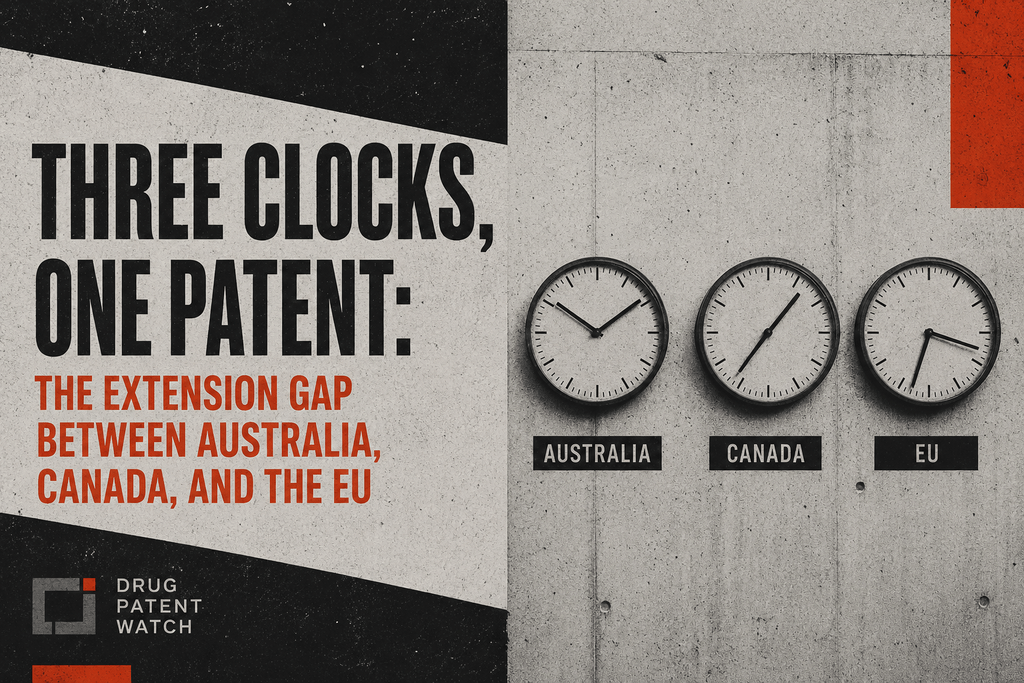
That is the gap this article maps. Most patent-cliff models treat “patent term extension” as one concept with the same shape everywhere: file, wait out regulatory review, collect up to five extra years. In practice, Australia, Canada, and the European Union each run a different formula, a different cap, a different reference date, and, as of December 2025, a different definition of what kind of patent even qualifies. A launch-sequencing decision made in a spreadsheet that treats “PTE” as a single global variable will misprice the extension in at least one of the three markets, and often in two. DrugPatentWatch tracks these mechanics across jurisdictions [7], and this piece works through the three formulas, the case law that has reshaped them since 2020, and what the divergence actually costs a portfolio team that models launch order as if the clocks were interchangeable.
The Short Answer
The EU’s Supplementary Protection Certificate (SPC) caps extensions at five years, plus a possible six-month pediatric bonus, and limits total exclusivity to fifteen years from the first EU marketing authorization [1].
Canada’s Certificate of Supplementary Protection (CSP) caps extensions at two years, less than half the EU maximum, by deliberate design during the CETA trade negotiations [8][9].
Australia’s patent term extension (PTE) caps extensions at five years, but since 1 December 2025 it applies only to patents claiming an active ingredient itself, not to formulation or delivery-system patents, following the Full Federal Court’s ruling in Otsuka Pharmaceutical Co Ltd v Sun Pharma ANZ Pty Ltd [2025] FCAFC 161 [3][4].
All three systems use a different reference date to start the clock: first EU/EEA marketing authorization for the SPC, the Canadian Notice of Compliance for the CSP, and first inclusion in Australia’s Register of Therapeutic Goods (ARTG) for the PTE [1][10][11].
In Canada’s 2024-2025 fiscal year, Health Canada issued 15 CSPs at the full two-year cap and only one at a shorter term, out of 11 applications filed, a full-term grant rate this analysis calculates at roughly 94 percent [12].
Because each system anchors to a national or regional approval date, the sequence in which a company files for marketing authorization across countries can change how much extension it recovers in each one, independent of how the underlying clinical and regulatory delay actually occurred.
Why “Patent Term Extension” Means Three Different Formulas
All three regimes share the same policy premise. A standard patent runs 20 years from filing, but a medicine cannot be sold until it clears clinical trials and regulatory review, so the effective commercial life of the patent is shorter than 20 years, sometimes far shorter. Each jurisdiction restores some of that lost time. The mechanics of the restoration are where the systems stop resembling each other.
The EU’s Supplementary Protection Certificate: Five Years Plus a Pediatric Bonus, Capped at Fifteen
The EU’s SPC regime is set out in Regulation (EC) No 469/2009, a codified version of the original 1992 regulation [1]. An SPC is not an extension of the underlying patent. It is a separate sui generis right that takes effect the day after the basic patent expires and runs for its own calculated term [1].
How the SPC Term Is Calculated
Under Article 13 of the regulation, the SPC term equals the period between the date the basic patent application was filed and the date of the first authorization to place the product on the market in the European Community, minus five years [2]. If that gap is five years or less, the SPC term is zero. If the gap is nine years, the SPC term is four years. The certificate cannot exceed five years regardless of how large the underlying gap was, and recital 9 of the regulation caps the combined patent-plus-SPC exclusivity at 15 years from the product’s first EU authorization [1].
The Pediatric Six-Month Add-On
Article 13(3) of Regulation 469/2009, read together with Article 36 of the EU’s pediatric medicines regulation, allows a further six-month extension where the holder has completed an agreed pediatric investigation plan [1]. This is commonly referred to in practice as the “SPC 5+6,” and it sits on top of, not inside, the five-year SPC cap.
Canada’s Certificate of Supplementary Protection: A Deliberately Half-Sized Cap
Canada did not have any pharmaceutical patent term extension mechanism until it ratified the Canada-EU Comprehensive Economic and Trade Agreement (CETA) in September 2017 [8][9]. CETA required Canada to provide supplementary protection modeled on the EU’s SPC system, but Canadian negotiators built in a materially smaller cap.
How the CSP Term Is Calculated
The formula, set out in sections 104 to 134 of the Patent Act and the CSP Regulations, is almost a direct copy of the EU formula with one number changed: CSP term equals the date of the Notice of Compliance (Canada’s marketing authorization) minus the patent filing date, minus five years, capped at two years rather than five [11][13]. The additional protection period takes effect from the date the basic patent expires [11].
Why CETA Negotiators Chose Two Years, Not Five
CETA’s text permitted a range of two to five years of sui generis protection [9]. Canada took, in the words of one Canadian IP firm’s analysis of the negotiating history, “the minimum negotiated scope of protection” available under the treaty [9]. The CSP Regulations also include a manufacturing exemption for export that has no EU equivalent, reflecting Canada’s stated policy goal of balancing innovator incentives against generic and biosimilar manufacturing capacity [9]. A CSP application must be filed within 120 days of the later of the Notice of Compliance date or the patent grant date, a tighter administrative window than the EU’s six-month SPC filing deadline [10][13].
Australia’s Patent Term Extension: Five Years Anchored to the ARTG
Australia’s PTE regime, in Part 3 of Chapter 6 of the Patents Act 1990, predates both the EU’s codified SPC regulation’s most recent form and Canada’s CSP by decades in one sense and postdates the original EU scheme by six years in another: it was added to Australian law in 1998 [14].
How the PTE Term Is Calculated
Section 77(1) sets the extension length as the period between the date of the patent and the earliest first regulatory approval date for any pharmaceutical substance disclosed and claimed in the patent, minus five years, capped at five years [15][16]. To be eligible at all, that gap must be at least five years under section 70(3) [15]. The reference point is first inclusion in the Australian Register of Therapeutic Goods, not first authorization anywhere else in the world [14][15].
The “Earliest First” Rule After Ono and MSD v. Sandoz
Two Full Federal Court decisions handed down on the same day in March 2022, Commissioner of Patents v Ono Pharmaceutical Co. Ltd [2022] FCAFC 39 and Merck Sharp & Dohme Corp. v Sandoz Pty Ltd [2022] FCAFC 40, settled a question that materially affects extension math: if a single patent’s claims cover more than one approved pharmaceutical substance, which ARTG date controls? The court held it is the earliest ARTG listing date for any covered substance, even one developed and marketed by a competitor [16][17]. In Ono, the patent (AU 2011203119) covered antibody products including Ono’s own pembrolizumab (Keytruda) and Bristol-Myers Squibb’s independently developed nivolumab (Opdivo) [17][18]. Opdivo was listed on the ARTG on 11 January 2016; Keytruda, a third party’s product under this patent, had been listed earlier, on 16 April 2015 [17][18]. The Full Court held that the earlier, third-party Keytruda date controlled the extension calculation for Ono’s patent, not the later Opdivo date the patentee actually relied on [16][18]. In MSD v Sandoz, both approved substances belonged to the same patentee, and MSD had sought to base its extension on the later-approved product because it would have produced an extension of almost 18 months longer; the court again applied the earliest date [16]. The practical lesson for portfolio teams: a patent claiming a broad genus of compounds can have its Australian extension term set by a competitor’s approval, not the patentee’s own, and that competitor’s approval date is not something the patentee controls.
The Reference-Date Problem: “First Authorization” Means Three Different Things
Every one of the three formulas above starts from the same conceptual anchor, a “first regulatory approval” date, and every one of the three defines that anchor differently. The EU counts the first marketing authorization anywhere in the EU or EEA, so a company that launches first in a smaller member state still starts the SPC clock on that date [1]. Canada counts only the Canadian Notice of Compliance, ignoring approvals elsewhere entirely [11]. Australia counts first inclusion in the ARTG, and, per Ono, will use the earliest ARTG date for any substance the patent’s claims happen to cover, whether or not the patentee sought that approval [16][17].
Why the Order of Global Filings Changes the Extension Math
Because each formula is a function of a jurisdiction-specific approval date minus the patent’s filing date, the order in which a company files for and receives marketing authorization across countries changes the extension outcome in each country separately, even though the underlying clinical and manufacturing delay is identical worldwide. A company that files in Australia early to capture a smaller, faster-reviewing market gets an ARTG date that may fall well inside the five-year eligibility threshold, producing a shorter, or zero, PTE. The same company filing in the EU later, after a longer clinical package is assembled, gets a larger gap and a larger SPC. Sterne Kessler’s guidance on multi-jurisdiction PTE strategy puts the underlying point plainly: “the particulars of PTE regulations are sufficiently varied across jurisdictions so that a country specific PTE strategy is needed to maximize the economic value of a patent family” [19]. Few launch-sequencing models built primarily around US and EU commercial priority actually run that country-specific calculation before locking in filing order.
What This Looks Like When the Filing Order Runs in Reverse: China’s Time-Deduction Rule
The AU-CA-EU divergence is a difference in formulas. China’s regulatory data protection regime adds a different kind of pressure entirely, one that punishes staggered launch sequencing outright. DrugPatentWatch’s own analysis of global patent and regulatory data protection strategy describes China’s “time-deduction” mechanism: for an innovative drug already approved abroad, China’s six-year regulatory data protection term is reduced by the number of days between the first foreign marketing approval and the date China’s National Medical Products Administration accepts the filing for review [7]. Where the AU-CA-EU gap rewards or penalizes a company depending on which extension formula reacts best to a given filing order, China’s rule actively punishes the traditional “US first, then EU, then rest of world” sequence that most global launch playbooks still default to [7][20]. A model that only accounts for the AU-CA-EU formula gap while ignoring China’s time-deduction penalty is solving half the sequencing problem.
What Changed in December 2025: Australia Just Narrowed Its Formula
Anyone modeling Australian patent term extension using guidance written before December 2025 is working from a rule that no longer fully applies.
Otsuka v. Sun Pharma and the End of Formulation-Patent PTEs
For nearly 30 years, IP Australia’s practice and multiple lower-court decisions had treated formulation and delivery-system patents, not just patents on the active ingredient itself, as eligible for PTE, provided they disclosed and claimed a pharmaceutical substance in some form [21]. On 1 December 2025, the Full Federal Court unanimously overturned that practice in Otsuka Pharmaceutical Co Ltd v Sun Pharma ANZ Pty Ltd [2025] FCAFC 161 [3][4][21]. The court held that “pharmaceutical substance” in section 70(2) of the Patents Act is confined to the active ingredient that produces the therapeutic effect, and does not extend to a formulation combining that ingredient with excipients or a delivery mechanism [3][21]. The court dismissed Otsuka’s appeal and confirmed revocation of the PTE that had been granted for its patent [22].
The Aripiprazole Depot Formulation at the Center of the Case
The patent at issue covered a controlled-release injectable formulation of aripiprazole, marketed as Abilify Maintena, and a related freeze-dried controlled-release formulation [21]. Sun Pharma, seeking to clear the way for a generic long-acting injectable aripiprazole, challenged the PTE that had extended the patent’s term, arguing the patent was a formulation patent and therefore outside the scope of what section 70 was ever meant to protect [21][22]. The Full Court agreed, examining the legislative history and concluding Parliament intended the PTE regime to reach active ingredients, not the pharmaceutical engineering built around them [22].
Abilify Maintena: A Real-Time Case Study in Jurisdictional Divergence
The timing here is what makes this a useful illustration rather than a purely legal footnote. Abilify Maintena’s EU and US market exclusivity both ended in October 2024, more than a year before the Full Federal Court decided its Australian formulation patent should never have received an extension at all [23][24]. For roughly fourteen months, the same molecule, in the same dosage form, was already facing generic competition in two major markets while a third market’s courts were still determining whether the extension protecting it there had a valid legal basis. A global patent estate spreadsheet that carried a single “loss of exclusivity” date for Abilify Maintena across all three regions would have been wrong in two directions at once: too early relative to Australia’s actual litigation timeline, and, once the Full Court ruled, suddenly and retroactively too late.
The High Court Appeal and What It Means for Existing PTEs
Otsuka filed for special leave to appeal to Australia’s High Court in December 2025, and the High Court granted that leave on 12 March 2026 [5][6]. Two industry bodies, the Institute of Patent and Trade Mark Attorneys of Australia and Medicines Australia, sought to intervene as amici curiae, a signal of how broadly the ruling is understood to affect the existing patent estate [6]. Until the High Court rules, likely later in 2026, formulation-based PTEs already on the Australian register remain vulnerable. IP Australia’s Commissioner can move to revoke them administratively, competitors can bring their own revocation proceedings, or a generic company can simply launch during the disputed extension period on the view that the Full Court’s reasoning has substantially reduced the infringement risk [21]. Any launch-sequencing model that assumed an Australian formulation-patent PTE would hold needs a contingency branch now, not a footnote.
When Canadian Courts Diverged from the EU on the Same Legal Question
The Otsuka case shows Australia narrowing its own formula. A separate and earlier set of Canadian cases shows something arguably more relevant to launch-sequencing risk: Canadian courts, applying a regime explicitly modeled on the EU’s, initially reached the opposite conclusion from EU courts on materially similar facts.
GSK v. Canada: The Shingrix Adjuvant Fight
In Glaxosmithkline Biologicals SA v Canada (Health), 2020 FC 397, the Federal Court considered whether a CSP could be granted for a patent covering the combination of an antigen and an adjuvant in GSK’s shingles vaccine Shingrix [25][26]. Health Canada had refused the CSP, reasoning that the antigen alone was the “medicinal ingredient” and the adjuvant was not, so the patent did not claim the medicinal ingredient as the CSP Regulations require [25][27]. The Federal Court found that refusal unreasonable, holding that because the adjuvant was biologically active and necessary for clinical efficacy, it could form part of a protectable combination [25][26].
What the UK and EU Courts Said About the Same Type of Claim
A UK court applying the EU’s SPC framework had already reached the opposite conclusion on a comparable antigen-adjuvant claim [25][26]. Osler’s analysis of the Canadian decisions at the time noted that “there was never any indication during trade negotiations or ratification that the scope of protection conferred by a CSP would be broader than the SPCs upon which they were based,” and warned that Canadian courts were on track to force broader CSP grants than the EU system that Canada’s regime was built to mirror [25]. On appeal, the Federal Court of Appeal reversed course. In Canada (Health) v Glaxosmithkline Biologicals S.A., 2021 FCA 71, decided 14 April 2021, the Federal Court of Appeal unanimously found Health Canada’s original refusal reasonable after all, restoring alignment with the narrower EU-style reading [27][28]. The GSK Shingrix CSP was denied. But for roughly a year, between the 2020 trial decision and the 2021 appellate reversal, Canadian and EU law were pointed in opposite directions on the identical legal question of whether an adjuvant can anchor supplementary protection.
ViiV Healthcare’s Juluca Dispute
A parallel case tested a related question: can a patent claiming only one medicinal ingredient support a CSP for an approved product containing two? In ViiV Healthcare ULC v. Canada (Health), 2020 FC 756, the Federal Court found Health Canada’s refusal to grant a CSP for a single-ingredient dolutegravir patent, in respect of ViiV’s two-ingredient combination product Juluca (dolutegravir and rilpivirine), unreasonable, and sent the matter back to the Minister [25][29]. The CJEU’s parallel test under EU law, from Teva UK and Others v Gilead Sciences Inc, Case C-121/17, decided 25 July 2018, requires that a patent “necessarily and specifically” relate to the combination of active ingredients actually in the approved product, a materially stricter standard [25][30]. The Minister of Health refused ViiV’s CSP application again on reconsideration, taking the position that the second refusal remained consistent with CETA, and ViiV sought a further judicial review of that redetermination [25]. As of the most recent public reporting on the matter, the underlying eligibility question for combination-drug CSPs based on single-ingredient patents in Canada had not been finally resolved by an appellate court in the way the Shingrix question had.
Merck’s Belsomra Timing Refusal
A third case illustrates that Canada’s CSP disputes are not limited to eligibility; timing has generated its own litigation. Health Canada denied Merck’s CSP application for Canadian Patent No. 2,670,892, covering suvorexant (Belsomra), on 9 August 2019, on a “timely submission” ground [31][32]. The Federal Court found that refusal unreasonable and remitted it for redetermination, while declining to substitute its own interpretation of the statutory timing provisions for the Minister’s [31][32]. Read together, the Shingrix, Juluca, and Belsomra cases show that Canada’s CSP regime, despite being explicitly modeled on the EU’s SPC to satisfy a CETA trade obligation, has generated a distinct and still partly unsettled body of case law on eligibility and timing that does not track EU precedent automatically, even when the underlying legal tests were designed to.
One Drug, Two Confirmed Clocks: Apixaban’s EU and Canada Numbers
Most of the case law above concerns eligibility disputes rather than a clean numeric comparison. Apixaban (Eliquis), Bristol-Myers Squibb and Pfizer’s blockbuster anticoagulant, offers one of the few drugs with fully public, dated figures in more than one jurisdiction, and it illustrates the reference-date problem in concrete terms.
In the EU and UK, the basic composition-of-matter patent for apixaban (European Patent 1 427 415) expired on 17 September 2022, and the SPC extending it is due to expire on 19 May 2026, an extension of roughly three years and eight months, within the five-year cap [33][34]. BMS and Pfizer estimate that extension has generated approximately $29.5 billion in additional global revenue for the product [35]. In Canada, the corresponding composition patent (Canadian Patent 2,461,202) was filed on 17 September 2002 and, per Health Canada’s Notice of Compliance data, the drug received its Canadian Notice of Compliance on 16 December 2011, a gap of roughly nine years and three months between filing and Canadian approval [36][37].
What the Same Nine-Year Delay Would Produce in Each System
This is a calculation this analysis performed using DrugPatentWatch and Health Canada’s own published dates, not an independently reported industry figure. Applying Canada’s CSP formula, Notice of Compliance date minus filing date minus five years, to the same roughly nine-year-three-month gap yields a theoretical CSP term of about four years and three months before the two-year statutory cap is applied, meaning the calculation caps out at the full two-year maximum [11][37]. The EU’s actual, confirmed SPC term on the same drug, applying the same style of formula to EU dates, landed at roughly three years and eight months, comfortably under the EU’s five-year cap [33][34]. Put differently, on a delay of similar underlying magnitude in each market, the EU formula produced an outcome closer to its own ceiling, while Canada’s formula, if a CSP was pursued and granted on this patent, would be mechanically capped at less than half of what the EU allowed on a comparable calculated gap, purely because of where CETA negotiators drew Canada’s statutory ceiling. This is the AU-CA-EU gap in miniature: two governments applying structurally similar formulas to structurally similar regulatory delays on the same molecule, and arriving at extension ceilings that differ by more than two years, by design.
The Reform Nobody’s Finished: The EU’s Pending Unitary SPC
Any model built today should also account for the fact that the EU side of this comparison is itself mid-reform. In April 2023, the European Commission proposed two linked regulations: one recasting the existing national SPC system, and one creating an entirely new unitary SPC that would run alongside the EU’s Unitary Patent, examined centrally by the EU Intellectual Property Office rather than national patent offices [38][39]. The European Parliament approved both proposals, with amendments, in February 2024 [39][40].
Why the Reform Stalled in Trilogue
As of the most recent European Parliament legislative tracking, dated 20 February 2026, the proposals remained in trilogue, the informal negotiation stage between Parliament, the Council, and the Commission, with a December 2025 Council stocktaking paper still working through unresolved questions about the design of the legal remedies system and which authority should have final grant authority [38]. Industry commentary from early 2025 had suggested the reform might take effect in “late 2025 or 2026” [39]; as of this writing that has not happened. A launch-sequencing model with a multi-year horizon on EU filings should treat the unitary SPC as a live variable, not a settled fact, and should track the European Parliament’s legislative train file directly rather than relying on older secondary summaries that assumed faster adoption [38].
Why This Gap Breaks Launch-Sequencing Models
Put the three formulas, the Australian narrowing, the Canadian case law, and the pending EU reform together, and the practical problem for a global launch team comes into focus.
The Default Model: US First, Then EU, Then “Rest of World”
Industry sequencing guidance describes the conventional pattern plainly: “for decades, pharmaceutical launches have followed a predictable geographic sequence, typically starting in the US before expanding to the EU4+UK, Japan, and other priority markets,” with sequencing decisions typically locked in 18 to 24 months before launch based on expected data readouts and regulatory review timelines [41]. Australia and Canada, in this conventional model, are frequently treated as smaller, later, lower-priority markets whose filing timing is set by administrative convenience rather than by extension-maximizing strategy [42].
How Filing Order Silently Resets Three Different Clocks
That convenience-driven sequencing is exactly what produces the gap this article opened with. Filing in Australia early, before the EU dossier is complete, can push the ARTG date closer to the patent’s filing date, shrinking or eliminating PTE eligibility under the five-year threshold [15]. Filing in Canada on a schedule set by US or EU commercial priorities, rather than by when the CSP’s 120-day post-approval filing window would be easiest to hit, risks missing that hard administrative deadline entirely [10][13]. And under the Ono “earliest first” rule, a broad platform patent’s Australian extension term can be set not by the patentee’s own filing choices in any market, but by a competitor’s ARTG date for an unrelated but claim-covered substance, a variable no amount of internal sequencing discipline can control [16][17]. None of this shows up in a model that carries a single global “PTE available: yes/no” flag per asset.
The Same Mechanism, Working in Reverse, in China
As covered above, China’s time-deduction rule inverts the incentive entirely, penalizing exactly the staggered US-then-EU-then-rest-of-world sequence that has traditionally optimized US and EU commercial launch value [7][20]. A portfolio strategy that solves for the AU-CA-EU extension-formula gap without simultaneously solving for China’s data-protection penalty is optimizing one jurisdictional constraint while actively worsening another.
A Taxonomy of Extension-Gap Risk
Drawing on the cases and mechanics above, the AU-CA-EU patent term gap breaks down into four distinct types of risk, each requiring a different mitigation.
Formula-Ceiling Risk
This is the simplest type: Canada’s statutory two-year cap versus the EU and Australia’s five-year caps. No amount of filing strategy changes this; it is a fixed legislative ceiling built into CETA’s negotiating outcome [8][9]. The only mitigation is accurate modeling, not avoidance.
Reference-Date Risk
This is the risk illustrated by the apixaban comparison: identical underlying development timelines can produce different extension outcomes purely because each system anchors to a different national or regional approval date [1][11][15]. Mitigation requires jurisdiction-by-jurisdiction filing-date modeling well before any single market’s marketing authorization application is submitted, not after.
Claim-Scope Risk
This is the risk Otsuka’s case just crystallized in Australia and that GSK’s Shingrix litigation tested in Canada: whether a given patent, formulation, combination, or adjuvant claim, qualifies for extension at all under a given jurisdiction’s statutory definition of the protected subject matter [3][21][25]. This risk is legally unsettled in both jurisdictions as of this writing, pending Australia’s High Court appeal and the residue of Canada’s still-developing CSP case law [6][25].
Third-Party Anchor Risk
This is the risk unique to Australia’s “earliest first” rule after Ono: a patentee’s own extension term can be set by a competitor’s regulatory approval date for a different but claim-covered substance [16][17]. This risk is largely uninsurable through sequencing discipline alone; it requires ongoing ARTG monitoring for any third-party product that could fall within a broad patent’s claim scope, well before that patentee ever applies for its own extension.
What This Means for Originator Portfolio Teams
Model Each Jurisdiction’s Formula Independently, Not as a Single Global Variable
A loss-of-exclusivity forecast that carries one date per drug across all markets will systematically misprice at least the Canadian and, since December 2025, the Australian position for any asset with formulation, delivery-system, or combination claims. Sterne Kessler’s recommendation to pursue divisional applications directed to different active ingredients separately, specifically so that PTE can be sought independently for each substance’s own regulatory approval, is a direct response to the Ono-style third-party anchor risk described above [19].
What This Means for Generic and Biosimilar Challengers
The Formulation-Patent Gap Is a Live Opening in Australia Right Now
Until the High Court rules on Otsuka’s appeal, any Australian PTE resting on a formulation, rather than an active-ingredient, patent sits on unsettled legal ground [3][21]. A generic or biosimilar competitor evaluating an at-risk Australian launch has a live, recent, on-point appellate precedent to rely on, not a theoretical argument. The same logic applies in reverse to Canada’s still-partly-unresolved combination-drug CSP eligibility standard following the Juluca litigation [25][29].
Methodology and Limitations
The statutory mechanics described in this analysis are drawn from the primary legislative texts: Regulation (EC) No 469/2009 for the EU, sections 104 to 134 of Canada’s Patent Act and the associated CSP Regulations, and Part 3 of Chapter 6 of Australia’s Patents Act 1990, cross-checked against government guidance documents and Federal Court and Full Federal Court judgments where available. The apixaban calculation in the section above applying Canada’s CSP formula to that drug’s own Canadian filing and Notice of Compliance dates is an original calculation performed for this analysis using publicly available dates; it does not confirm that a CSP was in fact sought or granted for that specific Canadian patent, only what the statutory formula would produce if applied to those two public dates. Canadian CSP grant-rate statistics are drawn from Health Canada’s own 2024-2025 annual statistical report; the approximately 94 percent full-term grant rate cited is this analysis’s own calculation from that report’s raw application and grant counts, not a figure independently published by Health Canada. The status of the EU’s unitary SPC reform and of Otsuka’s High Court appeal reflects the most recent publicly available legislative tracking and law firm reporting as of this writing and should be reverified before use in any filing decision, given both remain actively in motion.
Key Takeaways
The EU SPC, Canada’s CSP, and Australia’s PTE share a common design premise but run on three different formulas, three different caps, and three different reference dates.
Canada’s CSP cap of two years is less than half the five-year caps in the EU and Australia, a deliberate outcome of the CETA negotiations, not an administrative accident.
Australia’s Full Federal Court eliminated formulation-patent PTE eligibility on 1 December 2025 in Otsuka Pharmaceutical Co Ltd v Sun Pharma ANZ Pty Ltd, and the High Court granted special leave to appeal that ruling on 12 March 2026.
Canadian Federal Court decisions on Shingrix and Juluca initially interpreted CSP eligibility more broadly than parallel EU and UK courts had interpreted equivalent SPC claims, before the Federal Court of Appeal narrowed the Shingrix outcome back toward EU-style alignment in 2021.
Australia’s “earliest first” rule from the 2022 Ono and MSD v Sandoz decisions means a patentee’s own extension term can be set by a competitor’s regulatory approval date for a different substance covered by the same claims.
The EU’s proposed unitary SPC system remained in trilogue negotiations as of early 2026 and has not entered into force.
FAQ
What is the maximum patent term extension available in the EU, Canada, and Australia? The EU’s SPC caps at five years, plus a possible six-month pediatric extension. Canada’s CSP caps at two years. Australia’s PTE caps at five years, but since December 2025 only for patents claiming an active ingredient itself [1][3][8].
Why is Canada’s patent term extension cap so much smaller than the EU’s? Canada introduced its CSP regime to satisfy a CETA trade obligation that permitted a range of two to five years of protection, and Canadian negotiators chose the low end of that range as a deliberate policy choice, not an oversight [8][9].
Can a formulation patent still get a patent term extension in Australia? Not as of this writing. The Full Federal Court’s December 2025 ruling in Otsuka v Sun Pharma held that only patents claiming an active pharmaceutical ingredient per se are eligible, not formulation or delivery-system patents, and the matter is now pending before the High Court on special leave granted in March 2026 [3][5][21].
What reference date does each jurisdiction use to calculate the extension? The EU uses the first marketing authorization anywhere in the EU/EEA. Canada uses the Canadian Notice of Compliance date only. Australia uses first inclusion in the ARTG, and, following the 2022 Ono decision, will use the earliest ARTG date for any pharmaceutical substance covered by the patent’s claims, including a competitor’s product [1][11][16][17].
Can a competitor’s product affect my company’s patent term extension in Australia? Yes. Under the Full Federal Court’s ruling in Commissioner of Patents v Ono Pharmaceutical Co. Ltd, if a patent’s claims cover more than one approved pharmaceutical substance, the extension is calculated from the earliest ARTG listing date among all of them, even if that earliest listing belongs to an unrelated competitor’s independently developed product [16][17].
Did Canadian courts ever grant broader supplementary protection than EU courts would have on the same facts? Yes, at least temporarily. In 2020, the Federal Court found Health Canada’s refusal to grant a CSP for GSK’s Shingrix vaccine (an antigen-adjuvant combination) unreasonable, on facts where a UK court applying EU SPC law had reached the opposite conclusion. The Federal Court of Appeal reversed that outcome in April 2021, restoring a narrower, more EU-aligned result [25][26][27].
Is the EU planning to change its SPC system? Yes. The European Commission proposed a unitary SPC regulation in April 2023, which the European Parliament approved with amendments in February 2024. As of early 2026, the proposal remained in trilogue negotiations between Parliament, the Council, and the Commission, and had not entered into force [38][39][40].
How does the filing sequence across countries affect patent term extension outcomes? Because each jurisdiction’s formula is anchored to that jurisdiction’s own approval date, the order and timing in which a company files for marketing authorization in different countries changes the size of the calculated extension gap in each country independently, even when the underlying clinical and regulatory delay is the same worldwide [1][11][15][19].
How common is it for a Canadian CSP application to be denied outright? Recent data suggests denial is uncommon relative to full-term grants. Health Canada’s 2024-2025 statistical report recorded 11 CSP applications filed, 15 certificates issued at the full two-year term, one at a shorter term, and zero applications refused during that fiscal year [12].
Does China’s regulatory system create a similar patent-term gap? China’s mechanism works differently. Rather than a formula-and-cap system like the EU, Canada, or Australia, China applies a “time-deduction” penalty to its own regulatory data protection term, reducing it based on how long a drug was already approved abroad before the Chinese filing, which specifically discourages the traditional staggered US-then-EU-then-rest-of-world launch sequence [7][20].
References
Regulation (EC) No 469/2009 of the European Parliament and of the Council of 6 May 2009 concerning the supplementary protection certificate for medicinal products (Codified version). EUR-Lex. https://eur-lex.europa.eu/eli/reg/2009/469/2013-07-01
Bugnion. (2019, November 27). EU introduces new SPC manufacturing waiver. https://www.bugnion.eu/en/eu-introduces-new-spc-manufacturing-waiver/
Clayton Utz. (2025). Full Federal Court abolishes patent term extensions for pharmaceutical formulations. https://www.claytonutz.com/insights/2025/december/full-federal-court-abolishes-patent-term-extensions-for-pharmaceutical-formulations
Herbert Smith Freehills Kramer. (2025, December). Mixing it up: The end of the line for patent term extensions for formulation patents in Australia. https://www.hsfkramer.com/notes/ip/2025-12/mixing-it-up-the-end-of-the-line-for-patent-term-extensions-for-formulation-patents-in-australia
FB Rice. (2026). Patent Term Extension Saga Continues: Australian High Court Prescribes a Hearing for Formulation Claims. https://www.fbrice.com.au/ip-news-insights/patent-term-extension-saga-continues-australian-high-court-prescribes-a-hearing-for-formulation-claims/
Pearce IP. (2026, March 12). Breaking News – Australian High Court Grants Leave to Appeal to Otsuka in PTE Dispute. https://www.pearceip.law/2026/03/12/breaking-news-australian-high-court-grants-leave-to-appeal-to-otsuka-in-pte-dispute/
DrugPatentWatch. A Global Analysis of Pharmaceutical Patent and Regulatory Data Protection Strategies. https://www.drugpatentwatch.com/blog/a-global-analysis-of-pharmaceutical-patent-and-regulatory-data-protection-strategies/
BOEHMERT & BOEHMERT. (2018, January 25). Certificates of Supplementary Protection now also in Canada. https://www.boehmert.de/en/certificates-of-supplementary-protection-now-also-in-canada/
Osler, Hoskin & Harcourt LLP. (2021, February 24). Canadian courts are interpreting supplementary pharmaceutical patent protection more broadly than their EU counterparts. https://www.osler.com/en/insights/updates/canadian-courts-are-interpreting-supplementary-pharmaceutical-patent-protection-more-broadly-than-th/
Lexology / Aird & Berlis. Extension of Drug Patent Terms in Canada – Certificates of Supplementary Protection (CSPs). https://www.lexology.com/library/detail.aspx?g=f7bf22f5-391a-4753-9559-cbfc87591f2b
MBM. CETA agreement and the Canadian patent landscape. http://www.mbm.com/en/our-services/plant-breeders-rights/12-news/293-ceta-agreement-and-the-canadian-patent-landscape
Mondaq / IP firm analysis. (2025). Insights From Health Canada’s 2024-2025 Statistical Report On Canadian Pharmaceutical Patent Regime. https://www.mondaq.com/canada/patent/1659138/insights-from-health-canadas-20242025-statistical-report-on-canadian-pharmaceutical-patent-regime
Government of Canada. Guidance Document – Certificates of Supplementary Protection. https://www.canada.ca/content/dam/hc-sc/documents/services/drugs-health-products/drug-products/applications-submissions/guidance-documents/certificate-supplementary-protection-regulations.pdf
Griffith Hack. (2025). Unlocking patent lifespan: An Australian perspective on pharmaceutical patent term extensions. https://www.griffithhack.com/insights/publications/unlocking-patent-lifespan-an-australian-perspective-on-pharmaceutical-patent-term-extensions/
Spruson & Ferguson. (2024). Pharmaceutical patent term extension in Australia. https://www.spruson.com/pharmaceutical-patent-term-extension-in-australia/
Bird & Bird. (2022). Australian pharmaceutical patent term extensions. https://www.twobirds.com/en/patenthub/shared/insights/2022/australia/australian-pharmaceutical-patent-term-extensions
Lexology / Corrs Chambers Westgarth. (2022). Extensions of term for patents covering multiple approved pharmaceutical substances clarified. https://www.corrs.com.au/insights/extensions-of-term-for-patents-covering-multiple-approved-pharmaceutical-substances-clarified
Commissioner of Patents v Ono Pharmaceutical Co. Ltd [2022] FCAFC 39. Federal Court of Australia. https://www.judgments.fedcourt.gov.au/judgments/Judgments/fca/full/2022/2022fcafc0039
Sterne Kessler. Considerations for Developing a Global Patent Term Extension Strategy. https://www.sternekessler.com/news-insights/insights/considerations-developing-global-patent-term-extension-strategy/
Simon-Kucher. (2026). Rethinking global launch sequencing: Reinventing pharma’s playbook for a new era. https://www.simon-kucher.com/en/insights/rethinking-global-launch-sequencing-reinventing-pharmas-playbook-new-era
Laminar IP. (2026). Patent Term Extensions for Pharmaceutical Formulations in Australia after Otsuka v Sun Pharma. https://www.laminarip.com/patent-term-extensions-for-pharmaceutical-formulations-in-australia-after-otsuka-v-sun-pharma/
Kluwer Patent Blog. Full Federal Court abolishes patent term extensions for pharmaceutical formulations. https://legalblogs.wolterskluwer.com/patent-blog/full-federal-court-abolishes-patent-term-extensions-for-pharmaceutical-formulations/
GlobalData. Otsuka’s new formulations to offset Abilify Maintena dual patent expiry impact. https://www.globaldata.com/media/pharma/otsukas-new-formulations-offset-abilify-maintena-dual-patent-expiry-impact-says-globaldata/
Osler, Hoskin & Harcourt LLP. (2021, February 24). Canadian courts are interpreting supplementary pharmaceutical patent protection more broadly than their EU counterparts. https://www.osler.com/en/insights/updates/canadian-courts-are-interpreting-supplementary-pharmaceutical-patent-protection-more-broadly-than-th/
Torys LLP. (2020). Federal Court instructs Health Canada to reconsider “medicinal ingredient” in the context of CSP. https://www.torys.com/en/our-latest-thinking/publications/2020/04/federal-court-instructs-health-canada-to-reconsider-medicinal-ingredient-in-the-context-of-csp
Smart & Biggar. Federal Court of Appeal finds Minister of Health’s refusal to grant a CSP for SHINGRIX is reasonable. https://www.smartbiggar.ca/insights/publication/federal-court-of-appeal-finds-minister-of-health-refusal-to-grant-csp-for-shingrix-reasonable
Torys LLP. (2021). What’s in a claim? The FCA weighs in on CSP eligibility. https://www.torys.com/en/our-latest-thinking/publications/2021/04/whats-in-a-claim-the-fca-weighs-in-on-csp-eligibility
Lexology / Smart & Biggar. Federal Court remits BELSOMRA CSP timing refusal for redetermination [context includes Juluca/ViiV case summary]. https://www.lexology.com/commentary/healthcare-life-sciences/canada/smart-biggar/federal-court-remits-belsomra-csp-timing-refusal-for-redetermination
Teva UK and Others v Gilead Sciences Inc, Case C-121/17, Court of Justice of the European Union (25 July 2018), as cited in Osler, Hoskin & Harcourt LLP analysis. https://www.osler.com/en/insights/updates/canadian-courts-are-interpreting-supplementary-pharmaceutical-patent-protection-more-broadly-than-th/
Smart & Biggar. Federal Court remits BELSOMRA CSP timing refusal for redetermination. https://www.smartbiggar.ca/insights/publication/federal-court-remits-belsomra-csp-timing-refusal-for-redetermination
Mondaq / Smart & Biggar. Federal Court Remits BELSOMRA CSP Timing Refusal For Redetermination. https://www.mondaq.com/canada/patent/1127044/federal-court-remits-belsomra-csp-timing-refusal-for-redetermination
Mason Hayes Curran. (2025). Update on Plausibility in UK Patent Law [Apixaban SPC dates]. https://www.mhc.ie/latest/insights/bristol-myers-squibbs-spc-is-found-not-plausible
Lexology. Preliminary Injunction Granted against Teva Regarding BMS’ Apixaban. https://www.lexology.com/library/detail.aspx?g=deb481a5-f9e0-4f88-9457-6cb6d6ed66f5
GlobalData. Eliquis sales to fall by 15.2% in 2026 as European patent expiry nears. https://www.globaldata.com/media/pharma/eliquis-sales-to-fall-by-15-2-in-2026-as-european-patent-expiry-nears-forecasts-globaldata/
Government of Canada, Health Canada. Register of Innovative Drugs [Apixaban/Eliquis Notice of Compliance date]. https://www.canada.ca/content/dam/hc-sc/documents/services/drugs-health-products/drug-products/applications-submissions/register-innovative-drugs/reg-innov-dr-eng_2019-02-01.pdf
European Parliament. Legislative Train Schedule: Unitary supplementary certificate for medicinal products. https://www.europarl.europa.eu/legislative-train/theme-a-europe-fit-for-the-digital-age/file-unitary-supplementary-certificate-for-medicinal-products
D Young & Co. (2025). SPCs in Europe: what’s round the corner? https://www.dyoung.com/en/knowledgebank/articles/spcs-patents-europe-faq-2025
Managing Intellectual Property. Guide to the proposed reform of the SPC system for medicinal products. https://www.managingip.com/article/2ewd0ls0fdwy04c6gzlkw/sponsored-content/guide-to-the-proposed-reform-of-the-spc-system-for-medicinal-products
Simon-Kucher. (2026). Rethinking global launch sequencing: Reinventing pharma’s playbook for a new era. https://www.simon-kucher.com/en/insights/rethinking-global-launch-sequencing-reinventing-pharmas-playbook-new-era
Umbrex. Global Drug Launch Strategy and Sequencing. https://umbrex.com/resources/industry-analyses/how-to-analyze-a-pharmaceutical-company/global-drug-launch-strategy-and-sequencing/