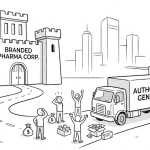
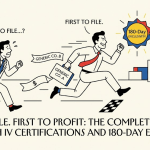
A generic company spends four years and fifteen million dollars fighting for the right to be first. It wins. It gets its 180 days. And six months later, the finance team is explaining to the board why the “winning” product barely cleared its cost of capital.
This happens constantly, and it happens for reasons that have nothing to do with bad luck. The 180-day exclusivity period is marketed inside the generic industry as the single most valuable prize in pharmaceutical law, a guaranteed duopoly against the brand for six months. It is also, in a large and predictable share of cases, a prize that costs more to win than it pays out. The mechanisms that turn a legal victory into a financial loss are well documented: authorized generics, at-risk launch liability, manufacturing forfeitures, litigation spend that exceeds the exclusivity’s net present value, and reverse-payment settlements that convert an entire Paragraph IV campaign into a smaller, safer, but still occasionally money-losing annuity. DrugPatentWatch tracks these outcomes across thousands of ANDA filings, and the pattern holds across therapeutic classes, company sizes, and decades.
This article walks through why “first to file” is not the same as “first to profit,” using real litigation, real damages awards, and real FDA enforcement actions to show where the money actually goes.
What Is 180-Day Exclusivity, and Why Doesn’t Winning It Guarantee a Profit?
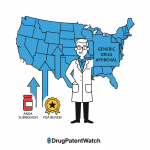
Short answer: 180-day exclusivity blocks the FDA from approving competing Paragraph IV generics for six months after the first filer launches, but it does not block the brand from launching its own authorized generic, does not protect the first filer from patent infringement damages if it launched before final judgment, and does not survive manufacturing violations, forfeiture events, or a change in patent status at the FDA. The exclusivity is a regulatory gate, not a profit guarantee.
How Hatch-Waxman Created the First-to-File Prize
The Drug Price Competition and Patent Term Restoration Act of 1984, universally known as Hatch-Waxman, built the modern generic industry on a trade. Brand companies got patent term restoration to compensate for years lost during FDA review. Generic companies got the Abbreviated New Drug Application pathway, which let them rely on the brand’s own safety and efficacy data instead of running their own clinical trials. Buried inside that bargain was a specific incentive mechanism: a generic company willing to certify that a listed patent is invalid or will not be infringed, a Paragraph IV certification, and willing to defend that position in court, would be rewarded with 180 days of market exclusivity against every other generic applicant filing on the same patent.
The logic was straightforward. Patent challenges are expensive and risky. Without a reward beyond ordinary generic margins, no rational company would take on that risk. The 180-day period exists to pay for the litigation.
What Triggers the Start of the 180-Day Clock
Commercial marketing starts the clock, not FDA approval. A first filer can sit on an approved ANDA for months without triggering exclusivity, but doing so now carries its own risk, discussed below. Where multiple filers submit substantially complete Paragraph IV applications on the same day, any one of them can trigger the shared exclusivity period by launching. The clock, once started, runs for all shared first filers simultaneously.
What Counts as Commercial Marketing for Startup Purposes
The FDA has generally interpreted commercial marketing as genuine introduction into interstate commerce, not token shipments designed to preserve a filing date. This distinction matters because gaming the definition, shipping small quantities without a real sales effort, has been treated by the agency as insufficient to avoid a failure-to-market forfeiture.
Shared Exclusivity: When Winning Means Splitting the Prize
Two or more companies filing substantially complete Paragraph IV applications on the same calendar day both qualify as first applicants and share the 180-day period. This is common enough on high-value targets that a company can spend years litigating a patent, win first-to-file status, and still discover it is splitting the exclusivity market with a competitor who filed on the identical date. Shared exclusivity converts what looked like a duopoly against the brand into a three-way (or more) market from day one of generic entry, which materially compresses the pricing and volume assumptions that justified the original litigation spend.
Timeline: How a 180-Day Exclusivity Win Actually Unfolds
Short answer: from Paragraph IV filing to cash in the bank typically takes three to five years, and the profitable window at the end of that process is only six months long, assuming nothing forfeits it first.
Months 0 to 45: Filing, Notice, and the Automatic 30-Month Stay
An ANDA with a Paragraph IV certification is, by statutory design, treated as an artificial act of patent infringement, sufficient to give the brand standing to sue before a single generic tablet reaches a pharmacy shelf. The generic applicant must notify both the patent holder and the NDA holder within 20 days of FDA’s acceptance of the filing. That notice starts a 45-day countdown. If the brand sues within that window, an automatic 30-month stay kicks in, during which the FDA cannot grant final approval regardless of the underlying merits of the case.
The Forfeiture Countdown: 75 Days to Launch or Lose
Once a first applicant obtains final approval, or once a qualifying court decision or patent delisting occurs, the failure-to-market forfeiture clock starts. Under 21 U.S.C. § 355(j)(5)(D)(i)(I), the first applicant forfeits exclusivity if it does not begin marketing within 75 days of the earlier of final approval or 30 months after ANDA submission, or within 75 days of specified litigation or delisting events for any other applicant that has received tentative approval. This is the provision Congress added in the Medicare Modernization Act of 2003 specifically to end the practice of “parking” exclusivity indefinitely through friendly settlements with the brand.
Day 180: The Cliff
The exclusivity period ends exactly 180 days after commercial marketing began, not a day later. On day 181, every other approved ANDA holder can enter simultaneously. Multi-source generic pricing typically arrives within weeks, and the pricing collapse that follows is steep enough that most of a molecule’s lifetime generic profit is earned, or lost, inside that single six-month window.
“Authorized generic entry during the 180-day marketing exclusivity period reduces the revenues of a first-filer generic firm by 47 to 51 percent, according to the Federal Trade Commission’s landmark interim report on the practice.” [4]
The Seven Forfeiture Events: Why First Filers Lose Exclusivity Before They Ever Launch
Short answer: the 2003 amendments created six statutory forfeiture triggers, later clarified by FDA guidance into what practitioners often describe as seven distinct scenarios: failure to market, withdrawal of the application, amendment of the certification, failure to obtain tentative approval within 30 months, a disqualifying agreement with the brand or another applicant, patent expiration, and failure to maintain the qualifying certification through final resolution.
Failure to Market and Failure to Obtain Tentative Approval
Failure to market is the forfeiture event that generates the most litigation, because it depends on a chain of triggering dates that are frequently contested between competing generic filers. Failure to obtain tentative approval within 30 months of ANDA submission is a separate, largely regulatory failure, one that can result from a company’s own inability to satisfy chemistry, manufacturing, and controls requirements rather than from any legal dispute at all. A company can win every patent argument in court and still forfeit the prize because its manufacturing dossier was not ready.
Withdrawal, Amendment, and Disqualifying Agreements
A first applicant that withdraws or amends its Paragraph IV certification for all qualifying patents forfeits exclusivity outright. Separately, an agreement between the first applicant and the NDA holder, a patent owner, or another ANDA applicant that the FTC or a court determines violates antitrust law can also trigger forfeiture. This provision exists specifically to prevent the reverse-payment “parking” arrangements that predated the 2003 reforms, where a first filer would agree, in exchange for compensation, to sit on its approved application indefinitely and block every other generic competitor from entering.
FDA’s July 2018 First-Applicant Clarification Letter
The forfeiture rules generated enough uncertainty in practice that FDA issued a clarifying letter in July 2018 addressing exactly who qualifies as a first applicant and precisely when the failure-to-market clock starts running, following disputes over whether a patentee’s voluntary delisting of a patent from the Orange Book could itself trigger forfeiture. [2] The agency’s position, consistent with the reasoning later applied in Teva Pharmaceuticals USA, Inc. v. Sebelius, is that a patent delisting can start the 75-day countdown even when the first applicant had no role in the decision to delist. [1] A first filer can therefore lose its exclusivity because of a decision made unilaterally by the brand it was suing.
What Happens When a Brand Launches an Authorized Generic During Your Exclusivity Window?
Short answer: the brand can legally launch its own generic, an authorized generic, at any point during the first filer’s 180 days, including day one, and doing so typically cuts the first filer’s exclusivity-period revenue by roughly half.
The Legal Basis: Teva Pharmaceuticals USA, Inc. v. FDA
The generic industry spent years arguing that authorized generic competition during the 180-day period violated the spirit, and arguably the text, of Hatch-Waxman. The argument failed. In Teva Pharmaceuticals USA, Inc. v. FDA, the D.C. Circuit held that nothing in the statute prohibits an NDA holder from marketing its own generic version of its own drug during a first filer’s exclusivity period, because an authorized generic is sold under the existing NDA rather than through a competing ANDA, and the exclusivity provision by its terms blocks only other ANDA approvals. The FTC subsequently studied the practice for years and Congress held hearings, but the courts’ reading of the statute has held.
The Economics: Modeling a $500 Million Drug Under AG Competition
The math is simple enough to run on a single spreadsheet tab. A first filer expecting to sell into a $500 million annual market, at a single-generic discount of perhaps 20 to 40 percent below brand pricing, models a defined revenue number for its six-month exclusivity window. Add an authorized generic on day one, and FTC data indicates that the first filer’s share of that revenue falls by roughly 40 to 52 percent, because the two products now split volume that would otherwise have gone entirely to the ANDA holder. [4] On a $500 million base case, that is the difference between capturing something in the neighborhood of $250 million and something closer to $500 million, for the identical litigation spend and identical regulatory risk.
FTC Interim Report: 40 to 52 Percent Revenue Decline
The FTC’s 2009 interim report on authorized generics remains the most cited empirical study on this dynamic. It found that authorized generic competition during the 180-day exclusivity window reduced first-filer revenues by a range the agency put at 47 to 51 percent, while simultaneously lowering retail prices by roughly 4.2 percent and wholesale prices by roughly 6.5 percent compared to periods without authorized generic competition. [4] The report is frequently summarized in generic-industry literature as a 40 to 52 percent range once later studies and case-level variation are included. [4] The consumer benefit and the first-filer’s financial loss are, in this case, the same transaction viewed from two sides.
Case Study: Ranbaxy’s Atorvastatin Exclusivity vs. Watson’s Authorized Generic
Ranbaxy Laboratories held first-to-file status on generic atorvastatin, the molecule behind Pfizer’s Lipitor, the best-selling drug in pharmaceutical history at its 2006 peak of roughly $12.9 billion in annual sales. [10] Ranbaxy’s path to that exclusivity was not clean. FDA had invoked its Application Integrity Policy against Ranbaxy’s Paonta Sahib manufacturing facility in February 2009 over data integrity concerns, and roughly 30 Ranbaxy products remained under U.S. import alert for years afterward. [9] [10] Mylan sued the FDA in 2011 attempting to strip Ranbaxy of its exclusivity on the theory that the underlying manufacturing data could not be trusted; a federal judge dismissed the suit for lack of standing in May 2011, and Ranbaxy launched on schedule on November 30, 2011, under a license from its patent settlement with Pfizer. [11]
Why Pfizer Chose an Authorized Generic Instead of Fighting to the Wire
Pfizer did not simply cede the six months. As part of the settlement structure, Pfizer licensed an authorized generic version of atorvastatin to Watson Pharmaceuticals, which competed directly against Ranbaxy’s exclusivity-protected product from the first day of generic availability. [13] Ranbaxy technically held sole first-to-file exclusivity against other ANDA filers, but it never held the market alone. The authorized generic ensured that Pfizer retained a share of the generic-channel revenue on the world’s largest pharmaceutical asset, at the direct expense of Ranbaxy’s exclusivity economics, precisely the dynamic the FTC’s 2009 study had already quantified.
What Does an At-Risk Launch Actually Cost If You Lose on Appeal?
Short answer: launching before final resolution of patent litigation can generate enormous short-term revenue, but a loss on appeal converts that revenue into a damages liability, and the damages award can run into the hundreds of millions of dollars even after accounting for the profit already collected.
Willful Infringement and the Case for Launching Anyway
An at-risk launch happens when a generic company begins commercial sales before final resolution of patent litigation, calculating that the value of early market entry exceeds the expected cost of losing. Because a blockbuster drug can generate hundreds of millions of dollars per quarter, and because litigation damages are typically calculated as lost profits rather than as a punitive multiple, the arithmetic can favor launching even against real legal risk. It is, in a strict sense, a rational bet. It is also a bet the generic company sometimes loses badly.
Case Study: Apotex, Plavix, and the $442 Million Bill
Apotex launched a generic version of Plavix, Bristol-Myers Squibb and Sanofi’s blockbuster antiplatelet drug clopidogrel bisulfate, on August 8, 2006, following FDA approval of its ANDA in January 2006 and while patent litigation with BMS and Sanofi remained unresolved. [6] The launch was immediate and severe for the brand: BMS estimated the at-risk launch cut Plavix’s net U.S. sales by $525 million to $600 million in the third quarter of 2006 alone, with quarterly branded sales falling from $988 million in the second quarter to $474 million in the third. [8] A federal court in the Southern District of New York enjoined further Apotex sales on August 31, 2006, but did not order a product recall, meaning Apotex-supplied generic clopidogrel continued satisfying much of U.S. prescription demand for months afterward. [8]
How $3.77 Billion in Revenue Became a $444 Million Liability
Apotex ultimately lost the underlying patent case. The U.S. Court of Appeals for the Federal Circuit upheld a damages ruling against the company in October 2011, and in February 2012 Apotex paid $442,209,362 to Sanofi and BMS to satisfy the judgment, plus $1,258,682 in post-judgment interest and $900,000 in costs. [6] [7] During its several weeks on the market before the injunction, and its extended tail of channel inventory afterward, Apotex is estimated to have generated roughly $3.77 billion in gross revenue from the at-risk launch. [16] Set against that figure, the final damages payment looks almost survivable, and this is the case at-risk-launch proponents cite as evidence the strategy can work. What it obscures is that Apotex’s $3.77 billion figure is gross revenue, not profit, and it does not capture years of litigation cost, the reputational cost of a court finding, or the opportunity cost of capital tied up in an unresolved damages exposure for six years between launch and final payment.
How Generic Companies Actually Decide Whether At-Risk Launch Pays Off
The decision comes down to four inputs a generic company’s legal and commercial teams model jointly: the brand’s estimated monthly sales, the probability-weighted odds of prevailing on appeal, the likely measure of damages if the company loses (typically lost profits rather than the infringer’s own profits), and the time value of money between the launch date and the date any damages judgment is actually paid. Where the brand’s monthly revenue is large relative to the litigation’s probability-weighted downside, at-risk launch remains a live strategic option. Where the underlying patent case is weak on the merits, and Apotex’s Plavix loss suggests the company’s own internal read of its case may have been overly optimistic, the strategy shifts from calculated risk to expensive gamble.
How Manufacturing Failures Turn a Winning Exclusivity Into a Forfeited One
Short answer: the FDA can freeze review of an ANDA over data integrity or good manufacturing practice violations at the facility that generated the application, and if that freeze prevents the company from obtaining final approval or launching in time, the exclusivity is lost regardless of how strong the underlying patent case was.
FDA’s Application Integrity Policy and Data Integrity Reviews
FDA’s Application Integrity Policy is the agency’s mechanism for pausing substantive review of pending applications tied to a facility where data integrity is in question, rather than continuing a normal scientific review of data the agency no longer trusts. Once AIP is invoked against a site, every pending application built on data from that facility effectively stalls, independent of the merits of the underlying science or the strength of the company’s patent position.
Case Study: Ranbaxy’s Paonta Sahib and Dewas Plants
FDA imposed an import alert on roughly 30 Ranbaxy products in 2008 tied to manufacturing problems at the company’s Paonta Sahib and Dewas facilities in India, then invoked its Application Integrity Policy against Paonta Sahib specifically in February 2009 after finding what the agency described as falsified data. [9] [10] Ranbaxy ultimately reached a consent decree and permanent injunction with FDA under which the company gave up 180-day exclusivity on three pending ANDAs outright and forfeited exclusivity on several additional applications, though FDA did not publicly identify the specific products affected. [9] The atorvastatin exclusivity survived, but only because Ranbaxy was able to shift final manufacturing to a different, unaffected site in time to launch on schedule in November 2011. [10] Products tied more directly to the compromised facilities were not so fortunate.
The $500 Million Guilty Plea and What It Means for Exclusivity Value
The manufacturing story did not end with the atorvastatin launch. In May 2013, Ranbaxy pleaded guilty to seven federal charges related to drug safety and paid $500 million in penalties and forfeitures to resolve the U.S. Department of Justice’s case, one of the largest generic drug fraud settlements on record. [11] The company recalled batches of its generic Lipitor in the U.S. months earlier after inspectors found possible glass particle contamination, and FDA issued a further import alert on additional Ranbaxy products in 2013 tied to fresh inspection findings at the same facilities. [11] A company can win the exclusivity race and still see the underlying value of that win eroded by the same quality culture that put the win at risk in the first place. Every dollar of atorvastatin exclusivity revenue Ranbaxy collected sat alongside a $500 million liability the company’s own manufacturing practices had created.
Are Reverse-Payment Settlements Still Legal After FTC v. Actavis?
Short answer: yes, but they are no longer presumptively lawful. The Supreme Court’s 2013 ruling in FTC v. Actavis subjects reverse-payment patent settlements to antitrust rule-of-reason review, meaning a large, unexplained payment from a brand to a generic first filer in exchange for delayed entry can now expose both companies to Federal Trade Commission enforcement.
The Rule of Reason Standard Replaces Scope of the Patent
Before 2013, most federal appeals courts applied a “scope of the patent” test: if a settlement’s anticompetitive effects fell within what the patent itself could have excluded had it been fully enforced, the settlement was immune from antitrust review. The Supreme Court rejected that framework in FTC v. Actavis, 570 U.S. 136 (2013), holding 5 to 3 that a reverse-payment settlement must instead be evaluated under the antitrust rule of reason, weighing the size of the payment, the likelihood the underlying patent case would have failed, and whether the payment can be explained by anything other than a payment for delay. [13] [14]
Case Study: Solvay’s AndroGel Payments to Actavis and Paddock
The underlying dispute involved AndroGel, Solvay Pharmaceuticals’ branded testosterone gel. Actavis and Paddock filed Paragraph IV applications; Solvay sued for infringement; the parties settled with Actavis and Paddock agreeing to delay generic entry by several years and to promote AndroGel to physicians, in exchange for payments the FTC’s complaint valued at $12 million to Paddock, $60 million to Par (a related party to the settlement), and $19 million to $30 million annually for nine years to Actavis. [15] The FTC alleged this amounted to the companies agreeing to share in Solvay’s monopoly profits rather than resolving a genuine patent dispute on its merits. [15] The Supreme Court agreed the arrangement deserved antitrust scrutiny it had not previously received, even though the underlying settlement fell within a scope-of-the-patent theory that lower courts had treated as automatically lawful. [13]
What Counts as a Large and Unjustified Payment Today
The ruling did not draw a bright-line dollar threshold, and lower courts have spent the years since Actavis working out what counts as “large” and “unjustified” in practice. A payment tied to legitimate consideration, litigation cost avoidance at ordinary commercial rates, a supply agreement, an authorized generic license priced at fair value, remains defensible. A payment vastly exceeding the brand’s own avoided litigation cost, with no credible non-delay justification, is the fact pattern the FTC continues to pursue. For a first filer, this means the once-reliable fallback of a negotiated settlement now carries its own residual legal risk, one that can surface years after the settlement closes.
What Does It Actually Cost to Win 180-Day Exclusivity?
Short answer: a full Paragraph IV campaign, from initial patent analysis through trial and commercial launch, typically costs a generic company somewhere between $2.7 million for a straightforward single-patent case and $25 million or more for a complex, multi-patent dispute litigated in the District of Delaware, and industry-wide averages have continued climbing.
Legal Fees, Expert Witnesses, and ANDA Preparation
The American Intellectual Property Law Association has long estimated that a patent case with more than $25 million at risk costs each side an average of $3 million to $5 million through trial. [16] More recent industry estimates put the average cost of Hatch-Waxman litigation specifically in the $2.7 million to $5.5 million range for narrower disputes, rising to $15 million to $40 million for a mid-sized target drug generating $500 million to $1 billion in annual U.S. sales once legal fees, expert witnesses, ANDA preparation, manufacturing scale-up, and commercial launch costs are all included. [17] [18] A separate 2025 industry estimate puts the average patent litigation cost, across the broader category, at $12.7 million per case. [44]
Complex, Multi-Patent Cases in the District of Delaware
Litigation cost scales sharply with patent portfolio complexity. A brand defending a blockbuster with layered composition-of-matter, formulation, method-of-use, and manufacturing patents forces the generic challenger to defeat every layer, not just the weakest one, and a multi-patent case litigated in the District of Delaware, the venue that hears a disproportionate share of Hatch-Waxman disputes, can run $8 million to $25 million per side through trial. [19] Brand companies understand this asymmetry well. Adding a continuation patent to a portfolio can cost as little as $25,000, a trivial sum next to the millions it forces a generic challenger to spend defeating it, which is precisely the economic imbalance that has drawn scrutiny from groups studying patent thicket strategies in the low-cost generic segment. [43]
When Litigation Funding Changes the Math
Third-party litigation funders have entered the Paragraph IV space specifically because the economics are so binary: a strong case pays back many multiples of the litigation spend through a six-month exclusivity window, while a weak case can be identified and avoided before the money is committed. A funding commitment functions as an independent signal that a sophisticated financial actor, running its own diligence on patent validity, concluded the case was worth backing, information a generic company’s own internal legal team obviously cannot provide about itself with full objectivity. [39]
180-Day Exclusivity vs. Other FDA Exclusivities: A Comparison
Short answer: 180-day exclusivity is unique among FDA exclusivities in being earned through litigation risk rather than granted automatically, and it is also uniquely fragile, subject to forfeiture in ways that New Chemical Entity, orphan drug, and biosimilar interchangeability exclusivities are not.
Exclusivity Type
Who Earns It
Duration
Can Be Forfeited?
Blocks Authorized Generic?
180-Day First-Filer Exclusivity
First ANDA filer with a Paragraph IV certification
180 days from commercial launch
Yes, six statutory forfeiture events
No
New Chemical Entity (NCE) Exclusivity
Brand NDA holder, automatically on approval
5 years (or 4 years with a Paragraph IV filing)
No
Not applicable
Orphan Drug Exclusivity
Brand NDA holder for a designated rare-disease indication
7 years
Only for the same indication, if criteria are not met
Not applicable
First Interchangeable Exclusivity (Biosimilars)
First interchangeable biosimilar under the PHS Act
Up to 12 to 42 months depending on trigger event
Yes, distinct triggers tied to interchangeability litigation
Governed separately under BPCIA
180-Day Exclusivity vs. New Chemical Entity Exclusivity
NCE exclusivity belongs to the brand, is granted automatically on NDA approval, and cannot be forfeited through litigation missteps or manufacturing failures the way 180-day exclusivity can. It functions as a floor under the brand’s market position; 180-day exclusivity functions as a ceiling on how much of the post-NCE generic market a single first filer can realistically expect to capture, and only if nothing goes wrong along the way.
180-Day Exclusivity vs. Orphan Drug Exclusivity
Orphan exclusivity runs seven years and, unlike 180-day exclusivity, is tied to the specific rare-disease indication rather than to a race between competing applicants. There is no equivalent “first filer” dynamic on the generic side because orphan exclusivity blocks approval of a competing product for the same orphan indication regardless of who files first, making the entire competitive calculus fundamentally different from the Paragraph IV race.
180-Day Exclusivity vs. First Interchangeable Exclusivity for Biosimilars
Biosimilar exclusivity operates under the Public Health Service Act rather than the FDCA, and its forfeiture triggers are distinct from the ANDA rules discussed above. Exclusivity for a first interchangeable biosimilar expires at the earliest of several defined events, and in cases like the adalimumab biosimilars competing against Humira, FDA has held that certain forfeiture triggers apply only when litigation specifically concerns interchangeability rather than the underlying biosimilarity determination, a distinction with no direct analog in small-molecule Paragraph IV practice.
Generic Entry Price Erosion: What Happens After Day 180?
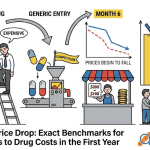
Short answer: multi-source generic pricing typically drops 80 to 85 percent below the original brand price within roughly a year of unrestricted competition, and the steepest part of that decline begins the moment the 180-day window closes.
Multi-Source Pricing Once the Exclusivity Ends
During the exclusivity window, a first filer, even one already sharing the market with an authorized generic, still enjoys meaningfully higher pricing than it will ever see again for that molecule. Single or dual-source generic pricing commonly sits 20 to 40 percent below brand levels. Once every approved ANDA holder can enter simultaneously on day 181, that discount deepens fast, and FTC data on fully competitive generic markets puts the eventual price decline at 80 to 85 percent below the original brand price, with generic products together capturing 80 to 90 percent of prescription volume within about a year.
Why the Post-Exclusivity Cliff Is Steeper for Commodity Molecules
Not every generic drug erodes at the same speed. A molecule with simple manufacturing, low barriers to entry, and a large number of companies holding tentative approval waiting for day 181 will see faster, deeper price collapse than a complex generic requiring specialized manufacturing, controlled-substance handling, or difficult bioequivalence demonstrations. First filers on commodity oral solids should model a faster post-exclusivity cliff than first filers on injectables or complex dosage forms, where fewer competitors are positioned to enter immediately.
How DrugPatentWatch Models Post-Exclusivity Revenue Decay
DrugPatentWatch’s patent and exclusivity data lets analysts build molecule-specific revenue decay curves rather than relying on industry-average erosion assumptions, tracking the number of ANDA holders with tentative approval waiting for a given loss-of-exclusivity date, prior authorized generic behavior by the same brand company, and historical erosion patterns for comparable therapeutic classes. That level of specificity is what separates a defensible internal return model from a generic rule-of-thumb applied uniformly across a portfolio of very different molecules.
How Should Generic Manufacturers Actually Evaluate a Paragraph IV Filing?
Short answer: treat the decision as a probability-weighted capital allocation problem, not a legal one, modeling litigation cost, the odds of an authorized generic, the odds of shared exclusivity, and the odds of a forfeiture event before committing resources, rather than after.
Building a Probability-Weighted Return Model
A defensible model starts with the brand’s addressable U.S. revenue, applies a realistic single-generic discount and volume-capture assumption for the 180-day window, then discounts that gross figure by the probability of authorized generic competition (using the FTC’s 40 to 52 percent revenue-reduction range as the base case), the probability of shared exclusivity with another same-day filer, and the probability of a forfeiture event tied to manufacturing readiness or litigation timing. Only after netting all of that against the fully loaded litigation and launch cost, typically $2.7 million on the low end and well into eight figures on the high end, does a company have a number worth comparing against its cost of capital.
When Walking Away From a Winnable Case Is the Right Call
The uncomfortable conclusion many generic companies reach only after running this math honestly is that a legally winnable patent challenge can still be a financially poor investment. A target drug generating $250 million in annual U.S. sales, facing near-certain authorized generic competition and a probable second same-day filer, may not clear a company’s cost of capital even with a high probability of prevailing on the underlying patent question. Winning the lawsuit and losing money are not mutually exclusive outcomes, and a disciplined generic manufacturer treats “we would probably win” as necessary but not sufficient.
Portfolio Diversification Across Multiple Paragraph IV Targets
Because any single filing carries real variance, from shared exclusivity to authorized generic risk to at-risk-launch damages exposure, sophisticated generic manufacturers manage Paragraph IV activity as a portfolio rather than betting the company on a single target, spreading litigation spend across multiple molecules with different risk profiles so that one adverse outcome, a lost appeal, an unexpected forfeiture, an aggressive authorized generic response, does not determine the year’s results on its own.
What This Means for Brands, Generic Manufacturers, and Investors
For Brand-Name Manufacturers
An authorized generic is not merely a defensive tactic; it is a quantifiable revenue-recapture strategy with a well-documented financial return, cutting a first filer’s exclusivity-period take by roughly half while accelerating price competition that would arrive anyway once day 181 hits. Brand IP and commercial teams should model authorized generic economics as a standard part of loss-of-exclusivity planning, not as an emergency response decided after a first filer’s launch is already underway.
For Generic Manufacturers
Winning first-to-file status is a necessary condition for capturing 180-day exclusivity value, not a sufficient one. Manufacturing readiness, data integrity, forfeiture-date tracking, and a realistic authorized generic probability assumption belong in the same investment committee memo as the underlying patent analysis, because the patent case is frequently the part of the equation a generic company is best positioned to get right, and the operational and commercial risks are where the actual losses tend to originate.
For Investors and Analysts
Headlines announcing that a company has “won” 180-day exclusivity on a blockbuster molecule are the beginning of the financial analysis, not the end of it. The relevant follow-up questions, whether the brand has signaled an authorized generic, whether a same-day filer shares the exclusivity, whether the winning company’s manufacturing sites carry any open FDA compliance history, determine whether that exclusivity translates into the revenue a press release implies.
Key Takeaways
180-day exclusivity blocks competing ANDA approvals for six months, but it does not block an authorized generic, which FTC data shows cuts first-filer revenue by 40 to 52 percent.
At-risk launches can generate enormous short-term revenue, as Apotex’s roughly $3.77 billion in Plavix sales shows, but a loss on appeal converts that revenue into a real damages liability, $442 million plus interest and costs in Apotex’s case.
Manufacturing and data integrity failures, not just patent losses, are among the most common reasons a winning exclusivity claim never converts into collected revenue, as Ranbaxy’s Paonta Sahib history demonstrates.
Reverse-payment settlements remain legal after FTC v. Actavis, but only under rule-of-reason antitrust review, meaning a large, unexplained payment can expose both the brand and the generic filer to enforcement risk.
Litigation cost alone can run from roughly $2.7 million to more than $25 million depending on patent complexity, a figure that must clear a company’s cost of capital before the exclusivity’s expected value is even considered.
FAQ
Does 180-day exclusivity guarantee a generic company will be the only generic on the market?
No. It blocks other ANDA holders from entering, but the brand can launch its own authorized generic at any point during the window, and if another company filed a substantially complete Paragraph IV application on the same day as the winner, that company shares the exclusivity from the start.
Can a company lose 180-day exclusivity after winning its patent case?
Yes. Failure to launch within the statutory forfeiture window, manufacturing or data integrity problems that prevent final approval, and certain settlement agreements can all forfeit exclusivity even after a favorable court ruling.
What is an at-risk launch?
An at-risk launch is commercial sale of a generic product before patent litigation over that product has been finally resolved. It can generate substantial revenue quickly, but exposes the generic company to damages liability if it ultimately loses the case.
How much does authorized generic competition typically reduce first-filer revenue?
The FTC’s interim report on authorized generics found revenue declines in the 47 to 51 percent range for first filers facing authorized generic competition during their exclusivity window, a figure often cited more broadly as a 40 to 52 percent range.
Is a reverse-payment patent settlement automatically illegal?
No. FTC v. Actavis subjected reverse-payment settlements to rule-of-reason antitrust review rather than declaring them per se illegal or per se legal. A settlement’s legality now depends on the size of the payment and whether it can be justified by something other than payment for delayed generic entry.
Why would a generic company walk away from a patent challenge it believes it would win?
Because winning the litigation and earning an adequate financial return are different questions. A target drug facing likely authorized generic competition, a probable same-day co-filer, or steep litigation costs relative to its market size can produce a negative expected return even for a strong patent case.
Does 180-day exclusivity apply to biosimilars the same way it applies to generic drugs?
No. Biosimilars operate under a separate exclusivity framework, first interchangeable exclusivity, governed by the Public Health Service Act rather than the Hatch-Waxman provisions that create small-molecule 180-day exclusivity, with its own distinct forfeiture triggers.
What happens to generic pricing after the 180-day exclusivity period ends?
Once every approved ANDA holder can enter on day 181, pricing typically falls sharply, with fully competitive generic markets historically settling 80 to 85 percent below the original brand price within about a year.
Can a brand company’s own manufacturing or data problems affect a generic competitor’s exclusivity?
Indirectly, yes, though more commonly it is the generic applicant’s own manufacturing history that puts its exclusivity at risk. FDA’s Application Integrity Policy freezes review of pending applications tied to a facility under active data integrity concerns, which can delay or forfeit exclusivity regardless of the outcome of the underlying patent case.
How can a generic manufacturer estimate the real value of a 180-day exclusivity opportunity before filing?
By building a probability-weighted model that starts with addressable brand revenue, applies realistic single-generic pricing and volume assumptions, discounts for the probability of authorized generic competition and shared exclusivity, and nets the result against fully loaded litigation and launch costs, ideally using molecule-specific patent, exclusivity, and prior-erosion data rather than industry-wide averages.
References
Bloomberg Law. (2010, May 4). Patent expiration and 180-day generic exclusivity under the Hatch-Waxman Act: Teva v. Sebelius. https://news.bloomberglaw.com/pharma-and-life-sciences/patent-expiration-and-180-day-generic-exclusivity-under-the-hatch-waxman-act-teva-v-sebelius
Cozen O’Connor. (2018, August 23). FDA’s clarification of 180-day exclusivity rules. https://www.cozen.com/news-resources/publications/2018/-fda-s-clarification-of-180-day-exclusivity-rules
U.S. Food and Drug Administration. (2023, October 26). Small business assistance: 180-day generic drug exclusivity. https://www.fda.gov/drugs/cder-small-business-industry-assistance-sbia/small-business-assistance-180-day-generic-drug-exclusivity
Federal Trade Commission. (2009, June). FTC issues interim report on “authorized generic” drugs. https://www.ftc.gov/news-events/news/press-releases/2009/06/ftc-issues-interim-report-authorized-generic-drugs
Axinn LLP. (2024, June 13). Hatch-Waxman overview. https://www.axinn.com/en/insights/publications/hatch-waxman-overview
Bristol Myers Squibb. (2012, February 8). Sanofi and Bristol-Myers Squibb collect damages in Plavix patent litigation with Apotex. https://news.bms.com/news/details/2012/Sanofi-and-Bristol-Myers-Squibb-Collect-Damages-in-Plavix-Patent-Litigation-with-Apotex/default.aspx
U.S. Securities and Exchange Commission. (2007). Bristol Myers Squibb Co., Form 10-Q, FY2007. https://www.sec.gov/Archives/edgar/data/0000014272/000119312507110445/d10q.htm
Justia U.S. Supreme Court Center. (2013). FTC v. Actavis, Inc., 570 U.S. 136. https://supreme.justia.com/cases/federal/us/570/136/
WilmerHale. (2013, June 18). FTC v. Actavis: Supreme Court adopts rule of reason for “reverse payment” settlements. https://www.wilmerhale.com/en/insights/client-alerts/ftc-v-actavis-supreme-court-adopts-rule-of-reason-for-reverse-payment-settlements
National Law Review. (2013, June 24). Federal Trade Commission (FTC) v. Actavis: What does it mean for reverse-payment settlements? https://natlawreview.com/article/federal-trade-commission-ftc-v-actavis-what-does-it-mean-reverse-payment-settlements
DrugPatentWatch. (2026, January 8). A strategic playbook for timing ANDA submissions using drug patent data. https://www.drugpatentwatch.com/blog/a-strategic-playbook-for-timing-anda-submissions-using-drug-patent-data/
DrugPatentWatch. (2026, March 8). Win the patent war before the drug goes generic: How Paragraph IV challenges and pay-for-delay settlements decide who gets paid, and who gets blocked. https://www.drugpatentwatch.com/blog/win-the-patent-war-before-the-drug-goes-generic-how-paragraph-iv-challenges-and-pay-for-delay-settlements-decide-who-gets-paid-and-who-gets-blocked/
DrugPatentWatch. (2026, April 5). Drug patent litigation costs: The $5M playbook pharma executives actually use. https://www.drugpatentwatch.com/blog/managing-drug-patent-litigation-costs/
DrugPatentWatch. (2026, April 17). Paragraph IV certifications: The complete IP strategy guide for generic drug market dominance. https://www.drugpatentwatch.com/blog/the-paragraph-iv-playbook-turning-patent-challenges-into-market-dominance/
Bristol Myers Squibb Co. (2006). Form 424B5. U.S. Securities and Exchange Commission. https://www.sec.gov/Archives/edgar/data/0000014272/000119312506238057/d424b5.htm
R Street Institute. (2026, May 26). The process is the penalty: How serial patent litigation delays low-cost drugs. https://www.rstreet.org/commentary/the-process-is-the-penalty-how-serial-patent-litigation-delays-low-cost-drugs/
HealthRX.com. (2026, May 25). Lipitor patent field and generic atorvastatin timeline. https://healthrx.com/atorvastatin/patent-generic-timeline
Biospace. Pfizer Inc. and Ranbaxy Laboratories settle Lipitor patent dispute; generic Lipitor to be launched Nov. 2011. https://www.biospace.com/pfizer-inc-and-ranbaxy-laboratories-settle-lipitor-patent-dispute-generic-lipitor-to-be-launched-nov-2011
nhyip.com. Patent cases and generic delays: 2023-2025 examples explained. https://nhyip.com/patent-cases-and-generic-delays-2023-2025-examples-explained