Every blockbuster drug runs on a clock it cannot stop. The question is whether your legal and portfolio teams know exactly what time it is — and what they can do about it before the window closes.
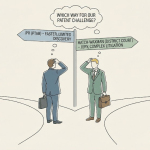
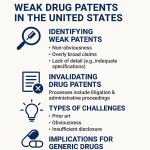
The Patent Trial and Appeal Board (PTAB), created by the Leahy-Smith America Invents Act (AIA) in 2012, is one of the most consequential institutional developments in pharmaceutical IP since the Hatch-Waxman Act itself. Its two primary proceedings — Post-Grant Review (PGR) and Inter Partes Review (IPR) — have turned patent validity into a live, continuously contested question rather than a settled matter resolved at grant. Through the first decade of PTAB operations, petitioners filed challenges against nearly 20,000 patents. The board instituted trial on more than half. Of those that reached a Final Written Decision, 84% had at least one challenged claim invalidated. That is not a rounding error. That is structural risk embedded in every pharmaceutical patent portfolio.
For an IP team or portfolio manager, the PTAB is not an external threat to be handled when it arrives. It is an ongoing variable in valuation models, licensing negotiations, M&A due diligence, and clinical-stage pipeline decisions. This guide builds the full technical and strategic picture: what each proceeding allows, when each clock starts, how the Hatch-Waxman intersection creates compounding deadline pressure, how estoppel reshapes litigation calculus, and what innovators and challengers should each be doing right now.
The America Invents Act and What It Actually Changed for Pharma
Before 2012, invalidating a patent meant federal district court or a costly ex parte reexamination. District court patent litigation routinely ran five to seven years from complaint to final judgment and cost each side $5 to $10 million in legal fees for matters with more than $25 million at stake, per the American Intellectual Property Law Association’s biennial survey. Reexamination was cheaper but slow and limited in scope.
The AIA restructured the challenge landscape in two ways that directly hit pharma. First, it replaced inter partes reexamination with IPR, a proper adversarial trial proceeding before technically trained administrative patent judges (APJs) rather than patent examiners. Second, it created PGR from scratch, giving challengers a high-powered tool in the first nine months of a patent’s life.
Both proceedings operate under ‘preponderance of the evidence’ as the standard for invalidity, a materially lower bar than the ‘clear and convincing evidence’ standard applied in district court. The combination of specialized judges, lower evidentiary bar, compressed timelines (the board targets a Final Written Decision within one year of institution), and lower cost relative to district court made PTAB an immediately attractive venue for generics, biosimilar applicants, and competing innovators alike.
The pharmaceutical industry absorbed the impact quickly. Between 2012 and 2022, pharma and biotech patents were among the most frequently challenged at the PTAB. Formulation patents, method-of-treatment patents, and dosing regimen patents — precisely the secondary patents that support evergreening strategies — proved especially vulnerable.
IP Valuation Implication: PTAB Risk as a Haircut on Patent Portfolio NPV
Any NPV model for a drug patent portfolio that does not include a PTAB risk-adjustment factor is incomplete. The mechanics are straightforward: take the probability-weighted revenue stream from a patent’s exclusivity period, then apply a discount that reflects the probability the patent faces a successful PTAB challenge before natural expiration.
For small-molecule blockbusters with Orange Book-listed patents and multiple ANDA filers, PTAB risk is not theoretical. A compound patent surviving its 20-year term without an IPR petition is the exception, not the rule. Analysts modeling exclusivity value should segment the portfolio by patent type (compound, formulation, method-of-use, dosing, device), then apply differentiated PTAB invalidation rates based on historical outcomes data. Compound patents, particularly those with strong prosecution history and robust non-obviousness evidence, carry materially lower invalidation risk than secondary formulation or method-of-treatment patents, which the PTAB has invalidated at rates exceeding 70% in challenged claims.
For a drug generating $3 billion in annual net revenue with a putative exclusivity runway through 2031, a 60% probability of successful IPR challenge by 2027 should translate directly into a reduced NPV calculation, earlier generic entry assumptions in earnings models, and an accelerated timeline for lifecycle management investment — not a footnote in legal disclosures.
Post-Grant Review (PGR): The Broadside Attack in the First Nine Months
PGR is the most powerful administrative patent challenge available in U.S. law, and its breadth is precisely calibrated to the vulnerability of newly issued patents.
Statutory Grounds: What PGR Can Attack
A PGR petition can challenge patent claims on any ground of invalidity under Title 35. That means §101 (patent-eligible subject matter), §102 (novelty), §103 (obviousness), and the full spectrum of §112 arguments: written description, enablement, and definiteness. This is the critical differentiator from IPR. A PGR petition can argue that a biologic patent claim lacks written description support for the full scope of claimed antibody variants — an argument unavailable in IPR. It can challenge a formulation patent for failing to enable a person of ordinary skill to practice the invention across the claimed pH range without undue experimentation.
These §112 arguments are not academic. Complex pharmaceutical and biotech patents, particularly those claiming broad genus coverage over chemical scaffolds or biologic sequence families, frequently have enablement and written description vulnerabilities that only appear years after prosecution when the full commercial scope of the claim becomes clear. The nine-month PGR window is often the only administrative venue where those arguments can be pressed.
The Nine-Month Window: Mechanics and Monitoring
Under 35 U.S.C. §321(c), a PGR petition must be filed no later than nine months after the date of grant of the patent or the date of issuance of a reissue patent. The clock is binary. It starts on the grant date shown on the patent face. It ends nine months later, regardless of whether the challenger had notice of the patent, access to all prior art, or sufficient time to prepare a petition.
Practically, this means that any company with a commercial interest in a technology space must run continuous patent monitoring across the USPTO grant database. New pharmaceutical patent grants publish weekly in the Official Gazette. The gap between publication of the granted patent and the nine-month expiration of PGR eligibility is fixed and does not flex for operational delays.
The preparation timeline is also real. A credible PGR petition — one that will survive the PTAB’s threshold determination that the petition demonstrates it is ‘more likely than not’ that at least one challenged claim is unpatentable — requires substantive prior art research, claim mapping, expert declaration preparation, and legal review. Realistically, a petitioner needs six to eight weeks of preparation minimum for a technically complex pharmaceutical patent. That means the practical monitoring-to-filing window is closer to seven months, not nine.
Threshold for Institution: ‘More Likely Than Not’
PGR has a higher institution threshold than IPR. The petitioner must demonstrate that it is ‘more likely than not’ that at least one challenged claim is unpatentable — a 50%-plus probability standard. IPR requires only a ‘reasonable likelihood’ that the petitioner would prevail on at least one claim. The difference matters. It means a weaker §101 or §112 challenge that might clear the IPR institution bar will fail at PGR institution if it does not reach the preponderance threshold.
Well-resourced challengers use this asymmetry strategically. If a newly issued patent has both obvious prior art vulnerabilities (suitable for IPR after the nine-month window) and written description gaps (exclusive to PGR), the PGR is the only chance to press the §112 arguments. The petitioner should front-load its PGR petition with the strongest §112 arguments and treat the §102/§103 grounds as supplementary. If PGR is instituted, those obviousness grounds can be joined within the same proceeding. The challenger preserves all grounds.
Reissue Patents and the Reset Mechanism
A reissue patent — issued when the original patent owner seeks to correct an error in the original grant — re-starts the nine-month PGR clock, but only for claims that are new or amended relative to the original patent. Claims carried over unchanged from the original patent do not receive a new PGR window. This distinction is operationally important: a patent owner who reissues to broaden claims in a new therapeutic area reopens PGR eligibility on the broadened claims. For challengers, reissue applications on commercially significant patents should trigger immediate monitoring and rapid prior art assessment.
Key Takeaways: PGR
The nine-month PGR window is the highest-value administrative challenge tool in pharmaceutical patent disputes, and it is also the most time-sensitive. It covers every ground of invalidity, including §112 arguments unavailable anywhere else in the administrative system. Missing the window is irreversible. Monitoring newly issued patents in your competitive space and maintaining a standing rapid-response capability to prepare PGR petitions is not optional for companies operating in crowded therapeutic areas. Portfolio managers should treat a competitor’s key patent grant date as an event with a defined decision deadline — not as background legal noise.
Inter Partes Review (IPR): The Primary Long-Range Challenge Weapon
IPR is the workhorse of pharmaceutical patent challenges. It can be filed at any point after the nine-month PGR window closes and, unlike PGR, is available to challengers even when they have been sued for infringement — subject to a critical one-year bar.
Statutory Grounds: Prior Art Only
Under 35 U.S.C. §311, an IPR petition can only challenge claims on grounds of invalidity under §102 (anticipation) or §103 (obviousness), and only based on prior art that is either a patent or a printed publication. This restriction is deliberate. IPR was designed to clear the USPTO’s mistakes on prior art — instances where the examiner missed relevant prior art during prosecution. It was not designed to relitigate §101 or §112 disputes, which are more squarely within the domain of either PGR or district court.
For pharmaceutical patents, the prior-art-only limitation is less constraining than it might appear. The bulk of secondary pharmaceutical patents — formulation patents, dosing regimen patents, method-of-treatment patents, polymorph patents — are vulnerable to obviousness challenges based on prior scientific literature, earlier patents, and conference proceedings. The published clinical literature for most drug candidates is extensive by the time secondary patents are filed. Prior art for an IPR challenge is usually available. The analytical challenge is selecting the right combination of references and building the strongest claim-mapping argument within the 14,000-word page limit for petitions.
The Institution Threshold: ‘Reasonable Likelihood’
IPR has a more permissive institution standard than PGR. The petitioner need only establish a ‘reasonable likelihood’ that it would prevail on at least one challenged claim. In practice, the PTAB institutes IPR on a substantial fraction of filed petitions, though institution rates have declined somewhat since the Supreme Court’s 2022 decision in Apple v. Vidal affirmed the board’s broad discretionary denial authority under the ‘Fintiv framework’ (discussed below).
The Two IPR Timing Triggers: Post-PGR Window and the §315(b) Bar
IPR timing has two distinct constraints that operate independently and must be tracked separately.
The first is structural: an IPR petition cannot be filed while the PGR window is still open. Under 35 U.S.C. §311(c), IPR is available starting nine months after the patent grant date — or immediately upon termination of any PGR proceeding filed against the patent. This ensures PGR and IPR are sequential options, not simultaneous ones.
The second constraint is the most consequential for pharmaceutical companies: the §315(b) one-year bar. If the petitioner, or a real party in interest to the petition, has been served with a complaint alleging infringement of the patent, the petitioner has exactly one year from the date of service to file an IPR petition. After that date, the petitioner is permanently barred from challenging that patent at the PTAB via IPR, regardless of subsequent developments in the litigation.
Dissecting the §315(b) Bar: Every Word Matters
‘Served with a complaint’ is the trigger event. Not the filing of the complaint. Not the mailing of the complaint. The date of formal legal service under the applicable procedural rules. In Hatch-Waxman litigation, this is typically when the brand-name plaintiff formally serves process on the generic defendant after filing suit in district court.
‘Real party in interest’ (RPI) extends the bar beyond the named petitioner. If a company that is an RPI to the IPR petition was served with an infringement complaint more than a year before the petition is filed, the petition is time-barred even if the petitioner itself was never sued. Determining RPI is a fact-intensive inquiry: who is funding the IPR proceeding, who exercises control over it, who stands to benefit from its outcome. Joint ventures, parent-subsidiary relationships, and indemnification agreements can all create RPI relationships that trigger the bar.
‘Privity’ functions similarly. A party in privity with a petitioner who was served more than a year prior to the petition date can bar the petition. Courts have applied privity broadly in some contexts and narrowly in others, creating ongoing litigation uncertainty. The standard inquiry examines whether the putative privy had a full and fair opportunity to litigate the validity issue previously.
The practical consequence: any company that might want to file an IPR against a patent in the future must track every infringement complaint served on itself and every RPI — including affiliated entities — from the moment of service.
Discretionary Denial: The Fintiv Framework and Its Aftermath
The PTAB’s discretionary authority to deny institution even when the petitioner meets the substantive threshold has added a layer of strategic complexity. The NHK-Fintiv framework, developed in 2020 and affirmed by the Federal Circuit, allows the board to deny institution based on the status of parallel district court litigation. Under the six-factor Fintiv analysis, a petition filed late in litigation — with a district court trial date imminent — may be denied on efficiency grounds even if it presents strong prior art arguments.
For pharmaceutical challengers, this means the IPR petition filing date relative to the district court schedule matters enormously. Filing an IPR petition early in Hatch-Waxman litigation — ideally within four to six months of service — maximizes the probability that the PTAB will reach institution before a district court trial date is set. A petition filed eleven months after service with a district court trial scheduled in eight months is at high risk of discretionary denial under Fintiv factor 4 (investment in parallel proceedings) and factor 5 (overlap between issues).
The Supreme Court’s 2022 decision in Consolidated Trial Practice Guide updates gave the USPTO Director authority to override panel-level discretionary denials in certain circumstances, creating additional uncertainty. The Biden-era Director Vidal exercised this authority sparingly. The posture of the current administration toward discretionary denial is a live policy variable that IP teams should monitor continuously.
Key Takeaways: IPR
IPR is prior-art-only and runs on two independent timing constraints: the post-PGR structural delay and the §315(b) one-year bar from service. For ANDA filers and biosimilar applicants, the one-year bar is the controlling deadline in most cases. Every infringement complaint served on the company or its affiliates must be docketed immediately and tracked with the same rigor as a court filing deadline. The Fintiv framework adds filing-timing strategy on top of the statutory deadline: earlier petitions survive discretionary denial more reliably than late ones. Petitioners who file an IPR eleven months after service, finding themselves racing the calendar, have already ceded significant strategic ground.
The Hatch-Waxman Framework: Where ANDA Timelines and PTAB Clocks Intersect
The Drug Price Competition and Patent Term Restoration Act of 1984 — Hatch-Waxman — is the statutory architecture governing generic drug entry in the U.S. market. Its core mechanism is the Abbreviated New Drug Application (ANDA), which allows a generic applicant to rely on the innovator’s safety and efficacy data rather than conducting independent clinical trials, provided it can establish bioequivalence. In exchange, the innovator receives several layers of exclusivity protection: compound patents, data exclusivity, pediatric exclusivity, and the Orange Book listing mechanism that links patent protection to the FDA approval pathway.
The Orange Book and What Gets Listed
The Orange Book (FDA’s publication of Approved Drug Products with Therapeutic Equivalence Evaluations) is the nexus between patent rights and regulatory exclusivity. An innovator must list in the Orange Book any patent that claims the drug substance, drug product (formulation), or approved method of use. Device patents and manufacturing process patents are not listable.
Orange Book listing converts a patent from a private IP right into a regulatory gatekeeper. An ANDA filer must certify against every Orange Book-listed patent. The certifications are tiered: Paragraph I (patent has expired), Paragraph II (patent will have expired before the applicant’s market entry date), Paragraph III (the applicant agrees to wait until the listed patent expires), or Paragraph IV (the patent is invalid, unenforceable, or will not be infringed). The Paragraph IV certification is the litigation trigger.
The Paragraph IV Mechanism: Artificial Infringement and the 30-Month Stay
The Hatch-Waxman Act deems a Paragraph IV certification an act of infringement — a legal fiction that allows the patent owner to sue for infringement before the generic product ever reaches market. This artificial infringement construct is the foundation of the entire ANDA litigation system. The generic filer sends a formal notice letter to the NDA holder and each patent owner, detailing the basis for the Paragraph IV certification (i.e., the invalidity or non-infringement arguments). If the brand files suit within 45 days of receiving the notice letter, it triggers an automatic 30-month stay of FDA approval of the ANDA.
The 30-month stay is a formidable tool for innovators. It buys 2.5 years of litigation time before the FDA can grant final approval to the generic, even if the underlying patent dispute is moving slowly. Multiple patents can generate multiple independent stays, though the 2003 Medicare Modernization Act prohibited the use of late-listed patents to trigger additional stays beyond the first.
For the generic challenger, the 30-month stay begins the moment the brand files suit. From that date, the one-year §315(b) IPR clock is also running — assuming the complaint was formally served. These two deadlines operate on different tracks but from the same triggering event. The 30-month stay is FDA-focused; the one-year bar is PTAB-focused.
First-Filer Exclusivity: The 180-Day Incentive
The first generic company to file a Paragraph IV ANDA receives 180 days of market exclusivity before any subsequent generic can enter. This is among the most valuable regulatory assets in the pharmaceutical industry. For a drug with $2 billion in annual brand revenue, the first filer’s 180-day exclusivity period can generate $600 million to $900 million in generic revenue at typical early-entry discounts to brand price — for a single company.
This 180-day exclusivity creates a competition among generic filers to be first to file (the ‘First to File’ race), which in turn creates strong incentives to file ANDAs early in a drug’s commercial life, before the innovator’s patent portfolio has been stress-tested. It also creates incentives to resolve litigation via settlement, because the first filer retains the 180-day exclusivity period even if it settles without a court ruling on validity. Pay-for-delay settlements — where the brand pays the generic to delay entry — were constrained by the Supreme Court’s 2013 FTC v. Actavis decision, which held they are subject to antitrust scrutiny under the rule of reason. But structured settlements that do not involve explicit cash transfers continue to be used, including authorized generics, royalty arrangements, and supply agreements.
The Dual-Track Model: ANDA Litigation Meets PTAB
The most sophisticated generic and biosimilar challengers do not choose between district court litigation and PTAB proceedings. They run both tracks simultaneously and coordinate them deliberately.
The district court track proceeds on Hatch-Waxman timelines: the brand files suit, the 30-month stay is triggered, discovery begins, claim construction is briefed, and the case moves toward a bench trial (patent cases under Hatch-Waxman are decided by judges, not juries). This track covers the full range of invalidity and non-infringement arguments, including §101 subject matter eligibility and §112 written description, which are unavailable at the PTAB via IPR.
The PTAB track — specifically the IPR — runs on a one-year timeline from institution to Final Written Decision. If the PTAB institutes IPR and ultimately invalidates the challenged claims, the district court litigation on those claims is effectively mooted. A Federal Circuit-affirmed PTAB invalidation has in rem effect on the patent; the claims are gone, not merely held unenforceable in one case.
The coordination challenge is managing estoppel exposure. If the IPR petition fails on prior art grounds, the challenger is estopped from raising those grounds in district court — specifically, any ground it raised or reasonably could have raised in the IPR. ‘Reasonably could have raised’ is broader than ‘actually raised,’ which means that a challenger who files a narrow IPR petition and loses may find itself unable to raise other prior art combinations in district court even though those combinations were never before the board. Petition drafting is therefore a strategic exercise in scope management: include every strong prior art argument, but do not include weak arguments that will fail and trigger estoppel on related grounds.
IP Valuation Implication: The Orange Book Listing as a Regulatory Asset
An Orange Book-listed patent is worth more than its nominal patent term suggests, because the listing activates the 30-month stay mechanism. The economic value of the stay — 2.5 years of delayed generic competition on a $2 billion drug — runs into the hundreds of millions of dollars in risk-adjusted present value terms. This is why innovators aggressively list patents in the Orange Book and why the FDA’s Orange Book listing criteria have been contested in recent years.
The FTC has pursued a rulemaking to require NDA holders to delist patents that were improperly listed in the Orange Book, based on a reading that device-combination patents (e.g., the autoinjector used to deliver a biologic) are not properly listable. The stakes of that rulemaking are directly quantifiable: each improperly listed patent that generates a 30-month stay represents potentially hundreds of millions of dollars of delayed generic entry. For portfolio managers, the Orange Book listing status of a brand’s key patents is not a compliance footnote — it is a material asset that affects competitive dynamics and should be modeled explicitly.
Evergreening: The Patent Lifecycle Extension Playbook
No analysis of PTAB challenge windows is complete without examining the innovation strategy those windows are designed to police. Evergreening — the practice of extending a drug’s effective market exclusivity beyond the original compound patent term through secondary patents — is the primary reason secondary pharmaceutical patents are challenged at the PTAB at rates far exceeding patents in other industries.
The Standard Evergreening Toolkit
The core evergreening mechanisms are well-documented and applied systematically across the industry. A drug compound patent typically expires 20 years from its filing date, though Patent Term Extensions (PTEs) under 35 U.S.C. §156 can add up to five additional years to compensate for time lost to FDA review. Beyond PTE, innovators build layered exclusivity through new formulation patents (extended-release, lipid nanoparticle delivery, subcutaneous formulations), polymorph patents on specific crystalline forms, method-of-treatment patents for new indications, dosing regimen patents specifying particular dose levels or administration schedules, combination product patents, and pediatric exclusivity extensions granted by the FDA for conducting required pediatric studies.
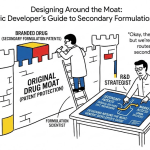
Each layer adds exclusivity. Together, they can extend effective market protection well beyond the compound patent term. AbbVie’s adalimumab (Humira) is the canonical case study: the compound patent expired in 2016, but a thicket of formulation, dosing, and manufacturing patents kept biosimilar competition largely out of the U.S. market until 2023. At its peak, AbbVie had filed more than 100 patents related to adalimumab. The compound patent alone represented a small fraction of the product’s IP estate.
Humira as an IP Valuation Case Study
The adalimumab patent estate is worth examining in detail because it illustrates how a layered patent portfolio translates into economic value that far exceeds any individual patent.
AbbVie’s 2022 U.S. net revenues from Humira were approximately $17.3 billion. Even with the compound patent expired, the combination of formulation patents (covering citrate-free, high-concentration formulations), device patents (the autoinjector), and method-of-use patents for specific rheumatologic and dermatologic indications sustained effective exclusivity. When U.S. biosimilar interchangeability designations began in 2023 and multiple biosimilar entrants began pricing aggressively, AbbVie’s Humira revenues declined sharply — but by that point, AbbVie had already shifted substantial patients to its next-generation IL-23 inhibitor, risankizumab (Skyrizi), and JAK inhibitor, upadacitinib (Rinvoq).
The IP valuation lesson: the value of an individual patent within an evergreening portfolio is not its standalone exclusivity value, but its contribution to the aggregate delay of biosimilar interchangeability. A formulation patent that would be worth $200 million on a $500 million drug becomes worth $2 billion in the context of a $17 billion product — and it becomes worth that much specifically because it delays biosimilar interchangeability under the BPCIA framework. The PTAB challenge risk on each individual patent within such a portfolio must be assessed in that systemic context, not in isolation.
The PTAB’s Role as Evergreening Counterbalance
IPR proceedings against secondary pharmaceutical patents have disproportionately targeted the patents that make evergreening work: method-of-treatment patents with broad claim language, dosing regimen patents where the ‘inventive step’ is thin, and formulation patents where the prior art includes published dissolution studies suggesting the claimed formulation was obvious. The PTAB has invalidated claims in this category at rates that give innovators reason to invest heavily in prosecution quality.
The implication for R&D leads and portfolio managers is concrete: every secondary patent filed to extend exclusivity should be evaluated not only for its prosecution likelihood of grant, but for its expected survival probability at the PTAB over the life of the product. A formulation patent with a 75% chance of grant at the USPTO but a 65% chance of invalidation via IPR has a net expected exclusivity contribution that should be modeled explicitly in the product’s lifecycle revenue forecast.
The Biosimilar Parallel: BPCIA Patent Dance and PTAB Timing
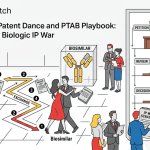
The Biologics Price Competition and Innovation Act (BPCIA) created an analogous but more complex framework for biosimilar drug entry. The ‘patent dance’ — the disclosure-and-negotiation process between a biosimilar applicant and the reference product sponsor — is the BPCIA equivalent of Hatch-Waxman’s Paragraph IV mechanism, though with significant structural differences.
Patent Dance Mechanics and Litigation Triggers
Under 42 U.S.C. §262(l), a biosimilar applicant who files a 351(k) application must, within 20 days of FDA acceptance, provide the reference product sponsor with a copy of the application and manufacturing information. The sponsor then has 60 days to identify patents it believes would be infringed by the biosimilar — the ‘list of patents’ step. The applicant responds with its non-infringement and invalidity contentions. The parties then attempt to narrow the list of patents subject to immediate litigation versus deferred litigation.
The process results in two litigation tracks: a first wave of patents litigated immediately, and a second wave of ‘listed patents’ deferred until the biosimilar is closer to market. Importantly, once the reference product sponsor files suit on first-wave patents, the §315(b) IPR clock starts from the date of service of the infringement complaint — just as in Hatch-Waxman. The one-year deadline applies identically.
Biosimilar Interchangeability: The IP Valuation Premium
A biosimilar designated as ‘interchangeable’ by the FDA can be substituted for the reference product at the pharmacy level without prescriber intervention, the same standard that applies to small-molecule generics. Interchangeability requires an additional comparative switching study demonstrating no greater risk from switching between the biosimilar and reference product than remaining on the reference product.
The commercial value of an interchangeability designation is material. Non-interchangeable biosimilars require prescriber action to substitute, limiting market penetration in practice. Interchangeable biosimilars achieve faster formulary placement and higher substitution rates. For reference product sponsors, a patent that delays interchangeability designation — even if it does not block biosimilar entry entirely — preserves more revenue than a patent that merely delays a non-interchangeable biosimilar.
This distinction should factor into PTAB challenge prioritization for biosimilar applicants. A reference product sponsor’s patent that, if upheld, would specifically block interchangeability designation (e.g., a patent on the specific switching study design or on the reference product’s high-concentration formulation required for autoinjector administration) has a higher challenge priority than a patent that merely duplicates exclusivity already covered by the compound patent.
The 12-Year Biologics Data Exclusivity Period
Unlike small-molecule generics, which are subject to data exclusivity for only five years (or three years for new clinical studies), biologics enjoy 12 years of reference product exclusivity under the BPCIA. For the first four years of this period, the FDA cannot even accept a biosimilar application. For the following eight years, it can accept applications but cannot grant final approval.
The 12-year clock runs from the date of first approval of the reference biologic — not from its patent filing date. Patent strategy for a biologic therefore operates against a different exclusivity timeline than for a small molecule. The compound patent may expire during the 12-year exclusivity period, meaning that secondary patents filed to extend exclusivity beyond year 12 are the primary PTAB targets. These are the patents where PTAB challenge windows matter most for biosimilar applicants: they are the patents that actually govern whether and when biosimilar competition begins.
Building PTAB-Resistant Pharmaceutical Patent Portfolios
For innovators, surviving PTAB challenges is an engineering problem as much as a legal one. Patent prosecution decisions made years before a challenge is filed determine whether the portfolio can withstand the scrutiny.
Prosecution Strategy for PTAB Resistance
The prosecution record is the primary source of evidence in an IPR or PGR. The board reviews claim amendments, examiner rejections, applicant responses, and the arguments made to distinguish prior art. A prosecution record that leans heavily on distinguishing prior art through claim narrowing — rather than through substantive arguments about secondary considerations of non-obviousness — leaves little on the record for the patentee to deploy during PTAB proceedings.
The stronger prosecution strategy builds a record of secondary considerations: commercial success tied specifically to the claimed invention (not merely to the drug generally), long-felt unmet need that the claimed invention addressed, failure of others to achieve the same result, and unexpected results documented with quantitative data. Secondary considerations can overcome weak obviousness positions at the PTAB, but only when they are documented in the prosecution record and corroborated by expert declaration during the PTAB proceeding.
For complex pharmaceutical patents — particularly biologics patents claiming specific antibody CDR sequences or conjugation chemistries — the prosecution record should include experimental data comparing the claimed structure against the closest prior art on the claimed functional parameter. If the patent claims an antibody with a binding affinity below 1 nM for a specific epitope and the closest prior art antibodies achieve affinities in the 50-100 nM range, that quantitative difference should be in the prosecution record as evidence of unexpected results, not left to be reconstructed years later during PTAB proceedings when the inventors may be unavailable and contemporaneous records may have been destroyed under document retention policies.
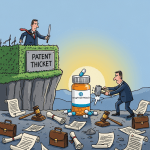
The Patent Thicket: Architecture for Coverage Depth
A patent thicket — a dense portfolio of overlapping patents covering multiple aspects of a drug product — is the primary defensive strategy against PTAB challenges precisely because invalidating any single patent leaves the remaining thicket intact. The challenger must bring separate IPR petitions against each patent, each requiring its own institution decision, briefing schedule, and Final Written Decision. This multiplies the legal cost and timeline pressure on the challenger while the brand retains the benefit of the unchallenged patents in the thicket.
Effective thicket architecture involves several layers. The compound patent covers the active pharmaceutical ingredient (API) at the broadest possible scope. Formulation patents cover each commercially relevant dosage form — oral, injectable, extended-release, combination. Method-of-treatment patents cover each approved indication and, where supported by clinical data, off-label use patterns that drive actual prescribing. Dosing regimen patents cover the specific approved dosing schedules. Device patents cover the drug delivery system — autoinjector, prefilled syringe, inhaler. Manufacturing process patents cover specific synthesis routes or purification steps that the generic or biosimilar applicant would be likely to use.
No individual layer of the thicket is intended to be impregnable. The thicket works because challenging every layer simultaneously is operationally and financially prohibitive for most generic or biosimilar applicants. The challenger must prioritize which patents to challenge, and that prioritization decision involves tradeoffs that the innovator can exploit.
Investment Strategy: IP Portfolio Quality as a Stock Screening Factor
For institutional investors in pharmaceutical equities, PTAB vulnerability of a company’s key patent portfolio is a quantifiable risk factor that can be incorporated into screening models. The relevant data points are publicly available: Orange Book listings identify which patents protect which products, PTAB PRPS filings show which patents have already been challenged, prosecution history files show the quality of non-obviousness support in each patent, and academic literature on PTAB invalidation rates stratified by patent type provides base-rate data.
A company whose top-three revenue products are protected by secondary patents with thin prosecution histories, no secondary considerations evidence, and prior art that the ANDA filers have already identified in their Paragraph IV notice letters, presents materially higher IP risk than a company with well-resourced prosecution records and diversified patent thickets. That risk differential should be reflected in valuation models — not buried in footnotes to annual report patent disclosures.
Estoppel: The Trade-Off at the End of Every PTAB Challenge
Every PTAB petitioner who reaches a Final Written Decision faces statutory estoppel under 35 U.S.C. §315(e) (for IPR) and §325(e) (for PGR). The scope of estoppel is the most consequential post-PTAB variable for litigation strategy.
IPR Estoppel: The ‘Reasonably Could Have Raised’ Standard
Under §315(e)(2), a petitioner who receives a Final Written Decision in an IPR is estopped from asserting in any civil action that the challenged patent claim is invalid on any ground that was raised or ‘reasonably could have been raised’ during the IPR. The ‘reasonably could have raised’ language is the operative phrase, and its interpretation has evolved through Federal Circuit case law.
The Federal Circuit has generally interpreted ‘reasonably could have raised’ to mean grounds that a skilled petitioner conducting a reasonable prior art search would have found. This is broader than ‘grounds the petitioner actually presented.’ If a petitioner files an IPR based on Reference A alone and loses, but a competent prior art search would have also found Reference B — which in combination with Reference A creates a strong obviousness argument — the petitioner may be estopped from using Reference B as part of an invalidity defense in district court.
This expansive reading of estoppel has several strategic implications. First, it means petitioners must conduct comprehensive prior art searches before filing and include every strong prior art combination in the petition, even if the petition thereby exceeds the optimum length. Second, it means that losing an IPR can be worse than not filing one at all, from a district court perspective. Third, it creates pressure to file IPR petitions only when the prior art case is strong enough to prevail, because a failed IPR forecloses district court prior art defenses.
PGR Estoppel: The Full Scope of Available Grounds
PGR estoppel under §325(e) is even broader. A PGR petitioner who receives a Final Written Decision is estopped from raising in district court any ground that was raised or reasonably could have been raised during the PGR. Because PGR covers all grounds of invalidity — including §101 and §112 — a failed PGR can foreclose the full range of invalidity defenses in district court. This makes PGR estoppel the most severe estoppel consequence in the PTAB system.
The practical effect: PGR petitioners must treat the PGR proceeding as their one all-in opportunity to invalidate the patent. Arguments not raised — including arguments the petitioner strategically reserved for district court — are at risk of being foreclosed if the petitioner loses on other grounds. This ‘all chips on the table’ dynamic explains why PGR petitions tend to be longer and more argumentatively dense than IPR petitions, and why the threshold decision to file a PGR is treated by sophisticated challengers as a higher-stakes commitment than an IPR.
Settlement Before Final Written Decision: Preserving District Court Options
One strategy for avoiding estoppel is settling the PTAB proceeding before a Final Written Decision is issued. If the parties jointly move to terminate the IPR or PGR, the board can grant termination and the estoppel provisions do not attach. The challenger retains the ability to raise invalidity arguments in district court. This creates a settlement dynamic late in PTAB proceedings: as a Final Written Decision approaches, both parties have incentives to consider settlement if the outcome is uncertain. The challenger values preserving its district court arguments; the patentee values avoiding an invalidity ruling with in rem effect. Mediated settlements at this stage often include licensing terms rather than simple dismissal.
Scenario Modeling: A Complete Dual-Track Timeline
The following scenario illustrates how these elements interact in a realistic Hatch-Waxman dual-track proceeding for a mid-sized small molecule drug.
The brand NDA holder holds a compound patent expiring in 2028, a formulation patent granted in January 2024, and a method-of-treatment patent expiring in 2030. All three are Orange Book-listed. The drug generates $900 million in annual net U.S. revenue.
A generic applicant files an ANDA in April 2024 with Paragraph IV certifications against all three patents. It sends notice letters in April 2024. The brand files suit in May 2024 and formally serves the complaint in late May 2024. The 30-month stay runs until approximately November 2026. The one-year §315(b) IPR bar runs until late May 2025.
The generic applicant’s legal team determines in June 2024 that the formulation patent (granted January 2024) is in its PGR window through October 2024. They also determine that the method-of-treatment patent has strong §103 vulnerabilities based on prior clinical literature. The compound patent is strong — broad, well-supported prosecution history, no close prior art.
The strategic decision: file a PGR against the formulation patent before October 2024 (citing both §103 and §112 enablement arguments on the claimed pH stability range), and file an IPR against the method-of-treatment patent before May 2025. Leave the compound patent unchallenged at the PTAB and defend it only in district court on non-infringement grounds.
The PGR is filed in September 2024. The board institutes in December 2024. The IPR against the method-of-treatment patent is filed in March 2025. The board institutes in June 2025. Both proceedings target a Final Written Decision by December 2025.
If both proceedings succeed, the remaining Orange Book obstacle is only the compound patent. The district court will likely grant summary judgment of non-infringement if the generic product’s formulation is sufficiently differentiated, or the brand may seek to negotiate a settlement that avoids an invalidity ruling on its compound patent. If either proceeding fails, estoppel applies only to the grounds that were raised or reasonably could have been raised, leaving the district court invalidity defenses on different grounds intact.
This scenario is not hypothetical. It is the template that sophisticated generic applicants apply systematically across their ANDA portfolios.
Frequently Asked Questions: PTAB Challenge Windows in Pharma
Can a brand-name company use IPR or PGR against a competitor’s patent?
Yes. Both IPR and PGR are available to any party, including competing innovators. A brand-name company may challenge a competitor’s formulation patent or method-of-treatment patent to clear the field for its own product. The §315(b) one-year bar applies if the brand has been sued for infringement of the challenged patent. If it has not been sued, it can file IPR at any point after the nine-month PGR window closes, subject to standing requirements and the threshold standards.
What happens when a reissue patent is filed on a commercially critical patent?
Reissue re-opens the nine-month PGR window for new or amended claims in the reissued patent. A patentee who files a reissue application to broaden claims — attempting to recapture subject matter from prior claim narrowing during prosecution — creates a new PGR target on the broadened claims. Challengers who monitor reissue application publications at the USPTO can use this window to attack the broadened claims before they mature into a stronger exclusivity position.
Does a voluntary dismissal of the infringement complaint reset the §315(b) clock?
Courts have generally held that a dismissal without prejudice does not reset the clock. The policy rationale is that allowing a patentee to dismiss and re-file to ‘refresh’ the one-year bar would be an abuse of the mechanism. A dismissal with prejudice — which forecloses any re-filing — presents a different analysis, but brands almost never voluntarily dismiss with prejudice because doing so permanently ends the litigation without a judgment in their favor.
Can a biosimilar applicant file an IPR before engaging in the BPCIA patent dance?
Yes. The BPCIA patent dance is not a prerequisite to filing an IPR. A biosimilar applicant can file an IPR against a reference product sponsor’s biologic patents independently of and concurrently with the patent dance process, provided the one-year bar has not been triggered. The dance and the IPR are separate procedural mechanisms. The interaction between them — specifically, whether litigation initiated during the dance starts the one-year IPR clock — depends on the timing of formal service of the infringement complaint.
What is the impact of inter partes review on a pending ANDA in FDA review?
The FDA does not pause ANDA review because of a PTAB proceeding. PTAB and FDA proceedings are independent. An ANDA can receive tentative approval during an IPR proceeding. If the PTAB then invalidates the challenged claims, and the 30-month stay has run or been resolved, the FDA can convert tentative approval to final approval without additional action. Patent invalidation at the PTAB does not automatically remove the patent from the Orange Book — the patentee must petition the FDA for delisting, or the challenger can seek a court order requiring delisting.
How do coalitions among generic filers affect the one-year IPR bar?
Multiple ANDA filers, each served with separate infringement complaints on different dates, each have their own independent one-year IPR bar running from their respective service dates. If Filer A was served in March 2024 and Filer B was served in July 2024, Filer A’s bar expires in March 2025 and Filer B’s bar expires in July 2025. They can file separate IPR petitions, potentially creating multiple PTAB challenges against the same patent on overlapping but not identical prior art records. The PTAB can consolidate multiple petitions against the same patent, or treat them as separate proceedings.
Key Takeaways for IP Teams and Portfolio Managers
The PTAB is not an external legal process that IP teams manage reactively. It is a core variable in pharmaceutical IP strategy, and it runs on unforgiving clocks that start without notice and end without exception.
PGR covers every ground of invalidity — including §112 arguments available nowhere else administratively — but only for nine months from the patent grant date. Miss that window and those arguments are only available in district court, at higher cost and against a higher evidentiary standard.
IPR covers prior art-based invalidity — §102 and §103 only — and can be filed after the PGR window closes. For Hatch-Waxman litigants, the one-year §315(b) bar from the date of service of the infringement complaint is the controlling deadline. Every infringement complaint must be docketed against this deadline from the moment of service.
The §315(b) bar applies to the petitioner and every real party in interest, with privity potentially extending it further. Due diligence on RPI relationships — including parent companies, subsidiaries, indemnification parties, and joint venture partners — must precede every IPR filing.
Estoppel following a Final Written Decision bars the losing petitioner from raising in district court any ground that was raised or reasonably could have been raised in the PTAB proceeding. This makes petition drafting a scope-management exercise: include all strong prior art arguments, coordinate with district court invalidity contentions, and assess whether the IPR case is strong enough to risk the estoppel consequence.
For innovators, portfolio architecture — thicket depth, prosecution record quality, and secondary considerations documentation — determines whether individual patents survive PTAB challenge. No single patent should be treated as the product’s exclusive barrier to generic entry. For challengers, prior art research and filing discipline against the §315(b) deadline are the operational fundamentals on which market entry strategy depends.
The clock is running. The only question is whether your team knows exactly what the clock says.
References
35 U.S.C. §311 — Inter Partes Review; 35 U.S.C. §315 — Relation to Other Proceedings or Actions; 35 U.S.C. §321 — Post-Grant Review; 35 U.S.C. §325 — Relation to Other Proceedings or Actions; 21 U.S.C. §355(j) — Abbreviated New Drug Applications; 42 U.S.C. §262 — Biological Products; USPTO Patent Trial and Appeal Board Trial Statistics, FY2022; American Intellectual Property Law Association Report of the Economic Survey 2021; FTC v. Actavis, Inc., 570 U.S. 136 (2013); Apple Inc. v. Vidal, 63 F.4th 1 (Fed. Cir. 2023); Apple Inc. v. Fintiv, Inc., IPR2020-00019 (PTAB Mar. 20, 2020) (precedential); NHK Spring Co. v. Intri-Plex Technologies, Inc., IPR2018-00752 (PTAB Sept. 12, 2018) (precedential).