On August 25, 2026, the D.C. Circuit told the FDA it had been reading its own forfeiture statute wrong for over a decade. The case involved a generic version of Xifaxan (rifaximin), a first-to-file applicant named Actavis, a nine-year gap between ANDA submission and final approval, and a legal standard called “but-for causation” that most patent teams have never had to think about. The ruling, Norwich Pharmaceuticals, Inc. v. Kennedy, did not touch the forfeiture trigger everyone already tracks: failure to market. It touched the one almost nobody tracks until it fires: failure to obtain tentative approval within 30 months.[1]
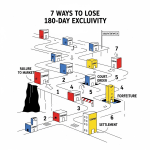
This matters beyond rifaximin. First-to-file 180-day exclusivity is one of the largest single prizes in generic pharmaceuticals, and Hatch-Waxman gives FDA six distinct statutory ways to take that prize away.[10] Two of those six triggers generate nearly all the litigation. Two more have real teeth but rarely reach a courtroom. One has never been used in the statute’s 22-year history. DrugPatentWatch’s own exclusivity tracking runs into the same pattern the case law shows: companies plan around the trigger they read about, not the one buried in a footnote.[18]
“The 180-day exclusivity period has often been triggered by the first applicant and run by the time the antitrust merits get decided by a court,” antitrust counsel Suchira Ghosh told Pharmaceutical Technology, explaining why FDA has never applied the disqualifying-agreement forfeiture provision to a single ANDA.[13]
The Short Answer: Six Forfeiture Triggers, Two That Actually Get Litigated
Congress created six statutory “forfeiture events” in the 2003 Medicare Modernization Act (MMA) amendments to the Federal Food, Drug, and Cosmetic Act: failure to market, withdrawal of application, amendment of certification, failure to obtain tentative approval, a disqualifying agreement found to violate antitrust law, and expiration of all patents.[10] Before 2003, a first filer could sit on an unlaunched ANDA indefinitely and block every other generic from entering, because the 180-day clock only started once the first filer actually launched or won a final court decision. The forfeiture provisions were Congress’s fix for that bottleneck.[18]
In practice, failure to market and failure to obtain tentative approval account for nearly every reported forfeiture dispute, including Norwich v. Kennedy, Teva v. Sebelius, Mylan Labs v. FDA, and Amneal v. FDA.[1][5][7][8] The other four triggers exist on paper, get cited in FDA guidance, and rarely generate a contested case. One of them, the antitrust disqualification provision, has a perfect record of never being applied at all.[13]
What Changed on August 25, 2026: Norwich v. Kennedy
Salix Pharmaceuticals sells rifaximin as Xifaxan, approved for travelers’ diarrhea in 2004, for hepatic encephalopathy (HE) at 550 mg in 2010, and for irritable bowel syndrome with diarrhea (IBS-D) at 550 mg in 2015.[17] Actavis Laboratories FL, a Teva Pharmaceuticals subsidiary, filed the first ANDA for 550 mg rifaximin tablets on December 18, 2015, with Paragraph IV certifications against the polymorph, IBS-D, and HE patents, including the patent covering the HE indication.[20][4]
The Rifaximin ANDA Timeline: Nine Years From Filing to Approval
Salix sued Actavis for infringement. The parties settled in September 2018 on terms letting Actavis enter the market no earlier than January 1, 2028, more than 22 months before Salix’s last patent expires.[3] Separately, FDA did not grant Actavis final approval until March 19, roughly nine years after the original filing and long past the 30-month statutory deadline for tentative approval.[3] In between, FDA revised its draft product-specific guidance for rifaximin in March 2017, after Salix filed a citizen petition, and required additional in vitro dissolution testing that had not been part of the requirements when Actavis filed in 2015.[2][3]
Table: Key Dates in Norwich Pharmaceuticals, Inc. v. Kennedy
Date
Event
Source
Dec. 18, 2015
Actavis submits the first ANDA for 550 mg rifaximin, with Paragraph IV certifications on polymorph, IBS-D, and HE patents
[20][4]
Mar. 2017
FDA revises draft product-specific guidance for rifaximin, adding dissolution testing not required at filing
[2][3]
Jun. 18, 2018
Statutory 30-month deadline for Actavis to obtain tentative approval
[3]
Sept. 2018
Salix-Actavis litigation settles; Actavis may enter no earlier than Jan. 1, 2028
[3]
Mar. 19 (~2025)
FDA grants Actavis final approval, roughly nine years after filing
[3]
Aug. 25, 2026
D.C. Circuit decides Norwich v. Kennedy, No. 25-5137
[1][2]
Norwich Pharmaceuticals filed its own rifaximin ANDA, later amended to include the 550 mg strength, with Paragraph IV certifications against the same polymorph and IBS-D patents Actavis had certified against, but a section viii statement rather than a Paragraph IV certification on the HE patent.[4] Norwich won its litigation on the patents it challenged, then argued to FDA that those wins triggered forfeiture of Actavis’s exclusivity under the failure-to-market provision, and separately that Actavis’s nine-year delay in getting tentative approval independently forfeited exclusivity.[2] FDA rejected both arguments. The district court agreed with FDA. The D.C. Circuit split the difference.[2]
How FDA’s “Multiple Sufficient Causes” Standard Worked
The failure-to-obtain-tentative-approval provision excuses a first filer from the 30-month deadline only if the delay “is caused by a change in or a review of the requirements for approval” imposed after filing.[10] For decades, FDA read “caused by” loosely: an applicant only had to show that a post-filing regulatory change delayed one part of its application, chemistry, bioequivalence, or labeling, regardless of what other deficiencies also existed in the ANDA. The agency’s position was upheld in Mylan Laboratories Ltd. v. FDA, 910 F. Supp. 2d 299 (D.D.C. 2012), and again in Amneal Pharmaceuticals LLC v. FDA, 285 F. Supp. 3d 328 (D.D.C. 2018).[7][8][12] Under that “multiple sufficient causes” test, FDA found that its March 2017 dissolution-testing guidance was merely “a” cause of Actavis’s delay, and that was enough to preserve exclusivity.[2]
The Burrage Standard: Why “Caused By” Means But-For Causation
The D.C. Circuit rejected that approach. Citing the Supreme Court’s drug-overdose causation decision in Burrage v. United States, 571 U.S. 204 (2014), the court held that “caused by” carries its ordinary meaning, but-for causation, unless the statute’s text or context says otherwise.[9] Nothing in the tentative-approval provision suggested otherwise, so FDA’s decades-old shortcut is gone.[2][3] The court borrowed a baseball analogy from Burrage itself: a walk-off home run is a but-for cause of a win even though skillful pitching and a scheduled game were also necessary conditions, and courts do not treat multiple necessary conditions as license to ignore the but-for test.[2]
Why Loper Bright Mattered to the Outcome
FDA’s forfeiture interpretations had survived judicial review for years partly through deference to the agency’s reading of an ambiguous statute.[12] The D.C. Circuit in Norwich declined to extend that deference, reasoning that a causation standard borrowed from tort and criminal law has little to do with FDA’s scientific or regulatory expertise.[2] That reasoning tracks the broader shift in administrative law since the Supreme Court eliminated Chevron deference, a shift Axinn’s own analysis flagged as a direct threat to FDA’s forfeiture win record even before Norwich was decided.[12]
The case was remanded to FDA to redo the tentative-approval analysis under the but-for standard, so Actavis’s exclusivity is not fully settled.[2] FDA Law Blog’s own review of the Paragraph IV list found other drugs that likely fit a similar fact pattern, where a prior non-forfeiture finding rested on the now-rejected “multiple sufficient causes” test and a subsequent filer may have grounds to ask FDA to reconsider.[2]
The Single, Indivisible Exclusivity Doctrine
The part of Norwich that did not change the law matters just as much for anyone building a forfeiture calendar. Norwich argued that because it, not Actavis, had won litigation on the polymorph and IBS-D patents, and because Norwich itself never certified against the HE patent, Actavis should forfeit exclusivity as to the non-HE patents even while keeping exclusivity on the HE patent. The D.C. Circuit disagreed: 180-day exclusivity is a single, indivisible period that a first applicant either forfeits entirely or keeps entirely.[2][4]
What “Qualifying Certification” Means After Norwich
The statute forfeits exclusivity under the failure-to-market provision only once a “forfeiture event” occurs as to each patent for which the first applicant submitted and lawfully maintained a qualifying Paragraph IV certification.[10] The court held that every Paragraph IV certification the first applicant contains and lawfully maintains counts as “qualifying,” regardless of whether a later applicant certified against that same patent.[2][4] Because Actavis maintained a live Paragraph IV certification on the HE patent, and no triggering event, a final court decision of invalidity or non-infringement, a consent judgment to that effect, or a patent-information withdrawal, had occurred on that specific patent, Actavis had not forfeited under the failure-to-market provision. Norwich’s own courtroom win on the other patents did not change that analysis.[2][4]
The Question the D.C. Circuit Declined to Decide
The opinion flags, without resolving, a commercially significant question: does a subsequent applicant’s ANDA need a Paragraph IV certification that matches one of the first applicant’s certifications to be blocked by that exclusivity in the first place? Norwich argued the statutory phrase “such a certification” requires a matching, patent-by-patent certification. FDA’s position leans toward blocking by default whenever both applicants have any Paragraph IV certification. The court explicitly left this open for a future case where it makes a difference.[2] That is a live drafting and litigation risk for any company relying on a section viii carve-out strategy to route around a first filer’s block.
The Six Statutory Forfeiture Triggers, Ranked by How Often They Fire
DrugPatentWatch’s exclusivity tracking treats all six triggers as calendar events to monitor. The case law treats them very differently by volume. Below is each trigger as FDA and Congress define it, ordered by how frequently it actually generates a contested dispute.[10][11]
Table: The Six Statutory Forfeiture Triggers at a Glance
Trigger
Statute
Litigation Frequency
Leading Case
Failure to market
355(j)(5)(D)(i)(I)
High
Norwich v. Kennedy (2026)[1]
Failure to obtain tentative approval
355(j)(5)(D)(i)(IV)
High
Norwich v. Kennedy; Amneal v. FDA; Mylan Labs v. FDA[1][7][8]
Amendment/withdrawal of certification
355(j)(5)(D)(i)(II)-(III)
Low
Addressed mainly in FDA guidance, not litigation[11][19]
Expiration of all patents
355(j)(5)(D)(i)(VI)
Low
Adjacent to the Teva v. Sebelius maintenance-fee dispute[24][25]
Disqualifying agreement (antitrust)
355(j)(5)(D)(i)(V)
None on record
Never applied by FDA[13]
Patent delisting (a sub-trigger of failure to market)
355(j)(5)(D)(i)(I)(bb)(CC)
Moderate, but narrowed by courts
Teva v. Sebelius; Ranbaxy v. Leavitt[5][6]
Failure to Market
This trigger has the most moving parts. A first applicant forfeits exclusivity if it fails to market by the later of two “bookend” dates. The first bookend is the earlier of 75 days after the first applicant’s approval becomes effective, or 30 months after the first applicant’s ANDA submission. The second bookend is 75 days after the date on which, for each qualifying patent, a court enters a final unappealable decision of invalidity or non-infringement, a court enters a consent judgment to the same effect, or the NDA holder withdraws the relevant patent information.[10][19] Because the statute requires the “later of” these two calculations, and because the second bookend can be triggered by litigation involving an applicant other than the first filer, the math changes every time a subsequent applicant wins or settles a case on the same patent family.[9][16]
Failure to Obtain Tentative Approval
Norwich v. Kennedy is now the controlling authority on this trigger. A first filer must obtain tentative approval within 30 months of filing, unless FDA imposed a post-filing change in approval requirements that was a but-for cause of the delay.[9] Before August 2026, FDA needed to show only that its change was one of several sufficient causes.[7][8] After Norwich, the agency must isolate whether the applicant would have obtained tentative approval on time absent the specific regulatory change, a materially harder factual inquiry that the court itself acknowledged will add to FDA’s workload.[2]
Amendment of Certification
A first applicant forfeits exclusivity if it amends or withdraws its Paragraph IV certification on every patent for which it originally certified.[19] FDA’s own guidance treats this as one of the more mechanical triggers: if any single qualifying certification survives, forfeiture under this provision does not occur, echoing the same all-or-nothing logic the D.C. Circuit applied to failure to market in Norwich.[11][19]
Expiration of All Patents
If every patent underlying the first applicant’s qualifying certifications expires, the exclusivity period necessarily ends, since there is nothing left to be exclusive against.[10] FDA’s draft guidance states that 180-day exclusivity never outlives the underlying patent life, and that a patent’s expiration can shorten an already-running exclusivity period even without triggering full forfeiture under this specific provision.[15]
Disqualifying Agreement (Antitrust)
The MMA also added a forfeiture trigger for reverse-payment or “pay-for-delay” settlements: if a first applicant’s agreement with another applicant, the NDA holder, or a patent owner is later found by the FTC or a federal court to violate antitrust law, exclusivity is forfeited.[10][13] On its face, this looks like the sharpest deterrent in the statute. In practice, it is the one trigger that has never fired.
Why the Timing Mismatch Defeats the Antitrust Provision
FDA’s own draft guidance states that the agency has not applied this forfeiture provision to any ANDA applicant.[13] Antitrust counsel Suchira Ghosh explained the mechanism to Pharmaceutical Technology: the 180-day exclusivity clock is usually triggered and has usually finished running long before an FTC or DOJ antitrust case against the same settlement reaches a final, unappealable decision.[13] By the time a court might rule that a reverse-payment deal violated antitrust law, the exclusivity period it protected is already history, with nothing left to forfeit.[13]
Patent Delisting Is Not a Forfeiture Event
The failure-to-market provision’s second bookend includes patent-information withdrawal as a trigger, and FDA initially read that broadly: if the NDA holder delisted a patent, the first filer’s clock started running whether or not there had been any litigation at all.[6][25] FDA applied that reading twice in public letter decisions, once for generic acarbose in 2008 and once for a generic version of Cosopt.[25]
Table: Forfeiture Triggers That Sound Automatic But Aren’t
Scenario
Intuitive Outcome
Actual Outcome
Case
NDA holder delists a Paragraph IV patent without suing the first filer
Forfeiture (patent no longer at issue)
No forfeiture; delisting alone does not trigger it
Ranbaxy v. Leavitt, 469 F.3d 120 (D.C. Cir. 2006); Teva v. Sebelius, 595 F.3d 1303 (D.C. Cir. 2010)[5][6]
Underlying patent expires because the owner stops paying maintenance fees
Forfeiture (patent no longer exists)
No automatic forfeiture on this basis alone
Teva Pharmaceuticals USA, Inc. v. Sebelius, No. 09-1111 (D.D.C. Mar. 16, 2010)[24]
FDA requires new commercial-scale manufacturing data after filing
Excuses the 30-month tentative-approval clock
Not automatically; routine scale-up data requests are not a “change in requirements”
Amneal Pharmaceuticals LLC v. FDA, 285 F. Supp. 3d 328 (D.D.C. 2018)[8]
A subsequent filer wins litigation on a patent the first filer never certified against
Triggers first filer’s forfeiture
No effect; only certifications the first filer itself maintains count
Norwich v. Kennedy, No. 25-5137 (D.C. Cir. 2026)[2]
Ranbaxy and Teva both challenged the delisting theory, and the D.C. Circuit sided with the generic applicants both times: conditioning exclusivity on whether the innovator chose to sue, rather than on the applicant’s own conduct, contradicted the statute’s purpose of rewarding the applicant that took on patent litigation risk.[5][6] In Teva v. Sebelius, Merck delisted its ‘075 patent covering Cozaar and Hyzaar (losartan potassium) after Teva filed its ANDA, and the D.C. Circuit held that a brand company’s unilateral delisting decision cannot, by itself, strip a first filer of exclusivity it otherwise earned.[5][24]
A companion district court ruling on remand went further: FDA could not treat a patent’s expiration through non-payment of maintenance fees as an automatic forfeiture event either.[24] Both rulings point the same direction. Congress built forfeiture around the first filer’s own conduct and its own qualifying certifications, not around actions a brand company or a patent office can take unilaterally.[4][24]
The Traps Hiding Inside “Failure to Obtain Tentative Approval”
The tentative-approval trigger looks simple on its face: 30 months, one exception. The exception is where the disputes live, because “a change in or a review of the requirements for approval” is not self-defining, and FDA has had to draw lines around what counts.
Amneal v. FDA: When a Routine Data Request Isn’t a “Change in Requirements”
Amneal Pharmaceuticals argued that FDA’s request for commercial-scale batch data, standard agency practice since around 2010 for complex drug products, constituted a post-filing “change in requirements” that excused its own missed 30-month deadline.[8] The district court disagreed. It held that a routine, previously established agency practice for complex manufacturing processes is not the kind of new, post-filing change the statute’s exception was designed to cover, even though FDA had not always announced the practice through formal rulemaking.[8]
Mylan Labs v. FDA: The 2012 Precedent That Just Got Overturned
Mylan Laboratories Ltd. v. FDA, 910 F. Supp. 2d 299 (D.D.C. 2012), is the case that established the “multiple sufficient causes” reading the D.C. Circuit rejected in 2026.[7][12] For fourteen years, that ruling and FDA’s 2017 draft guidance told applicants they only needed to show a regulatory change was a cause of delay, not the deciding cause.[11][2] Any first filer whose non-forfeiture determination rested on that older standard, rather than on a but-for showing, is now sitting on weaker legal footing than it was in July 2026.[2][12]
The Dead-Letter Trigger and the Guidance That Never Grew Up
Two structural facts round out the picture of how unevenly these six triggers actually operate, and both are more about institutional behavior than case law.
How Long FDA’s Own Guidance Has Sat in Draft Form
FDA issued its 45-question draft guidance, “180-Day Exclusivity: Questions and Answers,” in January 2017, consolidating a decade of citizen-petition responses, litigation outcomes, and internal letter decisions into one document.[11][23] Twelve of the guidance’s 26 pages address forfeiture specifically, reflecting how much of FDA’s interpretive workload sits in this one subparagraph.[2] FDA’s guidance-document database still labels the document “Draft: Not for implementation,” meaning industry’s primary reference point for how FDA thinks about forfeiture has never been finalized, nearly a decade after it was first proposed.[26]
Original Taxonomy: Classifying Forfeiture Risk by Litigation Density
Sorting the six statutory triggers by how often they generate contested case law, rather than by their order in the statute, produces three practical risk tiers. This classification is original to this analysis, built from the reported federal decisions and FDA guidance documents cited throughout this article; it is not an FDA or statutory category.
Tier One: Heavily Litigated Triggers
Failure to market and failure to obtain tentative approval generate nearly all the reported forfeiture disputes identified in this analysis, including Norwich, Teva v. Sebelius, Mylan Labs, and Amneal.[1][5][7][8] Both triggers depend on precise date math and on the conduct of parties other than the first filer, which is exactly what generates disagreement.
Tier Two: Rarely Litigated but Real
Amendment or withdrawal of certification and expiration of all patents are mechanical enough that FDA guidance resolves most questions without a lawsuit; they still matter for portfolio planning, particularly when a company relies on multiple patents to anchor a single certification package.[11][19]
Tier Three: The Dormant Trigger
The antitrust disqualification provision sits alone in this tier. It has existed in the statute since 2003, applies retroactively to older ANDAs under the MMA’s transition rules, and has never once been the basis for an FDA forfeiture finding.[6][13] Reverse-payment settlements remain a live FTC enforcement priority through other legal theories, but not through this specific mechanism.[13]
What This Means for First-to-File Applicants
The practical lesson from Norwich is that a settlement date and a regulatory approval date are two different clocks, and only one of them, tentative approval, has a hard 30-month deadline that does not move for litigation strategy.[9][3] A first filer that settles patent litigation on generous entry terms, as Actavis did with a 2028 entry date more than two years before Salix’s last patent expires, can still lose the underlying exclusivity if its own ANDA sits in FDA review past 30 months for reasons that do not meet the new but-for standard.[2][3] Before Norwich, showing “a” cause was enough. After Norwich, first filers need a factual record showing that, absent the specific regulatory change they are relying on, they would have hit the 30-month deadline anyway.[2]
What This Means for Brand Manufacturers and Patent Owners
Delisting a Paragraph IV patent to try to force a first filer’s hand does not work as a forfeiture lever; two D.C. Circuit panels, decades apart, have said so.[5][6] Brand manufacturers get more mileage from litigating to a final decision or negotiating a settlement with a defined entry date than from administrative maneuvers around the Orange Book listing itself.[5]
What This Means for Subsequent Filers Waiting in Line
The unresolved question in Norwich, whether a subsequent applicant’s certification must match the first filer’s certification patent-by-patent to be blocked at all, is now the highest-value open issue in this area of law.[2] A subsequent filer building a section viii carve-out strategy around a first filer’s Paragraph IV certification should model both outcomes, since the D.C. Circuit went out of its way to leave the question open rather than resolve it in FDA’s favor.[2]
Methodology
What Data Was Analyzed
This analysis draws on primary sources: the text of 21 U.S.C. § 355(j)(5)(D), the August 25, 2026 D.C. Circuit opinion in Norwich Pharmaceuticals, Inc. v. Kennedy, related federal district and appellate opinions addressing forfeiture (Teva v. Sebelius, Ranbaxy v. Leavitt, Mylan Labs v. FDA, Amneal v. FDA), FDA’s January 2017 draft guidance on 180-day exclusivity, and FDA’s own generic-drug-program approval statistics.[1][5][6][7][8][11][14]
Time Period and Selection
Case selection covers Hatch-Waxman forfeiture litigation from the 2003 MMA amendments through the August 2026 Norwich decision, prioritizing precedential circuit and district court rulings over unpublished letter decisions, and prioritizing the most recent controlling authority on each trigger.
Limitations
FDA does not publish a comprehensive public log of every internal forfeiture determination; many are resolved through unpublished citizen-petition responses or approval letters that never reach litigation, so the litigation-frequency tiers in this article describe reported case law, not FDA’s complete internal caseload.[2][11] The risk-tier classification above is original analysis based on that reported record and should be read as a qualitative ranking, not a statistical measurement of every forfeiture determination FDA has made since 2003.
Frequently Asked Questions
How many ways can a first-to-file ANDA applicant forfeit 180-day exclusivity?
Six, under 21 U.S.C. § 355(j)(5)(D)(i): failure to market, withdrawal of application, amendment of certification, failure to obtain tentative approval, a disqualifying antitrust agreement, and expiration of all underlying patents.[10]
What did the D.C. Circuit decide in Norwich Pharmaceuticals, Inc. v. Kennedy?
The court held that a first applicant’s failure to obtain timely tentative approval is excused only when a post-filing regulatory change was a but-for cause of the delay, rejecting FDA’s older “one of multiple sufficient causes” standard, while separately affirming that Actavis had not forfeited exclusivity under the failure-to-market provision.[1][2]
Does delisting a patent from the Orange Book cause a first filer to forfeit exclusivity?
No. The D.C. Circuit rejected that theory in both Ranbaxy Laboratories Ltd. v. Leavitt (2006) and Teva Pharmaceuticals USA, Inc. v. Sebelius (2010), holding that a brand company’s unilateral delisting decision cannot by itself strip a first filer of exclusivity.[5][6]
Has FDA ever forfeited a company’s exclusivity for a reverse-payment antitrust violation?
No. FDA’s own draft guidance and outside antitrust counsel confirm the agency has never applied the disqualifying-agreement forfeiture provision to any ANDA applicant, largely because the 180-day exclusivity period typically finishes running before an antitrust case reaches a final decision.[13]
Can a subsequent applicant’s litigation win trigger a first applicant’s forfeiture on a patent the first applicant never certified against?
No. Norwich v. Kennedy held that only the first applicant’s own lawfully maintained Paragraph IV certifications count toward the failure-to-market analysis, and 180-day exclusivity is forfeited or retained as a single, indivisible period rather than patent-by-patent.[2][4]
Does an FDA request for additional manufacturing data automatically excuse a missed tentative-approval deadline?
Not automatically. In Amneal Pharmaceuticals LLC v. FDA, the court held that a routine, previously established request for commercial-scale batch data was not the kind of new post-filing “change in requirements” that excuses the 30-month deadline.[8]
Is FDA’s guidance on 180-day exclusivity forfeiture legally binding?
No. The January 2017 “180-Day Exclusivity: Questions and Answers” guidance remains labeled as a non-binding draft in FDA’s own guidance database, meaning it reflects the agency’s interpretive position but does not carry the force of a final rule.[26]
What happens to a subsequent applicant’s approval if the first applicant forfeits exclusivity?
If all first applicants forfeit under the statute, approval of subsequent ANDAs is no longer blocked by that exclusivity, and the statute is explicit that exclusivity does not roll over to a subsequent applicant by default.[19][10]
Does patent expiration through non-payment of maintenance fees count as the “expiration of all patents” forfeiture trigger?
A district court rejected FDA’s attempt to treat maintenance-fee-driven patent expiration as an automatic forfeiture basis in the Teva-Sebelius litigation, underscoring that forfeiture determinations turn on the specific statutory language for each trigger rather than a general “the patent is gone” theory.[24]
Why does 180-day exclusivity forfeiture matter for competitive intelligence and market-entry planning?
FDA approved or tentatively approved roughly 900 ANDAs in calendar year 2024 alone, including 76 first-generic approvals, and each one carries its own forfeiture exposure that can shift a generic launch date by years depending on how these triggers resolve.[14] Tracking tools such as DrugPatentWatch exist because these dates move as litigation and regulatory guidance evolve, not just at the moment of ANDA filing.[18]
Key Takeaways
On August 25, 2026, the D.C. Circuit ruled in Norwich Pharmaceuticals, Inc. v. Kennedy that FDA must apply a strict but-for causation standard when deciding whether a post-filing regulatory change excuses a first filer’s failure to obtain tentative approval within 30 months, overturning FDA’s decades-old “multiple sufficient causes” reading.[1][2]
The same decision confirmed that 180-day exclusivity forfeits or survives as a single, indivisible period tied to the first applicant’s own lawfully maintained Paragraph IV certifications, not patent-by-patent based on a later applicant’s separate litigation wins.[2][4]
Of the six statutory forfeiture triggers, failure to market and failure to obtain tentative approval generate nearly all reported litigation; the antitrust disqualification provision has never once been applied by FDA.[10][13]
Patent delisting and patent expiration through non-payment of maintenance fees do not automatically trigger forfeiture, despite an intuitive assumption that they would.[5][6][24]
FDA’s interpretive guidance on forfeiture, first proposed in January 2017, remains a non-binding draft nearly a decade later.[26]
The D.C. Circuit explicitly left open whether a subsequent applicant’s Paragraph IV certification must match a first applicant’s certification patent-by-patent to be blocked by that first applicant’s exclusivity, an unresolved question with direct implications for section viii carve-out strategies.[2]
References
Norwich Pharmaceuticals, Inc. v. Kennedy, No. 25-5137 (D.C. Cir. Aug. 25, 2026). https://media.cadc.uscourts.gov/opinions/docs/2026/08/25-5137.pdf
Dickos, P. G., Koblitz, S. W., & Karst, K. R. (2026, August 27). A Costly 180: The D.C. Circuit Flips FDA’s Forfeiture Playbook. FDA Law Blog. https://www.thefdalawblog.com/2026/08/a-costly-180-the-d-c-circuit-flips-fdas-forfeiture-playbook/
Deming, M. T., & Jones, C. (2026). D.C. Circuit Clarifies Standards for 180-Day Forfeiture Decisions. National Law Review (Polsinelli PC). https://natlawreview.com/article/dc-circuit-clarifies-standards-180-day-forfeiture-decisions
Robins Kaplan LLP. (2026). Generically Speaking: Hatch-Waxman Bulletin – Norwich Pharms., Inc. v. Kennedy Jr. https://www.robinskaplan.com/newsroom/insights/generically-speaking-hatch-waxman-bulletin-2025-q2-norwich-pharms-inc-v-kennedy-jr
Teva Pharmaceuticals USA, Inc. v. Sebelius, 595 F.3d 1303 (D.C. Cir. 2010).
Mylan Laboratories Ltd. v. U.S. Food & Drug Administration, 910 F. Supp. 2d 299 (D.D.C. 2012).
Amneal Pharmaceuticals LLC v. Food & Drug Administration, 285 F. Supp. 3d 328 (D.D.C. 2018).
Burrage v. United States, 571 U.S. 204 (2014).
21 U.S.C. § 355(j)(5)(D). Cornell Law School Legal Information Institute. https://www.law.cornell.edu/uscode/text/21/355
U.S. Food and Drug Administration. (2017, January). Guidance for Industry: 180-Day Exclusivity: Questions and Answers (Draft Guidance). https://www.fda.gov/media/102650/download
Axinn LLP. (2024, March 5). FDA After Chevron. https://www.axinn.com/en/insights/publications/fda-after-chevron
BioPharm International. FDA Clarifies How It Handles 180-Day Exclusivity. https://www.biopharminternational.com/view/fda-clarifies-how-it-handles-180-day-exclusivity
U.S. Food and Drug Administration, Office of Generic Drugs. (2025, April 9). Working Together to Increase Access to Generic Drugs [Conference presentation]. Generic Drugs Forum. https://www.fda.gov/media/187296/download
Duane Morris LLP. (2017, March). FDA’s Draft Guidance for Industry on 180-Day Exclusivity. https://www.duanemorris.com/alerts/fda_draft_guidance_for_industry_on_180_day_exclusivity_0317.html
FDA Law Blog. (2017). FDA’s 180-Day Exclusivity Q&A Guidance: Two Items of Note. https://www.thefdalawblog.com/2017/02/fdas-180-day-exclusivity-qa-guidance-two-items-of-note/
Sheppard Mullin. Federal Circuit Upholds Rifaximin Patent Rulings, Affirms ANDA Approval Restrictions. https://www.sheppard.com/insights/blogs/federal-circuit-upholds-rifaximin-patent-rulings-affirms-anda-approval-restrictions
DrugPatentWatch. (2026, February 6). The ‘Use It or Lose It’ Rule: Decoding 180-Day Generic Exclusivity Forfeiture. https://www.drugpatentwatch.com/blog/the-use-it-or-lose-it-rule-decoding-180-day-generic-exclusivity-forfeiture/
FindLaw. Norwich Pharmaceuticals Inc. v. Kennedy (2026). https://caselaw.findlaw.com/court/us-dc-circuit/343922.html
U.S. Food and Drug Administration. (2025). ANDA 214370 Tentative Approval Letter, Norwich Pharmaceuticals, Inc. https://www.accessdata.fda.gov/drugsatfda_docs/appletter/2025/214370Orig1s000TAltr.pdf
Justia. Norwich Pharmaceuticals, Inc. v. Kennedy, No. 23-5311 (D.C. Cir., decided June 26, 2026). https://law.justia.com/cases/federal/appellate-courts/cadc/23-5311/23-5311-2026-06-26.html
Regulatory Affairs Professionals Society (RAPS). 180-Day Exclusivity for Generics: FDA Releases Draft Guidance. https://www.raps.org/resource/180-day-exclusivity-for-generics-fda-releases-dra.html
Bloomberg Law. (2010, May 4). Patent Expiration and 180-Day Generic Exclusivity Under the Hatch-Waxman Act: Teva v. Sebelius. https://news.bloomberglaw.com/pharma-and-life-sciences/patent-expiration-and-180-day-generic-exclusivity-under-the-hatch-waxman-act-teva-v-sebelius
vlex. Teva Pharmaceuticals USA, Inc. v. Sebelius, 638 F. Supp. 2d 42 (D.D.C. 2009) [case excerpt]. https://case-law.vlex.com/vid/teva-pharmaceuticals-usa-inc-895160226
U.S. Food and Drug Administration. Guidance Document Database entry: Guidance for Industry 180-Day Exclusivity: Questions and Answers. https://www.fda.gov/regulatory-information/search-fda-guidance-documents/guidance-industry-180-day-exclusivity-questions-and-answers