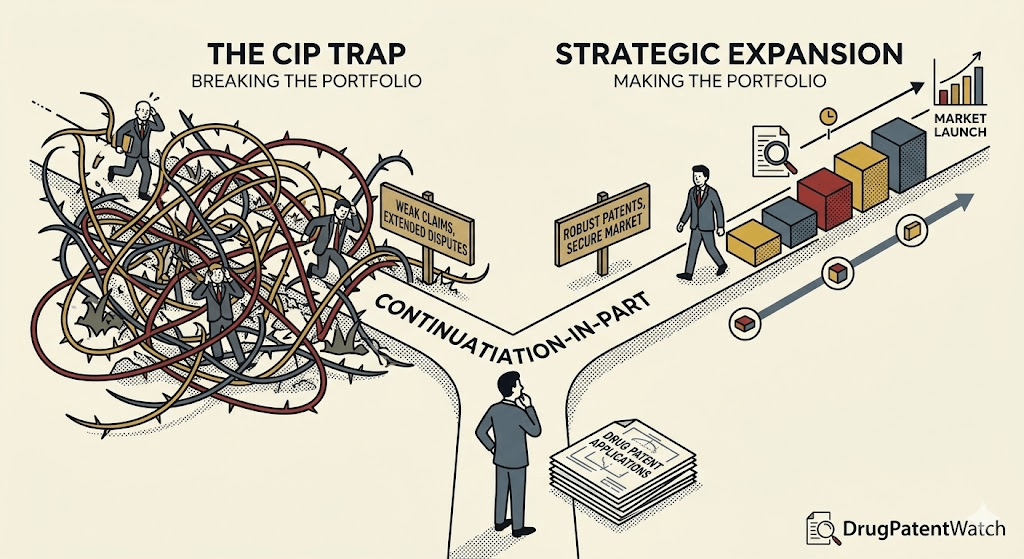
Every year, pharmaceutical companies collectively forfeit billions in potential patent term by misusing one of the most misunderstood tools in U.S. IP law. The continuation-in-part application — a mechanism that lets inventors introduce new technical data into a pending patent family — appears, at first glance, to be an elegant solution to a genuine problem: drug development keeps generating new discoveries long after the initial patent clock has started. The CIP promises to capture those discoveries without the overhead of a separate patent family.
It rarely works out that cleanly. The CIP is simultaneously the most flexible and most legally exposed filing type in the U.S. Patent and Trademark Office’s framework. It carries a unique, compounding set of risks — reduced patent term on new matter, the possibility that the parent application becomes prior art against its own child, and near-certain exposure to obviousness-type double patenting challenges that divisional applications are explicitly shielded from. For a drug generating $5 billion annually, losing three years of patent term to an avoidable CIP filing is not a footnote. It is a strategic failure worth $15 billion in pre-generic revenue.
This page maps CIP mechanics against the FDA development timeline, dissects the Federal Circuit case law that determines CIP patent validity, and translates those legal realities into commercial and investor-facing implications — from Humira’s 132-patent thicket to Gilead’s sofosbuvir crystalline form patents to the pipeline drugs most likely to face CIP-related vulnerabilities in the next litigation cycle.
What a Continuation-in-Part Application Actually Is — and What It Is Not
How CIPs Differ from Continuations, Divisionals, and New Applications
The USPTO recognizes three types of continuing applications under 35 U.S.C. § 120. The differences between them are not procedural hairsplitting — they determine patent term, prior art exposure, and which validity challenges a patent will face in court.
A continuation application pursues additional claims based on the exact same specification as the parent. No new technical information enters the record. Every claim in a continuation receives the parent’s priority date without exception, and the resulting patent is fully protected from double patenting challenges arising from the parent under 35 U.S.C. § 121’s safe harbor — provided the continuation was filed in response to a restriction requirement. Continuations are commonly used when a company wants to claim a competitor’s product that falls within the original disclosure but was not initially claimed, or when broader claims are worth pursuing after the parent has issued.
A divisional application similarly contains no new matter. It is used specifically to pursue claims on an invention that the USPTO deemed distinct from the invention prosecuted in the parent, typically after a restriction requirement. Divisionals receive the parent’s full priority date and, critically, carry the § 121 safe harbor that protects them from obviousness-type double patenting (ODP) challenges based on the parent. This protection is statutory. It does not require any action by the applicant.
A continuation-in-part is categorically different. It adds new technical information — new matter — that was not present in the parent’s specification. This is its defining characteristic and the source of every risk it carries. Because new matter cannot receive the benefit of the parent’s earlier filing date, CIP claims are analyzed on a claim-by-claim basis. Claims fully supported by the parent get the parent’s priority date. Claims relying on new matter get only the CIP’s later filing date.
The distinction that matters most commercially: CIPs receive no § 121 safe harbor protection from ODP. A divisional is shielded from ODP challenges arising from its parent by operation of statute. A CIP is not. Every CIP-derived patent must manage ODP through terminal disclaimers — which means forfeiting patent term — or face the risk of invalidation on those grounds during litigation.
Why the Dual Priority Date System Creates Litigation Risk
The claim-by-claim priority analysis that governs CIPs is not a theoretical construct. It is litigated routinely, and the outcomes frequently turn on whether a claim element was adequately disclosed in the parent or requires the new matter added in the CIP. If an element is found to require the CIP’s later date, the entire claim shifts to that date — not just the element in question.
This creates an adversarial dynamic in Paragraph IV litigation. A generic filer challenging a CIP-derived patent will analyze each asserted claim, identify any reliance on new matter, force the later priority date, and then search for prior art published between the parent filing date and the CIP filing date. That intervening period — six months, two years, five years — becomes a hunting ground for publications, conference presentations, competing patents, and even the patent holder’s own prior disclosures that could invalidate the CIP’s claims.
The incentive structure favors challengers. The patent holder bears the burden of demonstrating, for each asserted claim, that it is fully supported by the parent disclosure under the heightened written description standard established by Ariad Pharmaceuticals v. Eli Lilly. That standard is demanding, particularly in biologics and precision medicine, where early-stage disclosures often describe a research program rather than a concrete, fully characterized invention.
The $236 Billion Patent Cliff and Why CIPs Are Central to the Defense
Which Drugs Face the Largest Revenue Loss Through 2030
Between 2025 and 2030, roughly $236 billion in global pharmaceutical revenue is projected to come off patent. The drugs anchoring the largest exposure are, almost without exception, surrounded by secondary patent portfolios that include CIP-derived patents. Understanding which of those secondary patents will hold up under challenge is the central question for generic developers, biosimilar manufacturers, and the institutional investors holding positions in both.
The largest individual exposures in this window include:
Merck’s pembrolizumab (Keytruda), with $25 billion in 2023 revenue, faces composition of matter patent expiry in 2028, though secondary patents on specific dosing methods, combination regimens, and PD-1 binding domains extend the formal portfolio timeline. Several of these method-of-use patents were filed after the core molecule patents and are plausible CIP candidates based on filing sequences visible in the Orange Book.
Bristol Myers Squibb’s nivolumab (Opdivo) has faced sustained Paragraph IV challenges and post-grant review proceedings at the PTAB since its biosimilar window opened. BMS has filed extensively on combination regimens with ipilimumab (Yervoy), and some of those combination patents contain matter that post-dates the initial nivolumab disclosures — structurally identical to the scenario where a CIP would have been deployed.
AstraZeneca’s osimertinib (Tagrisso) generated $5.7 billion in 2023. Its secondary patent estate includes formulation and method-of-use patents that protect specific patient populations identified through post-approval clinical data — precisely the type of new matter that emerges in Phase II sub-group analysis and typically enters a patent family through a CIP or a closely timed new application.
Eli Lilly’s dulaglutide (Trulicity) and semaglutide-adjacent GLP-1 competitive dynamics add further pressure. Although Novo Nordisk’s semaglutide (Ozempic, Wegovy) has a different patent profile, the race among GLP-1 manufacturers to file secondary patents on specific formulations, device configurations, and dosing regimens has been aggressive since 2020, with multiple CIP filings detectable in the public prosecution histories.
Revenue at Risk: How Patent Term Forfeiture Translates to Commercial Exposure
A CIP filed three years after the parent application sacrifices three years of patent term on the new matter claims. For a drug generating $10 million per day in net revenue — a threshold Humira exceeded for several years — three years equals $10.9 billion in foregone exclusivity. This is not a litigation risk. It is a structural consequence of the filing decision itself, baked in the moment the CIP is submitted.
The calculation grows more adverse when CIPs are filed late in the parent’s life. A parent application filed in 2010, with a CIP filed in 2017, generates a patent on the new matter that expires in 2030 — the same year as the parent. The improvement receives no independent term. If instead the company had filed a standalone application for the same new matter in 2017, that patent would run to 2037, providing seven additional years of protection for the improvement specifically. On a $5 billion product, those seven years are worth $35 billion in pre-generic revenue — a figure that makes even a costly parallel prosecution strategy look rational.
Where New Matter Actually Comes From: CIP Trigger Points in FDA Drug Development
Why Preclinical Polymorphs and Phase I Formulation Data Drive Most Secondary Patent Filings
The FDA’s five-stage development pathway — discovery, preclinical, Phase I, Phase II, Phase III and post-approval — does not generate patentable new matter at uniform rates. Most composition of matter patents on the active pharmaceutical ingredient are filed at or before the IND submission, which means they frequently have 12 to 15 years of patent life consumed before first commercial sale. The secondary patents that extend effective market exclusivity are concentrated in two developmental windows: the formulation and manufacturing process work done during Phase I, and the indication and dosing discoveries that emerge from Phase II and III.
In the preclinical and Phase I window, solid-state chemistry work on the API routinely identifies polymorphic forms with superior stability, solubility, or hygroscopicity profiles. These new crystalline structures are protectable. They are also the most frequently challenged secondary patents, because generic and biosimilar developers claim that identifying stable polymorphs is routine and non-obvious only in hindsight. Gilead’s sofosbuvir polymorph patents were challenged on exactly this basis by I-MAK in 2017, with the challengers arguing that the beta crystalline form protected by key sofosbuvir secondary patents was a predictable discovery for a skilled formulation chemist — not an inventive step warranting patent protection through 2034.
The CIP relevance here is direct: if the parent application was filed on the base sofosbuvir compound before the optimal polymorph was identified, and the polymorph was added through a CIP filed years later, those polymorph claims carry the CIP’s later filing date. That later date opens the door to intervening prior art — any publication between the parent and CIP filings describing similar crystalline forms of nucleoside analogs could be used in an invalidity attack.
How Phase II Efficacy Data Opens New Indication Patents
Phase II is the most productive source of method-of-use new matter. A compound entering Phase II for one indication frequently shows signal in secondary endpoints for a different disease, particularly in oncology and immunology, where pathway overlap across diseases is common. Sirolimus (rapamycin), originally developed as an antifungal, illustrates the pattern: its immunosuppressive properties were identified in early clinical work and generated a separate patent estate for organ transplant rejection. The same molecule, under different trade names and different method-of-use patents, has appeared in multiple subsequent indications.
When a Phase II trial reveals an unexpected secondary indication, the company faces a binary filing choice: add the new indication claims and supporting data to the existing patent family through a CIP, or file a standalone method-of-use application. The CIP preserves patent family consolidation but sacrifices independent term. The standalone application maximizes term but creates a separate prosecution and maintenance burden. The choice should turn on the commercial value of the new indication relative to the original drug — not on the administrative convenience of keeping claims in one family.
Why Post-Approval Data Is the Most Commercially Valuable and Most Legally Vulnerable New Matter
Post-approval discoveries — new dosing regimens validated in Phase IV trials, new patient sub-populations identified through real-world evidence, device improvements incorporated into combination product submissions — generate some of the highest-value secondary patents in pharmaceutical portfolios. They also carry the highest CIP risk.
By the time post-approval data matures into a patentable invention, the parent composition of matter patent may be 12 to 15 years old. A CIP filed at that stage would leave the new matter claims with only 5 to 8 years of remaining term — the same as the aging parent, despite the new matter being a genuinely recent innovation. A standalone filing for the same post-approval discovery would generate a full 20-year term running from the new filing date, providing a decade or more of independent protection for the improvement.
AbbVie’s Humira extended-release formulation work illustrates the tension. Formulation patents filed on Humira’s adalimumab after the primary biologic patent’s 2016 expiry — covering aspects like concentration adjustments, citrate-free formulations, and low-volume autoinjector configurations — were filed as standalone applications or within continuation structures, not as CIPs off the original 2002 filings. The resulting patents carry independent expiry dates into the late 2020s and early 2030s, which is precisely why Humira biosimilar manufacturers in the U.S. had to negotiate settlements granting delayed entry rather than simply waiting for the primary patent to expire.
How the ‘Poisonous Parent’ Doctrine Works — and Which Drugs Are Most Exposed
The Santarus Doctrine and When Parent Applications Become Prior Art
The Federal Circuit’s decision in Santarus, Inc. v. Par Pharmaceutical, Inc. established the doctrine that functions as the sharpest edge of the CIP’s double edge. The holding is counterintuitive but legally precise: because CIP claims that rely on new matter are entitled only to the CIP’s later filing date, the parent application can itself qualify as prior art under 35 U.S.C. § 102(b) against those same claims.
The mechanics: if the parent application was published — either as a published application or as an issued patent — more than one year before the CIP’s filing date, and if the CIP’s claims rely on new matter such that they carry only the CIP’s later filing date, then the published parent document constitutes statutory prior art. A competitor does not need to find an obscure academic paper to challenge the CIP’s claims. The patent holder’s own foundational disclosure does the work.
This doctrine creates a direct, identifiable vulnerability in any CIP filed more than a year after the parent’s publication. The litigation strategy for Paragraph IV challengers targeting CIP-derived patents now includes a standard step: identify all claims relying on new matter, confirm the parent’s publication date, calculate whether the one-year bar applies, and then analyze the parent for anticipation or obviousness arguments against the CIP’s later claims.
Drugs with large secondary patent estates built on CIP filings made several years after the original compositions of matter filings are particularly exposed. Tighter filing windows — CIPs filed within a year of the parent’s publication — substantially reduce but do not eliminate this risk.
How In re Cellect Changed Terminal Disclaimer Strategy for CIP Portfolios
The Federal Circuit’s 2023 decision in In re Cellect compounded the ODP exposure that CIPs already carried. The issue was Patent Term Adjustment: when the USPTO delays examination through no fault of the applicant, the patent receives PTA to compensate. Different patents in the same family, filed at different times and examined at different rates, can end up with different amounts of PTA, creating different expiration dates even from the same original priority.
Cellect held that the ODP analysis must compare expiration dates after PTA is added, not the base 20-year term. A patent receiving significant PTA that expires later than a related patent — even a patent in the same family with the same original priority date — is now at risk of ODP invalidation unless a terminal disclaimer ties its expiry to the earlier-expiring family member.
For CIP portfolios, this ruling amplifies existing risk. The CIP’s new matter claims already carry a later filing date than the parent’s claims. If those new matter claims also receive substantial PTA during prosecution, the resulting patent could expire materially later than the parent — which now triggers an ODP vulnerability that must be managed proactively. The only remedy is a terminal disclaimer that surrenders the PTA benefit, returning the patent to the same expiry as the parent. The company pays twice: once in lost patent term from the CIP filing itself, and again by surrendering PTA through the terminal disclaimer required to avoid ODP.
For a high-revenue asset, this double forfeiture is the argument for filing a standalone application rather than a CIP.
AbbVie’s Humira Patent Thicket: What CIPs Contributed and Why It Worked
How 132 Patents Delayed U.S. Biosimilar Entry Until 2023
Humira’s primary composition of matter patent on adalimumab expired in 2016. The first U.S. biosimilar did not launch until January 2023. The intervening seven years are explained by a patent portfolio of 132 patents, the majority filed after 2014, covering formulations, manufacturing processes, dosing regimens, and methods of treatment for specific autoimmune conditions. AbbVie’s approach was explicit: build sufficient density and complexity in the secondary patent portfolio that no biosimilar developer could confidently assess freedom to operate without years of litigation.
The portfolio’s mechanics relied on two structural features. First, many of the secondary patents were linked through terminal disclaimers — 436 instances, according to one published analysis — indicating that the USPTO had found most of these later patents to be obvious variants of earlier family members. AbbVie filed and maintained them anyway, understanding that validity under ODP is only tested when a patent is asserted, and that filing a terminal disclaimer does not concede invalidity. Second, by filing so many patents in closely spaced succession, AbbVie created a patent family with overlapping claim scopes that required biosimilar developers to analyze each patent individually before the full landscape could be mapped.
CIP applications within this structure served a specific function. When new clinical data supporting a new indication — psoriatic arthritis, ankylosing spondylitis, Crohn’s disease — emerged from Phase III trials, adding that data to the existing patent family through a CIP allowed AbbVie to incorporate the new indication’s clinical evidence while maintaining family continuity. The resulting method-of-use patents covered adalimumab in specific disease contexts supported by data that post-dated the original IND filings. Biosimilar developers seeking to launch with labels covering those indications had to contend with these indication-specific patents.
Why the Patent Thicket Strategy Works Even When Individual Patents Are Weak
The strategic logic of a patent thicket does not depend on any individual patent being unassailable. It depends on the aggregate cost and uncertainty imposed on challengers. A biosimilar developer must analyze every listed patent before filing its 351(k) biologics application. Each patent that is not conceded requires a separate Paragraph IV certification, each of which triggers a 12-year exclusivity clock reset under the BPCIA if the patent holder files suit within 45 days. A 132-patent portfolio means 132 separate analyses, certifications, and potential litigation tracks — a workload that can require years of due diligence and tens of millions in legal fees before a single trial commences.
CIP-derived patents add friction within this structure by multiplying the analytical complexity per patent. Each CIP introduces distinct questions: which claims benefit from the parent’s date, which rely on new matter, whether the parent is prior art, whether ODP has been adequately managed, whether the specification satisfies Ariad‘s possession test for the parent-date claims. A biosimilar developer’s legal team must resolve all of these questions for each CIP in the portfolio. The complexity is not incidental — it is the product.
Gilead’s Sofosbuvir Polymorph and Prodrug Patents: The Secondary Patent Playbook
How Method-of-Use and Structural Form Patents Extended Sovaldi’s Monopoly
Sofosbuvir (Sovaldi, Harvoni, Epclusa) generated $12.4 billion for Gilead in 2015 alone. The compound’s base patent covered the nucleotide analog core structure. The commercial patent estate extended through a series of secondary patents on the prodrug form — the phosphoramidate structure that makes sofosbuvir orally bioavailable and active in hepatocytes — and on specific crystalline forms of the molecule.
I-MAK’s 2017 challenge argued that these secondary patents, which extended Gilead’s effective monopoly by nine years relative to the core compound, were obvious modifications that a skilled medicinal chemist would have made routinely. The prodrug strategy — using phosphoramidates to enable oral delivery of nucleoside analogs — was known in the literature. The beta crystalline form protected by Gilead’s polymorph patents followed standard solid-state characterization protocols. Neither, the challengers argued, reflected genuine inventive contribution.
The legal vulnerability in each of these secondary patents is compounded if they were filed as CIPs off earlier sofosbuvir applications, because each such filing would have: (1) reduced the patent term available to those claims relative to a standalone filing; (2) exposed the claims to prior art published between the parent and CIP filings; and (3) created ODP exposure relative to the parent that would require terminal disclaimers — each of which further erodes the already-reduced patent term.
What GLP-1 Patent Estates Can Learn from the Sofosbuvir Litigation History
The GLP-1 class — semaglutide (Novo Nordisk), tirzepatide (Eli Lilly), retatrutide (Eli Lilly, Phase III), orforglipron (Eli Lilly) — is generating patent portfolios that structurally resemble the sofosbuvir estate, with base compound patents surrounded by secondary filings on formulations, dosing devices, combination regimens, and cardiovascular or renal outcome indications supported by post-approval trial data.
Semaglutide’s composition of matter protection runs to 2031 in the U.S. for the injectable form (Ozempic) and 2026 for the oral form (Rybelsus), though additional method-of-use and formulation patents extend the practical exclusivity period. Tirzepatide (Mounjaro, Zepbound) faces a different timeline, with core compound protection through approximately 2036 and secondary filings on GIP/GLP-1 dual agonism methods and specific device configurations accumulating rapidly.
Generics developers watching this space should be mapping the prosecution history of each secondary filing to determine which, if any, were filed as CIPs off earlier applications — because those are the patents with identifiable structural vulnerabilities that could support Paragraph IV certifications and accelerated market entry.
How CIPs Are Used in Biosimilar Patent Thicket Strategy Under the BPCIA
Why Biologic Secondary Patents Are More Defensible Than Small Molecule CIPs
The Biologics Price Competition and Innovation Act creates a patent resolution mechanism — the so-called ‘patent dance’ — that differs structurally from the Hatch-Waxman framework governing small molecule generics. Under the BPCIA, a biosimilar applicant submits its abbreviated BLA and then exchanges patent lists with the innovator in a staged process. The innovator can list patents it believes are infringed; the applicant can challenge them; the parties negotiate which patents to litigate immediately.
This structure means that biologic secondary patents — including those derived from CIPs — are assessed before litigation, not only during it. An innovator with a large secondary patent estate can list dozens of patents, requiring the biosimilar developer to assess each one for infringement and validity before the litigation phase begins. CIP-derived biologic patents add complexity to this assessment: the dual priority date system, the potential for parent-as-prior-art, and the ODP exposure all become factors in the biosimilar developer’s decision about which patents to challenge first.
Manufacturing complexity provides an additional layer of protection for biologic CIP patents that does not exist for small molecules. A patent on a specific cell line, fermentation process parameter, or purification step is difficult for a biosimilar developer to design around — not because the patent is necessarily valid, but because the manufacturing process itself constrains what alternatives are feasible. A CIP-derived patent on a downstream purification process, even if it carries a later priority date and faces some ODP exposure, may be practically unworkable to design around without impairing the biosimilar’s analytical comparability to the reference product.
What Biosimilar Launch Timing Actually Depends On in a CIP-Heavy Patent Landscape
Biosimilar launch timing in a CIP-heavy patent landscape is determined by three factors operating in sequence: the settlement negotiations between the innovator and the biosimilar developer, the results of any litigation on patents the parties cannot resolve by agreement, and the regulatory exclusivity periods — 12 years for reference biologics under the BPCIA — that run independently of patent status.
CIP-derived patents often appear in settlement negotiations as bargaining chips rather than independently litigated claims. An innovator may offer a biosimilar developer a license to the entire patent portfolio, including CIP-derived patents, in exchange for a delayed launch date. The biosimilar developer’s decision about whether to accept that settlement or litigate turns on its assessment of each patent’s validity — and CIP-derived patents, with their identifiable structural vulnerabilities, often have a lower estimated validity probability than base composition of matter patents, which favors litigation over settlement.
The Humira biosimilar settlement pattern illustrates this. Most U.S. biosimilar developers reached settlement agreements with AbbVie allowing launch in January 2023 — a date AbbVie chose, not a date dictated by any single patent expiry. The settlements involved geographic carve-outs, royalty payments, and launch date commitments rather than patent-by-patent litigation outcomes. AbbVie’s ability to achieve this outcome depended on the density of the portfolio, not the validity of any individual patent.
The Federal Circuit Cases That Determine CIP Patent Validity
What Ariad Pharmaceuticals v. Eli Lilly Means for CIP Written Description
The Federal Circuit’s 2010 en banc decision in Ariad Pharmaceuticals v. Eli Lilly is the controlling authority on written description as a requirement independent from enablement. The court held that patents must demonstrate, through the specification, that the inventors actually possessed the claimed invention — not merely that they identified a research goal or a desired result.
Ariad‘s facts involved broad genus claims on methods of inhibiting NF-κB, a transcription factor. The specification described the desired biological outcome but provided no working examples of molecules that achieved it. The court found this constituted a research plan rather than a completed invention, and invalidated the claims for failure to satisfy the written description requirement.
For CIP applications, Ariad creates a specific trap. A parent application filed early in drug development — before clinical proof of concept, before specific structural characterization of the API’s binding mode, before formulation work is complete — often describes broad biological targets or mechanism of action at a level of generality that satisfies early-stage patenting goals but cannot support the more specific claims an applicant wants to assert from the same parent priority date years later. When those specific claims are added through a CIP, the applicant may argue they are entitled to the parent’s priority date because the parent generically described the same field. Ariad says that generic description is not enough. The parent must affirmatively demonstrate possession of the specific claimed subject matter.
How Regents of the University of California v. Eli Lilly Raised the Bar for Biotech CIPs
The 1997 Federal Circuit decision in Regents of the University of California v. Eli Lilly established that in biotechnology, genus claims require structural disclosure — not merely functional description. The case involved claims to rat and human insulin cDNA based on a disclosure that provided the amino acid sequence and a general method for isolating the corresponding gene. The court held that this was insufficient; the applicant needed to provide the actual nucleotide sequence of the claimed human cDNA.
Applied to CIP prosecution, Lilly means that a parent application describing a class of antibodies, nucleic acid sequences, or proteins by reference to their function or to the target they bind cannot support CIP claims directed to specific members of that class. The specific structural information must be present in whichever application the claims seek priority from. If the specific structures are added only in the CIP, those claims carry only the CIP’s date — exposing them to any prior art that emerged between the parent and CIP filings.
This is particularly consequential for antibody portfolio management, where parent applications often describe broad epitope-binding characteristics before the specific CDR sequences of the most commercially valuable antibodies are fully characterized. Companies that add specific antibody sequence claims to existing patent families through CIPs after Lilly must accept that those sequence claims carry the CIP’s later date.
Why In re Janssen Biotech Eliminated the Retroactive Fix
A CIP filed under the misimpression that it would receive the § 121 safe harbor protection available to divisionals cannot be retroactively redesignated. The Federal Circuit confirmed this in In re Janssen Biotech: the character of an application as a continuation-in-part, rather than a divisional, is fixed at filing. An applicant cannot, during reexamination or other post-grant proceedings, restructure the prosecution history to access protections it elected not to use when filing.
This ruling eliminates what would otherwise be a backstop for poorly planned CIP strategies. Companies that filed CIPs expecting to manage ODP through terminal disclaimers and later found that the terminal disclaimers were inadequate — either because of the Cellect PTA interaction or because the claimed filing dates were different from what was assumed — cannot recharacterize the filing to gain divisional protections.
The CIP Decision Matrix: When to File and When to File Separately
Factors That Favor a CIP Filing
A CIP makes strategic sense in a narrow set of circumstances, each of which should be present simultaneously, not as alternatives.
The improvement is incremental rather than independent. If the commercial value of the new matter is meaningful only in combination with the original invention — a specific dosing titration method for a particular formulation of a specific API — claiming them separately in different patent families would produce claims too narrow to enforce without asserting both families. A CIP allows ‘hybrid’ claims that combine parent and new matter within a single claim, something that would be procedurally impossible across separate patent families.
The CIP is filed within 12 months of the parent’s publication. The Santarus poisonous parent risk is substantially contained when the CIP is filed before the parent publishes or within a year of publication. Parent applications typically publish 18 months after their earliest effective filing date. Filing the CIP early — before the parent publishes — eliminates the risk that the parent qualifies as § 102(b) prior art against the CIP’s new matter claims.
The parent’s prosecution history is clean. A parent application with a history of arguments narrowing claim scope, admissions about the prior art, or statements distinguishing the claimed invention from competitor compounds creates prosecution history estoppel that the CIP inherits. If that estoppel would restrict the CIP’s ability to assert its claims broadly, the inheritance is a liability. A new application would start without that baggage.
The improvement does not independently justify blockbuster commercial expectations. If a new indication adds $500 million in annual revenue — significant, but not a standalone blockbuster — the forfeiture of independent patent term may be an acceptable cost for portfolio consolidation. If the new indication adds $5 billion annually, the calculus reverses sharply.
Factors That Favor a Standalone Application
The new matter is commercially significant on its own terms. A new indication for a biologic with its own patient population, its own reimbursement code, and its own sales force investment deserves independent IP protection. Filing it as a CIP subordinates the improvement’s patent term to the parent’s filing date, which may already be a decade old.
Substantial time has passed since the parent filing. Beyond approximately 24 months from the parent’s filing date, the CIP’s structural risks accumulate rapidly. The parent’s publication creates § 102(b) prior art exposure. The passage of time means the new matter claims have reduced term. ODP management through terminal disclaimers further reduces that already-reduced term.
The new matter could form the basis of a licensing deal or a standalone divestiture. IP assets that may be licensed or sold separately — a new indication’s method-of-use portfolio, a device patent family, a manufacturing process patent — are harder to transact when embedded in a CIP family that is legally entangled with the parent through shared prosecution history, terminal disclaimers, and dual priority date dependencies.
What Investors Are Watching: CIP-Related Patent Vulnerabilities in Active Drug Portfolios
How to Read a Drug’s Patent List for CIP Risk Indicators
Institutional investors and litigation finance firms assessing pharmaceutical patent risk have developed a set of indicators that signal elevated CIP vulnerability in a drug’s listed patent estate. These include: patent families where later-expiring patents list significantly later filing dates than the composition of matter patents; Orange Book listings where formulation and method-of-use patents carry filing dates two or more years after the base compound patents; and prosecution histories showing terminal disclaimers linking the expiry of secondary patents to earlier-expiring parents.
Each of these indicators suggests secondary patents that may have been filed as CIPs or close analogs, and each carries the associated vulnerabilities: reduced term, potential parent-as-prior-art exposure under Santarus, and ODP challenges that are resolved only through term-reducing terminal disclaimers.
Drug Patent Watch, Clarivate, and Derwent provide prosecution history data that allows analysts to map patent family relationships and identify CIP filings within a drug’s portfolio. The Orange Book’s patent listing for each drug — which includes both the patent number and the use code — combined with USPTO prosecution history records allows a reasonably complete reconstruction of which patents in a portfolio arose from CIP applications.
Which Competitors Could Benefit from Successful CIP Challenges
When a CIP-derived patent in a brand drug’s secondary portfolio is successfully challenged — either through inter partes review at the PTAB or through Paragraph IV litigation — the immediate beneficiary is the challenger who brought the case. Under Hatch-Waxman, the first generic filer to certify against a listed patent receives 180 days of marketing exclusivity before other generics can enter. Under the BPCIA, the biosimilar launch structure is different, but early entrants still capture disproportionate market share.
Companies positioned as first filers against specific CIP-derived patents in the portfolios of Humira biosimilar competitors, GLP-1 secondary patents, and oncology method-of-use patents include: Amneal Pharmaceuticals (active in Paragraph IV filings across multiple therapeutic classes), Teva’s generics division, Sandoz (Novartis biosimilar unit, recently separated), and Samsung Bioepis in the biosimilar space.
For branded companies, a competitor’s successful CIP challenge can also create freedom to operate in formulation or indication space that the CIP was protecting. If a CIP-derived extended-release formulation patent is invalidated, competing innovators — not just generics — may be able to pursue their own extended-release versions of the same molecule without licensing exposure.
How the FDA Could Affect CIP-Related Patent Timelines
The Orange Book Listing Rules and Which Secondary Patents Qualify
Not every secondary patent derived from a CIP can be listed in the Orange Book. The FDA’s Orange Book listing criteria require that a patent claim: the drug substance (API), the drug product (formulation), or a method of using the drug for an approved indication. Patents claiming manufacturing processes, packaging, or intermediates are not listable.
This constraint has material implications for CIP strategy. A CIP that adds formulation claims can be listed — and listing triggers the 30-month stay mechanism that delays generic entry during Paragraph IV litigation. A CIP that adds only process claims cannot be listed, which means it provides no automatic litigation stay benefit even if it would be infringed by a generic product. Companies planning CIP filings should confirm at the prosecution strategy stage which claim types will be Orange Book-eligible, since claims that cannot be listed generate less commercial value per dollar of prosecution cost than claims that can.
FDA Exclusivity Periods That Run Independently of Patent Status
CIP-derived patents interact with FDA regulatory exclusivities in ways that require separate analysis. A new chemical entity (NCE) receives five years of data exclusivity from FDA approval, during which no ANDA or 505(b)(2) application can be filed. A new clinical investigation exclusivity grants three years to applications relying on new clinical studies — including new indications, new formulations, and new dosing regimens. A pediatric exclusivity adds six months to existing patent terms and exclusivity periods.
A CIP filing that adds clinical data supporting a new indication or new dosing regimen may trigger three-year new clinical investigation exclusivity when the FDA approves the supplemental NDA for that indication. This exclusivity runs independently of whether the CIP-derived patent survives litigation, providing a regulatory backstop for the commercial exclusivity period even if the patent is invalidated. Smart lifecycle management integrates the CIP filing timeline with the sNDA submission timeline to maximize the overlap between patent protection and regulatory exclusivity — ensuring that even a successful patent challenge does not open the market before both the patent expiry and the exclusivity period have run.
How to Prosecute a CIP That Will Actually Hold Up in Litigation
Drafting Specifications That Survive Ariad Scrutiny
A CIP specification should be drafted to make the demarcation between parent matter and new matter explicit and unambiguous. This is not merely a best practice — it directly affects how courts and the USPTO determine priority dates during litigation and prosecution. Vague integration of new matter into the existing specification creates ambiguity that challengers exploit by arguing that specific claims are not entitled to the parent’s priority date.
The new matter section should provide working examples with complete structural data, not functional descriptions of desired outcomes. For small molecules, this means specific compound structures, synthesis routes, and characterization data (NMR, HPLC purity, crystallography data for polymorphs). For biologics, it means CDR sequences, binding affinity data, and in vivo efficacy data from animal models or human trials. The Ariad standard requires evidence that the inventor possessed the specific claimed subject matter — not merely that they were working in the relevant field.
Claim drafting in a CIP requires explicit mapping of each claim element to the specification disclosure that supports it. Claims that combine parent matter with new matter — the ‘hybrid’ claims that justify filing a CIP in the first place — need to be drafted so that the new matter element is traceable to the CIP specification and the parent matter elements are traceable to the parent application. Any ambiguity in this mapping creates an argument that the claim relies on new matter, pushing the priority date to the CIP’s later filing date.
Managing ODP Through Proactive Terminal Disclaimer Strategy
ODP should be analyzed before prosecution begins on a CIP, not after the examiner raises it. An applicant who waits for the examiner to issue an ODP rejection before filing a terminal disclaimer surrenders the initiative on the timing and scope of the disclaimer. An applicant who conducts a proactive ODP analysis can make the disclaimer decision as part of the prosecution strategy, weigh it against the option of filing a standalone application with independent term, and document the decision rationale for the record.
After Cellect, the proactive analysis must account for PTA. If the CIP is expected to receive substantial PTA — which is more likely if the prosecution involves complex claim arguments that generate multiple office action rounds — the terminal disclaimer strategy must be designed to handle the resulting expiry date differential. In some cases, the PTA-driven ODP risk makes the standalone application option more attractive than it appeared under pre-Cellect analysis.
Terminal disclaimers filed after a related patent has expired cannot cure an ODP defect. Counsel should track the expiry dates of all related family members and ensure that any terminal disclaimer is filed while those patents remain in force.
Key Patent Expiry Dates and CIP Vulnerability Windows: 2025 Through 2032
The following drugs carry secondary patent estates with structural characteristics suggesting CIP-derived or CIP-adjacent patents. Each represents a potential litigation target or licensing negotiation point as the base composition of matter patents expire and biosimilar/generic developers assess freedom to operate.
Pembrolizumab (Keytruda, Merck): Base composition of matter patent expires 2028. Secondary patents on specific dosing methods (200mg Q3W, 400mg Q6W regimens validated in later clinical trials) carry filing dates consistent with post-Phase III data integration. Method-of-use patents on specific tumor histologies supported by companion diagnostic data represent the highest-value, most litigation-likely secondary estate.
Nivolumab (Opdivo, Bristol Myers Squibb): Composition of matter expires 2026 in most key markets. BMS has filed extensively on combination regimens with ipilimumab (Yervoy), relatlimab (Opdualag), and chemotherapy. Combination patents filed after nivolumab’s original composition filings represent classic CIP territory — new clinical data on synergistic efficacy requiring new matter claims.
Osimertinib (Tagrisso, AstraZeneca): Composition of matter expires approximately 2031. Secondary patents cover specific patient populations (EGFR exon 19 deletion, exon 21 L858R substitution) identified through companion diagnostic work, and adjuvant use patterns validated in the ADAURA Phase III trial. Post-Phase III filing sequences are consistent with CIP use.
Upadacitinib (Rinvoq, AbbVie): Composition of matter expires 2031. Given AbbVie’s demonstrated comfort with dense secondary patent portfolios from the Humira experience, investors should expect an extensive secondary estate on Rinvoq covering specific JAK1 selectivity claims, patient population methods, and formulation parameters.
Semaglutide (Ozempic, Wegovy, Novo Nordisk): Base composition patent expires 2031 for injectable, 2026 for oral. The cardiovascular indication (SUSTAIN-6 data) and the obesity indication (STEP trial data) were supported by clinical data generated years after initial NDA filing. Secondary patents on these indications represent the most commercially significant CIP-adjacent exposure in the GLP-1 class.
Common Investor Questions About CIP-Derived Patent Risk
Does a CIP patent automatically expire at the same time as the parent?
Yes, if the CIP’s claims — including those directed to new matter — are part of a patent that issued from the CIP application. The patent’s term runs 20 years from the earliest effective filing date, which for the entire CIP patent is the parent’s filing date. The new matter claims do not receive their own 20-year term. A terminal disclaimer further ties the CIP patent’s expiry to the related parent.
What happens to exclusivity if a CIP’s key claims are invalidated at the PTAB?
PTAB invalidation of claims in a CIP-derived patent eliminates those claims’ protective effect — the Orange Book stays associated with the remaining valid claims, and the Paragraph IV litigation path for those invalidated claims closes. However, FDA regulatory exclusivity (three-year new clinical investigation exclusivity, NCE data exclusivity, pediatric exclusivity) runs independently and is unaffected by patent invalidation. A drug can lose its CIP-derived method-of-use patent at the PTAB and still maintain FDA exclusivity until the regulatory period expires.
Can a biosimilar developer use the innovator’s parent patent against the CIP’s claims?
Yes, and this is precisely the Santarus doctrine’s import. If the parent application published more than one year before the CIP’s filing date, and if specific CIP claims rely on new matter (carrying only the CIP’s later date), the published parent qualifies as § 102(b) prior art against those claims. A biosimilar developer can cite the innovator’s own foundational patent as anticipating or rendering obvious the secondary claims built on top of it.
How should buy-side analysts account for CIP patent risk in valuation models?
The standard approach is to probability-weight the exclusivity cliff: assign a probability to each listed patent’s survival through the litigation period and calculate the expected loss-of-exclusivity date as a probability-weighted average across the patent portfolio. CIP-derived patents should receive lower survival probabilities than composition of matter patents, reflecting their higher structural vulnerability. A simple 15-25% discount on estimated exclusivity for patents identified as CIP-derived — before applying any compound-specific litigation intelligence — is a reasonable starting point that can be refined as prosecution histories are analyzed.
Key Takeaways
The CIP application is the only vehicle in U.S. patent law that introduces new technical information into a pending patent family. That feature makes it uniquely useful when drug development generates improvements that are intertwined with the original invention and cannot be claimed effectively in a standalone application. It makes the CIP nothing else.
In most situations where pharmaceutical companies reach for a CIP, a standalone application would serve their interests better. The patent term mathematics are straightforward: a CIP sacrifices the difference between the parent’s filing date and the CIP’s filing date from the new matter claims’ effective term, and then loses additional term through terminal disclaimers required to manage ODP. A standalone application sacrifices nothing.
The legal vulnerabilities that are structural to CIPs — Santarus parent-as-prior-art exposure, ODP without § 121 safe harbor protection, Ariad written description risk for parent-date claims — are not addressable through better prosecution. They are inherent to the filing type. A well-drafted CIP manages these risks; it does not eliminate them.
For IP counsel and business development teams, the practical implication is a default toward standalone applications for commercially significant improvements, with CIPs reserved for the specific circumstance where hybrid claims combining parent and new matter are genuinely necessary for enforcement and cannot be achieved through any other means.
For investors, CIP-derived patents in a drug’s secondary estate represent a structurally elevated litigation risk that should be reflected in exclusivity duration estimates and valuation models. The same features that make these patents complex to challenge — dual priority dates, overlapping claim scopes, intertwined prosecution histories — also make their invalidation more likely when a well-resourced generic or biosimilar developer commits to a sustained litigation campaign.
The patent cliff facing the pharmaceutical industry through 2030 will not be navigated through clever application-type selection. It will be navigated through first-rate science, disciplined clinical development, and proactive lifecycle IP strategy that starts at IND submission rather than NDA approval. The CIP is one tool in that strategy. Rarely is it the right one.
Data on patent expiry timelines derived from Orange Book listings, USPTO prosecution records, and publicly available company disclosures. Revenue figures from company annual reports and IQVIA market intelligence. Legal analysis based on published Federal Circuit decisions. This content is for informational purposes and does not constitute legal or investment advice.