Chapter 1: The Modern Definition of Alpha in Biotechnology
Beyond Financial Theory: Disambiguating “Alpha” and Reimagining it as Predictive Intelligence
A foundational point of clarification is necessary to avoid a common terminological ambiguity. In certain scientific contexts, “alpha signals” refer to biological processes, such as the Saccharomyces cerevisiae α-mating factor secretion signal used to facilitate protein purification in expression systems.1 While a fascinating area of research, this report will exclusively use the term “alpha” in its financial context, as a measure of an investment’s performance.
In finance, alpha (α) is a term used to describe an investment strategy’s ability to “beat the market” or its “edge”.2 It represents the excess return achieved by an investment when adjusted for risk, particularly relative to a market index or other benchmark.2 Alpha is distinct from beta (
β), which measures an investment’s volatility in relation to the broader market.2 A portfolio that perfectly tracks its benchmark would have an alpha of zero, indicating no value has been added or lost by the manager.2 While historical evidence shows that consistently generating positive alpha over a long period is exceedingly difficult for most active funds, the pursuit of this outperformance is a central objective for sophisticated investors.2
In the context of biotechnology, an “alpha signal” is a data point or a collection of data points that, when properly interpreted, can predict a future positive or negative alpha. This analytical framework moves beyond traditional financial indicators like enterprise value-to-sales and instead leverages non-traditional, predictive metrics.5 The modern approach to generating alpha forecasts involves codifying a large collection of diverse signals into actionable insights, often with the assistance of machine learning tools.5 This systematic methodology stands in contrast to a purely discretionary approach, allowing for scalable model building and a more robust evaluation of investment opportunities.5
The Four Pillars of Biotech Alpha Signals: IP, Clinical, Corporate, and Strategic
The complex landscape of the biopharmaceutical industry provides a multitude of data sources that can be leveraged to generate alpha signals. These sources can be broadly categorized into four key pillars:
Intellectual Property (IP) Signals: This category includes information derived from patent filings, litigation, and portfolio management. IP signals reveal a company’s defensive competitive moat, its R&D focus, and its commercial intent.7 The quality and scope of a patent portfolio are a direct proxy for a company’s future revenue-generating potential.8
Clinical Signals: These are data points from clinical trials and regulatory interactions, which are the primary drivers of a biotech company’s valuation. These signals predict a drug’s likelihood of reaching the market and its potential efficacy and safety.9
Corporate Signals: Insights are gleaned from corporate actions such as mergers and acquisitions (M&A), out-licensing deals, and leadership changes. These signals often precede or confirm major market shifts and can indicate a company’s strategic direction.11
Strategic Signals: This pillar encompasses thematic trends in venture capital (VC) funding, government policy, and scientific publications that reveal broader, long-term industry movements and can indicate future areas of growth or consolidation.14
Chapter 2: The Patent and Intellectual Property Signal Landscape
Decoding the Patent Compass: From Defensive Shield to Strategic Map
The traditional view of the patent system is limited to its legal function as a defensive mechanism, a temporary monopoly granted in exchange for innovation.7 However, a modern, strategic perspective re-imagines the global patent database as a dynamic source of competitive, scientific, and commercial intelligence—a strategic compass.7 Every patent application is a “declaration of intent” that forces innovators to reveal their strategic priorities, the specific scientific problems they are trying to solve, their technical approaches, and the commercial markets they are targeting.7
For a small biotechnology company, the composition of matter patent is considered the “gold standard”.7 This type of patent, which covers the new chemical or biological entity itself, provides the broadest and most powerful protection.7 The strength and remaining term of this single patent are often the most significant drivers of a small biotech’s valuation.8 Conversely, a company’s use of secondary patents, such as method-of-use or formulation patents, signals an “evergreening” strategy designed to extend the drug’s market exclusivity and fend off generic challenges.8
A company’s valuation is fundamentally an assessment of the probability and value of its future cash flows. These cash flows are almost entirely dependent on the market exclusivity provided by a company’s intellectual property.8 Therefore, the discovery of a pre-existing “blocking patent” during due diligence can lead to catastrophic value destruction, while a strong, defensible patent is a powerful indicator of future financial viability.8 This makes an IP due diligence team’s analysis of patent validity and freedom-to-operate (FTO) a core financial risk assessment, not merely a legal exercise.7
IP Intelligence in Practice: Competitive & White-Space Analysis
The power of patent data is fully realized when it is used to conduct competitive and white-space analysis. Analyzing a competitor’s patent portfolio provides both a “rearview mirror perspective” on what they have already done and a “clear view of the road ahead” to anticipate their plans.7 This intelligence helps R&D teams and business development professionals identify a rival’s R&D strategies, technological focus, and areas of strength.17 For example, a company’s geographic filing footprint in specific countries is a direct signal of its market priorities and perceived profitability in those regions.7
Patent data is also the “ultimate map” for conducting white-space analysis.7 This is the process of identifying underexplored areas of innovation or “collective blind spots” before competitors do.7 This analysis can reveal untapped biological targets or unmet needs in drug delivery, providing a clear path for R&D strategy and pipeline development.8 By understanding how patents and market trends intersect, businesses can align their research and development efforts to address emerging technologies and secure a competitive advantage.17
A crucial component of this analysis is the use of quantitative patent metrics, such as forward citations, which measure the number of times a patent is cited by later patents.8 A patent that is frequently cited is a strong signal of its technological importance and influence, indicating that it forms the foundation for subsequent innovations.8 The full value of a single patent is unlocked when it is analyzed in conjunction with other data points. For instance, patent filings often precede scientific publications by a year or more.7 By mapping these data points together with clinical trial registrations, a strategic analyst can predict a competitor’s pipeline and strategic direction well before the company announces it in a press release.7 This integrated approach provides a significant information advantage.
Table 1: The Alpha Signal Matrix: Stakeholder Applications
Stakeholder Group
IP Signals
Clinical Signals
Corporate Signals
Strategic Signals
Investors
Identify undervalued companies with strong core IP 8; Assess IP validity for due diligence 8; Predict patent cliffs.8
Anticipate trial outcomes from subtle data changes 9; Use PDUFA dates for high-stakes binary trading 19; Analyze FDA designations as validation.20
Time M&A announcements 12; Evaluate leadership changes for stability and new direction 13; Assess capital-raising trends.15
Identify and fund emerging growth themes 15; Track long-term trends from public policy changes (e.g., NIH funding) and scientific publications.14
Pharma & R&D
Use patent landscapes to find untapped “white space” 18; Monitor competitor R&D strategies and technological focus 17; Align R&D with high-value, defensible assets.17
Benchmark trial design against competitors 22; Monitor enrollment data for signs of competitor risk 9; Use early-stage data to guide R&D pivots.22
Identify potential M&A targets to fill pipeline gaps 11; Assess competitor deal-making and partnerships.24
Track trends in gene therapy, AI drug discovery, and other emerging fields 15; Monitor government funding and policy shifts that affect R&D.11
Legal & IP Teams
Conduct Freedom-to-Operate (FTO) analysis to mitigate infringement risk 8; Assess patent validity and enforceability for litigation 7; Develop “evergreening” strategies.8
Review trial data to support method-of-use claims 8; Analyze regulatory correspondence (e.g., CRLs) to advise on legal strategy.19
Vet deal terms and IP chains of title during M&A 7; Advise on legal risks from litigation outcomes and Paragraph IV filings.8
Monitor regulatory changes and policy shifts to advise on compliance and risk 25; Anticipate legal challenges from competitor IP trends.8
Consultants & BD
Advise clients on portfolio optimization and licensing opportunities 24; Perform due diligence on IP assets for M&A and partnerships 23; Use patent data to position assets as a “partnership magnet”.7
Assess clinical trial risk using rNPV models 28; Evaluate trial design and endpoints 22; Benchmark asset valuation against comparable clinical milestones.24
Analyze M&A trends and deal valuations 23; Advise on strategic partnerships and out-licensing to optimize resource allocation.24
Provide market landscaping and due diligence on new therapeutic areas 15; Forecast market potential and competitive environment for new assets.29
Chapter 3: Clinical & Regulatory Signals: The Engine of Volatility
The Drug Development Lifecycle as a Signal Chain
The journey of a drug from the laboratory to the market is a long, expensive, and high-risk process. It is a sequence of milestones, each generating signals that can have a profound impact on a company’s valuation. Out of 5,000 compounds, only five typically enter human clinical trials, and just one is approved for human use.30 This reality makes clinical and regulatory milestones the primary drivers of volatility and a key source of alpha for those who can properly interpret the signals.
Phase I: Safety and Dosing. A Phase I trial’s primary objective is to assess the safety, tolerability, and dosage of a new treatment in a small group of people, typically 10 to 30.10 While not designed to test efficacy, successful completion is a critical “go/no-go” signal that de-risks the asset for subsequent, more extensive trials.10
Phase II: The “Go/No-Go” Decision. These trials involve a few hundred patients and are designed to provide “sufficiently promising efficacy” to justify a large-scale Phase III trial.10 For investors, a positive Phase II readout is a major catalyst, as it provides the first substantial evidence of a drug’s potential.32 A stock can surge by over 600% in a matter of days on the back of encouraging Phase II data, as seen with ProKidney (PROK).32 This phase also includes planned interim futility analyses, which can be a signal of a company’s disciplined approach to drug development.10
Phase III: The Definitive Trial. These large-scale trials compare the new treatment against the current standard of care and are designed to provide definitive evidence of efficacy and safety.10 Despite being the final stage, the failure rate is still approximately 50%.30 A positive Phase III result is the most definitive signal of a drug’s commercial viability and can lead to a significant stock rally.9
While press releases capture major milestones, a closer examination reveals that the market often anticipates these announcements. Stocks with positive Phase III results, for example, have been shown to have already climbed approximately 14% in the 120 days before the public announcement.9 This pre-announcement movement suggests that the market is detecting more subtle, earlier signals. These can include operational weaknesses such as delays beyond 150 days or significant drops in enrollment, which can increase the risk of a trial’s termination by 41% or double the chance of early failure.9
The Regulatory Decipher: FDA Designations and PDUFA Dates
The regulatory process is a critical signal chain for investors. The FDA offers several expedited programs—Fast Track, Breakthrough Therapy, and Priority Review—designed to facilitate the development and expedite the review of drugs for serious conditions that address an unmet medical need.19 Receiving one of these designations is a powerful alpha signal because it indicates a drug is highly valued by the FDA and can significantly reduce the time to market from an average of 10 months to as little as 6 months.19
The ultimate binary event in the regulatory process is the Prescription Drug User Fee Act (PDUFA) date.19 This date establishes a clear, time-bound deadline for the FDA to respond to a New Drug Application (NDA) or a Biologics License Application (BLA).19 A positive decision signals an imminent product launch and future revenue, while a
Complete Response Letter (CRL) is a rejection that can cause a stock to “collapse”.19
The impact of clinical and regulatory signals is not uniform across all companies. The impact on stock prices from a large pharmaceutical company’s positive Phase 3 trial result (e.g., Pfizer’s 9.2% rise) can be considerably smaller than the impact of an early-stage trial by a small biotechnology company (e.g., Moderna’s 35% rise from Phase 1 data).34 This is due to the inherent asymmetry of volatility in the sector. Small-cap biotechs often have only one or two products in their pipeline, and their valuation is heavily tied to the success of those assets.35 For a large pharmaceutical company, a single trial’s outcome is absorbed by a broad product base, which makes its stock less volatile.35 This highlights the high-risk, high-reward nature of investing in early-stage biotech, where the alpha potential is highest due to a greater degree of uncertainty.
Table 2: Key Clinical and Regulatory Milestones & Their Investment Significance
Milestone/Phase
Purpose
Information Signaled to Investors
Typical Market Reaction
Phase I Trial
Assess safety, dosing, and tolerability in a small group of people.31
The drug is safe enough for human testing and a potential path forward exists.10
Minimal, but successful completion can provide a significant catalyst for a small, single-asset company..34
Phase II Trial
Determine if the treatment has “promising efficacy” to warrant a Phase III trial.10
First substantial evidence of the drug’s potential efficacy..32
Major catalyst; can cause stock to surge by hundreds of percent.32
Phase III Trial
Obtain definitive evidence of efficacy and safety compared to the standard of care.10
The final, most definitive signal of commercial viability..31
Significant stock rally on positive news; a “binary event”.9
FDA Expedited Programs
Expedite the development and review of drugs for serious conditions.20
The drug is highly valued by the FDA and could reach the market sooner.19
Strong positive alpha signal; de-risks the asset.20
PDUFA Date
A time-bound deadline for FDA to make a decision on an NDA/BLA.19
The ultimate binary event: approval or rejection.19
Extreme volatility; stock can “collapse” on a negative decision or surge on approval.33
Complete Response Letter (CRL)
An FDA rejection that indicates a drug cannot be approved in its current form.19
A significant setback or end of the road for the drug’s development.19
Highly negative alpha signal; can cause stock price to plummet.33
Chapter 4: The Strategic Playbook: Applications Across the Ecosystem
For the Investment Community: Venturing Beyond the Balance Sheet
The investment community uses a strategic playbook to generate alpha that extends far beyond traditional financial analysis. Venture capitalists (VCs) like 8VC and Founders Fund are thesis-driven, seeking to fund groundbreaking scientific advancements and “platform companies” that can deliver outsized, venture-scale returns.15 Their due diligence focuses on the pedigree of the founding team, the novelty of the scientific approach, and the strength of the IP portfolio, as measured by metrics like patent citation indices and remaining patent life.15 They look for opportunities that other investors might overlook, such as companies tackling “massively complex problems” with unconventional approaches.38 A key strategy for them is to identify promising companies that are currently trading “at cash backing”—a clear signal that the market is assigning zero value to the company’s clinical pipeline.39
Hedge funds and other institutional investors use AI-powered platforms to generate “alpha forecasts” by analyzing a vast collection of signals.5 These platforms aim to identify market-moving insights, such as demand shifts or supply chain disruptions, in real time, well before they are reflected in earnings reports or public filings.40 This approach allows them to proactively adjust positions ahead of broader market movements.9 The goal is to act on these subtle signals and achieve a competitive advantage by positioning themselves ahead of the market, a strategy that is particularly effective in a sector where timing is critical.9
For Pharma & Biotech Teams: Building a De-Risked Pipeline
In a sector defined by patent cliffs and the immense cost of R&D, pharmaceutical and biotech teams must leverage alpha intelligence to build a de-risked and resilient pipeline. R&D teams use patent intelligence to inform their innovation strategies, identifying emerging trends and charting the most valuable research paths.17 By generating instant patent landscapes, they can identify underexplored areas or “white space” to address before competitors.17 This allows them to invest resources in high-value, defensible assets that align with long-term business goals.17 This proactive approach helps accelerate time-to-market and turns R&D from a reactive function into a strategic pillar.17
Business development (BD) and licensing teams use alpha signals to identify high-value M&A targets and out-licensing opportunities.23 They analyze a potential partner’s patent portfolio, pipeline, and scientific publications to identify strategic synergies and complementary strengths.24 For smaller biotechs, a strong and well-documented IP portfolio is a powerful “partnership magnet” that mitigates risk for a larger partner, making an asset more attractive for out-licensing.7 The analysis of recent comparable out-licensing transactions at similar development stages helps establish reasonable valuation expectations and negotiating ranges, ensuring the company avoids overvaluing or undervaluing its assets.24
For Legal & Consulting Firms: Enabling Strategic Decision-Making
Legal and consulting firms are integral to this ecosystem, using alpha intelligence to enable strategic decision-making for their clients. IP teams and law firms use patent analytics to assess a company’s exposure to litigation and perform crucial Freedom-to-Operate (FTO) analysis.8 They scrutinize the “chain of title,” patent validity, and claim scope to determine if the patents will stand up to legal challenges and prevent competitors from “designing around them”.7 A patent that has been challenged in an Inter Partes Review (IPR) or received a Paragraph IV filing is a clear litigation risk signal that must be addressed during due diligence.8
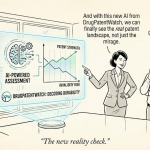
Consultants use a blend of traditional financial models and industry-specific methods, such as Risk-Adjusted Net Present Value (rNPV), to advise clients on deal-making and valuation.28 They synthesize IP, clinical, and market signals to provide an objective view of an asset’s inherent value.24 The use of AI-based predictive analytics can forecast deal values and the likelihood of a drug progressing to the next phase, which is far more accurate than conventional averages-based benchmarking.23 Their role is to provide a “reality check” for clients, ensuring that strategic decisions are based on objective, data-driven analysis rather than overly optimistic projections.27
Chapter 5: Illustrative Case Studies: Signals in Action
The Clinical Trial Rollercoaster
The high-stakes nature of the biotech industry is perhaps best illustrated by the extreme stock volatility that follows clinical trial readouts. The case of Cantab Pharmaceuticals is a stark example of this phenomenon.35 The company’s shares plunged 67% after its clinical trial failed to show its drug was better than a placebo.35 This outcome highlights the “unforgiving environment” of biotech investing, where the outcome of a single trial can make or destroy fortunes overnight, especially for companies with a narrow product base.35
Conversely, the immense alpha potential of early-stage success is exemplified by ProKidney (PROK), a stock that surged over 600% in a single week after releasing positive Phase 2 trial data.32 While this surge catapulted the company’s market cap to $2 billion, it also underscores the inherent risk; positive Phase 2 data is no guarantee of success in the final, definitive Phase 3 trial.32
The asymmetry of volatility is further demonstrated by the market’s reaction to vaccine trials during the COVID-19 pandemic. When Moderna announced positive Phase 1 data, its stock rose by 35%.34 In contrast, when
Pfizer announced positive Phase 3 data for its vaccine, its stock rose by a smaller 9.2%.34 This observation perfectly illustrates the concept that earlier-stage news for a small, single-asset company generates disproportionately higher percentage returns than late-stage news for a diversified mega-cap, for which a single trial’s outcome is absorbed by a broad product base.34
M&A Drivers and Thematic Deals
Mergers and acquisitions (M&A) in the biopharma sector are often driven by powerful alpha signals that predict a company’s strategic needs. A key driver is the patent cliff, which forces large pharmaceutical companies to “rejuvenate” their pipelines by acquiring smaller biotechs with promising assets.11
Pfizer’s Strategic Acquisition of Seagen: The $43 billion acquisition was motivated by Pfizer’s need to counter its looming patent cliffs for blockbuster drugs like Eliquis, Prevna, and Ibrance.11 Seagen’s pioneering expertise in Antibody-Drug Conjugates (ADCs) was a crucial alpha signal.42 This was not a single-asset deal but a strategic bet on a platform technology that could be leveraged to generate more than $10 billion in risk-adjusted revenues by 2030.42 The deal exemplifies how a platform company can become an irresistible M&A target due to its potential to create a diverse and resilient pipeline.
Merck’s Harpoon Deal: Facing the imminent loss of market exclusivity for its top-seller, Keytruda, in 2028, Merck acquired Harpoon Therapeutics for its lead candidate, HPN328.44 The 118% premium paid by Merck over Harpoon’s closing price was a strong signal of the urgency and value Merck placed on the asset and its bispecific antibody platform.44 This deal exemplifies how patent cliffs act as a powerful catalyst for M&A, forcing large players to seek inorganic growth to sustain revenue.12
J&J’s Intra-Cellular Acquisition: The $14.6 billion acquisition was driven by J&J’s clear strategic intent to strengthen its neuroscience portfolio.46 The alpha signals for this deal were clear: Intra-Cellular’s lead drug, CAPLYTA, had already received FDA approval for multiple indications and had a favorable safety profile.46 This acquisition was about leveraging J&J’s global distribution network to scale a proven asset and enhance its competitive position against rivals like Eli Lilly and Biogen.46
Table 3: M&A Deal Drivers: A Case Study Comparison
Acquirer
Target
Deal Value
Primary Alpha Signal(s)
Strategic Rationale
Pfizer
Seagen
$43 billion
Platform Technology: Seagen’s pioneering expertise in Antibody-Drug Conjugates (ADCs).42
Replenish pipeline to offset looming patent cliffs; gain a strategic platform for long-term growth in oncology.11
Merck
Harpoon Therapeutics
$680 million
Patent Cliff: Looming loss of market exclusivity for top-seller Keytruda.44
Acquire next-generation immunotherapy assets to sustain revenue growth and build a new pipeline for the post-Keytruda era.44
Johnson & Johnson
Intra-Cellular Therapies
$14.6 billion
FDA-Approved Asset: Intra-Cellular’s lead drug, CAPLYTA, was already approved and had a favorable profile.46
Strengthen and differentiate neuroscience portfolio; leverage J&J’s global scale to commercialize a proven asset and enhance market position.46
Chapter 6: The Limitations and Future of Alpha Intelligence
The Inherent Risks: Failure Rates, Hype Cycles, and Valuation Disconnects
Despite the power of alpha signals, the biotech sector is not without its inherent risks and limitations. The binary reality of drug development is a core feature of the market. Approximately 90% of drug candidates in clinical trials fail, primarily due to lack of efficacy or unmanageable toxicity.48 Even in the final, definitive Phase 3 trials, the failure rate remains around 50%.30 This high rate of failure means that even the most promising alpha signals cannot fully eliminate risk.28
Furthermore, the market is susceptible to “innovation hype-cycles” and periods of exuberance.49 Just as in other technology sectors, parts of the biotech market can become overvalued and disconnected from underlying fundamentals.21 A stock trading at 8x trailing revenue, for example, is highly vulnerable to market corrections, with historical precedent for catastrophic declines of 90% or more during periods of market stress.50 This valuation disconnect, where a company’s price-to-sales multiple is not justified by its revenue growth, creates a compelling case for caution.50
External, unpredictable events also act as massive alpha signals. The departure of a key FDA official, for instance, can send shares across the entire sector tumbling.25 Similarly, a change in government policy, such as the HHS decision to terminate $500 million in mRNA vaccine development, can effectively kill entire product lines and reshape the market landscape in an instant.16
The AI Frontier: From Data Aggregation to Predictive Modeling
The future of alpha intelligence lies in the seamless integration of AI and human expertise. AI-powered platforms can be used to monitor thousands of data sources in real-time, identifying subtle shifts that humans would overlook, such as minor deviations in clinical trial enrollment.9 These systems can autonomously source expert insights through live interviews and continuously learn from each new conversation to make the next one even smarter.40
However, this reliance on AI presents a challenge: the “black box” dilemma.6 To maintain a competitive advantage, firms are often reluctant to disclose their proprietary algorithms, which can create a lack of transparency and make it difficult to understand the basis for certain alpha forecasts.6 The solution lies in an “augmented intelligence” model, where powerful AI tools surface critical, real-time insights from disparate data sources, and human experts provide the strategic context and nuanced judgment needed to turn those insights into value.5
Conclusion
The era of simple, discretionary biotech investing has given way to a new paradigm. Success now belongs to those who view the industry not just through a financial lens but through a multi-layered, predictive framework. By treating every patent, every clinical trial update, and every corporate action as a potential “alpha signal,” professionals can gain an unprecedented competitive advantage. This requires a transition to an “augmented intelligence” model, where powerful AI tools surface critical, real-time insights from disparate data sources, and human experts provide the strategic context and nuanced judgment to turn those insights into value. Navigating the inherent risks of this high-stakes industry demands a playbook that is as sophisticated as the science itself.