In May 2023, the Supreme Court unanimously threw out two Amgen patents that, on their face, covered every antibody that could bind a 15-amino-acid stretch of a single protein and block it from doing its job. In October 2019, the Federal Circuit did something similar to a $2.54 billion jury verdict against Gilead Sciences. Both patents looked enormous. Both claimed to lock up entire classes of future drugs, not just the one product each patent holder had actually built. Neither survived a validity challenge under 35 U.S.C. § 112.[1][4]
That pattern repeats across pharmaceutical patent litigation more than the industry likes to admit. A portfolio’s size, its claim breadth, and its number of continuation patents are the metrics most often used to describe a drug’s intellectual property as “strong.” None of those metrics predicts whether a specific claim survives a validity challenge in front of a judge, a jury, or the Patent Trial and Appeal Board. This piece walks through four litigated cases and one widely cited patent thicket to show where the gap between portfolio size and courtroom survival actually sits, and what a more useful scoring framework looks like.
The Short Answer
Patent count, claim breadth, and continuation-family depth measure how much a company has filed, not how much of it will hold up. Across the four litigated disputes examined here, the patents facing a validity challenge on enablement, written description, or obviousness-type double patenting grounds survived exactly half the time: Amgen and Idenix lost their broadest claims, Allergan and Acadia kept theirs.[1][4][8][12] Separately, AbbVie’s widely cited 132-patent Humira estate was never tested to a U.S. verdict at all — every biosimilar maker that faced it settled rather than litigate — and in the one forum where a set of Humira patents actually went to trial, a Canadian federal court invalidated two of the three at issue.[15][18] Enforceability, not portfolio size, is the number that determines what a patent is actually worth in a fight.
What “Strong” Usually Means in Pharma Patent Strategy — And Why It Misleads
Ask a business development team to describe a drug’s intellectual property position and the answer usually comes back in three forms: how many patents cover it, how broad the claims are, and how far out the family extends. Each is easy to count. None of them measures what actually happens when a generic or biosimilar maker challenges the patent in court.
Patent Count as a Vanity Metric
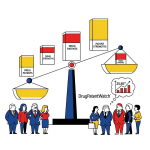
A patent count tells you how much prosecution work a company funded. It says nothing about which of those patents would survive a bench trial. Patent-intelligence platforms such as DrugPatentWatch track exactly this kind of data — how many patents and exclusivities cover a given drug, and when each one expires — and that data is genuinely useful for building a launch calendar. It is a different kind of analysis, though, from asking which of those listed patents would actually hold up if a challenger picked the single strongest invalidity argument and took it to judgment. AbbVie’s Humira portfolio, discussed in detail below, is the clearest illustration: a widely cited 132 granted patents, and zero adjudicated on the merits in the United States.[15][17]
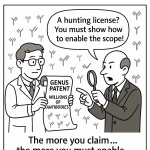
Claim Breadth: The Genus Trap
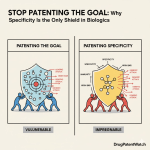
Broad claims look valuable because they block more competitors. A claim covering every antibody that binds a target epitope and achieves a functional result reads, on the page, as far more powerful than a claim tied to one specific amino acid sequence. Courts have increasingly treated that same breadth as a liability. Under the enablement requirement of Section 112(a), a specification has to teach a person skilled in the art how to make and use the full scope of what the claim covers, not just the handful of working examples the inventor actually built. The Supreme Court put it bluntly in Amgen: the more a patent claims, the more it has to enable.[1]
Family Depth and the Double-Patenting Blind Spot
Continuation patents are supposed to extend and reinforce a core invention. When those continuations pick up patent term adjustment on different schedules, they can end up with different expiration dates despite sharing a priority date and covering patentably indistinct subject matter. That mismatch is exactly what obviousness-type double patenting exists to police, and it is a risk that shows up only when someone actually maps a patent family’s filing dates, issue dates, and adjustment awards against each other — not when someone simply counts how many patents are in the family.[10][11]
Definitions: Enablement, Written Description, and Obviousness-Type Double Patenting
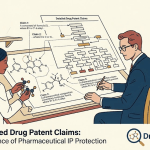
Three doctrines do most of the work in the cases below. Enablement, under 35 U.S.C. § 112(a), requires the patent specification to teach a skilled person how to make and use the full scope of the claimed invention without undue experimentation. Written description, also under Section 112(a), requires the specification to show that the inventor actually possessed the claimed invention as of the filing date, not merely that a skilled person could later figure out how to make it. Obviousness-type double patenting, or ODP, is a judge-made doctrine that prevents a patent owner from using a later, patentably indistinct patent to extend exclusivity beyond what the original invention earned — a rule aimed squarely at continuation families with staggered expiration dates.[1][4][11]
The Seven Findings That Matter
The Supreme Court unanimously invalidated Amgen’s Repatha genus patents in May 2023 for lack of enablement, even though the claims nominally covered millions of possible antibodies.[1][2]
A $2.54 billion jury verdict for Idenix against Gilead over the hepatitis C drug sofosbuvir was wiped out by the Federal Circuit in October 2019 on both enablement and written-description grounds — the largest patent verdict in U.S. history at the time it was later erased.[4][5]
AbbVie’s Humira patent estate, commonly cited as roughly 132 granted patents drawn from about 247 applications, was never tested to a U.S. verdict: every biosimilar maker that faced it chose settlement over litigating to judgment.[15][17]
In the one venue where a set of Humira patents was actually adjudicated — the Federal Court of Canada, in AbbVie Corp. v. JAMP Pharma Corp. (2023 FC 1520) — two of the three disputed patents were invalidated for obviousness.[18]
The Federal Circuit’s August 2023 In re Cellect decision opened the door to invalidating patent-term-adjusted claims through obviousness-type double patenting; its August 2024 Allergan v. MSN Laboratories decision partly closed that door for first-filed, first-issued parent patents.[9][8]
Acadia Pharmaceuticals’ Nuplazid composition patent survived an obviousness-type double patenting challenge in June 2025 by direct application of the Allergan rule, preserving pimavanserin composition-of-matter protection and a related formulation patent into 2038.[12][13]
Calculated: across the four litigated case studies examined here, patents facing an enablement, written-description, or ODP challenge survived exactly half the time — a two-out-of-four record that shows how binary and unpredictable enforceability outcomes are compared to what portfolio size alone would suggest.
Case Study: Amgen v. Sanofi — When “Millions of Antibodies” Became Zero Enforceable Claims
Amgen and Sanofi both built drugs that block a protein called PCSK9 from degrading LDL receptors, lowering LDL cholesterol as a result. Amgen’s version, Repatha (evolocumab), and Sanofi’s version, developed with Regeneron and marketed as Praluent (alirocumab), each use a distinct antibody with its own amino acid sequence. Both companies patented their specific antibodies in 2011 without dispute.[2]
The Genus Claim Amgen Actually Wrote
Amgen went further. In 2014 it obtained two continuation patents, U.S. Patent Nos. 8,829,165 and 8,859,741, that did not claim a specific antibody at all. Instead they claimed the entire genus of antibodies that bind a defined region of PCSK9 — a 15-amino-acid “sweet spot” out of the protein’s 692 total amino acids — and block it from binding to LDL receptors. The specification disclosed the amino acid sequences of 26 working antibodies. The claims, by contrast, covered a functional class the parties agreed could include millions of undisclosed antibodies.[2][3]
Two Trials, One Unanimous Reversal
Amgen sued Sanofi for infringement in 2014. A 2016 jury trial found the patents adequately enabled; the Federal Circuit vacated that verdict in 2017 and ordered a new trial after finding the district court had wrongly excluded post-priority-date evidence. A second jury, in 2019, again found the patents not invalid — but the district court overturned that finding as a matter of law, holding the claims not enabled. The Federal Circuit affirmed in 2021, finding “no reasonable factfinder” could conclude Amgen had enabled anything beyond its 26 disclosed examples.[2]
What Gorsuch’s Opinion Changed for Biologics
The Supreme Court affirmed unanimously on May 18, 2023. Justice Neil Gorsuch, writing for the Court, reduced the holding to a single line that has since become the standard citation for antibody-genus disputes:
“The more one claims, the more one must enable.”[3]
The ruling did not change the underlying enablement statute. It confirmed that functional genus claims — the same drafting strategy used across large swaths of the antibody-drug industry — face the identical full-scope enablement standard as any narrower claim, and that disclosing a “roadmap” or a handful of working examples is not enough when the claim covers a class that could run to millions of members.[1][3]
Timeline: Repatha’s Enablement Fight, 2014–2023
Date
Event
2011
Amgen and Sanofi each obtain patents on their own specific PCSK9 antibody
2014
Amgen obtains genus patents ‘165 and ‘741; sues Sanofi for infringement
2016
First jury trial finds claims not invalid; district court enters injunction
2017
Federal Circuit vacates injunction, orders new trial on enablement
2019
Second jury again finds claims not invalid; district court overturns as a matter of law
2021
Federal Circuit affirms invalidity for lack of enablement
May 18, 2023
Supreme Court unanimously affirms; genus claims invalid
Case Study: Idenix v. Gilead — The Verdict Enablement Erased
Four years before Amgen lost its genus claims, a nearly identical fact pattern played out in a hepatitis C dispute that produced, at the time, the largest patent damages verdict in U.S. history.
A Method Claim Covering Billions of Compounds
Idenix Pharmaceuticals, later acquired by Merck, held U.S. Patent No. 7,608,597, covering a method of treating hepatitis C by administering a class of modified nucleosides. The claim’s structural limitation — a purine or pyrimidine β-D-2′-methylribofuranosyl nucleoside — was, on undisputed evidence, satisfied by billions of possible compounds. Gilead’s blockbuster hepatitis C drugs Sovaldi and Harvoni use sofosbuvir, a compound with a fluorine substituent that falls within that structural definition. Gilead stipulated to infringement under the district court’s claim construction and instead fought the case entirely on validity.[4]
From Largest Verdict in Patent History to Zero
On December 15, 2016, after nine days of trial and less than two hours of deliberation, a Delaware jury awarded Idenix $2.54 billion, calculated as a 10 percent royalty on Gilead’s Sovaldi and Harvoni revenue.[5] Gilead moved for judgment as a matter of law. In February 2018, the district court agreed that no reasonable jury could have found the patent enabled, given that a skilled person would need to synthesize and test an enormous, largely unguided set of candidate compounds to practice the claim’s full scope. The Federal Circuit affirmed on enablement in October 2019 and went further, holding the patent also failed the written-description requirement — the specification never described Gilead’s specific fluorinated compound, so a jury could not reasonably have found Idenix possessed that embodiment as of its filing date. Chief Judge Prost authored the majority opinion; Judge Newman dissented, arguing the panel had substituted its own weighing of evidence for the jury’s.[4]
The Amgen Connection: A Genus-Claim Defender Becomes a Genus-Claim Casualty
The two cases are linked by more than doctrine. In February 2020, while Idenix’s petition for Federal Circuit rehearing was pending, Amgen filed an amicus brief supporting Idenix, warning that the panel’s enablement standard would “impede patent innovation in the medical field” and reduce Section 112 to “a pointless numbers game.”[7] Three years later, the same enablement standard Amgen defended in Idenix’s case invalidated Amgen’s own Repatha genus claims at the Supreme Court. The Supreme Court denied Idenix’s petition for certiorari in January 2021, leaving the Federal Circuit’s enablement standard for chemical and biologic genus claims intact and setting up the same doctrine that would later reach Amgen.[6]
Timeline: The ‘597 Patent’s Rise and Fall
Date
Event
2013
Idenix sues Gilead over the approaching launch of sofosbuvir (Sovaldi)
Dec. 15, 2016
Jury awards Idenix $2.54 billion; largest patent verdict in U.S. history at the time
Feb. 16, 2018
District court grants JMOL, holds patent invalid for lack of enablement
Federal Circuit affirms invalidity; adds written-description failure
Jan. 19, 2021
Supreme Court denies certiorari
May 18, 2023
Supreme Court applies the same enablement logic to invalidate Amgen’s own genus claims
Case Study: Allergan v. MSN Laboratories — How a Patent Almost Invalidated Its Own Parent
Not every enforceability threat comes from claiming too much. Sometimes it comes from a portfolio’s own internal architecture.
What Obviousness-Type Double Patenting Actually Prevents
Obviousness-type double patenting exists to stop a patent owner from stretching exclusivity past what a single invention earned, by obtaining a second patent on a patentably indistinct variant that happens to expire later. For most of patent history, courts compared issuance dates to catch this. Patent term adjustment, the automatic extension patents receive to compensate for United States Patent and Trademark Office prosecution delay, complicated that comparison: it can push one patent’s expiration date years past a sibling patent’s, even when both trace back to the same original application.[9][10]
In re Cellect’s Warning Shot
The Federal Circuit confronted that complication directly in In re Cellect, decided August 28, 2023. Cellect owned four patents on image sensor devices, all descended from a single original application, three of which received patent term adjustment while a fourth did not. Samsung persuaded the USPTO to reexamine the patents and argue that the three adjusted patents were obvious variants of the one that expired earliest. The Federal Circuit agreed: when evaluating obviousness-type double patenting, the relevant expiration date is the one that includes patent term adjustment, not the unadjusted 20-year term. Because the reference patent had already expired by the time of the appeal, Cellect could no longer file a terminal disclaimer to fix the problem, and all four patents were held invalid.[9] Cellect is not a pharmaceutical case, but its holding became the doctrinal foundation every drug patent litigator had to account for afterward, because pharmaceutical continuation families are exactly the kind of structure the ruling put at risk.
The Viberzi Family That Nearly Ate Its Own Term
Allergan’s U.S. Patent No. 7,741,356, the first-ever patent application covering eluxadoline — marketed as Viberzi for irritable bowel syndrome with diarrhea — was filed March 14, 2005, and issued June 22, 2010, after accumulating 1,107 days of patent term adjustment, of which Allergan disclaimed all but 467. Continuation applications claiming the same March 2005 priority date later issued as the ‘011 and ‘709 patents. Because those continuations moved through prosecution faster, they received no patent term adjustment and were set to expire earlier than the ‘356 parent. When Sun Pharmaceutical and MSN Laboratories filed an Abbreviated New Drug Application for generic eluxadoline, Allergan asserted the ‘356 patent, and the defendants argued — applying Cellect — that the ‘356 patent’s later, adjustment-extended expiration date made it invalid for obviousness-type double patenting over its own earlier-expiring children. In 2023, a Delaware bench trial agreed, invalidating claim 40 of the ‘356 patent along with the written-description basis of four related formulation patents.[8]
Why “First-Filed, First-Issued” Became a Safe Harbor
The Federal Circuit reversed on August 13, 2024. Writing for the panel, Judge Lourie held that Cellect answered a narrower question than the one this case actually presented: Cellect required courts to use the patent-term-adjusted expiration date in an ODP analysis, but it never addressed whether a later-filed, later-issued child patent could serve as a proper double-patenting reference against the first-filed, first-issued parent that spawned it. The panel held it could not. A first-filed, first-issued, later-expiring claim, the court reasoned, does not extend exclusivity beyond what the original invention earned merely because it received the patent term adjustment Congress intended it to receive; the child patents, not the parent, were the ones that arrived later. The same panel reversed the district court’s separate written-description findings against the four formulation patents as well, restoring Allergan’s full asserted portfolio.[8][10]
PTA vs. PTE: Why Courts Treat Them Differently
Patent term adjustment under 35 U.S.C. § 154(b) compensates for USPTO prosecution delay and is the extension at issue in Cellect and Allergan. Patent term extension under 35 U.S.C. § 156 is a separate mechanism that compensates for FDA regulatory review delay and is capped at five years per approved product. The Federal Circuit reached a patentee-friendly result for PTE years earlier, in Novartis AG v. Ezra Ventures LLC (2018), holding that obviousness-type double patenting cannot invalidate a patent whose only extension past a sibling patent comes from a validly granted Section 156 term extension for the multiple sclerosis drug Gilenya.[19] Cellect and Allergan address the PTA side of that same tension; together, the three cases mean a drug patent’s added term from FDA delay is on considerably firmer ground against an ODP challenge than added term from USPTO prosecution delay, unless the patent family’s filing sequence itself provides the kind of protection Allergan recognized.
Case Study: Acadia v. Aurobindo and MSN — Nuplazid Tests the New Rule
A Second Pharma Trial of the Same Doctrine
Acadia Pharmaceuticals’ Nuplazid (pimavanserin), the first FDA-approved treatment for hallucinations and delusions associated with Parkinson’s disease psychosis, faced its own obviousness-type double patenting challenge from MSN Laboratories, which filed an Abbreviated New Drug Application for a generic tartrate-salt version. Acadia’s foundational U.S. Patent No. 7,601,740 — filed January 15, 2004, issued October 13, 2009, and extended by 980 days of patent term adjustment plus a separate 1,315-day patent term extension for FDA review delay — was challenged as an obvious variant of Acadia’s own later-filed, no-adjustment U.S. Patent No. 9,566,271, which had already expired.[12]
What the Win Actually Preserved
The District of Delaware granted Acadia summary judgment of no invalidity in December 2023, and on June 9, 2025, the Federal Circuit affirmed by directly applying Allergan’s holding: a later-filed, later-issued, earlier-expiring sibling patent simply is not a proper double-patenting reference against a first-filed, first-issued parent, even one extended by both PTA and PTE.[12][13] The ruling preserved the ‘740 composition-of-matter patent’s protection, and Acadia separately secured a district court victory in May 2025 upholding a related formulation patent covering the 34-milligram capsule through 2038.[12]
Timeline: Nuplazid’s ODP Challenge, 2020–2025
Date
Event
July 2020
Acadia sues Aurobindo, MSN, Teva, Hetero, and Zydus over ANDA filings
2021–2023
Hetero and Zydus settle; MSN and Aurobindo litigation continues
Dec. 13, 2023
District court grants summary judgment of no invalidity for ODP
Jan. 2024
Final judgment entered; MSN appeals to the Federal Circuit
Aug. 13, 2024
Federal Circuit decides Allergan v. MSN, supplying the controlling rule
June 9, 2025
Federal Circuit affirms Acadia’s win by applying Allergan
Pending Question: The Acadia En Banc Petition
MSN sought rehearing en banc, and a separate August 2025 en banc petition in unrelated litigation has directly challenged the “first-issued safe harbor” the Allergan and Acadia panels created, arguing it lets two obvious, commonly owned patents coexist on different expiration schedules without the restrictions ODP was designed to impose.[14] Until the Federal Circuit resolves that challenge, the safe harbor established in Allergan remains the controlling law, but it is not yet a settled one.
What Humira’s 132-Patent Portfolio Actually Proves About Enforceability
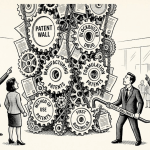
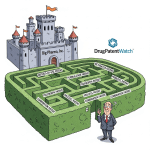
A Thicket That Survived Antitrust Review Without a Single U.S. Verdict
Humira (adalimumab) is the case most often cited when the phrase “patent thicket” comes up. AbbVie’s core adalimumab patent expired in 2016, but the company built a much larger estate around it: commonly cited figures put the total at roughly 247 patent applications filed, yielding about 132 granted patents, the last of which does not expire until 2034.[16][17] Ninety percent of those applications were filed after Humira’s 2002 FDA approval, and nearly half were filed in 2014 or later, as the core patent’s expiration approached.[17]
Every biosimilar maker that faced that estate — Amgen, Samsung Bioepis, Sandoz, Boehringer Ingelheim, Pfizer, Mylan, and others — settled rather than litigate a single Humira patent to a U.S. verdict, agreeing to enter the market on a staggered 2023 timeline in exchange for avoiding the cost and risk of fighting through dozens of asserted claims.[15][16] A group of Humira purchasers sued AbbVie under Sections 1 and 2 of the Sherman Act, arguing that the sheer number of patents functioned as an anticompetitive barrier regardless of any individual patent’s merit. The Seventh Circuit rejected that theory on August 1, 2022, framing the core question as: if AbbVie made 132 inventions, why can’t it hold 132 patents? The court found no antitrust violation in the settlements either, reasoning that AbbVie surrendered its monopoly on both continents before all of its patents expired and that no direct payment changed hands.[15][16]
What Happened When a Court Finally Looked: AbbVie v. JAMP Pharma
The Seventh Circuit’s ruling addressed whether holding many patents is illegal. It did not test whether those patents would individually survive a validity challenge, because none of the U.S. litigation ever reached that question. Canada’s Federal Court did reach it. In AbbVie Corporation and AbbVie Biotechnology Ltd v. JAMP Pharma Corporation (2023 FC 1520), a dispute over JAMP’s Simlandi adalimumab biosimilar, the court examined three specific Humira patents — CA 2,504,868, CA 2,801,917, and CA 2,904,458 — and invalidated the first two for obviousness while upholding the third and declining to grant an injunction.[18] Two of three, in the one proceeding where a Humira patent actually reached a merits decision, did not hold up.
Quantity as Leverage, Not as Proof
Put those two facts together and the lesson is not that Humira’s patents were weak. It is that nobody in the United States ever found out which of the 132 were strong, because none of AbbVie’s opponents chose to test more than a handful before settling, and the ones a court did test split roughly two-to-one toward invalidity. A patent thicket’s commercial value comes from the cost and delay of clearing it, not from a demonstrated record of surviving individual scrutiny. That distinction matters for anyone using patent counts to size up how defensible a competitor’s exclusivity really is — a portfolio that has never been tested carries a different kind of risk than one with a track record of surviving trial.
Illustrative Model: What a 132-Patent Portfolio Looks Like If Only a Third Survives Testing
The following is an illustrative calculation, not a reported finding about Humira specifically. If the roughly 2-of-3 invalidation rate observed in the JAMP Pharma litigation applied uniformly across a hypothetical 132-patent estate — which nothing in the public record suggests it does, since the Canadian case involved only three patents and a different legal standard than U.S. courts apply — a portfolio that size would be expected to yield somewhere near 44 enforceable patents rather than 132. The point of this exercise is not to estimate Humira’s real enforceable count, which is unknown and unknowable without individually litigating each claim. It is to illustrate, in concrete terms, how differently a portfolio’s value looks once a validity discount is applied instead of a raw count.
An Original Framework: Scoring Portfolios for Enforceability, Not Just Size
Four Categories of Enforceability Exposure
The four litigated cases above and the Humira thicket point to four distinct categories of enforceability risk, each requiring a different kind of diligence than simply counting patents.
Scope-to-disclosure mismatch. Claims that cover a broader genus, class, or functional definition than the specification’s working examples support. This is the exposure that sank Amgen’s and Idenix’s broadest claims and is most acute for antibody, small-molecule genus, and Markush-formula claims filed early in a drug’s development, before the full scope of active compounds is known.[1][4]
Family-architecture exposure. Continuation patents sharing a priority date but carrying different patent term adjustment awards, creating a mismatch between filing sequence and expiration sequence. This is the exposure Cellect exploited and that Allergan and Acadia partially, but not permanently, closed off.[8][9][12]
Thicket and antitrust exposure. Not an invalidity risk in the traditional sense, but a strategic and increasingly regulatory one: large numbers of overlapping patents invite scrutiny from the FTC, from Congress, and from purchaser class actions, even when courts have so far declined to treat sheer numerosity as unlawful on its own.[15]
Untested exposure. Patents that have never faced a validity challenge because every prior dispute settled. This is the largest and least visible category, since it covers the majority of every major drug’s listed patent estate, and it means the portfolio’s true enforceability is simply unknown until the first party willing to litigate through judgment shows up.
Reading This Framework Alongside DrugPatentWatch Data
Patent-count and expiration-date data of the kind tracked by DrugPatentWatch and similar platforms answers the first question anyone building a launch or diligence timeline needs answered: what is listed, and when does it expire. It does not, on its own, answer the second question: which of those listings would survive a scope-to-disclosure challenge, a family-architecture challenge, or simply the first real trial. Combining expiration-date tracking with the four-category framework above turns a list of patents into a ranked list of litigation risk.
How to Read a Patent Family Chart for ODP Risk
The specific pattern to look for, based on Cellect, Allergan, and Acadia, is a continuation family where one member — typically the first-filed application — carries meaningfully more patent term adjustment than its siblings, and where the family’s claims cover patentably similar subject matter without a terminal disclaimer tying their expiration dates together. If the first-filed, first-issued member is the one with the longer term, Allergan’s safe harbor currently protects it. If a later-filed, later-issued member ends up with the longer term through some other combination of prosecution delay, that fact pattern has not yet been tested under the current rule and carries meaningfully more risk.[8][14]
Methodology and Limitations of This Analysis
The four case studies were selected because each produced a precedential or otherwise citable Federal Circuit or Supreme Court decision squarely addressing enablement, written description, or obviousness-type double patenting for a marketed drug, decided between 2019 and 2025. The Humira thicket was included as a contrasting example because it is the most frequently cited “strong IP” portfolio in pharmaceutical patent commentary and because a foreign court’s decision on a subset of its patents provides a rare data point on tested, rather than merely asserted, validity. The calculated two-of-four survival rate and the illustrative 44-patent estimate are original calculations by the authors, based on the litigated outcomes and the Canadian invalidation ratio described above; they are not reported statistics from any cited source and should not be read as predictions about any specific portfolio’s true enforceable count. A meaningful limitation of this analysis is sample size: four litigated cases and one three-patent foreign proceeding are far too few to support a general base rate for how often pharmaceutical patents survive validity challenges across the industry, and the cases here were chosen for their doctrinal significance rather than through random sampling.
Drug Patent Enforceability Timeline, 2016–2026
Drug
Company
Doctrine at Issue
Court
Decision Date
Outcome
Repatha (evolocumab)
Amgen
Enablement
U.S. Supreme Court
May 18, 2023
Patents invalidated
Sovaldi / Harvoni (sofosbuvir)
Idenix (Merck)
Enablement; written description
Federal Circuit
Oct. 30, 2019
Patent invalidated; $2.54B verdict vacated
Image sensor devices (non-pharma)
Cellect LLC
Obviousness-type double patenting
Federal Circuit
Aug. 28, 2023
Patents invalidated
Viberzi (eluxadoline)
Allergan / Janssen
Obviousness-type double patenting; written description
Federal Circuit
Aug. 13, 2024
Patents upheld (reversed)
Nuplazid (pimavanserin)
Acadia
Obviousness-type double patenting
Federal Circuit
June 9, 2025
Patent upheld
Humira (adalimumab), U.S.
AbbVie
Antitrust (Sherman Act §§1–2)
Seventh Circuit
Aug. 1, 2022
Thicket and settlements upheld; patents never tested on merits
Humira (adalimumab), Canada
AbbVie
Obviousness
Federal Court of Canada
2023
2 of 3 patents invalidated
What This Means for Brand Manufacturers
A portfolio built primarily to maximize patent count invites exactly the kind of scope-to-disclosure and family-architecture scrutiny that sank Amgen’s and Idenix’s broadest claims. Filing genus claims that outrun the specification’s disclosed working examples produces patents that look formidable in a licensing negotiation and collapse the moment a well-funded challenger takes the enablement question to trial.[1][4] Continuation strategy deserves the same scrutiny: a family where the most valuable, longest-term member is not the first-filed, first-issued patent sits outside the safe harbor Allergan and Acadia currently provide, and depends on a legal rule that is itself under active en banc challenge.[8][12][14]
Before You Rely on Patent Count in Diligence
For licensing, acquisition, or investment diligence, the practical takeaway is to ask a different question than “how many patents cover this asset.” The more useful questions are which claims have actually faced a validity challenge, what doctrine that challenge invoked, and where the family’s expiration-date architecture would place it under Cellect and Allergan if a later challenger tried the same argument that took down Viberzi’s parent patent in the district court, before the Federal Circuit reversed.[8][9]
Terminal Disclaimers: The Fix Courts Keep Pointing To
Every court that has addressed obviousness-type double patenting in this line of cases has pointed to the same fix: a terminal disclaimer tying a later-expiring family member’s term to an earlier-expiring sibling’s, filed before the reference patent expires. Cellect could no longer use one because its reference patent had already expired by the time of the appeal. Allergan and Acadia avoided the problem by winning on the underlying legal question instead, but that safe harbor’s durability is not guaranteed, which makes proactive terminal disclaimer review of continuation families cheaper insurance than litigating the same question after a challenger has already filed an Abbreviated New Drug Application.[9][10]
What This Means for Generic and Biosimilar Challengers
The same four cases cut the other way for challengers deciding which patents are worth fighting rather than settling around. A genus claim built on a small number of disclosed working examples relative to its claimed scope is the single most exploitable pattern in this dataset — it is exactly what invalidated both Amgen’s and Idenix’s broadest claims, and it is a pattern that shows up across antibody and small-molecule genus claims well beyond the two drugs discussed here.[1][4] Obviousness-type double patenting, by contrast, has become a considerably narrower tool since August 2024: a challenge built on a later-filed, later-issued sibling patent against a first-filed, first-issued parent will currently lose under Allergan and Acadia, absent a successful en banc reversal of that rule.[8][12][14] And the Humira record is a reminder that patent count alone says nothing about litigation risk — the rational response to a numerically large but individually untested thicket is not automatic settlement, but a search for the specific claims most exposed under the scope-to-disclosure or family-architecture categories described above.
FAQ
What is the difference between “strong” and “enforceable” pharmaceutical IP?
“Strong” typically describes a portfolio’s size, claim breadth, or family depth. “Enforceable” describes whether specific claims actually survive a validity challenge in litigation. The two frequently diverge, as shown by Amgen’s and Idenix’s broad genus patents, both of which were invalidated despite covering enormous claim scope.[1][4]
What does patent enablement mean under 35 U.S.C. § 112(a)?
Enablement requires a patent specification to teach a person skilled in the relevant field how to make and use the full scope of what the claim covers, without undue experimentation. A claim covering a broad genus needs a specification that supports that entire genus, not just the specific examples the inventor built and tested.[1]
Why did the Supreme Court invalidate Amgen’s Repatha patents?
The Court found that Amgen’s genus claims, which covered potentially millions of PCSK9-binding antibodies, were not enabled by a specification that disclosed only 26 working examples and two general discovery methods. The unanimous decision, authored by Justice Gorsuch, held that the broader a claim, the more the specification must teach.[1][2][3]
What happened to the $2.54 billion Idenix v. Gilead verdict?
A Delaware jury awarded Idenix $2.54 billion in December 2016 over Gilead’s hepatitis C drugs Sovaldi and Harvoni. The district court overturned the verdict in 2018 for lack of enablement, and the Federal Circuit affirmed in 2019, adding a separate written-description failure. The Supreme Court denied review in January 2021, leaving the invalidation final.[4][5][6]
What is obviousness-type double patenting and why does it matter for drug patents?
Obviousness-type double patenting is a judge-made doctrine preventing a patent owner from using a second, patentably indistinct patent to extend exclusivity beyond what the original invention earned. It matters for pharmaceutical continuation families because patent term adjustment can give a later continuation a different expiration date than its parent, even though both stem from the same priority application.[9][10]
How did In re Cellect change patent term adjustment strategy?
The August 2023 Cellect decision held that, when evaluating obviousness-type double patenting, courts must use a patent’s expiration date after adding patent term adjustment, not the unadjusted 20-year term. That made continuation families with staggered adjustment awards newly vulnerable to double-patenting challenges unless protected by a timely terminal disclaimer.[9]
Did Allergan v. MSN Laboratories overturn In re Cellect?
No. The Federal Circuit in Allergan distinguished rather than overturned Cellect, holding that Cellect only controlled which expiration date to use in an ODP analysis, not whether a later-filed, later-issued sibling patent could serve as a valid reference against a first-filed, first-issued parent. The panel held it could not, protecting parent patents in that specific configuration.[8][10]
How many patents does AbbVie hold on Humira, and were they ever tested in court?
Commonly cited figures put AbbVie’s Humira estate at roughly 132 granted patents from about 247 applications. No U.S. court has ever adjudicated the validity of a Humira patent on the merits; every biosimilar maker that challenged the estate settled before trial.[15][16][17]
What happened when a Humira patent was actually litigated to a verdict?
In Canada, where AbbVie sued JAMP Pharma over its Simlandi biosimilar, the Federal Court examined three Humira patents and invalidated two of them for obviousness in a 2023 decision, upholding only the third.[18]
How can pharmaceutical companies build genuinely enforceable patent portfolios instead of just large ones?
Match claim scope to what the specification actually discloses and supports, review continuation families for patent-term-adjustment mismatches and file terminal disclaimers proactively where warranted, and treat a portfolio’s litigation record — not its patent count — as the real measure of its strength when making licensing, valuation, or freedom-to-operate decisions.[1][9][10]
Key Takeaways
The Supreme Court unanimously invalidated Amgen’s Repatha genus patents in May 2023 for lack of enablement, despite claims covering millions of potential antibodies.[1]
A $2.54 billion jury verdict against Gilead was fully reversed by 2019 on enablement and written-description grounds, and Amgen itself had defended the same broad-genus drafting strategy in an amicus brief three years before losing on identical grounds.[4][7]
In re Cellect (2023) made patent-term-adjusted continuation patents newly vulnerable to double-patenting challenges; Allergan v. MSN Laboratories (2024) and Acadia v. Aurobindo (2025) partly restored protection for first-filed, first-issued parent patents, though that rule faces an active en banc challenge.[8][9][12][14]
AbbVie’s widely cited 132-patent Humira estate was never tested to a U.S. verdict; in the one court that did adjudicate a set of Humira patents on the merits, two of three were invalidated.[15][18]
Across the four litigated case studies examined here, patents challenged on enablement, written-description, or double-patenting grounds survived exactly half the time, underscoring that portfolio size and courtroom survival are separate metrics.
References
Amgen Inc. v. Sanofi, 598 U.S. 594 (2023). Supreme Court of the United States. https://www.supremecourt.gov/opinions/22pdf/21-757_k5g1.pdf
Amgen Inc. v. Sanofi. (2023). Justia U.S. Supreme Court Center. https://supreme.justia.com/cases/federal/us/598/21-757/
Newman, C. (2023, May 18). Supreme Court sides with Sanofi, Regeneron in patent fight with Amgen. BioPharma Dive. https://www.biopharmadive.com/news/amgen-regeneron-supreme-court-decision-patents-pcsk9-antibodies/650641/
Jones Day. (n.d.). Idenix wins $2.54 billion jury verdict in Gilead patent dispute involving hepatitis C drugs. https://www.jonesday.com/en/practices/experience/2018/09/idenix-wins-254-billion-jury-verdict-in-gilead-patent-dispute-involving-hepatitis-c-drugs
Oblon, McClelland, Maier & Neustadt LLP. (2021, February 12). Supreme Court declines to hear Idenix case: Dispute surrounding the enablement standard for biotechnology patents continues. https://www.oblon.com/supreme-court-declines-to-hear-idenix-case-dispute-surrounding-the-enablement-standard-for-biotechnology-patents-continues
Sterne Kessler. (2020, February 3). Amgen asks Fed. Circ. to review Merck’s $2.5B patent loss. https://www.sternekessler.com/news-insights/news/amgen-asks-fed-circ-review-mercks-25b-patent-loss/
Allergan USA, Inc. v. MSN Laboratories Private Ltd., 111 F.4th 1358 (Fed. Cir. 2024). Justia. https://law.justia.com/cases/federal/appellate-courts/cafc/24-1061/24-1061-2024-08-13.html
Mintz. (2023, September 7). Federal Circuit puts the onus on patent owners to disclaim patent term or face double-patenting. https://www.mintz.com/insights-center/viewpoints/2231/2023-09-07-federal-circuit-puts-onus-patent-owners-disclaim-patent
Arnold & Porter. (2024, August 29). Federal Circuit clarifies obviousness-type double patenting rule. https://www.arnoldporter.com/en/perspectives/advisories/2024/08/federal-circuit-clarifies-odp-rule
Gibson Dunn. (2024, August 20). Federal Circuit decision in Allergan v. MSN. https://www.gibsondunn.com/federal-circuit-decision-in-allergan-v-msn/
Acadia Pharmaceuticals Inc. (2025, June 9). U.S. Court of Appeals for the Federal Circuit affirms prior Delaware District Court rulings in favor of Acadia in NUPLAZID (pimavanserin) composition of matter patent. https://ir.acadia.com/news-releases/news-release-details/us-court-appeals-federal-circuit-affirms-prior-delaware-district
Haug Partners. (2025, June 27). Federal Circuit provides further guidance on obvious type double patenting for patents sharing common priority. https://haugpartners.com/article/federal-circuit-provides-further-guidance-on-obvious-type-double-patenting-for-patents-sharing-common-priority/
Crouch, D. (2025, August 21). Obviousness-type double patenting: Challenging the Allergan first-issued safe harbor. Patently-O. https://patentlyo.com/patent/2025/08/obviousness-patenting-challenging.html
UFCW Local 1500 Welfare Fund v. AbbVie Inc. (7th Cir. Aug. 1, 2022). Bloomberg Law. https://news.bloomberglaw.com/ip-law/abbvie-beats-antitrust-challenge-to-humira-patent-settlements
Bristows. (2022, August 8). What’s wrong with having lots of patents? Humira ‘patent thicket’ survives antitrust challenge. https://www.bristows.com/news/whats-wrong-with-having-lots-of-patents-humira-patent-thicket-survives-antitrust-challenge/
Knox, R., & Curfman, G. (2022). The Humira patent thicket, the Noerr-Pennington doctrine, and antitrust’s patent problem. SSRN. https://papers.ssrn.com/sol3/papers.cfm?abstract_id=4215822
Gowling WLG. (2024, January 18). Federal Court clarifies validity and evidence-related legal principles, and declines to grant injunction for infringed patent in HUMIRA decision. https://gowlingwlg.com/en/insights-resources/articles/2024/federal-court-clarifies-humira-decision
Novartis AG v. Ezra Ventures LLC, 909 F.3d 1367 (Fed. Cir. 2018). Justia. https://law.justia.com/cases/federal/appellate-courts/cafc/17-2284/17-2284-2018-12-07.html
Association for Accessible Medicines. (2025, June 4). Patent settlements are necessary to help combat patent thickets. https://accessiblemeds.org/resources/blog/patent-settlements-are-necessary-to-help-combat-patent-thickets/