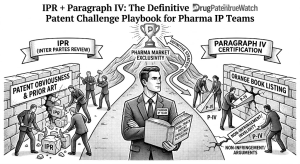
Pharmaceutical patent litigation has always been expensive and slow. What changed after the America Invents Act of 2011 is that generic manufacturers gained a genuinely fast administrative route to invalidity: inter partes review at the Patent Trial and Appeal Board. The problem is that generic filers also carry a strict statutory countdown the moment they file an ANDA with a Paragraph IV certification. Those two clocks rarely align.
The result is that roughly 90.4% of Orange Book-listed patents now face both a district court challenge under Hatch-Waxman and an IPR petition. Running those proceedings in parallel, rather than sequentially, is no longer a niche tactic. It is the default posture for any serious generic or biosimilar entrant, and it has become the primary IP risk event that innovator portfolio managers model before an asset reaches its exclusivity cliff.
The stakes are concrete. A successful Paragraph IV certification followed by a first-filer 180-day exclusivity period on a blockbuster small molecule can be worth $400 million to $1.5 billion in net revenue to the generic entrant, depending on the branded drug’s annual sales and the competitive launch landscape. Layer an IPR that invalidates even one formulation patent from an innovator’s cluster, and the royalty-bearing settlement that the innovator might otherwise extract disappears entirely. Running these two proceedings without coordinating them precisely is one of the costlier mistakes a generic IP team can make.
This guide covers the full tactical and legal architecture of parallel IPR/Paragraph IV proceedings, from the moment a Paragraph IV notice letter lands to the post-institution estoppel mechanics that constrain litigation arguments for years.
IPR Mechanics: What Every ANDA Filer Needs to Know Cold
The Basic IPR Framework
An IPR is an adversarial proceeding before the PTAB in which a petitioner challenges a granted U.S. patent on grounds of anticipation or obviousness under 35 U.S.C. sections 102 and 103, relying exclusively on patents and printed publications as prior art. The petitioner files a petition, the patent owner responds, and the PTAB decides within three months whether to institute the review. If instituted, the proceeding runs approximately 12 months to a final written decision, with an appeal path to the Federal Circuit.
The evidentiary standard is preponderance of the evidence, which is materially lower than the clear-and-convincing standard required to prove invalidity in district court. That gap explains most of IPR’s attractiveness in pharmaceutical litigation: prior art that cannot definitively carry a clear-and-convincing burden in front of a jury may still be sufficient to invalidate a claim at the PTAB.
Estoppel: The Double-Edged Consequence
IPR estoppel is the structural feature that makes parallel proceedings genuinely complex rather than simply expensive. Under 35 U.S.C. section 315(e)(2), a petitioner who receives a final written decision from the PTAB cannot raise in district court any ground it raised, or reasonably could have raised, during the IPR. The phrase ‘reasonably could have raised’ is interpreted broadly by most courts. It reaches prior art that the petitioner knew about but chose not to include in its petition.
The practical consequence: an ANDA filer that files a broad IPR petition, reaches a final written decision, and then loses on certain claims faces estoppel in the parallel district court litigation for any prior art it had access to at petition time. This is why petition drafting in pharmaceutical IPRs requires a deliberate choice about scope. Petitioning broadly maximizes invalidity arguments at the PTAB but potentially narrows the litigant’s options in court if the PTAB doesn’t kill every claim. Petitioning narrowly preserves district court flexibility but risks an IPR win that covers only a subset of the asserted claims.
The Pharmaceutical IPR Outcome Record
IPR institution rates across all technology areas have hovered around 60-65% of filed petitions over the past several years. Pharmaceutical patents, particularly those covering formulations, dosing regimens, and metabolite compositions, have faced somewhat higher denial rates at the institution stage because PTAB panels apply Fintiv analysis to the calendar proximity of Hatch-Waxman trial dates. Among instituted pharmaceutical IPRs, final written decisions that cancel all challenged claims occur in roughly 40-50% of cases. Partial cancellations, where some claims survive, occur in another 20-25%. The residual 25-30% of instituted cases result in all challenged claims surviving.
IP Valuation Dimension: How an IPR Filing Moves Asset Value
When an IPR petition is filed against a drug patent, the market immediately prices in the probability of invalidation. For a patent covering a drug with $2 billion in annual U.S. sales and a nominal expiry of 2031, the royalty-bearing revenue at risk across the remaining term may be $6-8 billion in present value terms. An IPR with a 50% estimated probability of full invalidation discounts that IP asset by $3-4 billion in expected value, net of any market share the innovator retains post-generic entry.
IP teams and portfolio managers should build IPR petition filing dates into their patent estate models as explicit event triggers, not trailing indicators. The filing date, not the institution date, is the moment at which estoppel risk begins accumulating and at which the innovator’s litigation settlement calculus shifts.
Paragraph IV Mechanics: The 30-Month Stay Clock and Its Consequences
How a Paragraph IV Certification Works
Under the Hatch-Waxman Act (codified at 21 U.S.C. section 355(j)), an ANDA applicant seeking to market a drug before expiration of an Orange Book-listed patent must certify one of four positions. A Paragraph IV certification states that the listed patent is invalid, unenforceable, or will not be infringed by the proposed generic. Filing that certification is a statutory act of patent infringement, which allows the innovator to sue immediately rather than wait for commercial launch.
The innovator has 45 days from receipt of the notice letter to file suit. If it files within that window, a 30-month stay on FDA approval automatically takes effect, running from the date of the original NDA holder’s receipt of the Paragraph IV notice letter. During that stay, FDA cannot grant final approval to the ANDA. The stay expires at 30 months, when a court rules on the merits (whichever comes first), or when the litigation settles.
The first ANDA filer to submit a Paragraph IV certification earns a 180-day exclusivity period that blocks all subsequent ANDA filers from obtaining final approval until that exclusivity runs. On a major branded drug, that 180-day head start on generic competition is the central economic prize around which all parallel IPR strategy is constructed.
The 30-Month Stay as a Litigation Timeline Anchor
The 30-month stay is effectively a hard deadline. Hatch-Waxman cases in the District of Delaware (the most common venue) typically go to trial in 24-30 months. In faster districts, such as the Western District of Texas before the judicial assignment rules changed, cases sometimes concluded in 18-24 months. The PTAB’s 18-month IPR timeline (12 months from institution plus the 6-month pre-institution period) means that in most cases, the district court trial concludes before or concurrent with the PTAB’s final written decision. That is the central timing problem of parallel proceedings.
Orange Book Gaming and Patent Listing Strategy
Innovators list patents in the Orange Book to trigger Paragraph IV certifications and the associated 30-month stays. The scope of listable patents has been contested for years. The Orange Book Transparency Act and subsequent FDA rulemaking have narrowed which patents can be listed, targeting device patents for combination products and patents covering processes rather than the approved drug itself. Each patent the innovator successfully lists is another 30-month clock the generic must endure, or another IPR target the generic can file. That asymmetry drives the escalatory patent listing behavior seen in high-revenue drugs like AbbVie’s adalimumab (Humira) and Novo Nordisk’s semaglutide products.
Key Takeaways: IPR and Paragraph IV Fundamentals
The preponderance of evidence standard at PTAB is genuinely lower than clear-and-convincing in district court; don’t treat them as equivalent legal thresholds.
Estoppel under section 315(e)(2) reaches prior art the petitioner ‘reasonably could have raised,’ which most courts interpret to cover art the petitioner had access to at petition time.
The 30-month stay runs from the innovator’s receipt of the notice letter, not from suit filing, meaning some ANDA filers underestimate how much calendar time is already spent before a PTAB petition is even drafted.
Orange Book patent cluster size directly determines the number of IPR filings a generic entrant must budget for and the corresponding duration of litigation risk exposure.
The Procedural Collision: Where IPR and Hatch-Waxman Crash Into Each Other
The Core Timing Problem
A generic manufacturer that files its ANDA and issues a Paragraph IV notice letter typically has 45 days to absorb the innovator’s lawsuit before the 30-month clock starts. If the generic wants to file an IPR, it must do so within one year of being served with the complaint, per 35 U.S.C. section 315(b). In practice, IPR petitions in pharmaceutical cases are usually filed 8-11 months after service, after counsel has had time to locate prior art, engage technical experts, and draft claims charts. That leaves 7-10 months of the 30-month stay period remaining when the IPR petition is filed.
The PTAB then takes up to 6 months to decide whether to institute. If instituted, the 12-month PTAB trial period puts the final written decision at roughly 18-24 months after petition filing, meaning 26-34 months after the Paragraph IV notice. In many cases, the Hatch-Waxman trial concludes at month 28-30, generating a judgment before the PTAB delivers its final written decision. The PTAB ruling, if favorable to the generic, then becomes relevant only for appeal or for subsequently filed ANDAs not covered by first-filer exclusivity.
Stays: Why Courts Almost Never Grant Them
District courts have discretion to stay Hatch-Waxman litigation pending IPR institution or outcome. They almost never do. Courts apply a four-factor test that considers whether a stay would simplify issues, the stage of the case, whether a stay would cause undue prejudice to the patentee, and the strength of the invalidity challenge. The undue prejudice factor reliably weighs against stays in Hatch-Waxman cases because the 30-month clock is running, public access to generic drugs is implicated, and the innovator’s market exclusivity is time-limited in a way that creates genuine harm from delay. Courts in Delaware have been explicit that the congressional policy embedded in Hatch-Waxman’s 30-month stay reflects a legislative judgment about timing that federal courts should respect rather than extend.
Parallel Discovery and Its Cost Multiplication Effect
Running parallel PTAB and district court proceedings means parallel expert retention, parallel claim construction, and parallel depositions of inventors and prior art witnesses. PTAB claim construction uses the Phillips standard (same as district court after the 2018 shift from broadest reasonable interpretation), which reduces some of the inconsistency risk but does not eliminate it. Innovators sometimes obtain favorable claim constructions in district court that complicate the petitioner’s invalidity theory at the PTAB, or vice versa. IP teams should document their claim construction positions carefully across both forums and ensure that PTAB arguments cannot be used as admissions against interest in district court.
Fintiv and Discretionary Denial: The PTAB’s Power to Kill Your Petition Before Institution
The NHK Spring/Fintiv Doctrine
The PTAB’s authority to deny institution as a matter of discretion is rooted in 35 U.S.C. section 314(a), which says the Director ‘may not authorize an inter partes review to be instituted’ unless certain thresholds are met, but gives no affirmative obligation to institute even when they are. The PTAB expanded this into a doctrine of discretionary denial in NHK Spring Co. v. Intri-Plex Technologies (2018) and Apple Inc. v. Fintiv (2020). Fintiv formalized six factors that the PTAB balances when deciding whether to exercise that discretion:
The first factor asks whether the district court has issued or is likely to issue a stay pending IPR. The second considers the proximity of the trial date to the expected PTAB institution decision or final written decision. The third evaluates the investment each party and the court has made in the parallel proceeding. The fourth looks at overlap between IPR grounds and litigation invalidity contentions. The fifth considers the relationship between the petitioner and defendant (whether they are the same party). The sixth factor is a catch-all for other circumstances bearing on efficiency and fairness.
In pharmaceutical cases, factor two is usually dispositive. When the Hatch-Waxman trial date is set within 12 months of the expected PTAB final written decision, PTAB panels regularly deny institution on Fintiv grounds without reaching the merits of the invalidity arguments. This means that a generic manufacturer’s timing error in petition filing, or a district court scheduling order that sets an aggressive trial date, can kill an IPR before the substantive prior art analysis ever begins.
Pharmaceutical-Specific Fintiv Outcomes
Empirical data from PTAB decisions between 2020 and 2024 shows that Fintiv-based denials in pharmaceutical IPRs cluster around cases where the trial date is set within 8-14 months of the expected final written decision. When petitioners have provided Sotera-style stipulations (discussed below), institution rates rebound significantly even when trial dates are proximate. Without a stipulation, trial dates within 8 months of the expected final written decision result in denial in the majority of cases.
Practitioners should build this analysis into petition filing decisions by obtaining the district court’s scheduling order, calculating the expected trial date, back-calculating the expected PTAB final written decision date from the planned petition filing, and running the differential. If that window is less than 12 months, a Sotera stipulation is not optional.
The Director Review Safety Valve
Post-Arthrex, the USPTO Director has independent authority to review and modify PTAB institution decisions. The Vidal-era interim guidance in June 2022 instructed PTAB panels to give weight to certain public interest considerations, including cases involving pharmaceutical patents where generic access is at issue. Whether this guidance meaningfully reduces Fintiv-based denials on meritorious petitions remains contested. Director Review petitions (formerly called Director Rehearing) take time and do not toll the statutory deadlines, so they are not a reliable substitute for filing a clean petition with a Sotera stipulation.
Key Takeaways: Fintiv
Fintiv-based denial is a merits-bypass mechanism. A PTAB panel can kill a petition with strong prior art if the trial date is too close to the expected final written decision without ever evaluating the art.
Factor two (trial date proximity) dominates the analysis in pharmaceutical cases. Factor four (argument overlap) is the second most frequently cited basis for denial.
Sotera stipulations substantially reduce Fintiv risk but require counsel to commit to not raising overlapping grounds in district court, which has estoppel-adjacent consequences that must be modeled before the stipulation is made.
The ITC exemption from Fintiv (see section below) creates a structural alternative for petitioners who cannot avoid trial date proximity in district court.
Sotera Stipulations: The Only Reliable Escape Valve
What the Sotera Stipulation Actually Says
The Sotera stipulation takes its name from Sotera Wireless, Inc. v. Masimo Corp., IPR2020-01019, where the PTAB declined to deny institution based on Fintiv factors after the petitioner stipulated that it would not pursue in district court litigation any ground it raised or reasonably could have raised in the IPR. The PTAB held that this stipulation substantially mitigated the efficiency concerns underlying Fintiv because it eliminated the risk of duplicative proceedings.
The key language in a Sotera-conforming stipulation is that the petitioner agrees not to assert in district court any invalidity ground that it raised, or that it reasonably could have raised, in the IPR petition. The word ‘reasonably’ is critical. Some petitioners have attempted narrower stipulations, agreeing only not to use grounds actually raised in the petition. PTAB panels have consistently given those narrower formulations less weight than full Sotera stipulations.
The Strategic Cost of a Sotera Stipulation
A full Sotera stipulation is functionally an advance waiver of the right to assert prior art-based invalidity in district court for the art within the IPR’s scope. For pharmaceutical small molecules where the primary invalidity arguments are anticipation or obviousness based on synthesis papers, clinical studies, or conference abstracts, this waiver can be substantial. If the PTAB ultimately issues an adverse final written decision, the petitioner heads into district court trial unable to use prior art it identified during IPR preparation.
IP teams should run a parallel assessment: what prior art is strong enough to go to the PTAB on, and what prior art should be held back for district court in case the PTAB proceeding fails? That segregation requires careful privilege management, because IPR petitions become public documents and innovators read them closely for signals about what the generic’s litigation strategy will emphasize.
Partial Stipulations and Their PTAB Reception
Some petitioners have attempted partial Sotera stipulations, committing not to raise particular prior art references rather than all prior art. PTAB panels evaluate partial stipulations under Fintiv factor four rather than as a complete Fintiv override. Partial stipulations reduce but do not eliminate the risk of discretionary denial. In cases where trial dates are very proximate (within 6 months of expected final written decision), even a partial stipulation may be insufficient without additional distinguishing circumstances.
Multiple Petition Strategy: When It Works and When It Blows Up
The General Plastic Framework
The PTAB uses the General Plastic Industrial Co. v. Canon Kabushiki Kaisha framework to evaluate serial petitions (successive petitions by the same petitioner against the same patent). The framework considers seven factors, centered on whether the petitioner had access to the same prior art when filing the earlier petition, whether the petitioner offers a satisfactory explanation for not including the grounds earlier, the relationship between the petitions, and the extent to which the PTAB has already invested resources in the challenged patent.
Parallel petitions (two petitions filed simultaneously against the same patent) face a separate but related analysis. The PTAB permits parallel petitions only when a petitioner shows ‘good cause,’ which in practice requires demonstrating that the patent’s claim set is so large or complex that a single petition cannot reasonably address all claims within the page limits.
The Pharmaceutical Large Claim Set Exception
Innovator pharmaceutical patents, particularly those covering formulation families with multiple dependent claims, sometimes exceed 50 claims. PTAB panels have occasionally permitted parallel petitions in those cases, though the institution rate drops materially. The PTAB has denied parallel petitions in cases including Masimo Corp. v. Apple Inc. where claim overlap was found sufficient for a single petition.
USPTO data through 2023 shows that serial petition institution rates sit at approximately 0.6%, reflecting how rarely the PTAB concludes that a second petition raises genuinely distinct grounds that could not have been raised in the first petition. For pharmaceutical cases specifically, the fraction is comparable. Serial petitions are effectively last-resort instruments, used when new prior art emerges post-institution or when a final written decision leaves open claims that a supplemental petition might address.
Joinder as an Alternative to Serial Petitions
When a co-defendant in Hatch-Waxman litigation has already filed an IPR that was instituted, other defendants can seek joinder under 35 U.S.C. section 315(c). Joinder allows the joining petitioner to participate in the existing proceeding rather than file a separate petition, avoiding the General Plastic analysis entirely. The PTAB’s joinder practice has tightened since 2021, with panels requiring that the joining petitioner not expand the scope of the proceeding (no new grounds, no new evidence). Cases like Samsung v. Rovi established that defendants who lag behind the original filer can still obtain PTAB review through joinder, which makes coordination among co-defendants in multi-defendant ANDA cases commercially valuable.
Key Takeaways: Multiple Petitions
Serial petitions face a 0.6% institution rate. Budget for one well-constructed petition per patent rather than planning for serial bites at the apple.
Joinder is a structurally cleaner mechanism than serial petitions for co-defendants who need PTAB coverage on a patent already under review.
Large claim set exceptions to single-petition rules require genuine complexity justification, not just a count of dependent claims.
New prior art discovered after institution is the strongest factual basis for a serial petition, but the petitioner must establish that the art was not reasonably available at the time of the original filing.
Venue Selection as an IPR Timing Tool
How District Court Scheduling Affects PTAB Fintiv Analysis
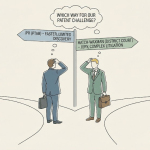
Trial date proximity is the most consequential Fintiv factor, and trial dates are set by district courts. That means venue selection, which determines which court governs the Hatch-Waxman litigation, is also de facto IPR strategy. ANDA defendants typically do not choose venue; the innovator files suit in its preferred district after receiving the notice letter. But ANDA defendants can move to transfer, and that transfer motion, if successful, can shift the case to a slower district.
The District of Delaware is the most common venue for Hatch-Waxman cases. Delaware’s schedule typically puts trial 24-30 months from filing, which creates a more favorable Fintiv analysis than the Western District of Texas, which at peak had trial dates as short as 18 months. Post the judicial assignment changes at WDTX in 2022, case flow has redistributed, but the calendar mathematics remain relevant: a 30-month trial schedule versus an 18-month trial schedule can be the difference between a PTAB final written decision arriving before trial versus arriving after.
For generic defendants, a successful motion to transfer to Delaware from a faster court can buy 6-12 months of additional calendar runway, which improves the probability that the PTAB final written decision precedes the district court judgment. That matters because a PTAB invalidity ruling, even if not binding on the court, affects settlement dynamics considerably. Innovators negotiate differently when they hold only a district court win and face an adverse PTAB ruling on appeal.
The New Jersey Option
The District of New Jersey, home to many major pharmaceutical company headquarters, is an occasionally used Hatch-Waxman venue with scheduling timelines that vary considerably by judge. Some NJ judges set aggressive schedules comparable to WDTX; others allow 36+ months. Due diligence on individual judge scheduling practices should be part of any venue analysis.
ITC Investigations and the Fintiv Exemption
Why ITC Creates a Fintiv Workaround
In June 2022, the USPTO issued interim guidance clarifying that the Fintiv factors do not apply when the parallel proceeding is an International Trade Commission investigation rather than a district court case. The ITC exclusion from Fintiv analysis gives petitioners a structural tool: if an innovator pursues an ITC Section 337 investigation (typically in biologics cases involving device components or where importation of the reference biologic can be characterized as an unfair trade practice), the petitioner can file an IPR against patents asserted at the ITC without facing Fintiv discretionary denial.
This is practically relevant in biologic pharmaceutical cases where the biosimilar entrant’s manufacturing process, fill-finish operations, or delivery device components may be the target of ITC claims. IPR proceedings targeting process patents or device patents from an ITC investigation proceed on the standard merits analysis without the trial-date-proximity overlay.
Limits of the ITC Exemption
ITC investigations do not generate the 30-month stay benefit of Hatch-Waxman litigation. The ITC’s principal remedy is an exclusion order barring importation, not money damages. Most biosimilar manufacturers who manufacture outside the U.S. face meaningful ITC exposure, but small molecule generic manufacturers with domestic API sourcing may be less vulnerable to ITC Section 337 claims. The ITC exemption from Fintiv is strategically valuable, but it applies only when there is a genuine ITC investigation to anchor it.
IP Valuation Under Attack: How Dual Challenges Reshape Asset Value
Modeling the Dual-Track Discount
A pharmaceutical patent estate functions as the primary revenue-protection asset on an innovator’s balance sheet. The contribution of the patent estate to enterprise value is the net present value of expected royalty-bearing or exclusivity-protected revenue across the remaining term of each patent, discounted by the probability of invalidity and the probability of non-infringement across each challenge vector.
When both an IPR and a Paragraph IV case are active against a patent simultaneously, the probability of invalidity does not double; it is a joint probability function across two correlated proceedings. But the correlation is less than 1. The PTAB applies a different evidentiary standard, considers different prior art, and operates on a different timeline than the district court. A patent that survives district court may still be invalidated at the PTAB. Conversely, a PTAB decision canceling claims does not automatically resolve the district court case, though it removes the patent from the claim set the innovator can enforce.
For institutional investors modeling entry risk on branded drugs, the correct analytical tool is not a binary ‘will the patent hold?’ assessment. It is a probability-weighted decision tree that assigns independent probabilities to each of the following events: PTAB institution, PTAB favorable final written decision for the petitioner (full or partial cancellation), district court invalidity ruling, district court non-infringement ruling, appeal outcomes at the Federal Circuit on each track, and settlement at any node in the tree. Each node changes the expected loss-of-exclusivity date and thus the NPV of the branded revenue stream.
Orange Book Patent Cluster Valuation
Innovators rarely rely on a single patent to protect a major drug. The more common structure is a cluster of patents covering the active pharmaceutical ingredient (primary composition), formulations (dosage form, excipient combinations, controlled release mechanisms), methods of treatment (indication-specific dosing, patient population subsets), manufacturing processes, and polymorph forms. Adalimumab carried more than 130 Orange Book-listed patents at its peak. Apixaban (Eliquis, BMS/Pfizer) carried more than 30. Even a mid-revenue drug might have a cluster of 8-15 patents across those categories.
Each patent in the cluster has a distinct IP valuation profile: the primary composition patent is typically the highest-value asset, worth the majority of exclusivity-protected revenue, while formulation and method-of-use patents carry value proportional to the difficulty of designing around them. IPR analysis should map directly to cluster valuation: prioritize the patents whose cancellation would materially accelerate loss of exclusivity, not necessarily the patents whose invalidity arguments are technically cleanest.
Settlement Value Dynamics in Parallel Proceedings
Pay-for-delay settlements (reverse payments) in Hatch-Waxman cases became subject to antitrust scrutiny after the Supreme Court’s FTC v. Actavis decision (2013). The presence of a concurrent IPR changes settlement dynamics in at least two ways. First, a generic that has filed an IPR and obtained institution has a credible, public-record invalidity argument that the innovator cannot wish away with a confidential settlement. Second, if the IPR produces a final written decision canceling claims before the district court trial, the settlement leverage evaporates because the innovator has nothing to sell.
Innovators increasingly seek to resolve Paragraph IV disputes before PTAB institution, specifically to avoid locking in a public record of prior art arguments. Generic manufacturers should evaluate whether accepting an early pre-institution settlement offer, potentially including an authorized generic arrangement or a negotiated entry date, is more valuable than pressing to institution and risking adverse discovery about the strength of their prior art.
Evergreening Under Fire: How Innovators Defend Patent Clusters
The Evergreening Technology Roadmap
Evergreening describes the practice of extending effective market exclusivity beyond the primary composition patent’s expiry through successive secondary patents. The technology roadmap for small molecule evergreening typically follows this sequence:
The primary composition patent, covering the active pharmaceutical ingredient in its base form, usually expires 20 years from filing, placing the core compound in the public domain unless a patent term extension (PTE) is obtained under 35 U.S.C. section 156. PTE can add up to 5 years, but is capped at 14 years of effective protection and requires that the drug spend regulatory review time after patent filing. For most drugs, PTE adds 2-4 years of exclusivity.
While PTE extends the primary patent, formulation patents covering specific dosage forms, controlled-release technologies, or excipient combinations are filed during Phase II and III development and typically expire 4-8 years after the primary patent. These are the first line of evergreening defense. Method-of-use patents covering newly approved indications or subpopulations can extend beyond formulation patents. Polymorph patents, covering crystalline or amorphous forms of the API that affect bioavailability or stability, are filed around the time of commercialization and can expire 5-12 years after primary patent expiry.
Metabolite patents covering active metabolites of the parent compound have become more contested after cases like Metabolite Laboratories v. Laboratory Corp., but remain tools in the evergreening arsenal for drugs with pharmacologically active metabolites. For biologics, the analog to small molecule evergreening includes patents covering manufacturing cell lines, purification processes, formulation buffers, dosing devices, and biosimilar interchangeability-blocking data exclusivity periods.
IPR as an Evergreening Disassembler
From the generic manufacturer’s perspective, IPR is a systematic tool for disassembling the evergreening cluster patent by patent. The strategic sequence is to identify the patents whose cancellation would most accelerate generic entry, rank them by IPR vulnerability (prior art availability, claim breadth, examiner history), and file petitions in order of priority against the highest-value, highest-vulnerability patents.
Formulation patents are frequently the most IPR-vulnerable patents in a cluster because the prior art literature on pharmaceutical formulation is extensive and well-indexed. A compound in development generates published formulation studies, conference presentations, and regulatory submissions that can serve as prior art against a subsequently filed formulation patent. Method-of-use patents are harder to invalidate via IPR because the prior art must specifically disclose the claimed dosage and patient population, but their claim scope is often narrow enough that a non-infringement argument suffices in district court without needing PTAB cancellation.
Polymorph patents present a distinct challenge. They require expert testimony on crystal form characterization, and the PTAB has been relatively patent-holder-friendly in polymorph cases where the innovator can show that the specific crystalline form was not obvious from the prior art, even if the parent compound was known. IPR petitions against polymorph patents should be filed only when high-quality crystallography prior art exists.
Key Takeaways: Evergreening and IPR
Primary composition patents are the highest-value targets but often the hardest to invalidate via IPR because the prior art must predate the compound itself.
Formulation patents are the most IPR-vulnerable assets in a cluster and should be prioritized when the prior art literature is rich.
Polymorph patents require specialized crystallography prior art and expert support that is more expensive to develop but, when available, can be dispositive.
Generic entrants should build a cluster-level IPR roadmap, not a single-patent strategy, to maximize the probability of accelerating loss of exclusivity across the full patent estate.
USPTO Reform: The 2024-2025 Rulemaking and What Changes Next
The Notice of Proposed Rulemaking on Multiple Petitions
The USPTO published a Notice of Proposed Rulemaking in 2024 that proposed to codify and formalize restrictions on parallel and serial IPR petitions. The NPR proposed requiring petitioners to show ‘good cause’ for filing parallel petitions and to satisfy a modified General Plastic analysis for serial petitions that gives greater weight to the question of whether the petitioner could have raised the same grounds in an earlier filing.
The NPR also proposed to modify the Fintiv framework by codifying the six factors as regulatory text rather than leaving them to PTAB panel discretion. Codification raises the barrier to Director Review reconsideration because panels would be applying promulgated rules rather than precedential board decisions, which have more interpretive flexibility.
Comment periods attracted substantial input from both the generic pharmaceutical industry and innovator companies. The generic industry argued that codifying Fintiv would systematically deprive IPR petitioners in pharmaceutical cases of PTAB review given the inherent calendar conflict between the 30-month Hatch-Waxman stay and the PTAB’s 18-month timeline. Innovator companies argued that the current system creates disproportionate invalidity risk for commercially valuable patents and that the Fintiv framework should be strengthened rather than formalized in its current form.
As of April 2026, final rules from the NPR have not been published. Practitioners should monitor the Federal Register and USPTO announcements closely, as the rule’s codification of Fintiv would require immediate adjustments to petition timing strategy.
The Post-Arthrex Director Review Landscape
The Supreme Court’s United States v. Arthrex decision (2021) held that APJ appointments were constitutionally defective because APJs exercised executive power without adequate presidential supervision. The remedy was to give the USPTO Director authority to review final written decisions. Director Review has since been used sparingly but consequentially. Several pharmaceutical patent cases have seen Director Review petitions filed by innovators after adverse final written decisions, seeking modification or reversal of claim cancellations.
The Director Review process takes 3-6 months and does not suspend Federal Circuit appeal deadlines, which creates sequencing complexity. Litigants must decide whether to file a Federal Circuit appeal and simultaneously seek Director Review, a procedurally cumbersome posture. In practice, Director Review has not dramatically changed outcomes in pharmaceutical IPRs, but it adds a layer of post-decision uncertainty that should be modeled into litigation timelines.
Patent Term Adjustment Reform
Congress and the USPTO have discussed modifications to patent term adjustment rules that could reduce or expand the effective terms of pharmaceutical patents, with knock-on effects for IPR strategy. PTA disputes, where an innovator argues that patent prosecution delays by the USPTO warrant additional term, create patents that expire later than the face date suggests. Generics who calculate their entry timelines against stated expiry dates may be surprised by PTA-adjusted terms. IPR petitions filed within one year of the complaint must account for PTA-adjusted claim terms when mapping invalidity arguments.
Investment Strategy: Reading the Dual-Track Signal for Portfolio Decisions
For Institutional Investors in Branded Pharma
When an IPR petition is filed against a major drug’s Orange Book-listed patent, the market reaction is typically a stock move of 2-8% for the branded company depending on the drug’s contribution to the revenue mix. That move is frequently an overreaction or underreaction depending on which patent was challenged and what prior art the petitioner used.
The analytically correct response is to assess: (1) which patent in the cluster was petitioned, (2) whether the petition’s prior art is sufficiently close to the claims to present a genuine obviousness argument, (3) whether the PTAB is likely to institute given the trial date proximity and whether a Sotera stipulation was provided, and (4) what the NPV impact of claim cancellation is across the remaining patent term, net of the remaining cluster patents that would continue to block generic entry even if this patent falls.
Investors who can answer those four questions faster and more accurately than the consensus produce alpha. The raw data required is in public PTAB filings, district court dockets, and Orange Book records. What is not publicly available, but must be estimated, is the prior art strength assessment, which requires chemistry or biology domain expertise.
For Generic Company Investors
The economic value of a first-filer ANDA position on a major drug is asymmetric. The 180-day exclusivity period has a known revenue ceiling (the branded drug’s U.S. sales times the market share the generic captures at the generic’s price) and a well-understood cost base (litigation costs, manufacturing readiness). The risk is binary loss of the position through adverse court rulings before the launch date.
Successful dual-track challengers (Paragraph IV plus IPR) that obtain PTAB claim cancellation before district court trial have effectively de-risked their launch position. The residual risk shifts from invalidity to non-infringement and regulatory approval. Investors modeling generic company revenue should track IPR institution decisions and expected final written decision dates against district court trial schedules to identify cases where the PTAB is likely to clear the field before launch.
For IP Portfolio M&A
Pharmaceutical patent estates are the principal asset in many pharma acquisitions. The acquirer’s valuation rests on the expected duration of exclusivity, which requires modeling each patent in the cluster against the probability and timeline of IPR and Paragraph IV challenge. A drug with five years of nominal patent life but three active Paragraph IV cases and two filed IPR petitions has a materially different expected exclusivity duration than its face expiry suggests.
Acquirers should conduct IP due diligence that includes: a full Orange Book patent cluster map, identification of filed and reasonably foreseeable Paragraph IV certifications, assessment of IPR vulnerability for each patent (prior art landscape, claim breadth, prosecution history estoppel), and a probability-weighted expected loss-of-exclusivity date range. The difference between a face-date expiry model and a probability-weighted model can be 2-4 years of exclusivity, which translates to $500 million to $3 billion in revenue depending on the drug’s scale.
Litigation Roadmap by Drug Class
Small Molecule Oral Drugs
Small molecule oral drugs are the most common Hatch-Waxman battleground. The patent cluster typically includes a primary composition patent, formulation patents for specific dosage forms (extended-release, immediate-release), and method-of-use patents. IPR is most effective against formulation patents where the pharmaceutical formulation literature from the 1980s-2000s is dense and well-indexed. Prior art searches should target Journal of Pharmaceutical Sciences, International Journal of Pharmaceutics, and AAPS conference proceedings.
The composition patent for a small molecule is usually filed well before the drug is commercialized, sometimes 10-12 years earlier, which means its expiry is the binding constraint regardless of IPR. IPR petitions against composition patents in small molecule cases succeed mainly when the compound’s synthesis was published in academic literature before the priority date or when a closely related compound was disclosed in a prior patent and the claimed compound is an obvious derivative.
Biologics and Biosimilar Patent Dance
Biologic drugs operate under the Biologics Price Competition and Innovation Act (BPCIA) rather than Hatch-Waxman, but IPR is available against biologic patents through the same PTAB process. The BPCIA’s patent dance mechanism, where the biosimilar applicant and reference product sponsor exchange patent lists and negotiate which patents to litigate, creates a structured process that is parallel to but distinct from Hatch-Waxman.
IPR petitions against biologic patents face a different prior art landscape. The relevant art is typically process patents (cell culture conditions, purification chromatography steps), formulation patents (buffer compositions, excipient concentrations), and characterization patents (glycosylation profiles, aggregation specifications). Prior art for biologic process patents often includes academic literature on monoclonal antibody manufacturing, FDA regulatory submissions made public, and competitor process patents. The prior art density is lower than for small molecule formulation patents, which makes IPR harder to execute against biologic process patents.
Biosimilar interchangeability is an additional strategic dimension. A biosimilar approved as interchangeable can be substituted at the pharmacy without prescriber authorization in states that have enacted interchangeability substitution laws. Interchangeability requires additional clinical switching studies. Innovators have pursued patents on the switching study designs themselves, though those patents present obvious Section 101 eligibility risks.
Combination Products and Device Patents
Combination products (drug-device combinations such as autoinjectors, inhalers, and prefilled syringes) generate Orange Book listing disputes around device patents. FDA’s Orange Book Transparency Act guidance has narrowed device patent listing eligibility, but many device patents remain listed and subject to Paragraph IV certification. IPR against device patents draws on mechanical and electronic prior art rather than pharmaceutical chemistry art, requiring different expert profiles than a typical ANDA IPR.
Key Takeaways by Practitioner Type
For Generic Manufacturer IP Teams
The central operational discipline is timeline management. The 315(b) one-year service deadline for IPR filing, the Fintiv proximate-trial-date calculus, and the 30-month stay clock must be mapped against each other at the moment the Paragraph IV notice letter is served. A firm Fintiv analysis should be completed within the first 30 days after service, before counsel is committed to a petition timeline.
Sotera stipulations should be considered standard operating procedure for any IPR filed against an Orange Book patent in active Hatch-Waxman litigation with a trial date set within 18 months of the expected final written decision. The estoppel cost is real but manageable if counsel segregates Sotera-covered prior art from district court art early in the litigation.
Prior art searches for pharmaceutical formulation patents should be conducted by patent search specialists with pharmaceutical formulation domain expertise, not generalist searchers. The prior art for formulation patents is often in non-English language publications, European patent applications from the 1990s, and internal regulatory submission dockets that have since become public. That art requires proactive identification, not reactive retrieval.
For Innovator IP Defense Teams
Innovator defense strategy in parallel proceedings has three operational priorities. First, file Hatch-Waxman suits promptly and in favorable venues to establish tight trial dates that trigger Fintiv denial risk for generic IPR petitions. Second, invest in Orange Book patent cluster design during drug development with IPR vulnerability assessment as an explicit criterion. A formulation patent with weak prior art differentiation is a liability at the PTAB even if it is a technical commercial advantage. Third, monitor PTAB petition filings on all Orange Book-listed patents from the moment of NDA approval. Generic manufacturers typically file ANDA certifications 2-4 years before primary patent expiry, but PTAB petitions can be filed by any party within one year of service in litigation or, for non-litigated petitions, at any time. Early warning of IPR risk allows earlier settlement negotiation from a position of strength.
For Portfolio Managers and Analysts
The actionable read on parallel proceedings is straightforward: an IPR that is instituted against a drug’s primary composition patent, where the petition contains strong prior art with non-English language references that the examiner likely did not consider during prosecution, is materially more threatening to exclusivity than an IPR that simply recycles district court invalidity contentions. The prior art quality assessment requires domain expertise but is the single most predictive factor for PTAB outcome.
Track the following signals in sequence: (1) Paragraph IV notice letter issuance, (2) IPR petition filing, (3) Sotera stipulation inclusion or exclusion, (4) PTAB institution decision, (5) expected final written decision date relative to district court trial date, and (6) settlement signals including authorized generic announcements. Each step updates the probability distribution of the expected loss-of-exclusivity date.
FAQs {#faqs}
Q: Can a generic manufacturer file an IPR before filing an ANDA?
Yes. The one-year filing deadline under 315(b) applies only when the petitioner has been served with a complaint alleging infringement of the patent. A generic can file an IPR before filing an ANDA, before serving a notice letter, and before being sued. Pre-ANDA IPR filings are sometimes used as competitive intelligence tools or to clear the prior art landscape before an ANDA is submitted, but they are subject to estoppel once filed even without active litigation, and they may alert the innovator to the challenger’s identity and prior art strategy prematurely.
Q: Does a PTAB final written decision canceling claims bind the district court?
No. PTAB decisions are not binding on district courts under principles of issue preclusion because the PTAB and district courts are different tribunals applying different evidentiary standards. However, when the Federal Circuit affirms a PTAB cancellation, that ruling has res judicata effect in the district court proceeding for the cancelled claims. Pending Federal Circuit appeal, the cancelled claims remain technically in the Orange Book until delisted, creating a gap period during which the practical enforceability of the claims is in question.
Q: How does the 180-day first-filer exclusivity interact with PTAB claim cancellation?
If a first-filer generic wins PTAB cancellation of the Orange Book patent covering its ANDA before the 30-month stay expires, the innovator’s ability to maintain the stay collapses for the cancelled claims. FDA can grant tentative approval and later final approval on the cancelled claim scope. The 180-day exclusivity period begins running from the first commercial marketing by the ANDA holder. PTAB cancellation does not trigger the forfeiture provisions of 180-day exclusivity, so a first-filer who wins an IPR still holds its exclusivity against subsequent filers.
Q: What happens when the district court reaches a non-infringement ruling and the IPR is still pending?
The district court’s non-infringement ruling does not moot the IPR. The PTAB will continue to the final written decision unless the petitioner voluntarily dismisses. Some petitioners maintain the IPR to completion even after a favorable district court ruling because the PTAB cancellation, if obtained, prevents the innovator from asserting the patent against other ANDA filers or in future litigation. A final written decision canceling claims is a system-wide asset for the generic industry, not just for the petitioner.
Q: Are joint defense agreements among multiple ANDA filers advisable in coordinating IPR filings?
Joint defense agreements allow co-defendants to share work product and coordinate strategy without waiving privilege. In cases with multiple ANDA filers against a major drug, joint defense arrangements can pool prior art research costs, coordinate petition filing to avoid duplicative PTAB proceedings, and manage the joinder process. The risk is that joint defense members must all agree on strategic decisions, including Sotera stipulation scope and petition claim selection, which creates coordination friction. Agreements should specify clearly whether each member retains independent authority to settle the district court case separately from the IPR proceedings.
Q: Does the Fintiv framework apply to IPR petitions filed by non-ANDA parties?
Yes. Fintiv applies to any IPR petition filed while a parallel district court case is pending between the petitioner and the patent owner involving the same patent, regardless of whether that litigation is Hatch-Waxman. A hedge fund that files an IPR against a pharmaceutical patent it identifies as commercially overvalued (a so-called ‘inter partes review for profit’ scenario) faces Fintiv analysis if the innovator has sued any party on the same patent in district court, though in that case the petitioner and the litigant are different parties, which affects factor five of the analysis.
A Note on Sources and Data Currency
IPR institution rates, Fintiv denial rates, and serial petition statistics cited in this article reflect published PTAB data and academic analysis through 2024. USPTO rulemaking is ongoing as of April 2026. Practitioners should verify current PTAB practice through the USPTO’s published statistics, PTAB trial statistics, and the Federal Circuit’s most recent decisions on discretionary denial, estoppel, and Director Review authority before relying on any specific figure for litigation planning purposes.
This article is published for informational and educational purposes. It does not constitute legal advice. Specific litigation and prosecution strategies should be developed with qualified patent counsel who has reviewed the complete factual record of each proceeding.