Every year, drug companies leave hundreds of millions of dollars on the table. Not because their molecules fail, not because regulators reject them, but because their patent attorneys and commercial teams operate in separate universes until about eighteen months before launch, when the panic sets in.
The problem is structural. Patent prosecution runs on a timeline governed by the USPTO and international patent offices. Commercial planning runs on a timeline governed by clinical milestones. The two calendars rarely sync, and when they don’t, the consequences range from suboptimal Orange Book listings to catastrophic generic entry years ahead of schedule.
This article dissects how leading pharmaceutical companies close that gap, what the actual financial consequences of misalignment look like, and how the mechanics of patent strategy, FDA exclusivity, and commercial planning interact from IND filing through post-launch lifecycle management. It draws on real litigation records, FDA Orange Book data, IQVIA revenue figures, and the strategic playbooks of companies that have done this well, and some that have done it badly.
The goal is not a general survey. It is to give you the specific levers that determine whether your product achieves peak sales on your projection model or hands that revenue to a generic manufacturer three years early.
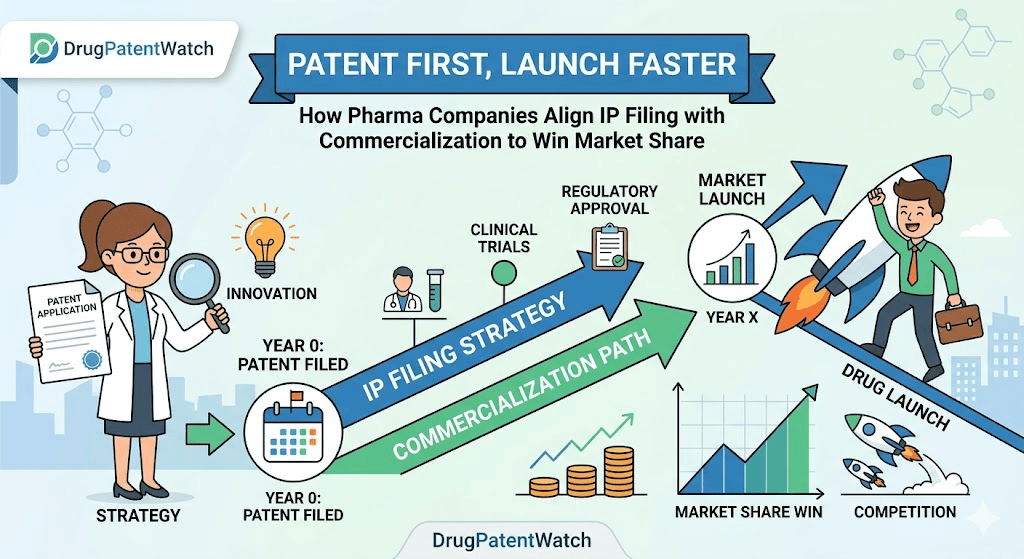
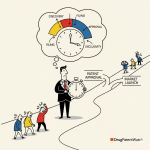
The relationship between patent filing date and commercial outcome is not philosophical. It is mathematical. U.S. utility patents expire twenty years from their earliest priority date. That clock starts the moment you file, not the moment you launch. For a compound patent filed during Phase I, the gap between filing and commercial launch typically runs eight to twelve years, leaving eight to twelve years of patent-protected sales, at best.
Compress that timeline poorly and you end up where AstraZeneca found itself with Nexium (esomeprazole). The compound patent expired in 2014. Despite multiple Orange Book-listed patents on dosage form and method of use, generic manufacturers had filed Paragraph IV certifications years earlier, and a string of settlements delayed but did not prevent the generic flood that cut branded Nexium revenues from roughly $6.2 billion in 2012 to under $1 billion within four years [1].
Expand it well, and you get the Humira (adalimumab) playbook, where AbbVie constructed what critics called a “patent thicket” of more than 130 patents covering formulation, dosing regimen, method of treatment, manufacturing process, and device design. The result was biosimilar entry delayed until January 2023 in the United States, years after European biosimilar competition began in 2018. That gap generated an estimated $80 billion in U.S. revenue AbbVie would not have collected under European-style patent terms [2].
Neither extreme is a realistic template for most programs. What matters is understanding the specific mechanisms that connect filing decisions to commercial outcomes, and building a process that applies them systematically.
How Patent Term Adjustment and Patent Term Extension Change the Math
Two USPTO mechanisms can extend effective patent life beyond the nominal twenty-year term. Understanding both is essential to any launch-alignment strategy.
Patent Term Adjustment (PTA) compensates for USPTO prosecution delays under 35 U.S.C. § 154(b). If the USPTO fails to meet statutory response deadlines, the patent term extends day-for-day. On a compound patent prosecuted over three to four years, PTA of 300 to 600 days is common. That addition is automatic and attaches to the patent at issuance, but it is only available for patents prosecuted with reasonable diligence. Unnecessary continuation filings that toll applicant delay can wipe out PTA.
Patent Term Extension (PTE) under 35 U.S.C. § 156 compensates for the time a product spends in FDA review after the patent was granted. It covers one patent per product, caps at five years, and cannot push the effective patent term beyond fourteen years from FDA approval. The calculation uses half the clinical testing period (from IND to NDA/BLA filing) plus the full FDA review period. For most small molecules, PTE adds one to three years. For biologics with long clinical programs and twelve months of FDA review, it can approach the five-year cap.
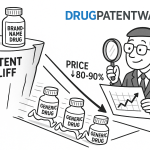
The commercial impact is direct. A single year of additional patent-protected sales on a product generating $2 billion annually is worth, after generic entry typically reduces brand revenues by 80 to 90 percent within twenty-four months, something in the range of $1.5 to $1.8 billion in net present value terms. PTE is not a legal technicality. It is a billion-dollar asset that requires active management starting in Phase I.
What Is an Orange Book-Listed Patent and Why Does Listing Strategy Matter?
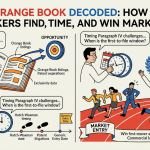
The Orange Book, formally the FDA’s Approved Drug Products with Therapeutic Equivalence Evaluations, is the public register of patents that brand manufacturers certify cover an approved drug product. Generic applicants must address every Orange Book-listed patent through certification, which triggers a 30-month stay of FDA approval for Paragraph IV certifications and an automatic 180-day exclusivity period for the first filer.
Orange Book listing criteria are specific: a patent must claim the drug substance, the drug product (formulation), or an approved method of using the drug. Process patents are not listable. Patents claiming unapproved methods of use are not listable. The FDA does not evaluate the validity of listed patents; it is up to the generic applicant or a court to challenge that.
Listing strategy has two dimensions. First, which patents to list, and when. A patent issued after NDA approval can be listed within 30 days of issuance. Companies with robust continuation programs use this window to add new claims as additional formulation and method-of-use patents issue, extending the period during which Paragraph IV challenges trigger 30-month stays. Second, how claims are drafted to maximize both listing eligibility and litigation strength.
The consequences of misalignment here are not theoretical. In 2020, the FTC issued an enforcement action and policy statement warning that improper Orange Book listings could constitute unfair methods of competition under Section 5 of the FTC Act. Amarin faced this issue with Vascepa (icosapentaenoic acid) when a district court ruled its method-of-use patents invalid after prolonged Orange Book-triggered litigation [3]. Listing patents that are legally vulnerable delays generic entry but creates massive litigation exposure and reputational risk.
The Patent Filing Timeline From IND to Launch: A Stage-by-Stage Map
Aligning patent filing with commercialization requires a stage-by-stage calendar that connects patent prosecution milestones to clinical and regulatory milestones. Most companies have some version of this. Few execute it with the precision that actually moves the needle on launch-day patent coverage.
Pre-IND and Phase I: Building the Compound Patent Foundation
The compound patent, typically a composition-of-matter claim covering the active pharmaceutical ingredient, is the most valuable patent in a pharmaceutical portfolio. It is also the most vulnerable to obviousness challenges if filed too late in the discovery process. The optimal filing window is as early as possible after identifying the lead candidate, before any public disclosure, and with claims broad enough to cover the compound, its pharmaceutically acceptable salts, key metabolites, and, where the data supports it, the closest structural analogs.
The challenge during pre-IND and Phase I is that the compound data is thin. Patentability requires novelty and non-obviousness under 35 U.S.C. §§ 102 and 103, and a written description that enables a person of ordinary skill in the art to make and use the claimed invention under 35 U.S.C. § 112. Filing too early on inadequate data can produce a patent that is valid but narrow, or one that fails § 112 scrutiny entirely in IPR proceedings later.
The better practice is a layered filing strategy. File a provisional application covering the lead compound and key analogs at the earliest reasonable point to establish a priority date. Convert to non-provisional within twelve months. File continuation applications as additional data clarifies the compound’s structural requirements for activity, expanding or narrowing claims as warranted. This approach locks in priority dates for the core compound while allowing claims to mature alongside the science.
Commercial teams should be involved even here. The product profile assumed at pre-IND shapes which therapeutic indications, patient populations, and dosing paradigms will drive revenue. Those commercial assumptions should directly inform the method-of-use claims in early filings. A company that files compound claims in Phase I but fails to simultaneously file method-of-use claims for the primary indication may find that a competitor’s earlier patent on the treatment method of that indication blocks commercialization, even if the compound itself is owned.
Phase II: Locking In Formulation and Dosing Regimen Patents
Phase II is where formulation data and dosing regimen information accumulates in sufficient volume to support meaningful patent filings. This is the stage most companies execute poorly. They run the Phase II program, accumulate a clinical database, and then convene a patent review meeting when NDA planning begins in Phase III to discover that the formulation optimized for Phase II studies was never patented and that a competitor has since published similar work.
The window for formulation patents is narrow. Once stability studies, pharmacokinetic data, and comparative bioavailability work are completed and included in regulatory submissions, those submissions become public after approval. Competitors can mine approved NDAs for formulation information. The only protection is a filed patent with a priority date predating publication.
Dosing regimen patents are equally important and consistently undervalued. A patent claiming a specific dosing schedule, particularly one tied to a safety or efficacy advantage that supports the product label, is listable in the Orange Book as a method-of-use patent. Generic manufacturers must certify to these patents, triggering litigation and 30-month stays. Janssen’s strategy with Risperdal Consta (risperidone long-acting injection) illustrates the model: detailed dosing regimen patents covering the initiation regimen, the overlap with oral antipsychotics, and specific patient populations provided layered Orange Book coverage that extended effective market protection well beyond the compound patent expiration [4].
Phase III: Filing Device, Delivery System, and Combination Patents
If your product uses a drug-device combination, a prefilled syringe, an auto-injector, an inhaler, or any other delivery system, Phase III is the last practical window to file patents covering that system before clinical data in the pivotal trials establishes prior art or public disclosure obligations.
Device patents operate on different strategic logic than drug patents. They are not compound patents, so they do not benefit from PTE under 35 U.S.C. § 156 unless the device is integral to the approved drug product. But they can be listed in the Orange Book if the patent covers the combination product as a whole. And critically, device design evolution during Phase III manufacturing scale-up often generates patentable improvements that lock in commercial manufacturing features while blocking generic manufacturers from using the same device.
Combination product patents deserve particular attention for specialty and biologic products. Eli Lilly’s Forteo (teriparatide) delivery device patent was central to its lifecycle management strategy. The prefilled pen injector system was covered by patents that outlasted the compound patent and created practical barriers to generic entry even after compound patent expiration, because generic manufacturers needed to design a delivery system that satisfied FDA substitutability requirements without infringing device patents [5].
NDA/BLA Submission Through Approval: The Orange Book Filing Window
The period between NDA or BLA submission and approval is the critical window for finalizing Orange Book patent strategy. FDA regulations require patent information to be submitted with the application, and any patents issued after NDA/BLA approval can be listed within 30 days of issuance.
Commercial teams should audit the Orange Book listing plan at this stage against two benchmarks. First, are all listable patents listed? Second, are the patents listed actually defensible in litigation? An Orange Book patent that triggers a Paragraph IV challenge but fails in litigation provides illusory protection: it generates a 30-month stay at the cost of significant litigation expense and, if the patent is found invalid or not infringed, hands the generic a competitive advantage with no remaining legal barrier.
The 2021 Supreme Court decision in Albrecht v. Eli Lilly & Co. did not directly address Orange Book listing strategy, but the broader litigation environment post-Actavis has shifted settlement economics in ways that change the calculus on listing marginally strong patents. Pay-for-delay settlements of Paragraph IV litigation are subject to antitrust scrutiny under the Actavis standard, which makes early-stage assessment of patent litigation strength central to commercial planning, not just a legal function [6].
Compound Patent vs. Formulation Patent: Which Drives More Commercial Value?
The compound patent is the foundation. The formulation patent is the lifecycle extension. Understanding which drives more commercial value requires understanding the timeline each covers.
A compound patent filed during lead optimization, say in year one of a ten-year development program, expires twenty years later. With PTE of three years added, effective protection runs through year twenty-three from first filing, or approximately year thirteen from commercial launch. On a product with a ten-year protected revenue window, the compound patent governs most of the commercial life of the product.
A formulation patent filed in Phase II, say year six of a ten-year program, expires twenty years from that filing, meaning year fourteen from commercial launch. It does not qualify for PTE separately from the compound patent, because only one patent per approved product gets PTE. But if the compound patent is selected for PTE and the formulation patent expires later anyway, the formulation patent provides coverage into the post-PTE period.
The practical interaction is more nuanced. What matters commercially is not which single patent provides coverage but what the combination of compound, formulation, dosing regimen, and device patents creates as an aggregate barrier to generic entry. Consider the profile of a well-managed patent portfolio:
Compound patent with PTE: expires year thirteen post-launch
Formulation patent (extended-release matrix): expires year fifteen post-launch
Dosing regimen patent (specific twice-daily protocol): expires year sixteen post-launch
Pediatric exclusivity (six months, if applicable): adds to each relevant patent
A generic manufacturer facing this stack must either: (a) wait until year sixteen, (b) challenge all four patents through Paragraph IV litigation and succeed on all of them, or (c) design around the formulation and dosing patents. Each option has costs, delays, and risks. The aggregate effect is not simply additive, it is multiplicative in terms of the deterrence it creates.
How Method-of-Use Patents Outperform Formulation Patents in Paragraph IV Litigation
Among Orange Book-listable patent types, method-of-use patents have a specific strategic advantage: generic manufacturers can carve out patented indications from their Abbreviated New Drug Applications (ANDAs) using a Section viii statement rather than a Paragraph IV certification. This avoids triggering the 30-month stay.
However, this carve-out only works if the carve-out indication represents a commercially viable stand-alone label. If the method-of-use patent covers the primary commercial indication, a generic cannot carve it out without producing a label that is commercially useless. This is why Eisai’s method-of-use patents on Aricept (donepezil) covering the 23mg dose for moderate-to-severe Alzheimer’s disease were commercially significant despite the compound patent expiring: carving out the indication for which the specific high-dose formulation was indicated was not practically feasible [7].
The lesson for commercial teams is that method-of-use patent strategy should be driven by label strategy. The claims that matter are claims on the exact indication, the exact patient population, and the exact dosing regimen that will appear on the approved label. Filing method-of-use patents that track the anticipated label language is a specific, executable task that patent and commercial teams need to coordinate during Phase III.
FDA Exclusivity vs. Patent Protection: How the Two Systems Interact
Patents and FDA exclusivity operate independently but interact in practice. Understanding both is essential to forecasting the actual date of generic entry, which is the number that drives revenue models.
New Chemical Entity Exclusivity: What It Covers and What It Does Not
New Chemical Entity (NCE) exclusivity under 21 U.S.C. § 355(j)(5)(F)(ii) provides five years of exclusivity for drugs containing a new active moiety, meaning a drug that has never been approved in any form. During this period, the FDA cannot accept ANDAs referencing the NCE brand. Generic manufacturers can file ANDAs four years into the exclusivity period if they include a Paragraph IV certification, which, if filed, triggers a one-year extension of NCE exclusivity (for a total of five years) and a 30-month stay from the date of ANDA filing.
NCE exclusivity is valuable primarily as a floor. It guarantees a minimum of four to five years of exclusivity regardless of patent coverage. But it does not extend patent terms, does not block filing of Paragraph IV challenges, and does not prevent generic manufacturers from designing around the NCE entirely with a differently structured molecule.
The commercial planning implication is specific: NCE exclusivity should not substitute for a strong patent portfolio. Companies that rely on NCE exclusivity as their primary protection mechanism, and whose compound patents have weak claims or short remaining terms, will face generic challenges starting in year four regardless of their Orange Book filings.
Three-Year Exclusivity for New Clinical Investigations: The Lifecycle Management Tool
Three-year exclusivity under 21 U.S.C. § 355(j)(5)(F)(iii) applies to drugs for which new clinical investigations essential to approval are conducted. It covers new indications, new dosage forms, new routes of administration, and new combinations. Unlike NCE exclusivity, it does not prevent FDA from accepting ANDAs for the original approved formulation; it only prevents approval of ANDAs for the new formulation or indication that required the new clinical investigations.
This is the engine of legitimate lifecycle management. A brand manufacturer that conducts a new study supporting a new indication, files a supplemental NDA, and receives three-year exclusivity for that indication can extend the commercial window for the branded product by blocking generic equivalents for the new indication. Combined with a method-of-use patent covering the new indication, this creates overlapping exclusivity that is difficult to challenge on multiple fronts simultaneously.
AstraZeneca’s work on Crestor (rosuvastatin) illustrates this. The company pursued additional clinical studies supporting new populations and dosing regimens, filing supplemental NDAs that triggered three-year exclusivity windows and supporting new Orange Book-listed patents. The result was a layered protection structure that sustained branded revenues well into the period when compound patent expiration would otherwise have opened the door to generics [8].
Pediatric Exclusivity: Six Months That Can Be Worth Billions
Pediatric exclusivity under the Best Pharmaceuticals for Children Act adds six months to all existing patents and FDA exclusivities for a drug, if the manufacturer conducts pediatric studies in response to an FDA Written Request. It attaches to patents, not just to exclusivity periods, which means it extends every Orange Book-listed patent by six months simultaneously.
The financial math is stark. For a drug generating $4 billion annually, six months of additional exclusivity is worth approximately $1.6 to $1.8 billion after accounting for generic price erosion dynamics. The cost of pediatric studies typically runs $5 to $50 million. The return on investment for qualifying products is among the highest of any regulatory strategy available in pharmaceuticals.
Commercial teams consistently undervalue pediatric exclusivity during development planning. The key qualifying criterion is an FDA Written Request for pediatric studies; companies can proactively request that the FDA issue a Written Request. For products with pediatric patient populations or conditions that affect children, this is a straightforward regulatory pathway. For products with no pediatric application, the FDA will not issue a Written Request, and the exclusivity is not available.
“Pediatric exclusivity has generated an estimated $57 billion in additional brand revenue across qualifying drug approvals since 1997, making it the single most commercially efficient regulatory incentive in U.S. pharmaceutical law.”
Source: U.S. Government Accountability Office, Drug Industry: Profits, Research and Development Spending, and Merger and Acquisition Deals (GAO-18-40, 2017), updated estimate based on IQVIA MIDAS data through 2022.
Orphan Drug Exclusivity vs. Patent Protection: Which Matters More for Rare Disease Launches?
Orphan Drug Exclusivity (ODE) under the Orphan Drug Act provides seven years of market exclusivity for drugs targeting conditions affecting fewer than 200,000 U.S. patients annually. Unlike NCE exclusivity, ODE prevents the FDA from approving the same drug for the same indication, not just generic versions, during the seven-year period. A competing manufacturer with a different drug for the same indication is not blocked.
For rare disease products, ODE often provides stronger near-term commercial protection than patents alone. Compound patents on rare disease drugs are frequently challenged; the patient populations are small enough that generic manufacturers need large market shares to justify ANDA litigation costs. But a competitor with a me-too drug can still enter if their molecule is different. ODE blocks even that in the short term.
The alignment challenge for rare disease commercial planning is the interaction between ODE and patent protection post-seven years. If the compound patent provides coverage beyond seven years from launch, ODE adds little incremental value for those later years. If the compound patent expires before ODE, ODE is the primary protection mechanism and commercial models should be built around the ODE expiration date, not the patent date.
Paragraph IV Litigation Timeline and Commercial Risk: What the Data Shows
Paragraph IV certification litigation under the Hatch-Waxman Act is the primary mechanism through which generic manufacturers challenge brand pharmaceutical patents. Understanding the average timeline, outcomes, and commercial implications of Paragraph IV litigation is central to launch alignment planning.
How Long Does Paragraph IV Litigation Take? Average Timeline to Decision
The 30-month stay triggered by a Paragraph IV certification begins running from the date of notification to the brand manufacturer and runs until the stay expires, the court rules, or the FDA acts, whichever comes first. In practice, most Paragraph IV cases that proceed to trial reach a final district court decision somewhere between twenty-four and forty months after filing, often roughly coinciding with or slightly exceeding the 30-month stay period.
Data from FDA Orange Book records and federal court dockets shows that of Paragraph IV cases filed between 2015 and 2022, approximately 70 to 75 percent settled before trial [9]. Of those that reached trial, brand manufacturers won approximately 40 to 45 percent. These numbers obscure important variation by patent type: compound patents have a somewhat higher win rate than formulation or method-of-use patents, which face greater obviousness challenges when prior art is extensive.
The commercial impact of the 30-month stay is a function of when the first Paragraph IV certification is filed. If generics file immediately upon ANDA acceptance (which occurs four years into NCE exclusivity for NCE drugs), the 30-month stay expires approximately 6.5 years after NDA approval. For products where the compound patent expires at year thirteen post-launch, this means the first litigation cycle resolves well before the patent expiry cliff. For products where the compound patent expires at year eight, the 30-month stay covers most of the remaining patent term, and a brand loss at trial means immediate generic entry.
Settlement Economics Post-FTC v. Actavis: What Brands Actually Gain
Before the Supreme Court’s 2013 decision in FTC v. Actavis, Inc., brand manufacturers frequently settled Paragraph IV litigation by paying generic manufacturers to delay their entry. The practice, called pay-for-delay or reverse payment settlement, was widespread and commercially rational: a brand generating $3 billion annually could pay a generic manufacturer $200 million to delay entry for two years and pocket the remaining $5.8 billion in net present value from the delay.
Post-Actavis, such settlements face antitrust scrutiny under a rule-of-reason standard. Courts must assess whether the payment is large enough to suggest that it is being made to maintain monopoly profits rather than to resolve legitimate litigation uncertainty. The practical result has been a significant reduction in large reverse payment settlements, a shift toward authorized generic agreements and other indirect compensation mechanisms, and increased litigation through trial.
For commercial planners, the post-Actavis environment means that patent strength matters more, not less. A strong patent portfolio that can be defended at trial is commercially valuable not just for the protection it provides if the brand wins, but because strong patents command better settlement terms and deter filing altogether. Tools like DrugPatentWatch allow commercial and IP teams to monitor ANDA filings and Paragraph IV certifications in real time, enabling early assessment of litigation risk and settlement strategy for specific Orange Book-listed patents before the 45-day notification window expires.
First-to-File 180-Day Exclusivity: How Generics Use It and What Brands Can Do
The first generic applicant to file a Paragraph IV certification against a listed patent receives 180 days of generic market exclusivity. During this period, the FDA cannot approve subsequent ANDAs for the same product. For generics, this is worth capturing because for large-volume products, 180 days of duopoly pricing allows significant revenue capture before second-wave generic entry drives prices down further.
Brands can use the 180-day exclusivity structure defensively. Authorized generic launches, where the brand licenses a generic version of its own product to a generic manufacturer, dilute the first filer’s 180-day exclusivity without triggering additional Paragraph IV litigation. This strategy reduces the financial incentive for first filers and, if executed before generic launch, reduces the expected value of Paragraph IV challenges on future products.
Pfizer’s use of authorized generics for Lipitor (atorvastatin) after Ranbaxy’s first-to-file status was established is the canonical example. By launching an authorized generic through Greenstone the same day Ranbaxy’s generic launched, Pfizer captured a significant share of the generic market during the 180-day exclusivity window, reducing Ranbaxy’s revenue from that period and signaling to subsequent generic filers that Pfizer would aggressively defend its economics even post-patent-expiry [10].
Biosimilar Patent Strategy: How It Differs From Small-Molecule Hatch-Waxman
Biologic drugs operate under a separate exclusivity framework. The Biologics Price Competition and Innovation Act (BPCIA), enacted in 2010, created a 12-year reference product exclusivity period (with four years of data exclusivity preventing biosimilar applications) and a complex patent information exchange process called the “patent dance.”
The BPCIA Patent Dance: Timeline and Commercial Implications
Under the BPCIA, a biosimilar applicant must share its biosimilar application with the reference product sponsor within 20 days of FDA acceptance. The sponsor then identifies patents it would assert and the applicant identifies those it contests. The parties negotiate a list for immediate litigation, with remaining patents subject to later claims. A 12-year period of reference product exclusivity applies from the date of first approval, not from the filing date of the BLA.
The commercial implication of 12-year exclusivity is that it provides a floor of protection significantly longer than the five-year NCE exclusivity for small molecules. But it operates alongside, not instead of, patent protection. Companies with strong biologic patent portfolios use the 12-year exclusivity as time to build layered protection in formulation, device, and method-of-use patents that extend beyond 2012 expiry dates.
AbbVie’s Humira strategy demonstrates both the power and the limits of this approach. In Europe, where biologic reference product exclusivity was shorter, biosimilars launched in 2018. In the U.S., the combination of BPCIA 12-year exclusivity and over 130 patents delayed biosimilar entry until January 2023. Once entry occurred, Humira’s U.S. market share eroded faster than many forecasts predicted, with biosimilar penetration in high-concentration adalimumab formulations accelerating to over 40 percent within nine months [11].
Biosimilar Launch Strategy: How Reference Product Sponsors Can Prepare for LOE
Loss of exclusivity (LOE) for biologics creates a different commercial dynamic than for small molecules. Generic small-molecule drugs are therapeutically equivalent and substitutable at the pharmacy level. Biosimilars are not automatically substitutable: interchangeability designation, which requires demonstrating the biosimilar can be switched with the reference product without safety or efficacy concerns, is separately granted by the FDA and not automatically conferred with biosimilarity approval.
This substitutability gap gives reference product sponsors a specific commercial window at LOE that does not exist for small molecules. Patient populations established on a biologic can be maintained even after biosimilar launch if prescriber relationships are strong, the biosimilar is not interchangeable (and thus requires a new prescription), and formulary management keeps the reference product preferred. The commercial strategy for biologic LOE preparation should include building interchangeability-proof patient programs, securing favorable formulary positions before LOE, and managing contract positions with payers to retain access at competitive prices.
AstraZeneca’s experience with Synagis (palivizumab) and the emergence of biosimilar competition illustrates this. Despite biosimilar nirsevimab (Beyfortus, Sanofi/AstraZeneca co-promoted) entering as a next-generation alternative rather than a traditional biosimilar, the respiratory syncytial virus prevention market demonstrated how biologic brands can lose share rapidly when a clinically superior alternative enters, regardless of substitutability status [12].
How to Structure a Patent Filing Calendar Aligned With the Commercial Launch Plan
Building a patent filing calendar that tracks commercial planning requires a cross-functional process, not a one-time filing decision. The following framework integrates patent prosecution milestones with commercial planning milestones from IND through year three post-launch.
Pre-IND Through Phase I: Priority Date Establishment and Claim Architecture
The actions required in this phase:
File provisional patent application covering lead compound, key analogs, and pharmaceutically acceptable salts. Priority date established.
Within 12 months of provisional: convert to non-provisional with claims informed by Phase I data and commercial profile. File PCT application for international protection simultaneously.
Identify jurisdictions of commercial priority for national phase entry decisions (typically U.S., EU major markets, Japan, China, Canada, Australia at minimum).
Phase II: Formulation and Regimen Patent Filings
Required actions:
Review Phase II formulation data with patent counsel. File formulation patent applications covering the Phase II formulation before Phase II data appears in any regulatory submission or publication.
Draft method-of-use patent claims tracking anticipated label language for primary indication. File before Phase II efficacy data is published.
Evaluate dosing regimen data. If a specific regimen provides differentiated safety or efficacy, file dosing regimen patents covering that regimen.
If a drug-device combination is anticipated, initiate device patent filings covering the Phase II device version.
Conduct first Orange Book strategy review: identify which patents will be listed, in what sequence, and what the aggregate Paragraph IV trigger timeline will be.
Phase III Through NDA/BLA Submission: Locking In Orange Book Coverage
Required actions:
Finalize Orange Book patent list. Confirm all listable patents are in prosecution and will issue before or shortly after approval.
File continuation applications covering manufacturing scale-up process innovations that are commercially relevant.
Submit patent information with NDA/BLA. All patents to be listed must be submitted at the time of NDA/BLA submission or within 30 days of issuance for patents issued after submission.
Initiate PTE application planning. Identify the patent best suited for PTE (typically the compound patent with the most remaining term value). PTE application must be filed within 60 days of NDA/BLA approval.
Evaluate pediatric exclusivity eligibility. If an FDA Written Request can be obtained, initiate pediatric study protocol.
Post-Approval Launch Planning: Monitoring and Active Portfolio Management
The most common commercial failure in patent strategy is treating patent filing as a pre-launch task rather than an ongoing program. Required post-approval actions:
Monitor ANDA filings through FDA Orange Book updates and commercial databases including DrugPatentWatch. DrugPatentWatch provides real-time ANDA filing data, Paragraph IV certification tracking, and patent expiry analysis that gives brand teams early warning of approaching generic challenges.
Respond to Paragraph IV notifications within 45 days if litigation is warranted. The 30-month stay only triggers if suit is filed within 45 days of notification.
Continue lifecycle management patent filings for new indications, new formulations, and new patient populations identified through post-launch clinical work.
Evaluate three-year exclusivity opportunities from supplemental NDAs for new clinical investigations.
Case Study: Eliquis (Apixaban) Patent Strategy and Commercial Alignment
Eliquis (apixaban), co-developed and co-commercialized by Bristol-Myers Squibb and Pfizer, provides a detailed case study in patent-commercial alignment that produced one of the most successful pharmaceutical franchise defenses of the past decade.
How BMS and Pfizer Built Eliquis’s Patent Wall
The apixaban compound patent (U.S. Patent No. 6,967,208) was filed in 2003 and issued in 2005, with a nominal expiry of November 2022. With PTE, the effective expiry extended to November 2026 for the primary compound patent. The Orange Book at approval in 2012 listed the compound patent and additional patents covering the pharmaceutical formulation and method of use for stroke prevention in atrial fibrillation.
The commercial situation in 2015 was that Eliquis was gaining market share rapidly against warfarin and against Xarelto (rivaroxaban, Bayer/Janssen), driven by the ARISTOTLE trial data showing superior stroke prevention and lower bleeding rates compared to warfarin. Peak global sales eventually exceeded $11 billion annually, making Eliquis the highest-revenue drug in the world in 2022 and 2023.
Generic manufacturers filed Paragraph IV ANDAs beginning in 2017, four years into the product’s NCE exclusivity period. BMS and Pfizer filed suit within 45 days, triggering the 30-month stay. Litigation proceeded for years, ultimately settling in ways that, per publicly available docket information, establish authorized generic entry dates in the 2026 through 2031 range depending on patent and jurisdiction [13]. The commercial planning teams at both companies had modeled revenue curves with this generic entry timeline for years, allowing them to structure rebate contracts, manufacturing commitments, and pipeline investment with a clear LOE forecast.
What Eliquis Teaches About Integrating Litigation Into Revenue Forecasting
The Eliquis case teaches a specific operational lesson: patent litigation outcomes are not unknowable and should not be modeled as binary events. Commercial teams that treat patent expiry as a cliff and Paragraph IV outcomes as a coin flip systematically misprice their revenue models.
A more rigorous approach models patent validity and infringement risk for each Orange Book-listed patent as a probability distribution based on claim construction, prior art landscape, and litigation history for similar claim types. It runs revenue scenarios under different Paragraph IV outcomes, weighted by those probabilities. And it updates the model as litigation proceeds, because claim construction rulings, IPR filings, and summary judgment outcomes all shift the probability distribution in real time.
Tools like DrugPatentWatch and services from IQVIA’s patent analytics division provide the underlying data for this kind of probabilistic modeling. The companies that do this well do not get surprised by generic entry. They have modeled it, planned for it, and structured their business around it.
Evergreening, Patent Thickets, and the Antitrust Boundary
No discussion of patent-commercial alignment is complete without the antitrust boundary. There is a significant difference between legitimate lifecycle management and behavior that courts and the FTC treat as anticompetitive.
What Courts Have Said About Evergreening in Pharmaceutical Patent Law
The term “evergreening” is used loosely to describe the practice of filing secondary patents to extend market exclusivity beyond the compound patent term. Courts have generally not treated secondary patenting as inherently anticompetitive, because the patent system explicitly allows patents on formulations, methods of use, and improvements. But specific practices have attracted antitrust enforcement:
Improper Orange Book listings. The FTC has taken the position that listing patents that do not claim the approved drug product or a method of using it, or that are trivially weak, constitutes an unfair method of competition. The 2023 FTC policy statement on Orange Book listings specifically identified device patents listed for drugs-device combinations as an area of heightened scrutiny.
Sham litigation. Filing Paragraph IV suits with no reasonable basis for believing the patent is valid and infringed, with the sole purpose of obtaining the 30-month stay, is actionable under the Noerr-Pennington doctrine’s sham litigation exception. Courts have found sham litigation in cases where brands filed suit on patents they knew had been invalidated in related proceedings or where claim construction made infringement implausible.
Product hopping. Withdrawing a product from the market and launching a reformulated version (extended-release, once-daily, different salt) shortly before compound patent expiry, with the purpose of switching patients to the new formulation before generics can reference the original, has been challenged as anticompetitive. The Second Circuit’s decision in New York v. Actavis (Namenda/Namenda XR) upheld a preliminary injunction against product hopping where the brand was withdrawing immediate-release Namenda to force patients to the extended-release version before generic entry [14].
Where the Commercial Strategy Line Is: Patent Filing Practices That Courts Uphold
The practices that consistently survive antitrust scrutiny share a common feature: they involve genuine innovation or genuine clinical value. A new formulation that reduces dosing frequency and improves patient adherence is commercially and legally defensible. A formulation change made entirely to reset the Orange Book clock with no clinical benefit is not.
The commercial-team implication is that lifecycle management decisions should be driven by clinical and scientific rationale, documented as such, and reviewed for patent-commercial alignment before investments are made. Companies that build lifecycle management around genuine product improvements, and file patents that accurately reflect those improvements, operate within the established legal framework. Companies that manufacture formulation changes to generate Orange Book filings create both litigation exposure and reputational risk with regulators and payers.
How Payer Strategy Interacts With Patent Filing and LOE Planning
Patent protection affects not just generic entry timing but the entire payer negotiation environment. Understanding this interaction is essential to commercial launch planning.
Why Managed Care Contracts Should Be Structured Around Patent Expiry Dates
Multi-year managed care contracts, including those with Pharmacy Benefit Managers (PBMs) and integrated health systems, typically include most-favored-nation clauses, price protection terms, and rebate structures tied to formulary tier positions. The terms brands can command in these negotiations are directly a function of the competitive landscape, which is primarily determined by patent coverage.
A brand negotiating a two-year managed care contract six years before compound patent expiry is in a fundamentally different position than one negotiating the same contract two years before expiry. In the first case, the brand has genuine leverage: there are no generic alternatives, and refusing a favorable tier position means the PBM cannot offer members a lower-cost equivalent. In the second case, the PBM knows generic entry is imminent and will offer preferred tier positions only in exchange for rebates that effectively price the brand close to anticipated generic net cost.
Commercial teams that do not integrate patent expiry timelines, including probabilistic Paragraph IV outcomes, into managed care contract strategy routinely lock themselves into unfavorable positions. The better approach: negotiate contracts with terms that account for LOE, including exit provisions or pricing adjustment clauses tied to generic entry, and reserve rebate capacity for the final years of exclusivity where tier position defense has the highest revenue impact.
Specialty Pharmacy and Hub Services: How They Extend Commercial Value at LOE
For specialty products, particularly biologics and specialty small molecules, specialty pharmacy programs and patient support hubs create commercial value that patent protection alone cannot generate. These programs include patient assistance programs, copay assistance for commercially insured patients, nurse navigation services, and adherence programs. They create patient and prescriber loyalty that persists into the post-LOE period in ways that commodity small-molecule generics do not replicate.
Regeneron and Sanofi’s approach to Dupixent (dupilumab) demonstrates how integrated patient support services, combined with a still-protected biologic, create commercial durability. The product’s complex indication expansion strategy (atopic dermatitis, asthma, CRS with nasal polyposis, eosinophilic esophagitis, prurigo nodularis) has been matched by patient support infrastructure that captures clinical data, supports reauthorization, and maintains prescriber relationships across multiple therapeutic areas. This infrastructure becomes more, not less, valuable as LOE approaches because it creates switching costs that biosimilar manufacturers cannot easily replicate [15].
International Patent Strategy: Filing Decisions That Affect U.S. Commercial Value
U.S. patent strategy does not operate in isolation. International patent filing decisions affect U.S. commercial value in specific ways that commercial teams frequently miss.
How Foreign Patent Filings Affect 35 U.S.C. § 102 Prior Art Analysis
Under the America Invents Act, public disclosure of an invention anywhere in the world more than one year before a U.S. patent application is filed constitutes prior art that can defeat U.S. patentability. A company that publishes Phase I data at a conference before filing a U.S. patent application on the related formulation has created prior art against its own patent.
This is not an abstract risk. Academic-industry collaborations, international clinical trial registration requirements, and conference publication timelines create multiple prior art exposure points. Commercial teams that push for early publication of Phase II results to generate commercial buzz can inadvertently foreclose patent protection for formulation and dosing innovations if patent filings have not been made in advance of publication.
The one-year grace period under 35 U.S.C. § 102(b)(1) protects against the inventor’s own disclosures for U.S. applications, but no equivalent protection exists in most foreign jurisdictions. A disclosure that is within the U.S. grace period may still destroy patentability in Europe, Japan, and other markets where absolute novelty is required. International patent filings must precede or accompany any public disclosure, or market-specific patent protection is permanently lost.
Supplementary Protection Certificates in Europe: The EU Equivalent of U.S. PTE
In the European Union, Supplementary Protection Certificates (SPCs) provide up to five years of patent term extension for medicinal products, calculated based on the time between patent filing and marketing authorization. Like U.S. PTE, they are available for one patent per product per EU member state, and are subject to specific eligibility criteria including a requirement that the marketing authorization be the first one for the product in the EU.
SPCs are valuable assets for products with significant European revenues. For a product generating €2 billion annually in the EU, a five-year SPC is worth approximately €7 to €8 billion in net present value, after accounting for biosimilar or generic price erosion dynamics in European markets. SPC applications must be filed within six months of marketing authorization, with no exceptions. Missing this deadline permanently forecloses European term extension.
Commercial planning for European launches must explicitly address SPC filing strategy. The patent selected for SPC should be the compound patent with the most remaining term value, consistent with U.S. PTE strategy. But the calculation differs because EU marketing authorization timelines differ from FDA review timelines, and the SPC term calculation uses different dates. A commercial team that models European LOE based on U.S. PTE calculations without accounting for SPC will produce inaccurate European revenue forecasts.
Building an Integrated IP-Commercial Team: Organizational Structure That Works
Most pharmaceutical companies organize patent prosecution as a legal function and commercial planning as a business function, with coordination occurring through governance processes rather than integrated workflow. This structure is the root cause of most patent-commercial misalignment.
What High-Performing Companies Do Differently: Integrated IP-Commercial Governance
The companies that consistently execute patent-commercial alignment well share a structural feature: they have created formal cross-functional roles or working groups that hold joint accountability for IP value maximization, not just for patent prosecution or commercial planning in isolation.
The most effective model places an IP commercial director or IP strategy lead in the commercial organization, not the legal department. This person has the technical background to interpret patent data and the commercial background to translate it into revenue impact. They attend both patent prosecution reviews and commercial planning sessions, and they own the commercial patent calendar that tracks every filing milestone against every commercial milestone.
Merck’s approach to Keytruda (pembrolizumab) lifecycle management illustrates this model’s output. The product has navigated a complex patent landscape involving the compound, the manufacturing process for the antibody, methods of use across multiple oncology indications, and combination regimen patents. The breadth and depth of Keytruda’s patent portfolio reflects coordinated execution across prosecution, regulatory, and commercial teams over more than a decade, not a series of independently generated filings [16].
The Patent-Commercial Launch Checklist: 12 Questions Every Commercial Team Should Answer Before Launch
Before launch, every commercial team should have documented answers to the following questions:
What is the nominal expiry date of the compound patent, and what is the PTE-adjusted expiry?
Which patents are listed or will be listed in the Orange Book, and on what timeline?
What is the earliest date on which an ANDA can be filed for the product, and what is the 30-month stay expiry from that date?
What is the probability-weighted forecast for Paragraph IV challenge success by patent type?
Are all high-value continuation applications filed and in prosecution?
Is the PTE application filed and is the PTE period accurately reflected in revenue models?
Is pediatric exclusivity eligible, and has the FDA Written Request been obtained or requested?
Are formulation and dosing regimen patents filed and listed before any public disclosure of Phase III formulation details?
Are lifecycle management targets (new indication, new formulation) identified and are clinical programs planned to generate three-year exclusivity?
Is the managed care contract strategy explicitly structured around the patent expiry calendar?
Is a DrugPatentWatch monitoring protocol in place to track ANDA filings in real time post-launch?
Have international SPC/SPE filing deadlines been calendared and assigned to responsible parties?
Revenue Modeling Around Patent Expiry: How to Build a Defensible LOE Forecast
Revenue modeling around patent expiry is one of the most consequential analytical tasks in pharmaceutical commercial planning. Poorly built LOE models generate inaccurate pipeline valuations, incorrect commercial investment decisions, and inaccurate guidance to investors.
Historical LOE Revenue Erosion Curves by Drug Class and Market Segment
Generic entry dynamics differ significantly by drug class, market structure, and product characteristics. The following patterns are documented across IQVIA data for major LOE events in the past decade:
For high-volume primary care small molecules, generic entry from multiple manufacturers on day one drives branded revenue erosion of 70 to 80 percent within three months and 85 to 95 percent within twelve months. Lipitor’s LOE in November 2011 is the archetype: Pfizer lost approximately $8 billion in annual Lipitor revenues within eighteen months of generic entry [17].
For specialty small molecules with limited generic competition and complex administration requirements, erosion is slower. Initial generic entry from one or two manufacturers drives 40 to 60 percent erosion within twelve months, with further erosion as additional generics enter. Products with strong patient support programs or restrictive REMS (Risk Evaluation and Mitigation Strategy) requirements show slower erosion because the operational complexity of generic substitution is higher.
For biologics facing biosimilar competition, the erosion curve varies dramatically by market and interchangeability status. U.S. biologic LOE curves have been slower than European equivalents because of the interchangeability gap and because biologic patients are less easily auto-substituted than small-molecule patients. But as more biosimilars achieve interchangeability designation and pharmacy-level substitution increases, U.S. erosion curves are converging toward European norms.
Scenario Analysis for Paragraph IV Outcomes: Three-Case Modeling
A defensible LOE forecast requires three scenarios, not one point estimate:
Base case: Paragraph IV litigation proceeds to trial. Brand wins compound patent case. Generic entry occurs at compound patent expiry (PTE-adjusted). Revenue erosion applies from that date.
Downside case: Paragraph IV litigation results in compound patent invalidity finding. Generic entry occurs 30 months after ANDA filing date. Revenue erosion applies from that earlier date.
Upside case: All Paragraph IV challenges settled with authorized generic and delayed entry agreements. Generic entry deferred by 12 to 24 months beyond base case. Revenue erosion applies from that later date.
Each scenario should be probability-weighted based on patent litigation historical outcomes for the specific claim types at issue. The weighted average of the three scenarios is the defensible expected value LOE date. This approach, which is standard in investment bank pharmaceutical equity research but inconsistently applied in company internal planning, produces forecasts that are more accurate and more useful for capital allocation decisions than single-point models.
What IPR Proceedings Mean for Orange Book Patents and How Brands Should Respond
Inter Partes Review (IPR) proceedings before the Patent Trial and Appeal Board (PTAB) have become a major weapon in generic manufacturers’ patent challenge arsenal. Since the America Invents Act created IPR proceedings in 2012, PTAB has been far more likely to invalidate pharmaceutical patents than district courts.
IPR Invalidation Rates for Pharmaceutical Patents: What the Data Shows
Studies of PTAB IPR outcomes for pharmaceutical patents show institution rates of approximately 60 to 65 percent for petitions that reach the institution decision stage, and final written decision invalidity (full or partial) rates of approximately 70 percent for instituted IPRs [18]. These numbers are substantially higher than district court patent invalidation rates, and they reflect PTAB’s use of a lower claim construction standard (broadest reasonable interpretation, though this was changed to the Phillips standard in 2018) and the ability to present new expert testimony not constrained by district court trial procedures.
Generic manufacturers now routinely file IPR petitions simultaneously with ANDA filings, creating parallel tracks of validity challenge that accelerate the pressure on brand patents. If PTAB invalidates an Orange Book patent before the district court Paragraph IV litigation concludes, the brand loses its 30-month stay protection and generic approval can proceed.
The brand response strategy requires evaluating each Orange Book-listed patent for IPR vulnerability before listing. A patent with obvious written description or enablement weaknesses that might survive Paragraph IV district court litigation might be invalided in IPR, eliminating both the district court stay and the patent itself. Listing such a patent provides less protection than it appears to, and the litigation cost of defending it in both forums simultaneously is significant.
What Cellect and Other PTAB Decisions Mean for Continuation Patent Strategies
The Federal Circuit’s 2023 decision in In re Cellect, LLC addressed obviousness-type double patenting in the context of PTA, ruling that PTA does not cure the obviousness-type double patenting problem created when continuation patents expire later than the parent due to PTA. This has significant implications for pharmaceutical continuation strategies, where compound patents and continuation formulation patents may have different PTAs and face new ODP risks that were not previously present.
Commercial teams should ensure their patent counsel has conducted post-Cellect ODP analysis for any portfolio relying on continuation filings with different PTA durations. Where ODP risk is present, terminal disclaimers tying the continuation’s expiry to the parent’s expiry may be required, reducing the effective continuation coverage below what was originally modeled.
Generic Entry Strategies Brands Should Anticipate: Design-Around and Active Ingredient Variations
Generic manufacturers do not simply wait for patents to expire. They pursue multiple strategies to accelerate entry, and brand manufacturers should model these strategies as scenarios in their competitive planning.
Active Pharmaceutical Ingredient Variations: Salts, Polymorphs, and Enantiomers
Generic manufacturers can file ANDAs for different salt forms or polymorphic forms of an active pharmaceutical ingredient if those forms are not covered by Orange Book-listed patents. A brand that patents only the free base form of a compound but not its commercially stable salt forms may find that a generic can develop a pharmaceutical equivalent using a different salt that is not claimed in any listed patent.
Proactive polymorph and salt form patenting during Phase II, before the compound’s physical properties are fully characterized in the literature, closes this design-around route. Companies that file polymorph patents based on comprehensive solid-state chemistry screening of the lead compound create a landscape in which generic manufacturers must develop and characterize new forms not covered by any patent, a significant development cost and timeline barrier.
How Generic Manufacturers Use Section viii Carve-Outs to Launch Before Full Patent Expiry
As discussed above, generic manufacturers can avoid Paragraph IV certification for method-of-use patents covering approved indications that they do not include in their label. If a product has two approved indications, only one of which is covered by a method-of-use patent, a generic can carve out the patented indication and seek approval only for the unpatented indication.
For brands, the counter-strategy is to ensure method-of-use patents cover the primary commercial indication and are drafted with claims specific enough to accurately reflect the approved label language, while being broad enough that a generic label without the patented indication would be commercially unviable. A generic that can only be approved for a secondary indication representing 10 percent of the market has limited commercial incentive to launch.
This strategy worked for AstraZeneca with Seroquel XR (quetiapine extended-release). The primary indication was schizophrenia; additional indications included bipolar disorder and major depressive disorder (MDD) adjunctive therapy. Method-of-use patents on the MDD indication, covered by Orange Book-listed patents, forced generic manufacturers to carve out that indication and limited their commercial positioning versus the branded product during the period those patents remained in force [19].
The LOE Cliff: Preparing Commercial Teams for Revenue Transition
The LOE cliff is not a surprise event. It is a known point in time that can be forecast with reasonable accuracy years in advance. Commercial teams that treat it as a surprise, or that fail to transition organizational resources and focus away from the LOE product toward successors before the cliff, systematically destroy value in the post-patent period.
How to Manage the Salesforce Transition at LOE: Redeployment vs. Reduction
The salesforce investment justified by a product generating $3 billion annually in a protected market cannot be justified for a product generating $600 million in a generically competitive market. Commercial teams know this but frequently defer salesforce transition planning until after LOE, when the pressure to cut costs is acute and the organizational disruption is maximum.
The better approach models the post-LOE revenue trajectory and rightsizes commercial investment twelve to eighteen months before LOE, not after. This requires having successor products in the pipeline whose commercial launches can absorb salesforce capacity. Companies that execute the most effective LOE transitions, Gilead’s management of Hepatitis C franchise LOE being a recent example, have aligned patent protection timelines, salesforce transition plans, and successor product launches in a single integrated commercial strategy. Gilead’s Sovaldi (sofosbuvir) and Harvoni (ledipasvir/sofosbuvir) LOE was partially managed through the commercial success of Epclusa and Vosevi, which extended the company’s HCV revenue base despite rapid market contraction [20].
Pricing Strategy Before and After LOE: What the Evidence Shows About Brand Defense
The conventional brand defense pricing strategy at LOE is to hold or raise price for the small segment of patients and payers who remain loyal to the branded product, accepting volume loss in exchange for margin preservation on the residual branded franchise. This strategy, practiced by most large pharmaceutical companies, is supported by the empirical pattern that brand market share post-LOE stabilizes at 5 to 15 percent for primary care small molecules and 15 to 30 percent for specialty products with strong clinical differentiation or patient support infrastructure.
Alternative strategies include aggressive price reductions to compete with generics, particularly in therapeutic areas where managed care formularies drive substitution. The evidence for this strategy is mixed; in highly price-sensitive formulary environments, brand price reductions rarely recover sufficient volume to compensate for the margin reduction, because generic manufacturers respond with further price cuts and the band advantage is lost without the margin advantage.
The practical implication for commercial planning is that pricing strategy at LOE should be modeled as a segment-specific decision, not a blanket policy. Patients on specialty pharmacy with chronic conditions, strong clinical outcomes data, and active case management are worth defending at premium pricing. Patients in commodity primary care markets where pharmacists auto-substitute generics are not. The patent expiry date should trigger a formal commercial strategy review that segments the patient population by defense value and tailors the post-LOE commercial approach accordingly.
Practical Tools for Patent-Commercial Alignment: Data Sources and Analytics
Building an effective patent-commercial alignment function requires data infrastructure. Several tools and databases provide the underlying information for the analyses described in this article.
How to Use DrugPatentWatch for ANDA Monitoring and Patent Expiry Analysis
DrugPatentWatch is a commercial database that tracks FDA Orange Book patent listings, ANDA filings and first-to-file exclusivity status, Paragraph IV certifications and litigation status, patent expiry dates (adjusted for PTE and pediatric exclusivity), and settlement outcomes. For commercial teams managing a portfolio of branded products approaching LOE, it provides a real-time dashboard of generic challenge activity that would otherwise require manual monitoring of FDA databases, federal court dockets, and patent office records.
The specific commercial use cases for DrugPatentWatch include: identifying the earliest date on which a generic ANDA can be filed for a product, tracking the number of ANDA filers and their first-to-file status to forecast the competitive landscape at LOE, monitoring IPR petitions against Orange Book-listed patents, and analyzing settlement patterns for comparable products to calibrate litigation risk models. Commercial teams at companies without dedicated patent analytics infrastructure often find DrugPatentWatch sufficient for ongoing LOE monitoring without requiring custom database development.
USPTO Patent Center, PTAB, and PACER: Free Government Data Sources
For teams with the bandwidth to work with primary sources, three government databases provide the underlying data that commercial patent analytics services aggregate:
USPTO Patent Center provides the full prosecution history for any U.S. patent, including the PTA calculation. Reviewing prosecution history for competitor patents identifies claim amendments, prior art cited by the examiner, and § 112 issues that may bear on litigation vulnerability.
PTAB (ptab.uspto.gov) provides the public docket for all IPR and PGR proceedings. Monitoring IPR petitions filed against Orange Book patents for competitive products, and against a company’s own patents, provides advance warning of validity challenges that will affect commercial forecasts.
PACER (Public Access to Court Electronic Records) provides full docket access for all federal district court cases, including Hatch-Waxman Paragraph IV litigation. For active litigation affecting products in the commercial portfolio, PACER monitoring provides real-time case status without depending on press releases or settlement notifications.
Future Trends: How AI Drug Discovery and Platform Biologics Change Patent Strategy
The patent-commercial alignment challenges described in this article assume a relatively conventional small-molecule or biologic development paradigm. Two trends are changing that paradigm in ways that require updating the alignment framework.
How AI-Discovered Drug Candidates Change the Compound Patent Landscape
AI-assisted drug discovery platforms, including those developed by Insilico Medicine, Recursion Pharmaceuticals, Exscientia, and Schrödinger, are compressing the lead identification and optimization timeline from years to months. This changes the patent filing calculus: when lead candidates can be identified and optimized rapidly, the window between first synthesis and publication pressure is shorter, requiring faster provisional filing cycles and more aggressive coordination between discovery teams and patent counsel.
More importantly, AI discovery platforms generate large numbers of candidate structures simultaneously, creating a portfolio of potentially patentable compounds rather than a single lead. The patenting strategy for AI-generated compound libraries requires a different approach than single-candidate prosecution: companies must decide quickly which of dozens or hundreds of related structures to patent, recognizing that unpatented structures in the library may constitute prior art against later-filed continuation claims covering related compounds.
The commercial-alignment implication is that AI discovery programs need patent strategy integration from day one of platform operation, not from lead candidate selection. The filing calendar for an AI discovery program should be a continuous process calendar, not a milestone-triggered event.
Platform Biologic Strategies: How Antibody and ADC Platforms Extend Patent Coverage
Antibody-drug conjugate (ADC) platforms, multi-specific antibody programs, and cell therapy platforms create patent portfolios that extend beyond individual molecules to cover platform technologies. A company that patents the linker-payload chemistry underlying a family of ADCs creates commercial barriers that go beyond any single product: generic manufacturers and biosimilar developers must design around the platform technology, not just the specific approved molecule.
AstraZeneca and Daiichi Sankyo’s joint ADC platform, underlying products including Enhertu (trastuzumab deruxtecan) and others in development, illustrates this. The linker-payload technology is covered by patents that, if valid and enforced, extend protection not just for Enhertu but for the entire proprietary ADC pipeline built on that technology. Commercial planning for this type of portfolio requires modeling platform-level patent protection as well as product-level protection, with integrated strategy across the full pipeline rather than product-by-product analysis [21].
Key Takeaways
Patent protection and FDA exclusivity are distinct but interacting systems. A commercial team that does not understand both will produce inaccurate LOE forecasts and underperform in competitive situations.
The compound patent is the foundation. File early, file broad, and prosecute with commercial profile in mind. Every day of patent term lost to delayed filing is a day of commercial exclusivity you cannot recover.
Formulation, dosing regimen, and device patents create layered protection that changes generic entry economics. These filings must be coordinated with commercial planning, not executed independently by patent counsel.
Patent Term Extension adds one to three years of exclusivity for most products and should be treated as a billion-dollar asset requiring active management from Phase I.
Pediatric exclusivity is among the highest-ROI investments available in pharmaceutical development for qualifying products. Six months of exclusivity on a $2 billion product is worth more than the entire cost of a pediatric clinical program.
Paragraph IV litigation outcomes are not binary events. Model them probabilistically, weight scenarios by empirical outcome data for similar patent types, and update the model as litigation proceeds.
Orange Book listing strategy requires genuine patent strength, not just patent breadth. Listing weak patents creates litigation exposure and FTC enforcement risk that can exceed the commercial value of the short-term delay they create.
DrugPatentWatch and comparable patent analytics tools should be standard infrastructure for any commercial team managing a portfolio of LOE-facing branded products.
The post-LOE commercial transition should be planned eighteen months in advance, not reactive to the cliff. Salesforce redeployment, pricing strategy segmentation, and lifecycle management succession planning require lead time that most companies underestimate.
International patent strategy, including SPC filings in Europe, is not separable from U.S. commercial modeling for products with significant international revenues. EU LOE dates and U.S. LOE dates require independent, jurisdiction-specific modeling.
FAQ: Patent Filing and Pharmaceutical Launch Alignment
1. What is the difference between patent protection and FDA exclusivity for a branded drug?
Patent protection is granted by the USPTO under Title 35 of the U.S. Code and gives the patent holder the right to exclude others from making, using, or selling the patented invention for twenty years from the filing date. FDA exclusivity is granted by the FDA under the Hatch-Waxman Act and BPCIA and prohibits the FDA from approving competing generic or biosimilar applications for a set period, regardless of patent status. A drug can have FDA exclusivity without any remaining patent protection, and can have patent protection without FDA exclusivity. Both matter for commercial forecasting because they operate on different timelines and can be challenged differently.
2. How long does the 30-month stay actually delay generic entry in practice?
The 30-month stay runs from the date of notification of a Paragraph IV challenge to the brand manufacturer. It expires at 30 months or when the court reaches a final judgment, whichever is earlier. In practice, most cases settle or reach decisions between 24 and 42 months after ANDA filing. The 30-month stay is not a guaranteed delay of 30 months; it is a ceiling that the stay cannot exceed, but litigation can resolve faster, and PTAB IPR proceedings can invalidate Orange Book patents in parallel without triggering the 30-month stay mechanism at all.
3. Can a brand manufacturer list a patent in the Orange Book after NDA approval?
Yes. The FDA regulations at 21 C.F.R. § 314.53 allow brand manufacturers to list patents issued after NDA approval within 30 days of issuance. This is a key mechanism for lifecycle management: continuation patents on new formulations or dosing regimens, issued years after original approval, can be added to the Orange Book and trigger 30-month stays against new Paragraph IV certifications. There is no limit on the number of patents that can be listed for a single approved product, as long as each patent meets the Orange Book listing criteria.
4. What is a Paragraph IV certification and how does it differ from Paragraph III?
An ANDA applicant must certify its relationship to each Orange Book-listed patent in one of four ways. Paragraph I certifies that no patent information has been filed. Paragraph II certifies that the patent has expired. Paragraph III certifies that the ANDA applicant will not market until the patent expires. Paragraph IV certifies that the listed patent is invalid, unenforceable, or not infringed by the generic product, and can support an ANDA seeking approval before patent expiry. Paragraph IV is the basis for most contested generic litigation because it allows the generic to challenge the patent immediately rather than waiting for expiry. Paragraph III is used when the generic manufacturer does not want to challenge the patent and is simply waiting for it to expire.
5. How does Patent Term Extension affect revenue modeling?
PTE extends the effective life of the selected patent by a period calculated as half the clinical testing period plus the full FDA review period, capped at five years. For revenue modeling, the PTE-adjusted expiry date, not the nominal patent expiry date, is the relevant date for forecasting the onset of generic competition. A compound patent with a nominal expiry of 2028 and a PTE of two years has an effective expiry of 2030. Revenue models that use the nominal expiry date will show generic entry two years earlier than actually occurs under PTE, producing a systematic underestimate of patent-protected revenues.
6. What commercial data does the FDA Orange Book provide, and how is it updated?
The FDA Orange Book is updated daily and provides the following data for each approved NDA: the approved drug product (drug name, active ingredient, strength, dosage form, route, applicant), the therapeutic equivalence codes, and the patent information including patent number, expiry date (with applicable exclusivity), and the type of patent claim (drug substance, drug product, or method of use). For ANDA filers and commercial analysts, it also shows pending exclusivity periods. The electronic Orange Book data can be downloaded in bulk from the FDA website and is the primary source data for commercial patent analytics services including DrugPatentWatch.
7. When should a pharmaceutical company consider filing an IPR petition against a competitor’s Orange Book patent?
An IPR petition is worth considering when: (a) the competitor’s Orange Book-listed patent has prior art that was not before the USPTO during prosecution, (b) the patent claims are likely to be construed broadly enough to cover a product in development, and (c) the commercial value of the patent challenge exceeds the cost of IPR proceedings (typically $500,000 to $2 million) and the reputational risk of challenging a competitor’s patent publicly. Timing matters: an IPR petition filed more than one year after service of a Paragraph IV complaint is barred under 35 U.S.C. § 315(b), so IPR strategy must be integrated with Paragraph IV litigation response within the 45-day notification window.
8. What is the commercial impact of failing to file a PTE application within the 60-day window?
The 60-day window for filing a PTE application runs from NDA/BLA approval. Missing this deadline permanently forecloses PTE for the product. For a product generating $2 billion annually, missing PTE forfeits between one and five years of additional exclusivity, representing a revenue loss in the range of $800 million to $9 billion depending on the applicable PTE period and generic entry dynamics. There is no mechanism for late filing or waiver of the deadline. Given this consequence, PTE application filing should be calendared as a day-one post-approval task with multiple internal reminders and an external counsel deadline management protocol.
9. How do authorized generic launches affect the 180-day first-filer exclusivity?
An authorized generic launched by the brand manufacturer itself, or under license to a generic subsidiary, does not infringe the first-filer’s 180-day exclusivity. The 180-day exclusivity blocks subsequent ANDA filers from receiving FDA approval, but it does not block the brand’s own authorized generic, because authorized generics are approved under the brand’s NDA, not a new ANDA. This means the brand can dilute the first-filer’s exclusivity revenue by competing with its own generic during the 180-day exclusivity period. The competitive impact of an authorized generic launch on first-filer revenue is significant: studies have found that authorized generic competition during the 180-day exclusivity window reduces the first-filer’s market share by 40 to 60 percent, substantially reducing the economic incentive for Paragraph IV challenges on future products by that generic manufacturer.
10. How should a commercial team model biologic LOE differently from small-molecule LOE?
Biologic LOE modeling differs from small-molecule LOE in four primary ways. First, biosimilar price discounts at launch are smaller than generic discounts: initial biosimilar price reductions are typically 15 to 30 percent below the reference biologic list price, compared to 80 to 90 percent for first-wave small-molecule generics. Second, formulary substitution is slower because interchangeability designation and prescriber inertia delay pharmacy-level switching. Third, reference product market share stabilizes at a higher floor (20 to 40 percent) for biologics than for small-molecule brands. Fourth, the number of biosimilar competitors entering at LOE matters significantly for price dynamics: one or two biosimilar competitors sustain higher reference product pricing than five or six. Biologic LOE models should incorporate interchangeability designation timing, formulary access dynamics, and the anticipated number of biosimilar entrants as key variables, with sensitivity analysis around each.
Eli Lilly & Co. v. Teva Pharmaceuticals USA, Inc., 619 F.3d 1329 (Fed. Cir. 2010).
FTC v. Actavis, Inc., 570 U.S. 136 (2013).
Eisai Co. v. Dr. Reddy’s Labs., Ltd., 533 F.3d 1353 (Fed. Cir. 2008).
AstraZeneca AB v. Apotex Corp., 782 F.3d 1324 (Fed. Cir. 2015).
Generic Pharmaceutical Association (now AAM). (2022). Generic drug savings and access in the United States: 2022 report. Association for Accessible Medicines.
Pfizer Inc. Form 10-K, fiscal year 2012. United States Securities and Exchange Commission.
IQVIA Institute. (2024). Global oncology trends 2024: Outlook to 2028. IQVIA Institute for Human Data Science.
Sanofi & AstraZeneca. (2023). Beyfortus (nirsevimab) U.S. commercial launch data, Q4 2023. Company press releases and IQVIA data.
Bristol-Myers Squibb Co. & Pfizer Inc. Form 10-K, fiscal years 2022-2024. Securities and Exchange Commission.
New York ex rel. Schneiderman v. Actavis PLC, 787 F.3d 638 (2d Cir. 2015).
Merck & Co., Inc. Form 10-K, fiscal year 2023. United States Securities and Exchange Commission.
Pfizer Inc. Form 10-K, fiscal year 2013. United States Securities and Exchange Commission.
Vishnubhakat, S., Rai, A. K., & Kesan, J. P. (2016). Strategic decision making in dual PTAB and district court proceedings. Berkeley Technology Law Journal, 31(1), 45-102.
AstraZeneca AB v. Mylan Pharmaceuticals Inc., 559 F.Supp.2d 482 (D. Del. 2008).
Gilead Sciences, Inc. Form 10-K, fiscal year 2019. United States Securities and Exchange Commission.