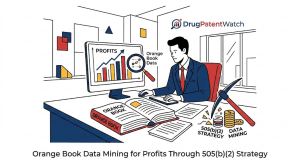
The pharmaceutical industry is trapped in a pincer movement. On one side, the cost of developing a new molecular entity through the 505(b)(1) pathway has passed $2.6 billion, and late-stage failure rates remain high. On the other side, the 505(j) generic market is a race to the bottom where price erosion leaves little room for margins. Between these extremes is the 505(b)(2) regulatory pathway. This mechanism allows firms to turn existing molecules into differentiated, branded assets with reduced risk, lower costs, and faster timelines.
As the industry prepares for a massive loss of exclusivity wave, the ability to innovate on established science is mandatory. We use data mining on the FDA Orange Book and patent landscapes via DrugPatentWatch to find opportunities to repurpose or combine existing drugs. This report analyzes the 505(b)(2) pathway, the mechanics of mining the Orange Book, and the case studies defining the modern market.
The Economic Crisis of Innovation
Modern drug development is defined by high investment and low returns. The traditional model of blockbuster discovery often fails to meet the economic requirements of shareholders.
The $2.6 Billion Gamble
Traditional drug development via the 505(b)(1) pathway is for novel drugs that have not been studied or approved. This pathway requires the sponsor to conduct all studies needed to prove safety and efficacy, including Phase 1, 2, and 3 trials. The timeline to market for a new chemical entity is often 10 to 15 years. This consumes most of a patent’s life before revenue begins. Our analysis of development costs shows that the 505(b)(1) route requires thousands of patients and decade-long commitments that many small biotechs cannot afford.
The Commodity Death Spiral
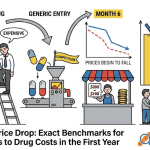
The 505(j) pathway, or Abbreviated New Drug Application (ANDA), focuses on bioequivalence. While this route is low-cost, it results in a commodity product with no brand differentiation. When ten or more generic competitors enter a market, prices drop by 70% to 95%. This leaves only high-volume manufacturers capable of profit. We find that firms are abandoning generic strategies for value-added medicines to escape this pricing pressure.
The Regulatory Middle Ground
The 505(b)(2) pathway was created by the Hatch-Waxman Amendments of 1984 to stop the duplication of studies. It allows a sponsor to create a differentiated product by relying on the FDA’s previous findings of safety for a reference listed drug (RLD) or on published literature.
505(b)(1) vs. 505(b)(2) Mechanics
A 505(b)(2) application is an NDA but shares traits with an ANDA. Like an ANDA, it references an existing approved drug. Unlike an ANDA, it does not require sameness and allows for new dosage forms, strengths, or combinations. A 505(b)(1) contains reports where the studies are conducted by the applicant. A 505(b)(2) also contains full reports, but some information comes from studies not conducted by the applicant. This allows developers to bridge their product to existing data through small studies rather than repeating massive trials.
The Hybrid Advantage
The 505(j) pathway is for duplicates. A generic must have the same active ingredient, route, dosage form, and strength as the RLD. If a developer changes any factor, they must use the 505(b)(2) pathway. This regulatory hurdle for generics is an opportunity for 505(b)(2) developers to create proprietary versions of off-patent molecules. We see this hybrid route as a way to gain three to seven years of market exclusivity without the billion-dollar cost of an NCE.
Feature
505(b)(1) NDA
505(b)(2) NDA
505(j) ANDA
Innovation Category
New Molecular Entity
Improved/Modified Drug
Bioequivalent Generic
Clinical Requirement
Full Phase 1, 2, and 3
Bridging Studies (PK/BE)
Bioequivalence only
Development Cost
$1B – $2.6B+
$8M – $200M
$1M – $5M
Timeline to Market
10 – 15 Years
3 – 7 Years
1 – 2 Years
Exclusivity
5-7 Years
0, 3, 5, or 7 Years
180 Days (if first)
Reliance on RLD Data
None
Partial
Full
Mining the Orange Book for Alpha
The FDA Orange Book is the primary resource for 505(b)(2) strategy. It contains approved prescription drugs, OTC products, and discontinued drugs, with their patents and exclusivities.
Understanding RLD and RS Designations
The Reference Listed Drug (RLD) is the product the FDA identifies as the one an applicant relies on for an abbreviated application. Data mining involves identifying RLDs with high sales but weak secondary patents. If the RLD is discontinued, the FDA designates a “Reference Standard” (RS) for bioequivalence testing. Identifying a discontinued RLD with a designated RS can reveal a market with no branded competition but a clear regulatory path.
Therapeutic Equivalence Strategy
Therapeutic Equivalence (TE) codes explain substitution risk. “A” codes mean a product is substitutable, while “B” codes mean it is not. A 505(b)(2) applicant often tries to either get an “AB” rating to be a “branded generic” or avoid it to be a “differentiated brand” requiring a new prescription. We find that DrugPatentWatch data helps firms determine if their formulation changes will trigger a “B” rating, which protects against automatic generic substitution but requires more marketing effort.
Predictive Modeling for Market Entry
Advanced data mining goes beyond manual searches. We use predictive modeling to anticipate patent challenges and market entry windows.
Random Forest and Elastic Net Applications
Research shows that patent challenges can be predicted with over 80% accuracy using machine learning. Researchers used Random Forest and Elastic Net models on drugs approved between 2007 and 2018 to find factors in a Paragraph IV challenge. Random Forest models used thousands of trees and an mtry of 3 to optimize performance. Elastic Net models accounted for collinearity between market size and patent counts. These models prioritize molecules for 505(b)(2) development based on the likelihood of winning a legal challenge.
Variables of Patent Challenge
The primary predictor of a patent challenge is market value; large markets increase the likelihood of a challenge. Drugs with “fast-track” status or those in the anti-infective class are less likely to face Paragraph IV challenges. This intelligence allows a firm to select targets with less competition.
Prediction Metric
Result
Accuracy in Predicting Challenges
>80%
Primary Positive Predictor
Market Size (Sales)
Primary Negative Predictor
Fast-track Status, Anti-infectives
Challenge Prevalence
55% of drugs challenged by Year 4
Preferred Model
Random Forest (mtry=3)
Intellectual Property Defense and Offense
A 505(b)(2) strategy involves navigating barriers that would block a generic.
Circumventing 180-Day Exclusivity
In the ANDA pathway, the first company to file a Paragraph IV certification gets 180 days of market exclusivity, blocking others. A 505(b)(2) applicant circumvents this by filing for a different version of the drug. Because the 505(b)(2) is an NDA, it is not blocked by the first-filer’s exclusivity. Dr. Reddy’s used this by filing a 505(b)(2) for amlodipine maleate to compete with Norvasc, bypassing the exclusivity of the first amlodipine besylate ANDA filer.
Avoiding the 30-Month Stay
A Paragraph IV certification usually triggers a 30-month stay on FDA approval. 505(b)(2) applicants avoid this by choosing their RLD carefully. If an applicant references an older, off-patent version, they do not file a Paragraph IV and avoid the stay. Hikma did this for Mitigare by referencing an off-patent product instead of the brand Colcrys, launching while others were in court.
Case Study: The Suboxone Hard Switch
The Suboxone case shows the risk of “product hopping,” where a brand switches patients to a new patented version just before exclusivity ends.
Indivior’s Antitrust Liability
Indivior developed a sublingual film version of Suboxone via the 505(b)(2) pathway. Once approved, the company used its sales force to disparage the tablets, claiming they were less safe for children than the film. The company then raised the price of the tablets and planned their removal from the market to force a switch.
The Cost of Coercion
Courts found this behavior anticompetitive. While new products are legal, Indivior combined the launch with the threatened removal of the old product and fabricated safety concerns. This resulted in a $50 million settlement with the FTC and a $10 million settlement for Indivior. We conclude that 505(b)(2) is for life cycle management, but it must not eliminate consumer choice.
Case Study: Aristada’s Dosing Advantage
Aristada (aripiprazole lauroxil) used the 505(b)(2) pathway to create clinical differentiation and commercial value.
Prodrug Chemistry as a Moat
Abilify Maintena is limited to monthly dosing. Alkermes used the 505(b)(2) pathway to launch Aristada with dosing intervals of 4, 6, or 8 weeks. This helps schizophrenia patients with adherence issues. Aristada is a prodrug that converts to active aripiprazole. The approval was based on a Phase 3 trial showing symptom palliation compared to placebo.
Differentiating from Abilify Maintena
By offering dosing Abilify Maintena could not match, Aristada carved out a market niche. Our analysis of the competitive landscape shows that Aristada achieved significant market share by solving the “ready-to-use” and “extended-duration” needs of clinics.
Feature
Abilify Maintena
Aristada
Active Ingredient
Aripiprazole Monohydrate
Aripiprazole Lauroxil
Dosage Form
Powder (Requires water)
Ready-to-use Suspension
Dosing Interval
4 weeks
4, 6, or 8 weeks
Conversion
Active directly
Prodrug conversion
Case Study: Namzaric Combination Moats
Namzaric is a fixed-dose combination (FDC) of memantine and donepezil for Alzheimer’s.
Bridging Studies for FDCs
The 505(b)(2) strategy for Namzaric was based on improving compliance. The FDA did not require new efficacy trials because it relied on data for the individual components. The clinical work focused on proving the FDC capsule was bioequivalent to the individual pills taken together.
Lifecycle Extension
Allergan used the MEM-MD-50 study, showing that memantine plus a cholinesterase inhibitor provided cognitive benefits. This allowed the company to market a branded combination protected by patents and exclusivity even as the individual drugs faced generic competition.
The 2024 FTC Enforcement Shift
The regulatory environment in 2024 and 2025 is hostile toward certain tactics, especially “junk” patent listings in the Orange Book.
Lina Khan and Device Patents
The FTC has challenged over 100 patent listings held by major firms. These challenges target patents that do not claim the drug, such as patents on inhaler caps or epi-pen drive mechanisms. The FTC’s delisting campaign has forced companies to remove these patents, stopping the 30-month stay and allowing 505(b)(2) competitors to enter sooner.
Impact on Inhalers and Epi-Pens
Challenges to inhaler patents led some firms to cut costs for patients to $35. 505(b)(2) strategists must now distinguish between robust formulation patents and weak device patents likely to be challenged by the FTC.
The Technical Execution of 505(b)(2)
A 505(b)(2) is faster and cheaper, but CMC issues are the leading cause of failure.
Bridging and PK Data
The “scientific bridge” is the set of studies proving that the safety data of the RLD applies to the new product. Establishing this bridge is the core of the submission. If the FDA disagrees with the bridge, it may demand new trials, adding $3 million to $5 million in costs.
CMC Risks and Multi-Cycle Reviews
Over 73% of multi-cycle 505(b)(2) applications are delayed by CMC issues. This includes stability and analytical method problems. Because 505(b)(2) products use novel formulations, they face higher scrutiny than generic tablets.
Global Strategy and Harmonization
Drug developers must look beyond the US to maximize the value of 505(b)(2) assets.
US vs. EU Regulatory Barriers
The EU has different standards for “inventive step” and “novelty”. While the US allows patent thickets, India’s Section 3(d) blocks most evergreening strategies. A global 505(b)(2) strategy must account for these regional differences.
GDUFA III and 2025 Fees
The fees for 2025 are substantial. An ANDA filing fee is $321,920, and annual program fees for large companies exceed $1.8 million. These costs make the “right-first-time” strategy of 505(b)(2) more attractive than multiple failed generic attempts.
GDUFA Fee Type (FY 2025)
Amount
ANDA Filing Fee
$321,920
DMF Fee
$95,084
Annual Program Fee (Large)
$1,891,664
Domestic API Facility Fee
$41,580
Foreign FDF Facility Fee
$246,952
Strategic Recommendations
We recommend a four-pillar approach to 505(b)(2) development. First, use DrugPatentWatch to map the patent cliff, accounting for PTE and pediatric exclusivity. Second, select molecules with high sales but weak secondary patents. Third, engage the FDA in a pre-IND meeting to confirm the bridging strategy and minimize required studies. Fourth, invest in CMC and stability early to avoid multi-cycle delays.
Key Takeaways
The 505(b)(2) pathway reduces capital expenditure by 70% to 90% compared to traditional NDAs.
Market entry is achieved in 2 to 3 years, a significant advantage over the 10-year NCE timeline.
Predictive modeling using Random Forest algorithms forecasts patent challenges with 80% accuracy.
The 2024-2025 regulatory shift by the FTC is dismantling “junk” device patents to promote competition.
CMC issues cause 73% of delays, making technical execution as important as regulatory strategy.
FAQ
What is the difference between 505(b)(2) and a branded generic? A branded generic can be an ANDA with a trade name or a 505(b)(2) that is therapeutically equivalent to the RLD. A 505(b)(2) branded generic usually has a modification that allows it to bypass generic exclusivity barriers.
Can a 505(b)(2) drug get 5-year NCE exclusivity? Yes. If the product contains an active moiety that has not been approved before, such as a specific prodrug or deuterated version, it can qualify for 5 years of exclusivity.
What are the primary causes of 505(b)(2) delays? Chemistry, Manufacturing, and Controls (CMC) issues are the leading cause, accounting for over 73% of multi-cycle applications. Strategy issues and bioequivalence bridging problems follow.
How do 2025 GDUFA fees impact small biotechs? Fees are rising, with ANDA filings costing over $320,000. This makes the 505(b)(2) route more attractive because it often requires fewer total submissions and offers higher revenue potential through exclusivity.
Why is market size the best predictor of a patent challenge? Larger markets offer higher ROI for generic and 505(b)(2) challengers, justifying the high legal costs of a Paragraph IV challenge. We find that drugs with over $100 million in annual sales are almost always challenged.