There’s a particular moment in modern medicine that produces more confusion than almost anything else in healthcare. It happens somewhere between the doctor’s office and the pharmacy register.
A patient looks at the label. The name is different. The pill is a different color. The price has changed wildly. Maybe insurance suddenly prefers another version. Maybe a pharmacist mentions “authorized generic.” Maybe TikTok says the generic doesn’t work as well. And suddenly everyone is asking the same question:
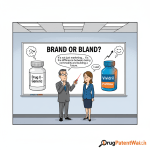
What’s the real difference between a brand-name drug and a generic?
Spend enough time looking through the questions people ask online and you realize this is not a niche concern. It’s one of the defining anxieties of the pharmaceutical era. Patients are trying to reverse-engineer the drug industry in real time — through copays, side effects, shortages, and package inserts.
At DrugChatter, the volume of “generic vs. brand” questions reveals something important: people are not just asking whether two products are chemically equivalent. They’re asking whether the healthcare system itself is trustworthy.
And the questions get surprisingly specific.
“Is there a generic yet?” may be the most financially loaded sentence in medicine
The modern blockbuster drug economy practically guarantees this question appears the second a therapy becomes successful.
Consider the relentless interest around GLP-1 drugs:
These aren’t merely pharmacology questions. They’re economic forecasting.
Patients know instinctively that the arrival of a generic can redraw the financial map overnight. Lipitor became atorvastatin. Prilosec became omeprazole. The price collapse after patent expiry is one of the few genuinely predictable events in healthcare economics.
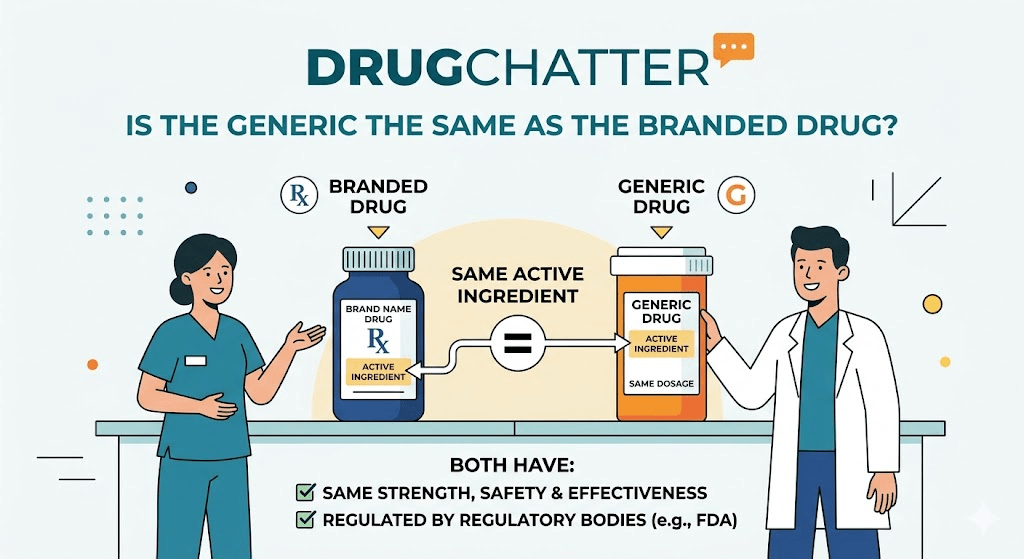
Scientifically, generics are required to demonstrate bioequivalence. But “bioequivalent” is a regulatory term, not an emotional one.
Patients notice fillers. Manufacturing changes. Tablet coatings. In rare cases they notice tolerability differences. Sometimes it’s pharmacology. Sometimes it’s nocebo effects. Sometimes it’s supply-chain inconsistency masquerading as clinical variability.
And because cholesterol drugs are taken for years, even tiny perceived changes become psychologically enormous.
That’s why the surrounding questions become almost anthropological:
At some point, the distinction between “drug information” and “insurance navigation” collapsed completely.
Patients now need to understand:
formulary tiers
prior authorization
manufacturer assistance
accumulator adjusters
rebate structures
generic launch timing
coupon exclusions
All before swallowing the first capsule.
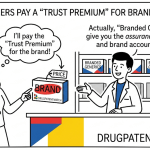
No wonder the internet keeps asking whether the brand-name version is somehow “better.” In many cases, the brand version simply has a better support infrastructure.
The pharmacy shelf has become a globalized maze
Another recurring pattern: patients are increasingly aware that “generic” also means “manufactured somewhere else.”
Pharmaceutical branding helped create this mindset. The industry spent decades differentiating products aggressively. Now patients expect meaningful distinctions everywhere — even when chemistry says otherwise.
The uncomfortable truth: sometimes the difference is mostly economic
The answer patients least want to hear is also often the correct one.
For many traditional small-molecule drugs, the clinical differences between brand and generic are minimal. FDA bioequivalence standards exist for a reason.
But the experience of taking the drug can still differ because:
insurance coverage changes adherence
pill appearance changes confidence
pharmacy substitution changes expectations
side-effect attribution changes perception
availability changes continuity
copays change whether treatment happens at all
In other words, the molecule may be identical while the healthcare experience is radically different.
And patients know this intuitively.
That’s why so many questions that superficially look like chemistry questions are actually trust questions:
Can I rely on this?
Will it still work?
Is cheaper secretly worse?
Is “equivalent” really equivalent?
The modern pharmaceutical market has trained people to ask those questions.