LEVETIRACETAM - Generic Drug Details
✉ Email this page to a colleague
What are the generic sources for levetiracetam and what is the scope of freedom to operate?
Levetiracetam
is the generic ingredient in six branded drugs marketed by Ucb Inc, Am Regent, Baxter Hlthcare Corp, Epic Pharma Llc, Eugia Pharma, Fresenius Kabi Usa, Hainan Poly Pharm, Hikma Farmaceutica, Hospira Inc, Jubilant Generics, Knack, Micro Labs, MSN, Mylan Labs Ltd, Prinston Inc, Sagent Pharms, Sun Pharm Inds Ltd, Xgen Pharms, B Braun Medical, Caplin, Gland, Hikma, Hq Spclt Pharma, Nexus, Actavis Mid Atlantic, Ajenat Pharms, Alembic, Amneal Pharms, Anda Repository, Apotex Inc, Aurobindo Pharma, Bionpharma, Chartwell Molecular, Hetero Labs Ltd Iii, Lupin Ltd, Pharm Assoc, Pharmobedient Cnsltg, Quagen, Strides Pharma, Taro, Tolmar, Tripoint, Actavis Elizabeth, Actavis Labs Fl Inc, Adaptis, Aiping Pharm Inc, Apotex, Aurobindo Pharma Usa, Chartwell Rx, Hisun Pharm Hangzhou, Lotus Pharm Co Ltd, Overseas, Ph Health, Pharmadax, Rouses Point Pharms, Sandoz, Sciegen Pharms, Sun Pharm, Sun Pharm Industries, Teva Pharms, Torrent Pharms Ltd, Aprecia Pharms, Accord Hlthcare, Alkem Labs Ltd, China Resources, Fosun Pharma, Granules, Ingenus Pharms Llc, Invagen Pharms, Lupin, Mpp Pharma, Mylan, Novax, Orbion Pharms, Oxford Pharms, Rising, Senores Pharms, Torrent Pharms, Watson Labs Inc, Zhejiang Jingxin, and Zydus Pharms Usa Inc, and is included in one hundred and thirteen NDAs. There are ten patents protecting this compound and two Paragraph IV challenges. Additional information is available in the individual branded drug profile pages.Eighty-eight suppliers are listed for this compound. There is one tentative approval for this compound.
Summary for LEVETIRACETAM
| International Patents: | 92 |
| US Patents: | 10 |
| Tradenames: | 6 |
| Applicants: | 81 |
| NDAs: | 112 |
| Finished Product Suppliers / Packagers: | 87 |
| Raw Ingredient (Bulk) Api Vendors: | 1 |
| Clinical Trials: | 249 |
| Patent Applications: | 7,146 |
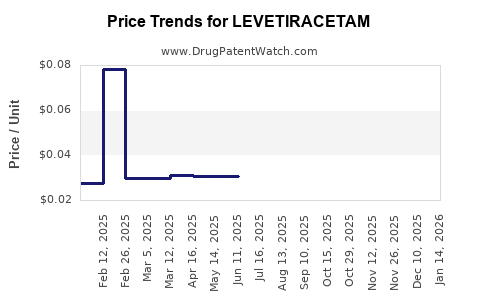
| Drug Prices: | Drug price trends for LEVETIRACETAM |
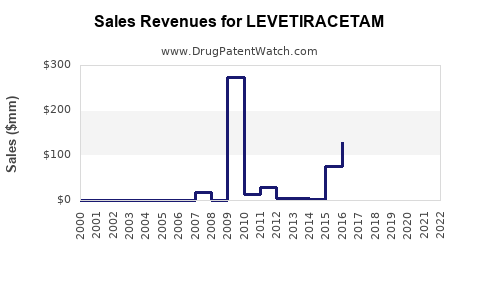
| Drug Sales Revenues: | Drug sales revenues for LEVETIRACETAM |
| Patent Litigation and PTAB cases: | See patent lawsuits and PTAB cases for LEVETIRACETAM |
| What excipients (inactive ingredients) are in LEVETIRACETAM? | LEVETIRACETAM excipients list |
| DailyMed Link: | LEVETIRACETAM at DailyMed |
Recent Clinical Trials for LEVETIRACETAM
Identify potential brand extensions & 505(b)(2) entrants
| Sponsor | Phase |
|---|---|
| Hospices Civils de Lyon | PHASE3 |
| Mansoura University | PHASE4 |
| Beijing Tiantan Hospital | PHASE3 |
Generic filers with tentative approvals for LEVETIRACETAM
| Applicant | Application No. | Strength | Dosage Form |
| ⤷ Start Trial | ⤷ Start Trial | 500MG | TABLET;ORAL |
| ⤷ Start Trial | ⤷ Start Trial | 1GM | TABLET;ORAL |
| ⤷ Start Trial | ⤷ Start Trial | 750MG | TABLET;ORAL |
The 'tentative' approval signifies that the product meets all FDA standards for marketing, and, but for the patents / regulatory protections, it would approved.
Pharmacology for LEVETIRACETAM
| Physiological Effect | Decreased Central Nervous System Disorganized Electrical Activity |
Anatomical Therapeutic Chemical (ATC) Classes for LEVETIRACETAM
Paragraph IV (Patent) Challenges for LEVETIRACETAM
| Tradename | Dosage | Ingredient | Strength | NDA | ANDAs Submitted | Submissiondate |
|---|---|---|---|---|---|---|
| KEPPRA XR | Extended-release Tablets | levetiracetam | 1000 mg | 022285 | 2 | 2011-01-07 |
| KEPPRA | Tablets | levetiracetam | 1000 mg | 021035 | 1 | 2007-01-24 |
US Patents and Regulatory Information for LEVETIRACETAM
| Applicant | Tradename | Generic Name | Dosage | NDA | Approval Date | TE | Type | RLD | RS | Patent No. | Patent Expiration | Product | Substance | Delist Req. | Exclusivity Expiration |
|---|---|---|---|---|---|---|---|---|---|---|---|---|---|---|---|
| Senores Pharms | LEVETIRACETAM | levetiracetam | TABLET;ORAL | 076920-001 | Jan 15, 2009 | AB | RX | No | No | ⤷ Start Trial | ⤷ Start Trial | ⤷ Start Trial | |||
| Tripoint | ELEPSIA XR | levetiracetam | TABLET, EXTENDED RELEASE;ORAL | 204417-001 | Dec 20, 2018 | DISCN | Yes | No | ⤷ Start Trial | ⤷ Start Trial | Y | ⤷ Start Trial | |||
| Hetero Labs Ltd Iii | LEVETIRACETAM | levetiracetam | TABLET;ORAL | 090515-004 | Oct 8, 2010 | AB | RX | No | No | ⤷ Start Trial | ⤷ Start Trial | ⤷ Start Trial | |||
| Sciegen Pharms | LEVETIRACETAM | levetiracetam | TABLET;ORAL | 215069-004 | May 27, 2022 | AB | RX | No | No | ⤷ Start Trial | ⤷ Start Trial | ⤷ Start Trial | |||
| Zydus Pharms Usa Inc | LEVETIRACETAM | levetiracetam | TABLET;ORAL | 078918-002 | Apr 29, 2009 | AB | RX | No | No | ⤷ Start Trial | ⤷ Start Trial | ⤷ Start Trial | |||
| Gland | LEVETIRACETAM IN SODIUM CHLORIDE | levetiracetam | INJECTABLE;INTRAVENOUS | 206880-003 | Oct 25, 2017 | AP | RX | No | No | ⤷ Start Trial | ⤷ Start Trial | ⤷ Start Trial | |||
| >Applicant | >Tradename | >Generic Name | >Dosage | >NDA | >Approval Date | >TE | >Type | >RLD | >RS | >Patent No. | >Patent Expiration | >Product | >Substance | >Delist Req. | >Exclusivity Expiration |
Expired US Patents for LEVETIRACETAM
| Applicant | Tradename | Generic Name | Dosage | NDA | Approval Date | Patent No. | Patent Expiration |
|---|---|---|---|---|---|---|---|
| Ucb Inc | KEPPRA | levetiracetam | TABLET;ORAL | 021035-001 | Nov 30, 1999 | ⤷ Start Trial | ⤷ Start Trial |
| Aprecia Pharms | SPRITAM | levetiracetam | TABLET, FOR SUSPENSION;ORAL | 207958-002 | Jul 31, 2015 | ⤷ Start Trial | ⤷ Start Trial |
| Aprecia Pharms | SPRITAM | levetiracetam | TABLET, FOR SUSPENSION;ORAL | 207958-002 | Jul 31, 2015 | ⤷ Start Trial | ⤷ Start Trial |
| Aprecia Pharms | SPRITAM | levetiracetam | TABLET, FOR SUSPENSION;ORAL | 207958-001 | Jul 31, 2015 | ⤷ Start Trial | ⤷ Start Trial |
| Ucb Inc | KEPPRA | levetiracetam | SOLUTION;ORAL | 021505-001 | Jul 15, 2003 | ⤷ Start Trial | ⤷ Start Trial |
| Aprecia Pharms | SPRITAM | levetiracetam | TABLET, FOR SUSPENSION;ORAL | 207958-001 | Jul 31, 2015 | ⤷ Start Trial | ⤷ Start Trial |
| >Applicant | >Tradename | >Generic Name | >Dosage | >NDA | >Approval Date | >Patent No. | >Patent Expiration |
EU/EMA Drug Approvals for LEVETIRACETAM
| Company | Drugname | Inn | Product Number / Indication | Status | Generic | Biosimilar | Orphan | Marketing Authorisation | Marketing Refusal |
|---|---|---|---|---|---|---|---|---|---|
| UCB Pharma SA | Keppra | levetiracetam | EMEA/H/C/000277Keppra is indicated as monotherapy in the treatment of partial-onset seizures with or without secondary generalisation in patients from 16 years of age with newly diagnosed epilepsy.Keppra is indicated as adjunctive therapy:in the treatment of partial-onset seizures with or without secondary generalisation in adults, children and infants from one month of age with epilepsy;in the treatment of myoclonic seizures in adults and adolescents from 12 years of age with juvenile myoclonic epilepsy;in the treatment of primary generalised tonic-clonic seizures in adults and adolescents from 12 years of age with idiopathic generalised epilepsy. | Authorised | no | no | no | 2000-09-29 | |
| Pfizer Europe MA EEIG | Levetiracetam Hospira | levetiracetam | EMEA/H/C/002783Levetiracetam Hospira is indicated as monotherapy in the treatment of partial onset seizures with or without secondary generalisation in adults and adolescents from 16 years of age with newly diagnosed epilepsy.Levetiracetam Hospira is indicated as adjunctive therapyin the treatment of partial onset seizures with or without secondary generalisation in adults, adolescents and children from 4 years of age with epilepsy.in the treatment of myoclonic seizures in adults and adolescents from 12 years of age with Juvenile Myoclonic Epilepsy.in the treatment of primary generalised tonic-clonic seizures in adults and adolescents from 12 years of age with Idiopathic Generalised Epilepsy.Levetiracetam Hospira concentrate is an alternative for patients when oral administration is temporarily not feasible. | Authorised | yes | no | no | 2014-01-07 | |
| Accord Healthcare S.L.U. | Levetiracetam Accord | levetiracetam | EMEA/H/C/002290Levetiracetam is indicated as monotherapy in the treatment of partial-onset seizures with or without secondary generalisation in patients from 16 years of age with newly diagnosed epilepsy.Levetiracetam is indicated as adjunctive therapy:in the treatment of partial-onset seizures with or without secondary generalisation in adults, children and infants from one month of age with epilepsy;in the treatment of myoclonic seizures in adults and adolescents from 12 years of age with juvenile myoclonic epilepsy;in the treatment of primary generalised tonic-clonic seizures in adults and adolescents from 12 years of age with idiopathic generalised epilepsy. | Authorised | yes | no | no | 2011-10-03 | |
| Pharmathen S.A. | Matever | levetiracetam | EMEA/H/C/002024Matever is indicated as monotherapy in the treatment of partial-onset seizures with or without secondary generalisation in patients from 16 years of age with newly diagnosed epilepsy.Matever is indicated as adjunctive therapy:in the treatment of partial-onset seizures with or without secondary generalisation in adults, children and infants from one month of age with epilepsy;in the treatment of myoclonic seizures in adults and adolescents from 12 years of age with juvenile myoclonic epilepsy;in the treatment of primary generalised tonic-clonic seizures in adults and adolescents from 12 years of age with idiopathic generalised epilepsy. | Authorised | yes | no | no | 2011-10-03 | |
| Actavis Group PTC ehf | Levetiracetam Actavis | levetiracetam | EMEA/H/C/002355Levetiracetam Actavis is indicated as monotherapy in the treatment of partial-onset seizures with or without secondary generalisation in patients from 16 years of age with newly diagnosed epilepsy.Levetiracetam Actavis is indicated as adjunctive therapy:in the treatment of partial-onset seizures with or without secondary generalisation in adults, children and infants from one month of age with epilepsy;in the treatment of myoclonic seizures in adults and adolescents from 12 years of age with juvenile myoclonic epilepsy;in the treatment of primary generalised tonic-clonic seizures in adults and adolescents from 12 years of age with idiopathic generalised epilepsy. | Authorised | yes | no | no | 2011-10-03 | |
| Actavis Group PTC ehf | Levetiracetam Actavis Group | levetiracetam | EMEA/H/C/002305Levetiracetam Actavis Group is indicated as monotherapy in the treatment of partial-onset seizures with or without secondary generalisation in patients from 16 years of age with newly diagnosed epilepsy.Levetiracetam Actavis Group is indicated as adjunctive therapy:in the treatment of partial-onset seizures with or without secondary generalisation in adults, children and infants from 1 month of age with epilepsy;in the treatment of myoclonic seizures in adults and adolescents from 12 years of age with juvenile myoclonic epilepsy;in the treatment of primary generalised tonic-clonic seizures in adults and adolescents from 12 years of age with idiopathic generalised epilepsy. | Authorised | yes | no | no | 2011-12-04 | |
| >Company | >Drugname | >Inn | >Product Number / Indication | >Status | >Generic | >Biosimilar | >Orphan | >Marketing Authorisation | >Marketing Refusal |
International Patents for LEVETIRACETAM
| Country | Patent Number | Title | Estimated Expiration |
|---|---|---|---|
| Australia | 2014228990 | ⤷ Start Trial | |
| Australia | 2017202752 | ⤷ Start Trial | |
| Canada | 2906029 | ⤷ Start Trial | |
| China | 105188849 | ⤷ Start Trial | |
| China | 109908355 | 包含左乙拉西坦的快速分散剂型 (Rapid disperse dosage form containing levetiracetam) | ⤷ Start Trial |
| European Patent Office | 2968994 | FORME PHARMACEUTIQUE À DISPERSION RAPIDE CONTENANT DU LÉVÉTIRACÉTAM (RAPID DISPERSE DOSAGE FORM CONTAINING LEVETIRACETAM) | ⤷ Start Trial |
| >Country | >Patent Number | >Title | >Estimated Expiration |
Supplementary Protection Certificates for LEVETIRACETAM
| Patent Number | Supplementary Protection Certificate | SPC Country | SPC Expiration | SPC Description |
|---|---|---|---|---|
| 0162036 | C300028 | Netherlands | ⤷ Start Trial | PRODUCT NAME: LEVETIRACETAM; REGISTRATION NO/DATE: EU/1/00/146/001 - EU/1/00/146/026 20000929 |
| 0162036 | 2000C/032 | Belgium | ⤷ Start Trial | PRODUCT NAME: LEVETIRACETAM; NAT. REGISTRATION NO/DATE: EU/1/00/146/001 20000929; FIRST REGISTRATION: CH 55297 20000329 |
| >Patent Number | >Supplementary Protection Certificate | >SPC Country | >SPC Expiration | >SPC Description |
Levetiracetam Market Dynamics, Patent Expiration, Generic Competition, and Financial Trajectory
More… ↓
Make Better Decisions: Try a trial or see plans & pricing
Drugs may be covered by multiple patents or regulatory protections. All trademarks and applicant names are the property of their respective owners or licensors. Although great care is taken in the proper and correct provision of this service, thinkBiotech LLC does not accept any responsibility for possible consequences of errors or omissions in the provided data. The data presented herein is for information purposes only. There is no warranty that the data contained herein is error free. We do not provide individual investment advice. This service is not registered with any financial regulatory agency. The information we publish is educational only and based on our opinions plus our models. By using DrugPatentWatch you acknowledge that we do not provide personalized recommendations or advice. thinkBiotech performs no independent verification of facts as provided by public sources nor are attempts made to provide legal or investing advice. Any reliance on data provided herein is done solely at the discretion of the user. Users of this service are advised to seek professional advice and independent confirmation before considering acting on any of the provided information. thinkBiotech LLC reserves the right to amend, extend or withdraw any part or all of the offered service without notice.
ISSN: 2162-2639

Privacy and Cookies
Terms & Conditions
Site Map
DrugPatentWatch Alternatives
LOE / Major Patent Expirations 2026 - 2027
NCE-1 Patent Challenge Dates 2026 - 2027
Friedman, Yali. "DrugPatentWatch" DrugPatentWatch, thinkBiotech, 2026, www.DrugPatentWatch.com.
See Primary Research Papers Citing DrugPatentWatch