Sun Pharm Company Profile
✉ Email this page to a colleague
What is the competitive landscape for SUN PHARM
SUN PHARM has seven hundred and four approved drugs.
There are fifty-nine US patents protecting SUN PHARM drugs. There are twenty tentative approvals on SUN PHARM drugs.
Summary for Sun Pharm
| US Patents: | 59 |
| Tradenames: | 426 |
| Ingredients: | 388 |
| NDAs: | 704 |
| Patent Litigation for Sun Pharm: | See patent lawsuits for Sun Pharm |
| PTAB Cases with Sun Pharm as petitioner: | See PTAB cases with Sun Pharm as petitioner |
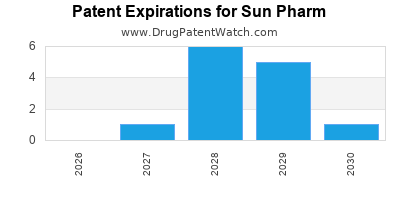
Drugs and US Patents for Sun Pharm
| Applicant | Tradename | Generic Name | Dosage | NDA | Approval Date | TE | Type | RLD | RS | Patent No. | Patent Expiration | Product | Substance | Delist Req. | Exclusivity Expiration |
|---|---|---|---|---|---|---|---|---|---|---|---|---|---|---|---|
| Sun Pharm Inds Inc | LISDEXAMFETAMINE DIMESYLATE | lisdexamfetamine dimesylate | CAPSULE;ORAL | 214484-006 | Aug 25, 2023 | AB | RX | No | No | ⤷ Start Trial | ⤷ Start Trial | ||||
| Sun Pharm | DRIZALMA SPRINKLE | duloxetine hydrochloride | CAPSULE, DELAYED REL PELLETS;ORAL | 212516-002 | Jul 19, 2019 | RX | Yes | No | 11,202,772 | ⤷ Start Trial | Y | ⤷ Start Trial | |||
| Sun Pharm Inds Ltd | RISPERIDONE | risperidone | TABLET, ORALLY DISINTEGRATING;ORAL | 077542-002 | Aug 6, 2010 | AB | RX | No | No | ⤷ Start Trial | ⤷ Start Trial | ||||
| Sun Pharm Inds Inc | ORTIKOS | budesonide | CAPSULE, DELAYED RELEASE;ORAL | 211929-002 | Jun 13, 2019 | DISCN | Yes | No | 9,707,182 | ⤷ Start Trial | Y | ⤷ Start Trial | |||
| Sun Pharm Industries | ERGOLOID MESYLATES | ergoloid mesylates | TABLET;SUBLINGUAL | 087407-001 | Approved Prior to Jan 1, 1982 | DISCN | No | No | ⤷ Start Trial | ⤷ Start Trial | |||||
| >Applicant | >Tradename | >Generic Name | >Dosage | >NDA | >Approval Date | >TE | >Type | >RLD | >RS | >Patent No. | >Patent Expiration | >Product | >Substance | >Delist Req. | >Exclusivity Expiration |
Expired US Patents for Sun Pharm
| Applicant | Tradename | Generic Name | Dosage | NDA | Approval Date | Patent No. | Patent Expiration |
|---|---|---|---|---|---|---|---|
| Sun Pharma Canada | FLO-PRED | prednisolone acetate | SUSPENSION;ORAL | 022067-001 | Jan 17, 2008 | 6,399,079 | ⤷ Start Trial |
| Sun Pharm Inds Inc | ABSORICA | isotretinoin | CAPSULE;ORAL | 021951-004 | May 25, 2012 | 7,435,427 | ⤷ Start Trial |
| Sun Pharm Industries | BACTRIM DS | sulfamethoxazole; trimethoprim | TABLET;ORAL | 017377-002 | Approved Prior to Jan 1, 1982 | RE28636 | ⤷ Start Trial |
| Sun Pharm Inds Inc | ABSORICA | isotretinoin | CAPSULE;ORAL | 021951-004 | May 25, 2012 | 8,367,102 | ⤷ Start Trial |
| Sun Pharm Inds Inc | ABSORICA | isotretinoin | CAPSULE;ORAL | 021951-003 | May 25, 2012 | 7,435,427 | ⤷ Start Trial |
| >Applicant | >Tradename | >Generic Name | >Dosage | >NDA | >Approval Date | >Patent No. | >Patent Expiration |
Paragraph IV (Patent) Challenges for SUN PHARM drugs
| Drugname | Dosage | Strength | Tradename | Submissiondate |
|---|---|---|---|---|
| ➤ Subscribe | Tablets | 125 mg | ➤ Subscribe | 2018-07-23 |
| ➤ Subscribe | Capsules | 20 mg | ➤ Subscribe | 2013-01-07 |
| ➤ Subscribe | Capsules | 25 mg | ➤ Subscribe | 2016-05-16 |
| ➤ Subscribe | Capsules | 35 mg | ➤ Subscribe | 2015-11-25 |
| ➤ Subscribe | Topical Spray | 0.25% | ➤ Subscribe | 2013-12-18 |
| ➤ Subscribe | Capsules | 20 mg | ➤ Subscribe | 2013-06-19 |
| ➤ Subscribe | Capsules | 30 mg and 40 mg | ➤ Subscribe | 2012-12-31 |
| ➤ Subscribe | Delayed-release Tablets | 20 mg | ➤ Subscribe | 2015-06-03 |
International Patents for Sun Pharm Drugs
| Country | Patent Number | Estimated Expiration |
|---|---|---|
| Brazil | PI0814163 | ⤷ Start Trial |
| South Korea | 20180021932 | ⤷ Start Trial |
| Slovenia | 2887923 | ⤷ Start Trial |
| Japan | 7586868 | ⤷ Start Trial |
| Turkey | 201909129 | ⤷ Start Trial |
| >Country | >Patent Number | >Estimated Expiration |
Supplementary Protection Certificates for Sun Pharm Drugs
| Patent Number | Supplementary Protection Certificate | SPC Country | SPC Expiration | SPC Description |
|---|---|---|---|---|
| 1453521 | 15C0050 | France | ⤷ Start Trial | PRODUCT NAME: ETHINYLESTRADIOL ET MELANGE DE LEVONORGESTREL ET ETHINYLESTRADIOL; NAT. REGISTRATION NO/DATE: NL 42237 20150320; FIRST REGISTRATION: SK - 17/0017/15-S 20150129 |
| 0817775 | 06C0010 | France | ⤷ Start Trial | PRODUCT NAME: ERLOTINIB HYDROCHLORIDE; NAT. REGISTRATION NO/DATE: EU/1/05/311/001 20050919; FIRST REGISTRATION: LI - 57266 20050321 |
| 2712622 | LUC00015 | Luxembourg | ⤷ Start Trial | PRODUCT NAME: DESMOPRESSINE OU UN DE SES SELS D'ACETATE; AUTHORISATION NUMBER AND DATE: 497271; 497280 20161101 |
| 1912999 | 1490062-5 | Sweden | ⤷ Start Trial | PRODUCT NAME: SIMEPREVIR, OR A SALT THEREOF, INCLUDING SIMEPREVIR SODIUM; REG. NO/DATE: EU/1/14/924 20140516 |
| 1758590 | LUC00029 | Luxembourg | ⤷ Start Trial | PRODUCT NAME: SEL DE SODIUM D'ACIDE DEOXYCHOLIQUE; AUTHORISATION NUMBER AND DATE: IS/1/16/071/01 20170401 |
| >Patent Number | >Supplementary Protection Certificate | >SPC Country | >SPC Expiration | >SPC Description |
Similar Applicant Names
Applicants may be listed under multiple names.
Here is a list of applicants with similar names.
Here is a list of applicants with similar names.
