Last updated: August 16, 2026
Keppra XR is the once-daily extended-release formulation of levetiracetam, marketed by UCB for adjunctive treatment of partial-onset seizures. Its commercial profile has shifted from branded growth product to mature neurology asset. Generic levetiracetam immediate-release products have long constrained the market, while generic extended-release competition has reduced the remaining price and volume premium for Keppra XR. UCB does not publicly report Keppra XR revenue separately from the broader Keppra franchise, so the product’s standalone financial trajectory cannot be calculated from company disclosures.[1]
What is Keppra XR and how does it compare with Keppra?
Keppra XR contains levetiracetam in an extended-release tablet designed for once-daily administration. Keppra, the original immediate-release product, is generally administered twice daily.
| Attribute |
Keppra XR |
Keppra immediate release |
| Active ingredient |
Levetiracetam |
Levetiracetam |
| Dosage form |
Extended-release tablet |
Immediate-release tablet |
| FDA approval |
2008 |
1999 |
| Typical administration |
Once daily |
Twice daily |
| Primary use |
Adjunctive treatment of partial-onset seizures |
Adjunctive treatment of partial-onset seizures and other labeled seizure indications |
| Original sponsor |
UCB |
UCB |
| Current market position |
Mature branded and generic extended-release product |
Predominantly generic market |
| FDA regulatory pathway for generics |
ANDA |
ANDA |
The clinical distinction is primarily dosing frequency and pharmacokinetic profile. The active ingredient is the same. That limits the ability of Keppra XR to maintain a large price premium after generic levetiracetam ER entry.
The FDA approved Keppra XR in September 2008 for adjunctive therapy in patients aged 16 years and older with partial-onset seizures at the time of approval. The product is available in 500 mg and 750 mg extended-release tablets.[2]
When did Keppra XR lose branded exclusivity?
Keppra XR’s branded exclusivity ended years before the current market period. FDA regulatory exclusivity and patent protection are separate legal concepts, and neither provided a durable barrier once generic manufacturers obtained approval or launched at risk.
| Milestone |
Timing |
Commercial effect |
| Keppra immediate-release approval |
1999 |
Established levetiracetam franchise |
| Keppra XR approval |
September 2008 |
Added once-daily formulation |
| New chemical entity exclusivity for XR |
Expired before the current market period |
Removed FDA exclusivity barrier |
| Generic levetiracetam IR entry |
2000s |
Created broad price pressure |
| Generic levetiracetam ER entry |
Subsequent period |
Directly reduced XR pricing and volume |
| Current status |
Mature genericized market |
Limited branded growth opportunity |
The precise launch date for each generic depends on the manufacturer, litigation outcome, settlement terms and whether the product entered through a Paragraph IV challenge, a Paragraph III certification or a later approval after patent expiry. FDA approval alone does not establish that a generic launched commercially.
What patents protect Keppra XR?
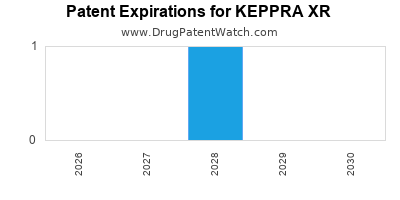
Keppra XR relied primarily on formulation and extended-release technology rather than a new active pharmaceutical ingredient. The core patent estate historically associated with Keppra XR included UCB patents covering extended-release levetiracetam formulations and related dosage forms.
Public patent records and FDA Orange Book listings should be read together because:
- The Orange Book identifies patents submitted for approved drug products.
- USPTO records establish prosecution history, continuations, patent-term adjustment and expiration calculations.
- Court records determine whether claims survived validity, infringement and enforceability challenges.
- A patent can remain in force without preventing an approved generic from launching if the generic does not infringe, if the patent is not listed for the relevant product, or if the parties settle.
| IP category |
Relevance to Keppra XR |
Commercial importance |
| Active-ingredient patents |
Limited for the mature levetiracetam market |
Low after expiry |
| Extended-release formulation patents |
Central protection for Keppra XR |
Historically high |
| Tablet-release and dosage-form claims |
May cover composition or release profile |
Relevant to ANDA litigation |
| Manufacturing patents |
Could affect production route or controls |
Usually secondary to formulation patents |
| Method-of-use patents |
Potentially relevant to seizure-treatment indications |
More limited for a broad generic product |
| Trademark rights |
Protect “Keppra XR” branding |
Do not prevent generic levetiracetam ER sales |
The patent estate was commercially valuable only while the formulation claims blocked or delayed generic extended-release entry. Once those barriers weakened, the brand’s ability to command a premium declined rapidly.
What is the Orange Book status of Keppra XR?
Keppra XR was subject to FDA Orange Book patent listings associated with its approved extended-release formulation. Orange Book listings are important in an ANDA challenge because a generic applicant must certify against listed patents.
The four principal certification categories are:
- Paragraph I: no patent information is listed.
- Paragraph II: the listed patent has expired.
- Paragraph III: the applicant will wait until patent expiration.
- Paragraph IV: the applicant asserts that the patent is invalid, unenforceable or not infringed.
A Paragraph IV certification can trigger patent litigation under the Hatch-Waxman Act. A timely patent suit may impose a statutory 30-month stay on final FDA approval, subject to statutory exceptions and court developments.[3]
Keppra XR’s market is now characterized by mature patent expiry and generic competition rather than an active branded defense strategy. Current Orange Book status should be evaluated using the FDA’s product-specific listing because patent entries, delistings and expiration calculations can change.
Which companies challenged or competed with Keppra XR?
Generic competition has come from manufacturers that develop levetiracetam extended-release tablets through the abbreviated new drug application pathway. The competitive field has included major generic companies and regional suppliers rather than a single dominant challenger.
Potential competitive dimensions include:
| Competitive factor |
Effect on Keppra XR |
| Number of approved ANDAs |
More suppliers generally increase price erosion |
| Launch timing |
Early entrants capture pharmacy and payer contracts |
| Tablet strengths |
500 mg and 750 mg availability supports substitution |
| Manufacturing reliability |
Shortages can temporarily support branded or secondary suppliers |
| Wholesaler access |
Determines retail and specialty-pharmacy penetration |
| Formulary treatment |
Generic tier placement reduces brand demand |
| Authorized generic strategy |
Can moderate third-party generic pricing |
The most important competitive threat was not another branded antiepileptic. It was substitution by generic levetiracetam, first in immediate-release form and later in extended-release form.
Briviact, another UCB antiseizure product containing brivaracetam, is a branded competitive reference within UCB’s neurology portfolio. It is not a direct formulation substitute for Keppra XR, but it competes for prescribing attention and UCB commercial resources.[1]
What is the financial trajectory of Keppra XR?
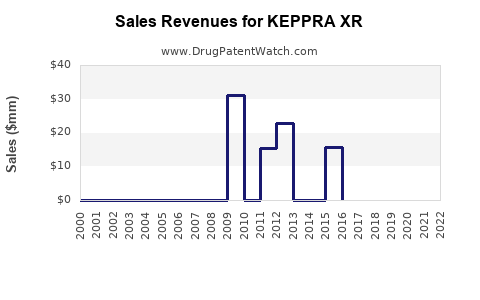
UCB does not disclose standalone net sales, gross margin, prescription volume or operating profit for Keppra XR. Its public reporting generally aggregates Keppra-related revenue or reports the product within broader portfolio categories. As a result, a product-level revenue series for Keppra XR is not available from UCB’s annual reports.
The financial trajectory can nevertheless be assessed through market structure:
1. Launch phase: differentiation through once-daily dosing
Keppra XR entered a market where levetiracetam was already widely recognized. Its commercial value came from dosing convenience and an extended-release formulation rather than a new mechanism.
The product likely supported incremental franchise retention, but its addressable market was constrained by the availability of low-cost immediate-release levetiracetam.
2. Maturity phase: limited premium durability
Once generic immediate-release levetiracetam became broadly available, physicians and payers had a lower-cost alternative containing the same active ingredient. Keppra XR could retain patients who valued once-daily dosing or who had adherence concerns, but that segment was narrower than the overall levetiracetam market.
3. Generic ER phase: rapid price compression
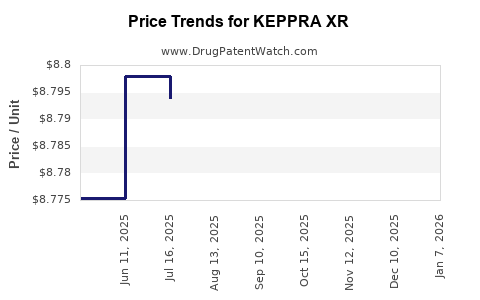
Generic extended-release products directly attacked the remaining differentiation. In a conventional oral-solid market, several approved suppliers can drive substantial reductions in average selling price. The branded product can continue to sell, but usually at lower volume and with greater rebate exposure.
4. Current phase: residual brand economics
Keppra XR’s remaining revenue is likely concentrated in:
- Patients who remain on the branded product;
- Prescribers with brand continuity preferences;
- Payers that permit brand dispensing under specific benefit designs;
- Markets where generic ER supply is limited;
- Patients with individualized tolerability or adherence considerations.
These segments generally do not support the revenue scale associated with an actively protected branded medicine.
How much revenue is exposed to generic Keppra XR competition?
The precise revenue exposure cannot be isolated from public UCB reporting. The more relevant exposure is franchise-level rather than product-level.
| Exposure area |
Assessment |
| Keppra XR volume |
Declining or mature after generic ER competition |
| Keppra XR price |
High downward pressure |
| Keppra immediate-release volume |
Predominantly genericized |
| Keppra franchise revenue |
Structurally declining from historical branded levels |
| UCB portfolio impact |
Manageable because UCB has diversified neurology products |
| Margin impact |
Greater than volume impact because generic substitution reduces net price |
| Pipeline replacement need |
High when mature products lose exclusivity |
Keppra was once a major UCB product. Its loss of exclusivity increased the company’s dependence on newer products, including Vimpat historically and Briviact, Fintepla and other growth assets in later periods. The commercial issue was therefore not only the decline of Keppra XR but the need to replace mature-product cash flow with newer protected medicines.[1]
What generic launch risks exist for Keppra XR?
Generic launch risk is high because levetiracetam is a well-established active ingredient with extensive clinical use and a conventional oral tablet presentation.
Generic substitution risk
Pharmacists and payers can substitute an approved generic where state law, prescription instructions and payer policy permit. Generic substitution is especially likely when:
- The generic has AB-equivalent status;
- The product is available in the same strengths;
- The payer assigns the generic to a preferred tier;
- The brand requires prior authorization;
- The brand carries a materially higher copayment.
Supply-chain risk
The main countervailing factor is supply reliability. If a generic manufacturer experiences manufacturing disruption, recalls or shortages, branded demand can temporarily stabilize. This does not create durable pricing power unless shortages persist.
Clinical switching risk
Switching between formulations requires attention to dosing frequency and release characteristics. Immediate-release and extended-release levetiracetam are not interchangeable on a simple tablet-for-tablet basis. The prescribing instructions and total daily dose must be maintained appropriately.
What formulation patents and method-of-use patents matter?
Formulation patents historically carried more commercial weight than method-of-use patents for Keppra XR.
Formulation patents
These may claim:
- Extended-release levetiracetam tablets;
- Release-controlling matrices;
- Drug loading and excipient relationships;
- Dissolution profiles;
- Tablet architecture;
- Manufacturing processes that produce the claimed release characteristics.
A generic applicant can avoid infringement by using a different formulation, although the product still must satisfy FDA performance requirements.
Method-of-use patents
Method patents may cover use of levetiracetam for particular seizure types, patient groups or dosing regimens. Their value depends on claim breadth and whether the relevant indication can be carved out of the generic label.
Method-of-use patents are generally less powerful against a broadly prescribed antiseizure product than formulation patents. A generic manufacturer may use a skinny label that omits patented indications, subject to the Orange Book, inducement and product-labeling rules.
Does biosimilar risk apply to Keppra XR?
No. Keppra XR is a chemically synthesized small-molecule drug, not a biologic. Its generic competition proceeds through the ANDA pathway rather than the biosimilar pathway under the Public Health Service Act.
The relevant risks are:
- ANDA approval;
- Paragraph IV patent litigation;
- Abbreviated labeling;
- AB-rating and pharmacy substitution;
- Generic price competition;
- Manufacturing and supply reliability.
Biosimilar concepts such as reference-product exclusivity, interchangeability designation and the 351(k) pathway do not apply.
What litigation and settlement issues affect Keppra XR?
Keppra XR generic litigation would typically involve UCB or an affiliated patent holder suing an ANDA applicant after receiving a Paragraph IV notice. The main issues would be:
- Whether the asserted formulation claims are valid;
- Whether the generic product infringes;
- Whether the patent is enforceable;
- Whether the applicant can launch before patent expiry;
- Whether the parties settle and, if so, on what entry date.
Settlement agreements may provide a generic launch date before full patent expiry. The economic value of such a settlement depends on the number of challengers, the strength of the asserted patents, the remaining brand revenue and the expected litigation outcome.
A litigation review should distinguish between:
- A filed case and a final judgment;
- A patent listing and an enforceable blocking patent;
- FDA approval and commercial launch;
- An agreement to settle and actual generic market entry.
How does Keppra XR compare with competing antiseizure drugs?
| Product |
Molecule |
Dosing proposition |
Market status |
Main commercial threat |
| Keppra XR |
Levetiracetam ER |
Once daily |
Mature branded/generic |
Generic levetiracetam ER |
| Keppra |
Levetiracetam IR |
Usually twice daily |
Predominantly generic |
Low-cost substitution |
| Briviact |
Brivaracetam |
Branded oral and injectable options |
Protected branded franchise during relevant periods |
Newer therapies and payer controls |
| Lamictal |
Lamotrigine |
Immediate- and extended-release options |
Genericized |
Established generic competition |
| Topamax |
Topiramate |
Multiple dosage forms |
Genericized |
Broad generic availability |
| Vimpat |
Lacosamide |
Oral and injectable options |
Mature branded/generic transition |
Generic lacosamide |
Keppra XR’s commercial advantage was convenience, not superior exclusivity or a novel mechanism. That distinction matters because convenience-based differentiation is more vulnerable to payer pressure than a product with a unique clinical profile or no close generic alternative.
What is the geographic coverage of Keppra XR?
Keppra and levetiracetam products have broad international exposure, but product names, formulations, patent rights and generic entry dates vary by jurisdiction. U.S. Keppra XR economics cannot be extrapolated directly to Europe, Japan or emerging markets.
Key geographic variables include:
- National reimbursement policy;
- Reference pricing;
- Generic substitution rules;
- Local patent term;
- Supplementary protection certificates;
- Formulation approval requirements;
- Tender-based procurement;
- Local manufacturing and registration status.
In many markets, levetiracetam is available under generic names or local brand names. The U.S. product-specific brand premium is therefore only one component of the global franchise economics.
How strong is the Keppra XR patent estate?
The estate was commercially meaningful during the period when extended-release formulation patents could delay direct generic entry. Its present strength is limited by the age of the product, the maturity of levetiracetam science, the availability of generic immediate-release alternatives and the normal erosion of oral-solid-dose patents.
| Patent-strength factor |
Current assessment |
| Active ingredient protection |
Weak or expired for commercial purposes |
| Extended-release formulation protection |
Historically important; duration-dependent |
| Design-around difficulty |
Moderate, because levetiracetam ER can be formulated through multiple technologies |
| Litigation leverage |
Lower after patent expiry and multiple generic approvals |
| Regulatory switching barrier |
Low to moderate |
| Manufacturing barrier |
Low to moderate |
| Brand loyalty |
Limited relative to products with no generic equivalents |
The estate should be viewed as a historical revenue-protection mechanism rather than a durable barrier to entry.
Key Takeaways
- Keppra XR is UCB’s once-daily extended-release levetiracetam tablet, approved by FDA in 2008.
- Its commercial differentiation is dosing convenience, not a new active ingredient.
- Generic immediate-release levetiracetam established substantial price pressure before direct ER competition emerged.
- Generic extended-release levetiracetam has materially reduced Keppra XR’s remaining volume and price premium.
- UCB does not report standalone Keppra XR revenue, so product-level financial performance cannot be isolated from public filings.
- Formulation patents were more important than method-of-use patents.
- Biosimilar risk does not apply; the relevant pathway is ANDA approval and Hatch-Waxman litigation.
- Current value is concentrated in residual branded demand, supply continuity and limited patient or prescriber preference.
- The product’s financial trajectory is consistent with a mature, genericized oral-solid medicine rather than a growth asset.
FAQs
Is Keppra XR still sold in the United States?
Keppra XR has been marketed in the United States, while generic levetiracetam extended-release products compete with the brand. Product availability can vary by strength, manufacturer and supply conditions.
Can patients switch from Keppra XR to generic levetiracetam?
Patients can switch when the prescribing clinician and pharmacist determine that the formulation, total daily dose and release characteristics are appropriate. Extended-release and immediate-release products require different dosing instructions.
Is levetiracetam ER an authorized generic for Keppra XR?
An authorized generic is a branded product sold without the brand name or a product marketed under an agreement with the innovator. FDA approval of a generic levetiracetam ER product does not, by itself, establish that it is an authorized generic.
Did UCB lose all value from the Keppra franchise after generic entry?
No. A mature product can continue to generate residual revenue after generic entry, but the revenue is typically lower and more price-sensitive. The larger strategic effect is the reduction of cash flow available to fund UCB’s newer neurology products.
Does Keppra XR have orphan-drug exclusivity?
Keppra XR was approved for a seizure indication but is not generally treated as an orphan-biologic or orphan-drug franchise for current commercial analysis. The principal exclusivity questions concern small-molecule regulatory exclusivity and formulation patent protection.
References
- UCB. (Various years). Annual report and financial results. UCB S.A. https://www.ucb.com/investors
- U.S. Food and Drug Administration. (2008). Keppra XR prescribing information. https://www.accessdata.fda.gov/drugsatfda_docs/label/
- U.S. Food and Drug Administration. (2024). Approved drug products with therapeutic equivalence evaluations: Orange Book. https://www.accessdata.fda.gov/scripts/cder/ob/
- U.S. Food and Drug Administration. (2024). ANDA submissions: Patent certifications and 30-month stays under the Hatch-Waxman Amendments. https://www.fda.gov/drugs/abbreviated-new-drug-application-anda/
- U.S. Patent and Trademark Office. (2024). Patent Center. https://patentcenter.uspto.gov/