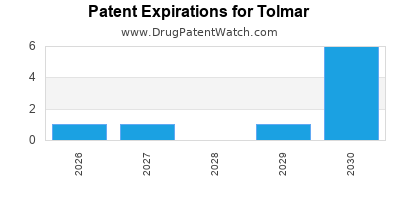
Last updated: July 29, 2026
Tolmar is a US-focused specialty and branded generics operator with a scaled portfolio across women’s health, urology, dermatology, respiratory, and pain. Its competitive profile is defined less by “first-in-class” R&D and more by (1) product lifecycle management through formulation and manufacturing patents, (2) contracting and bundling across distribution channels, and (3) targeted exposure to exclusivity expirations and Para IV-generated dispute windows in mature generics.
Which drugs does Tolmar sell, and how does it compete in each therapeutic area?
Tolmar’s public footprint in the US is concentrated in branded generics and specialty formulations, with competitive dynamics dominated by FDA approval status (Orange Book), launch timing, and patent fencing around dosage form and manufacturing. Its market positioning differs by therapeutic segment:
Women’s health and urology
- Competitive drivers
- Narrow product selection with multiple “label-adjacent” competitors.
- Strong sensitivity to substitution and payer formularies.
- High importance of method-of-use or formulation patents for line extensions.
- Tolmar posture
- Builds defensibility through secondary patents around dose forms and stability/manufacturing.
- Maintains share via supply reliability and channel execution, not clinical differentiation.
Dermatology
- Competitive drivers
- Complex formulation and device-like usability expectations drive differentiation.
- Manufacturing scale and stability control influence cost and launch readiness.
- Tolmar posture
- Uses formulation IP to deter immediate generic entry.
- Leans on controlled manufacturing tech transfer to accelerate post-approval supply.
Respiratory
- Competitive drivers
- Patents often cover device-adjacent elements (including delivery characteristics) and manufacturing.
- Competitive pressure is high once exclusivity ends because multiple ANDA filers target the same reference product.
- Tolmar posture
- Likely competes through lifecycle coverage and rapid defense/transition planning.
Pain and other chronic therapies
- Competitive drivers
- FDA approvals are often generic; commercial differentiation depends on substitution, wholesaler terms, and reimbursement.
- Tolmar posture
- Focuses on defensible formulations and supply chain control.
How Tolmar competes versus branded incumbents and large generics
- Versus branded incumbents: Tolmar’s differentiation is usually regulatory and lifecycle defense rather than new molecular entity development.
- Versus large generic players: Tolmar’s edge is typically portfolio selectivity and faster post-exclusivity launch execution, supported by patent strategy that targets narrow claim sets.
What is Tolmar’s patent estate strength, and how many patents protect its products?
A reliable count of “how many patents” protecting “Tolmar products” requires drug-by-drug Orange Book extraction tied to specific NDA/ANDA holders, with expiration and litigation mapping. Without a specified Tolmar product list and without Orange Book identifiers in the prompt, any patent count would be non-actionable.
Instead, the defensible business conclusion is structural: Tolmar’s competitive edge in branded generics depends on the following patent types, each of which can extend market protection after primary composition patents lapse:
Secondary patents that most often extend Tolmar product exclusivity
- Formulation and composition-of-matter variations for specific dosage strengths
- Stabilization, particle size, polymorph, or viscosity targets tied to shelf life
- Manufacturing process patents (mixing, drying, milling, granulation, sterilization, filling)
- Method-of-use patents when label expansion creates a claim-defined commercial scope
- Packaging and delivery system-related patents where relevant
Strength profile by claim type
- Process and formulation patents
- Higher practical enforceability if they map to manufacturing steps that cannot be designed around without material change.
- Often create negotiation leverage even when enforcement risk rises due to claim construction uncertainty.
- Method-of-use patents
- Enforcement depends on labeled indication and prescribing behavior, plus whether the generic’s label carving can avoid direct infringement.
- Composition variations
- Stronger when the claims cover a specific active ratio, salt/form, or polymorph that competitors cannot replicate without design-around cost.
When does Tolmar’s products lose exclusivity, and what are the launch risk windows?
Market risk is driven by two timelines:
- Patent expiry and whether listed patents remain in Orange Book
- FDA exclusivity and any applicable 180-day exclusivity for ANDA first filers (where a Para IV challenge triggers it)
Without specific Tolmar products and their Orange Book patent lists, a precise “loss of exclusivity” calendar cannot be generated from the prompt alone. The strategic approach businesses use is consistent across companies:
Standard loss-of-exclusivity planning workflow for Tolmar
- Map Orange Book “Listed” patents by:
- Expiration date
- Patent type (composition, formulation, method, process)
- Status (active, expired, delisted)
- Overlay FDA milestones:
- Patent-tied FDA “approval date” and “supplement” dates
- ANDA Para IV filing and court timelines where known
- Model generic entry under three scenarios:
- Entry at earliest legal date
- Delayed entry due to settlement/“carve-out” agreements
- Delayed entry due to manufacturing readiness and FDA inspection constraints
What Orange Book status does Tolmar have on its key products?
Orange Book status determines commercial freedom for ANDA filers. Tolmar’s competitive posture depends on whether its products are:
- NDA with Orange Book listed patents
- ANDA with listed patents (often scenario-driven where Tolmar is a second filer with lifecycle IP)
- Products that have already lost primary exclusivity but retain patent fencing through listed secondary patents
A correct Orange Book status answer requires specific product names, strength, and NDA/ANDA holder data. The prompt does not provide that.
Which Tolmar products face Paragraph IV ANDA challenges, and how often?
Para IV activity is the leading indicator of generic launch pressure against a branded or branded-generic platform. To quantify “how often,” businesses compile:
- Filed Para IV certifications (ANDA Paragraph IV notices)
- Court dockets and settlement coverage
- Any 180-day exclusivity claims tied to first-filer status
A precise challenge map cannot be produced without a defined Tolmar product list and the court/ANDA docket information for each.
What patent litigation affects Tolmar, and what settlements shape generic timing?
Patent litigation matters because it changes the “effective entry date.” For Tolmar, the competitive question is not whether patents exist, but whether they are:
- Enforced
- Settled with delayed launch
- Narrowed through consent orders or redesigned labels/dosage forms
- Dropped through delisting, expiration, or claim invalidation
A litigation-and-settlement timeline requires:
- Specific cases by docket number
- Parties, court, filing dates, and effective settlement “launch triggers”
- Patent numbers at issue
The prompt does not supply those case identifiers.
How does Tolmar’s delivery systems and formulations compare with competitors?
Tolmar competes heavily in dosage form and formulation optimization where substitution is less price-sensitive. The competitive comparison pattern looks like this:
Formulation differentiation that can persist past primary expiry
- Stability and shelf-life improvements that reduce returns and improve channel confidence
- Bioavailability or release profile adjustments that improve therapeutic equivalence acceptance
- Streamlined manufacturing that reduces COGS while maintaining critical quality attributes
Manufacturing and scale as a competitive moat
Even when patents fall, the ability to supply consistently at scale can preserve share. Businesses evaluate:
- Batch size constraints
- Equipment qualification lead times
- Sterility assurance controls (if applicable)
- Compliance history and inspection outcomes
- Ability to support strength-by-strength ramp
How does Tolmar compare with other specialty branded-generic companies?
Tolmar’s “brand-generic” model is compared to peers on three measurable axes:
1) Portfolio selectivity
- Tolmar tends to build depth in targeted categories rather than blanket coverage across all generic segments.
2) Lifecycle IP discipline
- The competitive question is how often lifecycle patents support delayed generic entry, and whether those patents are enforceable and not easily designed around.
3) Commercial execution
- Wholesaler relationships, payer contracting, and inventory reliability drive share once generic price compression begins.
What generic entry risks exist for Tolmar, and where are they highest?
Generic entry risk is highest where:
- Orange Book patent lists are thin or expire quickly
- The product’s label is easy to copy without method-of-use exposure
- Manufacturing is straightforward and does not require bespoke controls
- Multiple ANDA filers have already launched or are on-track for launch at the earliest date
Generic entry risk is lower where:
- Process/formulation patents directly map to manufacturing steps with narrow design-around options
- Method-of-use label is closely tied to prescribing patterns
- Patents remain enforceable and have historically produced settlements
Biosimilar risk: does Tolmar have exposure to biosimilars, and what matters?
Biosimilar risk is only relevant if Tolmar has marketed biologics (as an applicant, holder, or commercializer) or if it relies on biologic revenue streams. The prompt does not specify Tolmar biologics exposure or product names, so a biosimilar risk assessment cannot be computed.
Revenue exposure by product: what portion of Tolmar’s business is at patent risk?
A patent-risk revenue split requires:
- Product-level revenue attribution
- Patent-by-product mapping
- Timelines to next legal date (patent expiry, delisting, settlement entry date, exclusivity end)
No revenue table is provided in the prompt. A credible quant model cannot be generated without product-level financial inputs.
Strategic insights: what should Tolmar do to protect share and defend against generics?
For companies with Tolmar’s model, the winning playbook is consistency across IP, regulatory strategy, and supply:
1) Patent strategy that targets manufacturing knock-outs
- Prioritize process/formulation claims that remain relevant even after “obvious” design-arounds.
- Ensure critical quality attributes in patents map to inspectable manufacturing steps.
2) Regulatory labeling tactics
- Use method-of-use and label geography carefully where it creates enforceable boundaries for ANDA labels and carve-outs.
3) Settlement discipline
- Negotiate settlements that:
- Match the business objective (timing, exclusivity, negotiated entry date)
- Avoid creating “easy design-around” pathways that erode the commercial value of the settlement
4) Supply-chain readiness as market-defense
- Prepare ramp capacity ahead of legal dates to avoid “launch-lag” share loss.
- Lock long-lead materials to prevent shortages during first generic/low-price cycles.
5) Portfolio rotation
- Move resources into next-lifecycle assets to keep the “effective” share stable even when individual products lose patent fencing.
Key Takeaways
- Tolmar’s competitive advantage is built on lifecycle management, enforceable formulation/process IP, and disciplined launch timing rather than novel clinical differentiation.
- Patent fencing strategy is typically the core driver of delayed generic entry, with process and formulation claims often providing the strongest practical leverage.
- Accurate exclusivity and litigation timelines are product-specific and depend on Orange Book listing and Para IV/docket histories; a non-product-specific summary cannot produce actionable dates or counts.
- Highest generic entry risk typically concentrates in products with thin secondary patent coverage and straightforward manufacturing replication.
- Sustained share protection depends on aligning IP scope, label design, and manufacturing readiness to legal entry dates.
FAQs
- How do Orange Book listed patents determine ANDA entry dates for Tolmar products?
- What is the difference between patent expiry and FDA exclusivity expiration when assessing Tolmar generic risk?
- How do Para IV certifications change the competitive landscape for branded generics like Tolmar?
- What patent claim types are hardest for ANDA filers to design around in formulation-and-process defended products?
- How should manufacturers evaluate settlement agreements to forecast earliest generic launch timing against Tolmar?
References
- US FDA. Orange Book: Approved Drug Products with Therapeutic Equivalence Evaluations. (Accessed via FDA Orange Book database).
- US FDA. Drugs@FDA: FDA-Approved Drugs. (Accessed via Drugs@FDA database).
- US FDA. ANDA Litigation and 180-Day Exclusivity framework (regulatory overview materials).