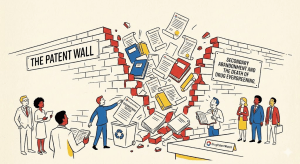
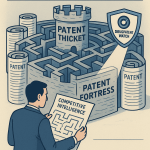
Pharmaceutical companies spend decades constructing legal fortresses around their best-selling drugs. They file dozens of secondary patents on minor formulation changes, delivery devices, and dosing regimens — anything to keep generic competitors at bay after the original compound patent expires. Industry insiders call this “evergreening.” Critics call it something less polite.
But something has quietly changed. Companies that built these patent walls are now watching them come down — sometimes from external pressure, sometimes by their own hand. The collapse is not dramatic. There is no single ruling or legislative bombshell that explains it. Instead, secondary patents are disappearing through a slower, more structural process: strategic abandonment.
Secondary patent abandonment — the deliberate or pressured withdrawal of patents that form the scaffolding of an evergreening strategy — is reshaping the pharmaceutical competitive landscape in ways that most market participants have not fully processed. The ripple effects touch generic manufacturers calculating launch timing, institutional investors modeling revenue curves, hospital formulary managers negotiating drug prices, and biosimilar developers deciding which assets to challenge at the Patent Trial and Appeal Board (PTAB).
This article dissects why secondary patents are being abandoned, who is doing it, what forces are accelerating the trend, and what the practical consequences are for everyone with skin in the pharmaceutical market.
Part One: The Architecture of Evergreening
H2: What a Secondary Patent Actually Is
Before understanding abandonment, you need to understand what these patents are protecting and why they exist.
A primary pharmaceutical patent covers the active ingredient — the novel molecule or biological entity that produces the therapeutic effect. This is the core invention. When Pfizer discovered atorvastatin, the compound patent covering that specific molecule was the primary patent. It was the genuine intellectual property the patent system was designed to reward.
A secondary patent covers everything else. Secondary patents can claim:
A specific crystalline form (polymorph) of the active ingredient
A particular salt or ester formulation
A method of treatment (using the drug to treat a specific condition)
A dosage regimen (taking the drug twice daily instead of once)
A delivery device (the inhaler, pen injector, or patch used to administer the drug)
An extended-release formulation
A combination of the active ingredient with another drug
Each of these categories can generate its own patent, with its own 20-year nominal term from the filing date. Because secondary patents are typically filed years after the primary compound patent, they expire later. That is the point. A company whose compound patent expires in 2024 might have a formulation patent expiring in 2028 and a delivery device patent expiring in 2032. Together, these create a rolling protection structure that extends the practical exclusivity period well past the nominal “patent cliff.”
The system works because the Hatch-Waxman Act, passed in 1984, created a regime in which any patent listed in the FDA’s Orange Book automatically triggers a 30-month litigation stay when a generic manufacturer files a Paragraph IV certification challenging it. File a lawsuit within 45 days of receiving notice of the challenge, and generic approval gets frozen for 30 months — regardless of whether the secondary patent has merit. For brand manufacturers, listing a secondary patent in the Orange Book is not just an IP strategy; it is a litigation weapon with automatic delay-inducing properties.
H2: The Scale of the Strategy
The data on secondary patent filing is not subtle. A May 2024 study published in JAMA Network examined the 10 best-selling prescription drugs in the United States by 2021 net sales. Those ten drugs had a combined total of 1,429 patents or pending patents. Of those, 72 percent were filed after the FDA initially approved these drugs — and 33 percent, or 469 patents, were already abandoned.
That last number deserves to sit on the page for a moment. Nearly one in three patents filed on the top 10 drugs in America is abandoned. These are not patents that expired naturally. They are patents that were withdrawn, allowed to lapse through nonpayment of maintenance fees, or surrendered during prosecution before issuance.
On average, there are 143 patents filed and 69 patents granted on each of the nation’s 12 top-selling drugs, with 56 percent filed post-FDA approval — many for minor product modifications.
The gap between “filed” and “granted” is telling. Companies file aggressively, knowing many applications will not survive prosecution. The filing itself has value: it creates a shadow of IP uncertainty that competitors must navigate even when the application is unlikely to result in a valid patent. As I-MAK, the Initiative for Medicines, Access & Knowledge, has documented, pending and abandoned patent applications can still act as a deterrent against competitors entering the market. As some abandoned applications can be revived, and as pending applications might be granted, the combination of issued patents and pending and/or abandoned applications creates a web of actual and potential barriers to entry that generic companies are forced to navigate.
This is the core of the strategic calculus: abandonment does not always mean defeat. Sometimes it is planned.
H2: Why Companies File Patents They Expect to Abandon
The pharmaceutical IP strategy that has evolved since the 1990s treats patent applications as options, not commitments. Filing a secondary patent application costs between $15,000 and $50,000 in legal and filing fees. Maintaining an issued patent through its full 20-year life costs roughly $50,000 to $100,000 in cumulative maintenance fees. Defending a challenged patent before the PTAB or in district court can cost $2 million to $10 million per patent.
Against these costs, the revenues from a single blockbuster drug like Humira, Eliquis, or Ozempic run into the billions annually. The math is straightforward: file broadly, maintain what matters, abandon what doesn’t, and use the uncertainty created by pending applications to deter entry.
Robin Feldman, a professor at UC College of the Law San Francisco and perhaps the leading academic researcher on pharmaceutical patent abuse, has spent years documenting this dynamic. “Evergreening is business as usual in the pharmaceutical industry. Much of evergreening has happened since the turn of the millennium, and it has increased substantially across time.”
The standard lifecycle management playbook has been well understood since at least the mid-2000s. What has changed is the external pressure on the playbook — pressure from regulators, courts, generic manufacturers, and now from the economics created by the Inflation Reduction Act. That pressure is forcing strategic abandonment on a scale that would have been unimaginable a decade ago.
Part One-B: The Economic Logic That Built the Thicket
H2: The Patent Cliff and What Companies Are Really Protecting
The patent cliff is not metaphorical. When a blockbuster drug loses its primary patent protection, brand revenues can plummet by 80 to 90 percent within the first 24 months of generic competition. The first generic enters at a 20 to 30 percent discount, triggering a cascade: the second generic pushes prices to 50 percent of brand, the fifth competitor produces an 80 percent reduction, and by the time a dozen generics are competing, the brand holds perhaps 5 to 10 percent market share at a fraction of its former price.
For a drug generating $10 billion annually in brand revenue, the financial model is straightforward. Each additional year of exclusivity is worth approximately $7 to $9 billion in net present value after accounting for the typical concessions made to keep managed care formularies — rebates, price locks, co-pay programs. A secondary patent that costs $2 million to maintain and defend, and that purchases even 18 months of additional exclusivity on a $10 billion drug, produces a return of roughly 3,500 to one. The math does not require sophisticated analysis to see why secondary patents proliferate.
The calculus created the playbook. Drug companies began the serious construction of secondary patent portfolios in the 1990s, as the first wave of drugs approved under the modern Hatch-Waxman regime approached their primary patent cliffs. What started as a reasonable legal strategy — patenting genuinely improved formulations and clinical insights developed during the marketing of a drug — gradually evolved into something more systematic. Companies began patenting formulation changes that produced no clinical benefit, dosing regimens that were obvious to any pharmacist, and delivery devices that differed from existing technology in ways no reasonable court would consider inventive.
The best-documented escalation of this strategy came in the 2010s, as biological drugs — immune therapies, monoclonal antibodies, enzyme replacements — began approaching their first patent cliffs. Because biologics are far more complex to replicate than small molecules, biosimilar development is slower and more expensive. Brand companies realized that in the biologic space, even a relatively modest patent thicket could delay a biosimilar for years, not months — because biosimilar developers had fewer resources and less risk tolerance for litigation campaigns against dozens of patents simultaneously.
H2: The Patent Thicket as Corporate Strategy — Not Just Legal Maneuvering
It is common to describe patent thickets as a legal strategy, and they are. But treating them purely as a product of legal departments misses the corporate governance dimension. The decision to build and maintain a secondary patent portfolio around a blockbuster drug is a board-level strategic decision, encoded in corporate planning documents, discussed in investor relations communications, and reflected in R&D budgets that allocate resources to what the industry calls “lifecycle management.”
AbbVie’s 10-K filings in the years leading up to Humira’s biosimilar exposure explicitly discussed the company’s patent portfolio as a source of competitive protection. Research shows that approximately 90% of the patent filings for Humira were made after the drug was already on the market. These were not patents on a new invention, but patents on the preservation of a monopoly.
The SEC requires pharmaceutical companies to disclose material patent risks. But it does not require them to assess the validity of their own secondary patents or disclose abandonment intentions. This regulatory gap created an information asymmetry that secondary patent strategies exploited for decades: the brand company knew exactly which secondary patents in its portfolio were legally marginal, but shareholders, generic manufacturers, and payers were left to guess.
The JAMA study that found 33 percent abandonment rates among top-10 drug patents was not documenting random failures. It was documenting the planned attrition that occurs when companies file secondary patents with the full knowledge that many will not survive examination or post-grant challenge — but that the filing alone, and the uncertainty it creates, has competitive value.
H2: The Use Code Manipulation — A Secondary Patent Strategy Inside the Patent Strategy
Within the Orange Book listing system, a subtler mechanism has emerged that amplifies the effects of secondary patents: the manipulation of “use codes.” According to a September 2024 analysis from STAT News, brand-name drug makers are increasingly utilizing an under-the-radar tactic to game the patent system that may delay the arrival of lower-cost generic medicines. Brand-name drug makers are increasingly submitting more “use codes,” which are brief descriptions of a type of patent claim, in the Orange Book.
Use codes matter because of how Hatch-Waxman’s carve-out provisions work. When a generic manufacturer wants to avoid a secondary patent covering a specific use or indication, it can file a “section viii carve-out” certification, essentially saying: our generic product will not carry the indication covered by the patented method of treatment. The generic label is skinny — it omits the patented indication.
But if a brand company submits a broadly worded use code that is difficult for a generic to carve around without omitting information so fundamental that the FDA will not approve the carved-out label, the generic faces a dilemma. It either faces patent litigation (by certifying the method patent is invalid) or it cannot get the FDA to approve a safe and efficacious generic.
By submitting multiple use codes for their patents in the Orange Book, brand-name drug makers are able to make it more “difficult for a would-be generic rival to successfully battle patent litigation.” This tactic functions as a secondary patent multiplier: a single secondary method patent, combined with a cleverly worded use code, can create patent litigation exposure that exceeds what the underlying patent — if challenged directly on its merits — would sustain.
The FTC’s 2023 enforcement action explicitly targeted this practice, arguing that overly broad or inaccurate use codes constitute the same type of mislisting as improper patent category listings. The enforcement pressure on use codes has had a similar effect to the pressure on device patent listings: companies have begun auditing their use code submissions and, where the codes cannot withstand scrutiny, effectively abandoning the litigation leverage those codes provided.
Part Two: The Mechanics of Abandonment
H2: How a Patent Gets Abandoned
Patent abandonment occurs through two distinct mechanisms, each carrying different strategic implications.
Prosecution abandonment happens before a patent issues. A company files an application, the USPTO examines it, and the applicant decides — for whatever reason — not to continue pursuing the application. This can happen through express abandonment (a formal withdrawal notice), through failure to respond to an office action within the statutory timeframe, or through failure to pay the issue fee after a notice of allowance. Express abandonment, as DrugPatentWatch has noted, is the clearest signal that a company has made a deliberate decision to stop pursuing the application.
Post-grant abandonment happens after a patent issues. Issued patents require maintenance fee payments at 3.5, 7.5, and 11.5 years from issuance. Missing a payment causes the patent to lapse. Patent holders have six months after a missed deadline to pay a surcharge and maintain the patent, and up to two years to petition for revival. After that, the abandonment becomes effectively permanent. For a pharmaceutical company managing a portfolio of hundreds of patents on a single drug, maintenance fee decisions function as a continuous portfolio review — each fee payment is a quiet vote of confidence in the patent’s value.
The third path to abandonment is more recent: external pressure that converts what might have remained a passive fee decision into an active strategic retreat. This is the path that has accelerated dramatically since 2023, and it is the one with the most immediate implications for pharmaceutical competition.
H2: The Forced Retreat — FTC Pressure and Orange Book Delisting
In September 2023, the Federal Trade Commission issued a policy statement asserting that improper Orange Book listings constitute an unfair method of competition under the FTC Act. The agency followed this with a wave of warning letters to pharmaceutical companies, challenging several pharmaceutical companies including AbbVie, AstraZeneca and Teva on the accuracy or relevance of over 100 patents listed in the FDA’s Orange Book. In May 2024, the FTC expanded that investigation to include another 300+ ‘junk listings’ from eight companies.
The practical effect was immediate. In December 2023, three companies voluntarily withdrew patents from the Orange Book, including Impax, Kaléo and GSK, which put in requests to pull listings for their epinephrine autoinjectors and asthma inhalers.
These voluntary withdrawals were not admissions of wrongdoing. They were calculations. The cost of defending the listings against FTC scrutiny — in legal fees, management attention, and reputational risk — exceeded the value of the delay those listings might purchase. When the expected value of a secondary patent listing turns negative, strategic abandonment becomes rational.
The Teva ProAir HFA case illustrates the dynamic most clearly. In a June 2024 ruling, five device patents were removed from Teva’s Orange Book entry after a generic maker, Amneal, and the FTC challenged them. The judge noted that listing device patents was improper, emphasizing that generics should not be blocked by peripheral claims. Teva appealed, and in December 2024, the Federal Circuit affirmed the district court’s decision. The Federal Circuit ruled that the Listing Statute requires a patent to both claim the drug and cover the NDA product itself — and Teva’s patents did not claim the active ingredient, only components of the inhaler.
Five patents. Each one had been creating litigation leverage and triggering stay periods that blocked generic approval. With those five gone, the competitive clock for generic albuterol inhalers moved forward by years.
H2: IPR Proceedings as an Abandonment Catalyst
Even before the FTC’s 2023 enforcement escalation, the Patent Trial and Appeal Board had been reshaping the economics of maintaining pharmaceutical secondary patents. The inter partes review (IPR) process, created by the America Invents Act in 2012, allows any third party to challenge an issued patent’s validity before an administrative tribunal, with a more patent-challenger-friendly evidentiary standard than district court litigation.
For secondary pharmaceutical patents, IPR proceedings have proven devastating. Across all technologies, the rate at which PTAB final written decisions find all challenged claims unpatentable has been steadily increasing, rising from 55% in 2019 to 70% in 2024. On a per-claim basis, nearly 78% of all claims that went to a final decision were found invalid.
These numbers reshape the cost-benefit analysis of maintaining a secondary patent. If the PTAB invalidates 70 percent of the patents that reach a final decision, a brand company facing an IPR petition on a secondary patent has to ask: is this patent worth fighting for? The maintenance fees are small. The litigation costs are large. And the probability of losing is substantial.
The answer is often: abandon before the final decision. Approximately 20% of patent disputes before the PTAB are settled, 6% are dismissed by the PTAB, and 5% end in a request for adverse judgment. Settlements frequently include the patent holder agreeing to abandon or not enforce the challenged claims. What looks like a settlement is, functionally, a structured abandonment of the secondary patent.
Teva’s Copaxone provided the pharmaceutical industry with one of the most instructive secondary patent abandonment case studies of the IPR era. After Copaxone’s original patent on a 20mg daily injection was set to expire, Teva developed and patented a new 40mg three-times-weekly dosing regimen. Teva’s patents on Copaxone were invalidated through IPR proceedings, which found that the patented dosing regime was obvious. After the Federal Circuit affirmed the PTAB’s ruling, prices of competitor drugs dropped by approximately 75%.
This is the concrete arithmetic of secondary patent abandonment: one dosing regimen patent, challenged, invalidated, abandoned under legal pressure — and 75 percent price reduction for patients.
Part Three: Case Studies in Strategic and Forced Abandonment
H2: AbbVie and Humira — The Anatomy of a Thicket
No examination of pharmaceutical secondary patents is complete without Humira. The drug has become the canonical reference point for evergreening, but the Humira story is more nuanced — and ultimately more instructive about abandonment — than its reputation suggests.
AbbVie’s adalimumab (Humira) received FDA approval in 2002 for rheumatoid arthritis. The company filed 311 patent applications for Humira in the U.S., 90% of them after the drug received FDA approval. While the primary patent expired in 2016, a thicket of add-on patents delayed biosimilar competition until 2023.
Research shows that approximately 90% of the patent filings for Humira were made after the drug was already on the market. These were not patents on a new invention, but patents on the preservation of a monopoly.
The thicket worked — for a time. But within AbbVie’s 311 applications, scores of patents were abandoned. Some were prosecution abandonments where the claims did not survive USPTO examination. Others were maintenance fee lapses on patents that AbbVie decided were no longer worth the annual outlay. The abandoned patents were not the point; they were the noise. The kept patents — the ones covering the citrate-free formulation, the auto-injector design, the concentration specifications — were the real wall.
What ultimately broke the Humira strategy was not a single IPR or court ruling but a shifting commercial calculation. Biosimilar competitors like Amgen, Sandoz, and Boehringer Ingelheim, each with an approved product, faced a thicket of over 100 patents. The cost and risk of litigating them all was too high. One by one, they settled with AbbVie, agreeing to a licensed market entry date of 2023. AbbVie successfully, and legally, used its patent thicket to secure an additional seven years of U.S. monopoly.
By 2023, many of the secondary patents that had formed that thicket were approaching natural expiration or were being quietly allowed to lapse. The product the patents were protecting was by then generating far less monopoly revenue than it had at peak. The calculus of maintaining each patent had shifted.
The Humira case teaches a critical lesson about secondary patent abandonment: abandonment does not always represent a strategy failing. It can represent a strategy successfully completing its mission. The patents did their job. When they were no longer needed, they were released.
H2: Copaxone — When Obviousness Kills a Lifecycle Management Patent
Teva built its lifecycle management strategy for Copaxone around a single insight: even as the 20mg daily injection patent expired, patients could be migrated to a 40mg three-times-weekly formulation protected by separate patents. The new regimen was clinically convenient. The new patents would delay generic competition by years.
The strategy unraveled through IPR. Generic manufacturers challenged the 40mg dosing patents as obvious — and they were right. Combining existing clinical knowledge of the drug with known dosing principles, anyone skilled in the art could have arrived at the three-times-weekly formulation. The PTAB agreed. The Federal Circuit agreed. After the Federal Circuit affirmed the PTAB’s ruling, prices of competitor drugs dropped by approximately 75%, making the treatment more affordable for patients with MS.
Teva’s response was instructive. Once the Federal Circuit ruled, Teva did not spend additional resources attempting to maintain the invalidated claims or filing new continuation applications on the same basic concept. The company let those patent positions collapse and shifted its strategic attention elsewhere.
This pattern — challenge, invalidation, quiet abandonment of related positions — repeats across the pharmaceutical patent landscape. Once a court or the PTAB has ruled that a core secondary patent concept is obvious or anticipated, maintaining related patents that rest on the same conceptual foundation becomes legally precarious and strategically pointless.
H2: Ozempic and GLP-1 — The New Battleground
The Inflation Reduction Act has rewritten the economics of drug lifecycle management, and nowhere is this more visible than in the GLP-1 space. Novo Nordisk’s semaglutide (Ozempic, Wegovy) sits at the center of the most commercially consequential patent battles currently underway in the pharmaceutical industry.
On April 30, 2024, the FTC sent warning letters to 10 companies and notified the FDA that it disputed more than 300 patent listings as being improper or inaccurate in the FDA’s Orange Book, including Ozempic. On October 4, 2023, the PTAB granted an inter partes review request by petitioner Mylan Pharmaceuticals.
Novo Nordisk has a primary compound patent on semaglutide that runs well into the 2030s. What the FTC challenged were the device patents — the auto-injector mechanisms, pen needle components, and similar hardware — listed alongside the compound patent in the Orange Book. The FTC issued a notice to Novo Nordisk identifying the improper listing of 17 device patents that do not contain any active ingredient on the Orange Book.
The FTC’s framing was explicit: listing device patents in the Orange Book when only drug-claiming patents are eligible for listing is a misuse of the regulatory framework designed to trigger litigation stays. Each of those 17 patents, if left listed, could trigger a 30-month stay against any generic or biosimilar challenger. Combined, they could add decades of protected delay.
Novo Nordisk faces a structural dilemma. The IRA’s drug price negotiation provisions, now fully active for CMS, mean that the longer a drug remains without generic competition, the more likely it is to be selected for price negotiation. The regulatory uncertainty itself is a weapon. It devalues the very late-stage patents that form a thicket. Why would a company invest in a 10-patent thicket if a future rule change could cause the entire structure to collapse?
For Ozempic specifically, the rational IP strategy has already begun shifting. Novo Nordisk’s legal team is engaged in a triage process: identify which secondary patents are defensible under the new Orange Book listing standards, withdraw those that are not, and concentrate resources on the compound and formulation patents that clearly meet the statutory requirements.
H2: Gilead HIV Drugs and the “Patent Cliff” Inside the Patent Wall
Gilead Sciences’ approach to HIV drug lifecycle management became the subject of a major New York Times investigation in July 2023, which exposed how the company employed secondary patent strategy around a pair of blockbuster HIV treatments — Truvada and Descovy — to delay access to safer versions of the medications for years.
The core mechanism was straightforward: Gilead had developed tenofovir alafenamide (TAF), a demonstrably safer and more effective reformulation of the active ingredient tenofovir disoproxil fumarate (TDF) used in Truvada. But Gilead did not rush TAF to market. Instead, it filed secondary patents on TAF years before combining it into a new product (Descovy), creating a patent cliff inside its own patent wall that forced patients to remain on an older, less safe formulation while Gilead’s compound patents on TDF remained intact.
When those TDF compound patents began expiring and generic competition for Truvada became imminent, Descovy was ready — protected by fresh patents, with a clinical profile that made physician switching relatively straightforward. In July 2023, the New York Times exposed how brand-name drug maker Gilead employed this patent strategy around a pair of blockbuster HIV treatments to maximize profits while blocking access to newer versions of those treatments proven to be safer for patients.
This case is important for understanding secondary patent abandonment because Gilead’s TAF patents — initially filed years before the product launched commercially — were not abandoned. They were maintained precisely as planned. But the patents that fell away were the older TDF secondary patents, the formulation and method-of-treatment claims around Truvada, which became economically redundant once Descovy was established. Gilead effectively engineered its own abandonment schedule, shedding older secondary patents as it moved patients toward the new patent wall.
The strategy was legally permissible, commercially effective, and — once exposed — deeply controversial. Congressional hearings followed. The resulting scrutiny contributed to the broader legislative environment that made the FTC’s 2023 enforcement escalation politically feasible.
H2: Boehringer Ingelheim Respiratory — Device Patents Under Fire
The inhaler patent space has become a concentrated flashpoint for secondary patent abandonment. Respiratory drugs rely on delivery devices — metered-dose inhalers, dry powder inhalers, soft mist inhalers — that can generate their own patent portfolios entirely separate from the active pharmaceutical ingredients they deliver.
Boehringer Ingelheim is accused of using a raft of patents, many covering inhaler devices rather than the active drug, to block generics for its respiratory products Combivent Respimat and Spiriva Respimat. Combivent (ipratropium/albuterol) and Spiriva (tiotropium) both had compound patents that expired years ago. The device patents covering the Respimat inhaler technology provided a second layer of protection.
The FTC’s position — crystallized by the Teva ProAir ruling — is that device patents do not belong in the Orange Book unless they claim the active ingredient itself. If that position holds on appeal and is extended through further litigation, it removes the most commercially valuable feature of device patent listings: the automatic 30-month stay trigger. A device patent that cannot be listed in the Orange Book is still a patent — it can still be asserted in district court — but it loses its ability to mechanically freeze FDA approval of a competing product.
Faced with this legal environment, companies holding device-only secondary patents listed in the Orange Book face a stark choice: fight expensive delisting litigation and risk the broader precedent, or voluntarily delist and abandon the Orange Book advantage while potentially retaining district court litigation rights. Many have chosen the latter. The voluntary delisting wave of late 2023 and early 2024 represents the largest single episode of coordinated secondary patent abandonment in the history of the Hatch-Waxman system.
Part Four: The Forces Driving the Collapse
H2: The FTC’s Orange Book Campaign — Enforcement Through Economics
The FTC’s approach to secondary patent listings has been strategically brilliant in its simplicity. Rather than litigating directly against the patents themselves — a process that would take years and require challenging each patent on its individual merits — the agency attacked the Orange Book listing mechanism.
Under the Hatch-Waxman framework, the FDA does not independently verify whether a patent listed in the Orange Book actually meets the statutory listing criteria. The brand company self-certifies its listings. For decades, this system operated largely on the honor principle, with the occasional court ruling correcting egregious mislistings. The FTC’s 2023 policy statement changed this by asserting that systematic mislistings constitute unfair competition under the FTC Act — a standalone enforcement theory that applies independent of individual patent validity.
The financial calculus for patent holders shifted immediately. According to FTC chair Lina M. Khan, “by challenging junk patent filings, the FTC is fighting these illegal tactics and making sure that Americans can get timely access to innovative and affordable versions of the medicines they need.”
Under the pre-2023 framework, a brand company that listed a marginal device patent in the Orange Book faced limited downside: a Paragraph IV challenge from a generic manufacturer, potential district court litigation, and possibly a successful invalidity or mislisting ruling years later. The upside — 30 months of automatic delay — was essentially free money.
Under the post-2023 framework, that same mislisting potentially subjects the company to FTC antitrust scrutiny, class action exposure, and the reputational damage of being named in a federal enforcement action. The asymmetry of risk has reversed. Listing a questionable secondary patent is no longer obviously rational.
H2: The Inflation Reduction Act’s Secondary Effects
The IRA’s drug price negotiation provisions, fully operational for the first cohort of drugs in 2026, have introduced a new variable into the secondary patent equation that brand companies are only beginning to absorb.
Under the IRA, drugs selected for Medicare price negotiation receive less favorable negotiated prices if they lack generic or biosimilar competition. The legislation creates a direct linkage between competitive dynamics and the prices the government pays. More generic competitors, theoretically, means higher negotiated prices for the brand — or at least less pressure on the brand price.
This creates a perverse incentive that was not present before 2022: in some circumstances, allowing generic competition earlier may actually benefit brand manufacturers by reducing their IRA exposure. The political risk reinforces the IRA’s economic impact, further pushing R&D strategy away from late-stage evergreening.
The drugs most at risk for IRA price negotiation are the ones with the longest periods of exclusivity and the highest Medicare spending. These are precisely the drugs that have been most aggressively evergreened. If the secondary patents sustaining that extended exclusivity now trigger IRA price negotiation rather than simply delaying generic competition, their expected value drops sharply — and abandonment becomes more rational.
Bristol Myers Squibb and Pfizer’s Eliquis (apixaban) illustrates the stakes. Medicare Part D alone spent over $16.4 billion on Eliquis between June 2022 and May 2023, covering more than 3.7 million enrollees. The IRA’s drug price negotiation program represents a positive step, with CMS’s “maximum fair price” of $231 for a 30-day supply achieving a 56% reduction from the current list price.
Between the patent term extension and follow-on patent protection, BMS and Pfizer are expected to collect over $50 billion in U.S. Eliquis revenue that would otherwise have been subject to generic competition. Whether any of that $50 billion is recoverable after IRA negotiations depends partly on what secondary patents remain in force — and whether the cost of defending those patents is justified by the revenue they protect.
H2: PTAB’s Evolving Institutional Role
The PTAB has undergone significant institutional evolution since its creation in 2012. Early criticism that it was a “patent graveyard” — invalidating too many patents too readily — prompted rule changes and director guidance that gave the board more discretion to decline institution of proceedings in certain circumstances.
But for pharmaceutical secondary patents, the PTAB has remained an effective challenge venue. Since FY2020, the number of IPR petitions against Orange Book patents ranged from 6-20 petitions annually, down sharply from peaks of well over 100 petitions in FY2015 and FY2016.
The drop in petition volume is not because secondary pharmaceutical patents have become more defensible. It reflects two changes: generic manufacturers have become more selective, targeting the highest-value secondary patents rather than filing broad challenges; and settlement dynamics have evolved, with more disputes resolving before petition filing through negotiations that include either abandonment or licensing of the challenged patent.
A biosimilar developer can use an IPR or PGR to proactively challenge the patents identified by the brand company, seeking to invalidate them in a faster, more favorable forum. A successful PTAB challenge can provide the biosimilar company with “freedom to operate,” clearing the path for market entry and providing significant leverage in any settlement negotiations.
The leverage point is key. Generic and biosimilar developers have learned that filing an IPR petition — even before the PTAB decides whether to institute proceedings — creates negotiating pressure on brand companies. Brand companies facing a petition on a secondary patent that they are not confident of defending often agree to settlement terms that include abandonment of the challenged claims, or licensing agreements that amount to authorized generic entry, rather than risk the precedential damage of a PTAB final written decision invalidating their patent.
H2: USPTO Quality Scrutiny and the Prosecution Obstacle Course
The abandonment wave is not purely driven by post-grant challenges. At the front end of the patent system, the USPTO has been applying heightened scrutiny to pharmaceutical secondary patent applications — particularly claims directed to obvious variations of existing molecules, dosing regimens, and delivery mechanisms.
The “obviousness” doctrine under 35 U.S.C. § 103 requires that a patent claim must not be obvious to a person of ordinary skill in the relevant art. For secondary pharmaceutical patents, this standard has been applied with increasing rigor. A formulation claim that simply optimizes the pH or adds a common excipient, or a dosing claim that follows obviously from known pharmacokinetic data, faces substantial obviousness rejections during examination.
Feldman says one route to quelling evergreening would be to strengthen the application of the obviousness doctrine in patent law. “Many of these patents should be obvious to those skilled in the art and should not receive the protections they are getting.”
When USPTO examiners issue multiple rounds of obviousness rejections on a secondary patent application, the economic equation for the applicant changes. Each round of argument costs thousands of dollars in attorney time. The claims that survive the examination gauntlet may be so narrowly written that they offer minimal competitive protection. At some point — often after two or three office actions — companies make the prosecution abandonment decision: the patent as it can plausibly be obtained is not worth what it costs to obtain it.
This quiet, administrative abandonment process accounts for a significant proportion of the 33 percent abandonment rate documented in the JAMA study of top-selling drugs. The applications were filed. The prosecution became difficult. The company walked away.
Part Five: The Intelligence Value of Abandoned Patents
H2: Reading Patent Abandonments as Market Signals
For pharmaceutical intelligence analysts and generic manufacturers, abandoned secondary patents are not merely entries in a database. They are signals — sometimes the most reliable signals available — about where a brand company believes its defensible IP position actually sits.
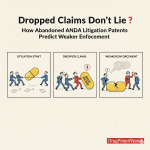
When a company abandons a secondary patent, it is revealing something. If it abandons a polymorph patent while maintaining a formulation patent, it is telling the market that the formulation is where it believes it can win litigation. If it abandons device patents while maintaining compound patents, it is acknowledging — before any court rules — that the device claims were unlikely to survive challenge.
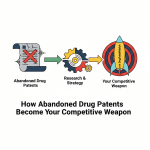
“Drug patent abandonment is not a clerical failure. It is a calculated move within a broader lifecycle management strategy or a forced retreat under regulatory and financial pressure. Understanding the distinction between expiration — the natural end of a patent’s life — and abandonment — the premature cessation of protection — is essential for any intellectual property lead or institutional investor.” — DrugPatentWatch, “Handling Drug Patent Abandonment: Opportunities and Challenges,” 2024 [2]
DrugPatentWatch tracks these abandonment patterns across the full pharmaceutical patent landscape, providing generic manufacturers and investors with the granular data needed to identify which secondary patents have been surrendered and which remain active. The database allows users to distinguish between express abandonments — the clearest signal of deliberate strategic retreat — and fee-lapse abandonments, which could represent either strategic decisions or administrative errors.
For a generic manufacturer calculating launch risk on a complex drug, knowing that a brand company abandoned three of its eight secondary patents two years ago tells a meaningful story. Were those three the weakest? Were they challenged internally and found wanting? Did the company’s lawyers advise that they were not defensible on obviousness grounds? The abandonment itself does not answer these questions, but it narrows the analytical space considerably.
Institutional investors use the same information differently. A brand company’s secondary patent portfolio abandonment rate is, in some circumstances, a leading indicator of competitive pressure. When the rate accelerates, it often precedes generic entry by 18 to 36 months — the gap between the abandonment decision and the time required for a generic manufacturer to receive FDA approval and scale manufacturing.
H2: The Intervening Rights Doctrine and What It Means for Generic Entry
When a secondary patent lapses through nonpayment of maintenance fees, the patent holder has a revival window — typically six months with a surcharge, and up to two years through petition. During that window, generic manufacturers who have acted in reliance on the apparent abandonment may acquire what patent law calls “intervening rights.”
Intervening rights provide a defense against claims of infringement for activities conducted between the abandonment and the revival. For a generic manufacturer that received FDA approval and began manufacturing during the lapse period, intervening rights can mean the difference between a viable commercial launch and an immediate injunction.
But as DrugPatentWatch has noted, intervening rights provide a defense, not a guarantee. They are an expensive legal shield that requires litigation to prove. A “Notice of Express Abandonment” is the safest signal, as it indicates a deliberate choice by the applicant that is much harder to reverse than a missed fee.
The practical lesson for generic manufacturers is that fee-lapse abandonments warrant caution in a way that express abandonments do not. A brand company that misses a maintenance fee on a secondary patent for a drug still generating hundreds of millions in annual revenue is almost certainly going to revive that patent. The lapse is an administrative error, not a strategic decision. Generic manufacturers who launch products in the revival window on the assumption that the abandonment is permanent do so at significant legal risk.
H2: Freedom-to-Operate Analysis in the Post-Abandonment Landscape
The rise in secondary patent abandonment has created a new challenge for generic and biosimilar manufacturers: Freedom-to-Operate (FTO) analysis has become simultaneously easier and more complex.
It is easier because the patent landscape for many established drugs has thinned as secondary patents fall away. A drug that had eight secondary patents in the Orange Book in 2021 might have three in 2025. Three is a more tractable FTO problem than eight.
It is more complex because the remaining patents — the ones a company chose to maintain and defend — are more likely to be genuinely valuable and more likely to be aggressively litigated. The secondary patents that survive the post-2023 enforcement environment are survivors for a reason. They are the claims that the brand company’s IP team has assessed as defensible, that survived examiner scrutiny, and that have not yet faced successful IPR challenge.
Conduct a fresh FTO search to ensure that while a primary patent is abandoned, there are no “evergreened” secondary patents, such as specific salts or polymorphs, still in force that cover the same product. This advice from DrugPatentWatch reflects the reality that secondary patent portfolios are dynamic, not static. The abandonment of one secondary patent may create FTO on one aspect of a drug’s composition while leaving another aspect completely protected.
Part Six: The Legislative and Regulatory Horizon
H2: Congressional Proposals and the Thicket Crackdown Bills
The legislative response to pharmaceutical patent abuse has generated unusual bipartisan support. The Affordable Prescriptions for Patients Act — which targets patent thickets by creating new standards for listing multiple secondary patents for a single drug — was unanimously passed by the U.S. Senate in July 2024 and reintroduced in the Senate in March 2025. The nonpartisan Congressional Budget Office estimated the bill would save $1.8 billion.
If enacted, the legislation would require brand manufacturers to certify that each secondary patent listed in the Orange Book provides a substantial, identifiable therapeutic advance or meaningful benefit to patients — a standard explicitly designed to exclude formulation tweaks, device patents, and dosing regimens that exist primarily to extend exclusivity rather than to improve treatment.
The bill has not yet passed the House, and the pharmaceutical industry’s lobbying effort against it has been substantial. But the unanimous Senate vote signals a political environment in which secondary patent defense is no longer cost-free. Companies that build their evergreening strategy on multiple secondary patents that cannot meet a meaningful clinical benefit standard are building on ground that is becoming legally and politically unstable.
Limiting the ability of pharmaceutical companies to obtain secondary patents for minor changes to existing drugs would encourage generic competition and lower drug prices. Secondary patents should be issued only when they provide significant, identifiable therapeutic advances or meaningful benefits to patients.
H2: The European Divergence
The United States and Europe are moving in the same direction on secondary patents, but at different speeds and through different mechanisms.
The European Union’s 2024 Pharmaceutical Package, adopted by the European Parliament, imposes explicit limits on supplementary protection certificates (SPCs) — the European equivalent of patent term extensions — and on the use of secondary patents to extend exclusivity. The European Medicines Agency wants 70% of patients on biosimilars within three years of patent expiry, up from 45% today.
In the U.S., the legal framework for challenging secondary patents relies heavily on post-grant proceedings and enforcement actions. In Europe, governments negotiate prices directly and national health technology assessment bodies have less tolerance for clinical claims that cannot be substantiated. A secondary patent covering a formulation change that offers no clinical benefit might support Orange Book listing in the U.S., but it will not move the needle in European HTA negotiations.
The divergence has a direct consequence for pharmaceutical company decision-making. European secondary patent abandonments have historically moved faster than U.S. abandonments because the commercial payoff is lower — generic competition triggers price negotiations rather than being blocked entirely. As the U.S. adopts IRA-style negotiation mechanisms, the calculus converges, and the incentive to maintain secondary patents weakens on both sides of the Atlantic simultaneously.
H2: FDA and USPTO Coordination — The New Enforcement Axis
The Biden administration’s 2023 announcement that the FDA and USPTO would work together on initiatives to promote generic competition represented something qualitatively new in pharmaceutical IP enforcement. Historically, the two agencies operated largely in their respective domains: the FDA managed drug approval and Orange Book administration while the USPTO handled patent prosecution and examination.
The new coordination effort targets the information asymmetry that allows mislistings to persist. The FDA, receiving a patent listing, does not have the expertise to assess whether the patent claims the drug’s active ingredient in the manner required by the listing statute. The USPTO, examining a patent application, does not know whether the applicant intends to list the resulting patent in the Orange Book in ways that might trigger inappropriate litigation stays.
Coordination between the agencies allows for shared information about listing practices and examination standards — creating a feedback loop that did not previously exist. If the FDA identifies patterns of mislistings clustered around specific claim types (device claims, dosing claims), it can flag those patterns to the USPTO, which can apply heightened scrutiny to similar applications during examination.
The result, over time, is that some secondary patents will face tougher examination and either issue in narrower form or fail to issue at all. This is front-end abandonment driven by regulatory coordination rather than post-grant challenge — and it is potentially the most durable form of secondary patent attrition.
Part Seven: Consequences for Market Participants
H2: Generic Manufacturers — The Strategic Opportunity
For generic pharmaceutical companies, the wave of secondary patent abandonment creates commercial opportunities that require sophisticated tracking to exploit. The generic industry’s analytical challenge is not simply identifying when a brand drug’s primary patent expires — that information is widely published. The challenge is identifying when the secondary patent landscape around a drug has thinned to the point where a generic launch is commercially viable with manageable litigation risk.
The economics of this decision are stark. Between 2025 and 2030, an estimated $236 billion in global pharmaceutical revenue is at risk due to patent expirations. Generic companies that correctly identify which secondary patents have been abandoned — and which remaining patents are genuinely defensible — capture the early-launch economics that define the sector’s profitability.
The decision to file a Paragraph IV certification is one of the highest-stakes analytical decisions in the generic pharmaceutical industry. File too early — against a drug whose secondary patent portfolio remains robust and whose brand company has demonstrated willingness to litigate aggressively — and you risk a 30-month stay, expensive litigation, and potential judgment against you that delays your launch and depletes your legal budget. File too late — after another generic manufacturer has already secured first-filer status — and the 180-day exclusivity prize is gone. The secondary patent abandonment signal, correctly read, is the information that allows generic manufacturers to calibrate this timing decision with more precision.
The most sophisticated generic manufacturers have built internal intelligence functions specifically to track secondary patent status changes. These functions monitor Orange Book listings for changes in real time, flag maintenance fee deadlines for key secondary patents on target drugs, track PTAB petition filings by competitors, and analyze FTC enforcement correspondence that names specific drugs and patents. When multiple signals converge — a maintenance fee deadline approaches on a device patent, a competitor files an IPR petition on a formulation patent, and the FTC issues a challenge to the Orange Book listings for the same drug — the convergence indicates a secondary patent collapse that may be approaching faster than the market has priced in.
First generic entry under Hatch-Waxman produces a 180-day exclusivity period during which the first-filer can charge a substantial premium over later generics. These 180-day windows, worth tens of millions of dollars for mid-size drugs and hundreds of millions for blockbusters, reward the generic manufacturer that has done the most thorough secondary patent analysis.
Once competition enters the market, the price of medicine reduces significantly. Experience shows prescription drug costs decline by more than 60 percent after 12 months of generics entering the market. When multiple generic companies enter the same market, prices for the drug can fall by 80-90 percent almost overnight.
The biologics space presents a distinct secondary patent abandonment dynamic. Biologic drugs are not listed in the FDA’s Orange Book — they fall under the Biologics Price Competition and Innovation Act (BPCIA) framework, and their reference product exclusivity period is 12 years regardless of patent status. But secondary patents still surround biologics, and they still matter.
AbbVie’s Humira biosimilar settlement strategy demonstrated how a patent thicket of over 130 patents can delay biosimilar entry even without the Orange Book listing mechanism. The BPCIA’s “patent dance” process — in which the brand company and biosimilar developer exchange information about potentially relevant patents in a structured sequence — creates its own opportunities for secondary patent leverage.
For biosimilar developers, the post-2023 environment offers more tools for cutting through biologic patent thickets. IPR remains available as a challenge mechanism. The FTC’s antitrust scrutiny of settlement agreements that delay biosimilar entry has intensified. And the IRA’s biosimilar transition support provisions create financial incentives for biosimilar uptake that reduce the commercial penalty of launching after a period of patent-related delay.
The global biosimilar market alone was valued at $26.5 billion in 2024 and is projected to skyrocket to $185.1 billion by 2033, a clear indicator of the massive transfer of wealth that occurs when patent protection falls away.
Within that expanding market, the biosimilar manufacturers best positioned to capture revenue are those with the most sophisticated secondary patent analysis capabilities — the ability to identify which of the hundreds of patents surrounding a reference biologic have been abandoned, challenged and found weak, or are ripe for IPR challenge.
H2: Institutional Investors — Modeling the Abandonment Risk
Portfolio analysis at major institutional investors has traditionally modeled pharmaceutical patent cliffs based on primary compound patent expiration dates. Secondary patents were treated as qualitative factors that might extend exclusivity by a few years, but the complexity of tracking them made quantitative modeling difficult.
The current wave of secondary patent abandonment has created a new analytical requirement: investors need to model not just when patents expire, but when they are likely to be abandoned, challenged, or delisted from the Orange Book — and what those events mean for revenue projections.
Consider a revenue model for a $5 billion annual drug with a compound patent expiring in 2027. Under a simple primary-patent model, generic competition begins in 2027. Under a more sophisticated secondary patent model, the revenue curve depends on:
Whether the four secondary patents listed in the Orange Book will survive FTC scrutiny
Whether the 40mg dosing patent is vulnerable to an obviousness challenge
Whether the auto-injector device patent was recently delisted or is likely to face a mislisting challenge
Whether the company’s maintenance fee payment patterns suggest it is planning to let any secondary patents lapse
These are now material financial questions. The difference between generic entry in 2027 and 2025 — if two secondary patents are abandoned or successfully challenged — is approximately $10 billion in brand revenue, assuming 2027 peak sales and standard generic price erosion curves. For an institutional investor holding a significant position in the brand company, correctly modeling this dynamic is not a peripheral analytical exercise. It is central to thesis construction.
H2: Payers and Pharmacy Benefit Managers
The implications for payers are perhaps the most straightforward: secondary patent abandonment accelerates the date on which they can begin substituting lower-cost generics for high-cost brand drugs on their formularies. But the path from abandonment to realized savings involves several intervening steps that payers increasingly need to track proactively.
When a secondary patent is abandoned or delisted, the FDA’s approval process for the competing generic must still run its course. If the generic manufacturer had already filed its ANDA and was waiting in a queue, the abandonment of a blocking patent can unlock FDA approval within months. If no ANDA has been filed, the payer may wait a year or more after abandonment before any competitive product is available.
Sophisticated pharmacy benefit managers now work backward from patent status to proactive formulary planning. When secondary patents for a high-cost drug begin showing signs of stress — FTC challenges, IPR petitions, voluntary delistings — PBMs begin the process of formulary restructuring, building in the lead time needed to shift utilization once the generic is available.
The commercial implications extend beyond simple cost savings. A payer that moves formulary before generic entry — by implementing step therapy requirements, prior authorization hurdles for the brand, or tiering the brand to a higher cost-sharing level — can accelerate volume shift when the generic arrives. This proactive formulary management, timed to secondary patent abandonment signals, is a material driver of total drug cost for large commercial and government payers.
Medicare Part D plans face a specific dimension of this challenge driven by the IRA’s redesigned benefit structure. Under the IRA’s reforms, Part D plan sponsors bear higher catastrophic phase risk than under the previous structure. This creates a direct financial incentive to accelerate generic uptake — and to identify, months in advance, which high-cost brand drugs are approaching secondary patent collapses that will create generic substitution opportunities.
The data infrastructure required to identify these opportunities — real-time secondary patent tracking integrated with ANDA filing data and FDA approval timelines — is exactly what platforms like DrugPatentWatch are designed to provide. For a Part D plan with $10 billion in drug spend, correctly anticipating a secondary patent collapse on a top-five drug three months earlier than competitors can translate into meaningful formulary savings over a contract year.
This analytical capability requires access to real-time patent status data that goes beyond basic Orange Book listings. DrugPatentWatch provides the granular secondary patent tracking — including prosecution status, maintenance fee payment history, and IPR petition filings — that allows payers to build these forward-looking models.
Part Eight: The Future of Pharmaceutical Patent Strategy
H2: What Evergreening Looks Like After the Abandonment Wave
The pharmaceutical industry is not abandoning its secondary patent strategy. It is adapting it. The new evergreening playbook is more selective, more sophisticated, and more focused on secondary patents that can actually survive the elevated scrutiny environment.
The era of filing 143 patents on a single drug and maintaining them all through their nominal terms is ending — not because companies have decided it was wrong, but because it no longer works as reliably. The Orange Book listing benefits of device patents are increasingly unavailable after the Teva ProAir ruling and the FTC’s enforcement posture. The PTAB’s high invalidation rate on dosing regimen patents discourages maintenance of weak claims. The IRA’s negotiation mechanics reduce the commercial payoff from extended exclusivity on Medicare-heavy drugs.
What remains viable as secondary patent strategy is narrower and more defensible: genuine formulation innovations that produce demonstrable clinical improvements, manufacturing process patents that are genuinely novel and commercially valuable, and indication-specific method patents backed by robust clinical data. These are secondary patents that can withstand obviousness challenge because they represent real inventive steps.
The irony is that this environment may push pharmaceutical companies toward secondary patent strategies that are more consistent with the original purpose of the patent system — rewarding genuine innovation rather than minor reformulations designed to extend monopoly. Whether that actually happens depends on what the FTC, PTAB, Congress, and the courts make possible and what the industry finds it can get away with.
H2: Product Hopping as the Next Strategic Frontier
As secondary patent maintenance becomes harder, product hopping — the practice of discontinuing a brand-name drug before generic entry and directing patients toward a new, reformulated, patent-protected version — has become a more attractive strategic alternative.
Product hopping is a strategy where a brand-name pharmaceutical company seeks to shift demand from a brand-name drug that faces generic competition to a newer one with a longer patent life. The tactics include switching to a new formulation with minor changes and discouraging the use of the original drug, often by making it harder to get and/or encouraging doctors to prescribe the new version.
Product hopping sidesteps the secondary patent abandonment problem by making it irrelevant. If patients are already on the new product — protected by its own fresh patent portfolio — generic entry into the old product’s market produces minimal revenue impact.
The Drug Competition Enhancement Act, introduced in the Senate in 2025, would hold Big Pharma accountable for product hopping to foster greater competition in the marketplace from more affordable alternatives. But product hopping legislation faces more complex legal and regulatory challenges than secondary patent reform, because the product hop itself — unlike an improper Orange Book listing — involves FDA-approved products and physician prescribing decisions that regulators are reluctant to override.
H2: Continuation Applications and the “Zombie Patent” Problem
One secondary patent strategy that the abandonment wave has not fully addressed is the continuation application. When a brand company files a continuation, it claims priority back to the original patent application’s filing date while pursuing new claims in the continuation. Because the 20-year patent term runs from the original filing date, continuation patents do not add time to the nominal term — but they can prevent a competitor from relying on the primary patent’s expiration as creating a clear FTO window.
Brand drug companies often hold some patents in reserve. This tactic enables them to threaten generic and biosimilar companies with litigation, carrying the possibility of massive damages liability later in the process. Pending continuation applications function as zombie patents — not yet issued, not abandoned, but casting a shadow over generic launch decisions.
The JAMA study’s finding that 15 percent of the top-10 drug patents were still pending at the time of analysis reflects this dynamic. Of the patents examined in the study, 218 — or 15 percent — were pending patents. Pending applications can remain pending for years through continuation filings, requests for continued examination, and appeals. Each pending application represents a potential future patent claim that must be accounted for in any FTO analysis.
Addressing continuation abuse requires either legislative reform — limiting the number of continuation applications that can be filed on a single parent application — or more aggressive use of terminal disclaimers to limit the practical term of continuation patents. Neither approach is simple. Both are on the agenda of patent reformers.
H2: The Global Dimension — What Happens Outside the U.S.
Secondary patent abandonment is primarily a U.S. story because the U.S. is where the commercial stakes are highest and where the Orange Book listing mechanism creates the most acute competitive incentives. But abandonment dynamics are not purely domestic.
In India, the Patents Act’s Section 3(d) explicitly prohibits the grant of secondary patents on new forms of existing substances unless the applicant demonstrates enhanced therapeutic efficacy. This provision has prevented much of the secondary patent proliferation that characterizes the U.S. market. Indian generic manufacturers operating under a stricter domestic secondary patent regime have developed FTO analysis capabilities that are, in some ways, more sophisticated than their U.S. counterparts — because they have been doing it longer.
When Indian generic manufacturers enter the U.S. market through ANDA filings, they bring those analytical capabilities with them. Companies like Dr. Reddy’s Laboratories — which filed IPR petitions against Novo Nordisk’s semaglutide patents — are simultaneously navigating the U.S. secondary patent landscape and demonstrating that competitors who are accustomed to challenging weak secondary patents in their home markets are effective adversaries in the U.S. system.
Petitioner Dr. Reddy’s Laboratories requested an IPR of claims 1-10 of a key semaglutide patent, asserting anticipation and obviousness on multiple grounds. This is not opportunistic litigation. It is a systematic approach to secondary patent challenge that treats the PTAB as an extension of the competitive strategy that Indian generic manufacturers have employed domestically for years.
Part Nine: What Professionals Need to Do Now
H2: A Practical Framework for Patent Intelligence
The secondary patent abandonment environment requires a different approach to pharmaceutical patent intelligence than the traditional primary-patent-expiration tracking model. Professionals across the pharmaceutical ecosystem need frameworks that account for the dynamic nature of secondary patent portfolios, and for the multiple pathways through which secondary patents can be eliminated or weakened before their nominal expiration dates.
The first step in any systematic framework is categorization. Not all secondary patents are equally vulnerable. Secondary patents can be ranked by their theoretical durability based on claim type: compound and salt patents are generally more defensible than formulation patents, which are more defensible than dosing regimen patents, which are more defensible than device patents. This rough hierarchy reflects the legal standards that have emerged from PTAB proceedings and district court rulings over the past decade.
A drug with a secondary patent portfolio concentrated in device claims and dosing regimen claims faces a qualitatively different competitive threat environment than a drug whose secondary patents cover novel crystal forms with documented bioavailability advantages. The categorization step alone — assigning each secondary patent to its claim type category and assessing the category’s historical PTAB success rate — provides a first-pass vulnerability score for the portfolio.
The second step is competitive mapping. Who has filed ANDAs or biosimilar applications against this drug? Do any of those ANDA filers have strong IPR practices and a track record of secondary patent challenges? Have any competitors already begun IPR proceedings against related patents? The presence of experienced, well-capitalized generic manufacturers with ANDA filings and IPR capabilities is the most reliable predictor of which secondary patents will face formal challenge — and therefore which are most likely to be abandoned under pressure.
The third step is regulatory intelligence. Has the FTC sent warning letters to the brand company about specific Orange Book listings? Are any device patents in the portfolio listed in the Orange Book in ways that look similar to the Teva ProAir patents that were delisted? Has the brand company had any court rulings in related drug markets that suggest its litigation position on certain claim types is weak? Regulatory and judicial signals from related markets often predict what will happen in the specific market under analysis.
For generic manufacturers, the core analytical question is no longer “when does the compound patent expire?” but rather “which secondary patents remain active, which are vulnerable to challenge or delisting, and what is the realistic litigation landscape at the time of planned ANDA approval?”
Answering this question requires tracking:
Orange Book listing changes, including voluntary delistings and FTC dispute outcomes
IPR petition filings against Orange Book-listed and non-listed secondary patents
Maintenance fee payment patterns that might signal abandonment intentions
Prosecution status of pending continuation applications
For institutional investors, the analytical requirement is translating this patent intelligence into revenue timing models. The tools for doing this are increasingly available through pharmaceutical patent databases, but the interpretation of the data still requires specialized IP legal judgment.
For payers, the priority is identifying which secondary patent expirations or abandonments are likely to produce actionable generic substitution opportunities in the planning horizon, and building those milestones into formulary transition planning. A payer that is 18 months ahead of a secondary patent collapse can negotiate more aggressively with the brand company while the exclusivity appears intact — the informational advantage of knowing the collapse is coming changes the negotiating dynamic even before the competitive alternative is available.
H2: Using Patent Data Strategically
The pharmaceutical patent landscape is one of the most information-dense commercial environments in the world. Every patent application, every office action response, every maintenance fee payment, every IPR petition is public record. The challenge is not access to information — it is processing it efficiently.
Platforms like DrugPatentWatch aggregate, analyze, and present this information in forms that allow non-patent-attorney professionals to track the key metrics: patent status changes, ANDA filing data, PTAB petition outcomes, and Orange Book listing changes. For professionals who need to make decisions informed by secondary patent dynamics — but who cannot afford to have a patent attorney analyze every drug’s portfolio every quarter — these analytical tools have become essential infrastructure.
The strategic insight that data platforms provide goes beyond simple status updates. Pattern recognition across the secondary patent landscape reveals which categories of secondary patents are failing most consistently — device claims, dosing regimens, polymorphs — and helps professionals assess where the vulnerabilities lie in any specific drug’s remaining portfolio.
Part Ten: The Zytiga Moment — When Secondary Patent Defeat Becomes Industry Signal
H2: Abiraterone Acetate and the PTAB’s Impact on Cancer Drug Markets
When generic manufacturer Argentum Pharmaceuticals challenged Johnson & Johnson’s secondary patents on abiraterone acetate (Zytiga) in 2017, the case seemed unremarkable — another small company taking a long shot at a cancer drug’s formulation patents. The PTAB’s decision to invalidate the challenged patents was eventually upheld, and generic versions of the prostate cancer medication entered the market. The price decline was not trivial. It followed the typical generic entry curve: substantial price compression within months of the first generic launch.
What made Zytiga notable as a secondary patent abandonment precedent was not the invalidation itself, but the behavior that followed. After the PTAB ruled and the Federal Circuit affirmed, Johnson & Johnson did not fight to maintain related secondary patent positions that rested on the same formulation principles. The legal loss was absorbed as a strategic signal: this category of secondary patent claim, on this type of drug, in this legal environment, is not defensible. The company’s IP team updated its portfolio management approach accordingly.
This pattern — a decisive PTAB ruling prompting a broader reassessment and abandonment of related secondary patents — is what researchers at the Public Interest Patent Law Institute called the “demonstration effect” of IPR proceedings. One successful challenge produces information that reshapes strategy around a wider set of patents, even patents that were never directly challenged. The brand company’s lawyers, after a loss, do not simply replace the invalid patent with an equivalent. They assess which remaining secondary patents in the portfolio are vulnerable to the same arguments that just succeeded — and they quietly discontinue maintaining those positions.
The Zytiga case demonstrated this effect most visibly in the cancer drug secondary patent space. Following the abiraterone rulings, several cancer drug manufacturers accelerated their internal reviews of secondary formulation and dosing patents. Patents that had sat unchallenged for years — benefiting from the deterrent effect of potential litigation — were now being internally assessed against the legal standards the PTAB had applied to Zytiga’s claims. Many did not survive that internal review.
H2: The Prasugrel Case and Obvious Combination Claims
Daiichi Sankyo’s experience with prasugrel (Effient) illustrates a different dimension of secondary patent vulnerability: combination claims. Following the expiration of prasugrel’s primary compound patent, Daiichi Sankyo held secondary patents covering the use of prasugrel in combination with aspirin for cardiovascular patients — a combination that was, in practice, standard clinical protocol for the drug’s primary indication.
The PTAB found the combination obvious. When the IPR proceedings concluded that combining prasugrel with aspirin was an obvious application of known clinical principles — and therefore not deserving of patent protection — the decision effectively cleared a major secondary patent position that had been blocking generic competition.
The prasugrel case is a clean illustration of what patent reformers mean when they argue that many secondary pharmaceutical patents “should be obvious to those skilled in the art and should not receive the protections they are getting.” The combination of the drug with aspirin was not a surprise to anyone treating cardiovascular patients. It was standard care. But it had been patented, listed in the Orange Book, and used to delay generic competition in the post-primary-patent period.
After the prasugrel PTAB ruling, Daiichi Sankyo did not pursue aggressive continuation strategies to rebuild the combination claim position. The legal framework had spoken: combination claims on this type of obvious application would not withstand challenge. The company let those secondary positions go.
H2: Rivastigmine and the Patch Delivery Device Problem
Novartis’s Exelon Patch (rivastigmine transdermal system) provided another canonical secondary patent abandonment case. Novartis held patents on the use of a transdermal patch to deliver rivastigmine — a treatment for dementia — even after the compound patent on rivastigmine itself had expired or been challenged successfully. The patch delivery method patents were challenged through PTAB proceedings. When the PTAB found them invalid, generic transdermal rivastigmine became available.
The Exelon Patch case highlights a specific category of secondary patent that has proven particularly vulnerable: delivery system patents that claim a method of administration rather than a pharmaceutical innovation. Transdermal patches, auto-injectors, slow-release capsules, and similar delivery mechanisms can generate secondary patents — but those patents face heightened obviousness scrutiny when the clinical benefit of the delivery system is modest compared to existing alternatives and the technical implementation uses known engineering principles.
Novartis’s abandonment of the rivastigmine patch patent position, forced by PTAB invalidation, cleared the market for generic delivery systems. More importantly for the industry, it signaled to other companies maintaining similar delivery mechanism secondary patents that the post-grant challenge environment had become hostile to this category of claim.
The lesson was absorbed. In the years following the Exelon Patch case, pharmaceutical companies maintaining large secondary patent portfolios around delivery mechanisms began conducting internal vulnerability assessments. Patents that rested on similar legal foundations — delivery system claims where the clinical benefit was incremental and the technical implementation was conventional — were candidates for strategic abandonment before a challenger forced the issue.
Part Eleven: The Data Infrastructure of Patent Intelligence
H2: What Patent Databases Actually Track — and What They Miss
The pharmaceutical patent landscape involves five distinct data streams that any sophisticated analyst needs to integrate: USPTO prosecution records, Orange Book listings, PTAB proceedings, district court litigation filings, and maintenance fee payment records. Each stream provides a different lens on the secondary patent landscape, and the interaction between streams generates insights that neither can provide alone.
USPTO prosecution records tell you when a patent application was filed, what claims were pursued, how the examiner responded, what arguments the applicant made, and whether the application resulted in an issued patent, a continuation, or an abandonment. For secondary pharmaceutical patents, prosecution records reveal the full trajectory of what a company tried to patent and what it ultimately obtained or gave up.
Orange Book listings — maintained by the FDA and updated monthly — tell you which patents the brand company has asserted cover its approved drug products, along with the statutory categories (drug substance, drug product, method of use) under which each patent is listed. Cross-referencing the Orange Book with prosecution records allows analysts to identify patents that are listed but legally questionable, or patents that have been quietly removed.
PTAB proceedings provide real-time intelligence on which secondary patents are under active challenge. A petition filing date is public. Institution decisions are published. Settlement agreements between the parties, filed with the PTAB, reveal terms that sometimes include patent abandonment or licensing.
District court dockets are the complement to PTAB proceedings: they show which patents are being actively litigated, which courts are presiding, and how the litigation is progressing. The 45-day filing clock that triggers the 30-month Hatch-Waxman stay means that district court filings arrive in predictable clusters after ANDA notification — and the specific patents asserted in those filings tell you which secondary patents the brand company has prioritized for enforcement.
Maintenance fee records — publicly available through USPTO databases with a lag — reveal payment status for issued patents. Gaps in payment history, surcharge payments, and petition-for-revival filings all provide signals about whether a company is actively managing a secondary patent or allowing it to drift toward abandonment.
DrugPatentWatch integrates these data streams into a unified platform designed specifically for pharmaceutical patent intelligence. The database allows users to track, across a single drug, the full arc of the patent portfolio — from prosecution status of pending applications to maintenance fee payment history of issued patents to Orange Book listing status to PTAB proceeding outcomes. This integration is what allows sophisticated analysts to distinguish, for example, between an Orange Book listing that remains fully supported by an active, maintained patent and one where the listed patent is technically still issued but has missed a maintenance fee payment and faces a filing deadline that the brand company appears unlikely to meet.
H2: The 180-Day Exclusivity Premium and Why Patent Intelligence Pays
For generic pharmaceutical manufacturers, the difference between being first-to-file on a Paragraph IV challenge and being second matters enormously. The Hatch-Waxman Act grants a 180-day period of marketing exclusivity to the first generic applicant to file a substantially complete ANDA with a Paragraph IV certification challenging a listed Orange Book patent. During this 180-day window, the FDA cannot approve any other ANDA seeking to market the same drug — creating a temporary duopoly between the brand and the first generic.
For a drug with $5 billion in annual brand revenue, the first-filer’s 180-day exclusivity can be worth $200 million to $800 million, depending on the price discount the generic charges and the speed at which brand prescribers and insurers shift volume to the generic. This is the prize for correctly identifying that a secondary patent is vulnerable, filing the first ANDA, winning the Paragraph IV litigation, and reaching commercial launch ahead of every competitor.
The intelligence advantage in this competition comes from understanding the secondary patent landscape well enough to identify which drugs are approaching the point where a Paragraph IV filing is commercially rational and legally viable. A drug whose compound patent is expiring in two years but whose secondary patent landscape shows three recent voluntary delistings, two maintenance fee lapses on device patents, and a pending IPR petition by a competitor may be at a very different competitive inflection point than the primary patent expiration date alone suggests.
Getting this analysis right is the difference between capturing the 180-day prize and watching a competitor do it first because they saw the secondary patent collapse coming earlier. The patent intelligence infrastructure that enables this analysis — real-time tracking of maintenance fee status, Orange Book changes, PTAB proceedings, and prosecution records — is no longer a luxury for generic manufacturers competing in high-value brand drug markets. It is table stakes.
H2: What Sell-Side Analysts Are Getting Wrong
Pharmaceutical sector equity research has historically treated the patent cliff as a binary event: primary patent expires in year X, generic entry begins, revenue collapses. Secondary patents were acknowledged in qualitative notes — “the company has a portfolio of secondary patents that may delay generic competition” — but were rarely quantified or modeled precisely.
This analytical gap has created mispricings. Brand pharmaceutical companies that faced an accelerating secondary patent abandonment cycle — driven by FTC enforcement pressure, PTAB petitions from generics manufacturers, or the IRA’s changed economics — saw their secondary patent portfolios deteriorate faster than the consensus model anticipated. The generic entry dates implied by those portfolios moved earlier. Revenue estimates proved too high. Share prices corrected when the competitive reality became undeniable.
The inverse also occurs. Generic manufacturers that correctly identified an accelerating secondary patent abandonment cycle for a high-value drug — seeing the same signals that analysts were dismissing as background noise — were able to accelerate ANDA preparation, capture first-filer status, and generate returns that surprised market observers.
The analytical skill required is not merely knowing that secondary patents exist. It is understanding which secondary patents are under pressure, why, and what the realistic timeline for their elimination is. That requires integrating legal analysis, regulatory intelligence, commercial modeling, and maintenance fee tracking in a way that typical sell-side research functions are not yet structured to provide.
Conclusion: The Quiet Collapse Has Commercial Consequences
Secondary patent abandonment is not a peripheral technical issue. It is a structural shift in the pharmaceutical competitive landscape with direct implications for drug prices, generic entry timing, biosimilar market development, and brand company revenue curves.
Consider what that shift looks like in aggregate. The pharmaceutical industry globally is worth $1.6 trillion and projected to reach $2.35 trillion by 2030. Within that market, generic drugs represent the single largest mechanism for cost containment — responsible for over 90 percent of prescription volume in the United States at roughly 13 percent of total drug spending. Every year of additional exclusivity secured by secondary patents is a year during which that cost containment does not operate.
The FTC’s position — that improperly listed secondary patents constitute unfair competition — has regulatory legitimacy that is now backed by Federal Circuit precedent from the Teva ProAir ruling. The PTAB’s record on secondary pharmaceutical patent challenges — finding all challenged claims unpatentable in approximately 70 percent of cases that reach final decision — establishes a legal environment in which poorly constructed secondary patents face a high probability of invalidation if challenged. The IRA’s price negotiation mechanism removes the commercial case for maintaining secondary patents that extend exclusivity into the negotiation selection window.
Together, these three forces — regulatory, judicial, and legislative — have created a secondary patent environment that rewards quality over quantity. Companies that file 143 patents on a single drug, knowing most will not survive scrutiny, are investing resources in a strategy that produces diminishing returns. Companies that file 30 patents, ensure each represents a genuine inventive step, and maintain the ones they can defend are building IP portfolios that are both more durable and more defensible.
The shift in secondary patent strategy is not being announced. It is occurring quietly, patent by patent, maintenance fee payment by maintenance fee payment, Orange Book delisting notice by notice. The professionals who see it most clearly are those with access to real-time patent status data — and who have the analytical framework to convert that data into actionable intelligence about when and where competitive opportunities will materialize.
The pharmaceutical patent landscape in 2026 looks different from the one that existed in 2019. The most aggressive secondary patent strategies have been exposed, challenged, and in significant measure defeated. The companies that built those strategies are adjusting. The generics manufacturers that challenged them are winning. The patients who needed lower-cost alternatives are, in some markets, beginning to access them.
The process is not finished. Secondary patent filing continues. New evergreening approaches — product hopping, continuation applications, use code manipulation — are being refined. But the foundational architecture of the patent thicket strategy is under more stress than it has been at any point since the Hatch-Waxman Act created the framework within which it operates. The quiet collapse is real, it is ongoing, and the professionals who understand its mechanics will be the ones best positioned to capitalize on — or defend against — the competitive disruption it produces.
The forces driving abandonment — FTC enforcement, PTAB invalidation rates, IRA economics, and heightened USPTO scrutiny — are not temporary. They represent a durable change in the risk-reward calculus of secondary patent maintenance that will continue to thin the patent thickets around established drugs for years.
In 2023, the FDA approved 870 generic drugs — 12% more than the year before. Many of those were for high-cost medications just past their patent cliff. That number will grow as secondary patent walls thin. The secondary patent that gets abandoned today clears the path for a generic application that produces a 60-80 percent price reduction tomorrow.
For professionals across the pharmaceutical ecosystem — generic manufacturers, biosimilar developers, institutional investors, payers, policy analysts — the ability to track and interpret secondary patent abandonment patterns has moved from a specialized analytical nice-to-have to a core competitive intelligence function.
The patent fortress is not falling all at once. It is losing one stone at a time. Knowing which stones are gone — and which are next — is the analytical edge that separates those who see the competitive shift coming from those who get caught flat-footed when the wall comes down.
Key Takeaways
Secondary pharmaceutical patents — covering formulations, dosing regimens, delivery devices, and manufacturing processes — are being abandoned at an accelerating rate, driven by FTC Orange Book enforcement, PTAB invalidation rates, and the economics created by the Inflation Reduction Act.
A May 2024 JAMA Network study found that 33 percent of all patents filed on the 10 top-selling U.S. drugs were already abandoned, revealing the scale of secondary patent attrition in the most commercially significant portion of the pharmaceutical market.
The FTC’s 2023 policy statement and subsequent challenge of over 400 Orange Book patent listings represents the most significant regulatory intervention in pharmaceutical secondary patent strategy since Hatch-Waxman’s passage in 1984. Voluntary withdrawals by Impax, Kaléo, GSK, and others in late 2023 and 2024 reflect the changed enforcement environment.
Device patents — covering auto-injectors, inhaler mechanisms, and delivery hardware — are the secondary patent category most immediately at risk following the Teva ProAir HFA Federal Circuit ruling, which held that patents claiming only device components cannot be listed in the Orange Book.
Strategic abandonment differs from forced abandonment in ways that matter for FTO analysis and investment modeling. Express abandonment notices are reliable signals of deliberate retreat; maintenance fee lapses require more careful analysis to distinguish administrative error from strategic decision.
Generic and biosimilar manufacturers who build systematic secondary patent intelligence capabilities — tracking abandonment patterns, IPR petition outcomes, and Orange Book listing changes — have a material competitive advantage in launch timing decisions worth hundreds of millions of dollars on high-value drugs.
The secondary patent landscape will continue to thin. The bipartisan legislative environment, the IRA’s competitive incentives, the PTAB’s invalidation record on formulation and dosing patents, and the FDA-USPTO coordination initiative all push in the same direction. Companies that have built their revenue projections on secondary patent portfolios that do not survive this scrutiny will face accelerated competitive exposure.
Frequently Asked Questions
Q1: Is it ever strategically rational for a brand pharmaceutical company to voluntarily abandon secondary patents without being forced to?
Yes — and it happens more often than the public record reveals. A company might voluntarily abandon a secondary patent when maintenance costs exceed the expected value of the protection it provides (typically true for drugs experiencing significant revenue decline), when a weaker patent in the portfolio is creating more litigation risk for the company than it is deterring competitors (because an IPR loss creates a bad precedent for stronger related patents), or when IRA price negotiation exposure makes extended exclusivity commercially counterproductive. The strategic calculation always comes back to expected value: the discounted revenue the patent is protecting versus the cost of maintaining and, if challenged, defending it.
Q2: How should a generic manufacturer differentiate between a secondary patent that has been strategically abandoned and one that lapsed by administrative error?
The distinction is critical for launch risk assessment. The clearest signal of intentional abandonment is a formal “Notice of Express Abandonment” filed with the USPTO. This is a deliberate legal act that is extremely difficult to reverse. Fee-lapse abandonments — where a maintenance payment was simply missed — are far more ambiguous. For any blockbuster drug still generating more than $500 million in annual revenue, treat a fee-lapse abandonment as a probable administrative error and assume revival. The six-month revival window with surcharge means the lapse may be corrected before you have time to act on the FTO opening it creates. For drugs in commercial decline with patent portfolios that have not seen active maintenance investment, fee-lapse abandonment signals are more likely to be genuine.
Q3: The PTAB’s overall patent invalidation rate is high. Why are Orange Book patent challenges through IPR declining in volume while the overall IPR market has remained robust?
This apparent paradox resolves when you account for settlement dynamics. Generic manufacturers and biosimilar developers have learned that filing an IPR petition against a secondary pharmaceutical patent — particularly one listed in the Orange Book — creates immediate settlement leverage without requiring the case to proceed to a final written decision. A brand company facing even a plausible IPR petition will often agree to settlement terms that include a licensed early entry date for the generic, effectively achieving the challenger’s commercial objective without the cost and uncertainty of full PTAB trial. The low petition volume reflects a market that has become more efficient at achieving secondary patent elimination through negotiated resolution rather than adjudicated invalidation.
Q4: How do continuation applications — which neither expire nor get abandoned in the traditional sense — create risks for generic manufacturers that IPRs and Orange Book delisting do not address?
Continuation applications are the most underappreciated risk in secondary pharmaceutical patent strategy. A brand company can file a continuation on a parent application that is 15 years old, pursuing new claims on technology disclosed in the original filing with a priority date that predates most of its competitors’ R&D. When that continuation issues — potentially after the primary compound patent has expired and generic competition has launched — it can cover the generic manufacturer’s product and create infringement exposure on a patent that did not exist when the generic launched. The standard FTO analysis, which looks at issued and listed patents, may completely miss this risk. Robust FTO requires tracking all pending continuation applications in addition to issued patents — a requirement that significantly expands the analytical workload and makes specialized patent intelligence databases essential rather than optional.
Q5: What does the IRA’s drug price negotiation mechanism do to the long-term investment case for pharmaceutical companies that have historically relied on secondary patent portfolios for revenue extension?
The IRA fundamentally changes the terminal value of secondary pharmaceutical patents in a way the industry has not fully priced. Under pre-IRA economics, each year of generic-free exclusivity secured by a secondary patent was worth approximately the brand drug’s net revenue for that year. Under the IRA, if the secondary patent’s exclusivity extension causes the drug to be selected for Medicare price negotiation, the brand company may receive a negotiated price that is 40-60 percent below the current list price for the remainder of the product’s commercial life — whether or not generics eventually enter. This means secondary patents that extend exclusivity into the IRA negotiation window can, paradoxically, trigger price reductions that a negotiated-early-generic-entry deal might have avoided. Strategic abandonment of secondary patents that would push a drug into the IRA negotiation cohort — allowing generic competition earlier and removing the IRA selection trigger — may become an affirmatively rational commercial decision for some brand manufacturers over the next five to seven years.
References
[1] Aldred, J. (2024, September 20). Explainer: How is the US pharmaceutical patent system being misused? Chemistry World. https://www.chemistryworld.com/news/explainer-how-is-the-us-pharmaceutical-patent-system-being-misused/4019798.article
[2] DrugPatentWatch. (2024, October 30). Handling drug patent abandonment: Opportunities and challenges. https://www.drugpatentwatch.com/blog/handling-drug-patent-abandonment-opportunities-and-challenges/
[3] DiMasi, J. A., Grabowski, H. G., & Hansen, R. W. (2024, May). Pharmaceutical nominal patent life versus effective patent life, revisited. Center for Intellectual Property x Commerce, George Mason University. https://cip2.gmu.edu/2024/05/20/pharmaceutical-nominal-patent-life-versus-effective-patent-life-revisited/
[4] IntuitionLabs. (2025). Drug patents expiring in 2026: A comprehensive guide. https://intuitionlabs.ai/articles/drug-patent-expirations-2026
[5] Bacigalupo, M. L., Pignataro, M. F., Scopel, C. T., Kondratyuk, S., Mellouk, O., & Chaves, G. C. (2023). Unveiling patenting strategies of therapeutics and vaccines: Evergreening in the context of COVID-19 pandemic. Frontiers in Medicine, 10, 1287542. https://doi.org/10.3389/fmed.2023.1287542
[6] Commonwealth Fund. (2025, November). How drugmakers use the patent process to keep prices high. https://www.commonwealthfund.org/publications/explainer/2025/nov/how-drugmakers-use-patent-process-keep-prices-high
[7] DrugPatentWatch. (2025, November 9). The end of exclusivity: Navigating the drug patent cliff for competitive advantage. https://www.drugpatentwatch.com/blog/the-impact-of-drug-patent-expiration-financial-implications-lifecycle-strategies-and-market-transformations/
[8] IP Brief. (2025, December 10). Evergreening: The backbone of pharmaceutical patents. American University Intellectual Property Brief. https://www.ip-brief.com/blogs/evergreening-the-backbone-of-pharmaceutical-patents
[9] American Bar Association. (2024, Fall). Weight-loss wonder drug faces legal disputes. Landslide. https://www.americanbar.org/groups/intellectual_property_law/resources/landslide/2024-fall/weight-loss-wonder-drug-faces-legal-disputes-ozempic/
[10] BioSpace. (2024, October 3). FTC supports PTO push for patent settlement scrutiny, better antitrust oversight. https://www.biospace.com/ftc-supports-pto-push-for-patent-settlement-scrutiny-better-antitrust-oversight
[12] Finnegan. (2024). Trends in PTAB trials involving drug and biologic patents. https://www.finnegan.com/en/insights/blogs/at-the-ptab-blog/trends-in-ptab-trials-involving-drug-and-biologic-patents.html
[13] Patent Progress. (2024, May 10). How challenging low quality patents is lowering drug prices. https://patentprogress.org/2024/05/how-challenging-low-quality-patents-is-lowering-drug-prices/
[14] Fish & Richardson. (2025, March 3). Recent decisions and FTC challenges dictate caution when listing patents in the Orange Book. https://www.fr.com/insights/thought-leadership/blogs/recent-decisions-and-ftc-challenges-dictate-caution-when-listing-patents-in-the-orange-book/
[16] FDA Approved Rx. (2025). Economic impact of patent expiration: When drug prices drop. https://fda-approved-rx.net/economic-impact-of-patent-expiration-when-drug-prices-drop
[17] Campaign for Sustainable Rx Pricing. (2025, April 2). FACT SHEET: Big Pharma’s patent abuse costs American patients, taxpayers and the U.S. health care system billions of dollars. https://www.csrxp.org/fact-sheet-big-pharmas-patent-abuse-costs-american-patients-taxpayers-and-the-u-s-health-care-system-billions-of-dollars-2/
[18] Association for Accessible Medicines. (2024, November 13). Stop patent abuse and unleash generic and biosimilar price competition. https://accessiblemeds.org/campaign/abuse-patent-system-keeping-drug-prices-high-patients/
[19] DrugPatentWatch. (2025, November 19). How safe is your drug patent from PTAB challenges? A strategic guide for pharma leaders. https://www.drugpatentwatch.com/blog/how-safe-is-your-drug-patent-from-ptab-challenges-a-strategic-guide-for-pharma-leaders/
[21] Evernorth. (n.d.). How drugmakers exploit the patent system to delay competition and inflate prices. https://www.evernorth.com/articles/how-drugmakers-exploit-patent-system-delay-competition-and-inflate-prices
[22] Mosseri-Marlio, C., & Happe, L. (2020). Strategic patenting by pharmaceutical companies — Should competition law intervene? PMC. https://pmc.ncbi.nlm.nih.gov/articles/PMC7592140/
[23] Federal Trade Commission. (2023). Policy statement concerning brand drug manufacturers’ improper listing of patents in the Orange Book. https://www.ftc.gov/system/files/ftc_gov/pdf/p239900orangebookpolicystatement092023.pdf