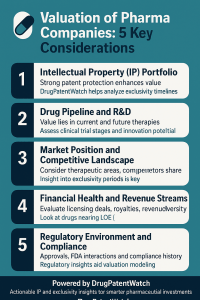
Welcome to the most volatile, high-stakes, and strategically critical discipline in modern business: the valuation of pharmaceutical and biotechnology companies.
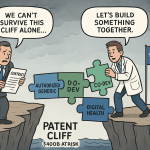
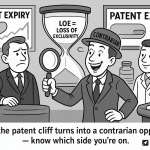
If you’re in this industry, you’re standing at the center of a paradox. On one side, we have a tidal wave of capital. Big Pharma is sitting on a “war chest” of deployable “dry powder” that has steadily grown and is estimated to exceed an astounding $1.5 trillion in 2025.1 This isn’t just idle cash; it’s a strategic imperative. On the other side of this paradox is the “patent cliff,” a chasm that threatens to wipe out over $200 billion in biopharma industry revenue by 2030.1
This is the $1.5 trillion question. How do you deploy that capital to survive the cliff?
The answer is no longer just “internal R&D.” The industry’s survival and growth are now inextricably linked to acquiring external innovation. This puts the accurate valuation of preclinical and clinical-stage biotech assets at the absolute center of C-suite strategy.
Let’s be clear about the stakes. Research and development costs remain astronomically high. After a decade of brutal, declining returns, the tide is finally showing fragile signs of turning. The average internal rate of return (IRR) for the top 20 biopharma companies has staged a mild recovery, climbing from a dismal 1.2% in 2022 to 5.9% in 2024.3 This “recovery” is driven almost entirely by a few promising late-stage assets.5 Meanwhile, the average cost to develop each of those assets has hit a staggering $2.23 billion5, and that’s before factoring in the 10- to 15-year timeline.6
This is not an academic exercise. This is a high-stakes, data-driven war for survival. The teams that can accurately value an asset, a patent, or a regulatory risk will win. The teams that can’t, will overpay, under-invest, and fall off the cliff.
This report is the new playbook. We are moving far beyond the simple “5 Key Considerations.” We’re going to dissect why pharma valuation is a unique beast, dive deep into the specific financial models that work (and the common, billion-dollar mistakes most teams make), and build a comprehensive framework for turning data into a competitive, high-ROI advantage.
How do you value an asset when the outcome is binary—zero or billions? How do you turn a dense file of patent applications into a predictive financial model? How do you quantify the risk of a new law like the Inflation Reduction Act?
If you’re a pharma or biotech professional in IP, R&D, or business development—or an investor, consultant, or lawyer advising them—you are being asked to answer these questions. You need to be skeptical of hype, and you need hard data. You’ve come to the right place. Let’s get to work.
The $1.5 Trillion Question: Pharma’s Valuation Paradox
As we established, the entire industry is caught in a strategic vise. The $1.5 trillion in “deal capacity” 1 is not a luxury; it’s a necessity. It’s the only tool large enough to fill the $200 billion revenue hole the patent cliff will create by 2030.1
This dynamic has fundamentally changed the market. It’s no longer a buyer’s market or a seller’s market; it’s a high-stakes market. The valuation of a single Phase II biotech asset is no longer a simple discussion between a CEO and a VC. It’s now the central battlefield for the future of the entire pharmaceutical industry.
The pressure to do deals is immense. We saw this in 2023, which hosted the largest biopharma deal since 2019.8 We’re seeing it in 2025, where, despite macroeconomic headwinds, M&A activity is seen as the primary solution.9 Big pharma must acquire innovation to survive.
But this pressure creates risk. When you’re desperate to fill a revenue gap, you are primed to overpay. The only defense against value destruction is a rigorous, data-driven, and unflinchingly realistic valuation framework.
And that’s where the paradox lies. The very assets pharma must buy are the hardest to value. They are not factories with predictable outputs. They are clinical-stage companies with no revenue, no profits, and a single asset that is, statistically speaking, most likely to fail.11
This is why we need a specialized playbook. The standard financial toolkit is useless here.
Why Pharma Valuation Is a Different Beast
If you try to value a clinical-stage biotech company like you value a tech startup or a manufacturing firm, you will fail. You’ll fail because the fundamental “physics” of the industry are different.7 A standard financial model built on “smooth, predictable revenue growth” simply cannot capture the seismic shifts in value that occur in this space.13
The entire discipline is built on four unique, interlocking pillars that set it apart.
Pillar 1: The R&D Marathon and Binary Outcomes
Developing a new drug is not a sprint; it’s an “arduous, multi-decade marathon”.7 The timeline from initial discovery to market approval typically spans 10 to 15 years.6 This protracted timeline requires immense, sustained R&D investments, which now average over $2.2 billion per asset when you include the cost of failures.5
This financial profile is unique. But the real challenge is the outcome. A tech startup can pivot. A manufacturing firm can retool. A pharmaceutical asset, in most cases, cannot. Its future cash flows are “highly bimodal”.11
Think about it. A drug candidate in Phase III clinical trials is not worth a “risk-adjusted average.” It is worth one of two numbers:
Zero: It fails to meet its primary endpoint. The entire $2.2 billion investment is written off.
Billions: It succeeds, gets FDA approval, and secures a 10-plus-year monopoly.
Standard valuation models are not built for this 0-or-1, binary reality. They are built to model shades of gray. This is the single biggest reason why we must use specialized tools.
Pillar 2: The Patent Bedrock and the Predictable Cliff
What enables a company to recoup that $2.2 billion investment and fund future research? A single, powerful, and temporary legal document: the patent.13
The entire value of a pharmaceutical company is built on this government-granted monopoly.13 This monopoly is the only thing that allows a company to price a drug at a level that generates a return on the decade-long R&D investment.
But this bedrock of value has a built-in, finite, and predictable self-destruct mechanism: the “patent cliff.”
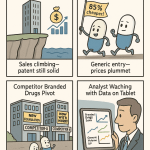
This isn’t a gentle slope. It’s a sheer, catastrophic drop. When a blockbuster drug loses its patent protection, competitors flood the market with generics (for small molecules) or biosimilars (for biologics).2 The consequences are swift and brutal. It is common to see a revenue plunge of up to 90% within a single year.2
Look at the classic example: Eli Lilly’s Prozac. When its core patent expired in 2001, it lost nearly 70% of its market and $2.4 billion in annual U.S. sales, seemingly overnight.16 This dynamic—a decade of monopoly profits followed by a near-total collapse—is the central, defining feature of the pharmaceutical P&L.
Pillar 3: The Regulatory Labyrinth
In most industries, value is determined by two actors: the company and the market (the customer). In pharma, there is a third, all-powerful actor: the regulator.
A drug’s value is not just determined by its scientific innovation or the unmet medical need it serves. It is determined by a gauntlet of government and quasi-government agencies.7
The U.S. Food and Drug Administration (FDA): Determines if you can sell the drug at all.
The U.S. Patent and Trademark Office (USPTO) & Patent Trial and Appeal Board (PTAB): Determine how long you can sell it exclusively.
Health Technology Assessment (HTA) bodies (e.g., the UK’s NICE, Germany’s IQWiG): Determine if your drug is cost-effective—a hurdle that is now just as important as the FDA’s safety and efficacy hurdle.17
The Centers for Medicare & Medicaid Services (CMS): Now, through the Inflation Reduction Act, this body can negotiate (i.e., set) the price for your most successful drugs, effectively rewriting your revenue forecasts.19
A valuation model that ignores this regulatory labyrinth is a work of fiction.
Pillar 4: The Strategic Objective
Because of these three pillars, the objective of a pharma valuation is different. You are not just trying to find a “fair market value.” You are trying to answer a set of specific, high-stakes strategic questions:
Scientific Risk: What is the probability this asset will work?
Monopoly Risk: How long will its exclusivity really last, and can it be challenged?
Market Access Risk: Will payers actually pay the price we need to get a return?
Macro Risk: How will a new law, a new president, or a new geopolitical conflict change the rules of the game?
This report is your guide to building the models that answer these questions.
Deconstructing the Pharma Valuation Toolkit: From DCF to rNPV and Real Options
Given this unique landscape, our toolkit has to be specialized. A robust valuation, the kind that underpins a multi-billion dollar M&A decision, never relies on a single method. It uses a combination of approaches to triangulate a value, building a case that is defensible from every angle.
Let’s walk through the four primary valuation methodologies and, more importantly, discuss when and how to use them.20
The Core Methodologies: An Executive Overview
1. The Cost Method
This method values an asset based on the R&D costs incurred to date.20 In pharma, this is almost entirely useless and can be dangerously misleading. As a WIPO report correctly notes, “spending money on research and development does not automatically guarantee the creation of valuable products”.20
A company can spend $500 million on a Phase III trial that fails. The cost method would value that asset at $500 million. The market, correctly, values it at $0. We can dismiss this method for our purposes. It’s a backward-looking accounting metric, not a forward-looking valuation tool.
2. The Market Approach (Comparables)
This is our “sanity check”.21 This method benchmarks the value of an asset against what the market has recently paid for similar assets.20 It comes in two primary flavors:
Public Company Comparables: This involves looking at the trading multiples (e.g., Enterprise Value / Revenue) of publicly traded companies that are “similar” in size, therapeutic area, or stage of development. For example, in 2023, the median EV/Revenue multiple for biotechnology companies was 12.97x.22 Some exceptional firms even reached multiples of 20x or, in rare cases, 100x.22
Precedent Transactions (M&A Comps): This is the more common and useful approach. You look at what a “strategic acquirer” (like Big Pharma) paid for a “similar” asset. For example, a 2018 case study used a comparable transaction analysis to identify the relative value of a novel reformulation in two dermatological indications.23
The Pitfall: The entire value of this approach hinges on one subjective word: “similar.” What does “similar” mean? Same mechanism of action? Same therapeutic area? Same phase of development? As a WIPO guide on the topic warns, the key is “comparing recent relevant deals” and “extracting useful data toward economic truth”.20
The real skill here is in the selection of the “comps.” A lazy analysis just pulls the last 10 deals. A professional analysis builds a defensible basket of 3-5 truly relevant deals and justifies, line-by-line, why they are comparable. This provides a “market-based” reality check on the theoretical value you’re about to calculate with our next method.
3. The Income Approach (DCF/rNPV)
This is the workhorse. This method forecasts the future cash flows an asset will generate and then discounts them back to their value in today’s dollars.20 This is the home of the Discounted Cash Flow (DCF) model and its critical, industry-specific variant, the Risk-Adjusted Net Present Value (rNPV) model.
4. The Real Options Method
This is the strategic layer. This sophisticated method values flexibility—the value of the option to make future decisions (like abandoning, delaying, or expanding a project) as new information becomes available.20 It is perfectly suited to the “staged” nature of pharma R&D.24
Now, let’s get into the mechanics. The rNPV model is the non-negotiable core, so we’ll spend the most time there.
The Gold Standard: A Practical Guide to Risk-Adjusted Net Present Value (rNPV)
If you work in pharma or biotech, this is your gold standard. The rNPV model is the superior method for valuing early-stage assets and R&D pipelines because it is the only one that explicitly accounts for the high probability of failure.25
A traditional DCF model assumes all forecasted cash flows will happen. As we discussed, this is fundamentally wrong for a biotech asset. The rNPV model corrects this by “de-risking” the future cash flows based on statistical probabilities.12
The formula looks complicated, but it’s really a simple, powerful concept 26:
$$rNPV = \sum \frac{(\text{Expected Cash Flow in Year } t \times \text{Probability of Success})}{ (1 + r)^t}$$
Let’s break down each variable. The entire valuation game is won or lost in the assumptions you make for these inputs.
Expected Cash Flow in Year t
This is your standard revenue-minus-cost calculation. You build a 15- to 20-year forecast for the asset, assuming it’s successful.26
Revenue: This is your Peak Sales forecast, based on market size, addressable patient population, and market share.13
Costs: This includes R&D expenses to get to launch, Cost of Goods Sold (COGS), SG&A (Selling, General & Administrative—your sales force), and taxes.12
For example, a model might assume: First year of sales = $850 million; Operating Cost = 38% of sales; Tax Rate = 20%.12 This gives you a clear “un-risked” cash flow for each year of the drug’s monopoly.
Probability of Success (PoS)
This is the “risk-adjustment” and the magic of the rNPV. This is the cumulative probability that the asset will successfully pass all remaining development and regulatory hurdles and reach the market.26
You don’t just guess. You use historical, data-driven probabilities for each phase of development.12
For example, if your drug is just entering Phase I, it doesn’t have a 100% chance of reaching the market. It has to pass Phase I, Phase II, Phase III, and an NDA review. Using historical data, the cumulative probability might be:
Probability (Phase I $\rightarrow$ Phase II): 59.52% 12
Probability (Phase II $\rightarrow$ Phase III): 35.52% 12
Probability (Phase III $\rightarrow$ NDA Submission): 61.95% 12
Probability (NDA Submission $\rightarrow$ Approval): 90.35% 12
You multiply these together: $59.52\% \times 35.52\% \times 61.95\% \times 90.35\% = \textbf{11.83\%}$.12
So, for a drug in Phase I, you multiply all your big, exciting future cash flow forecasts by 11.83%. This is how the rNPV model “de-risks” the forecast and brings it back to a statistically-sound reality.12 As the drug successfully completes each phase, the PoS goes up, and the rNPV of the asset “steps up” in value.
Discount Rate (r)
This is the single most common, and most critical, error I see in pharmaceutical valuation.
This r is your discount rate, typically the Weighted Average Cost of Capital (WACC).28 It accounts for the time value of money and the systematic risk of the investment.12
Here is the billion-dollar mistake: many teams “double-count” the risk. They apply a low PoS (e.g., 11.83%) to the cash flows, and then they apply a massive, VC-style “hurdle rate” of 30%, 40%, or even 50% as their discount rate r.
This is mathematically and logically wrong.
As technical papers from Analysis Group and others point out, the PoS already accounts for the specific, diversifiable, scientific risk of the asset (i.c., the risk that the trial fails).12 Therefore, the discount rate r should only reflect the systematic market risk (beta)—the risk you cannot diversify away.12
A 2012 analysis of publicly traded biotech firms gives us a much more realistic set of discount rates 28:
Preclinical stage WACC: 17.7%
Clinical stage WACC: 13.3% – 13.6%
Market-stage WACC: 8.7%
Notice how the discount rate decreases as the asset de-risks and moves closer to market.28 This is the professional way to model risk. You let the PoS handle the scientific risk (a binary, diversifiable risk) and the WACC handle the market risk (a systematic, non-diversifiable risk). Double-counting these two is the fastest way to systematically undervalue your entire pipeline.
This “valuation gap” is often at the heart of failed negotiations between a startup and a VC.12 The startup, using an appropriate WACC, arrives at a high rNPV. The VC, using a high “hurdle rate” on top of the PoS, arrives at a much lower value.12 The final deal price is, in effect, a negotiation over which r and which PoS are “correct.”
To provide a practical starting point, here is a table of sample inputs you can use for your own “back-of-the-envelope” rNPV models, combining data from industry analyses.
Sample rNPV Inputs: PoS and Discount Rates by Phase
Development Phase
Probability of Success (PoS) to Next Phase*
Cumulative PoS to Approval (from start of phase)*
Appropriate Discount Rate (WACC)**
Preclinical
N/A
$\sim$8.0% – 10.0%
17.7%
Phase I
59.52%
11.83%
13.3% – 13.6%
Phase II
35.52%
19.95%
13.3% – 13.6%
Phase III
61.95%
56.40%
13.3% – 13.6%
NDA Submission
90.35%
90.35%
8.7%
Approved
N/A
100%
8.7%
*Phase success probabilities (PoS) are based on an analysis cited in 12 and.12 Cumulative PoS is calculated by multiplying the success rates of all subsequent phases (e.g., Phase II cumulative PoS = 35.52% * 61.95% * 90.35% = 19.95%).
**WACC/Discount Rates based on a 2012 analysis of publicly traded biotech firms cited in.28
The Strategic ‘What If’: Valuing Flexibility with Real Options Analysis (ROA)
The rNPV model is a fantastic, powerful, static photograph. It gives you the value of the asset assuming you follow a single, predetermined plan.
But as we all know, R&D is not a static plan; it’s a dynamic movie. It’s a series of “staged decisions” where managers constantly react to new information.24 This is where Real Options Analysis (ROA) comes in.
ROA, which often uses decision trees 11, is a method that values managerial flexibility. It understands that a research program isn’t just a single cash flow stream; it’s a bundle of “options”.20
Specifically, ROA assigns a tangible financial value to these critical strategic choices:
The Option to Abandon: What is the value of being able to kill a project after receiving bad Phase II data? It’s the value of all the money you save by not conducting the $500 million Phase III trial. An rNPV model struggles to capture this, but a decision tree builds it in explicitly.30
The Option to Expand: What is the value of a drug that could potentially be used for multiple indications?29 A simple rNPV might only value the first, primary indication. An ROA model values the option to pursue secondary and tertiary indications if the first one is successful.
The Option to Delay: What is the value of waiting for a competitor to reveal their data first, or for market conditions to improve?24 This, too, has a calculable value.
This is not just an academic theory. This is exactly how you must value “platform” technologies. If you try to value a company with a novel gene-editing tool or an AI-driven discovery engine by only running an rNPV on its first drug candidate, you will always undervalue it by a massive amount.31
The real value of that company is not in its first asset; it’s in the “scientific spillover” 32—the platform’s option to generate a second, third, and tenth drug, each at a (theoretically) lower cost and higher PoS. This is the “goose that lays the golden eggs,” and ROA is the only method that can properly value the goose, not just the first egg.
The Bedrock of Value: Why Your Entire Valuation Rests on IP and Exclusivity
Let’s move to the single most sensitive variable in your entire valuation model: t (time).
The t in your $rNPV = \sum \frac{CF_t}{(1+r)^t}$ formula represents the years of cash flow. In pharma, this variable is defined by one thing and one thing only: your monopoly.
The entire multi-billion dollar valuation of your asset rests on its period of market exclusivity. When that period ends, your cash flows—and thus your valuation—collapse.7
This is why, for any serious business development, IP, or R&D team, understanding the true lifespan of an asset is the most critical valuation input.
The ‘Patent Cliff’ Isn’t a Date, It’s a Dynamic Model
We must destroy the simplistic idea of a single “patent expiration date.” The effectiveLoss of Exclusivity (LOE) date is a complex, dynamic, and constantly shifting target.33
As we’ve discussed, the moment of LOE is financially catastrophic, with revenue collapses of 80-90%.2 For anyone making an investment decision, pipeline prioritization, or generic-launch plan, predicting this effective LOE date is “non-negotiable”.33
This is where sophisticated, real-time competitive intelligence becomes indispensable. You cannot build a credible valuation model using a static, 10-year-old spreadsheet of patent data. You need a systematic, living process.
This is the precise, high-ROI function of a competitive intelligence platform like DrugPatentWatch. A professional IP or BD team doesn’t guess at the LOE date; they model it. They use such tools to systematically track all key competitor patent filing dates, monitor the status of global regulatory exclusivities, and, critically, follow the outcomes of patent litigation.34
This hard data is the direct, non-negotiable input for the t (time) variable in your rNPV model. Guessing at this date is malpractice. Modeling it with real-time data is your single greatest competitive advantage.
Patent Thickets vs. Regulatory Exclusivity: The Two Levers of Monopoly
To model your monopoly, you must understand that it comes from two separate and concurrent sources.35 They are not the same, and they have different risk profiles.
Patents: Granted by the USPTO. A 20-year right, from filing, to sue infringers.14
Exclusivity: Granted by the FDA. A statutory monopoly that blocks the FDA from approving a competitor’s application.35
A savvy valuation analyst models both.
Patent Strategies: From Thickets to Litigation
In the modern era, patents are not just defensive shields; they are offensive strategic weapons.14 The most famous and controversial of these strategies is the “patent thicket.”
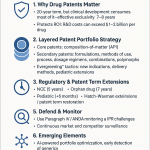
A patent thicket is a dense, overlapping, and complex web of patents filed around a single drug. You don’t just patent the main composition of matter (the molecule). You patent:
The manufacturing process.
The formulation (e.g., tablet vs. capsule).
The delivery device (e.g., the auto-injector pen).
Specific “methods of use” for different patient subgroups.
The goal is to make it so legally complex and expensive for a generic or biosimilar competitor to “design around” your IP portfolio that they simply give up, or are delayed for years.
The most legendary example? AbbVie’s Humira. AbbVie built “Fortress Humira” by filing an astonishing 247 patent applications.36 This legal strategy, not a scientific one, extended its U.S. exclusivity to a staggering 39 years36, long after its primary patent expired.
Valuation Implication: You can’t just value the one core patent. You must value the entire thicket.
But this strategy has its own risks: litigation. A patent is only as good as your ability to defend it. And the data here is sobering.
In ANDA (generic) litigation, the “innovator” (the brand) has a historical win rate of only 25%.37
However, in PTAB (Patent Trial and Appeal Board) trials for Orange Book patents, the innovator/patent owner wins 61% of the time.37
As a valuation analyst, your rNPV model for a patented asset must include a “Litigation Risk” factor. That 20-year patent term shouldn’t be taken at face value. It should be probability-weighted by the chance of losing a legal challenge. These 25% and 61% statistics give you a hard-data starting point for that risk-weighting.
Regulatory Exclusivity: The ‘Other’ (and Often Better) Monopoly
This is a critical, and often misunderstood, source of value. These are FDA-granted monopolies that run independently of your patent status.35
New Chemical Entity (NCE) Exclusivity: Grants 5 years of exclusivity for a novel small molecule.38
Orphan Drug Exclusivity (ODE): This is the big one. Granted to drugs that treat a “rare disease” (affecting <200,000 people in the U.S.). It provides 7 years of total market exclusivity for that drug in that indication.39
Pediatric Exclusivity: This is a “bonus.” If you run the pediatric studies the FDA requests, they will add an extra 6 months of monopoly to the end of all your existing patents and exclusivities.38 On a blockbuster drug like Keytruda, those 6 months can be worth billions of dollars.
The Valuation Insight: Let me ask you a strategic question. Which is more valuable: a 20-year patent or a 7-year Orphan Drug Exclusivity?
For an analyst, the 7-year ODE is often better.
Why? A 20-year patent is just a “right to sue”.37 Its strength is debatable, and it will be constantly challenged in court, with a high risk of failure. The 7-year ODE, by contrast, is a date-certain, non-challengeable (via patent law) monopoly. The FDA is statutorily prohibited from approving another application for that drug, for that disease, for 7 years.39
The cash flows generated under that 7-year ODE are far less risky (i.e., more certain) than the cash flows from year 8-20 of a patent. Therefore, in your rNPV model, the ODE-protected cash flows should be discounted at a lower rate (like the 8.7% for market-stage firms 28), making them significantly more valuable.
This is precisely why companies designated as “orphan” are such prime M&A targets.41 Their cash flows are more predictable.
The ‘Orange Book’ Controversy: Valuing the Listing Itself
This is one of the most current and sophisticated topics in IP valuation. The FDA’s “Approved Drug Products with Therapeutic Equivalence Evaluations,” known as the “Orange Book,” is the official catalog of approved drugs and the patents that an innovator company asserts against them.42
This isn’t just an administrative list. It has massive financial consequences. When a generic company files for approval, it must certify against the patents in the Orange Book. This challenge automatically triggers a 30-month stay (a 2.5-year delay) on the generic’s approval while the courts sort it out.44
Therefore, the listing of a patent in the Orange Book itself has direct financial value by delaying competition.
The New Risk: This system was, in the view of regulators, being abused. In 2023 and 2024, the Federal Trade Commission (FTC) took the unprecedented step of challenging over 400 patents listed in the Orange Book.42 The FTC’s position is that companies were “improperly” listing “junk patents”—like those for the injector device or a sterile packaging system—to trigger the 30-month stay and illegally block generic competition.36
The Valuation Implication: This is a new, politically-driven risk factor. As an M&A or IP team, you can no longer take an Orange Book listing at face value. Your due diligence must now assess the quality of those listings.
Is your target’s patent thicket a fortress of steel (composition-of-matter patents) or a house of cards (device and packaging patents)? A portfolio full of these “weak” listings now carries a higher risk of being challenged and de-listed by the FTC, which would accelerate the LOE date. This is a new, specific risk factor that must be incorporated into the t (time) variable of your rNPV model.
Valuing the Unseen: A Practitioner’s Guide to the Clinical Pipeline
We’ve established the “how” (the models) and the “how long” (the IP). Now we move to the most subjective and artful part of the valuation: valuing the asset itself.
How do you forecast the “Peak Sales” and “Market Share” variables for a product that doesn’t exist yet? This is where strategic analysis, clinical data, and a deep understanding of the competitive landscape become paramount.
The Eternal Debate: ‘First-in-Class’ vs. ‘Best-in-Class’
This is one of the biggest strategic questions in pharma, and it will radically alter your “Market Share” assumption. Is it better to be first to market with a new mechanism of action (MoA), or is it better to be best in class, even if you’re the third, fourth, or fifth entrant?13
Traditional, algorithmic models will tell you to just dock market share for every new entrant. They’re wrong.
A sharp analysis from L.E.K. Consulting 45 debunks this lazy approach. The reality, they find, is more binary. And the entire equation hinges on one word: differentiation.
1. The Undifferentiated “Me-Too” Market
If a new class of drugs launches and all the products are basically “me-too” (i.e., undifferentiated on efficacy, safety, or convenience), then ‘first-in-class’ wins. And wins big.
In these markets, the first entrant often captures and retains more than 60% market share.45 All subsequent “me-too” entrants are left to fight for the scraps, often capturing less than 10-20% share. Being first creates a durable “first-mover” advantage with physicians, who see no compelling clinical reason to switch.
2. The Differentiated “Best-in-Class” Market
If, however, a later entrant is truly and demonstrably “best-in-class,” then order of entry plays a “far lesser role”.45
This differentiation can come from several angles 45:
Superior Efficacy: (e.g., better survival data)
Superior Safety: (e.g., fewer side effects)
Superior Convenience: (e.g., a daily pill vs. an infusion, or a once-monthly shot vs. a daily pill)
The Classic Case Study: Pfizer’s Lipitor.46
Lipitor (atorvastatin) was the fifth statin on the market. It arrived more than 9 years after the first-in-class drug, Merck’s Mevacor. By any traditional, order-of-entry model, Lipitor should have been a commercial failure.
Instead, it became the best-selling drug in the history of the world, with peak annual sales of $13 billion.46
Why? Because it was demonstrably “best-in-class.” It offered a therapeutic advantage (superior cholesterol-lowering) that was clinically meaningful. Physicians switched to it in droves because it was better, not despite it being late.
The Valuation Implication: This is where you, the analyst, earn your paycheck. You must stop being a simple modeler and become a clinician. You cannot just look at the pipeline stage.13 You must read the clinical data.13
Is your target’s Phase II asset really differentiated? Is that 1.5-month improvement in Progression-Free Survival (PFS) clinically meaningful in this indication, or is it just statistical noise? Ask your medical affairs team.
If the answer is “no,” then you are a “me-too.” If you’re not first, your market share assumption should be slashed to 10-20%, period. Honesty in this qualitative judgment can save your company billions.
The Modality Premium: Valuing Cell, Gene, and mRNA
You cannot use the same rNPV assumptions for a simple small-molecule pill and a revolutionary, patient-specific gene therapy.47 The inputs for new modalities—like biologics, mRNA, cell therapies (e.g., CAR-T), and gene therapies—are fundamentally different.48
When valuing these assets, you must adjust almost every variable in your model.
1. Higher Probability of Success (PoS)
The data shows that biologics (the precursors to these new modalities) have higher clinical trial success rates than traditional small-molecule drugs.51 This means, for an asset in the same phase, you are justified in using a higher PoS variable in your rNPV model for a biologic vs. a small molecule.
2. Higher Revenue (Price)
These are not incremental therapies; they are often curative or near-curative.49 As such, they command premium, high-value pricing. Biologics have been shown to generate “substantially higher revenues” than small-molecule drugs.51 This justifiably supports a higher “Peak Sales” forecast.
3. Much Higher Cost of Goods Sold (COGS)
This is the big catch. Manufacturing a small-molecule pill is cheap, often 5-10% of revenue. But manufacturing a new modality?
Gene Therapies: Require “many complex phases” and a “highly trained workforce.” The process of growing vectors and cells is sterile, complex, and incredibly expensive.32
Cell Therapies (CAR-T): Many of these are autologous, meaning they are patient-specific. You must harvest a patient’s cells, ship them to a-state-of-the-art facility, genetically re-engineer them, and ship them back to the hospital for infusion.49
Your COGS assumption for these assets can’t be 10%. It might be 30%, 40%, or even 50%+, which dramatically impacts your net cash flow and, thus, your valuation.
4. The Real Options “Platform” Value
This is the most important concept. As we discussed in the Real Options section, the real value of these companies, especially for early gene therapies, is in the “scientific spillover”.32
The 2024 BCG report notes that as CAR-T matures, the focus is on broadening its applicability and reducing its manufacturing cost.49 The know-how gained from the first approved gene therapy (and its complex manufacturing) is a massive intangible asset. It radically lowers the cost and risk of all future gene therapies that company develops.32
This is why Pfizer paid $43 billion for Seagen.8 They weren’t just buying 4 approved ADC drugs. They were buying the platform—the know-how, the scientists, and the manufacturing technology to create dozens of future ADCs.8 You must use a Real Options framework to value this, or you will miss the entire point.
The Strategic ‘Make-or-Buy’: In-House vs. CDMO Manufacturing
This leads us to a crucial, and newly relevant, valuation driver. For these complex new modalities, the decision of how to manufacture is no longer a simple operational question. It is a core strategic and financial one.
The traditional trade-off was simple 52:
Outsource (to a CDMO): You save massive upfront capital investment in facilities and equipment. You get speed-to-market and can access specialized expertise. The downside is a loss of control over your IP, your process, and your timelines.52
In-House: You have full control over your IP, quality, and timelines. You can innovate on the process itself. The downside is a massive, high-risk, upfront capital cost and a longer time-to-market.53
Historically, for small biotechs, the answer was always to outsource.56 But the valuation calculus has changed for two key reasons.
1. Manufacturing as De-risking: For a complex cell or gene therapy, the manufacturing is half the battle. A biotech company that has already built and validated its own in-house manufacturing facility has de-risked a massive, critical bottleneck.54 This tangible asset (the facility) and the intangible asset (the process know-how) command a significant valuation premium in an M&A negotiation.
2. The “Biosecure Act” Geopolitical Risk: This is the new, politically-driven valuation factor that is shaking up boardrooms. The industry, seeking efficiency, became heavily reliant on low-cost, high-efficiency Chinese Contract Development and Manufacturing Organizations (CDMOs).57
Now, the proposed U.S. Biosecure Act aims to prohibit federal contracts with biotechnology providers connected to “foreign adversaries,” with a clear focus on China.56 This has sent a shockwave through the industry.
The Valuation Implication: As of 2024, a biotech company’s reliance on a Chinese CDMO has been transformed from a cost-saver into a massive valuation liability. An acquirer (like Big Pharma, who relies on U.S. government contracts) now sees that reliance as a critical risk that must be “de-risked,” (i.e., expensively moved).
Conversely, a company that has its own U.S./EU facility, or a contract with a U.S./EU-based CDMO, now gets a valuation premium.56 They are “de-risked” from this specific and potent geopolitical turmoil. This is a perfect example of how macro factors are now core valuation inputs.
The New Macro-Environment: How Regulation, Payers, and Politics Are Warping Valuations
It’s time to zoom out. A perfect rNPV model of a brilliant drug with a 20-year patent can be rendered worthless overnight by a single act of Congress or a new regulatory rule.
Your valuation models are no longer built in a vacuum. They are built at the mercy of a new, complex, and volatile macro-environment. An expert analyst doesn’t treat these as “externalities”; they are quantifiable risk factors that must be modeled.
The IRA Effect: Modeling the Impact of Price Negotiation
The Inflation Reduction Act (IRA) of 2022 is, without a doubt, the boogeyman in every pharmaceutical boardroom.19 It fundamentally rewrites the rules for the U.S. market.
For the first time, it gives Medicare (CMS) the power to “negotiate” (i.e., set) the price for the most expensive drugs, and it penalizes companies for price hikes that outpace inflation.19 This is a direct, frontal assault on the Price and Peak Sales variables in every valuation model.
The debate is no longer if it will have an impact, but how big. A critical analysis from the USC Schaeffer Center gives us the key metric: the “elasticity of innovation”.59
Their finding? For every 10% reduction in expected U.S. revenues, pharmaceutical innovation (measured in things like new clinical trials or drug approvals) is expected to fall by 2.5% to 15%.59
This is the critical takeaway. The IRA doesn’t just lower the revenue for existing blockbuster drugs. It destroys the Net Present Value of future, un-invented drugs, making them financially non-viable to develop in the first place.
But the story is more nuanced, and this is where the real strategic insight lies. The IRA’s structure creates a “strategic distortion.”
The law’s price-setting provisions hit small-molecule drugs (pills) sooner (9 years post-approval) than they hit “biologics” (13 years post-approval).19 This isn’t a subtle difference; it’s a massive, multi-billion dollar signal.
The Valuation Implication: The IRA has, perhaps unintentionally, disincentivized R&D in the small-molecule, chronic-care drugs that are the backbone of primary care. Simultaneously, it has created a massive new incentive for R&D and M&A in biologics and orphan drugs, which have longer exemption periods.
As a valuation analyst, you must reflect this new political reality. The valuation premium for a biologic or an orphan-designated biotech has increased as a direct result of the IRA.
The Payer Gauntlet: Valuing HTA and Reimbursement Risk
Getting FDA approval is just the first hurdle. The second, and often higher, hurdle is getting paid for your drug.
This is the world of Health Technology Assessment (HTA) bodies.18 These are the agencies, like the UK’s National Institute for Health and Care Excellence (NICE) or Germany’s IQWiG, that rule on whether a new drug is cost-effective.17
They ask a simple, brutal question: “Your drug is $100,000 more than the old standard of care. Is it worth it?” They measure this using metrics like the Quality-Adjusted Life-Year (QALY).60
For a valuation team, this is a critical ex-US risk.
The Global Contagion Effect: A key study found that a negative NICE decision has a more powerful global impact than a positive one.17 Payers in other countries (like Brazil, Sweden, and Israel) will directly reference a NICE rejection to justify their own “no” or, more likely, to demand a massive, bottom-line-crushing discount.17
Greater Reimbursement Restrictions: HTA-based systems impose far greater restrictions on patient access than non-HTA approaches. One study of anticancer drugs found that while US payers covered 100% of FDA-approved drugs (with some restrictions), NICE (UK) recommended less than 40%.61
The Valuation Implication: Your “global revenue” forecast can’t just be (US Sales) + (EU Sales * 0.7). That’s lazy, and it’s wrong.
A professional valuation model risk-adjusts each ex-US country’s revenue forecast by the probability of a favorable HTA decision. This, again, forces you to be a clinician. You have to look at the data: does your drug barely beat the standard of care, or is it a slam-dunk on cost-effectiveness? The answer will dramatically change the entire ex-US portion of your valuation.
The ‘Accelerated Approval’ Double-Edged Sword
The FDA’s Accelerated Approval (AA) pathway is a godsend for patients and companies, especially in oncology and rare diseases. It allows a drug to get to market years sooner, based on a “surrogate marker” (e.g., “tumor shrinkage”) rather than a hard clinical outcome (e.g., “living longer”).62
Financially, this seems like a pure win. But it’s a double-edged sword.
The “Win”: Boosting NPV
Getting to market 2-3 years faster means the t (time) in your NPV model is shorter. Your cash flows start sooner, which dramatically increases their present value.63
A report from Vital Transformation quantified this: it estimated that a 3-year delay (the equivalent of not getting AA) would cause 33% to 66% of AA-approved drugs to have a negative NPV.64
For many orphan and oncology drugs, the AA pathway is the only path to financial viability. It is a massive value-driver, and 82% of AA approvals are for orphan indications.64
The “Risk”: Contingent Withdrawal
Here’s the other edge of the sword. The AA is contingent. It’s a temporary approval, granted on the promise that the company will “with due diligence” run a confirmatory trial to prove the drug actually makes people live longer.62
For years, this system was lax. But the FDA is now cracking down hard on companies that get AA and then fail—or “conveniently” delay—their required confirmatory trials.62 This creates a new, potent contingent withdrawal risk.
The Valuation Implication: Your rNPV model needs a new, more sophisticated variable. You can no longer model a simple 10-year monopoly for an AA-approved drug.
A sophisticated model must now project:
A 3-5 year cash flow stream post-AA (the time it takes to run the confirmatory trial).
Followed by a probability-weighted outcome:
(Probability(Confirmatory Success) * Full Monopoly Cash Flow)
This makes the valuation far more complex, but also far more realistic.
Geopolitics and Supply Chains: The New ‘Cost of Goods’
Our final macro-risk is one that, five years ago, wasn’t even on the radar for most valuation teams: the supply chain.
Your COGS (Cost of Goods Sold) assumption used to be a sleepy, stable 10-15% in your model. Not anymore. Geopolitics has turned it into a primary source of risk.
The Risk: The pharmaceutical supply chain is dangerously centralized.57 For decades, the industry optimized for cost, not resilience, by outsourcing manufacturing to low-cost hubs in China and India.57 The result? Over 80% of key API (Active Pharmaceutical Ingredient) starting materials now come from China.57
This has created a massive, systemic “supply dependency.”
The Cost: This dependency is now colliding with “geopolitical trends such as protectionism and economic nationalism”.66 The US-China technological rivalry 67, tariffs 68, and the Biosecure Act 56 are forcing a strategic “reshoring” or “multi-shoring” of these critical supply chains.57
This is expensive. It means building new, costly facilities in the U.S. or Europe. It means higher labor costs and higher capital costs, all of which squeeze your margins and ROA.69
The Valuation Implication: A valuation model that doesn’t include a “Supply Chain Risk” sensitivity is incomplete.
A company with a single-source API from China now has a higher-risk cash flow stream. A smart analyst will apply a higher discount rate to that company’s valuation to account for this geopolitical risk.
Conversely, a company that has already invested in a diversified, “reshored,” or multi-continent supply chain 57 has a lower-risk cash flow stream. They deserve a higher valuation, even if their COGS are slightly higher, because their revenue is more secure.
From Valuation to Value Creation: The Strategic Application of Pharma Intelligence
So far, we’ve treated valuation as a defensive, analytical exercise. Now, let’s flip the script.
For the most sophisticated IP, BD, and R&D teams, valuation is not a report you run; it’s a weapon you wield. The data you generate isn’t just for a negotiation; it’s for capital allocation. It’s how you decide where to place your billion-dollar bets.
The BD & IP Team’s Offensive Playbook
Your job as an IP or Business Development leader is not just to perform “Freedom-to-Operate” (FTO) analysis. That’s a defensive, “check-the-box” mentality. Your real job is to use patent and pipeline data as an offensive tool to drive ROI.34
A systematic, data-driven competitive intelligence (CI) program is how you find investment signals before they become obvious.3
This is how a world-class team uses a competitive intelligence platform like DrugPatentWatch to create tangible, quantifiable value 34:
Map R&D Priorities 70: You don’t wait for a competitor’s press release. You systematically analyze their patent filings. This shows you where they are placing their bets 3-5 years before a product is public. It allows you to identify emerging trends, new target classes, and shifting research priorities while they are still nascent.3
Find the “White Space” 3: You run a patent landscape analysis and integrate it with market data. This allows you to find the “holy grail”: a high-value, high-unmet-need therapeutic area that is not already heavily patented. This is where you direct your own R&D for a higher probability of success and a more defensible monopoly.
Kill Internal Programs 34: This is the highest-ROI, and most politically difficult, activity. Your CI data shows a competitor is 2-3 years ahead of you, has a dominant patent position, and their Phase II data looks better. You make the call to terminate your $200 million “me-too” internal program. This isn’t a failure; it’s a massive, tangible, strategic win. You just saved $200 million and freed up your scientists to work on a program you can win.
Identify M&A & Licensing Targets 34: This is the flip side. Your CI analysis shows a critical gap in your 2030 oncology pipeline. Your landscaping also identifies a small biotech with the perfect, well-protected asset to fill that gap. This patent data doesn’t just support the M&A valuation; it initiates it.
Plan Generic/Biosimilar Challenges 34: If you’re in the generics business, this is your bread and butter. You monitor a competitor’s patent thicket, identify the weakest patent in the bunch, and use your data to plan the optimal legal, regulatory, and commercial time to strike.
This is how you turn a “cost center” (your IP team) into a “value-creation” engine (your strategic intelligence hub).
Life Cycle Management (LCM): Extending Value Beyond the Cliff
The patent cliff isn’t just a threat; it’s a transition.71 Your valuation model shouldn’t just stop at the LOE date.
Life Cycle Management (LCM) is the art and science of maximizing the total value of an asset, both before and after its primary patent expires.71
This is a critical, and often-overlooked, source of value. The old way of thinking was that a drug’s life was over at LOE. The new, modern LCM strategy understands that the post-exclusivity period can account for 30% of a drug’s total lifetime sales.73
How do you capture that 30%? You don’t just sit and wait for the cliff. You plan for it 5-10 years in advance with a combination of these strategies 74:
Innovation (Follow-on Products): This is the most common and effective strategy. You develop a “new and improved” version of your own drug. This could be a new, more convenient formulation (e.g., a daily pill becomes a weekly shot), a new delivery device 74, or a fixed-dose combination with another drug.75 You launch this “son of” product 2-3 years before the original’s patent expires and “switch” patients over. This creates a brand new patent and exclusivity clock, effectively extending your franchise.
New Indications: You find new diseases your drug can treat. Each new indication you get approved can come with its own 3-year exclusivity, helping to protect your revenue stream.75
Branded Generics (“Authorized Generics”): You compete with yourself. Through a subsidiary, you launch your own “authorized generic” on Day 1 of the LOE.75 You know the manufacturing, you have the supply chain. This allows you to compete on price and capture a large share of the generic market you would have lost anyway.
The Valuation Implication: When you are valuing a company, you must look for a visible, funded LCM strategy. If you find one, your revenue model doesn’t drop to $0 at LOE. It models a step-down, followed by a sustained, lower-level cash flow (a “fat tail”) from these LCM initiatives. This “fat tail” can add hundreds of millions, or even billions, to the asset’s total Net Present Value.
Case Studies from the Trenches: What We Can Learn from Gilead, Pfizer, and AbbVie
Theory is one thing. Billions of dollars are another. The best way to understand this new, integrated valuation playbook is to see how it played out in some of the largest, most formative deals and strategic battles in recent history.
M&A Masterclass: Gilead’s $11B Bet on Pharmasset (Sovaldi)
In late 2011, Gilead Sciences announced an $11 billion all-cash acquisition of Pharmasset. The deal, at a staggering 89% premium, was widely panned by analysts as “risky” and a massive overpayment.76
The asset at the center of the deal was a Phase III drug for Hepatitis C, sofosbuvir (which would become Sovaldi).
This case is a masterclass in strategic framing and how it dictates valuation.
The Seller’s Valuation: A U.S. Senate investigation later uncovered Pharmasset’s own internal valuation models. Their “management case” projected a price for the drug at $36,000. Their most aggressive “blue sky” model topped out at $50,000.78
The Acquirer’s Valuation: Gilead’s internal models, used to justify the $11 billion price tag, were looking at a price range of $55,000 to $75,000.78
The Strategic Pivot (Post-Acquisition): Here is the brilliant part. Once Gilead owned the asset, their pricing team threw out the old models. They anchored the price not to other drugs, but to the cost of the problem. They looked at the existing “standard of care” for severe Hepatitis C, which was a long, painful, and ineffective drug cocktail that often ended in a $300,000+ liver transplant.79
Compared to that, what was a cure worth?
Gilead launched Sovaldi at $84,000 (or $1,000 per pill).79
The Lesson: Pharmasset, the seller, undervalued its own asset because it was anchored in an old paradigm: “What do other drugs cost?” Gilead, the acquirer, paid an $11 billion premium because they correctly valued Sovaldi in a new paradigm: “What is the value of ending a disease?”.79
They paid $11 billion because their valuation was based on the problem Sovaldi solved, not the product it was. This demonstrates that the strategic framing of the asset is the most important step in any valuation.
Buying the Pipeline: Pfizer’s $43B Seagen Acquisition
Fast forward to 2023. Pfizer, facing a massive patent cliff for its COVID-19 products and other blockbusters, executed the largest biopharma deal since 2019: the $43 billion acquisition of Seagen.8
This was a pure “buy, don’t build” strategy to solve their looming revenue gap.
The “Why”: Seagen was the undisputed global leader in a “hot,” new, and incredibly complex modality: Antibody-Drug Conjugates (ADCs), or “smart bombs” that deliver chemotherapy directly to cancer cells.8
The Valuation Lesson: This was a Real Options acquisition, plain and simple.
If you tried to justify that $43 billion price tag by running a simple rNPV on Seagen’s four approved drugs, you would never get there. The numbers don’t work.
Pfizer’s CEO, Albert Bourla, said it himself. He wasn’t just buying the four assets. He was buying “the goose that lays the golden eggs”.8
Pfizer paid a massive, multi-billion dollar premium for the platform.8 They bought Seagen’s “trove of ADC technology,” its world-class scientific team, and its proprietary manufacturing know-how. This platform gives Pfizer the option to create dozens of future best-in-class cancer drugs.
The $43 billion valuation was a strategic, long-term, Real Options value for the platform, not a simple financial DCF of its existing assets.
The LOE Playbook: AbbVie’s ‘Fortress Humira’
Our final case is not an M&A deal, but a multi-decade strategic war. For a decade, AbbVie’s entire valuation was propped up by one drug: Humira (adalimumab), which generated over $20 billion per year.82
AbbVie’s defense of this asset is a 3-act play, and it perfectly illustrates the integrated nature of modern pharma valuation.
Act 1: The Science. Humira is a brilliant biologic that changed the game for millions of patients with autoimmune diseases. This scientific value created the initial cash flow.
Act 2: The Law. As Humira’s primary patent neared expiration, AbbVie’s valuation was based entirely on a legal strategy. They built “Fortress Humira”—a nearly-impenetrable patent thicket of 247 applications.36 This legal fortress, not science, delayed U.S. biosimilar entry for years, protecting those $20 billion/year cash flows.
Act 3: The Payer. The cliff finally came in 2023. Biosimilars flooded the U.S. market. The result? In the following year, AbbVie lost 60% of its net sales… but maintained its brand share (volume).83
How is that possible? How do you lose 60% of your revenue but 0% of your volume?
By executing a brilliant, and very costly, payer strategy. AbbVie gave massive, steep discounts and rebates to the Pharmacy Benefit Managers (PBMs) to keep Humira on the preferred formulary tier, effectively blocking the “cheaper” biosimilars from getting access. They traded margin for volume.
The Lesson: This case study is a microcosm of this entire report. The valuation of a single asset over its lifetime is a multi-stage game.
Phase 1 (R&D): Value is based on Science (rNPV, PoS).
Phase 2 (Monopoly): Value is based on Legal Strategy (IP, Patent Thickets).
Phase 3 (LOE): Value is based on Commercial & Payer Strategy (LCM, Rebates).
A good analyst understands this. A great analyst models all three phases.
“By 2028, over $300 billion in biopharma revenue is at risk due to patent cliffs. To offset these losses, companies are strategically targeting assets earlier in development, particularly pre-Phase III candidates, where innovation is often most promising. This shift reflects a growing trend toward acquisitions that align closely with therapeutic area expertise.”
Source: CROMOS Pharma, “Reflections from JPM 2025: A CEO’s Perspective on Biopharma’s New Era” 10
The 2025 Horizon: Executive Sentiment and What’s Next in Biopharma Valuation
We’ve built the framework, dissected the models, and studied the cases. Now, let’s look at the road ahead. How are these forces shaping the M&A and investment landscape in 2025?
The sentiment coming out of the major 2025 healthcare conferences (like J.P. Morgan) and recent market reports is clear, consistent, and cautious.9
The M&A Landscape: Cautious Optimism and a Focus on “Bolt-Ons”
The overall sentiment for 2025 is one of “cautious optimism”.9 The strategic imperative is undeniable: Big Pharma must do deals to fill the patent cliff gap, and they are sitting on $1.5 trillion in “dry powder”.1
But this $1.5 trillion is not going to be spent on a few massive, industry-consolidating “megamergers”.85 That era is over.
Executive sentiment, including from leaders like J&J’s CEO, is that smaller, “bolt-on” deals are often more impactful and easier to integrate.86 The market in 2025 is being defined by “bespoke, strategic acquisitions in the $1–$5 billion range“.87
The focus is targeted. The money is flowing to specific, “hot” areas that are either scientifically revolutionary or favored by the new macro-environment:
Antibody-Drug Conjugates (ADCs)88
GLP-1s (the new generation of obesity and diabetes drugs) 88
Precision Medicine and targeted therapies 10
We’re also seeing a massive uptick in licensing deals, which are often a “try before you buy” approach. Notably, a huge portion of this activity involves Chinese biotechs84, as Western pharma looks to in-license promising, lower-cost assets.
The VC and IPO Market: A Tale of “Haves and Have-Nots”
While the M&A market for proven assets is hot, the venture capital and public-offering market for early-stage companies is a different story.
The 2024-2025 funding environment has been described as a “brutal” 91, “barbell” market.92
The “Have-Nots”: For most early-stage, preclinical companies, fundraising is incredibly difficult. The market is “on track for its worst fundraising year in more than a decade“.90 LPs are worried, and capital is tight.90
The “Haves”: At the other end of the barbell, a few select companies are raising massive, eye-watering rounds. These are companies that are either:
In “hot” sectors like AI drug discovery.93
Have crossed the chasm to human proof-of-concept.
This second point is the key. According to PitchBook, Phase 2 data “is the name of the game” in 2025.94 VCs are overwhelmingly prioritizing companies that are advancing to Phase 2 and beyond because this is the single most important “de-risking” event.94
The Valuation Implication: This “flight to quality” creates a massive valuation “step-up” at Phase II. A biotech with positive human proof-of-concept data is now exponentially more valuable than one with even the best preclinical data. Why? Because it has entered the tiny pool of “de-risked” assets that all VCs and all Big Pharma acquirers are fighting over.
The Macro-Drivers: Interest Rates and Political Uncertainty
What could change this “cautious optimism”? Two big, external forces are holding the market in a state of tension.
1. Interest Rates: Biotech is the ultimate “long-duration” asset. Its value is not based on this quarter’s earnings, but on projected cash flows 10-15 years in the future.
This makes biotech valuations hyper-sensitive to interest rates.68
The high interest rates of 2022-2023 crushed biotech valuations. Why? Because a higher r (discount rate) in your rNPV model means those distant-future cash flows are worth much less today.
The “cautious optimism” for 2025 is explicitly tied to the hope that the Fed will cut interest rates.68 Historically, biotech stocks have performed extremely well during cycles of rate cuts, as a lower r makes their future value “pop”.68
2. Political Uncertainty: The market hates uncertainty. A new administration brings talk of tariffs 68, FDA leadership shakeups 91, and general regulatory unpredictability.84
This isn’t just “noise.” An analyst translates “uncertainty” into a “higher risk premium,” which, once again, increases the discount rate r and pushes valuations down. The market is waiting for clarity.
The Executive Mandate: A New Prioritization Framework
This new, complex world demands a new way of thinking. Valuation is no longer a siloed, financial-modeling exercise. It is the strategic prioritization framework for the entire company.
I’ll leave you with an insightful quote from Akiko Amakawa, a corporate strategy officer at Takeda:
“Currently, digital investments are driven by specific initiatives, but we…source for these investments is still evolving.” 96
This perfectly captures the central theme of this report.
Valuation is that “consistent metric.” It’s the only framework that allows a C-suite to compare, on an apples-to-apples basis:
The value of an AI platform (an efficiency and risk-management play).
The value of a Phase II drug (a pure revenue play).
The value of a supply-chain “reshore” (a pure risk-mitigation play).
The teams that master this expanded, integrated, and strategic definition of valuation will be the ones who successfully navigate the $200 billion patent cliff. They will be the ones who deploy their $1.5 trillion war chest to create value, not destroy it. They will be the ones who win.
Key Takeaways
Valuation is Strategy: Pharma valuation is not a passive, academic report. It is an active, strategic prioritization framework. The assumptions you make on price, market share, and risk are your corporate strategy.
Master the Inputs (PoS, t, r): The rNPV formula is simple. The war is fought over the inputs. The PoS (Probability of Success), t (effective LOE), and r (discount rate) are where valuations are won and lost.
Stop Double-Counting Risk: This is the most common technical error. The PoS already accounts for scientific risk. The discount rate r should only account for systematic market risk (WACC), not a thumb-in-the-air “hurdle rate.” 12
Exclusivity is a Model, Not a Date: The only thing underpinning your cash flow is your monopoly. You must model the effective LOE by integrating patent, regulatory, and litigation risk data. This is a dynamic model, not a static date on a calendar.33
CI Platforms are Non-Negotiable: To model your LOE, you cannot be static. You must use a competitive intelligence platform like DrugPatentWatch to track competitor filings, litigation, and regulatory statuses in real-time. This is the only way to have a defensible t variable.34
Differentiation is Binary: “Best-in-class” beats “first-in-class” only if the differentiation is real, demonstrable, and clinically meaningful. “Me-too” drugs that aren’t first are almost worthless. The Lipitor case proves this.45
Model the Macro-Risks: Your NPV is at the mercy of the IRA, HTA bodies, and the Biosecure Act. These are no longer “externalities”; they are quantifiable risk factors that must be modeled as probabilities or adjustments to your cash flows.17
Orphan > Patent: A 7-year, date-certain Orphan Drug Exclusivity (ODE) is often more valuable than a 20-year, challengeable patent because its cash flows are more certain and should be discounted at a lower rate.39
Turn Data into ROI: Use patent intelligence offensively. Find “white space” to direct your R&D, and, most importantly, kill your own internal “me-too” programs when the data shows you can’t win. This is the highest-ROI activity of an IP/BD team.3
Valuation is a 3-Act Play: An asset’s value is derived from (1) Science, then (2) Law (patent thickets), and finally (3) Payer Strategy (trading margin for volume). Your valuation must model all three phases of an asset’s life.36
Frequently Asked Questions (FAQ)
1. What is the single biggest mistake you see valuation teams make?
The most common and costly technical mistake is “double-counting” the risk. A team will correctly “risk-adjust” the future cash flows by applying a low, phase-specific Probability of Success (PoS)—for example, 12% for a Phase I asset. Then, they will also discount those already-risked cash flows using a massive, VC-style “hurdle rate” of 30-50%. This is mathematically wrong. The PoS already accounts for the specific, diversifiable, scientific risk of trial failure.12 The discount rate r should only account for the systematic market risk (WACC), which is far lower (e.g., 13-18% for a clinical-stage firm).28 This one error systematically and unjustifiably slashes valuations, leading to failed deals and killed projects.
2. How do I really value a “platform” technology (like an AI discovery engine or a new gene-editing tool) that doesn’t have a lead asset yet?
You cannot use a simple rNPV. This is the classic, perfect use case for a Real Options Analysis (ROA).20 A platform has no value if you assume a static plan. Its entire value is in its flexibility. You are not valuing a single cash flow stream; you are valuing the option (but not the obligation) to pursue multiple future projects. The platform’s value is the sum of all the rNPVs of potential future drugs it could generate (e.g., 10 “shots on goal”), each weighted by the probability of starting that project and the (theoretically) higher PoS or lower R&D cost the platform enables. It’s a valuation of strategic flexibility, and it’s exactly how Pfizer valued Seagen.8
3. How has the Inflation Reduction Act (IRA) really changed M&A strategy for 2025?
It has created a “strategic distortion” that massively favors two categories. Because the IRA’s price-setting mechanism hits small-molecule drugs sooner (9 years post-launch) than it hits biologics (13 years post-launch), it has created a massive, multi-billion dollar strategic incentive to abandon small-molecule R&D and over-invest in biologics.19 This, combined with exemptions for many orphan drugs, means the M&A valuation premium for biotechs specializing in biologics and orphan/rare diseases has dramatically increased. That is where the M&A money is flowing, as it’s a “safe harbor” from the IRA’s biggest impacts.
4. My asset is “first-in-class,” but I know three competitors are right behind me (6-12 months). How does that affect my valuation?
It means your “first-in-class” premium is almost zero. According to market analysis 45, being “first” only grants a durable >60% market share in an undifferentiated, “me-too” market. The fact that competitors are so close means you are not in that market; you are in a differentiated race. Your valuation is no longer based on timing; it’s based on quality. You must now prove to acquirers and payers that you are “best-in-class” on efficacy, safety, or convenience.13 If your clinical data is merely “me-too,” your valuation should reflect a hyper-competitive, fragmented market, with a market-share assumption likely below 20-30%, not the 60%+ a “first” mover might expect.
5. What’s more valuable in a valuation model: a 20-year composition-of-matter patent or a 7-year Orphan Drug Exclusivity (ODE)?
In many cases, the 7-year Orphan Drug Exclusivity (ODE) is more valuable. A 20-year patent is merely a “right to sue”.37 Its strength is debatable, it will be constantly challenged in PTAB and district court, and the innovator’s win rates are far from 100% (as low as 25% in some ANDA cases).37 An ODE, by contrast, is a date-certain, statutory monopoly granted by the FDA, which is prohibited from approving a competitor’s application for that indication for 7 years.39 The cash flows generated during that 7-year period are far more certain (i.e., less risky). Therefore, a sophisticated valuation model will apply a lower discount rate to ODE-protected cash flows, making them more valuable on a per-year basis.
NICE and Fair? Health Technology Assessment Policy Under the UK’s National Institute for Health and Care Excellence, 1999–2018, accessed November 9, 2025, https://pmc.ncbi.nlm.nih.gov/articles/PMC7387327/
The value of the accelerated approval pathway: real-world outcomes associated with reducing the time between innovations – NIH, accessed November 9, 2025, https://pmc.ncbi.nlm.nih.gov/articles/PMC11721754/