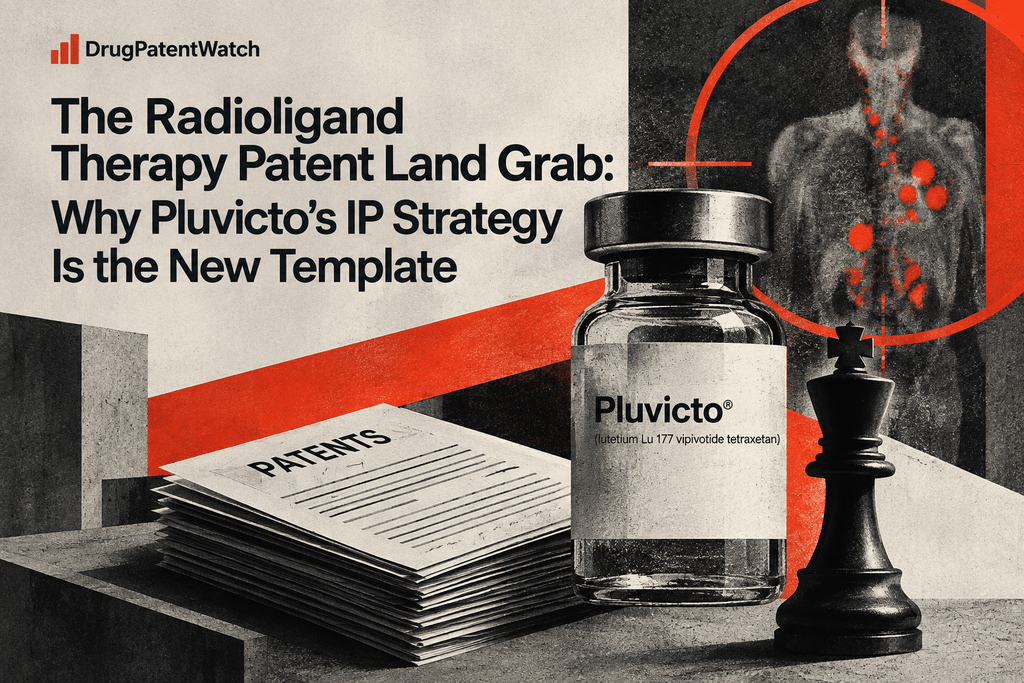
On June 17, 2026, a federal judge in Delaware ruled that every Lutathera patent Novartis had asserted against two rivals was invalid. The claims, Judge Maryellen Noreika found, were on sale for more than a year before their effective filing date, a defeat for the same Novartis subsidiary that spent a combined $6 billion buying its way into radioligand therapy in the first place [1][2]. Seven weeks earlier, Novartis had told investors its other radioligand drug, Pluvicto, was still on track to hit $5 billion in annual sales by 2030 [3]. Both statements describe the same company, the same manufacturing network, and largely the same patent strategy. The gap between them is the story of how radioligand therapy IP actually works in practice, not in the pitch deck.
Pluvicto (lutetium Lu 177 vipivotide tetraxetan) did not begin as a Novartis invention. Its underlying patent came out of Purdue University, its clinical program was built by a small Indiana biotech called Endocyte, and its manufacturing base was assembled through two separate multibillion-dollar acquisitions [4][5]. That path, buy the molecule, buy the manufacturing, then litigate the perimeter, has become the template every large radiopharmaceutical acquirer since 2017 has followed, from Bristol Myers Squibb’s $4.1 billion purchase of RayzeBio to Eli Lilly’s $1.4 billion purchase of a direct Pluvicto rival [6][7][8]. This piece maps that template using FDA’s own Orange Book data, federal court dockets, and company financial filings, and shows where it has held and where, as of mid-2026, it has already broken.
The Short Answer: Ten Findings That Matter
Before the detail, the findings that carry the article, each traceable to a primary source below.
Pluvicto’s original composition-of-matter patents, US 10,406,240 and US 11,318,121, expire August 15, 2028. Its newest Orange Book-listed patent, US 12,208,102, does not expire until September 18, 2041, a 13-year spread across a single drug’s patent estate [9].
Patent term extension pushed the listed expiration of US 10,398,791 from October 17, 2034 to March 23, 2036, a gain of roughly 523 days calculated from the two dates FDA has published in successive Orange Book editions [9][10].
Novartis paid a combined $6 billion in cash, roughly $3.9 billion for Advanced Accelerator Applications in 2017 and $2.1 billion for Endocyte in 2018, to assemble the IP and manufacturing base behind Pluvicto and Lutathera before either drug was a blockbuster [4][11][5].
Since 2017, four large-cap acquirers have spent a combined $10.9 billion or more buying into radioligand therapy platforms: Novartis ($6.0B), Bristol Myers Squibb ($4.1B for RayzeBio), Eli Lilly ($1.4B for POINT Biopharma), and AstraZeneca (up to $2.4B for Fusion Pharmaceuticals) [4][11][6][8][12].
Pluvicto’s core small-molecule patent traces to a 2020 Purdue University grant, US 10,624,970, exclusively sublicensed to Endocyte. Novartis, Endocyte, and the Purdue Research Foundation are jointly asserting that same patent against Eli Lilly and POINT Biopharma’s rival candidate, PNT2002, in the Southern District of Indiana [13][14].
On June 17, 2026, the District of Delaware invalidated every asserted Lutathera patent under the on-sale bar following a five-day bench trial in December 2025. Novartis has appealed [1][2][3].
POINT Biopharma’s PNT2002, Pluvicto’s closest clinical rival, missed its Phase 3 SPLASH primary endpoint in December 2023; Lantheus disclosed no further investment in the program in May 2025, and a related actinium candidate, PNT2001, was discontinued in February 2026. Clinical failure, not the patent lawsuit, appears to have done more to remove the nearest head-to-head challenger [15][16].
Pluvicto generated $1,994 million in net sales in full-year 2025, up 43% year over year, with Novartis now directing 40% of its oncology R&D budget to radioligand therapy [17][3].
As of this writing, no ANDA has reached the Orange Book against Pluvicto, while Lutathera already faces two generic-style challengers, Curium and Lantheus, litigated on separate legal theories [18][2].
Novartis’s own Q2 2026 SEC filing states its remaining Lutathera patents run to 2039 with pediatric exclusivity, a protection horizon the June 2026 ruling has now called into question on appeal [3].
“The global radioligand therapy market was valued at about $3.2 billion in 2025 and is projected to reach roughly $30 billion by 2034, a tenfold expansion driven largely by expanding Pluvicto and Lutathera indications and a wave of new isotope-based entrants.” [19][20]
What the Data Shows: Pluvicto’s Orange Book Patent Timeline
Pluvicto was approved on March 23, 2022, for adults with PSMA-positive metastatic castration-resistant prostate cancer (mCRPC) who had already received an androgen receptor pathway inhibitor and taxane chemotherapy [21][22]. Two label expansions followed: a March 28, 2025 approval moving Pluvicto earlier in the treatment sequence, ahead of chemotherapy, based on the Phase 3 PSMAfore trial, and a July 31, 2026 approval adding metastatic hormone-sensitive (androgen pathway modulation-naive or -sensitive) disease in combination with an ARPI [23][24][25]. Novartis said the 2025 expansion alone roughly tripled the eligible patient population [24].
The Five Patents Currently Listed Against Pluvicto
FDA’s Orange Book, as reflected in the July 2026 snapshot for NDA 215833, lists five unexpired patents against Pluvicto [9]:
Patent
Listed expiration
Coverage
Submitted
US 10,406,240
August 15, 2028
Drug substance, drug product
April 20, 2022
US 11,318,121
August 15, 2028
Drug substance, drug product
May 31, 2022
US 10,398,791
March 23, 2036 (PTE-extended)
Drug substance, drug product
April 20, 2022
US 11,951,190
November 12, 2035
Method of use
May 7, 2024
US 12,208,102
September 18, 2041
Method of use
February 27, 2025
Source: FDA Orange Book, Application N215833-001, patent listing as of the 2026-07 edition [9]. This is original tabulation of public data, not an independent report.
Read as a set, the table shows a deliberate staircase rather than a single cliff. The two oldest patents expire together in 2028. A third, method-of-use patent covers 2035. The PTE-extended substance patent covers 2036. And a patent filed as recently as February 2025, four months before this article’s research window, does not expire until 2041, nearly two decades after Pluvicto’s original approval [9].
Calculating the Patent Term Extension: How Many Days Novartis Gained
FDA opened a regulatory review period determination for a Pluvicto patent in September 2024, publishing notice in the Federal Register under Docket FDA-2023-E-2484, filed by Novartis Institutes for Biomedical Research [10][26]. Patent term extension under the Hatch-Waxman Act restores part of the term a patent loses while its underlying drug awaits FDA approval, capped at five years and limited to one patent per approved product [27][28]. Successive Orange Book editions show US 10,398,791 listed at an expiration of October 17, 2034 as late as the February 2026 edition, then at March 23, 2036 in the July 2026 edition [9]. The difference between those two dates is approximately 523 days, a figure this article calculates directly from FDA’s own published listings rather than from any company disclosure. That is a derived statistic, not an independently reported one, and it should be read as such.
What the Use-Code Change From U-3345 to U-4169 Signals
Every Orange Book method-of-use patent carries a use code, a unique alphanumeric identifier that FDA requires the application holder to submit, linking the patent to a specific approved indication rather than to the molecule generally [29]. Across the 2024-09 through 2025-03 Orange Book editions, all five Pluvicto patents carried use code U-3345. By the 2025-08 edition, all five had shifted to U-4169, and they have stayed there through the most recent 2026-07 snapshot [9]. That switch falls squarely inside the window bounded by the March 28, 2025 pre-chemotherapy label expansion [24]. FDA’s underlying use-code text is not part of the structured dataset this article draws on, so the exact wording of U-4169 cannot be confirmed here, but the timing is a documented fact: Novartis relisted its patent portfolio’s use codes within months of expanding Pluvicto’s approved population, the same portfolio-refresh mechanic DrugPatentWatch has separately catalogued across dozens of small-molecule brands facing indication expansions [29].
The Two Layers of Exclusivity: NCE Versus New-Indication Protection
Separate from patents, Pluvicto carries two FDA regulatory exclusivities. New chemical entity (NCE) exclusivity, which blocks FDA from accepting a competing application referencing Pluvicto’s data, runs five years from the original approval and expires March 23, 2027 [9]. A second exclusivity, code I-965, expires March 28, 2028, exactly three years after the PSMAfore-based label expansion [9][24]. FDA typically grants three years of new-indication exclusivity for an efficacy supplement supported by new clinical trials, a protection period that runs independently of, and does not extend, any Orange Book-listed patent [30]. The exact-to-the-day match between the March 28, 2025 approval and the March 28, 2028 exclusivity expiration is a clean confirmation that I-965 was granted for that specific label change.
From Endocyte to Pluvicto: How Novartis Assembled the IP Through Acquisition
Pluvicto’s patent estate did not originate inside Novartis. It arrived through two acquisitions three years apart, both aimed at the same emerging modality.
The Roughly $3.9 Billion AAA Deal That Started It
In 2017, Novartis agreed to acquire Advanced Accelerator Applications SA, a French-Italian radiopharmaceutical company, for approximately $3.9 billion in cash, its first move into the radioligand field [11]. That deal brought Lutathera (lutetium Lu 177 dotatate), the first FDA-approved peptide receptor radionuclide therapy, indicated for somatostatin-receptor-positive gastroenteropancreatic neuroendocrine tumors, an orphan disease [4].
The $2.1 Billion Endocyte Deal That Added PSMA-617
A year later, Novartis announced it would acquire Endocyte, an Indiana-based biotech, for $24 per share in cash, valuing the company’s equity at $2.1 billion [4][5]. Endocyte’s lead asset was 177Lu-PSMA-617, then in Phase 3 development for mCRPC, the molecule that became Pluvicto [4]. One year prior, Endocyte itself had paid just $12 million upfront, plus stock and milestones, to license the same underlying compound from a German company called ABX, a nearly 200-fold markup on the license fee within roughly a year, as reported by the Indianapolis Business Journal at the time of the Novartis deal [5].
Why Endocyte’s Core Patent Came From Purdue, Not Endocyte’s Own Labs
The composition patent underlying PSMA-617, US 10,624,970, issued in 2020 to the Purdue Research Foundation, not to Endocyte [13][14]. Endocyte holds an exclusive sublicense, which passed to Novartis’s Endocyte subsidiary on the 2018 acquisition and was further sublicensed to another Novartis entity, NPC, according to the 2024 infringement complaint Novartis, Endocyte, and Purdue jointly filed against Eli Lilly [14]. That university-originated ownership structure is a recurring feature of the radioligand field: the foundational chemistry frequently comes from academic labs (Purdue for PSMA-617, Weill Cornell for the J591 antibody platform discussed below), with commercial rights consolidated later through licensing and acquisition rather than in-house discovery.
The Radioligand Land Grab: Who Else Bought Their Way In
Novartis’s two-step acquisition strategy has been repeated by every subsequent major entrant, though with a different isotope in most cases: actinium-225, an alpha emitter, rather than lutetium-177’s beta emission.
BMS’s $4.1 Billion Bet on Actinium
On December 26, 2023, Bristol Myers Squibb agreed to acquire RayzeBio, a clinical-stage radiopharmaceutical company, for $62.50 per share in cash, an equity value of approximately $4.1 billion, or $3.6 billion net of RayzeBio’s cash [6][31]. The deal closed via tender offer on February 22, 2024, roughly five months after RayzeBio’s IPO, at more than triple its $18 IPO price [6][32]. RayzeBio’s lead program, RYZ101, is an actinium-based candidate for gastroenteropancreatic neuroendocrine tumors, the same disease category Lutathera treats [6]. Actinium-225’s alpha particles travel a shorter range in tissue than lutetium-177’s beta particles, a property companies pursuing it argue can produce more targeted cell killing, though supply has proven a constraint: RayzeBio temporarily halted new-patient enrollment in its Phase 3 ACTION-1 trial in 2024 after an actinium shortage [32][33].
Lilly’s $1.4 Billion Purchase of a Direct Pluvicto Rival
On October 3, 2023, Eli Lilly announced it would acquire POINT Biopharma Global for $12.50 per share in cash, an aggregate of approximately $1.4 billion, closing December 27, 2023 [7][34][35]. POINT’s lead asset, PNT2002, is a PSMA-targeted, lutetium-177-based radioligand for mCRPC, developed under a commercialization agreement with Lantheus that included a $250 million upfront payment and up to roughly $1.8 billion in additional milestones across two licensed programs [8][36]. PNT2002 and Pluvicto target the identical patient population, which is precisely why Novartis, Endocyte, and Purdue sued within months of the Lilly deal closing [14][13].
Radioligand M&A Since 2017
Acquirer
Target
Announced
Deal value
Isotope
Lead indication
Novartis
Advanced Accelerator Applications
2017
~$3.9 billion
Lutetium-177
Neuroendocrine tumors (Lutathera)
Novartis
Endocyte
Oct. 2018
$2.1 billion
Lutetium-177
mCRPC (Pluvicto)
Bristol Myers Squibb
RayzeBio
Dec. 2023
~$4.1 billion
Actinium-225
Neuroendocrine tumors, other solid tumors
Eli Lilly
POINT Biopharma
Oct. 2023
~$1.4 billion
Lutetium-177 / Actinium-225
mCRPC, neuroendocrine tumors
AstraZeneca
Fusion Pharmaceuticals
2024
Up to ~$2.4 billion
Actinium-225
mCRPC and other solid tumors
Sources: [4][11][7][6][12]. Combined disclosed deal value across the five transactions: roughly $13.9 billion, though the figure is sensitive to how contingent value rights and net-of-cash adjustments are counted, and should be read as an order-of-magnitude comparison rather than a precise sum.
AstraZeneca’s Follow-On Actinium Bet
AstraZeneca agreed to acquire Fusion Pharmaceuticals for $21.00 per share in cash plus a non-transferable contingent value right, worth up to approximately $2.4 billion in total [12]. Fusion’s lead program, FPI-2265, is an actinium-based radioconjugate for mCRPC, a fourth large-cap entrant into the same prostate cancer indication Pluvicto already dominates [12]. The pattern across all four post-Novartis deals is consistent: acquire a small, often recently public, radiopharmaceutical company with an isotope-manufacturing capability and a late-preclinical or clinical asset, rather than build the platform organically.
What Happened After the Land Grab: Litigation as the Second Wave
Once the acquisitions closed, Novartis moved to defend the resulting IP estate directly, filing three separate infringement actions in 2024 against Lilly and POINT, against Point’s partner Lantheus, and against Curium Pharma [37][38].
Novartis v. Lilly and POINT: The PNT2002 Purdue Patent Fight
In June 2024, the Purdue Research Foundation, joined by Endocyte and Novartis Pharmaceuticals Corp., sued Eli Lilly and POINT Biopharma in the U.S. District Court for the Southern District of Indiana, Case No. 1:24-cv-01011, alleging PNT2002 infringes US 10,624,970 [37][14]. The complaint asked for injunctive relief and damages [14]. Lilly called the suit meritless [14].
Why the Case Stalled: A Stay Pending a Motion to Dismiss
Lilly and POINT argued the suit was premature because PNT2002 was nowhere near commercialization, an argument that gained force as the drug’s original mid-2025 target approval date slipped [38]. U.S. Magistrate Judge Tim Baker granted the defendants’ motion to stay the litigation pending resolution of their motion to dismiss [38].
The Clinical Failure That May Matter More Than the Lawsuit
Independent of the litigation, PNT2002’s own trial data undercut its commercial case. The Phase 3 SPLASH trial, PNT2002’s pivotal study for post-hormonal-therapy mCRPC, reported disappointing results in December 2023 [15]. Lantheus disclosed no further investment in the program in May 2025 [15]. A separate actinium-based POINT asset, PNT2001 (225Ac-PSMA-62), was discontinued in February 2026, and a third program, PNT2004, an actinium FAP-targeted candidate, was terminated in June 2025 for what Lilly described as a business decision [15]. Of POINT’s four originally acquired clinical programs, only PNT2003, a Lutathera-referencing generic candidate, remained an active regulatory pursuit as of this article’s research window [15][2]. The sequence suggests clinical execution, not the Purdue patent suit, did more to remove Pluvicto’s most direct head-to-head small-molecule rival from contention.
Novartis v. Lantheus and Curium: The Lutathera Front
Novartis’s Lutathera-side litigation ran on a different track. In October 2024, Advanced Accelerator Applications first sued Curium in the U.S. District Court for the Eastern District of Missouri over three patents covering lutetium Lu 177 dotatate formulations, then voluntarily dismissed that complaint without prejudice fourteen days later after the parties agreed Delaware was the proper venue [39]. The Delaware litigation, consolidated with a parallel dispute against Lantheus over its PNT2003 candidate, ultimately covered four Orange Book-listed Lutathera patents: one issued in April 2020 and three issued in late 2024, with Novartis adding a newly issued patent, US 12,415,003, to the fight in September 2025 [40][41][2].
The On-Sale Bar That Invalidated Every Asserted Lutathera Patent
Following a five-day bench trial in December 2025, Judge Maryellen Noreika ruled in June 2026 that every asserted patent claim was invalid because the claimed inventions had been on sale for more than a year before their effective filing dates, a statutory bar to patentability under U.S. patent law [1][2]. The court separately found that Lantheus’s generic did infringe one of the patents, a finding the invalidity ruling rendered moot [1]. At a July 2025 status conference, the judge told counsel the dispute involved “more disputes than any” abbreviated-application case she had encountered, according to trade-press coverage of the hearing [41].
What the Ruling Means for Pluvicto’s Own Defensibility
Novartis has appealed the Delaware ruling [3]. The company’s own Q2 2026 SEC filing states that its Lutathera patents, absent the invalidity finding, run to 2039 with pediatric exclusivity, and that no manufacturer currently holds final FDA approval to launch a Lutathera-referencing product in the U.S. pending the appeal’s outcome [3]. The underlying legal theory, an on-sale bar defense targeting formulation and process patents rather than the core molecule, is a template a Pluvicto challenger could attempt to replicate, since radioligand patents in this space are disproportionately formulation and manufacturing claims rather than composition-of-matter claims covering a genuinely novel molecule, a distinction radiopharmaceutical IP counsel have noted publicly [42]. Whether that theory succeeds against Pluvicto’s own portfolio, which includes composition-of-matter claims not present in the invalidated Lutathera patents, is a materially different legal question that this ruling does not resolve.
Who Is Exposed: Mapping the Competitive Field Against Pluvicto
Three distinct strategies have emerged among companies trying to reach Pluvicto’s market. This is an original classification based on the competitive programs documented above, not an established industry taxonomy.
Strategy One: Direct Small-Molecule Challengers
POINT Biopharma’s PNT2002 used the same PSMA-617-style small-molecule scaffold as Pluvicto, which is precisely why it drew a direct patent challenge from Purdue, Endocyte, and Novartis, and precisely why its SPLASH trial miss mattered so much competitively [14][15]. As of this article’s research window, no other late-stage small-molecule PSMA-617 analog is positioned as a near-term direct challenger to Pluvicto in the U.S. market.
Strategy Two: Antibody-Based Design-Arounds
A second group of competitors has pursued a structurally different targeting molecule, a monoclonal antibody rather than a small-molecule urea-based ligand, licensed from a separate academic lineage. Convergent Therapeutics’ lead candidate, CONV01-alpha (also called Ac-225 rosopatamab tetraxetan, or 225Ac-J591), pairs actinium-225 with an antibody originally developed by Neil Bander at Weill Cornell Medicine, exclusively licensed from Cornell University patents [43][44]. Telix Pharmaceuticals’ TLX591 uses the same underlying J591 antibody lineage, paired with lutetium-177, and is in Phase 3 development with results expected in 2028 [43]. In 2026, Convergent presented Phase 2 CONVERGE-01 data specifically in patients previously treated with lutetium-177 PSMA radioligand therapy, positioning CONV01-alpha as a post-Pluvicto option rather than a head-to-head replacement [45][46].
Why an Antibody Ligand Design-Arounds Endocyte’s Composition Claims
Because Endocyte and Purdue’s core patents claim small-molecule PSMA-binding conjugates of a specific chemical structure, a monoclonal antibody targeting the same PSMA protein through an entirely different binding mechanism falls outside those claims by construction, not by legal maneuver. That is the same freedom-to-operate logic that has shaped generic and biosimilar strategy across other drug classes, applied here to a novel modality where the targeting molecule, rather than the radioisotope, is the more heavily patented component.
No company has yet filed an ANDA against Pluvicto. Lutathera, further along its lifecycle, already has two: Curium’s 505(b)(2) application and Lantheus’s ANDA for PNT2003, both litigated under Hatch-Waxman’s 30-month-stay framework and now shaped by the June 2026 invalidity ruling [2][18]. That litigation is the closest available preview of what a future Pluvicto generic-style challenge would look like once its earliest 2028 patents approach expiration.
The Manufacturing Moat: Why Isotope Supply May Matter More Than Patents
Patent protection is only one barrier to entry in radioligand therapy. Manufacturing capacity, specifically the ability to produce and distribute a radioactive isotope with a six-day half-life before it decays, has proven at least as constraining.
The 2023 Pluvicto Shortage and What It Revealed
From March to October 2023, FDA classified Pluvicto as being in shortage after Novartis told new patients it could not supply the drug, a shortage FDA declared resolved on October 26, 2023, only after Novartis said it had more than doubled weekly production capacity [47]. The episode demonstrated that even the market leader, with no generic competition at the time, could not fully meet demand through patent protection alone; production throughput was the binding constraint.
Novartis’s Build-Out: Four Facilities and a Bet on In-House Isotopes
By January 2024, Novartis operated four active radioligand therapy manufacturing facilities with a combined production capacity of 250,000 doses annually, adding its largest facility in Indianapolis that month [48]. In September 2024, the company announced construction of two additional U.S. facilities: an expansion of the Indianapolis site to produce isotopes in-house, rather than sourcing them externally, and a new third U.S. production facility in California [49]. The stated rationale was securing supply for both Pluvicto and Lutathera and for pipeline candidates beyond prostate cancer [49].
Novartis’s U.S. Radioligand Manufacturing Footprint
Milestone
Date
Detail
Pluvicto shortage begins
March 2023
FDA-classified shortage after Novartis restricted new-patient supply [47]
In-house isotope production (Indianapolis) plus new California facility [49]
This buildout is itself a competitive barrier distinct from patent protection: a challenger with a legally clean, non-infringing molecule still needs reactor access, isotope purification capacity, and a cold-chain distribution network capable of delivering a decaying radioactive product to hospital infusion sites within hours. Curium, formed in 2017 through the merger of IBA Molecular and Mallinckrodt Nuclear Medicine, is explicitly positioning its own multiple lutetium-177 production lines and an Indiana manufacturing facility as a competitive asset separate from, and in addition to, its ongoing patent litigation with Novartis [50].
What This Means for Generic and Biosimilar-Style Entry
Why No ANDA Has Reached the Orange Book for Pluvicto
Pluvicto’s earliest listed patents do not expire until 2028, and its NCE exclusivity runs through March 2027, meaning FDA could not accept a competing ANDA referencing Pluvicto’s data before that date regardless of patent status [9]. That combination, no expired patent and active regulatory exclusivity, is the standard reason a novel small-molecule or radiopharmaceutical drug shows no generic filings this early in its lifecycle, and Pluvicto’s current position is unremarkable by that standard.
Lutathera as the Bellwether: What a Radioligand Patent Fight Actually Looks Like
Lutathera, approved in January 2018, is roughly four years further along than Pluvicto, and its generic-style litigation offers the field’s only completed example of how these disputes resolve [2]. The outcome so far favors challengers: every asserted patent invalidated, an infringement finding rendered moot, and the brand owner reduced to an appeal as its remaining defense [1][2]. If that result holds on appeal, it establishes that Novartis’s formulation and process patents, the same style of patent that dominates Pluvicto’s own later-filed estate, are more vulnerable to invalidity challenges than composition-of-matter claims on a genuinely novel molecule would be.
Original Analysis: Pluvicto’s Realistic Exclusivity Runway
Methodology
This analysis draws on FDA’s Orange Book patent and exclusivity listings for NDA 215833-001 as archived by FDA.report, using the July 2026 edition snapshot as the current state and comparing it against nine prior editions captured between June 2022 and February 2026 to identify changes in listed expiration dates and use codes [9]. It cross-references those listings against the Federal Register’s September 2024 regulatory review period determination for the same product [10] and against Novartis’s own SEC disclosures on Lutathera’s litigated patent life [3]. Limitations: Orange Book listings can change if new patents are added, existing listings are delisted following a successful patent-listing dispute, or a court invalidates a listed patent, any of which would alter the figures below after this article’s research window closes. This analysis does not attempt to independently assess the validity of any listed Pluvicto patent; it reports what FDA has published and what that data implies about protection timing.
Findings: Layered Protection Through 2041
Read together, Pluvicto’s protection runs in three overlapping bands. NCE exclusivity and the two earliest substance patents cover the drug through 2027 to 2028. A method-of-use patent and the PTE-extended substance patent extend coverage through 2035 to 2036. A newly filed method-of-use patent, listed as recently as February 2025, extends nominal protection to 2041 [9]. Whether that 2041 patent would actually block a generic entrant filing after 2028, when the substance patents expire, depends on whether a future ANDA filer’s product falls within that later patent’s claims, a question this dataset cannot answer and that the Lutathera litigation shows is genuinely contestable in court [1][2]. The Curium and Lantheus outcome demonstrates that a listed expiration date on the Orange Book is a starting point for competitive analysis, not a guaranteed protection date.
What Happens Next: Scenario Analysis for 2027 Through 2036
Two scenarios bound the range of plausible outcomes, based on identifiable assumptions rather than a prediction of which will occur.
Scenario One: The Layered Patents Hold
If Pluvicto’s later-filed method-of-use and PTE-extended patents survive any future validity challenge, effective generic-style entry would not be realistic until the mid-2030s, and the 2041 patent could extend contestable protection even further depending on its claim scope. Under this scenario, Novartis’s acquisition-and-litigation template would have converted a molecule licensed from a university and a small Indiana biotech into three-plus decades of layered market protection.
Scenario Two: The Curium Precedent Extends to Pluvicto
If the Delaware on-sale bar theory that invalidated Novartis’s Lutathera patents proves generalizable to formulation and process-style claims across the company’s radioligand portfolio, and if Novartis’s Federal Circuit appeal fails to reverse it, Pluvicto’s later-filed method-of-use patents, several of which appear structurally similar to the invalidated Lutathera claims, would face a credible invalidity path well before their nominal 2035 to 2041 expiration dates. Pluvicto’s earlier substance patents, which more directly claim the drug’s composition, would likely be more resistant to the same on-sale bar theory, since composition claims and formulation-process claims raise different prior-use and prior-sale fact patterns.
Definitions
Radioligand therapy (RLT): a treatment that pairs a targeting molecule, either a small molecule or an antibody, with a radioactive isotope, delivering radiation directly to cancer cells that express the target protein while sparing surrounding tissue [22].
On-sale bar: a U.S. patent law doctrine barring patent protection on an invention that was on sale more than one year before the patent’s effective filing date, the theory the District of Delaware applied to invalidate Novartis’s Lutathera patents [1][2].
Orange Book use code: a unique, FDA-required alphanumeric identifier, prefixed “U-“, that links a method-of-use patent to one specific FDA-approved indication rather than to the drug in general, allowing generic applicants to certify around indications not covered by a given patent [29].
Patent term extension (PTE): a Hatch-Waxman Act mechanism restoring up to five years of patent term lost to regulatory review, available for only one patent per approved product [27][28].
What This Means for Brand Manufacturers Entering Radioligand Therapy
The Novartis template, acquire the molecule and the manufacturing together, then litigate the perimeter once competitors approach commercialization, has now produced two divergent outcomes within the same company’s own portfolio: a Pluvicto estate still substantially intact through at least 2028, and a Lutathera estate currently invalidated pending appeal. For a company like Bristol Myers Squibb or AstraZeneca evaluating its own RayzeBio or Fusion Pharmaceuticals radioligand assets, the lesson is not that acquisition-led IP strategy fails, but that formulation and process patents filed after a product’s initial approval carry meaningfully higher validity risk than the composition-of-matter claims filed at or before first approval, a distinction the Delaware court’s on-sale bar reasoning makes concrete rather than theoretical.
Frequently Asked Questions
When does Pluvicto lose patent protection in the United States?
Its two earliest substance patents, US 10,406,240 and US 11,318,121, expire August 15, 2028. A PTE-extended substance patent runs to March 23, 2036, and later-filed method-of-use patents are listed through September 2041, though later-filed patents carry more litigation risk, as the Lutathera invalidity ruling illustrates [9][1].
Who actually owns the core patent behind Pluvicto?
US 10,624,970, the small-molecule composition patent central to Pluvicto’s IP position, issued to the Purdue Research Foundation in 2020 and is exclusively sublicensed to Endocyte, now a Novartis subsidiary [13][14].
Has any company filed a generic version of Pluvicto?
No ANDA has reached the Orange Book against Pluvicto as of this article’s research window. Its NCE exclusivity runs through March 2027, and its earliest patents do not expire until 2028 [9].
What happened in the Novartis v. Eli Lilly and POINT Biopharma lawsuit?
Purdue Research Foundation, Endocyte, and Novartis sued Lilly and POINT in the Southern District of Indiana in June 2024, alleging POINT’s PNT2002 infringed US 10,624,970. The court granted a stay pending a motion to dismiss after Lilly argued the drug was too far from commercialization to support the suit [37][38]. PNT2002 subsequently missed its Phase 3 primary endpoint and Lantheus withdrew further investment [15].
Did Novartis win or lose its Lutathera patent litigation?
Novartis lost. In June 2026, the District of Delaware ruled every asserted Lutathera patent invalid under the on-sale bar following a December 2025 bench trial. Novartis has appealed [1][2].
How much has the pharmaceutical industry spent acquiring radioligand therapy companies?
At least $10.9 billion since 2017 across four large-cap acquirers: Novartis ($3.9B for AAA, $2.1B for Endocyte), Bristol Myers Squibb ($4.1B for RayzeBio), Eli Lilly ($1.4B for POINT Biopharma), and AstraZeneca (up to $2.4B for Fusion Pharmaceuticals) [4][11][6][7][12].
What is the difference between Pluvicto’s small-molecule design and Convergent Therapeutics’ or Telix’s antibody-based competitors?
Pluvicto and POINT’s PNT2002 use a small-molecule, urea-based ligand covered by Purdue and Endocyte’s patents. Convergent’s CONV01-alpha and Telix’s TLX591 use a monoclonal antibody, licensed from Cornell University patents, that targets the same PSMA protein through a structurally different binding mechanism, placing them outside the small-molecule composition claims [13][43][44].
Why did Pluvicto face a supply shortage in 2023 despite having no generic competition?
The shortage, which FDA classified from March to October 2023, resulted from manufacturing capacity constraints, not patent-related competition. Novartis resolved it by more than doubling weekly production capacity [47].
How large is the radioligand therapy market projected to become?
Estimates put the global market at approximately $3.2 billion in 2025, projected to reach roughly $30 billion by 2034 [19][20].
What does DrugPatentWatch data show about how patent use codes work in cases like Pluvicto’s?
A use code is a unique, FDA-required identifier tied to one specific approved indication rather than the drug generally, which is why Novartis’s five Pluvicto patents could shift from use code U-3345 to U-4169 within months of the drug’s March 2025 label expansion, without any change to the underlying patent claims themselves [29][9].
Key Takeaways
Pluvicto’s IP did not originate at Novartis; it was assembled through a $2.1 billion acquisition of Endocyte, whose core patent traces to a 2020 Purdue University grant [4][13].
Patent term extension added approximately 523 days to one Pluvicto patent, and a February 2025-filed method-of-use patent extends nominal protection to 2041, though later-filed patents carry documented invalidity risk [10][9][1].
At least four large-cap companies have spent a combined $10.9 billion or more since 2017 replicating Novartis’s acquire-the-platform strategy in radioligand therapy [4][11][6][7][12].
Novartis’s aggressive 2024 litigation campaign produced a stayed case against Lilly and POINT, whose rival candidate failed clinically regardless of the lawsuit’s outcome, and a lost case against Curium and Lantheus, currently on appeal [38][15][1].
Manufacturing capacity and isotope supply, not patents alone, constrained Pluvicto’s market during its 2023 shortage, and Novartis has responded with a $250,000-dose-capacity, multi-facility U.S. build-out [47][48].
Antibody-based competitors like Convergent Therapeutics’ CONV01-alpha and Telix’s TLX591 sidestep Pluvicto’s small-molecule composition claims by using a structurally different, Cornell-licensed targeting mechanism [13][43].
References
Bloomberg Law. (2026, June 18). Curium Knocks Out Novartis Cancer Drug Patents in Generics Fight. https://news.bloomberglaw.com/ip-law/curium-knocks-out-novartis-cancer-drug-patents-in-generics-fight
Novartis AG. (2026). Form 6-K, second quarter 2026 results. U.S. Securities and Exchange Commission. https://www.sec.gov/Archives/edgar/data/0001114448/000111444826000012/nvs-20260630-99_2.htm
Novartis. (2018, October 18). Novartis announces planned acquisition of Endocyte to expand expertise in radiopharmaceuticals. https://www.novartis.com/news/media-releases/novartis-announces-planned-acquisition-endocyte-expand-expertise-radiopharmaceuticals-and-build-commitment-transformational-therapeutic-platforms
Indianapolis Business Journal. (2018, October 18). Endocyte acquisition gives Novartis key therapy, at almost 200 times its last price. https://www.ibj.com/articles/70949-endocyte-acquisition-gives-novartis-key-therapyat-almost-200-times-its-last-price
Bristol Myers Squibb. (2023, December 26). Bristol Myers Squibb Adds Premier Radiopharmaceutical Platform with Acquisition of RayzeBio. https://news.bms.com/news/details/2023/Bristol-Myers-Squibb-Adds-Premier-Radiopharmaceutical-Platform-with-Acquisition-of-RayzeBio/default.aspx
Eli Lilly. (2023, October 3). Lilly to Acquire POINT Biopharma to Expand Oncology Capabilities into Next-Generation Radioligand Therapies. https://investor.lilly.com/news-releases/news-release-details/lilly-acquire-point-biopharma-expand-oncology-capabilities-next
CNBC. (2023, October 3). Eli Lilly to buy cancer-focused Point Biopharma for $1.4 billion. https://www.cnbc.com/2023/10/03/eli-lilly-to-buy-cancer-focused-point-biopharma-for-1point4-billion.html
FDA.report. NDC 69488-010 PLUVICTO: Orange Book product, patent, and exclusivity listings. https://fda.report/NDC/69488-010
Federal Register. (2024, September 9). Determination of Regulatory Review Period for Purposes of Patent Extension; PLUVICTO. https://www.federalregister.gov/documents/2024/09/09/2024-20246/determination-of-regulatory-review-period-for-purposes-of-patent-extension-pluvicto
BioPharma Dive. (2018, October 18). Novartis buys Endocyte for $2.1B in latest deal under CEO Narasimhan. https://www.biopharmadive.com/news/novartis-buys-endocyte-for-21b-in-latest-deal-under-ceo-narasimhan/540015/
PrivSource. Bristol Myers Squibb Acquires RayzeBio in $4.1B Deal [deal database entry including AstraZeneca-Fusion Pharmaceuticals terms]. https://www.privsource.com/acquisitions/deal/bristol-myers-squibb-acquires-rayzebio-in-4-1b-deal-deS0MW
Indianapolis Business Journal. (2024, June 17). Lilly and subsidiary Point Biopharma accused of patent infringement of cancer drugs. https://www.ibj.com/articles/lilly-and-subsidiary-point-biopharma-accused-of-patent-infringement-of-cancer-drugs
IniPLaw. (2024, June 18). Cancer Treatment Controversy: Eli Lilly and POINT Biopharma Sued by Purdue for Alleged Patent Infringement. https://www.iniplaw.org/cancer-treatment-controversy-eli-lilly-and-point-biopharma-sued-by-purdue-for-alleged-patent-infringement/
OncologyPipeline / ApexOnco. (2026, May). Lilly misses its Point. https://www.oncologypipeline.com/apexonco/lilly-misses-its-point
FiercePharma. (2024, November 4). In defense of radioligand therapies, Novartis fired off patent lawsuits against Lilly and other rivals. https://www.fiercepharma.com/pharma/novartis-sues-lilly-others-over-radioligand-therapies-pluvicto-lutathera
IntuitionLabs. (2026, August 7). Radioligand Therapy Manufacturing Capacity: The CDMO Crunch. https://intuitionlabs.ai/articles/radioligand-therapy-manufacturing-capacity
Precision Medicine Online. (2026, March 13). Lantheus Gains Tentative FDA Nod for Lutathera Generic Amid Novartis Patent Fight. https://www.precisionmedicineonline.com/precision-oncology/lantheus-gains-tentative-fda-nod-lutathera-generic-amid-novartis-patent-fight
Drugs.com. Pluvicto (lutetium lu 177 vipivotide tetraxetan) FDA Approval History. https://www.drugs.com/history/pluvicto.html
U.S. Food and Drug Administration. (2022, March 23). FDA D.I.S.C.O.: Burst Edition: FDA approval of Pluvicto. https://www.fda.gov/drugs/resources-information-approved-drugs/fda-disco-burst-edition-fda-approval-pluvicto-lutetium-lu-177-vipivotide-tetraxetan-treatment-adult
Urology Times. (2025, July 4). Regulatory recap: FDA approvals in urology from the first half of 2025. https://www.urologytimes.com/view/regulatory-recap-fda-approvals-in-urology-from-the-first-half-of-2025
Novartis. (2025, March 28). FDA approves Novartis radioligand therapy Pluvicto for earlier use before chemotherapy in PSMA-positive metastatic castration-resistant prostate cancer. https://www.novartis.com/news/media-releases/fda-approves-novartis-radioligand-therapy-pluvicto-earlier-use-chemotherapy-psma-positive-metastatic-castration-resistant-prostate-cancer
U.S. Food and Drug Administration. (2026, July 31). FDA approves lutetium Lu 177 vipivotide tetraxetan with androgen receptor pathway inhibitor therapy for metastatic androgen pathway modulation-naïve or -sensitive prostate cancer. https://www.fda.gov/drugs/resources-information-approved-drugs/fda-approves-lutetium-lu-177-vipivotide-tetraxetan-androgen-receptor-pathway-inhibitor-therapy
U.S. Patent and Trademark Office. Correspondence re PLUVICTO patent term extension application, Docket No. FDA-2023-E-2484. https://downloads.regulations.gov/FDA-2023-E-2484-0004/attachment_1.pdf
Sterne Kessler. (2025, October 22). Patent Term Extension. https://www.sternekessler.com/news-insights/insights/patent-term-extension-2025/
U.S. Patent and Trademark Office. MPEP 2758: Notice of Final Determination, Calculation of Patent Term Extension. https://www.uspto.gov/web/offices/pac/mpep/s2758.html
DrugPatentWatch. (2026, March 23). Pharmaceutical Patent Use Codes: The Definitive Technical and Strategic Guide to Orange Book Method-of-Use Patents, Skinny Labeling, and Induced Infringement Risk. https://www.drugpatentwatch.com/blog/patent-use-codes-for-pharmaceutical-products-a-comprehensive-analysis/
Fish & Richardson. Orange Book 101: The FDA’s Official Register of Drugs. https://www.fr.com/insights/ip-law-essentials/orange-book-101/
Bristol Myers Squibb. (2024, February 26). Bristol Myers Squibb Completes Acquisition of RayzeBio. https://news.bms.com/news/details/2024/Bristol-Myers-Squibb-Completes-Acquisition-of-RayzeBio-Adding-Differentiated-Actinium-Based-Radiopharmaceutical-Platform/default.aspx
FiercePharma. (2024, January 2). BMS enters radiopharma race with $4.1B acquisition of RayzeBio just 3 months after biotech’s IPO. https://www.fiercebiotech.com/biotech/bms-enters-radiopharma-race-41b-acquisition-rayzebio-just-3-months-after-biotechs-ipo
FiercePharma. (2024, June 3). Bristol Myers’ RayzeBio halts radiotherapy trial enrollment after isotope runs scarce. https://www.fiercepharma.com/pharma/bms-and-rayzebio-halt-radiotherapy-trial-enrollment-after-isotope-runs-scarce
Eli Lilly. (2023, December 27). Lilly Completes Acquisition of POINT Biopharma. https://investor.lilly.com/news-releases/news-release-details/lilly-completes-acquisition-point-biopharma
BioSpace. (2023, October 3). Lilly Deepens Oncology Pipeline with $1.4B Point Biopharma Purchase. https://www.biospace.com/lilly-deepens-oncology-pipeline-with-1-4b-point-biopharma-purchase
Lantheus Holdings. (2024). Form 10-Q, quarter ended March 31, 2024. U.S. Securities and Exchange Commission. https://www.sec.gov/Archives/edgar/data/1521036/000162828024019798/lnth-20240331.htm
Indianapolis Business Journal. (2024, June 17). Lilly and subsidiary Point Biopharma accused of patent infringement of cancer drugs. https://www.ibj.com/articles/lilly-and-subsidiary-point-biopharma-accused-of-patent-infringement-of-cancer-drugs
FiercePharma. (2024, November 4). In defense of radioligand therapies, Novartis fired off patent lawsuits against Lilly and other rivals. https://www.fiercepharma.com/pharma/novartis-sues-lilly-others-over-radioligand-therapies-pluvicto-lutathera
PatSnap. AAA vs Curium: LUTATHERA Lutetium-177 Patent Dispute. https://www.patsnap.com/resources/blog/litigation/aaa-vs-curium-lutathera-lutetium-177-patent-dispute-patsnap/
Bloomberg Law. (2025, September 18). Novartis Adds New Patent to Curium Fight Over Cancer Drug. https://news.bloomberglaw.com/ip-law/novartis-adds-new-patent-to-curium-fight-over-cancer-drug
Precision Medicine Online. (2026, March 13). Lantheus Gains Tentative FDA Nod for Lutathera Generic Amid Novartis Patent Fight. https://www.precisionmedicineonline.com/precision-oncology/lantheus-gains-tentative-fda-nod-lutathera-generic-amid-novartis-patent-fight
Precision Medicine Online. (2026, July 21). Novartis Talks Up Early Radioligand Pipeline After Losing Patent Battle. https://www.precisionmedicineonline.com/precision-oncology/novartis-talks-early-radioligand-pipeline-after-losing-patent-battle
Synapse (PatSnap). CONV01-alpha: Drug Targets, Indications, Patents. https://synapse.patsnap.com/drug/d43ffbc39ddf4b1788a9aa49d71a932a
Applied Radiology. (2021, September 15). Collaboration Will Evaluate Treatment for Progressive mCRPC. https://appliedradiology.com/articles/collaboration-will-evaluate-treatment-for-progressive-mcrpc
BioSpace. (2026). Convergent Therapeutics to Present Phase 2 Data for CONV01-alpha in Lu-PSMA pretreated Metastatic Castration-Resistant Prostate Cancer Patients at the 2026 ASCO Annual Meeting. https://www.biospace.com/press-releases/convergent-therapeutics-to-present-phase-2-data-for-conv01-%CE%B1-in-lu-psma-pretreated-metastatic-castration-resistant-prostate-cancer-patients-at-the-2026-asco-annual-meeting
PRNewswire. (2024, September 24). Convergent Therapeutics Announces First Patient Treated in Phase II Clinical Trial with Lead Therapeutic Candidate and Corporate Updates. https://www.prnewswire.com/news-releases/convergent-therapeutics-announces-first-patient-treated-in-phase-ii-clinical-trial-with-lead-therapeutic-candidate-and-corporate-updates-302256398.html
IntuitionLabs. (2026, August 7). Radioligand Therapy Manufacturing Capacity: The CDMO Crunch [FDA shortage determination and resolution details]. https://intuitionlabs.ai/articles/radioligand-therapy-manufacturing-capacity
Novartis. (2024, January 5). Novartis expands production of Pluvicto with addition of its largest and most advanced radioligand therapy manufacturing facility in Indianapolis. https://www.novartis.com/news/media-releases/novartis-expands-production-pluvictotm-addition-its-largest-and-most-advanced-radioligand-therapy-manufacturing-facility-indianapolis
Novartis. (2024, September 4). Novartis begins construction of two new radioligand therapy facilities in the US. https://www.novartis.com/us-en/news/media-releases/novartis-begins-construction-two-new-radioligand-therapy-facilities-us-expanding-its-world-class-rlt-manufacturing-and-supply-network
BioSpace. (2026). Preparing for Novartis showdown, Curium touts value of radiopharma supply resiliency. https://www.biospace.com/drug-delivery/preparing-for-novartis-showdown-curium-touts-value-of-radiopharma-supply-resiliency