FDA charges $2,300,376 in fiscal year 2027 to file a 505(b)(2) application that needs no clinical data. It charges $375,684 to file an ANDA. [2][3] The first number is 6.1 times the second (our calculation). That gap exists before either company buys a stability batch.
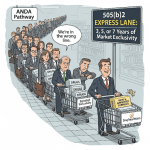
The hybrid route has a reputation as a shortcut. The record is mixed. FDA sets the same 10-month goal for a standard NDA that is not a new molecular entity and for a standard original ANDA. [6][7] The cost of the hybrid route sits in other places: fees, evidence, exclusivity, substitution, and the risk of a second review cycle.
This article shows where a full ANDA is the better route and where it is not. It uses FDA guidance, FDA user-fee notices, FDA review goals, SEC filings, and court records. It also adds calculations that you can repeat. DrugPatentWatch tracks the patent and exclusivity records that decide most of these cases. [23]
The Short Answer: When Does a Full ANDA Beat a 505(b)(2) Hybrid Filing?
A full ANDA is the better route when the product can match the reference listed drug (RLD) in active ingredient, dosage form, route, and strength. For parenteral, ophthalmic, and otic products, it must also match in inactive ingredients, with narrow exceptions. [1]
In that case, FDA treats the ANDA as the correct pathway. The 2019 FDA guidance says “a 505(b)(2) application is not appropriate for a drug product that should have been submitted under the ANDA pathway.” [1]
A hybrid filing is the better route only when the change is intentional, an ANDA cannot carry it, and the market will pay for it. Examples are a new inactive ingredient that is not an exception excipient, a different salt form, or a new indication. [1]
The Eight Findings That Matter
The FY2027 PDUFA fee for an application that needs no clinical data is $2,300,376. The FY2027 ANDA fee is $375,684. The ratio is 6.1 to 1 (calculated). [2][3]
The FY2027 PDUFA fee for an application that needs clinical data is $4,600,753. That is 12.2 times the ANDA fee (calculated). [2][3]
FDA sets a 10-month goal for 90 percent of standard non-NME original NDAs, counted from receipt. It sets a 10-month goal for 90 percent of standard original ANDAs, counted from submission. [6][7]
FDA guidance says an ANDA needs the same active ingredient, dosage form, route, and strength as the RLD. If sameness fails, the product “should not be submitted for approval in an ANDA.” [1]
FDA says it “generally will refuse to file a 505(b)(2) application for a drug that is a duplicate of a listed drug.” [1]
Eagle Pharmaceuticals submitted its Pemfexy NDA on December 30, 2016. Sales started on February 1, 2022. That is 1,859 days (calculated). [15][16][17]
Eagle filed its vasopressin ANDA in April 2018. FDA approved it on December 15, 2021, about 44 months later (calculated). Eagle expected 180 days of exclusivity. [15][18]
The Food and Drug Omnibus Reform Act (FDORA) section 3222 lets applicants for some 505(b)(2) parenteral, ophthalmic, and otic solutions ask FDA for a therapeutic equivalence evaluation. This narrows one old disadvantage of the hybrid route. [11]
What Is a 505(b)(2) Application, and How Does It Differ from an ANDA?
A 505(b)(2) application is an NDA in which some of the safety or effectiveness evidence comes from studies that the applicant did not run and has no right to use. FDA says section 505(b)(2) “expressly permits FDA to rely” on data that the applicant did not develop. [8]
An ANDA relies on FDA’s earlier finding for an RLD. It does not contain the clinical studies that an NDA contains. [8] The Hatch-Waxman Amendments created both the 505(b)(2) and 505(j) pathways. [9]
Definition: ANDA, 505(b)(2) NDA, and Full NDA
Feature
ANDA (section 505(j))
505(b)(2) NDA
Source
Basis for approval
Sameness to the RLD plus bioequivalence
Own data plus reliance on FDA’s finding for a listed drug or on literature
[1][8]
Clinical studies
Not contained in an ANDA
Contained when needed to support the change
[8]
Allowed differences from the RLD
Narrow. Listed in the guidance
Wide. Must be scientifically bridged
[1]
Filing fee, FY2027
$375,684
$2,300,376 or $4,600,753
[2][3]
180-day exclusivity
Available to the first applicant with a Paragraph IV certification
Not described in FDA’s rule as available
[10]
Why Do So Many NDAs Use the Hybrid Route?
The hybrid route is common. A Tufts Center for the Study of Drug Development analysis of 451 original NDAs approved from 2009 to 2015 found that 63 percent were 505(b)(2) applications. [12]
Industry statistic: 63 percent of 451 original NDAs approved by FDA from 2009 to 2015 were 505(b)(2) applications (Tufts CSDD analysis, reported by Brennan, Regulatory Focus, March 9, 2017). [12]
That share is old. It does not tell you how often a hybrid filing was the wrong route. It does show that the pathway is a standard option and not a niche.
How Does FDA Decide Between an ANDA and a 505(b)(2) Application?
FDA decides by comparing the proposed product with the RLD. The test is in the May 2019 guidance, “Determining Whether to Submit an ANDA or a 505(b)(2) Application.” [1] The guidance is a recommendation, not a rule, but FDA reviewers use it.
Active Ingredient, Dosage Form, Route, and Strength
An ANDA product must be the same as the RLD in “active ingredient(s), dosage form, route of administration, strength.” [1] If the applicant cannot show sameness, the product “should not be submitted for approval in an ANDA.” [1]
The guidance also says that products that “differ considerably from the RLD are generally not candidates for approval under the section 505(j) pathway.” [1]
Q1/Q2 Sameness: Do Inactive Ingredients Decide the Route?
For many injectable, eye, and ear products, yes. Inactive ingredients can force a company out of the ANDA pathway. The guidance sets different rules by dosage form. [1]
Parenteral Products
The guidance says parenteral products “generally must contain the same inactive ingredients and in the same concentrations as the RLD.” Preservatives, buffers, and antioxidants are exception excipients. [1]
This exception matters. A company that changes only a buffer can still file an ANDA. A company that adds a different solubilizer cannot. FDA says an applicant should consider a 505(b)(2) application if a formulation change is “not permissible in an ANDA.” [1]
Ophthalmic and Otic Products
The guidance says ophthalmic products “generally must be Q1/Q2 same as the RLD with respect to all of their inactive ingredients.” Otic products follow the same rule. [1] Q1 means the same inactive ingredients. Q2 means the same amounts.
Topical Products: What the Guidance Does Not Cover
The 2019 guidance does not set out an inactive-ingredient rule for topical products. [1] A team that works on a topical product must check FDA’s product-specific advice and the regulations before it picks a route.
Bioequivalence and Intentional Absorption Changes
An ANDA must show bioequivalence to the RLD. A product that is only unintentionally less available than the RLD generally cannot use the 505(b)(2) route. [1] A product with an intentional difference in absorption may use it. [1]
The practical point is simple. A failed bioequivalence study does not turn a generic into a hybrid. FDA reads it as a failed ANDA.
What Happens If FDA Treats the Product as a Duplicate?
FDA “generally will refuse to file a 505(b)(2) application for a drug that is a duplicate of a listed drug.” [1] In this case the ANDA is not just cheaper. It is the only route.
Do Suitability Petitions Open the ANDA Route for Different Strengths or Dosage Forms?
They can. An applicant may file a suitability petition to ask permission to submit an ANDA for a product that “differs from an RLD in its route of administration, dosage form, or strength.” [1]
The risk is timing. FDA will not receive an ANDA that cites a pending or denied petition, because the application “lacks a legal basis for the submission.” [1] A team must wait for the petition decision.
New Indications and Labeling Carve-Outs
If proposed labeling states a new indication or dosing regimen, “an ANDA is not appropriate.” [1] The guidance does allow labeling carve-outs for information that a patent or exclusivity protects. [1] A generic company can omit a protected indication and still use the ANDA route.
Route-Fit Taxonomy: Four Classes of Product Change
This section is an original framework. It is not an FDA classification. We built it from the sections of the 2019 guidance. [1] It sorts a proposed product by the type of difference from the RLD.
The Four Classes and the Route Each Points To
Class 1: Same-Same
The product matches the RLD in active ingredient, dosage form, route, strength, and permitted inactive ingredients. The ANDA is the correct route. A 505(b)(2) filing risks a refuse-to-file decision as a duplicate. [1]
Class 2: Permitted Variance
The product differs only in ways that the ANDA rules allow. Examples are a different preservative, buffer, or antioxidant in a parenteral product, and a labeling carve-out. [1] The ANDA is still the correct route.
Class 3: Petition Variance
The product differs in route, dosage form, or strength. A suitability petition may open the ANDA route. If the petition fails, the hybrid route is the fallback. [1]
Class 4: Intentional Difference
The product has a changed formulation that an ANDA cannot carry, a different salt form, an intentional absorption change, or a new indication. The 505(b)(2) route fits. [1]
Why the Classes Matter for Route Choice
Classes 1 and 2 have no reason to use the hybrid route. Class 3 is a timing decision. Class 4 is a business decision. The extra cost of the hybrid route is justified only if the difference produces a product that doctors, payers, or patients prefer.
Fee Math: How Much More Does a 505(b)(2) Filing Cost Than an ANDA?
The filing fee for a 505(b)(2) application is 6.1 to 12.2 times the ANDA filing fee in FY2027 (calculated from FDA fee notices). [2][3] The size of the gap depends on whether the application needs clinical data.
FDA defines the full PDUFA fee tier by the clinical data that approval requires. Bioavailability and bioequivalence studies are excluded from that definition. [8] A hybrid filing that needs only bridging pharmacokinetic work can fall in the lower tier. [8]
FY2027 and FY2026 Filing Fees Compared
Fee
FY2026
FY2027
Change
Source
PDUFA application, clinical data required
$4,682,003
$4,600,753
-1.7% (calculated)
[4][2]
PDUFA application, no clinical data required
$2,341,002
$2,300,376
-1.7% (calculated)
[4][2]
GDUFA ANDA filing fee
$358,247
$375,684
+4.9% (calculated)
[5][3]
Ratio: no-clinical-data NDA fee to ANDA fee
6.5 to 1
6.1 to 1
Gap narrows (calculated)
[2][3][4][5]
Ratio: clinical-data NDA fee to ANDA fee
13.1 to 1
12.2 to 1
Gap narrows (calculated)
[2][3][4][5]
Dollar gap, no-clinical-data NDA over ANDA
$1,982,755
$1,924,692
-$58,063 (calculated)
[2][3][4][5]
FY2027 fees apply from October 1, 2026 through September 30, 2027. [3] PDUFA fees fell 1.7 percent from FY2026 to FY2027. The ANDA fee rose 4.9 percent (calculated). The gap is narrowing, but it is still large.
What the Fee Table Leaves Out: Program and Facility Fees
The filing fee is not the full cost. FDA also sets a PDUFA prescription drug program fee of $416,857 for FY2027. [2] ANDA holders pay GDUFA program fees by size of operation: $192,729 for a small business, $770,916 for a medium operation, and $1,927,291 for a large operation. [3] GDUFA also sets facility fees and a Drug Master File fee of $109,899. [3]
We did not add these fees to the comparison, because they depend on company size, product count, and facility use. A full model must include them. The filing-fee gap is a floor for the cost difference, not a total.
Scenario: How Many ANDAs Cost as Much as One Hybrid Filing?
At FY2027 rates, the no-clinical-data hybrid filing fee equals 6.1 ANDA filing fees. The clinical-data hybrid filing fee equals 12.2 (calculated). The assumption is a single filing for a single product with no fee waiver. This matters for companies that file several strengths or several RLD-based products.
Review Clock Comparison: Is the 505(b)(2) Review Slower Than the ANDA Review?
No, not on FDA’s stated goals. A standard non-NME NDA and a standard original ANDA both have a 10-month goal. [6][7] The difference is in what happens after a first review fails.
PDUFA VII and GDUFA III Goals Side by Side
Submission type
Standard goal
Priority goal
Source
Original non-NME NDA (includes 505(b)(2) filings that are not NMEs)
10 months from receipt
6 months from receipt
[6]
Original NME NDA or BLA
10 months from the 60-day filing date
6 months from the 60-day filing date
[6]
Class 2 resubmission of an original NDA
6 months from receipt
Not stated separately
[6]
Original ANDA
10 months from submission
8 months with a timely pre-submission facility correspondence (PFC), otherwise 10 months
[7]
ANDA major amendment
8 months, or 10 months if inspection is needed
6 months, or 8 to 10 months if inspection is needed
[7]
ANDA minor amendment
3 months
3 months
[7]
The table shows one fact that surprises many readers. On paper, a hybrid NDA resubmission has a 6-month goal. An ANDA major amendment has an 8-month or 10-month goal. [6][7] The hybrid route is not slower at the review step on FDA’s goals.
What Do First-Cycle Approval Numbers Show?
First-cycle outcomes are weak for both pathways. The data come from different populations and different years, so we show them side by side without ranking them.
ANDA Snapshot: June 2026
FDA’s Office of Generic Drugs reported 77 full ANDA approvals in June 2026. Eight were first-cycle full approvals, which is 10.4 percent of that month’s full approvals. [14] FDA also issued 90 complete response letters that month. [14] About 1,254 ANDAs waited for FDA action and 1,784 waited for a sponsor response. [14]
This is a one-month snapshot reported by Lachman Consultants from FDA data. It is not an annual first-cycle rate for submissions.
505(b)(2) Snapshot: 2009 to 2015
The Tufts analysis found that about half of 505(b)(2) applications won approval in the first cycle from 2009 to 2015. For NMEs, the first-cycle rates were 78 percent in 2014 and 85 percent in 2015. [12] Tufts also found that mean approval times for 505(b)(2) applications were nearly five months longer than for NMEs. [12]
The Tufts article also reports a 2015 Thomson Reuters study. It found that median approval times were 46 days slower for standard-review 505(b)(2) drugs and 24 days slower for expedited-review drugs. [12]
What a Complete Response Letter Costs: An NME Benchmark
A 2026 analysis of FDA small-molecule NME NDAs from 2013 to 2023 found a median of about 245 days to approval for first-cycle approvals. The median was about 709 days for applications that received a complete response letter. [13] The difference is about 464 days (calculated). Each resubmission review took 6 to 10 months. [13]
These are NME data. They are not hybrid data. We use them only to size the cost of a second cycle. A hybrid NDA that needs a second cycle for chemistry, manufacturing, and controls problems faces the same type of delay.
Limits of Cross-Pathway Comparison
The periods differ. The populations differ. One source is a monthly snapshot. Another is a news report of a study from 2017. No source we found compares first-cycle outcomes for ANDAs and 505(b)(2) applications in one dataset. We do not claim that one route has a higher first-cycle rate.
Exclusivity and Patent Mechanics: What Does an ANDA Filer Get That a 505(b)(2) Filer Does Not?
The main difference is 180-day exclusivity. FDA’s rule says “the first applicant to submit a substantially complete ANDA that contains” a Paragraph IV certification “may be eligible for a 180-day period of marketing exclusivity.” [10] The rule describes this reward in an ANDA context.
180-Day Exclusivity and the First Applicant
Eagle Pharmaceuticals said in its FY2020 annual report that it expected “180 days of exclusivity for vasopressin” under its ANDA. [15] A trade report in January 2022 said Eagle received 180 days of generic market exclusivity. [21] A hybrid applicant cannot plan for the same reward. DrugPatentWatch’s 505(b)(2) guide also states that 505(b)(2) applicants do not get first-filer exclusivity. [23]
Patent Certifications and the 30-Month Stay Apply to Both Routes
A 505(b)(2) application and an ANDA “must include an appropriate patent certification or statement for each patent” that claims the listed drug or a method of using it. [10] If the patent owner sues within the statutory window, “there generally will be a statutory 30-month stay of approval of the 505(b)(2) application or ANDA.” [10]
The stay does not separate the routes. A hybrid filer cannot avoid the stay by choosing a new formulation. The question is whether the new formulation avoids the patent claims.
What Happens If a 505(b)(2)-Style Formulation Change Still Infringes?
A different salt form does not guarantee freedom to operate. In Eli Lilly and Company v. Apotex, Inc., Apotex sought approval of a pemetrexed product through an NDA. The product contained pemetrexed dipotassium. Lilly’s Alimta contains pemetrexed disodium. [24]
The district court found infringement under the doctrine of equivalents. On December 21, 2020, the Federal Circuit affirmed in a nonprecedential opinion. It held that prosecution history estoppel did not bar Lilly’s claim. [24] The judgment bars FDA approval of Apotex’s product until U.S. Patent No. 7,772,209 expires. [24]
The source does not say whether Apotex filed under section 505(b)(2), so we cite the case only for the point that a salt change did not avoid the patent. The lesson holds for any NDA route: a reformulation is a new product for FDA and the same product for a patent claim.
Substitution and Market Access: Why Does a Therapeutic Equivalence Code Matter?
An A-rated product can replace the brand at the pharmacy. A product without an A code cannot rely on that path. FDA’s Orange Book defines therapeutic equivalents as approved products that are pharmaceutical equivalents and bioequivalent, and that “can be expected to have the same clinical effect and safety profile.” [9]
What Does the Orange Book Say About 505(b)(2) Products?
The Orange Book Preface says “certain drug products approved in 505(b)(2) applications might not have therapeutic equivalence codes.” It says a person who wants a rating for such a product can petition FDA through the citizen petition process. [9]
A B code marks products that FDA “at this time, considers not to be therapeutically equivalent.” [9] A product with no code sits outside the substitution system in practice. A hybrid company must then build demand through prescriber detailing, payer contracts, hospital formulary work, and its own pricing decisions.
How Did FDORA Section 3222 Change the Rule for Some 505(b)(2) Products?
FDORA section 3222 amended section 505(j)(7)(A) of the Federal Food, Drug, and Cosmetic Act. FDA must now evaluate certain 505(b)(2) drugs for an A code when the applicant asks. [11] Before this, applicants had to file a citizen petition.
Which Products Qualify
The covered products are parenteral, ophthalmic, and otic solutions or suspensions that are pharmaceutical equivalents of the RLD. They may differ only in the identity and concentration of certain excipients: a preservative, buffer, antioxidant, tonicity-adjusting agent, or thickener. [11]
FDA must find bioequivalence to the RLD and evidence of the same clinical effect and safety profile under the labeled conditions. [11]
Which Products Still Need a Citizen Petition
Oral tablets and capsules, oral liquids, topicals, and suppositories still require a citizen petition. [11] FDA must act within 180 days of approval for a pre-approval request, or within 180 days of the request for a post-approval request. [11]
Analysis: Does FDORA Close the Gap?
It closes part of it. A hybrid injectable that differs from its RLD only in permitted excipients may now seek an A code on a fixed clock. An oral hybrid cannot use that route. Note the overlap. For parenterals, the FDORA list of excipients includes the preservative, buffer, and antioxidant that the ANDA rules already allow. [1][11] A parenteral that differs from its RLD only in those three excipients can already use the ANDA route, at a lower filing fee. FDORA also covers a tonicity-adjusting agent and a thickener, and it covers eye and ear solutions. [11]
That last point is our reading of the two sources. It is not a statement by FDA. A team should confirm it against the specific formulation before it acts.
Case Study: Eagle’s Vasopressin ANDA Versus a 505(b)(2) Competitor
Eagle’s vasopressin product shows what an ANDA can deliver. It also shows that the ANDA route is not fast. Eagle filed in April 2018 and FDA approved the ANDA on December 15, 2021. [15][18]
Vasopressin Timeline: ANDA Filing to Launch
Date
Event
Source
April 2018
Eagle files an ANDA referencing Vasostrict
[15]
May 2018
The NDA owner sues Eagle within the 45-day window
[15]
July 1, 2019
Court issues a Markman ruling
[15]
December 20, 2019
Par dismisses three patents from the case
[15]
February 2, 2021
Eagle announces an FDA complete response letter for the ANDA
[15]
July 2021
Trial in the District of Delaware
[15][19]
December 15, 2021
FDA approves the ANDA, after the district court rules that Eagle’s product does not infringe the asserted patents
[18]
January 2022
Eagle starts to market the product. A trade report gave January 17, 2022 as the planned date
[19][21]
August 18, 2022
Federal Circuit affirms non-infringement
[19][20]
From filing in April 2018 to approval on December 15, 2021 is about 44 months (calculated). From approval to the planned launch date is 33 days (calculated). The ANDA route did not give Eagle speed. It gave Eagle an A-rated product with a 180-day exclusivity expectation.
What Did Eagle Say About Its Product Rating and Exclusivity?
Eagle’s chief executive described the product as an “A-rated, therapeutic equivalent product.” Eagle also said it was the first to file an ANDA that referenced Vasostrict. [18] That claim is Eagle’s statement, and we report it as such. Eagle stated that Vasostrict had U.S. sales of $786 million in 2020. [18]
What Did Par v. Eagle Decide?
On August 18, 2022, the Federal Circuit affirmed the district court in Par Pharmaceutical, Inc. v. Eagle Pharmaceuticals, Inc., No. 2021-2342. [20] The patents were U.S. Patent Nos. 9,744,209 and 9,750,785. Both claim a pH range of 3.7 to 3.9. [20]
Eagle stipulated that its product met all asserted limitations except the pH range. [20] The district court found no discernible upward pH drift. It also found that Eagle’s stability specification required a pH of 3.4 to 3.6 over the shelf life. [20]
The Federal Circuit held: “Here, the inquiry begins and ends with Eagle’s ANDA specification.” [20] We rely on a law-firm summary for this quotation. We did not review the full opinion.
What Did the 505(b)(2) Competitor Look Like?
Generics Bulletin reported on January 14, 2022 that American Regent’s vasopressin product was an FDA-approved 505(b)(2) hybrid NDA that referenced Vasostrict. The same report said that Eagle’s management was unsure what Eagle’s launch would mean for American Regent’s product. [21]
The report gives no approval date and no launch date for the American Regent product. We do not compare the two products on speed, because the data are missing. We compare the structure: one route offered an A-rated generic and 180 days of exclusivity. The other offered neither.
What This Means for ANDA Strategy
A first filer can accept years of litigation and a complete response letter if the payoff is exclusivity on a drug with large sales. Eagle’s case supports that logic. It does not prove that every ANDA filer will win. Eagle won non-infringement on a narrow pH specification. [20]
Case Study: Pemfexy, the Hybrid That Had No ANDA Alternative
Pemfexy is the counter-example. It shows when the hybrid route is the only route, and what it costs. FDA’s review file states: “This is a 505(b) (2) application by Eagle Pharmaceuticals.” The RLD was Lilly’s Alimta (pemetrexed disodium) for injection. [17]
Why Could Pemfexy Not Be an ANDA?
FDA’s review says the two products “differ in salt form of the active moiety, excipients, dosage form, and the solution for dilution.” Alimta is a lyophilized powder. Eagle’s product is a ready-to-dilute aqueous solution at 25 mg/mL in a 500 mg vial. [17]
Alimta contains mannitol and an acid or base for pH adjustment. Eagle’s product contains propylene glycol, tromethamine, hydrochloric acid, and water for injection. [17] Under the 2019 guidance, these differences place Pemfexy in Class 4 of our taxonomy. [1]
Pemfexy Timeline in Days
Date
Event
Days from NDA submission (calculated)
Source
December 30, 2016
Eagle submits the NDA
0
[15][17]
October 27, 2017
FDA grants tentative approval
301
[15]
August 9, 2019
FDA file memorandum lists a resubmission
952
[17]
December 13, 2019
Eagle and Lilly settle the patent litigation
1,078
[15]
February 10, 2020
FDA grants final approval
1,137
[15]
February 1, 2022
Initial market entry under the settlement
1,859
[16]
April 1, 2022
Uncapped entry date
1,918
[16]
Where Did the Time Go?
FDA granted tentative approval 301 days after submission. That is close to the standard review goal. [6][15] The rest of the delay was not a review-clock problem. FDA gave final approval on February 10, 2020, and sales did not start until February 1, 2022. That is 722 days, or 38.8 percent of the 1,859-day total (calculated). [15][16]
The settlement set the entry date. Eagle’s agreement with Lilly “provides for a release of all claims by the parties” and “allows for an initial entry of Pemfexy into the market on February 1, 2022.” [15] A later uncapped entry date was April 1, 2022. [16]
The August 2019 resubmission date appears in FDA’s file memorandum. [17] The sources we reviewed do not say what caused it, so we do not assign a cause.
What Pemfexy Shows About the Hybrid Route
A hybrid filer can win approval and still wait years for the market. The route did not cause most of the wait. The patent and the settlement did. The lesson is that a 505(b)(2) filing is an IP decision and a regulatory decision at the same time. A team that treats it as only a regulatory shortcut will mis-time its launch plan.
ANDA Prioritization Pilot: Is There a Faster ANDA Lane for U.S.-Made Generics?
Yes, for qualifying ANDAs. On October 3, 2025, FDA announced a pilot that gives priority review to ANDAs when the applicant does required bioequivalence testing in the United States and makes the product in the United States with exclusively domestic API sources. [22]
FDA’s page says the pilot offers “faster reviews for generic companies.” It does not state a target review time. [22] Under GDUFA III, a priority original ANDA has an 8-month goal if the applicant files a timely PFC. [7] We do not claim that the pilot meets that goal, because FDA’s page does not say so.
The pilot applies to ANDA applicants. We found no equivalent FDA program on that page for 505(b)(2) filers. This is an additional reason to choose the ANDA route when a product can meet the sameness test and a company can meet the domestic-sourcing conditions.
Scenario Analysis: Six Product Changes and the Better Route
The table applies the 2019 guidance and the FY2027 fee notices to six common product changes. The fee column shows the filing fee only, under the stated assumption. [1][2][3]
Scenario
Class
Better route
FY2027 filing fee under that route
Basis
Generic injectable with the RLD’s inactive ingredients
1
ANDA
$375,684
[1][3]
Generic injectable with a different buffer or preservative
2
ANDA
$375,684
[1][3]
Injectable with an added excipient that is not an exception excipient
4
505(b)(2)
$2,300,376 if no clinical data are required
[1][2]
Eye drop with a different inactive ingredient
4
505(b)(2)
$2,300,376 if no clinical data are required
[1][2]
New strength of an existing drug
3
ANDA after a suitability petition, if FDA grants it. Hybrid if not
$375,684 or $2,300,376
[1][2][3]
New indication or dosing regimen
4
505(b)(2). A generic may carve out a protected indication
$2,300,376 or $4,600,753 depending on data needs
[1][2]
Assumption: one filing, one product, no fee waiver, and no clinical data except where the table says so. The hybrid fee rises to $4,600,753 if FDA requires clinical data other than bioavailability or bioequivalence studies. [2][8]
Methodology and Limits of the Analysis
Data and Period
We used FDA user-fee notices for FY2026 and FY2027. We used the PDUFA VII and GDUFA III performance goals for FY2023 to FY2027. We used the May 2019 FDA guidance and the 2016 FDA final rule on ANDAs and 505(b)(2) applications. We used SEC filings, FDA review documents, and court-related sources for the two case studies. Fee and goal data were checked in November 2026.
How We Selected Cases
We chose Pemfexy and vasopressin because their key dates appear in primary records: SEC filings and an FDA review file for Pemfexy, and SEC filings and a company press release for vasopressin. They are not a random sample. Two cases cannot show a rate.
How We Calculated
Ratios are the larger fee divided by the smaller fee. Percent changes are the FY2027 fee divided by the FY2026 fee, minus one. Day counts are calendar days between the dates in the cited records. The 44-month vasopressin figure counts from April 2018, because Eagle’s filing does not give the day. [15]
Limits
The filing-fee comparison excludes program, facility, and Drug Master File fees.
The OGD figures come from a consultant’s summary of FDA data for one month. [14]
The Tufts figures come from a news report on a 2017 study and cover 2009 to 2015. [12]
The Par v. Eagle holding comes from a law-firm summary, not from our review of the opinion. [20]
The sources do not say whether Eli Lilly v. Apotex involved a 505(b)(2) filing. [24]
FDA guidance is non-binding, and FDA decides each application on its facts. [1]
What This Means for Each Type of Company
What This Means for Generic Manufacturers
Check sameness first. If the product fits Class 1 or Class 2, file an ANDA. You pay a lower filing fee, you have a route to 180-day exclusivity, and you can seek an A code through the normal ANDA process. Look at the pilot if your bioequivalence work and API supply are in the United States. [22]
What This Means for 505(b)(2) Developers
Prove that the difference is real. Map it to Class 4 before you spend on bridging work. If the product is an injectable, eye, or ear solution that differs only in permitted excipients, ask whether an ANDA would reach the same product. Then ask for an A code under FDORA section 3222 if you file the hybrid. [1][11]
What This Means for Brand Manufacturers
Expect challenges from both routes. A Paragraph IV certification starts the same patent clock for an ANDA and for a 505(b)(2) application. [10] Formulation patents are tested against salt forms and excipient changes, as the pemetrexed cases show. [17][24]
What This Means for Investors and Business Development Teams
Do not value a hybrid product on approval date alone. The Pemfexy record shows 722 days between approval and sales. [15][16] Value it on the settlement or court date. For an ANDA with a first-filer position, value the exclusivity period and the litigation outcome, as Eagle’s vasopressin case shows. [15][18]
How to Check a Route Decision With DrugPatentWatch
DrugPatentWatch compiles patent, exclusivity, and litigation records for approved drugs, and it publishes a guide to 505(b)(2) strategy. [23] Use it to locate the listed patents and exclusivities for the RLD. Then confirm each record in the Orange Book, the USPTO record, and the court docket. DrugPatentWatch is a finding aid. It is not a substitute for the primary record.
A practical check has four steps:
List every Orange Book patent and exclusivity for the RLD, with expiration dates.
Compare each formulation patent claim with your proposed product and its specification.
Run the route-fit classes in this article against the 2019 guidance. [1]
Price the filing fee, the 30-month stay risk, and the exclusivity gap before you commit.
Key Takeaways
FY2027 filing fees: $375,684 for an ANDA, $2,300,376 for a 505(b)(2) NDA with no clinical data, and $4,600,753 with clinical data. The hybrid fee is 6.1 to 12.2 times the ANDA fee (calculated). [2][3]
FDA sets a 10-month standard goal for both a non-NME original NDA and an original ANDA. The hybrid route is not slower on the review goal. [6][7]
An ANDA is the required route when a product is the same as the RLD. FDA says a 505(b)(2) “is not appropriate” for a product that belongs in the ANDA pathway. [1]
A first ANDA applicant with a Paragraph IV certification may earn 180 days of exclusivity. FDA’s rule describes this reward in the ANDA context. [10]
Both routes face the same patent certification rule and the same 30-month stay. [10]
FDORA section 3222 lets applicants for some 505(b)(2) injectables, eye solutions, and ear solutions request an A code. Oral products still need a citizen petition. [11]
Pemfexy took 1,859 days from NDA submission to sales. Of that, 722 days came after final approval (calculated). Patent settlement set the entry date. [15][16]
Eagle’s vasopressin ANDA took about 44 months from filing to approval and led to an A-rated product with expected 180-day exclusivity. [15][18]
FAQ
Can a 505(b)(2) product earn 180-day generic exclusivity?
FDA’s rule describes 180-day exclusivity as a reward for the first ANDA applicant with a Paragraph IV certification. [10] DrugPatentWatch’s 505(b)(2) guide states that 505(b)(2) applicants do not get it. [23] A hybrid company should not plan on this reward.
How big is the FDA fee gap between an ANDA and a 505(b)(2) application?
In FY2027 the gap is $1,924,692 if the hybrid application needs no clinical data, and $4,225,069 if it does (calculated from the fee notices). [2][3] Program and facility fees are extra.
How long does FDA take to review a 505(b)(2) application?
FDA’s goal is to act on 90 percent of standard non-NME original NDAs within 10 months of receipt. For a priority non-NME NDA, the goal is 6 months. [6] A Class 2 resubmission has a 6-month goal. [6]
Can a 505(b)(2) product be rated therapeutically equivalent?
Yes, but not automatically. The Orange Book says some 505(b)(2) products might not have a code. [9] Under FDORA section 3222, applicants for certain parenteral, ophthalmic, and otic products can ask FDA for an evaluation. FDA must respond within 180 days. [11]
What happens if FDA decides my 505(b)(2) product duplicates a listed drug?
FDA “generally will refuse to file” the application. [1] The correct route is an ANDA.
Does a 505(b)(2) applicant have to certify to patents?
Yes. A 505(b)(2) application and an ANDA must each include a patent certification or statement for each patent that claims the listed drug or a method of using it. [10]
When do I need a suitability petition?
You need one if you want to use the ANDA route for a product that differs from the RLD in route, dosage form, or strength. FDA will not receive an ANDA that cites a pending or denied petition. [1]
What share of new NDA approvals used the 505(b)(2) route?
In a Tufts analysis of 451 original NDAs approved from 2009 to 2015, 63 percent were 505(b)(2) applications. [12] The data are more than ten years old.
Can a generic company carve out a new indication and still file an ANDA?
Yes. The guidance permits labeling carve-outs for information that a patent or exclusivity protects. A proposed label with a new indication or dosing regimen is not appropriate for an ANDA. [1]
Does the ANDA prioritization pilot give a fixed review time?
FDA’s pilot page does not state a fixed review time. It says qualifying ANDAs are eligible for priority review if bioequivalence testing, the finished dosage form manufacturer, and the API supplier are in the United States. [22]
References
U.S. Food and Drug Administration. (2019, May). Determining whether to submit an ANDA or a 505(b)(2) application: Guidance for industry. https://www.fda.gov/media/124848/download
U.S. Food and Drug Administration. (2026). Prescription drug user fee rates for fiscal year 2027 (Document No. 2026-15334). Federal Register. https://public-inspection.federalregister.gov/2026-15334.pdf
U.S. Food and Drug Administration. (2026, July 30). Generic drug user fee rates for fiscal year 2027. Federal Register, 91, 48154-48160 (Document No. 2026-15343). https://www.federalregister.gov/documents/2026/07/30/2026-15343/generic-drug-user-fee-rates-for-fiscal-year-2027
U.S. Food and Drug Administration. (2025). Prescription drug user fee rates for fiscal year 2026 (Document No. 2025-14413). Federal Register. https://public-inspection.federalregister.gov/2025-14413.pdf
U.S. Food and Drug Administration. (2025, July 30). Generic drug user fee rates for fiscal year 2026. Federal Register, 90(144), 35877-35883 (Document No. 2025-14411). https://www.govinfo.gov/content/pkg/FR-2025-07-30/html/2025-14411.htm
U.S. Food and Drug Administration. (n.d.). PDUFA reauthorization performance goals and procedures, fiscal years 2023 through 2027. https://fda.gov/media/151712/download
U.S. Food and Drug Administration. (n.d.). GDUFA reauthorization performance goals and program enhancements, fiscal years 2023 through 2027. https://fda.gov/media/153631/download
U.S. Food and Drug Administration. (2017, October 19). PDUFA V fee information. https://www.fda.gov/industry/prescription-drug-user-fee-amendments/pdufa-v-fee-information
U.S. Food and Drug Administration. (n.d.). Orange Book preface. https://www.fda.gov/drugs/development-approval-process-drugs/orange-book-preface
U.S. Food and Drug Administration. (2016, October 6). Abbreviated new drug applications and 505(b)(2) applications; final rule. Federal Register, 81(194), 69580. https://www.govinfo.gov/content/pkg/FR-2016-10-06/html/2016-22690.htm
Locke Lord LLP. (2023). Congress forces FDA to evaluate some 505(b)(2) products for therapeutic equivalence listing in Orange Book. Troutman Pepper Locke. https://www.troutman.com/insights/locke-lord-quickstudy-congress-forces-fda-to-evaluate-some-505b2-products-for-therapeutic-equivalence-listing-in-orange-book/
Brennan, Z. (2017, March 9). 505(b)(2) approval pathway: Not necessarily shorter approval times. Regulatory Focus, Regulatory Affairs Professionals Society. https://www.raps.org/resource/505b2-approval-pathway-not-necessarily-shorte.html
McCarthy, G., & O’Boyle, N. M. (2026). Analysis of FDA approvals, delays and denials of new drug applications, 2013-2023. Drug Discovery Today, 31(4), 104739. https://www.sciencedirect.com/science/article/pii/S1359644626001443
Lachman Consultants. (2026, August). OGD official statistics released for June 2026. https://www.lachmanconsultants.com/2026/08/ogd-official-statistics-released-for-june-2026/
Eagle Pharmaceuticals, Inc. (2021). Form 10-K for the fiscal year ended December 31, 2020. U.S. Securities and Exchange Commission. https://www.sec.gov/Archives/edgar/data/827871/000082787121000011/egrx-20201231.htm
Eagle Pharmaceuticals, Inc. (2022, February 1). Press release, Exhibit 99.1 to Form 8-K. U.S. Securities and Exchange Commission. https://www.sec.gov/Archives/edgar/data/827871/000110465922010010/tm224896d1_ex99-1.htm
U.S. Food and Drug Administration. (2019-2020). Medical review and file memorandum, NDA 209472 (Pemfexy). https://www.accessdata.fda.gov/drugsatfda_docs/nda/2020/209472Orig1s000MedR.pdf
Eagle Pharmaceuticals, Inc. (2021, December 15). Eagle Pharmaceuticals receives FDA approval for vasopressin. Business Wire. https://www.businesswire.com/news/home/20211215005960/en
Eagle Pharmaceuticals, Inc. (2022, August 18). Press release, Exhibit 99.1 to Form 8-K. U.S. Securities and Exchange Commission. https://www.sec.gov/Archives/edgar/data/827871/000110465922092622/tm2224120d1_ex99-1.htm
Robins Kaplan LLP. (2022). Par Pharm. v. Eagle Pharms. (Fed. Cir. Aug. 18, 2022) [Case summary]. Generically Speaking, Q3 2022. https://robinskaplan.com/resources/legal-updates/generically-speaking-hatch-waxman-bulletin/2022/generically-speaking-q3/par-pharm-v-eagle-pharms
Rudge, D. (2022, January 14). American Regent’s vasopressin questioned as Eagle prepares ANDA launch. Generics Bulletin, Citeline. https://insights.citeline.com/GB151560/American-Regents-Vasopressin-Questioned-As-Eagle-Prepares-ANDA-Launch
U.S. Food and Drug Administration. (2025, October 3). FDA announces new ANDA prioritization pilot to support U.S. generic drug manufacturing and testing. https://www.fda.gov/drugs/drug-alerts-and-statements/fda-announces-new-anda-prioritization-pilot-support-us-generic-drug-manufacturing-and-testing
DrugPatentWatch. (2026). 505(b)(2) NDAs: The complete IP, litigation, and commercial strategy guide. https://www.drugpatentwatch.com/blog/review-of-drugs-approved-via-the-505b2-pathway-uncovering-drug-development-trends-and-regulatory-requirements/
Eli Lilly and Company v. Apotex, Inc., No. 20-1328 (Fed. Cir. Dec. 21, 2020) (nonprecedential). https://law.justia.com/cases/federal/appellate-courts/cafc/20-1328/20-1328-2020-12-21.html