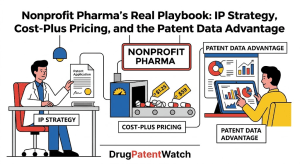
‘Nonprofit pharma’ covers at least three distinct entity types, and conflating them produces bad analysis. The first type is the 501(c)(4) social welfare organization, exemplified by Civica Rx. It can engage in commercial activity without restriction, but surplus revenue must support the social mission. The second is the 501(c)(3) charitable organization, like Harm Reduction Therapeutics. Its commercial activities face tighter IRS scrutiny and must be clearly subordinate to the charitable purpose. The third is the mission-driven public benefit corporation (PBC), like Mark Cuban’s Cost Plus Drug Company. It is for-profit, but its charter requires decision-makers to weigh social impact alongside profit. Understanding which structure you’re analyzing matters because each carries different tax treatment, capital access constraints, and IP ownership posture.
The 2024 ASPE report from the Department of Health and Human Services gave the clearest regulatory framing to date: nonprofit pharmaceutical companies ‘promote the affordability of medical products as a goal in their mission and vision statements, offering a cost-plus model that prices drugs at sustainable margins.’ That pricing model, cost-plus, is the core operational feature. In practice it means the organization sets a list price by summing its actual cost of goods sold, a defined overhead allocation, and a margin just sufficient to fund the next production cycle. There is no room in the model for a gross-to-net spread, no rebate architecture, and no tiered WAC pricing by payer class.
Why for-profit incumbents have not simply copied this
The answer is structural, not strategic. For-profit pharma’s pricing is not set by its cost of goods; it is set by the net present value of its patent exclusivity period. A compound that costs $0.10 to manufacture and carries a valid composition-of-matter patent through 2031 is priced to capture maximum value from that exclusivity window, regardless of manufacturing cost. Management teams that tried to switch to cost-plus pricing without also eliminating shareholder return expectations and long-term debt obligations would collapse their own equity value. The nonprofit structure, by removing those obligations at formation, is what makes the pricing model viable.
Key Takeaways: Structural Section
Three distinct entity types operate under the ‘nonprofit pharma’ umbrella, each with different IP ownership rules, tax obligations, and capital constraints.
Cost-plus pricing is viable only when shareholder return expectations and large-scale R&D debt obligations are absent at the structural level.
The 2024 ASPE report represents the first systematic federal framing of the sector, giving portfolio managers a regulatory anchor for scenario analysis.
The IP Architecture That Makes It Work
Patent Strategy Inversion: Access as the Goal, Not Exclusivity
For-profit pharmaceutical IP strategy centers on erecting the densest possible patent thicket around a commercial asset. A typical small-molecule brand might carry a composition-of-matter patent, a formulation patent, a method-of-use patent, a polymorph patent, and a pediatric exclusivity extension, all listed in FDA’s Orange Book and each capable of triggering a 30-month stay against Paragraph IV generic challengers. Evergreening this cluster can extend effective market exclusivity by seven to twelve years beyond the original patent expiration date.
Nonprofit pharma inverts this logic. DNDi, for example, seeks IP rights not to exclude competitors but to ensure it controls whether manufacturing licenses get granted. Under its pro-access IP framework, DNDi negotiates non-exclusive, royalty-free (or low-royalty) licenses with all manufacturing partners and publishes model contract templates publicly so no single CMO can capture rent from the distribution chain. The goal is to make a drug a global public good from the moment it reaches regulatory approval, rather than at patent expiration.
How Non-Exclusive Licensing Plays Out Operationally
When DNDi develops a compound in partnership with a pharma company, like Sanofi in the case of fexinidazole, the IP agreement must be structured before clinical trials begin. DNDi’s standard terms require that any regulatory approval obtained by the partner in high-income markets cannot be used to block access in endemic, low-income countries. The partner retains the ability to commercialize in regulated markets, but DNDi or its generic manufacturing partners can supply the drug in low- and middle-income countries without triggering an infringement claim.
This structure is more complex than it looks. It requires a jurisdiction-by-jurisdiction analysis of patent filing status because patents are territorial. A composition-of-matter patent filed in Germany through the European Patent Office does not automatically protect the compound in Uganda or Malawi. DNDi’s IP legal team actively maps endemic-country patent status for every program compound, identifying jurisdictions where the compound is unpatented and therefore available to generic manufacturers without any licensing negotiation at all.
IP Valuation: The Nonprofit Asset Base
For an IP team or portfolio manager trying to value a nonprofit pharma entity as a potential strategic partner or acquisition target, the relevant IP assets are not what they appear on a standard IP audit. Civica Rx’s most valuable IP is not a drug patent: it is the 501(c)(4) structure itself, the hospital membership contracts (which represent long-term off-take commitments), and the $124.5 million Petersburg, Virginia manufacturing facility, which, once fully licensed and operational for commercial output in 2026, constitutes a hard-to-replicate sterile-fill-finish asset in a domestic supply chain. Its capacity of 90 million vials and 50 million prefilled syringes annually gives it a manufacturing footprint that most mid-sized CMOs cannot match for generic injectables.
DNDi’s IP asset base is different. The organization holds rights through co-development agreements rather than outright patent ownership in most cases. Its most defensible asset is its clinical data package, accumulated across fourteen approved treatments as of 2025. Clinical data packages, including the complete dossiers submitted to the EMA and FDA, are not publicly available and cannot be replicated without running the original trials. That data represents the primary barrier to a generic manufacturer attempting to obtain independent regulatory approval for the same compound in a regulated market.
Key Takeaways: IP Architecture Section
Nonprofit pharma uses IP rights as access guarantors, not exclusivity mechanisms. Non-exclusive licensing is the standard structure, not an exception.
Jurisdiction-by-jurisdiction patent filing analysis is the primary IP due diligence task for any organization evaluating neglected-disease compound access.
Civica Rx’s core asset is its manufacturing infrastructure and hospital offtake contracts. DNDi’s core asset is its clinical data packages.
Civica Rx: A Full Technical Breakdown
Formation, Structure, and Governance
Civica Rx incorporated in 2018 as a 501(c)(4) nonprofit. Its founding health system members include Intermountain Healthcare, Mayo Clinic, HCA Healthcare, and Ascension Health. The Gary and Mary West Foundation, the Peterson Center on Healthcare, and the Helmsley Charitable Trust provided the initial philanthropic capital. The governance model is a healthcare utility: member hospitals sign long-term purchase and supply agreements, commit to minimum volume offtake, and in exchange receive supply priority and price stability. As of April 2025, Civica supplies more than 70 medications to over 1,500 hospitals, covering roughly one-third of all licensed U.S. hospital beds. The organization has distributed more than 210 million vials or syringes cumulatively, enough to treat over 97 million patients.
The Petersburg Manufacturing Asset: Technical Specifications
The Petersburg, Virginia plant at 1 Civica Way is a 140,000-square-foot sterile injectable facility representing a $124.5 million investment. Its three production lines cover vials, prefilled syringes, and prefilled pen cartridges. At full capacity, the facility produces 90 million vials and 50 million prefilled syringes annually. The filling lines use disposable isolator technology, which significantly reduces human intervention during fill-finish operations and lowers contamination risk compared with older open-line facilities. The plant employs approximately 275 people as of 2025, with a target headcount of 350.
Commercial drug production from the Petersburg facility is projected to begin in 2026 after completion of FDA process validation and facility inspection. Until that date, Civica sources all hospital-supply-chain medications through contracted manufacturing organizations, maintaining a six-month buffer inventory across the product portfolio to absorb supplier disruptions.
The Insulin Initiative: IP, Regulatory, and Market Strategy
Civica’s insulin program targets three biosimilar analogs: glargine (corresponding to Lantus), lispro (corresponding to Humalog), and aspart (corresponding to Novolog). All three are biologics regulated under the Public Health Service Act rather than the Drug Price Competition and Patent Term Restoration Act (Hatch-Waxman), meaning the approval pathway is a 351(k) abbreviated BLA, not an ANDA.
For insulin glargine, Civica signed a multiyear exclusive distribution agreement with Biocon Biologics, announced in October 2025. Biocon Biologics manufactures glargine-yfgn in Malaysia under its existing U.S. market approval. Civica distributes under a separate Civica label. Commercial launch was set for January 2026 at a distribution price of $45 per five-pen box to U.S. pharmacies, with a recommended consumer price ceiling of $55. That compares with Lantus pricing that, without rebates, has historically exceeded $300 per vial.
For insulin aspart, Civica struck a drug-substance supply agreement with Biocon Biologics in March 2025. Under this structure, Biocon supplies the drug substance; Civica produces the finished drug product at its Petersburg facility. This is a split-manufacturing model that requires both parties to satisfy FDA’s site-specific registration requirements. Development and clinical trials for aspart are still underway as of 2026, with commercial availability a post-2026 event. Virginia state government provided a $3 million grant in August 2025 to partially fund aspart development, reflecting the political economy around domestic drug manufacturing investment.
Total development cost for all three insulins is estimated at $200 million. The California government’s CalRx initiative provided a 10-year, $50 million commitment to Civica in March 2023 for statewide insulin supply, giving Civica guaranteed off-take revenue during the most capital-intensive development period.
CivicaScript: The Retail Channel
CivicaScript is Civica’s retail pharmacy operating unit. It applies the same cost-plus, price-transparent model to high-cost generics dispensed at retail rather than hospital pharmacies. Founding members include the Blue Cross Blue Shield Association and 18 independent BCBS plans, plus Anthem. CivicaScript’s most documented impact is in abiraterone acetate, the prostate cancer androgen-synthesis inhibitor. CivicaScript offers abiraterone at $160 per bottle. Medicare Part D patients who were previously paying market rates for branded Zytiga or higher-priced generics were saving approximately $3,000 per month on that single drug.
IP Valuation for Civica Rx
Civica holds no composition-of-matter patents on the drugs it supplies. Its IP position is entirely operational: long-term supply contracts with force majeure and price-stability clauses, manufacturing process know-how embedded in its Petersburg isolator lines, and the regulatory data packages it develops for its biosimilar insulin filings. For analysts trying to benchmark Civica’s value, the closest structural comparable is a specialty CMO with an embedded distribution network and a regulated-payer-guaranteed off-take book. The hospital membership model de-risks revenue more effectively than a typical CMO’s spot-market contract portfolio.
Key Takeaways: Civica Rx Section
Civica’s Petersburg plant represents the most significant domestic sterile-fill-finish capacity addition in the nonprofit pharmaceutical sector since 2018. Commercial production begins in 2026.
The insulin program uses two distinct regulatory structures: a distribution-only agreement for glargine (Biocon as manufacturer) and a split-manufacture model for aspart (Biocon drug substance, Civica drug product).
CivicaScript’s abiraterone pricing demonstrates that the cost-plus model generates clinically meaningful savings in high-cost oncology generics, not only commodity hospital injectables.
Civica’s core IP is operational: off-take contracts, manufacturing know-how, and biosimilar BLA data packages.
DNDi: The Non-Exclusive License Model in Practice
Origin and Mandate
DNDi launched in 2003 under the co-founding leadership of Medecins Sans Frontieres and research institutions from Brazil, India, Kenya, Malaysia, and France, with early WHO technical support. Its mandate is to develop safe, effective, and affordable treatments for neglected diseases where the commercially driven R&D pipeline is empty. These are conditions with disease burden concentrated in low-income populations, meaning no viable payer base for premium pricing. By 2025, DNDi had delivered fourteen approved treatments across six disease areas: sleeping sickness (human African trypanosomiasis), visceral leishmaniasis, Chagas disease, filarial infections, mycetoma, and pediatric HIV.
Fexinidazole: The Full Technology Roadmap
Fexinidazole is the most thoroughly documented case study in the DNDi portfolio and provides a complete model of how the organization moves a compound from compound screening through regulatory approval and access deployment.
The compound itself was identified in DNDi’s compound library screening in partnership with the Sanofi chemical library. Preclinical work confirmed activity against Trypanosoma brucei gambiense, the parasite responsible for the West and Central African form of sleeping sickness (HAT). Phase II/III trials ran in the Democratic Republic of Congo and Central African Republic, sponsored jointly by DNDi and Sanofi.
The EMA granted a positive scientific opinion for T.b. gambiense HAT in December 2018. FDA approval for both stages of T.b. gambiense followed in July 2021; at that point, DNDi and Sanofi jointly obtained the rights to an FDA Priority Review Voucher (PRV), a transferable regulatory instrument that grants the holder an expedited six-month FDA review on a future NDA or BLA. PRVs have traded at valuations of $100 million or more in secondary-market transactions, making them a meaningful financial instrument even for nominally nonprofit programs.
For the more acute T.b. rhodesiense strain, DNDi led a Phase II/III trial through the HAT-r-ACC consortium, running from 2019 through 2022 across sites in Malawi and Uganda. The EMA issued a positive opinion in December 2023. The WHO updated its global treatment guidelines to designate fexinidazole as the first-line treatment for T.b. rhodesiense in June 2024. By mid-2025, fexinidazole was registered and actively treating patients in Malawi, Uganda, and Zimbabwe, with Zambia and Ethiopia also granting approval for the extended indication.
Distribution operates through a Sanofi donation model: Foundation S, Sanofi’s philanthropic arm, donates the drug to WHO, which delivers it to African endemic countries. This eliminates the pricing layer entirely in the highest-burden markets.
The pipeline successor to fexinidazole is acoziborole, a single-dose oral drug developed by DNDi and Sanofi for T.b. gambiense. Its adult-patient safety study enrolled 1,208 participants and confirmed a favorable safety profile. Pediatric trials, the ACOZI-KIDS study, completed recruitment in March 2025. If approved, acoziborole would enable a ‘test-and-treat’ model deployable in primary healthcare settings, eliminating the need for hospitalization.
R&D Cost Benchmarking
DNDi publishes cost data for its programs. Its estimated cost to bring a new chemical entity through to approval is $110 to $170 million, compared with the pharmaceutical industry’s self-reported figure of approximately $1 billion to $2 billion. The gap is explained by several factors. DNDi compounds are often repurposed or repositioned molecules with existing safety data, which shortens Phase I timelines. Trial sites are in endemic countries with lower cost structures. The organization has no shareholder-driven cost-of-capital requirement built into its financial model. Partner pharmaceutical companies contribute in-kind resources, including compound libraries, CMC manufacturing support, and regulatory expertise, that do not appear as cash expenditures in DNDi’s financial statements.
IP Valuation for DNDi
DNDi’s IP is primarily held through co-development agreements. The organization does not typically take outright patent ownership. Instead, it negotiates the terms under which the pharmaceutical partner (Sanofi, in the case of fexinidazole) can commercialize in high-income markets. DNDi’s retained rights include the ability to sublicense to generic manufacturers for low-income country supply. The PRV generated by the FDA fexinidazole approval is an example of a financial asset that DNDi co-holds with its partner.
The most strategically significant IP assets DNDi holds are its clinical data exclusivity periods. FDA grants five years of data exclusivity to new chemical entities and three years to new clinical investigations of previously approved compounds. During those periods, generic applicants cannot rely on DNDi’s clinical data to support an ANDA or 505(b)(2) application in the U.S. That exclusivity window, combined with the non-exclusive licensing approach, means the drug is commercially available in regulated markets through the originator only, while simultaneously accessible in endemic countries through generic supply.
Key Takeaways: DNDi Section
Fexinidazole’s T.b. rhodesiense approval is now in active clinical use across Malawi, Uganda, and Zimbabwe as of 2025, with the successor compound acoziborole in pediatric trials.
DNDi’s co-development agreements generate FDA PRVs, which are high-value transferable assets that provide a financial return mechanism without compromising access in endemic markets.
DNDi R&D costs of $110-170 million per approved treatment compare with the industry’s $1 billion-plus figure, driven by molecule repositioning, in-kind partner contributions, and lower trial-site cost structures.
Data exclusivity periods, not patents, are the primary IP protection instrument in DNDi’s regulated-market strategy.
Harm Reduction Therapeutics and the Naloxone Patent Gap
RiVive and the OTC Naloxone Market
Harm Reduction Therapeutics is a 501(c)(3) that entered the naloxone market with a single product, RiVive, a 3 mg naloxone hydrochloride nasal spray. FDA approved it in June 2023. Pricing is $36 per two-dose kit at retail. The branded comparator, Narcan (Emergent BioSolutions), was FDA-approved for OTC use in March 2023 at a price exceeding $125 per two-pack.
The naloxone IP situation is instructive. Naloxone itself is an off-patent compound, first approved in 1971. The patents on 4 mg nasal spray formulations (Narcan) covered a specific delivery system and concentration, not the active pharmaceutical ingredient. RiVive at 3 mg uses a different dosing rationale: naloxone’s onset of action at 3 mg is clinically equivalent to 4 mg for the vast majority of overdose events, and the lower dose reduces cost of goods without meaningfully compromising efficacy for most use cases. The formulation choice is both a clinical decision and a patent-clearance decision.
IP Valuation for Harm Reduction Therapeutics
RiVive’s competitive moat is not IP-based. Harm Reduction Therapeutics holds FDA approval and the regulatory data package for its specific formulation, plus the brand equity associated with its mission positioning. The primary barrier to market share growth is not patent exclusivity but distribution: OTC naloxone requires pharmacies to stock it on shelf, community organizations to purchase it, and payers to reimburse it. A for-profit acquirer of Harm Reduction Therapeutics would need to maintain the mission positioning to preserve its payer and institutional relationships.
The broader market signal from the RiVive launch is significant. Emergent BioSolutions, the originator, responded to OTC competition by signing a voluntary license agreement with generic manufacturer Perrigo, which launched a store-brand 4 mg nasal spray. The OTC naloxone category is now a three-entity market with distinct price points, and the nonprofit entrant at the lowest price point has stabilized the competitive floor.
RiVive’s pricing strategy ($36 vs. $125+ for Narcan) is driven by a deliberate formulation choice at 3 mg that avoids the specific delivery-system patents covering 4 mg Narcan, while maintaining clinical utility.
The naloxone OTC market now functions as a three-tier price structure: nonprofit at $36, store-brand generic around $40-50, and branded OTC above $125.
The nonprofit’s market entry triggered a generic licensing response from the brand innovator, demonstrating the competitive-discipline effect that is central to the nonprofit pharma thesis.
Cost Plus Drugs: The For-Profit Sibling Reshaping the Same Market
Structure and Pricing Model
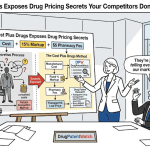
Mark Cuban Cost Plus Drug Company (MCCPDC) is a public benefit corporation, not a nonprofit. Its pricing model is manufacturer acquisition cost plus a fixed 15% markup, a $5 pharmacy service fee, and a $5.25 shipping fee. As of 2026 the company has over 2,200 drugs in its pharmacy catalog. It operates a 22,000-square-foot sterile fill-finish manufacturing facility in Dallas, Texas, opened in 2023.
The cost-plus structure removes the pharmacy benefit manager (PBM) from the pricing chain. Traditional retail drug pricing passes through a manufacturer, a wholesaler, a PBM, and a retail pharmacy, each capturing margin. MCCPDC eliminates three of those four steps, transacting directly between its manufacturing/wholesale operations and the patient. The company’s July 2023 partnership with Blue Shield of California, a $4.8 million member payer that replaced CVS Health as its pharmacy network partner, was the first large-scale payer validation of the model.
Research published in Pharmacoeconomics in 2024 estimated that applying MCCPDC pricing to 2021 Medicare Part D generic drug spending would have generated substantial system-wide savings. A separate 2023 study in Frontiers in Pharmacology quantified the savings specifically for generic cardiology drugs: Medicare spent $7.7 billion on the 50 most used generic cardiology drugs by volume in 2020, and applying MCCPDC pricing would have reduced that figure significantly. For individual patients, savings on individual drugs such as imatinib (generic Gleevec) reached $9,600 per 30-day supply compared with standard pharmacy retail.
The Regulatory Advocacy Dimension
In October 2025, Cuban testified before the U.S. Senate on drug pricing reform. Separately, in December 2025, Reuters reported that Cuban was in direct discussions with the Trump administration about waiving FDA generic drug application fees, which can run hundreds of thousands of dollars per ANDA submission and create a barrier to entry that favors incumbent generics manufacturers. If those fee waivers materialize, they would reduce the cost of building a cost-plus generics pipeline and could accelerate MCCPDC’s manufacturing expansion. MCCPDC has also confirmed a collaboration with TrumpRx, the administration’s direct drug purchasing platform announced in 2025.
Competitive Influence on the Incumbent Market
MCCPDC’s direct market influence is visible in two behavioral changes by incumbent retail pharmacy chains. CVS Health announced its CostVantage program in late 2023, which applies a transparent formula (drug cost plus a defined markup) to consumer cash pricing. Walgreens launched a comparable price-comparison tool for cash-pay customers. Neither program matches MCCPDC’s transparency (CVS has not disclosed its specific markup percentages), but both represent a structural acknowledgment that the incumbent model is under pricing pressure from the cost-plus entrant.
Key Takeaways: Cost Plus Drugs Section
MCCPDC is not a nonprofit, but its cost-plus model produces functionally identical pricing outcomes for patients. The PBC structure provides financial sustainability advantages over a traditional 501(c)(3) in the retail pharmacy context.
Blue Shield of California’s 2023 adoption of MCCPDC as a preferred pharmacy network is the most significant payer-side validation of the model to date.
FDA generic application fee waivers, if granted, would disproportionately benefit cost-plus entrants by reducing the capital requirement for expanding a generic catalog.
How Nonprofit Pharma Uses Patent Expiry Data as a Strategic Input
The Core Intelligence Problem
Nonprofit pharma organizations, whether Civica Rx targeting hospital-formulary generics or DNDi evaluating compound repositioning opportunities, share a common intelligence requirement: they need to know exactly when a branded drug’s IP protection expires in specific jurisdictions before committing capital to a manufacturing or development program. Entering a market too early means competing against a brand with active IP and Paragraph IV litigation exposure. Entering too late means the generic market has already commoditized to a price floor that makes capital recovery from manufacturing investment impossible.
Patent Expiry Analysis for Generic Entry Decisions
For a drug like abiraterone acetate (Zytiga), the IP landscape is not a single expiration date. It is a stack of Orange Book-listed patents with different expiration dates, each of which a generic applicant must either wait out or challenge via Paragraph IV certification. The composition-of-matter patent may have expired, but a method-of-use patent covering low-dose or food-effect administration could still carry protection. A formulation patent on the tablet versus the suspension formulation might be active. Each of these creates a different barrier to generic entry.
Platforms like DrugPatentWatch map the full Orange Book-listed patent stack for any given drug, track Paragraph IV filing activity (which signals that a generic applicant has certified a listed patent is invalid or not infringed), and surface the market entry dates projected for each generic competitor. For a nonprofit like Civica Rx deciding whether to add a drug to its hospital-supply portfolio, this data determines three things: whether the drug is off-patent (and therefore subject to standard ANDA process), whether it is patent-challenged (meaning generic entry could come sooner than patent expiration via litigation success), and what the competitive generic landscape will look like at the projected entry date.
Drug Repositioning and IP Clearance
For DNDi-style repurposing programs, the patent intelligence task is different. When screening existing approved compounds for activity against a neglected disease indication, the organization needs to know whether the compound is patent-protected in endemic countries, whether the method-of-use for the new indication is unpatented or patentable, and whether any regulatory exclusivity (orphan drug, new chemical entity) attaches to the existing approval.
Fexinidazole illustrates the method-of-use patent opportunity. Nitroimidazole compounds like metronidazole (the drug class fexinidazole belongs to) had long been known for antiprotozoal activity. The specific efficacy of fexinidazole against both stages of HAT, including its blood-brain barrier penetration for stage-2 disease, represented a genuinely new use that generated patentable claims. DNDi and Sanofi held those method-of-use claims, giving them a regulatory data package worth protecting in high-income markets while keeping the compound fully accessible in endemic countries where the same patents either were not filed or would not be enforced.
IP Intelligence for Payers and Hospital Systems
Payers and hospital pharmacy teams within Civica’s member network use patent expiry projections to build drug budget models. When a branded biologic approaches its biosimilar entry date, the pharmacy acquisition cost can drop by 30-60% in the first two years after market entry, and by more thereafter as the biosimilar market matures. For high-cost biologics, the savings from accurate biosimilar entry forecasting, captured through strategic formulary switching timed to competitive entry, can reach tens of millions of dollars annually for a large health system.
Key Takeaways: Patent Data Section
Orange Book patent stack analysis, not single expiration dates, governs generic entry timing decisions for any drug with active IP protection. Paragraph IV filing activity is the earliest market signal of competitive generic intent.
Nonprofit pharma organizations use patent expiry data to identify the window between IP clearance and market commoditization, the period of best-case impact.
Biosimilar entry forecasting using patent expiry data is a direct budget-planning tool for hospital pharmacy systems, with material financial consequences at scale.
Financial Sustainability: What the Funding Stack Actually Looks Like
The Dual-Revenue Architecture
Nonprofit pharma financial models are not donation-dependent in the way that most 501(c)(3)s are. The financially viable ones blend two revenue streams: operational revenue from drug sales, priced at cost-plus, and philanthropic or government capital for programs that cannot yet generate operational revenue. Civica Rx’s operations are substantially self-funded through hospital membership fees and drug sale margins. Its capital expansion programs, such as the Petersburg manufacturing facility and the insulin development program, required external capital: $124.5 million for the facility, $50 million from California’s CalRx commitment, and a $3 million Virginia state grant for aspart development.
DNDi’s model is more philanthropy-dependent because its programs deliberately target diseases with no commercially viable market. Its 2023 annual budget was approximately 80 million euros, sourced from governments (France, Switzerland, Netherlands, UK, among others), the Bill and Melinda Gates Foundation, MSF, and a smaller share from pharmaceutical partners. The pharmaceutical partner contributions are primarily in-kind: compound libraries, manufacturing development support, and regulatory resources.
Harm Reduction Therapeutics funds operations through a combination of foundation grants and drug sale revenue. Because naloxone is an OTC product and the opioid crisis drives consistent demand, the drug sale revenue component is more robust than for a rare-disease nonprofit.
The Tax Code Problem
The ASPE 2024 report identified the tax code as a structural barrier to nonprofit pharma growth. Current IRS rules do not provide a suitable tax-exempt category for organizations that engage in substantial commercial pharmaceutical manufacturing. A 501(c)(4) can do it, but faces unrelated business income tax (UBIT) on commercial activities that the IRS determines are not substantially related to its exempt purpose. A 501(c)(3) is more constrained still. The practical result is that as Civica Rx scales its Petersburg plant toward $200+ million in annual commercial output, it faces increasing tax complexity that a for-profit CMO does not.
Access to Capital
Nonprofit pharma organizations cannot issue equity. They cannot access venture capital or public equity markets. They rely on debt (which requires collateral or grant-backed guarantees), philanthropic capital (which is episodic and mission-constrained), and government contracts. The Civica-Phlow-Virginia Commonwealth University-AMPAC collaboration, partially funded by the Biomedical Advanced Research and Development Authority (BARDA), provides a model for how government procurement can function as quasi-equity for nonprofit manufacturing scale-up.
Key Takeaways: Financial Sustainability Section
Civica Rx’s model is operationally self-funding at steady state. Capital expansion requires philanthropic or government sourcing. The insulin program’s $200 million development cost required the CalRx commitment and Virginia state grants to reach financial viability.
DNDi’s annual budget of approximately 80 million euros comes primarily from government donors and foundations. Pharmaceutical partner contributions are predominantly in-kind.
The 501(c)(4) tax structure avoids the strictest IRS constraints on commercial activity, but UBIT exposure increases as commercial scale grows, creating a regulatory drag on scaling.
Regulatory and Manufacturing Bottlenecks
FDA Site Inspection and Process Validation
The Petersburg facility’s path from occupancy permit (late 2022) to commercial drug production (projected 2026) spans roughly three years of process validation, equipment qualification, and FDA site readiness work. Sterile injectable manufacturing requires three layers of facility qualification: installation qualification (IQ), operational qualification (OQ), and process qualification (PQ). Each must be completed and documented before an ANDA or BLA supplemental filing can reference the site. For biosimilar products, the FDA’s expectations around analytical similarity and immunogenicity testing add further complexity.
Civica’s decision to use disposable isolator technology rather than traditional barrier-isolation systems is both a quality advantage and a regulatory one: FDA’s guidance on aseptic processing strongly favors closed-system approaches, and the Petersburg fill lines reflect this. CMO partners that Civica might bring in to backstop supply during the facility ramp-up phase may use older technology, creating a quality management challenge.
The Abbreviated New Drug Application Process for Generics
For small-molecule generics (not biosimilars), the ANDA process under Hatch-Waxman requires demonstrating bioequivalence to the reference listed drug. The Paragraph IV certification pathway, where a generic applicant certifies that a listed patent is invalid or not infringed, initiates a 30-month statutory stay on FDA approval while patent litigation proceeds. The first applicant to file a Paragraph IV ANDA on a given drug earns 180 days of marketing exclusivity, creating a financial incentive for Civica or other nonprofits to file early even when the litigation risk is real. Civica has not, to date, filed Paragraph IV certifications aggressively, preferring to operate in the post-exclusivity generic market where IP conflict risk is low.
The 351(k) Biosimilar Pathway for Insulin
Civica’s biosimilar insulin program operates under 351(k) of the Public Health Service Act. Unlike Hatch-Waxman ANDAs, 351(k) filings require a clinical pharmacology bridge study demonstrating that the biosimilar’s PK/PD profile is sufficiently similar to the reference product. For insulin analogs, the FDA also requires an immunogenicity study to confirm that anti-drug antibody formation rates are comparable. These studies, while smaller than Phase III pivotal trials, add 18 to 36 months and $20 to $60 million to the development timeline for each product.
The split-manufacturing model for insulin aspart, where Biocon Biologics supplies drug substance and Civica completes fill-finish in Petersburg, requires both manufacturers to be FDA-qualified for their respective operations. The BLA supplement listing the Petersburg site must clear FDA inspection before Civica can ship commercial aspart product.
Key Takeaways: Regulatory and Manufacturing Section
The Petersburg facility’s commercial production timeline (2026) reflects the three-to-four-year process validation cycle typical for new sterile injectable sites. It is not a construction delay; it is a regulatory workflow.
Civica’s Paragraph IV aversion reduces litigation exposure but yields the first-filer 180-day exclusivity benefit to for-profit generic applicants. This is a conscious trade-off of financial opportunity for operational risk reduction.
The 351(k) pathway for biosimilar insulin analogs requires immunogenicity data that adds 18-36 months and $20-60 million per product to development timelines.
Investment Strategy: What Institutional Analysts Should Monitor
Signal 1: Petersburg Commercial Milestones
The Petersburg plant’s progression toward FDA commercial-use approval in 2026 is the most measurable near-term indicator of Civica Rx’s operational scaling. Watch for FDA inspection scheduling and facility clearance notices in FDA’s Establishment Inspection Report database. A successful first commercial production run will materially change Civica’s cost structure by shifting from CMO-sourced supply (where Civica pays manufacturing margin to a third party) to self-manufactured supply.
Signal 2: Biosimilar Insulin Approval Timelines
Track FDA BLA supplement submissions for the Civica-Biocon glargine and aspart filings. Glargine distribution began in January 2026 under Biocon’s existing approval. Independent Civica-labeled BLA submissions will determine how much pricing control Civica has over the long-term product and its label claims. Any 351(k) filing from Civica for its own glargine or aspart label would represent a material escalation in the organization’s regulatory asset base.
Signal 3: DNDi’s Acoziborole Approval
Acoziborole’s single-dose oral administration for T.b. gambiense HAT, if approved, would eliminate the last remaining clinical barrier to a ‘test-and-treat’ protocol in primary care settings across sub-Saharan Africa. This event would validate DNDi’s next-generation R&D model and likely trigger increased government donor commitments. An acoziborole approval would also generate a potential FDA PRV, valued in secondary market transactions at $100 million or more.
Signal 4: Cost Plus Drugs’ FDA Fee Waiver Campaign
If the FDA generic application fee waiver advocacy succeeds, the first beneficiaries will be small-volume generic applicants including mission-driven organizations. Current FDA ANDA fees are approximately $248,000 per application (FY2025), a meaningful barrier for programs with no for-profit return expectation. Fee reduction would accelerate the cost-plus generic catalog expansion.
Signal 5: Federal Nonprofit Pharma Tax Classification
The ASPE 2024 report recommended congressional consideration of a new tax-exempt category specifically designed for nonprofit pharmaceutical manufacturers. If enacted, this would eliminate the UBIT exposure problem for Civica and reduce compliance overhead. Monitor Ways and Means Committee markups for healthcare provision language that creates a new 501 subcategory for pharmaceutical manufacturers with a public benefit mandate.
Signal 6: IRA Negotiation List Intersection
The Inflation Reduction Act’s Medicare Drug Price Negotiation program targets the highest-expenditure drugs in Part D and Part B. When a negotiated price for a branded drug is announced, it changes the competitive economics for generic or biosimilar alternatives. If the negotiated price narrows the gap between brand and biosimilar, it reduces the incentive for payers to switch to the biosimilar. Monitor negotiation list selections for overlap with Civica’s and MCCPDC’s current or pipeline product portfolios.
Policy Levers That Could Accelerate or Stall the Sector
Acceleration: New Tax-Exempt Category
The most structurally significant policy change would be a statutory amendment creating a tax classification for nonprofit pharmaceutical manufacturers that exempts commercial drug sales from UBIT when the drug is sold below a defined percentage of the branded reference price. This would remove a compliance drag that currently consumes management bandwidth at organizations like Civica Rx.
Acceleration: BARDA and ARPA-H Procurement Vehicles
BARDA’s existing authority to enter into Other Transaction Authority (OTA) agreements with manufacturers, including nonprofits, for essential medicines allows cost-sharing for facility construction and process development that does not require the organization to issue equity or take on commercial debt. The Biden administration’s use of OTAs with Civica and Phlow Corp established a procurement template that subsequent administrations can expand. ARPA-H, the Advanced Research Projects Agency for Health, has a mandate that could include funding de-risked late-stage development for neglected-disease compounds in the DNDi pipeline.
Stall Risk: PBM Pushback on Cost-Plus Networks
PBMs have market levers that can limit cost-plus pharmacy network access. PBMs negotiate formulary placement and preferred network status with payers. An employer plan that switches to a cost-plus pharmacy benefit must typically exit its incumbent PBM network contract early, triggering termination penalties. PBMs have reportedly used these contract structures to slow Blue Shield of California-style defections. Legislative action at the federal level to prohibit restrictive PBM network exclusivity contracts would directly accelerate cost-plus model adoption.
Stall Risk: FDA PDUFA Fee Dependency
FDA’s budget is substantially dependent on industry-paid user fees under the Prescription Drug User Fee Act (PDUFA) and its generic equivalent, GDUFA. A reduction in generic application fees would reduce FDA’s GDUFA revenue, creating a budget offset that requires either appropriations or reduced review capacity. Fee waivers without an appropriations substitute could slow ANDA review timelines, which would hurt nonprofit generic programs more than incumbent generic manufacturers with larger volume portfolios.
Key Takeaways: Policy Section
A new IRS tax category for nonprofit pharmaceutical manufacturers is the single highest-leverage domestic policy change for the sector.
BARDA’s OTA procurement authority is already being used to subsidize nonprofit manufacturing scale-up and represents a replicable template.
PBM network exclusivity contracts are the primary commercial barrier to cost-plus pharmacy model adoption and are the target of the most consequential pending pharmacy-benefit legislation.
Key Takeaways by Segment
For IP Teams and Patent Counsel
Nonprofit pharma does not eliminate IP risk for incumbents; it changes its character. Instead of Paragraph IV litigation from a generics challenger, brands face a different threat: a nonprofit that waits out the full patent term, enters with a fully cleared ANDA or 351(k) BLA, and competes on price alone in a market where payer support now includes government off-take agreements and foundation capital. The competitive moat for brand companies facing nonprofit competition is not IP duration but switching costs, clinical differentiation, and formulary lock-in.
For Portfolio Managers and R&D Leads
Tracking nonprofit pharma entry into a market provides an early-warning signal that the branded product in that market is approaching effective end-of-life from a commercial standpoint. Civica Rx selects drugs based on shortage risk and price-to-cost ratio. A drug that Civica targets has, by definition, a cost of goods well below its WAC price. That spread is the indicator of commercial vulnerability.
For Payers and Hospital Systems
The six-month buffer inventory model and long-term supply contracts that Civica offers represent a supply-security premium that has tangible balance-sheet value for hospital systems. Drug shortage events cost hospital systems through emergency procurement premiums, formulary substitutions, and delayed care. The NPV of supply security from a Civica membership agreement should be included in any financial analysis of network participation.
FAQ
Q: Can a for-profit company acquire a nonprofit pharma organization?
Not directly. A 501(c)(3) or 501(c)(4) nonprofit cannot be purchased by a for-profit acquirer in the conventional sense. Its assets can be sold or transferred to a for-profit entity, but this requires state attorney general approval, a fair-market-value determination, and a cy-pres distribution of any proceeds to a comparable charitable purpose. The practical effect is that Civica Rx and DNDi are not acquirable in the conventional M&A sense, which affects how competitors should model the long-term competitive landscape.
Q: How does Paragraph IV certification work in the context of nonprofit generics?
Under Hatch-Waxman, any ANDA filer can certify that a patent listed in the Orange Book is invalid or not infringed by the generic product. Filing a Paragraph IV certification triggers the 30-month statutory stay and initiates litigation. The first filer to submit a Paragraph IV certification on a given drug earns 180 days of generic marketing exclusivity, meaning no other ANDA filer can launch during that window. Civica Rx has historically not pursued Paragraph IV strategies, operating instead in fully patent-cleared generic markets.
Q: What is biosimilar interchangeability and why does it matter for Civica’s insulin program?
The FDA’s biosimilar interchangeability designation allows a pharmacist to substitute a biosimilar for its reference biologic without prescriber authorization, in states that have enacted substitution laws. Interchangeability requires additional switching studies demonstrating that alternating between the biosimilar and the reference product does not produce greater safety or efficacy concerns than using the reference product alone. For Civica’s insulin program, interchangeability designation would allow automatic pharmacy-level substitution from branded Lantus, Humalog, or Novolog without requiring the prescriber to change the prescription. This is a significant commercial enabler and a key regulatory milestone to track.
Q: How does DrugPatentWatch support nonprofit pharma strategy?
DrugPatentWatch tracks the full Orange Book-listed patent stack for FDA-regulated drugs, projected generic entry dates, Paragraph IV filing activity, ANDA applicant data, and biosimilar filing timelines. For a nonprofit deciding whether to add a drug to its portfolio, this data answers the threshold question (is the IP cleared?), the timing question (when will generics enter and how crowded will the market be?), and the intelligence question (who else is already targeting this market, and at what stage?).