1. What Pharmaceutical Portfolio Management Actually Is (and What Most Teams Get Wrong)
Pharmaceutical portfolio management is the discipline of allocating R&D capital across a set of drug programs to maximize risk-adjusted net present value (rNPV) for the enterprise. That definition sounds clean. The practice is not.
The core tension is structural: drug development timelines run 10-15 years from IND filing to commercial launch, yet most portfolio review cycles operate on annual or semi-annual cadences. A governance model designed for 12-month planning horizons will consistently misallocate capital toward programs that look productive in the near term but are strategically incoherent at a portfolio level. AstraZeneca’s near-death experience in the early 2010s, when six blockbusters faced patent expiry simultaneously between 2010 and 2016, was not a product failure. It was a portfolio failure, one rooted in under-investment in late-stage pipeline replenishment a decade earlier when the IP position on Crestor, Seroquel, and Nexium looked impregnable.
Portfolio management in pharma has three distinct layers, and conflating them produces bad decisions. The first layer is project-level prioritization: which programs get funded, at what stage gate, and under what kill criteria. The second is therapeutic area strategy: whether the company should concentrate IP generation in oncology, CNS, metabolic disease, or rare disease, each with radically different development costs, probability of technical success (PoTS), and competitive dynamics. The third is corporate portfolio strategy: how the mix of in-house development, licensing, and acquisition positions the company against a 10-year IP expiry schedule.
Most published reading lists on pharma portfolio management address the first layer competently, make passing reference to the second, and largely ignore the third. This guide corrects that.
Key Takeaways: Section 1
Portfolio management failure is usually an IP timing failure. Teams that review their patent expiry schedules five years out, rather than 15, will consistently be surprised by revenue cliffs. The analytical starting point for any serious portfolio review is not the pipeline stage-gate table but the IP expiry calendar mapped against projected branded revenue.
2. The IP Asset Layer: Patent Valuation as the Core Portfolio Input
A drug’s commercial value and its IP value are not the same number, and treating them interchangeably is the most expensive mistake a portfolio team can make. The commercial value of a product is its discounted projected cash flow. Its IP value is the incremental cash flow attributable specifically to patent protection, the delta between what the asset earns under exclusivity and what it earns once generic or biosimilar entry occurs.
How Patent Valuation Works in Practice
The standard approach to patent valuation in pharma uses a real options model rather than a simple DCF. This is appropriate because drug patents are not static assets. They are option positions on future cash flows contingent on regulatory approval, competitive entry, and litigation outcomes. The core inputs are: the base patent expiry date, the probability and expected timing of Paragraph IV challenges, the likelihood of any challenged claim surviving inter partes review (IPR) at the USPTO, any expected pediatric exclusivity extensions under the Best Pharmaceuticals for Children Act (BPCA), and the regulatory data exclusivity period (five years for NCEs, 12 years for reference biologics under the BPCA/ACA framework).
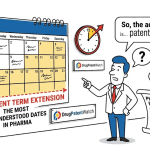
For a small molecule drug, the IP estate typically consists of a composition-of-matter patent (filed at or near the IND, expiring roughly 20 years from filing, adjusted for Patent Term Extension under 35 U.S.C. § 156), one or more method-of-use patents, and potentially formulation or polymorph patents. Each layer has a different litigation profile and a different contribution to portfolio value.
Case Study: Humira’s IP Estate as Portfolio Architecture
AbbVie’s management of adalimumab (Humira) is the most-studied example of patent estate construction in modern pharma. The base composition-of-matter patent for adalimumab expired in 2016 in the United States. AbbVie’s IP team then built what critics called a ‘patent thicket’ of over 100 subsequent patents covering dosing regimens, formulations, syringes, and manufacturing processes. The result was a negotiated biosimilar entry settlement structure that delayed meaningful U.S. competition until January 2023, seven years after the core composition patent expired. At peak, Humira generated roughly $21 billion in annual global revenue. The IP management extended that revenue base by approximately $100 billion in cumulative U.S. sales.
The AbbVie/Humira case is not anomalous. It is the template that every biologics IP team studied after 2016. It illustrates that for a large biologic, the IP estate is not a legal compliance function. It is a capital allocation decision with balance-sheet scale consequences.
Portfolio Valuation Frameworks
At the portfolio level, IP value aggregates across assets but does not simply sum them. Correlation between patent expiry dates matters: a portfolio where five top-selling products lose exclusivity within a 36-month window is worth materially less than a portfolio where the same five expirations are spread over eight years, even if the individual asset valuations are identical. Diversification across expiry dates is itself a source of portfolio value, a fact that is consistently underweighted in stage-gate portfolio reviews focused on near-term PoTS.
The FDA’s Orange Book (for small molecules) and Purple Book (for biologics) are the primary public-domain inputs for mapping IP expiry across a competitive landscape. DrugPatentWatch aggregates and enriches this data, cross-referencing patent expiry dates with ANDA filing history, Paragraph IV certification activity, and litigation outcomes to produce forward-looking competitive entry timelines. For any portfolio team doing competitive intelligence or BD targeting, this is baseline infrastructure, not a discretionary subscription.
Key Takeaways: Section 2
Patent valuation requires separating composition-of-matter exclusivity from method-of-use and formulation exclusivity. Each layer has a different legal vulnerability and a different expected duration. Portfolio optimization at the enterprise level must account for correlation between expiry dates across assets, not just asset-level rNPV.
Investment Strategy Note
Investors screening for patent cliff risk should map the ratio of near-term revenue concentration (revenue from products losing exclusivity within 5 years as a share of total revenue) against the pipeline coverage ratio (estimated peak sales of late-stage pipeline assets versus projected exclusivity losses). A ratio below 0.7 historically precedes material earnings pressure and often prompts M&A.
3. Foundational Texts and Their Analytical Gaps
The published literature on pharmaceutical portfolio management has improved substantially since the early 2000s, but it contains systematic blind spots that practitioners need to understand before selecting a curriculum.
‘Portfolio, Program, and Project Management in the Pharmaceutical and Biotechnology Industries’ (Harpum, ed., Wiley)
Pete Harpum’s edited volume remains the most comprehensive single-volume treatment of P3M (Portfolio, Program, and Project Management) in life sciences. Structured in three parts, the text covers organizational frameworks for portfolio oversight, planning and control processes for drug development programs, and the organizational capability-building required to sustain P3M practice. Martin D. Hynes III’s chapter on integrated business processes for cross-functional drug development is particularly useful for teams trying to align discovery, clinical, regulatory, and commercial functions under a single portfolio governance model.
The gap in Harpum’s framework: it treats portfolio management primarily as a project-coordination discipline. IP strategy, specifically the interaction between portfolio composition and patent estate construction, gets minimal treatment. Teams using this text as a primary reference will develop strong governance processes but may systematically underinvest in IP lifecycle planning.
‘Optimization of Pharmaceutical R&D Programs and Portfolios: Design and Investment Strategy’ (Springer)
This text, written by contributors from finance, clinical research, statistics, and regulatory affairs, takes a quantitative approach that distinguishes it from most portfolio management literature. Its central contribution is treating probability of technical success (PoTS) as a variable to be optimized through study design choices, rather than a fixed input. Dose-selection strategy, adaptive trial design, and biomarker-based enrichment all affect PoTS, and therefore affect portfolio value, before a single patient is enrolled.
The book covers indication sequencing (the question of which indication to pursue first for a given asset, given differential PoTS and commercial value across disease areas), the economics of adaptive platform trials, and decision-theoretic frameworks for portfolio-level kill/continue criteria. This is one of the few texts written for a technical audience that explicitly integrates clinical design and financial optimization.
Its limitation: it was written primarily from a small molecule perspective, and its PoTS frameworks require modification for biologics, where manufacturing scale-up and immunogenicity considerations add risk dimensions that do not appear in the standard clinical development model.
‘Portfolio Management for New Products’ (Cooper, Edgett, Kleinschmidt)
Cooper and colleagues brought the stage-gate process into mainstream pharmaceutical R&D, and their portfolio management framework remains the dominant mental model at most mid-size pharma companies. The bubble diagram, plotting assets by strategic score and NPV, became ubiquitous in portfolio reviews from the late 1990s onward. The book’s practical toolkit for scoring and prioritizing projects is genuinely useful.
The problem is that Cooper’s framework was developed primarily in industrial product contexts and does not account for the degree to which pharmaceutical portfolio value is determined by IP timing rather than development execution. A drug that is technically excellent but whose composition patent expires before Phase III completion is worth less than a technically marginal drug with 15 years of patent runway, and Cooper’s scoring models do not capture that asymmetry well.
‘The Textbook of Pharmaceutical Medicine’ (7th Ed., Faculty of Pharmaceutical Medicine)
Recommended by the Faculty of Pharmaceutical Medicine as core curriculum, this text integrates regulatory, scientific, and commercial considerations across the pharmaceutical development lifecycle. Its portfolio-relevant sections cover regulatory strategy and how development pathway choices affect both approval probability and commercial exclusivity duration. The interaction between accelerated approval pathways, post-marketing confirmation requirements, and competitive entry timing is particularly well covered.
‘Pharmaceutical Economics and Policy’ (Schweitzer and Lu)
Schweitzer and Lu cover the economic determinants of pharmaceutical portfolio decisions at a level of rigor that most comparable texts avoid. Their treatment of the Hatch-Waxman Act’s competitive dynamics, specifically the 180-day exclusivity window that accrues to the first filer of a Paragraph IV ANDA, provides the economic foundation for understanding why generic entry timing is not random. Patent expiry dates, Paragraph IV filing activity, and litigation settlement structures are all endogenous to the incentive framework created by Hatch-Waxman, and Schweitzer and Lu trace those linkages carefully.
Key Takeaways: Section 3
No single text covers the full analytical surface of pharmaceutical portfolio management. Harpum provides governance frameworks. The Springer optimization text provides quantitative rigor on PoTS and study design. Schweitzer and Lu provide the economic and legal architecture for understanding competitive entry dynamics. A complete curriculum uses all four in sequence, supplemented by current literature on biologics IP.
4. Strategic Decision-Making: From Pipeline Priority Lists to Paragraph IV Tactics
The decision architecture for a pharmaceutical portfolio operates at three timescales. Immediate decisions (0-18 months) involve stage-gate go/no-go at Phase IIb/III transition, resource reallocation between programs, and BD prioritization. Medium-term decisions (2-5 years) involve indication sequencing, formulation development strategy, and preparation of the Orange Book patent listing. Long-term decisions (5-15 years) involve composition-of-matter patent prosecution strategy, lifecycle extension planning, and biologics exclusivity positioning.
Most portfolio reviews focus on the immediate timescale because those are the decisions with the most near-term P&L visibility. This creates systematic underinvestment in the medium and long-term decisions that actually determine whether the portfolio will be defensible when current assets mature.
The Pipeline Priority List: Construction and Limitations
A pipeline priority list ranks active development programs by some combination of rNPV, strategic fit, and resource intensity. The construction methodology matters more than most teams acknowledge. rNPV calculations are sensitive to three inputs above all others: the discount rate applied to distant cash flows (a 10% rate vs. a 12% rate can change program rankings materially for assets more than eight years from launch), the PoTS assumptions by phase (industry averages mask enormous variance by therapeutic area and mechanism), and the competitive entry assumptions post-approval.
That last input is where IP data directly enters the portfolio model. If the competitive entry assumption treats patent expiry as the only trigger for generic entry, the model will be systematically optimistic. Paragraph IV challenges can accelerate generic entry by years ahead of nominal patent expiry, and the probability of a Paragraph IV challenge is itself predictable. Products with annual U.S. sales above $250 million face Paragraph IV challenges with near certainty. Products with concentrated IP positions (a single composition patent, no formulation protection) face a higher probability of successful challenge than products with layered estates.
Paragraph IV Filing Dynamics
A Paragraph IV certification is an ANDA applicant’s assertion that a listed Orange Book patent is either invalid or will not be infringed by the generic product. Filing a Paragraph IV triggers a 30-month litigation stay under Hatch-Waxman, during which the NDA holder can sue for patent infringement. If the NDA holder wins, the ANDA approval is deferred until patent expiry. If the generic wins, or if the 30-month stay expires without resolution, generic entry can proceed.
The strategic implications for portfolio managers are direct. A product with a vulnerable IP position generates a lower rNPV than a nominally identical product with a strong, layered patent estate, because the expected generic entry date is earlier. Portfolio teams that do not model Paragraph IV challenge probability explicitly are working with structurally inflated rNPV figures. This is not a minor modeling refinement: for a product with $2 billion in annual revenue, a three-year difference in expected generic entry date translates to roughly $4-6 billion in NPV at a 10% discount rate.
Authorized Generics and Patent Settlements
Two additional strategic tools affect the competitive entry timeline for any given asset: authorized generic programs and Hatch-Waxman settlement agreements. An authorized generic is a generic version of a branded product marketed by the brand company (or a licensee) simultaneously with the first Paragraph IV filer’s 180-day exclusivity window, eroding the economic value of that exclusivity and deterring further Paragraph IV challenges. AstraZeneca deployed this tactic against generic entrants on Nexium; Pfizer used it on Lipitor.
Patent settlements between brand companies and generic filers are governed by FTC scrutiny under the ‘reverse payment’ standard established in FTC v. Actavis (2013). A settlement that includes a payment from the brand to the generic (explicit or implicit) in exchange for a delayed entry date is subject to antitrust challenge under a rule-of-reason analysis. Portfolio teams working on settlement strategy need both IP counsel and antitrust counsel at the table.
Key Takeaways: Section 4
Pipeline priority lists that do not incorporate Paragraph IV challenge probability and expected litigation outcome are producing optimistic rNPV figures. For any product with projected U.S. revenues above $250 million, the IP litigation risk adjustment is material. Orange Book patent listing strategy, and the decision of which patents to list and when, is a portfolio-level capital allocation decision with direct NPV consequences.
Investment Strategy Note
Analysts evaluating branded pharma companies should treat the Orange Book patent listings for top-revenue products as primary investment research inputs, not background. The number of Paragraph IV certifications filed against a given product, the litigation history on those certifications, and the patent expiry profile of the listed claims all provide quantifiable data on the expected duration of branded revenue. DrugPatentWatch and the FDA’s ANDA database make this analysis possible at the individual product level.
5. Evergreening: A Technical Roadmap
Evergreening is the set of IP and regulatory strategies by which an NDA or BLA holder extends the effective commercial exclusivity of a drug asset beyond the expiry of its base composition-of-matter patent. The term has acquired pejorative connotations in the policy literature, but for IP and portfolio professionals it describes a legitimate and necessary discipline. Without lifecycle management, the R&D investment in a first-in-class drug generates returns that end at composition patent expiry, after which generic or biosimilar competition typically erodes branded revenue by 80-90% within 24 months.
The Evergreening Toolkit for Small Molecules
The primary instruments for small molecule lifecycle extension are:
Patent Term Extension (PTE) under 35 U.S.C. § 156 restores patent term lost during FDA regulatory review, up to a maximum of five years, with a total post-approval patent life cap of 14 years. PTE is available only for the first permitted commercial marketing of the product and applies to a single patent. Selecting which patent to apply PTE to is a strategic choice that requires modeling the competitive landscape and the vulnerability of alternative patents.
Pediatric exclusivity, a six-month extension available under BPCA for conducting FDA-requested pediatric studies, attaches to all Orange Book patents and the five-year NCE data exclusivity period. It is one of the most cost-efficient exclusivity extensions available, given that the required pediatric studies typically cost $10-30 million while the exclusivity extension on a $1 billion revenue product is worth $500 million or more.
New Chemical Entity (NCE) and New Molecular Entity (NME) data exclusivity provides five years of non-patent protection against ANDA filings for new small molecule drugs. Under a technical reading of the regulations, a Paragraph IV filing cannot be submitted during the five-year NCE period (except for the ‘four-year rule,’ which allows filing in year four for patents set to expire before the NCE exclusivity window closes). This regulatory exclusivity is separate from and additive to patent protection.
Formulation patents protect specific dosage forms, controlled-release delivery systems, or combination products. These are among the most commonly litigated evergreening patents because their validity is frequently challenged on obviousness grounds. The 2012 Supreme Court decision in Mayo Collaborative Services v. Prometheus Laboratories tightened Section 101 subject-matter eligibility standards, affecting method-of-use claims in particular, though composition and formulation claims remain more robust.
New use (method-of-use) patents protect specific therapeutic indications. A brand company that obtains approval for a new indication can list the corresponding method-of-use patent in the Orange Book, providing a fresh patent runway for that indication. Generic versions of the product can enter the market for previously approved indications under ‘skinny label’ (carve-out) NDAs that exclude the new indication, but the risk of induced infringement liability for off-label use has generated significant litigation since the 2021 GSK v. Teva decision.
Polymorph and Salt Form Patents
Polymorphism, the property of a compound to exist in multiple crystal forms with different physical properties, generates a distinct category of IP. Pharmaceutical companies routinely patent specific polymorphic forms of drug substances, and these patents can provide exclusivity independent of the original composition patent. Clopidogrel (Plavix) and omeprazole (Prilosec/Nexium) are canonical examples of polymorph strategy, where Sanofi’s Form II clopidogrel bisulfate patent and AstraZeneca’s esomeprazole (the S-enantiomer of omeprazole) both generated substantial litigation and exclusivity value.
The analytical challenge with polymorph patents is that their validity is highly fact-specific and dependent on whether the specific form was disclosed or rendered obvious by the prior art. Their contribution to a portfolio’s rNPV therefore requires legal assessment, not just financial modeling.
The Evergreening Technology Roadmap
A systematic evergreening program for a small molecule asset should be constructed at IND filing, not at Phase III. The roadmap should identify:
The primary composition patent and its expected PTE-adjusted expiry date. The pediatric exclusivity opportunity: whether FDA has issued a written request for pediatric studies, the cost of compliance, and the expected exclusivity value. The formulation development pipeline: controlled-release versions, co-formulations, or device-drug combinations that could support new patent filings and, if clinically differentiated, new NDA approvals under the 505(b)(2) pathway. New indication development: which additional indications the mechanism could address, ranked by development cost, PoTS, and patent runway relative to the original approval. Method-of-use patents for dosing regimens: specific dosing protocols, patient selection criteria (particularly biomarker-defined populations), or combination therapy regimens that warrant independent patent protection.
Building this roadmap at IND stage rather than at Phase III approval is not premature optimization. It is the difference between having a 15-year IP runway and a 5-year runway on the same compound.
Key Takeaways: Section 5
Evergreening is not a single tactic. It is a structured IP lifecycle program that requires coordination between medicinal chemistry, clinical development, regulatory affairs, and IP counsel from early development. Each instrument (PTE, pediatric exclusivity, NCE data exclusivity, formulation patents, new indication filings) has different cost, timeline, and value characteristics. A portfolio team that does not model these instruments individually is leaving measurable NPV on the table.
Investment Strategy Note
Companies with active 505(b)(2) programs for their top revenue products, and those with documented pediatric study programs tied to their Orange Book listings, signal IP management competency that markets sometimes undervalue. The BPCA pediatric exclusivity database is publicly searchable and provides a direct window into which companies are systematically exploiting this instrument versus treating it as an afterthought.
6. Biologics and Biosimilar Interchangeability: Portfolio Implications
Biologics operate under a different exclusivity architecture than small molecules, and portfolio teams that apply small molecule mental models to a biologics portfolio will systematically misvalue their assets. The core differences are regulatory exclusivity duration, the complexity of IP estate construction, the manufacturing-based barriers to biosimilar entry, and the clinical and regulatory requirements that determine whether a biosimilar achieves interchangeability designation.
The 12-Year Exclusivity Framework
Under the Biologics Price Competition and Innovation Act (BPCA, enacted as part of the ACA in 2010), a reference biologic has 12 years of data exclusivity from the date of its first FDA approval. During this window, no biosimilar application referencing that product can be approved. A four-year ‘exclusivity block’ within the 12-year period prevents biosimilar applications from even being submitted in years 1-4.
This regulatory exclusivity is independent of patent protection and applies even if all relevant patents have expired or been invalidated. For a biologic approved in, say, 2015, the data exclusivity alone protects the product until 2027, irrespective of what happens in patent litigation. Portfolio modelers valuing biologics assets must start with data exclusivity as the floor for competitive entry timing, then layer patent analysis on top.
The Patent Thicket Phenomenon in Biologics
The AbbVie/Humira model, described in Section 2, is now the industry template. Post-2016, every major biologics company with a high-revenue asset has aggressively filed secondary patents covering: cell culture and fermentation processes, purification methods, formulation excipients and concentrations, delivery device designs (autoinjectors, prefilled syringes), dosing regimens for specific patient populations, and combination therapy methods. Amgen deployed this approach for Enbrel (etanercept). Roche did so for Herceptin (trastuzumab) and Avastin (bevacizumab).
The result is a litigation environment in which biosimilar entry requires not just a scientifically similar product but a litigation strategy that either survives or works around dozens of secondary patents. The 351(k) biosimilar application pathway includes a ‘patent dance’ mechanism (42 U.S.C. § 262(l)) that structures information exchange between the reference product sponsor and the biosimilar applicant, culminating in a list of patents to be litigated before launch. Managing this process efficiently is a specialized litigation competency that most portfolio teams lack in-house and must source from outside counsel.
Biosimilar Interchangeability: What It Actually Means
The FDA’s interchangeability designation, available under BPCA, allows a pharmacist to substitute a biosimilar for the reference biologic without prescriber intervention, the biological equivalent of automatic generic substitution. Achieving interchangeability requires demonstrating that the product can be expected to produce the same clinical result in any given patient, and for products administered more than once, that alternating between the biosimilar and the reference product does not present a greater safety or efficacy risk than using the reference product alone.
As of 2025, a modest but growing number of biosimilars have achieved interchangeability designation. Boehringer Ingelheim’s Cyltezo (adalimumab-adbm) was the first interchangeable biosimilar approved for an immunology indication. Coherus BioSciences obtained interchangeability for Yusimry (adalimumab-aqvh). The commercial significance of interchangeability is debated: state substitution laws vary, and formulary placement by PBMs may matter more than interchangeability status in driving biosimilar uptake. But for portfolio valuation of reference biologics, the potential acceleration of biosimilar substitution post-interchangeability designation is a risk factor that requires explicit modeling.
Manufacturing as an IP Moat
One competitive dynamic specific to biologics has no direct small molecule analog: the manufacturing process itself is a barrier to entry. Biologics are manufactured in living cells, and the production process, from cell line selection through upstream fermentation, downstream purification, and fill-finish, materially affects product quality attributes, immunogenicity profiles, and clinical performance. A biosimilar manufacturer must demonstrate analytical and clinical similarity to the reference product using a manufacturing process that is, by definition, different from the originator’s. The technical and capital requirements to achieve this create a barrier that is independent of patent protection and data exclusivity.
This manufacturing moat has portfolio implications. Unlike a small molecule whose composition patent expiry leads to near-certain generic entry within 12-24 months, a biologic facing biosimilar entry may see only partial market erosion even after data exclusivity expires, simply because the number of manufacturers capable of producing a high-quality biosimilar at commercial scale remains limited. Portfolio models for biologics should incorporate a competitive entry curve that reflects manufacturing capacity constraints, not just patent and regulatory timelines.
Key Takeaways: Section 6
Biologics portfolio valuation requires four inputs that have no direct small molecule equivalent: 12-year BPCA data exclusivity, secondary patent portfolio depth, the interchangeability designation status of any biosimilar applicants, and a manufacturing capacity constraint curve for expected competitive entry. Teams applying small molecule competitive entry assumptions to biologics assets will produce materially inaccurate rNPV figures.
Investment Strategy Note
Biosimilar companies targeting high-revenue biologics need capital for both development and litigation. Assessing a biosimilar company’s litigation readiness, specifically whether it has engaged specialist patent litigation counsel and mapped the full patent dance for its target product, is a leading indicator of whether biosimilar entry will actually occur on the expected timeline. Patent dance timelines are publicly filed and searchable.
7. R&D Portfolio Optimization: Probability of Technical Success as a Design Variable
The most sophisticated advance in pharmaceutical portfolio management over the past 15 years is the recognition that probability of technical success (PoTS) is not a fixed historical average to be looked up in a table. It is a function of decisions made in study design, biomarker strategy, indication selection, and adaptive trial architecture. A team that treats PoTS as an exogenous input is making portfolio allocation decisions on the basis of industry averages that may be deeply irrelevant to any specific program.
Phase-Transition Success Rates: What the Data Actually Shows
Industry-average PoTS figures are widely cited and consistently misused. The Hay et al. (2014) study published in Nature Biotechnology, which remains one of the most-cited reference datasets, estimated overall Phase I to approval success rates at approximately 10.4% across all therapeutic areas between 2003 and 2011. Oncology Phase II success rates in that dataset were among the lowest at approximately 28%. CNS was worse.
These averages mask dramatic variance by mechanism of action. First-in-class drugs with validated biomarkers demonstrating target engagement consistently outperform industry averages. The FDA’s Breakthrough Therapy designation, which requires preliminary clinical evidence of substantial improvement over available therapy, is one signal of this elevated PoTS: Breakthrough designated programs have historically achieved FDA approval at meaningfully higher rates than non-designated programs, though the designation itself does not causally improve PoTS so much as it selects for it.
Adaptive Trial Design and Portfolio Value
Adaptive trial designs, which allow pre-specified modifications to sample size, randomization ratios, or endpoints based on accumulating data, directly affect portfolio value through two channels. The first is resource efficiency: adaptive designs can reduce sample size requirements when the interim data is strong, freeing capital for other portfolio programs. The second is decision speed: adaptive designs can produce earlier futility signals, allowing faster kill decisions on programs that are not working.
Seamless Phase II/III adaptive designs, in which a Phase II dose-selection stage flows directly into the Phase III confirmatory stage without a separate study initiation, have become standard in oncology and increasingly common in other areas. From a portfolio management perspective, the key metric is the expected time to decision (either approval or futility) weighted by the capital deployed. An adaptive design that cuts expected program duration by 12 months on a program with $50 million annual burn rate generates $50 million in option value, independent of the probability of success.
Biomarker Enrichment and the Precision Medicine Premium
Biomarker-based patient selection (enrichment) improves PoTS by concentrating trial enrollment in the patient population most likely to respond. The operational cost is higher (biomarker screening adds per-patient cost and can slow enrollment), but the improvement in PoTS and the reduction in required sample size can more than offset this. For portfolio optimization, the relevant calculation is expected NPV of a biomarker-enriched trial versus an unselected trial, accounting for the smaller addressable patient population that biomarker restriction implies for commercial planning.
The Keytruda (pembrolizumab) story is the canonical example. Merck’s decision to develop pembrolizumab against a PD-L1 expression-enriched population, rather than an unselected one, increased Phase III PoTS and produced approval in PD-L1 high NSCLC. The commercial sacrifice (excluding PD-L1 low patients from the initial label) was more than offset by the value of a robust approval that competitors initially struggled to replicate.
Indication Sequencing Strategy
For a drug with activity across multiple indications, the sequence in which indications are pursued affects both total portfolio value and IP duration. The first indication approved establishes the NCE/NME data exclusivity clock (for small molecules) or the BPCA 12-year data exclusivity clock (for biologics). Subsequent indication approvals add method-of-use patent protection but do not restart data exclusivity.
The optimal sequence prioritizes indications that maximize the combination of approval PoTS, time to approval, commercial size, and IP runway. Rare disease indications under Orphan Drug designation have several relevant features: smaller required trial sizes (due to patient population limitations), Orphan Drug Exclusivity (ODE) of seven years from approval for the orphan indication, and potential Priority Review Vouchers (PRVs) that have traded at $100-150 million in secondary markets. For a program with rare disease activity, obtaining ODE before pursuing the larger common-disease indication preserves both commercial and IP optionality.
Key Takeaways: Section 7
PoTS is a design output, not an industry benchmark lookup. Portfolio teams that treat it as fixed are systematically misallocating R&D capital. The decisions that most directly improve PoTS (biomarker strategy, adaptive design, indication selection) are made in early clinical development, not at Phase III, which is why portfolio strategy must engage R&D at the IND stage rather than waiting for Phase IIb readouts.
8. The Patent Cliff: Forecasting and Defense Mechanics
The patent cliff, the period in which a company’s revenue base erodes sharply as multiple top-selling products lose exclusivity, is the most visible failure mode of pharmaceutical portfolio management. Merck’s 2011-2012 cliff (Singulair, Cozaar, and Fosamax all losing exclusivity within 18 months), Bristol-Myers Squibb’s 2011-2012 cliff (Plavix and Abilify), and AstraZeneca’s extended 2010-2016 cliff are the reference cases. Each was foreseeable with a 10-year horizon. None was fully anticipated in portfolio planning at the point when corrective action was still cost-effective.
Quantifying Cliff Exposure
The standard metric for patent cliff exposure is the patent cliff revenue ratio: the percentage of current branded revenue attributable to products whose base composition or primary method-of-use patent will expire within a specified horizon (typically 5 years). A ratio above 40% in a 5-year window is generally considered high-risk for a company without a late-stage pipeline capable of replacing that revenue.
A more precise version of this metric discounts each revenue stream by the probability of generic/biosimilar entry in each year of the horizon, incorporating Paragraph IV challenge probability, litigation outcome probability, and (for biologics) biosimilar development timelines. This produces an ‘expected IP-adjusted revenue’ figure that is both more accurate and more granular than the simple expiry-date-based calculation.
Pipeline Coverage Ratio
The pipeline coverage ratio compares the estimated peak sales of Phase III and late Phase II assets against the expected exclusivity loss revenue over the next 5-7 years. A ratio above 1.0 suggests the pipeline can offset cliff exposure. Most large pharma companies operate at ratios between 0.6 and 1.2, with significant variance driven by whether recent BD activity has refreshed the late-stage pipeline.
The pipeline coverage ratio is directionally useful but methodologically imprecise because peak sales estimates for pipeline assets are notoriously optimistic at the Phase III stage. A standard heuristic adjustment is to apply a 30-40% haircut to consensus pipeline NPV estimates before comparing them to expected exclusivity losses.
Defensive Strategies: What Actually Works
Patent cliff defense strategies fall into four broad categories, each with different lead times and capital requirements.
Internal lifecycle management is the cheapest defense if executed early enough. It relies on the evergreening toolkit described in Section 5. The critical constraint is time: formulation development, new indication trials, and pediatric studies all require 3-7 years of lead time to produce Orange Book-listable patents before the base patent expires. Companies that begin lifecycle planning at Phase III approval rather than at IND are typically too late to build a meaningful formulation or new-use patent estate.
Portfolio diversification through BD is the most common large pharma response to an identified cliff. The peak acquisition cycle for bolt-on licensing deals and smaller acquisitions tends to occur 3-5 years before the expected revenue loss, when the cliff is visible but the acquiree’s assets are not yet pricing in the acquirer’s desperation. Pfizer’s acquisition of Warner-Lambert (Lipitor) in 2000, just as its organic pipeline was thinning, and AstraZeneca’s $39 billion acquisition of Alexion in 2021, completed just as the AstraZeneca base portfolio was stabilizing post-cliff, are illustrative.
Biosimilar entry, for originator companies that have biosimilar development capability, converts a competitive threat into a revenue source. Several large biologics originators have built biosimilar portfolios specifically to offset the revenue impact of their own reference biologics losing data exclusivity. Amgen’s biosimilar business, which includes biosimilar versions of adalimumab, bevacizumab, and trastuzumab, generates substantial revenue that partially offsets the impact of biosimilar competition on Enbrel and Neulasta.
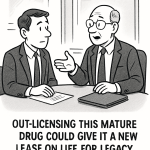
Portfolio restructuring through divestiture is the least discussed but operationally significant option. Divesting mature assets with thin patent protection and declining branded revenue recycles capital into higher-value development programs and improves the portfolio’s average IP runway. Pfizer’s consumer health joint venture with GSK, and subsequent spinout as Haleon, was partly motivated by this logic: consumer OTC assets have different competitive dynamics than on-patent branded pharmaceuticals, and segregating them improves portfolio clarity for equity investors.
Key Takeaways: Section 8
Patent cliff forecasting requires modeling the full expected generic entry distribution for each asset, not just the nominal expiry date. The two most actionable defensive metrics are the patent cliff revenue ratio (concentration of near-term revenue in products with expiring protection) and the pipeline coverage ratio (late-stage NPV relative to expected exclusivity losses). Both require IP expiry data integrated into financial models, not held separately in a legal database.
9. Regulatory Intelligence as a Portfolio Input
Regulatory pathway selection is a portfolio decision with capital consequences that most management frameworks treat as a purely scientific or legal matter. The FDA approval pathway determines the exclusivity duration, the required development investment, the approval timeline, and the competitive entry landscape. Portfolio managers who leave regulatory strategy to regulatory affairs, without incorporating those decisions into portfolio valuation models, are working with incomplete data.
The 505(b)(2) Pathway
The 505(b)(2) NDA is a hybrid approval mechanism that allows an applicant to rely on existing safety and efficacy data from published literature or from an FDA-approved drug, combined with the applicant’s own new clinical data. This pathway applies to new formulations, new dosage forms, new routes of administration, new combinations, and new uses of approved drugs.
The strategic value of 505(b)(2) lies in its ability to generate new NCE-equivalent exclusivity (three years for new clinical investigation data, five years if FDA determines a new chemical entity is involved) with a materially smaller clinical development investment than a full NDA. For an evergreening program, a 505(b)(2) approval for a controlled-release formulation can generate three years of data exclusivity plus a new set of Orange Book-listable patents, effectively extending the commercial exclusivity window at a fraction of the cost of a new molecular entity program.
Breakthrough Therapy, Fast Track, and Accelerated Approval
The FDA’s expedited programs (Breakthrough Therapy Designation, Fast Track designation, Priority Review, and Accelerated Approval) affect portfolio value in different ways. Breakthrough Therapy designation accelerates development timelines through intensive FDA guidance and rolling review, which reduces the capital required to reach approval by compressing the development clock. Fast Track facilitates more frequent FDA interactions during development but does not itself guarantee faster review. Priority Review shortens the FDA review period from 12 to six months, which has modest but non-trivial NPV value for large-revenue products.
Accelerated Approval, which allows approval based on a surrogate endpoint reasonably likely to predict clinical benefit, introduces a distinct risk profile: the requirement for post-marketing confirmatory trials means that approval does not terminate clinical development investment. If the confirmatory trial fails, FDA can withdraw approval under the streamlined process established by the 2022 FDA reforms post-Aduhelm controversy. Portfolio models for Accelerated Approval assets must account for both the capital cost of confirmatory trials and the approval withdrawal risk.
Orphan Drug Designation and PRV Strategy
Orphan Drug Designation (ODD) requires a disease prevalence of fewer than 200,000 patients in the United States. ODD provides seven-year orphan drug exclusivity (ODE) from approval (for the designated indication only), a 50% tax credit on qualified clinical testing expenses, and waiver of the PDUFA user fee. ODE is independent of patent protection and cannot be challenged by Paragraph IV certification.
The PRV (Priority Review Voucher) program generates tradable vouchers for approvals in neglected tropical diseases, rare pediatric diseases, and certain medical countermeasures. PRVs entitle the holder to a Priority Review of any subsequent NDA or BLA. Because Priority Review compresses the FDA review timeline by approximately six months, PRVs have commercial value primarily to large pharma companies with high-revenue products in their pipeline review queue. Market prices for PRVs have ranged from $65 million to $350 million in recent transactions, making PRV generation a potentially significant portfolio value-add for companies developing rare disease drugs.
Key Takeaways: Section 9
Regulatory pathway selection is a portfolio-level capital allocation decision. The choice between a standard 505(b) NDA, a 505(b)(2) NDA, a Breakthrough Therapy program, or an Orphan Drug/Accelerated Approval path affects exclusivity duration, development cost, approval timeline, and competitive entry dynamics. Portfolio teams that do not model these pathway differences will misallocate R&D capital across programs.
10. Statistical Frameworks for Pipeline Valuation
The quantitative infrastructure of pharmaceutical portfolio management rests on a small set of statistical and financial methods that are frequently misapplied in practice. Understanding both their correct application and their failure modes is necessary for producing reliable portfolio valuations.
Risk-Adjusted Net Present Value (rNPV)
rNPV is the dominant valuation method for pharmaceutical pipeline assets. It discounts projected cash flows by both time (using a risk-free or weighted average cost of capital) and cumulative development success probability. The basic calculation multiplies each year’s projected cash flow by the cumulative PoTS to that year and discounts back to present value.
The two most common errors in rNPV modeling are double-discounting risk (applying both a high discount rate and a PoTS adjustment, which overstates risk-adjustment) and treating PoTS as a scalar rather than a phase-conditional probability tree. A drug that is currently in Phase II does not face the same PoTS profile as a drug at IND filing: the conditional probability of approval given Phase III entry is approximately 60-70% for most therapeutic areas, not the 10% overall Phase I to approval rate. Using the wrong PoTS figure for the current stage is one of the most common pipeline valuation errors.
Monte Carlo Simulation
For portfolio-level analysis, where the goal is not just to value individual assets but to characterize the distribution of portfolio outcomes, Monte Carlo simulation provides a more complete picture than point-estimate rNPV. By sampling from distributions over PoTS, market size, and competitive entry timing, Monte Carlo produces a range of portfolio value outcomes and quantifies the probability of different revenue scenarios. This is particularly valuable for identifying tail risks (scenarios where multiple programs fail simultaneously) and for stress-testing portfolio coverage ratios.
The ICH E9 guideline on statistical principles for clinical trials, while written for study-level analysis, provides the methodological foundation for understanding how study design affects the reliability of the clinical data that feeds into PoTS estimates. A Phase IIb trial with inadequate power does not just risk a false negative. It produces an unreliable PoTS estimate that propagates through the portfolio model, distorting capital allocation.
Real Options Analysis
Real options analysis, which values the embedded options (the right but not the obligation to proceed) within a development program, is theoretically superior to rNPV for assets with significant optionality. Stage-gate decisions, indication sequencing choices, and formulation development pivots all have option-like characteristics that rNPV does not capture well. In practice, real options models are harder to parameterize and communicate than rNPV, which limits their adoption in operational portfolio reviews.
The most useful application of real options thinking in practice is not a formal binomial or Black-Scholes model but rather the explicit identification and valuation of the decision points in a development program. If a Phase IIb trial produces a positive result, what additional indications or formulations does that unlock? What does the optionality on those secondary programs contribute to the current-stage asset value? Answering these questions qualitatively and incorporating them into kill/continue criteria improves capital allocation even without a formal options model.
Key Takeaways: Section 10
rNPV accuracy depends critically on using phase-conditional rather than cumulative PoTS estimates, and on separating risk adjustment from discount rate adjustment. Monte Carlo simulation at the portfolio level is the appropriate tool for characterizing outcome distributions and quantifying tail risk. The ICH E9 statistical framework, applied at the study design stage, directly affects the reliability of the PoTS estimates that feed portfolio models.
11. Investment Strategy: Reading Patent Data for Alpha
Patent data is one of the few high-quality, legally mandated, and publicly available datasets that directly predicts pharmaceutical revenue trajectories. Sophisticated institutional investors have used it for decades; retail and generalist institutional investors systematically underutilize it.
What the Orange Book and Purple Book Tell You
The FDA Orange Book (searchable at accessdata.fda.gov) lists the patents that NDA holders have certified as covering approved drug products, along with their expiry dates. A product with a single composition patent expiring in three years and no formulation or use patents listed has a fundamentally different revenue trajectory than a product with a layered estate of patents expiring across the next 12 years. The Orange Book makes this difference visible.
The Purple Book equivalent for biologics, maintained by FDA under BPCA, lists licensed biologics and their biosimilar and interchangeable biosimilar counterparts. Combining Purple Book data with BPCA data exclusivity timelines and 351(k) biosimilar application data (available in FDA’s drug approval databases) produces a map of expected biosimilar competition for any reference biologic.
Paragraph IV Activity as a Leading Indicator
Paragraph IV certification filings are published in the Federal Register and in FDA databases within 20 business days of ANDA acceptance. A spike in Paragraph IV filings against a specific product is a public signal that generic companies believe the IP estate is vulnerable. The subsequent patent infringement suit filings (in federal district court) are also public record. Together, these create a litigation activity indicator that precedes generic entry by approximately 2-4 years, well within a useful investment horizon.
Empirically, products that receive two or more Paragraph IV certifications from different generic filers experience generic entry at or before nominal patent expiry at a significantly higher rate than products that are not challenged. The presence of multiple Paragraph IV filers also indicates that generic entry, when it occurs, will be more rapid: multiple generic manufacturers competing from day one of entry drives faster branded erosion than a monopoly generic period under 180-day exclusivity.
Biosimilar Application Activity
The 351(k) biosimilar application pathway requires FDA notification to the reference product sponsor within 20 days of biosimilar BLA acceptance. These notifications, combined with biosimilar company pipeline disclosures, provide roughly 2-3 years of advance notice before a potential biosimilar launch. For reference biologics with revenues above $500 million annually, tracking the biosimilar application pipeline against the data exclusivity calendar is baseline portfolio intelligence.
M&A Signals from Patent Data
Companies that are net acquirers of late-stage pipeline assets, as evidenced by licensing deal announcements and NDA transfers in FDA databases, are actively managing their patent cliff exposure. The timing and pricing of these acquisitions provide signals about acquirer management’s internal assessment of organic pipeline coverage.
Conversely, companies that are heavy sellers of pipeline assets (out-licensing or divestiture of NDA rights) may be indicating that their internal portfolio optimization has concluded those assets have higher value to another party. The most sophisticated analysis combines deal flow data with patent expiry schedules to assess whether the transaction makes sense in the context of each party’s IP runway.
Key Takeaways: Section 11
Patent data in the Orange Book, Purple Book, Paragraph IV databases, and biosimilar application filings is systematically underused in institutional investment analysis. It provides a 2-5 year forward look at competitive entry dynamics that is both legally mandated and more reliable than management guidance. Integrating this data with revenue models produces materially better forecasts of branded revenue trajectories than models that treat patent expiry as a cliff-edge event.
12. Building a Pharma Portfolio Management Capability from Scratch
Most pharmaceutical companies do not have a fully integrated portfolio management function. They have a project management office (PMO) that tracks program milestones, a business development team that evaluates in-licensing opportunities, an IP department that manages patent prosecution, and a finance team that builds revenue forecasts. These functions operate largely independently of each other, which means portfolio optimization happens by accident rather than design.
The Organizational Architecture
An effective portfolio management function requires authority over four decisions that are often siloed: stage-gate investment decisions (go/no-go at Phase I/II and II/III transitions), resource allocation between therapeutic areas, business development and in-licensing prioritization, and IP lifecycle planning including Orange Book listing and pediatric study decisions.
Without authority over at least the first two, a portfolio management team is a reporting function, not a decision-making one. The most common organizational model that gives portfolio management real authority is the Portfolio Review Committee (PRC), a cross-functional governance body that includes the CMO, CFO, Chief Business Officer, and head of IP/Legal. The PRC reviews program data and makes explicit capital allocation decisions, rather than delegating those decisions to individual program teams.
Data Infrastructure Requirements
A portfolio management function that lacks reliable data infrastructure will produce low-quality analyses regardless of the sophistication of its analytical frameworks. The minimum data requirements are: real-time clinical trial status for all programs (typically sourced from internal trial management systems and cross-referenced against ClinicalTrials.gov), patent expiry data for all Orange Book and Purple Book-listed products (accessible through FDA databases and enriched by commercial providers), competitive pipeline data (sourced from IQVIA, EvaluatePharma, or equivalent), and ANDA/biosimilar application activity for products approaching patent expiry.
For companies with on-patent biologics above $500 million in annual revenue, biosimilar competitive intelligence is not optional. The biosimilar applicant’s manufacturing quality, clinical similarity data, and litigation track record all affect the probability and timing of commercial entry, and each requires dedicated monitoring capability.
The P3M Capability Development Framework
John Arrowsmith, Patrick Grogan, and Bob Moore’s framework for developing P3M capability in drug development organizations, published in Harpum’s edited volume, provides a useful developmental model for teams building this function. Their framework identifies five organizational maturity levels, from ad hoc project execution at Level 1 to integrated portfolio optimization with active capital reallocation at Level 5. Most pharmaceutical companies, including several large-cap players, operate at Level 2 or 3.
The practical implication: don’t attempt to build a Level 5 portfolio management function before the organizational governance structures, data systems, and executive sponsorship are in place to support it. A well-executed Level 3 capability, with robust stage-gate governance and systematic IP monitoring, produces more value than an aspirational Level 5 function that lacks organizational authority.
Key Takeaways: Section 12
Portfolio management organizational capability is most commonly limited by governance authority gaps (lack of cross-functional decision rights) and data infrastructure deficits (IP and competitive entry data not integrated into financial models). Building capability progressively against the P3M maturity framework, rather than attempting a full transformation, produces more sustainable results.
13. Data Tools and Competitive Intelligence Infrastructure
The analytical quality of pharmaceutical portfolio management depends heavily on the quality of the data inputs. Several commercial and public-domain tools are standard infrastructure for teams doing serious work in this area.
Orange Book and Purple Book: Primary IP Data
The FDA’s Orange Book provides patent expiry dates, patent numbers, and exclusivity information for all currently marketed small molecule drugs. The Purple Book provides equivalent data for biologics. Both are freely accessible but require significant time to navigate efficiently at scale. Several commercial providers (DrugPatentWatch, Clarivate Derwent, RxPad) aggregate, normalize, and enrich this data with litigation history, ANDA filer lists, and projected generic entry dates.
DrugPatentWatch’s specific value-add over the raw Orange Book data is its integration of ANDA filing history, Paragraph IV certification records, patent litigation outcomes, and first-filer 180-day exclusivity tracking. This transforms a static patent expiry table into a dynamic competitive entry model, which is the relevant output for portfolio planning.
Clinical Trial and Pipeline Databases
ClinicalTrials.gov is the mandatory registration database for clinical trials under the FDAAA 801 requirement. It provides real-time status for approximately 400,000 registered trials. For competitive pipeline intelligence, the trial registry data is the most reliable public signal of competitor development activity. A competitor’s Phase III initiation in a disease area where you have a Phase II program is a material input to portfolio prioritization that shows up in ClinicalTrials.gov before any press release.
Commercial pipeline databases from IQVIA, EvaluatePharma, GlobalData, and Pharma Intelligence (Citeline) supplement ClinicalTrials.gov with analyst-curated peak sales estimates, development milestone calendars, and deal transaction data. These are standard subscriptions for BD teams and should be equally standard for portfolio management functions.
Litigation Intelligence
Paragraph IV patent litigation is filed in federal district court and is publicly recorded in PACER (Public Access to Court Electronic Records). The specialized legal databases LexisNexis and Bloomberg Law provide better search and analysis tools for the pharmaceutical patent litigation history that PACER contains. Understanding the track record of specific IP law firms, the performance of specific patents in Paragraph IV litigation, and the typical settlement dynamics for a given class of claims all require access to this litigation history data.
IQVIA MIDAS and Commercial Data
IQVIA’s MIDAS (Market Research Data) database provides prescription volume and revenue data at the product, indication, and geography level. For portfolio valuation, MIDAS data is the primary input for calibrating market size assumptions and for tracking actual branded revenue erosion trajectories post-generic entry. Because the rate of branded erosion varies significantly by therapeutic area, dosage form, and patient switching behavior, using MIDAS actuals from comparable generic entry events is more reliable than assuming a standard erosion curve.
Key Takeaways: Section 13
The data infrastructure for serious pharmaceutical portfolio management includes at minimum: Orange Book/Purple Book (with commercial enrichment), ClinicalTrials.gov (with commercial pipeline database supplement), Paragraph IV litigation tracking, and IQVIA MIDAS for commercial benchmarking. Teams that lack access to any of these are working with incomplete competitive intelligence.
14. Key Takeaways by Segment
On IP Valuation: Patent value is not the same as commercial value. The IP-attributable cash flow delta, the revenue earned under exclusivity versus under competition, is the relevant variable for portfolio optimization. Composition-of-matter patents, secondary method-of-use patents, and regulatory exclusivities (NCE data exclusivity, BPCA 12-year exclusivity, ODE) each contribute differently and must be modeled independently.
On Foundational Texts: No single published text covers the full analytical scope of pharmaceutical portfolio management. Harpum (P3M governance), the Springer optimization text (PoTS as a design variable), and Schweitzer and Lu (Hatch-Waxman competitive dynamics) are complementary, not interchangeable. All three, combined with the ICH statistical guidelines and current FDA regulatory guidance, form a coherent curriculum.
On Strategic Decision-Making: Paragraph IV challenge probability is a quantifiable and predictable input to portfolio valuation, not an unpredictable litigation event. Products with concentrated IP positions and high revenues will face Paragraph IV challenges. Orange Book listing strategy, including which patents to list and when, is a capital allocation decision.
On Evergreening: Lifecycle management programs must begin at IND, not at approval. A formulation development program that begins at Phase III launch has a maximum 3-4 year window to produce Orange Book-listable patents before the base composition patent expiry triggers Paragraph IV filings. That window is insufficient for most controlled-release or new indication programs.
On Biologics: Apply the 12-year BPCA data exclusivity as the floor for competitive entry modeling. Layer patent analysis on top. Account for manufacturing barriers as a separate and partially quantifiable source of competitive protection beyond patent and regulatory exclusivity.
On R&D Optimization: Biomarker enrichment, adaptive trial design, and indication sequencing are not purely scientific choices. Each has a direct and quantifiable effect on portfolio rNPV. Portfolio committees that do not engage these decisions at the program design stage are surrendering control over the most important variables in the valuation model.
On the Patent Cliff: Identify cliff exposure with a 10-year horizon, not a 5-year one. The corrective actions available at 5 years (licensing, BD, formulation development) are all more expensive and less effective than the same actions taken at 10 years. The patent expiry calendar is fully visible at any point in time. The failure to act on it is a governance failure, not an information failure.
On Investment Strategy: Orange Book and Purple Book data, Paragraph IV filings, biosimilar application activity, and M&A deal flow each contain predictive signals about pharmaceutical revenue trajectories that are underutilized by most equity analysts. The 2-5 year forward visibility that patent data provides is a material analytical advantage for investors willing to build the capability to use it.
Primary data sources referenced: FDA Orange Book (accessdata.fda.gov), FDA Purple Book, ClinicalTrials.gov, PACER, DrugPatentWatch, IQVIA, Federal Register.