By the end of 2025, China’s National Intellectual Property Administration had accepted roughly 270 administrative patent linkage cases, and the Supreme People’s Court’s Intellectual Property Tribunal had received 41 related appeals.[1] Neither number would have meant much five years ago, when the system barely existed. Together they mark a five-year-old regulatory mechanism that has quietly moved from theoretical to operational, while most foreign patent teams are still working from the framework they read about at launch in 2021.
The bigger change is not the case count. It is a ratio. Across CNIPA’s own published case data, the proportion of China-marketed generic drugs covered by a listed patent, relative to those not covered, has fallen from roughly 1.4-to-1 in data spanning 2021 to 2024 to roughly 0.8-to-1 in data spanning 2021 to 2026.[2] Generic applicants are no longer waiting to challenge patents. Increasingly, they are redesigning formulations to avoid them before they ever reach a courtroom or CNIPA’s adjudication desk.[2] That is not a footnote. It is a shift in how the entire system gets used, and it has direct consequences for how brand-side teams should be listing, drafting, and monitoring patents in China.
The Short Answer
China’s Drug Patent Dispute Early Resolution Mechanism, the country’s patent linkage system, has grown from a nearly untested pilot in 2021 to a platform holding more than 2,000 registered drug entries and nearly 21,000 patent declarations by mid-2026.[1] Case volume has grown alongside it, but the more consequential shift is qualitative: generic manufacturers are increasingly designing around listed patents rather than challenging them, a new parallel data-exclusivity regime took effect in May 2026, and patent term extension has gone from a single headline case to a routine grant covering 32 drugs.[1][2][6] None of this is secret. It is published, dated, and sitting in CNIPA and NMPA’s own disclosures. Most of it has not made it into foreign IP teams’ working assumptions about the system.
What Changed: Six Findings From the 2025-2026 Data
The platform nearly quadrupled in scope. As of July 18, 2026, China’s National Registered Drug Patent Information Platform held 1,296 chemical drug entries, 366 biological product entries, and 434 traditional Chinese medicine entries, alongside 20,881 patent declarations.[1] A 2024 academic study covering the system’s first two years found only 632 branded drugs listed and 5,058 patent certifications through June 2023.[4]
Case volume moved from theoretical to real. CNIPA had accepted approximately 270 administrative patent linkage cases by the end of 2025, and had already published 183 administrative adjudication decisions as of November 14, 2025.[1][3] The Supreme People’s Court’s IP Tribunal had received 41 related appeals over the same period.[1]
The coverage ratio flipped. The ratio of patent-covered to non-patent-covered generics fell from roughly 1.4-fold to roughly 0.8-fold between the 2021-2024 and 2021-2026 CNIPA case windows, a shift attributed mainly to generic applicants reformulating around listed patents rather than filing challenges.[2]
A new exclusivity layer arrived in parallel. Revised Implementing Regulations of the Drug Administration Law, covering nine chapters and 89 articles, took effect May 15, 2026, and had already produced data exclusivity protection for 54 drugs by July 18, 2026, 19 with six-year terms and 31 with four-year terms.[1][6]
Patent term extension stopped being a novelty. By July 18, 2026, 32 drugs, spanning chemicals, biologics, and traditional Chinese medicines, had received a patent term extension, 24 of them at the full five-year maximum.[1]
Foreign manufacturers are still under-registered. Peer-reviewed research covering the system’s first two years found that brand owners whose drugs had not yet launched in China were systematically under-represented on the registration platform, and flagged this as a gap requiring attention.[4] Nothing in the growth data since suggests that gap has closed.
How China’s Patent Linkage System Actually Works
China’s patent linkage system, formally the Drug Patent Dispute Early Resolution Mechanism, was introduced through Article 76 of the 2020 Patent Law amendment, which took effect June 1, 2021.[8] NMPA and CNIPA jointly issued the Implementing Measures on July 4, 2021, the same day the Patent Information Registration Platform for Marketed Drugs went live.[7] DrugPatentWatch has covered the system’s core mechanics in detail elsewhere.[9] The short version follows.
The Platform and the Four-Type Declaration System
Marketing authorization holders must register patents covering a drug’s active ingredient, formulation, or use within 30 days of receiving a drug registration certificate.[8] When a generic applicant files for approval, it must certify against every listed patent using one of four declaration types: no relevant patent is registered, the patent has lapsed or the applicant holds a license, the patent exists but the generic will not launch until after expiry, or the patent exists but is invalid or not infringed.[9][10] The fourth category splits further into two: 4.1, where the applicant argues the patent should be invalidated, and 4.2, where the applicant argues the generic simply falls outside the patent’s claims.[10]
Two Channels: Administrative Adjudication and Beijing IP Court Litigation
A patent holder who disputes a Category 4 declaration can pursue either an administrative adjudication before CNIPA or a civil infringement suit before the Beijing Intellectual Property Court, which holds nationwide first-instance jurisdiction over these disputes.[10] Appeals from Beijing IP Court rulings go to the Supreme People’s Court’s Intellectual Property Tribunal, established January 1, 2019, to centralize technical IP appeals nationally.[1]
The Nine-Month Stay
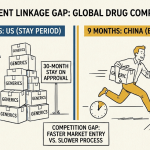
Filing a challenge within the required window triggers a nine-month stay on NMPA’s approval of the generic application, giving the patent holder a window to litigate before the generic can reach the market.[5] That compares with a 30-month stay under the US Hatch-Waxman framework, and China’s first generic exclusivity period runs 12 months against a US 180-day period.[5] If neither the court nor CNIPA rules within nine months, NMPA can approve the generic regardless of the pending dispute, which puts real pressure on both sides to move fast.[5]
The Baseline: What the System Looked Like Through 2023
632 Branded Drugs, 5,058 ANDAs, and a Registration Gap
A study published in Globalization and Health in April 2024 captured every listed patent and patent certification on the registration platform from June 25, 2021, through June 30, 2023.[4] During that window, 632 branded drugs had patents listed, and 5,058 generic applications submitted patent certifications.[4] Of the 632 branded drugs, 462, or 73.1 percent, had already been approved before their patents were registered on the platform, and the average branded drug carried just 1.8 listed patents.[4] The study’s authors flagged a specific concern: manufacturers of foreign branded drugs that had not yet entered the Chinese market needed to pay closer attention to the platform, since a drug with no China marketing history has no obvious trigger prompting its owner to register.[4]
Why Patent Challenges Stayed Rare
Of the 5,058 certifications filed in that period, 85.1 percent were Category 1, meaning the generic applicant found no relevant patent listed at all.[4] Category 3 and Category 4, the certifications that actually engage with an existing patent, accounted for only 16 percent combined.[4] Within Category 2 certifications, where applicants asserted a listed patent had lapsed, 46.4 percent involved a patent invalidation.[4] For Category 3 certifications, where a generic applicant agreed to wait out a patent’s remaining term, that remaining term had a median of 17 months, with an interquartile range of 10 to 30.75 months.[4] The study’s own conclusion was blunt: the growth of actual patent challenges was “not obvious” relative to the growth in ANDA filings connecting to the system.[4]
What the Platform Looks Like By Mid-2026
Platform Growth in Numbers
The most recent published figures, drawn from CNIPA and NMPA data cited in an August 2026 overview, show the registration platform holding 1,296 chemical drug entries, 366 biological product entries, and 434 traditional Chinese medicine entries as of July 18, 2026, a combined 2,096 registered drugs.[1] Patent declarations across those entries totaled 20,881.[1] Measured against the 632 branded drugs and 5,058 certifications the 2024 academic study found through mid-2023, the platform has grown roughly 3.3 times in registered drug entries and roughly 4.1 times in patent declarations over the following three years, though the two counts are not drawn from identical measurement windows or fully identical categorization and should be read as a directional signal of growth rather than a precise multiplier (author’s calculation from sources 4 and 1).
Case Volume: From Rare to Routine
By the end of 2025, CNIPA had accepted approximately 270 administrative patent linkage cases, and the Supreme People’s Court’s IP Tribunal had received 41 related appellate cases.[1] Separately, as of November 14, 2025, CNIPA had published 183 administrative adjudication decisions involving pharmaceutical patents.[3] Most disputes across the system have ended in reconciliation between the parties rather than proceeding to a final contested ruling, which the same source credits with avoiding large-scale post-launch infringement litigation of the kind that dominated the pre-2021 landscape.[1]
Metric
2021-2023 (academic baseline)
Mid-2026 (CNIPA/NMPA data)
Source
Registered drug entries
632 branded drugs
2,096 (1,296 chemical + 366 biological + 434 TCM)
[4] / [1]
Patent declarations/certifications
5,058 ANDA certifications
20,881 patent declarations
[4] / [1]
Category 3 + 4 (challenge) certifications
~16% combined (~809 filings)
Not separately published at declaration level
[4]
Administrative + appellate cases accepted
System pre-litigation through most of window
~270 CNIPA cases + 41 SPC appeals (cumulative through end-2025)
[1]
Published CNIPA adjudication decisions
Not yet meaningfully produced
183 (as of Nov. 14, 2025)
[3]
Drugs with a granted patent term extension
0 (PTE not yet operational)
32 (24 at the full 5-year maximum)
[1]
Drugs with granted data exclusivity
0 (regime not yet in force)
54 (19 six-year terms, 31 four-year terms)
[1] / [6]
The Ratio That Flipped: What Declining Patent Coverage Actually Means
From 1.4-Fold to 0.8-Fold
Across CNIPA’s own published case data, the ratio of China-marketed generics covered by a listed patent to those not covered fell from roughly 1.4-to-1 in the 2021-2024 window to roughly 0.8-to-1 in the 2021-2026 window, a reversal analysts attribute mainly to generic manufacturers redesigning formulations rather than litigating listed patents.[2]
This is the single most consequential shift in the data, and it is the one least likely to show up in a US-trained IP team’s mental model of the system. A patent linkage regime is built on the assumption that generic applicants will engage with listed patents, either by waiting them out or by challenging them. When the coverage ratio falls below 1, it means the more common outcome is now neither: it is design-around. Generic manufacturers are altering formulations enough to fall outside a listed patent’s claims before they ever file a Category 4 declaration.[2]
Why This Happens Without a Single Court Ruling
The same source notes that the proportion of cases voluntarily withdrawn by patent holders and marketing authorization holders has stayed essentially flat across the same period.[2] That stability, next to the falling coverage ratio, points to where the actual behavioral change is happening: not in how disputes get resolved once filed, but in whether they get filed at all. A generic applicant that can reformulate around a method-of-use or formulation patent has no reason to certify against it, challenge it, or wait for it to expire. It simply never appears in the case statistics, which is exactly why the shift is easy to miss if a team is only watching litigation and administrative-adjudication counts rather than the underlying registration-to-generic-application ratio.[2]
What This Means for Listing Strategy
For originator companies, this reframes what a “strong” China patent listing looks like. A composition-of-matter patent is comparatively hard to design around. A narrow formulation or polymorph patent, absent the kind of robust comparative efficacy data China’s examiners require for polymorph claims, is comparatively easy to.[9] If the system-wide trend is toward design-around rather than challenge, then the practical value of a listed patent increasingly depends on claim breadth and defensibility against reformulation, not merely on whether it is listed at all.
A New Parallel Track: Data Exclusivity Arrives
Six, Four, and Three-Year Terms Take Effect May 15, 2026
On January 28, 2026, NMPA announced that China’s State Council had signed a decree revising the Implementing Regulations of the Drug Administration Law, a nine-chapter, 89-article overhaul centered on a clinical-value-oriented approach to drug development, effective May 15, 2026.[6] Within that revision, the Measures for the Implementation of Drug Regulatory Data Protection established exclusive protection terms of six, four, or three years for undisclosed pharmaceutical, non-clinical, and clinical trial data, depending on drug category.[1] Generic applications that depend on that protected data cannot be approved during the protection term, and can only be submitted for review one year before the term expires.[1]
54 Drugs Protected Within Ten Weeks
As of July 18, 2026, roughly nine weeks after the regulation took effect, 54 drugs had already obtained data protection: 19 with the full six-year term and 31 with a four-year term.[1] That is a meaningfully fast uptake for a brand-new regulatory instrument, and it signals that originator companies with China-marketed innovative drugs are actively using the new mechanism rather than waiting to see how it plays out.
How Data Exclusivity Interacts With Patent Linkage
Data exclusivity is not a substitute for patent protection. It blocks a generic applicant from relying on the originator’s own trial data to support an abbreviated approval, forcing an independent bioequivalence or clinical package, but it does not by itself block a marketing application the way an unresolved Category 4 patent dispute can.[9] For a drug with a thin or easily-designed-around patent estate, data exclusivity now functions as a separate, parallel barrier to entry with its own multi-year clock, running independently of whatever happens on the patent linkage platform. Any China IP strategy built purely around patent listings is now working from an incomplete map.
Patent Term Extension Goes Mainstream
As recently as January 2026, coverage of China’s patent-term-extension system centered on a single landmark case: RemeGen’s Telitacicept, which received the system’s first full five-year extension.[9] Seven months later, that single case has become a caseload. By July 18, 2026, 32 drugs spanning chemicals, biologics, and traditional Chinese medicines had received an extension, and 24 of those, exactly three in four, secured the full five-year maximum.[1] Under the framework, extension length is calculated as the gap between a patent’s Chinese filing date and the drug’s China marketing approval date, minus five years, capped at five years of extension and a 14-year total effective term after approval.[9] A system that looked, as recently as this year, like a single proof-of-concept case is now a routine part of how China-marketed innovative drugs extract additional patent life.
Case Study: Chugai v. Wenzhou Haihe and the Nine-Month Test
The Eldecalcitol Patent and the Timeline
The first Supreme People’s Court ruling under the new patent linkage system involved Chugai Pharmaceutical, a Japanese subsidiary of the Roche Group, against Wenzhou Haihe Pharmaceutical over a generic version of Eldecalcitol Soft Capsules.[5] The relevant patent, registered on the platform on July 13, 2021, covered the innovator product.[5] Haihe filed for marketing approval of its generic along with a Category 4 declaration, triggering Chugai’s suit before the Beijing IP Court.[5] The court ruled that Haihe’s generic fell outside the scope of Chugai’s patent protection, and the Supreme People’s Court upheld that decision on August 5, 2022, dismissing Chugai’s infringement claim.[5][9]
What the Ruling Established
The case mattered less for who won than for what it proved was possible. Both instances issued rulings within the nine-month stay period, a timeline widely considered difficult for patent infringement disputes generally.[5] The presiding Beijing IP Court judge framed the linkage system’s purpose as balancing innovator interests against drug accessibility, an interpretation some analysts read as favorable to generic manufacturers, while others treated the case as proof that the nine-month framework could function as designed rather than collapsing under its own timeline.[5] Four years later, with 270-plus administrative cases and 41 Supreme People’s Court appeals on the books, the second reading has held up better than the first.[1]
Judicial vs. Administrative: Which Channel Is Actually Winning
Reconciliation, Not Rulings, Is the Dominant Outcome
The most recent available data indicates most patent linkage disputes end in reconciliation between the parties rather than a fully litigated administrative or judicial decision.[1] That pattern, combined with 183 published CNIPA administrative decisions against roughly 270 cases accepted, suggests the administrative channel is producing a meaningfully higher throughput of resolved disputes than headline case counts alone would suggest, even as a large share of those resolve through settlement rather than a contested ruling on the merits.[1][3]
Context From the Broader IP Tribunal Numbers
It is worth separating patent-linkage-specific statistics from the Supreme People’s Court IP Tribunal’s overall caseload, which covers all technical IP and monopoly appeals nationally, not only pharmaceutical patent linkage disputes. Across that broader docket, the Tribunal’s second-instance cases carried a 20.9 percent reversal rate and a 37.7 percent mediation-or-withdrawal rate, both better outcomes than the national average for civil second-instance appeals from higher courts.[1] Punitive damages were applied in 58 of the Tribunal’s cases at an average award exceeding RMB 35 million, and in the 73 cases where damages exceeded RMB 10 million, the average award was nearly RMB 72 million.[1] These figures describe the Tribunal’s general IP docket, not a pharmaceutical-linkage-specific subset, but they establish the judicial environment that any Beijing IP Court patent linkage appeal ultimately lands in.
Biologics and Traditional Chinese Medicine: Coverage Nobody Expected
When China’s patent linkage system launched in 2021, commentary at the time noted that only chemical drugs enjoyed its full benefits, with biologics and traditional Chinese medicine covered in a more limited fashion.[7] The mid-2026 platform data tells a different story about scope, if not necessarily about procedural parity: 366 biological product entries and 434 traditional Chinese medicine entries now sit alongside 1,296 chemical drug entries.[1] Biologics now account for roughly 17 percent of registered platform entries, and traditional Chinese medicine for roughly 21 percent, a meaningfully larger footprint for both categories than the system’s early “chemical-first” reputation would suggest (author’s calculation from source 1). For originator biologics companies and biosimilar developers assessing China market entry, treating the platform as a chemical-drug-only tool is now an outdated assumption, even if procedural details for how disputes over biologic and TCM patents are adjudicated may still differ in practice from the chemical-drug process.
What This Means for Brand-Side IP Teams
Four practical shifts follow from the data above.
Widen Patents, Not Just Count Them
With the coverage ratio falling below 1, a narrow formulation or polymorph patent is increasingly a paper listing rather than a functional barrier. Teams evaluating China filing strategy should weight claim breadth and design-around resistance more heavily than simple patent count per drug, which the 2021-2023 baseline already showed averaged only 1.8 patents per branded drug.[4]
Register Before Launch, Not After
The 2024 academic study’s core warning, that foreign brands without an existing China launch are systematically under-registered, has not been resolved by three years of platform growth.[4] A drug with no China marketing history generates no internal trigger to register a patent, which means the registration decision has to be made proactively rather than reactively.
Treat Data Exclusivity as a Separate Clock
With 54 drugs already covered within ten weeks of the new regulation taking effect, data exclusivity filing is not a slow-moving, theoretical option.[1] It runs on its own three-, four-, or six-year term, independent of patent status, and should be evaluated for every innovative drug entering China regardless of the strength of its patent estate.[1]
Monitor the Platform, Not Just the Docket
Because the biggest recent shift is happening in formulations that never generate a filed dispute, watching CNIPA and Beijing IP Court case dockets alone will miss it. A platform intelligence tool that tracks new generic applications and their declaration types against a company’s own listed patents, of the kind DrugPatentWatch maintains across more than 130 countries including China, gives visibility into design-around activity before it shows up as a market-share loss rather than after.[9]
What This Means for Generic and Biosimilar Filers
The same data cuts the other way for generic and biosimilar manufacturers. The falling coverage ratio suggests that reformulation, where scientifically and regulatorily feasible, is proving a more reliable path to market than litigating a Category 4 challenge, particularly given how narrow the average branded drug’s patent estate remains.[2][4] At the same time, the new data exclusivity regime adds a fixed multi-year delay that reformulation cannot avoid, since it attaches to the originator’s underlying trial data rather than to any specific patent claim.[1] A generic strategy built solely around patent design-around, without accounting for the data exclusivity term now running in parallel, risks a cleared patent landscape sitting behind a regulatory approval date that has not moved at all.
Methodology and Limitations
The figures in this article are drawn from two primary data windows. The first, covering June 25, 2021, through June 30, 2023, comes from a peer-reviewed descriptive study of China’s registration platform published in Globalization and Health in April 2024.[4] The second, covering data as of July 18, 2026, and case totals through the end of 2025, comes from CNIPA and NMPA figures cited in an August 2026 sponsored overview published by Managing Intellectual Property, authored by patent attorneys at Liu Shen & Associates.[1] A third data point, 183 published CNIPA administrative adjudication decisions as of November 14, 2025, comes from a November 2025 Lexology analysis.[3] Growth comparisons between the two primary windows, including the approximate 3.3-times growth in registered entries and 4.1-times growth in patent declarations, are original calculations derived from these two sources and are clearly not apples-to-apples in every respect: the earlier study’s “branded drugs” count and the later “chemical plus biological plus TCM entries” count may not use identical inclusion criteria, and the two windows do not cover identical time spans. They should be read as directional evidence of platform growth, not as a precise growth multiplier. Case-level detail on the roughly 270 administrative cases accepted through 2025, including how many resolved through reconciliation versus contested ruling, is not broken out by category in the available public sources, and this article does not claim a precise reconciliation rate.
Key Takeaways
China’s drug patent registration platform grew from 632 branded drugs and 5,058 patent certifications through mid-2023 to 2,096 registered drug entries and 20,881 patent declarations by July 18, 2026.[4][1]
CNIPA had accepted roughly 270 administrative patent linkage cases and published 183 administrative adjudication decisions by late 2025, with 41 related appeals reaching the Supreme People’s Court’s IP Tribunal.[1][3]
The ratio of patent-covered to non-patent-covered generics fell from roughly 1.4-fold to roughly 0.8-fold across 2021-2024 versus 2021-2026 CNIPA case data, driven mainly by generic manufacturers reformulating around listed patents.[2]
A new data exclusivity regime, offering three-, four-, or six-year protection terms, took effect May 15, 2026, and had already covered 54 drugs by mid-July 2026.[1][6]
Patent term extension grants grew from a single landmark case to 32 drugs, 24 at the full five-year maximum, within roughly six months.[1][9]
Biologics and traditional Chinese medicine now make up roughly 38 percent of registered platform entries combined, a larger footprint than the system’s chemical-drug-first reputation suggests (author’s calculation from source 1).
FAQ
What is China’s drug patent linkage system?
It is the Drug Patent Dispute Early Resolution Mechanism, established under Article 76 of China’s 2020 Patent Law amendment, which links generic drug marketing approval to the resolution of disputes over patents registered against the corresponding branded drug on a national platform.[8]
How does China’s system differ from the US Orange Book and Hatch-Waxman framework?
China applies a nine-month stay on generic approval when a patent dispute is filed, compared with 30 months in the United States, and grants 12 months of first-generic marketing exclusivity compared with 180 days under Hatch-Waxman.[5]
How many patents are currently registered on China’s patent platform?
As of July 18, 2026, the platform held 2,096 registered drug entries across chemical, biological, and traditional Chinese medicine categories, with 20,881 total patent declarations filed against them.[1]
What does the shift from 1.4-fold to 0.8-fold patent coverage actually mean?
It means that, across CNIPA’s case data, generics without a covering listed patent now outnumber those with one, a reversal attributed mainly to generic manufacturers reformulating products to fall outside a listed patent’s claims rather than challenging the patent directly.[2]
When did China’s new drug data exclusivity rules take effect?
The revised Implementing Regulations of the Drug Administration Law, which established the current data exclusivity framework, took effect May 15, 2026.[6]
How many drugs have received a patent term extension in China?
By July 18, 2026, 32 drugs had received a patent term extension, with 24 of them granted the full five-year maximum permitted under the system.[1]
What happened in the Chugai v. Wenzhou Haihe case?
It was the first Supreme People’s Court ruling under China’s patent linkage system, decided August 5, 2022, over a generic version of Eldecalcitol Soft Capsules. The court found the generic did not fall within the scope of Chugai’s registered patent and upheld the Beijing IP Court’s dismissal of the infringement claim.[5]
Do most China patent linkage disputes end in litigation or settlement?
Most disputes have ended in reconciliation between the parties rather than a fully contested ruling, according to CNIPA and NMPA data covering cases accepted through the end of 2025.[1]
Are biologics and traditional Chinese medicine covered by China’s patent linkage system?
Yes. As of July 18, 2026, the registration platform held 366 biological product entries and 434 traditional Chinese medicine entries, alongside 1,296 chemical drug entries, though the system’s procedural mechanics were initially designed with chemical drugs as the primary use case.[1][7]
Should foreign pharmaceutical companies register patents in China before launching there?
A 2024 peer-reviewed study of the system’s first two years found that brand owners without an active China launch were systematically under-registered on the platform, since no domestic marketing event triggers the registration requirement, and recommended closer attention to proactive registration.[4]
References
Mou, K., & Zou, S. (2026, August 7). A panoramic overview of China’s pharmaceutical IP protection system. Managing Intellectual Property. https://www.managingip.com/article/2gqbuus9g3tw0qdiljlds/a-panoramic-overview-of-chinas-pharmaceutical-ip-protection-system
Analysing key trends in China’s patent-linkage system and their impact on pharmaceutical patent strategies. (2026). IAM, The Guide to Life Sciences 2026. https://www.iam-media.com/guide/global-life-sciences/2026/article/analysing-key-trends-in-chinas-patent-linkage-system-and-their-impact-pharmaceutical-patent-strategies
Understanding China’s Pharmaceutical Patent Linkage System: Framework and Case Overview (Part 1). (2025, November 28). Lexology. https://www.lexology.com/library/detail.aspx?g=28e9d70f-bcd6-4ee0-9497-fa9c64e6b019
Yao, X.-F. (2024). Characteristics and outcomes of the drug patent linkage system in China. Globalization and Health, 20(1), 1-9. https://doi.org/10.1186/s12992-024-01035-x
China’s Supreme People’s Court Issued its First Patent Linkage Decision. (2022). Harvard Journal of Law & Technology, Submit to Digest. https://jolt.law.harvard.edu/digest/chinas-supreme-peoples-court-issued-first-patent-linkage-decision
China revises drug administration regulations to spur innovation, tighten oversight. (2026, January 28). Xinhua, via National Medical Products Administration. https://english.nmpa.gov.cn/2026-01/28/c_1157477.htm
Further Updates on Patent Linkage and Patent Term Extension in China. Kluwer Patent Blog, Wolters Kluwer. https://legalblogs.wolterskluwer.com/patent-blog/further-updates-on-patent-linkage-and-patent-term-extension-in-china/
Cobden, A. What China’s new patent linkage and patent term extension systems mean for foreign pharma. Hogan Lovells. https://www.hlc.com/en/publications/what-chinas-new-patent-linkage-and-pte-systems-mean-for-foreign-pharma
DrugPatentWatch. (2026, January 14). Navigating the Dragon’s Den: A Definitive Guide to China’s Drug Patent Strategy. https://www.drugpatentwatch.com/blog/navigating-the-dragons-den-a-definitive-guide-to-chinas-drug-patent-strategy/
Intro of Drug Patent Linkage System in China. (2024, October). Lifang & Partners, 6th Berkeley-Tsinghua Transnational IP Litigation Conference. https://www.law.berkeley.edu/wp-content/uploads/2024/10/Intro-of-Drug-Patent-Linkage-System-in-China_20241003_submitted-version.pdf