Business Intelligence on Biologic and Small Molecule Drugs
The Patent Trial and Appeal Board: The Definitive Analyst’s Guide to IPR Strategy, Pharmaceutical IP Valuation, Discretionary Denial Mechanics, and the Post-Arthrex Power Shift
1. Why the PTAB Is the Single Most Important Variable in Pharmaceutical Patent Valuation
Analysts who model pharmaceutical patent portfolios without tracking the Patent Trial and Appeal Board’s petition docket are working with incomplete data. The PTAB is not a peripheral legal detail; it is the primary mechanism through which the effective market exclusivity period of a pharmaceutical patent can be shortened, unpredictably and at low cost to the challenger, years before the patent’s nominal expiry date.
Consider the stakes. A composition-of-matter patent on a $5 billion drug that survives until its 2029 expiry date represents a very different NPV than the same patent invalidated at the PTAB in 2026. The delta between those two scenarios can exceed $10 billion in revenue for the patent holder. For the generic or biosimilar challenger that successfully petitioned for IPR, the same delta represents the prize available from early market entry. The PTAB is, in the most precise financial sense, a venue where billions of dollars in asset value are transferred between companies through adversarial legal proceedings resolved by administrative patent judges.
That framing matters because many IP professionals still treat the PTAB as an adjunct to ‘real’ litigation. It is not. Since the AIA’s AIA trial proceedings launched in September 2012, the PTAB has received more than 14,000 IPR petitions. Institution rates historically ran at 60-70% until new discretionary denial policies began driving them sharply downward in 2025. Once a trial is instituted, approximately 70-80% of challenged claims in final written decisions are found unpatentable. That combination produces an overall invalidity rate that dwarfs what patent challengers achieve in district court under the ‘clear and convincing evidence’ standard.
For pharma/biotech IP teams specifically, the critical distinction is that Bio/Pharma patents face materially different institution dynamics than patents from other technology categories. As of April 2025, while overall PTAB institution rates have collapsed to below 45% under new discretionary denial policies, Bio/Pharma patents are being instituted at or near 100%. The discretionary denial framework that is throttling access to the PTAB for software and mechanical patents is, so far, leaving the pharmaceutical channel essentially wide open. Every IP director managing a biologic patent thicket needs to understand why that asymmetry exists and whether it will persist.
Key Takeaways: Section 1
The PTAB is a direct determinant of pharmaceutical patent NPV, not a litigation footnote. Institution rates remain near 100% for Bio/Pharma patents even as the overall rate has fallen below 45%. The expected invalidation rate in final written decisions runs at 70-80%, producing challenger outcomes that consistently exceed what district court litigation delivers under clear and convincing evidence. Analysts and IP teams who do not track PTAB petition filings as a real-time portfolio risk signal are systematically underpricing their patent vulnerability.
2. The Pre-AIA Problem: Why Congress Needed to Build a New Court
2a. The Structural Failures of the Pre-AIA System
Before the Leahy-Smith America Invents Act of 2011 restructured U.S. patent law, the primary forum for resolving patent validity was federal district court litigation, with administrative alternatives that were largely ineffective. Inter partes reexamination existed but was slow, did not produce discovery, had no estoppel consequences comparable to those the AIA later created, and could take as long as a district court case. The result was a system in which ‘bad patents’, meaning patents that should never have been granted because they lacked genuine novelty or were obvious in light of existing knowledge, were extremely expensive to challenge and nearly as expensive to defend.
Litigating a patent case through a district court to final judgment typically cost each side $1.5 million to $5.5 million. For a pharmaceutical company facing a lawsuit based on a weak secondary formulation patent, the rational economic calculation was often to settle, regardless of the patent’s merit, rather than bear the cost and schedule risk of multi-year litigation. This dynamic was exploited systematically by Patent Assertion Entities (PAEs), which held portfolios of questionable patents and extracted nuisance settlements from operating companies. By the time Congress acted, PAEs were generating roughly 60% of all U.S. patent lawsuits. An independent estimate placed the direct cost of PAE activity at $29 billion annually, a figure that excluded the harder-to-quantify effect of deterred R&D investment.
2b. The Specific Pharmaceutical Dimension
The pharmaceutical industry’s relationship with the pre-AIA system had its own pathology. Generic drug manufacturers challenging brand patents under the Hatch-Waxman Paragraph IV framework could deploy district court litigation, but the 30-month automatic stay effectively guaranteed the brand 2.5 years of continued exclusivity even when the patent challenge was strong. The brand company had every incentive to initiate litigation upon receiving Paragraph IV notice regardless of the underlying patent quality, because the automatic stay cost nothing and delivered 30 months of market protection for free.
Secondary pharmaceutical patents, covering formulations, salt forms, and methods of use, were particularly problematic. The USPTO’s examination capacity was strained, the technical complexity of pharmaceutical claims was high, and examiner tenure with any given patent family was often limited. The result was a body of issued secondary pharmaceutical patents whose validity was uncertain but whose enforceability was presumed and whose challenge required $3 million or more in litigation cost. AbbVie’s eventual construction of a 250-patent thicket around Humira (adalimumab) was partly a rational response to an environment in which secondary patents, however questionable, were difficult and expensive to challenge.
Key Takeaways: Section 2
The pre-AIA patent system’s structural flaws were: prohibitive district court litigation costs, ineffective administrative reexamination, automatic 30-month stays that rewarded patent assertion regardless of quality, and a legal standard (clear and convincing evidence) that made challenging weak patents extremely difficult. For the pharmaceutical industry, these failures translated directly into years of extended monopoly from secondary patents that should not have survived validity scrutiny. Congress designed the AIA to correct these failures, specifically by creating a faster, cheaper, expert-staffed forum with a lower burden of proof.
3. The America Invents Act: Legislative Architecture and Core Design Choices
3a. The AIA as a System Architecture Problem
The Leahy-Smith America Invents Act, signed into law September 16, 2011, is the most comprehensive revision of U.S. patent law since the Patent Act of 1952. Its headline change, the transition from a ‘first to invent’ to a ‘first inventor to file’ priority system, aligned U.S. law with every other major patent jurisdiction in the world. But for pharmaceutical patent strategy, the AIA’s more consequential contribution was the creation of a set of post-grant trial proceedings that fundamentally altered the risk-return calculation for holding, challenging, and litigating patents.
The AIA’s architects made a series of deliberate structural choices that are worth examining individually, because they explain the PTAB’s behavior and the controversies that have surrounded it ever since.
The choice to use ‘preponderance of the evidence’ as the burden of proof, rather than the ‘clear and convincing evidence’ standard required in district court, was deliberate and consequential. Congress reasoned that because PTAB proceedings occur without the presumption of validity that attaches to patents in district court, the lower evidentiary standard was appropriate. The practical effect was to shift the odds in favor of challengers by a wide margin. In district court, a challenger who cannot prove invalidity by clear and convincing evidence loses. At the PTAB, a challenger who proves invalidity by even a slight majority of the evidence wins. This single design choice explains more of the PTAB’s invalidation statistics than any other factor.
The choice to staff PTAB with Administrative Patent Judges who possess technical credentials was equally deliberate. Congress wanted a forum where complex prior art arguments about protein folding, polymorphic crystal structures, or extended-release drug formulation mechanisms would be evaluated by judges who understood them, rather than explained to lay juries through months of expensive expert testimony. This choice has been largely successful: APJ decisions consistently demonstrate technical literacy that exceeds what most district court opinions show in pharmaceutically complex cases.
The one-year statutory deadline for final written decisions (subject to a six-month extension for good cause) was a direct response to the years-long timelines of district court patent cases. The AIA compresses the same validity question into an 18-month process from petition to final decision.
3b. First-Inventor-to-File: The Patent Priority Shift and Its IP Valuation Implications
The transition to first-inventor-to-file has IP valuation implications that pharmaceutical companies do not always account for fully. Under the first-to-invent system, a company that could establish a prior invention date, even through laboratory notebooks rather than a patent application, could survive a novelty challenge. Under first-inventor-to-file, what matters is the application filing date. This creates stronger incentives to file early and broadly, which in turn accelerates the construction of patent thickets, because each element of a potential thicket gets its own application filing date as early as possible.
For biosimilar developers seeking to challenge biologic patent thickets, the transition matters because AIA first-inventor-to-file patents are the only ones eligible for Post-Grant Review (PGR). A biologic patent filed before March 16, 2013 cannot be challenged via PGR, only via IPR. This means that for older biologics, the full arsenal of validity challenges under 35 U.S.C. sections 101 and 112 is unavailable at the PTAB. Adalimumab’s core patents were filed in the pre-AIA era, which meant AbbVie’s thicket could only be challenged via IPR, with its narrower prior art-based grounds, rather than via PGR with its broader subject matter eligibility attacks.
Key Takeaways: Section 3
The AIA’s ‘preponderance of the evidence’ standard is the single most important design choice explaining PTAB invalidation rates. It shifts the balance of proof substantially toward challengers compared to district court. The first-inventor-to-file transition accelerates patent thicket construction by incentivizing early, broad filing. Pre-AIA patents can only be challenged via IPR, not PGR, which limits the available invalidity grounds and preserves biologic patent thickets from subject matter eligibility attacks.
4. The PTAB’s Organizational Structure: Who Decides and Why That Matters
4a. Statutory Membership and Administrative Infrastructure
The PTAB is an adjudicative body within the USPTO, not a standalone court. Its statutory foundation sits in 35 U.S.C. section 6, which specifies four statutory members: the USPTO Director, the Deputy Director, the Commissioner for Patents, and the Commissioner for Trademarks. Day-to-day adjudication is performed by the Board’s corps of Administrative Patent Judges (APJs), appointed by the Secretary of Commerce. The Chief APJ and Deputy Chief APJ manage the Board’s administration. Vice Chief APJs manage divisions that are further organized into technology sections, each overseen by a Lead APJ.
The Board’s operational support infrastructure, including its case management systems, docketing operations, IT, and hearing coordination, sits in a dedicated Board Operations Division. For parties practicing before the PTAB, understanding this administrative structure matters because resource constraints at the Board level are now, explicitly, a factor in the new discretionary denial framework. The USPTO Director can deny an IPR petition partly on the grounds that the Board lacks the capacity to handle it, a consideration that was never previously part of the institution calculus.
4b. APJ Qualifications and Composition
APJs must hold legal credentials and technical expertise as a matter of statutory requirement. In practice, the APJ corps is heavily drawn from patent attorneys with prior experience in private patent prosecution or litigation, in-house IP roles at technology or life sciences companies, the Department of Justice, or other government IP bodies. Many APJs have advanced science degrees. The USPTO structures the corps into technology sections to allow APJs to develop and maintain expertise in particular fields, matching judges to cases in their area of technical background.
This specialization produces measurable quality differences compared to generalist federal district court adjudication. A PTAB panel assigned to a case involving polymorph crystallography or protein glycosylation patterns will typically include APJs with organic chemistry or biochemistry backgrounds. The expert quality of the tribunal is, from the standpoint of patent validity analysis, the PTAB’s most consistent structural advantage over district court.
4c. The Three-Judge Panel System and Its Strategic Implications
Most PTAB trials are decided by a three-judge panel. Panels are assigned by the Chief APJ and can be expanded to five judges for precedential decisions or cases of particular importance. The three-judge system means that outcomes are not produced by a single decision-maker with idiosyncratic views. Dissents at the PTAB are uncommon but do occur, and patterns in panel compositions, such as whether particular APJs are consistent in their approach to obviousness combinations or claim construction, can be informative for experienced PTAB practitioners.
Parties cannot select their panel, and the internal assignment process is not public. However, the PTAB does publish its precedential and informative decisions, which collectively define the current state of Board practice on recurring procedural and substantive questions. Monitoring these opinions for shifts in how the Board treats claim construction disputes, motivation to combine analyses, or secondary considerations of non-obviousness is part of the continuous intelligence gathering that sophisticated PTAB practitioners perform.
Key Takeaways: Section 4
PTAB organizational structure matters to IP teams because APJ specialization by technology area means pharmaceutical and biologic patents are evaluated by judges with relevant scientific credentials, producing more technically literate decisions than district court. The three-judge panel system produces more consistent outcomes than single-judge decisions. The USPTO Director’s new discretionary denial framework explicitly incorporates Board workload as a denial factor, meaning PTAB docket pressure can now be a strategic element in petition timing.
5. The Constitutional Crisis and Its Resolution: Arthrex, APJ Status, and Director Review
5a. The Appointments Clause Challenge
The constitutional challenge that ultimately reshaped PTAB governance arose from a straightforward structural observation. APJs issue final written decisions on behalf of the executive branch, decisions that invalidate patents, which are government-granted property rights, and that cannot be reviewed by any presidentially appointed superior within the agency. Under the Constitution’s Appointments Clause (Article II, section 2, clause 2), officers who exercise that kind of authority are ‘Principal Officers’ who must be appointed by the President with Senate confirmation. APJs are appointed by the Secretary of Commerce, a permissible method only for ‘Inferior Officers’ whose decisions are subject to supervision by a Principal Officer.
In United States v. Arthrex, Inc. (2021), the Supreme Court accepted this analysis. A majority of the Court held that the statutory framework, which insulated APJ decisions from review by the USPTO Director, made APJs effectively Principal Officers despite their appointment by the Secretary of Commerce.
5b. The Remedy and Its Long-Term Consequences
The Court fashioned a narrow remedy. Rather than invalidating the PTAB’s authority wholesale, which would have disrupted tens of thousands of concluded and pending proceedings, the Court severed the statutory provision insulating APJ decisions from Director review. The remedy held that the USPTO Director must have authority to review any PTAB final written decision and, if warranted, to vacate or modify it. This created what the USPTO now calls ‘Director Review’, a discretionary mechanism by which the Director can take up any PTAB decision for review on his or her own initiative or upon a party’s request.
The Arthrex remedy solved the constitutional problem but created a different one. Before the decision, the PTAB operated as a largely independent administrative tribunal. Its decisions were appealable only to the Federal Circuit. The Director could influence the PTAB through rulemaking and guidance but could not directly override individual case outcomes. After Arthrex, the Director can. And because the USPTO Director is a presidential appointee who serves the priorities of the administration in office, placing final adjudicative authority in the Director’s hands introduces a channel through which policy considerations can enter what were previously technical patent validity determinations.
5c. Director Review in Practice: Policy Power Dressed as Adjudication
The Arthrex remedy was barely a year old before its implications became concrete. Several Director Review proceedings drew attention to the fact that the Director was not just correcting APJ errors, as the Court had contemplated, but using Director Review authority to establish new precedent and shift PTAB policy on recurring issues. The discretionary denial framework introduced in 2025, which will be discussed in detail in Section 16, was formally implemented through USPTO guidance rather than through Director Review itself. But the authority underlying the new framework, the Director’s ability to directly shape what petitions the PTAB will and will not institute, flows directly from the post-Arthrex understanding that the Director is the ultimate decision-maker for all PTAB outcomes.
For pharmaceutical IP teams and their investors, the Arthrex decision introduced a risk that did not previously exist: the risk that the outcome of a specific high-stakes PTAB proceeding could be influenced by the policy priorities of a given administration, not just by the technical merits of the patent claims. An administration focused on reducing pharmaceutical drug prices through patent challenge facilitation could use Director Review to lower the bar for IPR institution for pharmaceutical patents, or to overturn PTAB decisions that upheld pharma patents on discretionary grounds. An administration focused on strengthening property rights could do the opposite. The PTAB is no longer purely a technocratic forum.
Investment Strategy: Arthrex and Political Risk Pricing
Investors in pharmaceutical companies with major patent cliffs should price in a new layer of political risk that postdates Arthrex. A biologic patent thicket that survived several years of IPR challenges under one administration’s PTAB policy may be more vulnerable under a Director whose discretionary denial framework is calibrated differently. This is not speculation; the 2025 bifurcated institution process specifically introduces ‘compelling economic, public health, or national security interests’ as factors that can drive a discretionary grant of institution even where the standard procedural analysis would support denial. That factor can cut both ways: an administration focused on drug access could cite public health interests to grant institution of pharmaceutical IPRs over procedural objections.
Key Takeaways: Section 5
Arthrex resolved an Appointments Clause violation by vesting Director Review authority in the USPTO Director, creating a mechanism by which a political appointee can directly review and reverse individual PTAB outcomes. Before Arthrex, the PTAB was a largely insulated administrative tribunal. After it, the Director holds final adjudicative authority over all PTAB decisions. The 2025 discretionary denial framework is the clearest expression yet of Director-level policy control over PTAB access. Pharmaceutical patent valuations must now incorporate administration-specific PTAB policy risk as a distinct variable.
6. Ex Parte Appeals: Volume Function, Strategic Use, and What the Data Show
Ex parte appeals constitute the largest portion of the PTAB’s docket by case count, far exceeding AIA trial proceedings. An applicant whose patent claims have been rejected twice by a patent examiner, or who has received a final rejection, can appeal the examiner’s decision to a three-judge PTAB panel. The appeal proceeds through a Notice of Appeal, an Appeal Brief, the Examiner’s Answer, an optional Reply Brief, and an optional oral hearing. The panel issues a decision affirming the rejections, reversing them, or remanding with instructions.
The ex parte appeal function matters to pharmaceutical companies in ways that get insufficient attention. First, it is the internal quality-control mechanism for the patent prosecution process. A biologic company prosecuting a complex antibody patent family through the USPTO is not simply generating intellectual property; it is building a legal record that will be scrutinized in any subsequent IPR. The arguments made before the examiner, the claim amendments filed in response to rejections, and the reasoning offered in an Appeal Brief all become part of the file history that adverse parties will use in IPR proceedings to argue prosecution history estoppel or to understand the scope of the claims. Appeal Brief arguments that distinguish prior art too broadly, or amendments that narrow claims more than necessary to overcome an examiner rejection, can create vulnerability that only manifests years later at the PTAB.
Second, the ex parte appeal data signal something about prosecution trends in specific technology areas. When PTAB reversal rates in particular technical categories increase, it often reflects a mismatch between examiner rejections and the current state of the law on patentability standards such as written description adequacy or obviousness. For pharmaceutical companies monitoring the prosecution environment for their competitors’ applications, unusual patterns in ex parte appeal outcomes in particular IPC subclasses (antibody engineering, for instance, or nucleic acid delivery systems) can be informative about what examiner units are allowing versus rejecting.
Key Takeaways: Section 6
Ex parte appeals generate a prosecution record that becomes evidence in subsequent IPR proceedings. Overly broad distinctions made in Appeal Briefs to overcome examiner rejections create prosecution history estoppel risks that constrain claim scope interpretation in later litigation. Reversal rate trends in ex parte appeals by technology category provide early intelligence on prosecution difficulty in specific technical areas.
7. Inter Partes Review: Complete Mechanics, Timeline, and Decision Standards
7a. Who Can File and the Critical Bars
Inter Partes Review is available to any person who is not the patent owner. The statute imposes two threshold bars that represent the primary gatekeeping constraints at the filing stage. The one-year time bar under 35 U.S.C. section 315(b) prohibits filing an IPR petition more than one year after the petitioner, its real party in interest (RPI), or a privy was served with a complaint alleging infringement of the challenged patent. ‘Real party in interest’ and ‘privy’ are terms that have generated substantial litigation at the PTAB. If a petitioner has an undisclosed RPI that was served with an infringement complaint more than one year earlier, the petition is time-barred, and the PTAB can dismiss proceedings that have already been instituted if this bar is later discovered.
For pharmaceutical companies, the RPI and privy questions have practical importance in situations involving generic drug licensing, co-development agreements, and trade association activities. A generic company that is a member of a trade association that filed an amicus brief challenging a patent, or that has a co-development agreement with a company already in Hatch-Waxman litigation, may have privity issues that affect its IPR eligibility window.
The estoppel bar under 35 U.S.C. section 315(e) operates prospectively: once an IPR proceeding concludes with a final written decision, the petitioner and its privies are estopped from challenging the patent on any ground that was raised or reasonably could have been raised in that proceeding. This estoppel, discussed at length in Section 9, is the strongest reason why IPR petitions must be drafted with exhaustive prior art searches, because arguments not made in the petition are potentially forfeited forever.
7b. The Petition: Structure, Evidentiary Requirements, and Strategic Considerations
An IPR petition is not a brief statement of invalidity concerns. It is a comprehensive pleading that must identify every challenged claim, the specific statutory grounds of invalidity for each claim (anticipation under section 102 or obviousness under section 103), and the specific prior art references relied upon for each ground. The petition must include claim charts mapping the prior art to every element of every challenged claim, and it must be supported by a declaration from a qualified technical expert.
The completeness requirement is not merely formal. Under the all-or-nothing rule established by SAS Institute v. Iancu (2018), if the PTAB institutes an IPR, it must issue a final written decision on every claim challenged in the petition. If the petition challenges 15 claims on four grounds, the final written decision must address all 15 claims on all four grounds. There is no more partial institution. This means that including a weak ground or a thinly challenged claim in the petition produces a final written decision finding that claim patentable, which both looks bad and creates estoppel consequences for that ground as to that claim.
Sophisticated petitioners draft IPR petitions with the estoppel consequences in mind from the first page. The goal is not just to challenge the patent effectively but to avoid creating binding precedent that constrains future challenges or parallel district court positions. The question ‘what grounds should we not raise in this IPR so that we can raise them in district court?’ is one of the most consequential strategic questions in dual-forum pharmaceutical patent litigation.
7c. The IPR Timeline: Phase-by-Phase Analysis
An IPR runs on a statutory clock. The PTAB must issue its institution decision within three months of the Patent Owner Preliminary Response deadline (which falls three months after petition filing), and it must issue a final written decision within 12 months of institution, with a possible six-month extension. Total elapsed time from petition filing to final written decision runs approximately 18 months.
The pre-institution phase is the patent owner’s best opportunity to kill the proceeding before it starts. The Patent Owner Preliminary Response (POPR) is not just a formality; in a well-run PTAB practice, the POPR is a carefully constructed document designed to demonstrate to the panel that the petition fails the ‘reasonable likelihood’ threshold, that prior art cited in the petition is not actually applicable, or that the petition should be denied on discretionary grounds. The 2025 bifurcated discretionary review process means that a POPR should now address the discretionary denial factors explicitly, before addressing the technical merits of the petition, because a discretionary denial terminates the proceeding without reaching the merits.
After institution, the trial phase opens with the Patent Owner Response, which is the patent owner’s first full opportunity to rebut the petition on the merits with its own expert declarations and prior art analysis. The patent owner can also file a Motion to Amend (MTA) to propose substitute claims that overcome the cited prior art. The petitioner replies to the Patent Owner Response, the patent owner may file a sur-reply, and the proceeding concludes with an oral hearing before the three-judge panel. The final written decision issues within 12 months of institution.
IPR Proceeding Timeline Table
Phase
Event
Approximate Timing
Pre-Institution
Petition Filed
Day 0
Pre-Institution
Patent Owner Preliminary Response Due
~3 months post-filing
Pre-Institution
Institution Decision Issued
~6 months post-filing
Trial
Patent Owner Response + Motion to Amend Due
~9 months post-filing
Trial
Petitioner Reply Due
~12 months post-filing
Trial
Patent Owner Sur-Reply Due
~13 months post-filing
Trial
Oral Hearing
~16 months post-filing
Trial
Final Written Decision
~18 months post-filing
7d. Grounds for Challenge and Burden of Proof
IPR is limited to invalidity challenges based on anticipation (35 U.S.C. section 102) and obviousness (35 U.S.C. section 103), using only prior art in the form of patents and printed publications. Grounds not available in IPR include: lack of patentable subject matter under section 101, indefiniteness under section 112(b), lack of written description under section 112(a), enablement failures, and prior public use or sale. These broader invalidity theories remain available in PGR (for qualifying patents) and in district court litigation.
The institution threshold is ‘reasonable likelihood’ that the petitioner will prevail on at least one challenged claim. Once the PTAB institutes, the burden shifts: the petitioner must prove unpatentability by a preponderance of the evidence. The patent owner bears no burden to prove patentability; the preponderance burden rests entirely on the petitioner. However, in practice, patent owners who fail to file substantive expert evidence in response to a credible petition rarely prevail.
Key Takeaways: Section 7
The one-year time bar and the RPI/privy analysis are threshold traps that require careful due diligence before filing, especially in pharma licensing and co-development contexts. Petition completeness directly determines estoppel scope, making the decision about which grounds to include or exclude one of the most consequential strategic choices in the proceeding. The POPR is underutilized as a tool to seek discretionary denial under the 2025 bifurcated framework before the merits are even reached. The preponderance of evidence standard, applied by APJs with technical credentials and no validity presumption, is the primary engine of the PTAB’s high invalidation rates.
8. IPR Institution Decision: The Gatekeeping Function and Its New Constraints
8a. The ‘Reasonable Likelihood’ Standard and Its Practical Application
The institution decision is the PTAB’s threshold determination that a petition is worth a full trial. The ‘reasonable likelihood’ standard requires that the petition, on its face, makes a credible showing that at least one challenged claim is likely unpatentable. Historically, the PTAB granted institution in roughly 60-70% of petitions that proceeded to a decision. That historical rate now means nothing for purposes of planning current proceedings, because the new discretionary denial framework has severed the relationship between petition quality and institution probability for many technology categories.
For Bio/Pharma petitions, the institution rate remained near 100% as of April 2025. This exceptional figure reflects two realities. First, IPR petitions in the pharmaceutical space are typically filed by sophisticated legal teams with strong prior art and expert support; weak petitions are less common in a space where the cost and strategic stakes are higher. Second, and critically, the discretionary denial factors that are driving down institution rates in software and mechanical patents do not apply as forcefully to pharmaceutical patents because parallel Hatch-Waxman district court litigation, the primary trigger for Fintiv-based discretionary denial, involves different timing dynamics than commercial patent litigation. A Paragraph IV case filed on a biologic patent may be years away from trial, which weakens the Fintiv argument that a nearby district court trial date warrants deferring to the court forum.
8b. Partial Institution Eliminated: SAS Institute and Its Consequences
Before the Supreme Court’s 2018 decision in SAS Institute Inc. v. Iancu, the PTAB frequently practiced ‘partial institution,’ in which it would institute trial on some of the challenged claims while declining to institute on others. The PTAB justified this as a resource management tool: focus the trial on the strongest challenges, avoid wasting resources on weaker claims. The Supreme Court held that this practice was unlawful. The AIA requires the PTAB to address every claim challenged in the petition, so if it institutes at all, it must issue a final written decision on all challenged claims.
The practical consequence for petitioners was immediate and significant. A petition that previously might have received a partial institution on its strongest grounds must now receive a decision on all grounds, including its weaker arguments. Where the pre-SAS PTAB might have quietly declined to institute on a thin obviousness combination and focused the trial on the two claims with the most compelling prior art, the post-SAS PTAB must address the thin combination in its final written decision. The weaker arguments that get aired and rejected in a final written decision generate estoppel on those grounds, which creates strategic disadvantages in parallel district court proceedings.
The SAS rule has also changed patent owner strategy. Under partial institution, a patent owner facing an instituted trial had a narrowed set of claims to defend. Under the current all-or-nothing framework, institution means the patent owner must defend every challenged claim in full, which increases the cost and complexity of the trial phase.
Key Takeaways: Section 8
The Bio/Pharma institution rate’s divergence from the overall rate (near 100% vs. below 45% as of April 2025) is the most strategically important current statistical fact at the PTAB. It means pharmaceutical patent challengers retain essentially unimpeded access to IPR while challengers in other technology sectors face escalating discretionary denial barriers. The elimination of partial institution under SAS Institute forces full litigation of all petition grounds, which increases both the estoppel risk for weak arguments and the cost of patent owner defense.
9. IPR Estoppel: The Highest-Stakes Trap in Patent Litigation
9a. The Statutory Scope of Estoppel
The estoppel provision in 35 U.S.C. section 315(e) is among the most consequential statutory terms in the AIA. It reads: if an IPR results in a final written decision, the petitioner, its RPI, and its privies may not subsequently assert in any forum, including the USPTO, a district court, or the International Trade Commission, that a challenged claim is unpatentable on any ground that was raised or ‘reasonably could have been raised’ during the proceeding.
‘Raised or reasonably could have been raised’ has been interpreted broadly by most courts. The dominant interpretation is that any prior art reference that could have been found by a skilled patent attorney exercising reasonable diligence was ‘reasonably could have been raised,’ even if it was not actually found or cited. This means a petitioner who files an IPR petition on the basis of three prior art references and loses is typically estopped from raising a fourth prior art reference in district court litigation on the same claims, if that fourth reference was in the prior art literature and discoverable at the time of the IPR.
The implications for pharmaceutical patent litigation strategy are severe. A generic company that files an IPR against a biologic patent’s formulation claims, loses, and then faces an infringement suit in district court, cannot raise the prior art arguments it failed to raise in the IPR. If the prior art is strong enough to be invalidating, the company needed to bring it at the PTAB when it had the chance.
9b. Strategic Estoppel Planning: What to File and What to Hold Back
Because IPR grounds are limited to section 102 and section 103 arguments based on patents and printed publications, the estoppel under section 315(e) for an IPR is correspondingly limited. A petitioner who loses an IPR is not estopped from raising section 101 subject matter eligibility arguments in district court, because those arguments could not have been raised in the IPR. The same applies to section 112 written description and enablement challenges, prior public use or sale, inequitable conduct, and other invalidity and unenforceability defenses that are outside IPR’s scope.
This creates a deliberate, structured allocation of invalidity arguments across forums. In the IPR, deploy the best prior art anticipation and obviousness arguments with exhaustive prior art searches, knowing that failure to raise a prior art argument creates district court estoppel. In district court, reserve section 101, section 112, prior use, and inequitable conduct challenges, because these are unavailable at the PTAB and therefore not subject to IPR estoppel. A well-designed dual-forum litigation strategy maps each invalidity theory to its optimal forum from the outset.
9c. Estoppel and the BPCIA ‘Patent Dance’ for Biosimilars
For biosimilar manufacturers challenging biologic patents under the Biologics Price Competition and Innovation Act (BPCIA) framework, estoppel management is particularly complex. The BPCIA’s ‘patent dance’ requires the biosimilar applicant to produce its manufacturing process information, which the reference product sponsor then uses to identify patents it believes are infringed. The parties exchange lists of identified patents and proposed invalidity contentions. This exchange creates a detailed record of which patents the biosimilar applicant has identified and what invalidity theories it has proposed.
If the biosimilar applicant subsequently files IPRs against some of the identified patents and those IPRs conclude with final written decisions, the estoppel attaches to the patents at issue. For the biologic patents not challenged via IPR, the BPCIA patent dance contentions effectively signal what invalidity theories are in play, creating a strategic preview of what the district court litigation will look like. Coordinating between the BPCIA patent dance contentions, the IPR petition arguments, and the district court invalidity contentions requires tight integration between the biosimilar developer’s PTAB counsel and its district court counsel. Failure to maintain that integration produces estoppel traps that close off district court defenses.
Investment Strategy: Estoppel as Due Diligence Item
In M&A due diligence for pharmaceutical and biotech companies, PTAB estoppel status is a material asset and liability question that belongs in every IP due diligence checklist. A target company whose key composition-of-matter patent survived an IPR final written decision is more valuable than the nominal patent term suggests, because the challenger is now estopped from raising those prior art arguments in district court. Conversely, a target company that filed IPRs against competitor patents and lost is carrying estoppel liabilities that limit its district court defenses against those same patents. Neither of these dynamics appears on a standard patent term expiry table; both can be found in PTAB case records and should be priced into acquisition valuations.
Key Takeaways: Section 9
Section 315(e) estoppel is among the most severe legal consequences in patent litigation. A lost IPR bars the petitioner from raising any prior art argument that was or reasonably could have been raised, in any forum, against any challenged claim that received a final written decision. The estoppel does not extend to section 101, section 112, prior use, or inequitable conduct arguments, which creates a structured basis for allocating invalidity theories between IPR and district court. BPCIA patent dance contentions and IPR petition arguments must be coordinated or estoppel traps will close off district court defenses. Estoppel status belongs in pharmaceutical M&A due diligence analyses.
10. Post-Grant Review: The Nine-Month Vulnerability Window That Most Companies Miss
10a. PGR as the Broadest Challenge Vehicle
Post-Grant Review allows a petitioner to challenge any ground of invalidity except the best mode requirement. This includes anticipation, obviousness, subject matter eligibility under section 101, written description, enablement, and indefiniteness. No other forum provides this breadth in a single proceeding. The tradeoff is the filing window: a PGR petition must be filed within nine months of the patent’s grant or reissuance. Miss that window and the broader PGR grounds are permanently unavailable; the challenger is limited to IPR’s prior art-only scope.
This nine-month window is commercially critical for biological drug patents for a specific reason. Many biologic patent thickets include continuation patents that issue years after the original applications were filed. When a continuation covering a specific formulation or manufacturing process issues, the nine-month PGR window opens. If the challenger files a PGR petition within that window, it can challenge the continuation on section 101 grounds (is the claimed process genuinely patent-eligible?), section 112 grounds (does the specification adequately describe and enable the claimed invention?), and prior art grounds simultaneously. This combined attack is frequently more powerful than the prior art-only IPR that would be the only option after nine months.
The relatively low volume of PGR filings compared to IPR filings, routinely fewer than 30 to 40 PGR petitions per year versus more than 1,200 IPR petitions, likely reflects the narrow timing window combined with the fact that most PGR-eligible patents are less than nine months old and therefore have not yet generated the commercial activity that motivates challenger investment. For pharmaceutical patents, where the commercial significance may not be clear until a drug reaches regulatory approval years after the patent issued, the nine-month window often closes before the patent’s relevance is apparent.
10b. PGR Estoppel: The Broader Risk
PGR estoppel tracks the same ‘raised or reasonably could have been raised’ language as IPR estoppel, but because PGR allows any ground of invalidity, the estoppel is correspondingly broader. A petitioner who files a PGR and loses is potentially estopped from raising section 101, section 112, prior art, and other invalidity arguments in subsequent district court proceedings. This is a substantially larger estoppel exposure than an IPR, and it explains why PGR filers must be even more thorough than IPR filers in surfacing all available invalidity arguments before filing.
For pharmaceutical company IP teams monitoring competitor patent portfolios, the nine-month PGR window represents both a threat and a tool. When a competitor’s continuation or divisional patent issues, the IP team should immediately assess whether a PGR petition makes strategic sense. The broader grounds available, particularly section 112 written description challenges for biologics claiming structural features that may not be fully described in the specification, can be more powerful than the prior art challenges available in IPR.
10c. The Institutional Implication: Why PGR Rates Are Low
The low PGR filing rate is partly explained by timing constraints, but it also reflects the fact that PGR petitioners face a higher institution threshold than IPR petitioners. PGR requires a showing that it is ‘more likely than not’ that at least one claim is unpatentable, a higher bar than IPR’s ‘reasonable likelihood’ standard. This asymmetry is logical given PGR’s broader scope, but it means that a challenger who can credibly argue invalidity on section 101 or section 112 grounds must still clear this higher threshold to get a trial started.
Key Takeaways: Section 10
PGR permits invalidity challenges on any statutory ground except best mode, making it the most powerful patent challenge vehicle in the PTAB’s toolkit. The nine-month filing window regularly closes before a pharmaceutical patent’s commercial significance becomes clear, which is the primary reason the PGR route is underutilized. PGR estoppel is broader than IPR estoppel, covering any invalidity ground that was or could have been raised, which requires exhaustive pre-filing analysis. Pharma IP teams should implement systematic monitoring of competitor patent issuances to identify PGR windows for continuation patents that add coverage to existing biologic thickets.
11. PTAB vs. District Court: A Head-to-Head Forum Analysis for Pharmaceutical Litigants
11a. The Fundamental Asymmetry: Burden of Proof
The most consequential structural difference between the PTAB and district court is the burden of proof for invalidity. In district court, an issued U.S. patent is presumed valid, and the challenger must overcome this presumption by clear and convincing evidence, the highest standard in U.S. civil litigation. This standard requires the challenger to produce evidence that leaves no serious doubt about invalidity. At the PTAB, there is no presumption of validity. The challenger proves unpatentability by preponderance of the evidence, meaning that it is more likely than not that the claim is invalid. These are not minor procedural distinctions; they are the primary reason the same prior art that fails to invalidate a patent in district court frequently succeeds at the PTAB.
For pharmaceutical companies, this asymmetry has a direct NPV implication. A composition-of-matter patent that a generic manufacturer has challenged in district court and failed to invalidate under the clear and convincing standard may still be vulnerable to an IPR that applies preponderance of evidence. The PTAB can, and frequently does, reach different validity conclusions than district courts on the same prior art, applying the lower standard to the same technical record.
11b. Decision-Maker Quality: APJs vs. Juries
PTAB trials are decided by a three-judge panel of APJs with legal and technical credentials. District court trials on patent validity are decided by lay juries, advised by a single judge who may or may not have significant patent law experience, on the basis of expert testimony presented over weeks of trial. The jury system has structural advantages for patent owners in some cases: a credible narrative of invention, a sympathetic inventor, a story of pioneering research against a well-funded generic competitor. These advantages do not translate to the PTAB.
At the PTAB, APJs read the technical record themselves, evaluate expert declarations directly, and apply their own technical knowledge to assess whether a prior art combination would have been obvious to a person of ordinary skill in the field. The ‘story of invention’ that plays well before a jury is irrelevant to an APJ analyzing whether a formulation patent’s claims were obvious in light of two prior art publications. Patent owners who have successfully defended patents at trial before juries, based largely on narrative and witness credibility, face a qualitatively different challenge at the PTAB.
11c. Scope of Issues and the Coordination Problem
District court handles the full range of patent dispute issues: validity, infringement, damages (including reasonable royalty and lost profits calculations), willfulness, injunctive relief, and equitable defenses including inequitable conduct. The PTAB addresses validity only. This scope difference creates a coordination problem that is one of the central challenges in modern pharmaceutical patent litigation.
A generic company facing a Paragraph IV infringement lawsuit in district court that simultaneously files an IPR must maintain consistent positions across both forums. If the company argues in its IPR petition that a claim term has a particular meaning for purposes of mapping the prior art to the claim elements, and then argues in its district court infringement defense that the same claim term has a different meaning to support a non-infringement position, it will face severe credibility problems in both forums. The 2018 alignment of the PTAB’s claim construction standard with the Phillips standard used in district courts reduced (but did not eliminate) the risk of inconsistent constructions across forums, because the same standard applies in both venues.
11d. Cost and Timeline Differential
A PTAB trial costs each side $350,000 to $700,000 or more on average, with the most complex biologic patent cases running higher. A district court patent case to final judgment costs $1.5 million to $5.5 million per side, with the most complex cases substantially exceeding that range. The timeline differential is similarly stark: an IPR concludes with a final written decision in approximately 18 months from petition filing. A district court patent case typically runs two to five years from complaint filing to trial verdict.
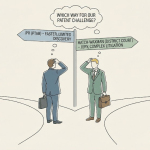
For pharmaceutical defendants in Paragraph IV litigation, the economic logic of a parallel IPR is compelling even apart from the substantive validity advantage. Filing an IPR and seeking a stay of district court proceedings pending the PTAB outcome allows the defendant to potentially resolve the validity question in 18 months for $400,000 to $700,000 rather than in three to five years for $3 million to $5 million. The stay is not guaranteed, and district courts use varying frameworks to evaluate stay requests. But when the PTAB agrees to institute the IPR, the prospect of imminent final written decision on validity provides a strong argument for a stay.
The preponderance of evidence standard at the PTAB vs. clear and convincing evidence in district court is the dominant forum advantage for patent challengers. The same prior art that fails in district court routinely succeeds at the PTAB. APJ technical credentials eliminate the narrative advantages that patent owners enjoy before lay juries. The 70-80% claim cancellation rate in final written decisions is a direct product of these structural advantages. Parallel PTAB and district court proceedings require rigorous coordination of claim construction positions and invalidity theory allocation to avoid estoppel traps and credibility problems.
12. The Supreme Court and the PTAB: Five Cases That Reshaped the Board
The PTAB has generated more Supreme Court patent law than any other development since the AIA’s passage. Five decisions, each addressing a different structural element of the Board’s authority and procedure, collectively define the institution as it exists today.
12a. Cuozzo Speed Technologies v. Lee (2016)
Cuozzo established two durable holdings. First, the PTAB’s decision to institute an AIA trial is ‘final and nonappealable.’ This insulated the Board’s threshold gatekeeping function from judicial review, meaning that if the PTAB grants institution incorrectly (or denies institution incorrectly), the Federal Circuit cannot correct it. The practical consequence is that the institution decision is the most important decision in an IPR proceeding, because errors in it cannot be appealed. Second, the Court affirmed the PTAB’s then-current use of the Broadest Reasonable Interpretation standard for claim construction. The USPTO subsequently abandoned BRI in favor of the Phillips standard in 2018, but the principle that the PTAB has authority to adopt different procedural rules from district courts, within the limits of the statute, was established by Cuozzo.
12b. Oil States Energy Services v. Greene’s Energy Group (2018)
Oil States addressed the most existential challenge to the PTAB’s legitimacy: the argument that invalidating an issued patent through an administrative proceeding, rather than through Article III court adjudication, was unconstitutional. The Court rejected this challenge with an 7-2 majority. The key holding was that the grant of a patent is a ‘public right’ or ‘public franchise,’ not a private property right in the constitutional sense. Because Congress granted the right, Congress can authorize an administrative body to reconsider and cancel it without violating Article III or the Seventh Amendment. Oil States settled the question of whether the PTAB exists constitutionally. It does.
12c. SAS Institute Inc. v. Iancu (2018)
SAS Institute addressed the PTAB’s practice of ‘partial institution,’ by which it would grant a trial on some challenged claims while declining to address others. The Court held, 5-4, that the AIA’s statutory language requires the PTAB to issue a final written decision on every claim challenged in the petition when it institutes a trial. The practical effect was the elimination of the PTAB’s resource-management tool for handling overbroad petitions and the imposition of the all-or-nothing institution rule described in Section 8b above.
12d. Thryv Inc. v. Click-to-Call Technologies (2020)
Thryv extended Cuozzo’s nonappealability holding to cover the PTAB’s determination of whether a petition was filed within the one-year time bar of section 315(b). The Court held that because the time bar determination is part of the institution decision, and the institution decision is unreviewable, the PTAB’s conclusion about whether the petition was timely is also unreviewable by the Federal Circuit. This matters in pharmaceutical cases because time bar disputes (involving RPI and privity questions in Paragraph IV litigation contexts) are resolved by the PTAB itself without recourse to external judicial correction.
12e. United States v. Arthrex Inc. (2021)
Arthrex has already been analyzed in detail in Section 5. The key constitutional holding was that APJs wielding unreviewable final adjudicative authority were acting as Principal Officers, making their appointment by the Secretary of Commerce unconstitutional. The remedy, Director Review authority, transformed the PTAB’s power structure in ways that continue to unfold.
Supreme Court PTAB Cases: Reference Table
Case
Year
Core Holding
Operational Impact
Cuozzo v. Lee
2016
Institution decision is final and nonappealable; PTAB claim construction rules upheld
PTAB gatekeeping insulated from judicial correction; standard-setting authority confirmed
Oil States v. Greene’s Energy
2018
IPR is constitutional; patents are public rights subject to administrative revocation
PTAB’s fundamental legitimacy confirmed; ended existential constitutional challenge
SAS Institute v. Iancu
2018
PTAB must issue final decision on all challenged claims when it institutes
Eliminated partial institution; petitioners must litigate all claims; stronger estoppel exposure
Thryv v. Click-to-Call
2020
Section 315(b) time bar determinations are nonappealable institution decisions
PTAB’s threshold RPI/privity rulings are final; no Federal Circuit correction available
U.S. v. Arthrex
2021
APJ appointment unconstitutional; remedy is Director Review authority
Director can review/modify any FWD; political risk introduced into adjudicative outcomes
Key Takeaways: Section 12
Five Supreme Court decisions have progressively confirmed the PTAB’s constitutional legitimacy while simultaneously concentrating power in the USPTO Director and insulating threshold decisions from judicial review. The combination of nonappealable institution decisions (Cuozzo, Thryv) and Director Review authority (Arthrex) means the PTAB’s gatekeeping and final adjudicative decisions are both controlled by the Director, with limited Federal Circuit correction available at either end.
13. Pharmaceutical Patent IP Valuation Under PTAB Risk: A Quantitative Framework
13a. The PTAB Discount Factor
Standard pharmaceutical patent valuation models use a discounted cash flow framework with the LOE date as the terminal exclusivity date. The PTAB introduces a probability-weighted scenario tree that bifurcates the expected value of the patent between two paths: the ‘PTAB challenge absent’ path, in which the patent proceeds to its nominal expiry, and the ‘PTAB challenge present’ path, in which the patent faces institution and a final written decision before its nominal expiry.
The PTAB discount factor has three components: the probability that a petition is filed (a function of market size, patent visibility, and the existence of Paragraph IV challengers); the probability that the petition is instituted (historically 60-70% overall, currently near 100% for Bio/Pharma under the new regime); and the probability that the patent’s claims are cancelled in the final written decision if instituted (approximately 70-80% based on published FWD statistics).
For a pharmaceutical patent with $3 billion in annual revenue and a nominal expiry in 2030, the PTAB-adjusted NPV calculation is substantially different from a naive NPV based on the nominal expiry date. Using a 75% institution probability for Bio/Pharma, a 75% claim cancellation rate in FWDs, and assuming that a successful IPR accelerates LOE by four years (from 2030 to 2026), the expected value reduction from PTAB risk alone can exceed $5 billion in present value terms at a 10% discount rate. This is the number that pharmaceutical IP directors and investors need to track, not just the nominal patent expiry date.
13b. Patent-Specific Vulnerability Scoring for Pharmaceutical Assets
Not all pharmaceutical patents carry the same PTAB risk. Vulnerability scoring should incorporate at least six variables.
The first variable is claim type. Composition-of-matter patents on new molecular entities (NMEs) have the highest survival probability at the PTAB because the prior art landscape for a genuinely novel molecule is by definition sparse. Secondary patents covering formulations, salts, polymorphs, and methods of use are more vulnerable because the prior art for incremental modifications of known molecules is richer, and obviousness combinations are easier to construct. A patent portfolio comprising only secondary claims around a molecule whose composition-of-matter patent has already expired should carry a materially higher PTAB discount factor than one built around a recently issued NME composition claim.
The second variable is prior art density. The more published prior art exists in the field immediately adjacent to the claimed invention, the higher the risk that a skilled PTAB practitioner can construct a convincing obviousness combination. Pharmaceutical method-of-use patents for indications that have been explored in published academic literature, biosimilar manufacturing patents that overlap with widely published recombinant expression techniques, and formulation patents for dosage forms described in pharmacopeial literature all sit in high prior art density environments.
The third variable is claim dependency structure. A patent with independent claims that are broad and multiple dependent claims that narrow progressively is harder to fully invalidate at the PTAB than a patent with one independent claim and few dependents. If the PTAB cancels the independent claim but finds the narrowest dependent claims patentable, the patent owner retains some protection, and the product as marketed may be covered by those narrower claims. Patents with thin claim trees (one independent, few dependents) are more vulnerable to all-claims cancellation.
The fourth variable is file history strength. Claims that were amended during prosecution to overcome prior art rejections have a prosecution history estoppel record that the patent owner can use at the PTAB to explain why the claims are distinguishable from the cited prior art. Claims that issued with no amendment and minimal examiner interaction have a weaker prosecution history record, which can cut both ways: less ammunition for the patent owner to explain distinctions, but also less estoppel constraining the claims’ ultimate scope.
The fifth variable is existing PTAB petition history. A patent that has already survived one or more IPR proceedings, particularly where the PTAB issued a final written decision finding claims patentable, has a demonstrably stronger position. The surviving claims have been validated against the best prior art that at least one sophisticated challenger could find. New petitions must present new prior art or different theories not already addressed, and the patent owner has the benefit of established FWD findings in its favor.
The sixth variable is the number and quality of existing Paragraph IV filers. When multiple ANDA applicants have filed Paragraph IV certifications against a drug’s Orange Book patents, it signals that sophisticated generic challengers have assessed the patent as vulnerable. The more filers, the more legal resources are searching for invalidating prior art, and the higher the probability that an IPR petition will be filed. The reverse is also informative: a drug with multiple Orange Book patents and no Paragraph IV certifications after several years on the market signals that the challenger community has assessed the patent thicket as too strong to attack.
13c. The Copaxone IP Valuation Case Study
Teva Pharmaceuticals’ Copaxone (glatiramer acetate) is the most instructive pharmaceutical IP valuation case study in the PTAB era. Copaxone generated approximately $4 billion in annual U.S. revenue at its peak. Teva constructed a dense patent thicket around the active compound and its three-times-weekly dosing formulation that included composition and method-of-use patents with expiry dates extending to 2030, well beyond the original composition-of-matter expiry.
Generic manufacturers, led by Mylan, Sandoz, and others, mounted coordinated IPR and district court challenges targeting the secondary dosing-regimen patents specifically. PTAB proceedings invalidated several of the extended dosing patents on obviousness grounds, finding that moving from a daily injection schedule to a three-times-weekly schedule was not sufficiently inventive to warrant patent protection given published pharmacokinetic data suggesting that less frequent dosing was achievable. District court proceedings in parallel ultimately led to a settlement allowing generic entry.
From an IP valuation standpoint, the Copaxone case demonstrates how a patent thicket that appears to protect revenue to 2030 can be rapidly dismantled when the secondary patents are built on dosing changes that are obvious in light of clinical pharmacology literature. The composition-of-matter value (which expired earlier) was not at issue; the lost value came from secondary patents that added years of exclusivity but whose obviousness was apparent to experienced PTAB practitioners. The IP valuation discount that should have been applied to Copaxone’s secondary patent portfolio at any point after 2012 was material and was underpriced by analysts who treated the 2030 expiry dates at face value.
Investment Strategy: PTAB Vulnerability Scoring in Portfolio Analysis
Institutional investors managing positions in pharmaceutical companies should implement a PTAB vulnerability score for each major product’s patent portfolio. The score should weight: composition-of-matter vs. secondary patent coverage (with secondary coverage carrying a 1.5x-2x vulnerability multiplier), prior art density in the claim’s field, number of Paragraph IV filers on the Orange Book, existing IPR petition history, and whether any claims have already been found patentable in a prior FWD. This score should feed directly into LOE probability distributions and NPV models. A product whose patent protection is entirely from secondary patents with high prior art density should not be modeled with a single LOE date; it should be modeled with a probability-weighted distribution of LOE dates that reflects PTAB invalidation scenarios.
Key Takeaways: Section 13
PTAB risk should be modeled as a probability-weighted scenario tree, not a binary patent-expires-on-date assumption. The vulnerability scoring framework has six measurable variables: claim type, prior art density, claim dependency structure, file history strength, prior PTAB petition history, and Paragraph IV filer count. Secondary pharmaceutical patents carry materially higher PTAB vulnerability than NME composition-of-matter patents. The Copaxone case demonstrates how a patent thicket built on dosing-regimen claims can be dismantled quickly when the secondary patents cover obvious incremental changes. Analysts who model pharmaceutical patent portfolios without PTAB vulnerability scores are systematically overstating the durability of secondary patent protection.
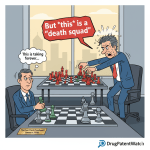
14. The ‘Patent Death Squad’ Debate: Invalidation Rate Data and What It Actually Means
14a. The Headline Statistics
Former Federal Circuit Chief Judge Randall Rader coined the term ‘patent death squad’ in describing the PTAB in 2013, less than a year after AIA trials launched. The label was inflammatory and has largely been discredited as a description of the Board’s work, but it captured a genuine concern about the invalidation rate data that was emerging from the first years of operation. In early PTAB years, institution rates ran at 70% or higher, and of the patents that proceeded to a final written decision, 80% or more had claims cancelled. The all-claims cancellation rate (where every challenged claim is cancelled) was consistently above 60% in FY2024.
These statistics look alarming in isolation. They look different when viewed with context. The PTAB’s ‘preponderance of evidence’ standard without a validity presumption will, by design, produce higher invalidation rates than district courts operating under ‘clear and convincing evidence’ with a validity presumption. The comparison is not between the PTAB and a neutral baseline; it is between two systems with different intended outcomes. Congress built the PTAB to be more likely to find patents invalid than district courts. The invalidation rate reflects the system working as designed.
14b. The Self-Selection Effect
The self-selection argument is compelling and empirically grounded. IPR petitions are not filed randomly. A petitioner commits to spending $350,000 to $700,000 in legal fees, triggering broad estoppel consequences, and running the clock on a defined timeline for a strategic purpose: it believes the patent is vulnerable. Rational economic actors who have conducted due diligence and concluded the patent is strong do not file IPR petitions. The pool of patents that actually reach IPR final written decisions therefore over-represents the weakest issued patents, not the typical issued patent. Measuring the invalidation rate in this self-selected pool and projecting it to all issued U.S. patents is analytically unsound.
The Federal Circuit affirmance rate for PTAB decisions supports the competence argument. The Federal Circuit upholds PTAB decisions in substantially above 70% of appeals, which is comparable to or better than Federal Circuit affirmance rates for district court patent decisions. If the PTAB were producing systematically biased or legally erroneous invalidity findings, the appellate reversal rate would be materially higher.
14c. The Pharmaceutical-Specific Argument: Secondary Patents and the ‘Weak Patent’ Population
For pharmaceutical patents specifically, the self-selection argument is particularly strong. Generic drug manufacturers do not target composition-of-matter patents on genuinely novel small molecules for IPR challenges; these patents are hard to find prior art for and expensive to challenge. They target secondary formulation, polymorph, and dosing patents where the prior art landscape is rich and the obviousness arguments are more accessible. The population of pharmaceutical patents challenged at the PTAB therefore disproportionately represents the secondary patents that are the focus of the evergreening debate, not the core pharmaceutical invention patents. High invalidation rates in this population may accurately reflect the quality of the challenged patents, not bias in the PTAB.
14d. The Legitimate Concern: Small Inventors and the Cost Barrier
The strongest genuine criticism of the PTAB is the asymmetric cost problem for smaller patent holders. A well-funded generic manufacturer or technology company can file multiple IPR petitions against a smaller company’s patent portfolio, knowing that even a favorable PTAB outcome costs the patent owner $350,000 to $700,000 per proceeding to defend. For a small startup whose entire enterprise value may rest on two or three core patents, even successful PTAB defense is financially crippling. The risk is that the PTAB, designed as a tool to challenge weak patents, can be used strategically by large, well-capitalized challengers to impose disproportionate litigation costs on smaller competitors, regardless of the underlying patent quality.
Key Takeaways: Section 14
The 70-80% claim cancellation rate at the PTAB is a product of design (lower burden of proof) and self-selection (petitioners target the weakest patents). It does not mean 70-80% of all U.S. patents would be invalid if challenged. The Federal Circuit’s high affirmance rate for PTAB decisions supports the competence interpretation over the bias interpretation. The legitimate asymmetric-cost concern is real: the PTAB’s proceeding costs, though lower than district court, can still be weaponized by large entities against small patent holders. For pharmaceutical secondary patents, the high invalidation rate likely reflects genuine quality problems with incremental dosing and formulation patents, not systemic bias.
15. Pharmaceutical Case Studies: Copaxone, Humira, and Biologic Patent Thickets at PTAB
15a. Copaxone (Glatiramer Acetate): How PTAB Dismantled an Evergreening Strategy
Copaxone’s 40 mg three-times-weekly formulation was protected by a series of patents with expiry dates extending to 2030. Teva’s strategy was a textbook evergreening execution: obtain secondary patents covering the specific dosing interval and formulation concentration as the core composition-of-matter expired, thereby extending the commercial exclusivity period by years. The 40 mg/mL formulation patents (covering the three-times-weekly dosing regimen) were the key protective layer.
Mylan, Sandoz, and Amneal filed IPR petitions targeting these secondary patents beginning in 2015 and 2016. The central obviousness argument was that the published clinical literature on glatiramer acetate pharmacokinetics, combined with the known art of modified dosing schedules for self-injected therapies, made the three-times-weekly 40 mg/mL regimen obvious to a person of ordinary skill in the relevant biomedical field. The patent owner’s response was that unexpected results, a secondary consideration of non-obviousness, distinguished the claimed regimen from what the prior art would have suggested.
The PTAB found several of the secondary Copaxone dosing patents unpatentable on obviousness grounds, crediting the prior art’s teaching of alternative dosing schedules and finding that the unexpected results evidence was insufficient to overcome the prima facie case of obviousness. The Federal Circuit affirmed several of these decisions. Generic glatiramer acetate entered the market on an accelerated timeline as a direct result of the PTAB proceedings, years earlier than the 2030 nominal expiry dates of the secondary patents would have suggested.
From an IP valuation perspective, the PTAB proceedings stripped an estimated three to five years of secondary patent protection from Teva’s Copaxone portfolio. At Copaxone’s peak U.S. revenues of approximately $4 billion annually, each year of accelerated generic entry represents a revenue impact in the billions. A DCF model that treated the 2030 secondary patent expiry dates at face value, without applying a PTAB vulnerability discount, overstated Copaxone’s patent portfolio NPV by a material amount.
15b. Humira’s Patent Thicket: IPR-Resistant by Design
AbbVie’s Humira (adalimumab) patent thicket of more than 250 patents represents the deliberate construction of an IPR-resistant defensive position, and studying it reveals how a sophisticated IP strategy specifically accounts for the PTAB. AbbVie did not simply accumulate patents; it structured the thicket to make any single IPR challenge insufficient to clear a path to market for a biosimilar developer.
The key architectural feature is layering. AbbVie’s thicket covers the adalimumab molecule, multiple antibody formulation concentrations, citrate-free excipient systems, auto-injector device characteristics, methods of use for each individual inflammatory indication, specific dosing intervals, and manufacturing process parameters. A biosimilar developer who successfully IPRed the molecule composition claim (if one were available; composition-of-matter claims for biologics function differently from small molecules) would still face formulation patents, device patents, and method-of-use patents for each indication.
Additionally, AbbVie executed biosimilar settlement agreements that included structured entry dates and patent licenses, effectively converting the IPR threat into a commercial negotiation. By licensing biosimilar developers to enter the market at defined dates, AbbVie obtained settlements that neutralized the PTAB challenge route entirely. The biosimilar developers agreed not to challenge the remaining patents in exchange for a commercial entry date. This strategy demonstrates that the optimal response to PTAB risk for a patent thicket holder is not just building the thicket, but negotiating settlement frameworks that make the IPR challenge less economically attractive than the licensed entry alternative.
15c. The Next Wave: Keytruda, Dupixent, and the PD-1/IL-4 Biologic Challenges
Merck’s Keytruda (pembrolizumab) and Regeneron/Sanofi’s Dupixent (dupilumab) represent the next generation of biologic patent portfolios that will face PTAB scrutiny as biosimilar development programs advance. Both drugs carry patent thickets with similar architectural features to Humira’s: multiple antibody claim layers, formulation and device patents, and method-of-use patents for each approved indication.
Keytruda’s specific PTAB vulnerability profile differs from Humira’s in several ways. Pembrolizumab is a PD-1 checkpoint inhibitor, a class of antibodies whose biological mechanism was extensively published in academic literature before the antibody drugs themselves were developed. The prior art density around checkpoint inhibitor biology is substantial, which creates richer material for obviousness combinations against method-of-use patents covering specific tumor types or combination regimens. As biosimilar pembrolizumab development programs mature (several are in Phase III trials as of early 2026), IPR filings against Keytruda’s secondary method-of-use patents should be expected.
Dupixent’s IL-4/IL-13 pathway patents share some characteristics with Humira’s thicket: a core antibody composition claim, multiple indication-specific method-of-use patents, and formulation patents covering the pre-filled syringe presentation. Dupixent’s indication expansion strategy (which has grown from atopic dermatitis to asthma, COPD, and several other inflammatory conditions) generates new method-of-use patents for each new indication, each earning its own three-year new clinical investigation exclusivity from FDA and each potentially becoming an IPR target as biosimilar developers map the patent landscape.
Key Takeaways: Section 15
The Copaxone case demonstrates how PTAB invalidity findings on secondary dosing and formulation patents can collapse years of secondary exclusivity and accelerate generic entry by three to five years, with direct NPV consequences in the billions. AbbVie’s Humira thicket was specifically structured to be IPR-resistant through layering and converted the IPR threat into commercial negotiation leverage. The next wave of biologic PTAB challenges will target method-of-use and formulation patents on PD-1 inhibitors and IL-4/IL-13 pathway antibodies, where prior art density in the underlying biology literature is high.
16. The Fintiv Framework and the 2025 Bifurcated Discretionary Denial Regime
16a. The Fintiv Framework: Background and Factors
The PTAB’s precedential 2020 decision in Apple Inc. v. Fintiv established a multi-factor framework for the Board to use in evaluating whether to exercise its discretion to deny institution of an IPR petition on the grounds that a parallel district court proceeding was sufficiently advanced that proceeding with the PTAB trial would be duplicative or wasteful. The six Fintiv factors are: whether the district court has issued a stay or is likely to; the proximity of the district court’s trial date to the projected PTAB final written decision date; the investment already made in the district court case; whether the district court issues and PTAB issues overlap; whether the petitioner is a party to the district court proceeding; and other circumstances affecting the merits of efficiency and fairness.
The Fintiv framework was controversial from its inception. Patent challengers argued that it arbitrarily denied them access to the PTAB’s more favorable forum based on procedural accidents of district court scheduling. Patent owners argued that it appropriately prevented parallel proceedings that created inefficiency, inconsistency, and the possibility that a petitioner could extract two bites at the invalidity apple. The debate was essentially a policy dispute about whether the PTAB was meant to be a generally available forum or a backstop for cases where district court was inadequate.
16b. The 2022-2023 Rollback and the 2025 Reversal
The Biden administration USPTO Guidance in 2022 substantially restricted the application of Fintiv, directing that petitioners could use sounder approaches such as proposing stipulations that they would not raise the same prior art in district court as an offset to Fintiv concerns, and that the Fintiv analysis should not be applied in ways that effectively deny meritorious petitions on purely scheduling grounds. Fintiv denials dropped substantially in 2022-2023 as a result.
In early 2025, the USPTO reversed course again. The Biden guidance restricting Fintiv was rescinded, and the full Fintiv framework was reinstated, with the addition of a new, bifurcated institution process that introduces a preliminary discretionary review phase before the petitioner’s technical arguments are even considered. Under this new procedure, the PTAB first evaluates the petition for discretionary denial factors, including Fintiv, before reaching the technical merits. If the petition is denied on discretionary grounds in this preliminary phase, the technical arguments are never reviewed.
16c. The New Factors: ‘Settled Expectations,’ Workload, and Public Interest
The 2025 bifurcated framework introduced several factors not part of the original Fintiv analysis. The ‘settled expectations’ doctrine, cited in USPTO guidance, incorporates the idea that a patent that has been in force for many years without challenge deserves greater deference to its owner’s reliance on its continued validity. This factor is intellectually novel for U.S. patent law, which has not traditionally recognized patent owner reliance as a basis for denying validity challenges. Its application creates a new incentive for patent owners to delay mounting their thickest legal defenses until the ‘settled expectations’ argument becomes available.
The Board workload and resource constraint factor is also new. It creates the possibility, however unusual in practice, that a facially meritorious IPR petition against a pharmaceutical patent could be denied on the grounds that the PTAB lacks capacity to handle it. For pharmaceutical patent holders, this factor is potentially valuable; if the PTAB’s docket in a particular technology area is constrained, seeking early denial on workload grounds could delay or prevent institution even for strong petitions.
The ‘compelling economic, public health, or national security interests’ factor cuts in both directions. An administration that has publicly identified pharmaceutical drug pricing as a public health priority could cite this factor to grant institution of IPRs against pharmaceutical patent thickets that would otherwise receive discretionary denials. An administration focused on strengthening innovator protection could use the same factor in the opposite direction.
The April 2025 PTAB data show the new framework’s immediate impact. The overall institution rate collapsed to below 45%, from 68% in the prior six months. The technology sector breakdown tells the story: Electrical and Computer technology patents saw institution rates fall to 38%, and Mechanical and Business Method patents to 33%. Bio/Pharma patents saw institution rates remain near 100% in the same period.
The divergence reflects the different litigation contexts in which pharmaceutical IPRs typically arise. A Hatch-Waxman district court case involving a pharmaceutical patent often has a trial date years away (because the 30-month stay starts running only after the Paragraph IV suit is filed, and trials may be scheduled two to three years after complaint filing). Fintiv’s denial trigger, which focuses on whether a nearby district court trial date makes PTAB proceedings redundant, fires much less often in the pharmaceutical context. Meanwhile, technology patent IPRs are frequently filed in response to commercial patent litigation with more compressed timelines, making the district court trial date proximity factor more likely to trigger a Fintiv denial.
Key Takeaways: Section 16
The 2025 bifurcated institution process inserts a discretionary denial layer before technical merits review, creating a pre-institution hurdle that petitioners must clear separately. The new ‘settled expectations’ factor, if applied broadly, rewards patent owners who have long-standing portfolios and creates novel reliance-based barriers to IPR access. Bio/Pharma institution rates remain near 100% because Hatch-Waxman litigation timelines are inconsistent with Fintiv’s near-trial-date trigger. The ‘compelling public health or economic interest’ factor is explicitly bidirectional and is the clearest expression of how political priorities can now directly influence PTAB institution decisions.
17. Current Statistics: Institution Rate Collapse, FWD Invalidation Rates, and MTA Failures
17a. Institution Rates: The March 2026 Picture
As of early 2026, the overall PTAB institution rate for IPR petitions has stabilized in the 42-48% range, reflecting the full implementation of the 2025 bifurcated discretionary denial framework. The technology sector divergence that was apparent in April 2025 data has persisted. Electrical and Computer patents are being instituted at approximately 35-40%. Bio/Pharma patents remain near 90-100% institution rates. This divergence is the single most operationally important current fact in pharmaceutical PTAB strategy: the pharmaceutical channel remains essentially open while the general PTAB access has been substantially restricted.
This means that pharmaceutical patent holders who have relied on the general tightening of PTAB access as a reason to discount IPR risk have made an error. The tightening has not reached their portfolio. A biologic with a secondary formulation patent under IPR petition has approximately the same likelihood of getting instituted as it did before the 2025 changes. The more relevant question for pharmaceutical patent holders is not whether institution will occur but whether the technical arguments in the petition are strong enough to prevail at a final written decision.
17b. Final Written Decision Claim Cancellation Rates
For petitions that proceed to a final written decision, the claim cancellation rate remains high and has been stable. Approximately 70-80% of claims challenged in final written decisions issued in FY2024 were found unpatentable. The all-claims invalidation rate (where every single challenged claim is cancelled) was 70% for FY2024, with a slight decline to approximately 64% in early FY2025. This stability is notable because it confirms that the 2025 framework changes, while restricting access to the PTAB (particularly for non-pharma sectors), are not producing softer outcomes for the petitions that do get instituted. Once inside, challengers still win at very high rates.
The implication for pharmaceutical patent holders is direct: the probability that a Bio/Pharma IPR petition that receives institution will produce a final written decision cancelling claims is approximately 70-80%. This is not a figure that should be footnoted in a patent valuation model; it should be the central parameter of the PTAB risk adjustment calculation.
17c. Motion to Amend Grant Rates
The Motion to Amend (MTA) is the patent owner’s only tool during a PTAB trial to substitute challenged claims with narrower claims designed to survive the cited prior art. The cumulative grant rate for MTAs is approximately 15-16%. This persistently low rate means that patent owners who rely on the MTA pathway as a fallback when original claims are at risk will be disappointed approximately 84% of the time.
The reasons for MTA failure are instructive. MTAs require the patent owner to propose substitute claims that are patentably distinct from the prior art cited by the petitioner, without simply adding limitations that are themselves obvious or anticipated. The patent owner bears the burden of proof on the substitute claims’ patentability, which is a reversal from the general IPR posture where the petitioner bears the burden. Many MTAs fail because the proposed substitute claims add limitations that are themselves in the prior art, or because the new claim language introduces its own written description issues. The lesson is that the MTA is not a viable insurance policy; patent owners should not enter PTAB trials assuming they can save their claims through amendment if the original claims falter.
PTAB Current Statistics Reference Table
Metric
Time Period
Rate/Value
Commentary
Overall IPR Institution Rate
Q1 2026
~42-48%
Stabilized after 2025 Fintiv reinstatement
Bio/Pharma Institution Rate
April 2025-Q1 2026
~90-100%
Largely unaffected by discretionary denial changes
Electrical/Computer Institution Rate
April 2025
~38%
Significantly reduced by Fintiv denials
Mechanical/Business Method Institution Rate
April 2025
~33%
Substantially reduced
All-Claims Invalidation Rate in FWDs
FY2024
~70%
All challenged claims cancelled
All-Claims Invalidation Rate in FWDs
Early FY2025
~64%
Slight decline; still very high
Claim-Level Cancellation Rate in FWDs
FY2024-FY2025
~77-80%
Per-claim cancellation rate across all decisions
Motion to Amend Grant Rate
Cumulative to early 2025
~15-16%
Persistently low; not a reliable fallback strategy
Key Takeaways: Section 17
The Bio/Pharma institution rate’s immunity from the 2025 Fintiv-driven decline is the most strategically significant current PTAB statistic for pharmaceutical companies. Secondary pharmaceutical patents face approximately 90-100% institution likelihood and 70-80% claim cancellation rates in FWDs once instituted. The MTA grant rate of 15-16% makes claim amendment an unreliable fallback. Pharmaceutical patent portfolios whose protection depends substantially on secondary claims without composition-of-matter coverage should carry explicit PTAB invalidation probability adjustments in NPV models.
18. Director Review as Policy Instrument: Political Risk in a Formerly Technocratic Forum
18a. The Mechanics of Director Review
Director Review is the post-Arthrex mechanism by which the USPTO Director can review any final written decision of the PTAB. Director Review can be triggered in two ways: a party can request Director Review of a decision, or the Director can take up a decision sua sponte without any party request. The Director’s authority extends to affirming, modifying, reversing, or remanding for further proceedings. There is no defined standard limiting which decisions the Director will take up or how the Director’s review will proceed.
The absence of a defined limiting standard is itself a policy risk. A Director who reviews every closely decided PTAB final written decision involving pharmaceutical patents could systematically shift outcomes in one direction or another without changing any regulation. The Director’s review decisions are themselves appealable to the Federal Circuit, but only after the Director has acted, and the Federal Circuit reviews Director Review decisions under the same deferential standard it applies to PTAB final written decisions generally.
18b. Director Review as Policy Channel: The Evidence
The Director Review process has been used in ways that extend beyond correcting individual APJ errors. Several Director Review proceedings have issued broad guidance on recurring PTAB issues, effectively using Director Review as a mechanism for making new precedent without formal rulemaking. This use of Director Review is arguably consistent with the Arthrex remedy’s purpose, which was to ensure that a Principal Officer exercised oversight over APJ decisions. But it also means that the Director is not just reviewing individual cases; he or she is using individual cases to establish general policy.
For pharmaceutical patent litigation, the most consequential Director Review developments have involved the discretionary denial framework itself, where the Director has used guidance documents, interim procedures, and Director Review precedent in tandem to construct a new institution policy architecture that significantly alters access to the PTAB. The 2025 bifurcated institution process is not the product of formal APA notice-and-comment rulemaking; it is an interim Director-level procedure implemented through guidance. Its legal durability against challenge on APA grounds is uncertain.
18c. Administration Transition Risk for Pharmaceutical Patent Portfolios
The post-Arthrex PTAB framework means that pharmaceutical patent portfolios must now be analyzed against administration-specific PTAB policy scenarios, not just technical validity scenarios. A biologic patent thicket that is safe from Fintiv-based discretionary denial under current PTAB policy could become more vulnerable if a future administration’s Director chooses to apply the ‘compelling public health interest’ factor aggressively to pharmaceutical patents on the theory that drug pricing is a public health issue.
Conversely, an administration that prioritizes strengthening IP rights and reducing uncertainty for innovators could use Director Review and new discretionary denial guidance to make pharmaceutical patent thickets more durable by granting institution only for petitions with exceptionally strong prior art. The pharmaceutical patent portfolio’s political risk profile is now part of its legitimate IP valuation, and that risk profile changes with administrations.
Investment Strategy: Director Review and Political Risk Premium
Investors modeling pharmaceutical patent portfolio value should add an explicit ‘Director Review policy risk’ scenario to their PTAB scenario trees. This scenario should represent the possibility that a change in USPTO Director leadership produces a meaningful shift in Bio/Pharma IPR institution rates, either upward (accelerating patent thicket dismantlement) or downward (extending secondary patent protection). Given that Bio/Pharma institution rates are currently near 100%, the relevant risk direction for most patent holders is downward, but the downside scenario (a Director who prioritizes drug access and applies public health interests broadly) could push Bio/Pharma institution rates toward the elevated levels seen before the 2025 discretionary denial regime. The option value of this bidirectional political risk premium is not zero and should not be modeled as zero.
Key Takeaways: Section 18
Director Review has evolved from an Arthrex constitutional remedy into a substantive policy instrument that the USPTO Director uses to make PTAB precedent and establish institution policies without formal rulemaking. The 2025 bifurcated institution process was implemented through interim Director guidance rather than APA notice-and-comment, which creates legal uncertainty about its durability. Administration transition risk is now a material pharmaceutical patent portfolio variable; a new Director can meaningfully shift Bio/Pharma institution rates through guidance changes without amending any statute or regulation.
19. Dual-Forum Strategy: Integrating PTAB Proceedings with Hatch-Waxman Litigation
19a. The Paragraph IV Litigation Timeline and IPR Window
When a generic drug manufacturer files an Abbreviated New Drug Application (ANDA) with a Paragraph IV certification challenging an Orange Book-listed patent, the brand company has 45 days to file an infringement suit in district court. If it does, the FDA is barred from approving the ANDA for 30 months or until final court resolution, whichever comes first. The generic company that is sued for patent infringement has a concurrent option: file an IPR petition against the same patent within one year of being served with the infringement complaint (the section 315(b) time bar applies).
The decision about whether to file an IPR in parallel with Hatch-Waxman district court litigation is one of the most consequential strategic choices in pharmaceutical patent litigation. The primary arguments for filing are: the PTAB’s more favorable legal standards (preponderance, no validity presumption, technical judges), the potential to stay the more expensive district court case pending the PTAB outcome, the ability to generate early claim construction findings that influence the district court, and the opportunity to get a binding FWD on validity before the district court trial date.
The arguments against filing are: the IPR estoppel consequences (a losing IPR bars the challenger from using those prior art arguments in district court), the cost of running parallel proceedings, the risk that the PTAB’s claim construction influences the district court in a direction unfavorable to the challenger, and, under the current Fintiv framework, the risk that the IPR is denied on discretionary grounds if the district court trial is scheduled within a time window that makes PTAB proceedings redundant.
19b. The Stay Decision: Factors and Trends
When a generic company files an IPR against an asserted patent and seeks a stay of the district court Paragraph IV case, district courts apply varying frameworks. The most commonly applied factors consider whether the stay would simplify the issues in the district court, whether the case is at an early stage (favoring a stay) or near trial (weighing against), and the likely undue prejudice to the brand company if the stay is granted.
Pharmaceutical district courts have been inconsistent on stay requests. The District of Delaware, which handles a large proportion of Hatch-Waxman cases, has granted stays when the PTAB has instituted IPR proceedings but has also denied stays in cases where trial is approaching and the generic challenger has been slow to file the IPR petition. The current Fintiv framework creates a perverse dynamic: filing the IPR early (before significant district court progress) reduces the risk of a Fintiv discretionary denial but also reduces the probability of a stay, because the court case is still at an early stage. Filing the IPR late (after significant district court progress) increases the stay probability but increases the Fintiv denial risk.
19c. Claim Construction Coordination
The 2018 USPTO rule aligning the PTAB’s claim construction standard with the Phillips standard nominally solved the problem of inconsistent claim constructions across forums. In practice, the problem persists because the same legal standard can be applied differently by different decision-makers to the same record. APJs and district court judges read the same claim language, the same specification, and often the same prosecution history and reach different constructions.
When a PTAB panel has already issued claim construction findings in an institution decision or a final written decision, district courts must decide whether to give those findings preclusive or persuasive effect. The answer is not settled law. Most district courts treat PTAB claim constructions as highly persuasive but not binding, while some courts have treated them as having more preclusive effect. For a party trying to maintain consistent positions across forums, the safest approach is to argue for the same claim construction at the PTAB and in district court from the beginning, rather than hoping to exploit a favorable construction in one forum without being bound by it in the other.
19d. BPCIA Patent Dance Integration with IPR Strategy
For biosimilar manufacturers, the BPCIA patent dance is not an isolated event; it is the beginning of a patent strategy that will eventually include both IPR proceedings and BPCIA district court litigation. The patent dance requires disclosure of the biosimilar’s manufacturing process information, which the reference product sponsor uses to identify patents it believes are infringed. The biosimilar applicant then has an opportunity to respond with its invalidity and non-infringement positions.
The positions taken in the patent dance negotiations directly feed into the subsequent litigation and IPR strategy. A biosimilar applicant who identifies ten patents as invalid in the patent dance exchange and then files IPRs against only six of them has effectively conceded the other four, at least for purposes of signaling. Conversely, a biosimilar applicant who proposes narrow non-infringement positions in the patent dance may be constrained in later district court arguments if the patent dance positions are treated as prior statements that limit the available arguments.
Key Takeaways: Section 19
Parallel Hatch-Waxman litigation and IPR proceedings require coordination at three levels: claim construction positions (which must be consistent across forums), invalidity theory allocation (which arguments go to PTAB under section 315(e) estoppel constraints and which are held for district court), and filing timing (which affects both Fintiv denial risk and stay probability). BPCIA patent dance positions are the first chapter of a document record that will be scrutinized in every subsequent IPR and district court proceeding; they must be drafted with the full multi-forum strategy in mind.
20. Investment Strategy: PTAB Signals as Alpha-Generating Indicators
20a. IPR Petition Filings as Leading Loss-of-Exclusivity Indicators
IPR petitions filed against pharmaceutical patents are public records available through the USPTO’s PTAB End-to-End (P-TEP) system. The filing date, petitioner identity, challenged claims, and prior art references are all public information. An IPR petition against a pharmaceutical patent is, in many cases, a 24-to-36-month leading indicator of generic or biosimilar market entry: it signals that a challenger is actively investing in entry, it often accompanies or follows a Paragraph IV ANDA filing, and the 18-month PTAB timeline runs in parallel with the district court proceedings that determine the LOE date.
Investors who monitor PTAB petition filings against Orange Book and Purple Book patents for the drugs in their portfolios have a systematic informational advantage over investors who rely solely on company investor relations disclosures of patent challenge status. Companies often disclose Paragraph IV notifications in 10-K filings, but the PTAB petition filing is a separate, publicly accessible signal that may not receive the same investor relations attention. When multiple petitioners file IPR petitions against the same pharmaceutical patent, the signal intensifies: sophisticated challengers are independently concluding that the patent is vulnerable.
20b. Institution Decision as a Catalyst Event
The PTAB institution decision is a binary event with an identifiable date and a material impact on the probability distribution of the patent’s survival. When the PTAB institutes an IPR against a pharmaceutical composition-of-matter or major formulation patent, the probability that the patent will survive unchanged drops from its pre-institution baseline to approximately 20-30%, based on FWD cancellation statistics. This repricing of the underlying patent asset is a material event for the patent holder’s equity value but is often not reflected in market prices until the institution decision is disclosed and analyzed.
The institution decision for Bio/Pharma patents is expected to take place approximately six months after petition filing. An investor who monitors petition filings and positions in advance of the expected institution decision date has a structured opportunity to act before the information is widely processed.
20c. Final Written Decision as the Definitive Patent Validity Signal
A final written decision finding pharmaceutical patent claims unpatentable is the most definitive signal that an accelerated LOE event is probable. While the patent holder can appeal to the Federal Circuit, the Federal Circuit affirms PTAB decisions at a high rate. An FWD cancelling all challenged claims against a pharmaceutical patent with no alternative IP protection for the branded product is a strong signal that generic or biosimilar entry is imminent, subject only to any remaining regulatory exclusivities.
The market frequently underreacts to PTAB FWDs against secondary pharmaceutical patents, because the immediate revenue impact depends on whether the cancelled claims cover the product as actually marketed and on whether other unchallenged patents in the Orange Book remain as barriers. A careful analysis of which specific claims were cancelled, which remain, and whether the marketed product is covered by surviving claims is necessary to convert an FWD into an accurate LOE probability adjustment. Investors who perform this claim-level analysis consistently outperform those who rely on summary coverage of PTAB outcomes.
20d. PTAB Claim Construction as an Infringement Defense Signal
In PTAB proceedings involving pharmaceutical patents, the PTAB’s claim construction findings (issued in the institution decision and elaborated in the FWD) provide early intelligence on how the claims will likely be construed in district court infringement proceedings. If the PTAB construes a biologic antibody claim narrowly, that construction is likely to be influential in the district court’s subsequent Markman hearing. A narrow construction that excludes the biosimilar’s structure from the claim’s scope is an early infringement defense signal that the branded product may have a weaker infringement position than the patent’s nominal scope suggests.
Investment Strategy: Building a PTAB Intelligence System
An effective PTAB intelligence system for pharmaceutical investors requires four data inputs: (1) real-time petition filing monitoring against a target portfolio’s Orange Book and Purple Book patents; (2) institution decision tracking for petitions already filed; (3) FWD monitoring with claim-level analysis of which claims were cancelled and which survived; (4) Director Review petition and decision monitoring for major pharmaceutical patent decisions. These inputs are all publicly available but require systematic aggregation and analysis. The pharmaceutical companies with the most material PTAB exposure to monitor as of early 2026 include Merck (Keytruda), BMS/Pfizer (Eliquis), J&J (Stelara, Darzalex), Regeneron/Sanofi (Dupixent), and AstraZeneca (Farxiga, Calquence).
Key Takeaways: Section 20
IPR petition filings against pharmaceutical patents are public, 24-to-36-month leading indicators of generic entry that precede company investor relations disclosures. Institution decisions reprice the underlying patent asset from pre-petition baseline to a 20-30% survival probability in approximately six months from petition filing. FWD claim-level analysis, not summary PTAB outcome reporting, is required to accurately convert a cancellation decision into a specific LOE probability. The five pharmaceutical companies with the largest pending PTAB exposure in 2026 should be monitored systematically for petition filings, institution decisions, and FWDs using publicly available PTAB data sources.
21. Master Key Takeaways
The PTAB is a direct pharmaceutical patent valuation variable, not a litigation detail. Secondary pharmaceutical patents carry PTAB vulnerability rates of approximately 90-100% for institution and 70-80% for all-claims cancellation in final written decisions. Every pharmaceutical patent portfolio valuation model that uses nominal expiry dates without PTAB probability-weighted adjustments is systematically overstating expected revenue duration.
Bio/Pharma institution rates remain near 100% under the 2025 discretionary denial framework. The overall PTAB institution rate has fallen below 45% due to Fintiv-based discretionary denials, but pharmaceutical patents face institution rates near 100%. The factors that trigger Fintiv denials (nearby district court trial dates) apply less frequently in Hatch-Waxman litigation contexts. Pharmaceutical patent holders should not assume that the general tightening of PTAB access applies to their portfolios.
Preponderance of evidence without a validity presumption is the primary engine of high PTAB invalidation rates. The PTAB’s 70-80% claim cancellation rate in FWDs is a structural outcome of its evidentiary standard and its expert-judge composition, not evidence of institutional bias. The same prior art that fails at district court under clear and convincing evidence regularly succeeds at the PTAB.
IPR estoppel is among the most severe legal consequences in patent litigation. A lost IPR bars the petitioner from raising any prior art argument that was or could have been raised, in any forum, forever. Petitioners must conduct exhaustive prior art searches before filing and must deliberately allocate invalidity theories between IPR (prior art grounds) and district court (section 101, section 112, inequitable conduct) from the outset.
The nine-month PGR window for newly issued patents is systematically underutilized in pharmaceutical strategy. PGR allows broader invalidity grounds including section 101 and section 112 challenges that are unavailable in IPR. Pharmaceutical IP teams should monitor competitor patent issuances and evaluate PGR viability within the nine-month window for continuation patents that add coverage to existing biologic thickets.
The Arthrex Director Review mechanism has introduced political risk into PTAB adjudication. The USPTO Director can review and modify any PTAB final written decision. The same Director implements discretionary denial policies that directly control IPR access rates. These are functions of a political appointee, and they change with administrations. Pharmaceutical patent portfolio valuations must now incorporate an administration-specific PTAB policy risk premium.
Motion to Amend success rates of 15-16% make claim amendment an unreliable fallback during PTAB trials. Patent owners who enter PTAB trials without a primary defense strategy based on original claims are in a weak position. The MTA is not a reliable insurance mechanism; it fails approximately 84% of the time.
Dual-forum strategy must be built from day one of Paragraph IV litigation. Claim construction positions, invalidity theory allocation, and patent dance contentions must be coordinated across PTAB and district court proceedings before any document is filed. Post-hoc coordination, after positions have been staked in one forum, creates estoppel traps and credibility problems that cannot be corrected.
PTAB petition filings, institution decisions, and FWDs are public, dateable, high-value signals for pharmaceutical equity investors. Systematic monitoring of these events against target portfolio Orange Book and Purple Book patents provides 24-to-36-month leading indicators of generic and biosimilar entry that consistently precede market pricing of LOE events.
22. Glossary of PTAB Terminology
Administrative Patent Judge (APJ): A judge appointed by the Secretary of Commerce to adjudicate proceedings before the PTAB. APJs are required to have both legal and technical credentials.
AIA (America Invents Act): The Leahy-Smith America Invents Act of 2011, the most significant revision of U.S. patent law since 1952, which created the PTAB and its AIA trial proceedings.
All-Claims Invalidation Rate: The percentage of IPR final written decisions in which every challenged claim is found unpatentable. Approximately 70% in FY2024.
BPCIA (Biologics Price Competition and Innovation Act): The 2009 statute governing biosimilar approval and the patent dispute process for biologics, including the ‘patent dance’ exchange of information between biosimilar applicants and reference product sponsors.
Covered Business Method (CBM) Review: A now-expired transitional PTAB proceeding for challenging the validity of patents related to financial products or services. No new petitions have been accepted since September 16, 2020.
Director Review: The post-Arthrex mechanism by which the USPTO Director can review, modify, or reverse any PTAB final written decision, providing executive branch oversight of APJ adjudicative outcomes.
Estoppel (35 U.S.C. section 315(e)): The legal bar that prevents an IPR petitioner (and its real parties in interest and privies) from asserting invalidity in any forum on any ground that was raised or reasonably could have been raised in the completed IPR proceeding.
Final Written Decision (FWD): The PTAB’s binding adjudication at the conclusion of an AIA trial, issued within 12 months of institution (extendable by six months), which determines the patentability of each challenged claim.
Fintiv Framework: The multi-factor discretionary denial framework from Apple Inc. v. Fintiv (PTAB 2020), under which the PTAB may deny IPR institution when parallel district court proceedings are sufficiently advanced. Reinstated at full force by USPTO guidance in early 2025.
Inter Partes Review (IPR): The primary AIA trial proceeding, available against any issued patent, limited to invalidity grounds of anticipation and obviousness based on prior art patents and printed publications.
Motion to Amend (MTA): The patent owner’s mechanism during an IPR trial to propose substitute claims that cancel challenged claims and replace them with narrower claims designed to survive the cited prior art. Grant rate approximately 15-16%.
Patent Dance: The informal name for the multi-step BPCIA information exchange process between a biosimilar applicant and the reference product sponsor, designed to identify patents that may be infringed and narrow the scope of patent litigation.
Patent Owner Preliminary Response (POPR): The patent owner’s optional pre-institution brief, filed within three months of the petition, seeking to persuade the PTAB to deny institution before the trial begins.
Post-Grant Review (PGR): An AIA trial proceeding available only within nine months of patent grant, only for AIA first-inventor-to-file patents, allowing invalidity challenges on any statutory ground except best mode.
Preponderance of the Evidence: The burden of proof applied in PTAB trials, requiring the challenger to show that invalidity is more likely than not (greater than 50% probability). Materially lower than the ‘clear and convincing evidence’ standard required in district court.
PTAB (Patent Trial and Appeal Board): The administrative tribunal within the USPTO established by the AIA, replacing the BPAI, which adjudicates ex parte appeals from patent applicants and AIA trial proceedings initiated by third-party challengers.
Real Party in Interest (RPI): A party who has a direct financial or legal interest in the outcome of an IPR proceeding. An IPR petition that fails to identify an RPI that is actually controlling or funding the proceeding may be subject to dismissal if the omission is discovered.
Reasonable Likelihood Standard: The institution threshold for IPR, requiring the petitioner to demonstrate a reasonable likelihood of prevailing on at least one challenged claim.
Section 315(b) One-Year Time Bar: The statutory rule prohibiting IPR institution if the petition is filed more than one year after the petitioner, its RPI, or a privy was served with a complaint alleging infringement of the challenged patent.
Settled Expectations: A discretionary denial factor introduced in 2025 PTAB guidance, weighing the patent owner’s reliance on a long-standing patent’s continued validity as a basis for denying institution. Novel in U.S. patent law and of uncertain legal durability.
This analysis targets pharmaceutical and biotech IP teams, R&D directors, institutional investors, and M&A professionals. It reflects public PTAB data, USPTO guidance, and court decisions. PTAB institution rates, FWD invalidation statistics, and discretionary denial policies are subject to change as Director Review authority continues to evolve and as administration-level USPTO policy priorities shift. All PTAB statistical data sourced from USPTO PTAB statistics reports and published practitioner analyses of official PTAB data unless otherwise noted.