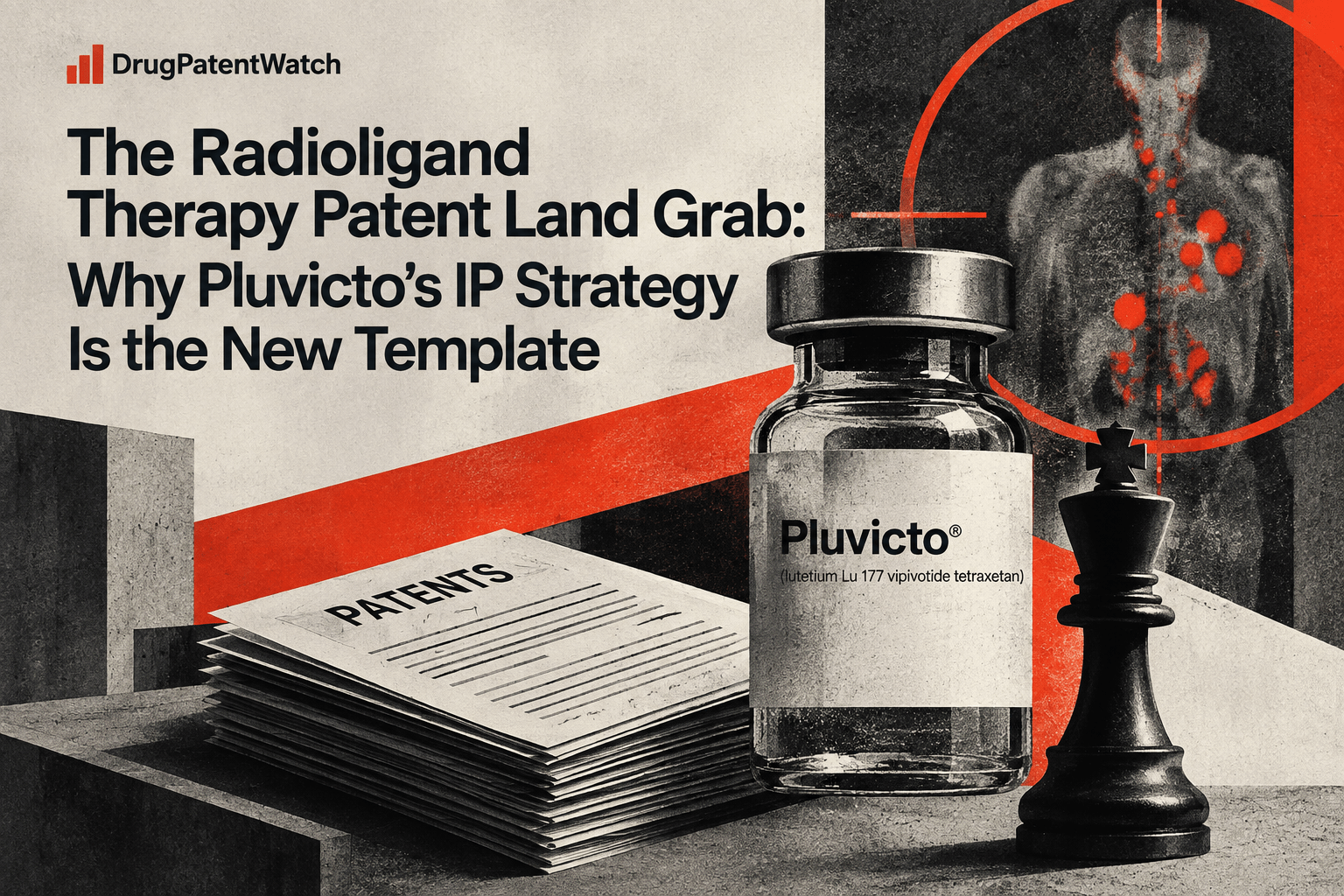
Novartis reported Entresto sales of $1,253 million in the fourth quarter of 2025. That figure was 43% below the $2,180 million it reported a year earlier [1]. The patent that set the date of that drop lost in a district court in July 2023. It won on appeal in January 2025 [2]. An investor who wrote “cliff priced in” in July 2023 had to price a patent that a court had just called invalid. An investor who wrote the same words in February 2025 had to price a patent that the Federal Circuit had just restored.
A patent cliff note usually gives one date. That date is the expiration of one patent. The note rarely gives the odds that a court will agree the patent is valid. This article tests the “priced in” claim against four documented cases: Entresto, Tecfidera, Eliquis, and the Amgen antibody patents that the Supreme Court held invalid in 2023. It also builds a small model that shows what a validity probability does to expected revenue. We label every calculated figure as our analysis.
The Short Answer: “Priced In” Tests a Date, Not a Patent
A patent expiration date has value only if a court upholds the patent through that date. If a court invalidates the patent, loss of exclusivity (LOE) moves earlier. Biogen’s Tecfidera ‘514 patent was set to expire in 2028. A court invalidated it, and a US generic launched in August 2020 [3].
What does a “priced in” claim assume?
The claim assumes three things at once. It assumes the market uses one LOE date. It assumes that date comes from a patent that a court will uphold. It assumes no other event will move the date. When all three assumptions hold, “priced in” is correct. When one fails, the claim is wrong by the size of the date shift.
What does a “priced in” claim leave out?
The claim leaves out the legal status of the patent. It does not say whether a court has ruled on validity. It does not say on which legal ground the challenge rests. It does not say whether an appeal is pending. It does not say how much revenue sits behind each month of exclusivity. The sections below show each gap with a real case.
The Five Findings That Matter
These findings can be quoted alone. Each one has a source, and we mark calculated figures as our analysis.
Entresto’s ‘659 patent was held invalid for lack of written description on July 7, 2023, and held not invalid on that ground on January 10, 2025. The two rulings were 553 days apart (our calculation) [2].
Tecfidera US revenue fell from $3,306.5 million in 2019 to $680.6 million in 2021. That is a 79.4% drop (our calculation) [4][5].
Biogen’s Tecfidera ‘514 patent was set to expire in 2028. A US generic launched in August 2020. The early entry was between 7.4 and 8.4 years (our calculation) [3].
The Eliquis patents survived a nine-day bench trial and a Federal Circuit appeal. Bristol Myers Squibb (BMS) and Pfizer state that the earliest permitted US generic launch is April 1, 2028 [6][7].
In the FTC’s 1992-2001 notice cohort, generic applicants won 29 of the 40 product disputes that a court decided. That is 73% [8].
In inter partes review (IPR) of Orange Book patents from September 2012 to April 2017, 38 of 89 final written decisions (43%) invalidated all petitioned claims [9].
The Supreme Court held on May 18, 2023, in a unanimous opinion, that Amgen’s antibody genus claims were not enabled. The patents had issued in 2014, about nine years earlier (our calculation) [10].
In our illustration, a 25% chance of early invalidity cuts seven-year expected revenue by 12.5% against a model that assumes zero chance (our analysis, section on scenario analysis below).
What Does “Patent Cliff Priced In” Mean in a Valuation Model?
In a valuation model, “priced in” means the share price already reflects the expected revenue loss. The model needs a date and an erosion curve to calculate that loss. The date usually comes from a patent expiration or from a company disclosure.
Where does the expiration date in a model come from?
Companies publish their own estimates. The BMS annual report for fiscal year 2025 lists an “estimated minimum market exclusivity date” for Eliquis in the US of 2028 [11]. The same filing says BMS “settled with a number of these generic companies and won at the trial and appellate levels against others” [11]. It also says the settled generic companies “are permitted to launch in 2028, subject to additional challenges” [11].
An analyst can copy that date into a model. The label says “estimated minimum.” The label does not say “certain.” The filing itself names the remaining risk.
Estimate versus event
An estimate is a forecast of a date. An event is a ruling, a launch, or an expiration that has occurred. A model that treats an estimate as an event removes the uncertainty from the number. The Tecfidera case shows the cost of that step.
What probability does a one-date model give to invalidity?
A one-date model gives invalidity a probability of zero. The model has one LOE date, so it has no branch for an earlier date. If the analyst believes any chance of invalidity exists, the model is wrong by definition. The correct question is how large the error is. We answer that with a scenario table later in this article.
Why a point estimate hides a probability
Every date in a model carries a belief about legal outcomes. The belief can be 95% or 60%. The analyst rarely writes it down. A reader cannot challenge a number that the note does not state. For this reason, we recommend that notes state the validity assumption in one line.
How Drug Patent Validity Is Tested: Definitions That Matter
Four terms control most of the analysis. We define them in the order a reader meets them in a dispute.
Who has the burden of proof in district court?
The challenger has the burden. The statute says “A patent shall be presumed valid” and “The burden of establishing invalidity of a patent or any claim thereof shall rest on the party asserting such invalidity” [12]. The Supreme Court held in 2011 that the challenger must prove invalidity by clear and convincing evidence [13]. This standard favors the patent holder. It is one reason a trial loss, such as the Entresto ‘659 ruling, can reverse on appeal.
What is a Paragraph IV certification and a 30-month stay?
A Paragraph IV certification is a statement by a generic applicant that a listed patent is “invalid, unenforceable, or will not be infringed” [14]. If the brand company sues within 45 days of the notice, “approval of the ANDA generally will be stayed for 30 months” [14]. The first applicant can also earn 180-day exclusivity. The FDA states that this exclusivity “is available only to a ‘first applicant'” [14].
These rules create a fixed set of events that a patent cliff note can track. Orange Book listings, notice letters, suit dates, and rulings are all public. DrugPatentWatch organizes these records by drug, patent, and litigation, so an analyst can see the full docket behind one expiration date [15].
What is inter partes review?
Inter partes review (IPR) is a challenge to a patent at the Patent Trial and Appeal Board (PTAB). The petitioner “shall have the burden of proving a proposition of unpatentability by a preponderance of the evidence” [16]. That standard is lower than the clear and convincing standard in court. A claim can survive in court and fail at the PTAB on the same facts for this reason.
Definition: invalid versus not infringed
A patent is invalid if a court or the PTAB finds that the claims do not meet the legal requirements for a patent. A patent is not infringed by a generic product if the product falls outside the claims. The patent stays valid in the second case. The generic still enters. For revenue, both results end exclusivity for that product.
Definition: patent expiration versus loss of exclusivity
Patent expiration is the date a patent term ends. LOE is the first date a generic or biosimilar can lawfully sell. The two dates can differ. DrugPatentWatch makes the same distinction in its own analysis of how to find the date that counts [15].
Definition: written description
Written description is a requirement under 35 U.S.C. section 112. The specification must show that the inventor possessed the claimed invention. The Federal Circuit invalidated Tecfidera’s ‘514 patent on this ground [17]. A district court invalidated Entresto’s ‘659 patent on the same ground before the Federal Circuit reversed [2].
What Does the Litigation Record Say About Patent Validity Odds?
Two public data sets give anchors. Both are old, and neither gives the probability for one drug. We use them to show that the chance of invalidity is not zero.
What share of Paragraph IV cases do generic applicants win?
The FTC studied 104 brand-name drug products. The brand company received a Paragraph IV notice for each product between January 1, 1992 and January 1, 2001. The brand company sued the first generic applicant on 75 of the 104 products. The FTC reported outcomes as of June 1, 2002 [8].
Courts decided disputes on 40 products. Generic applicants prevailed on 29 of them, which is 73%. Brand companies prevailed on 11, which is 27% [8]. The FTC wrote:
“Generic applicants prevailed in 73 percent of the cases in which a court has resolved the patent dispute.” (Federal Trade Commission, 2002, p. vii) [8]
The FTC also reported that “the minimum invalidity rate of patents that the parties chose to litigate to conclusion is 28 percent” [8]. That figure is 11 of 40 products. The FTC reported that the Federal Circuit reversed district court invalidity and non-infringement decisions in 8% of cases [8]. Among first-applicant cases, 20 of 53 resolved cases ended in settlement [8].
How often does IPR kill Orange Book patent claims?
Darrow, Beall and Kesselheim studied IPR petitions against Orange Book patents. IAM reported their data. From September 2012 to April 2017, 362 IPR proceedings targeted 198 distinct Orange Book-listed rights. Eighty-nine proceedings reached a final written decision [9]. The study appeared in Nature Biotechnology in 2017 [18].
The same report gives a pattern in the type of patent. Only two of the 25 Orange Book patents that were subject to fully successful administrative challenges were active ingredient patents [9]. Risk concentrates in secondary patents, such as formulation and treatment-method patents. The Tecfidera ‘514 patent is a treatment-method patent. It claims treatment of multiple sclerosis with 480 mg of dimethyl fumarate per day [4].
Why neither statistic gives the probability for one drug
Both statistics describe groups. They do not describe a specific patent. Four limits apply.
Selection effects
Parties choose which cases reach a decision. Strong patents tend to settle, and weak patents tend to reach a ruling. The decided cases are not a random sample of all patents. A 73% generic win rate in decided cases does not mean a 73% chance for any listed patent.
Age of the data
The FTC data cover notices received from 1992 to 2001. The IPR data cover 2012 to 2017. Law and PTAB practice have changed since then. We use both sets only to show that the invalidity rate has been well above zero in documented samples.
Stakes are lopsided
Jacobo-Rubio, Turner and Williams estimated that brand-firm stakes in Paragraph IV decisions average $4.3 billion, and generic-firm stakes average $204.3 million [19]. A generic firm can accept a loss that a brand firm cannot. This difference changes how both sides litigate.
Patent type matters
Administrative challenges succeeded more often against secondary patents than against active ingredient patents [9]. A single “invalidity rate” across all patent types hides this difference.
Case Study: Entresto (Sacubitril/Valsartan) and a Patent That Was Invalid, Then Valid
Entresto is a heart failure drug from Novartis. The key issue was the ‘659 patent, which Novartis asserted against generic makers. The patent’s validity moved in two directions in 553 days.
What did the Federal Circuit decide on the ‘659 patent?
The Federal Circuit decided In re Entresto on January 10, 2025. Judge Lourie wrote the opinion for a panel that included Judges Prost and Reyna [2]. The court held that the district court clearly erred when it found that claims 1 to 4 lacked written description. It affirmed that MSN had not shown non-enablement or obviousness [2].
The key point was timing. The court noted that the valsartan-sacubitril complex was discovered four years after the patent’s priority date and “is not what is claimed” [2]. The court held that later-discovered complexes could not “reach back” to invalidate the asserted claims [2].
Calculated gap between the two rulings
The district court ruled on July 7, 2023. The Federal Circuit ruled on January 10, 2025. The interval is 553 days, or about 18.2 months (our calculation). Any note written in that window priced a patent with no settled legal status.
What did analysts say after the July 2023 ruling?
TipRanks reported a JPMorgan note by analyst Marjan Daeipour after the ruling. The note said the share weakness on the patent loss “seems overdone” [21]. As reported, the note relied on other patents. Novartis had won a case against Viatris on the ‘938 patent, which expires in 2027. The note said MSN could not launch while its ‘918 case was pending [21].
We do not fault the note. It addressed validity directly. We include it because it shows the right kind of reasoning: it names a patent and a ruling, and it gives a date. The later record also shows why this reasoning needs updates. In December 2024, the district court found that Novartis did not prove MSN infringed the ‘918 patent [20]. That ruling came about 17 months after the note (our calculation). In 2025, the ‘659 patent’s restored validity set the entry date, and the ‘918 patent did not delay it [2][20].
What happened to Entresto revenue after generic entry?
Novartis reported Entresto sales of $7,748 million for 2025, down 1% from $7,822 million in 2024 [1]. In the fourth quarter, sales were $1,253 million against $2,180 million a year earlier. That is a 43% fall in US dollars, or a drop of $927 million (our calculation of the dollar amount) [1]. Novartis said sales declined “due to generic entry in the US in Q3 2025.” Novartis also reported a 32% fall in the fourth quarter when it excluded revenue deduction adjustments [1].
Why the later patents carried less weight than the date suggested
A model that used the ‘918 expiry of November 2026 as the LOE date would have placed generic entry about 16 months later than it occurred (our calculation, from July 15, 2025 to November 2026). The ‘918 patent covers an amorphous solid form of the sacubitril/valsartan sodium salt [20]. A court found no proven infringement by MSN. The patent therefore did not hold the date.
Case Study: Tecfidera (Dimethyl Fumarate) and a Dose Patent That Fell
Tecfidera is Biogen’s oral multiple sclerosis drug. U.S. Patent No. 8,399,514 claims treatment of multiple sclerosis with 480 mg of dimethyl fumarate per day [4]. Fierce Pharma reported that the patent was set to expire in 2028 [3].
What did the courts decide on the ‘514 patent?
Judge Irene Keeley of the Northern District of West Virginia ruled for Mylan in June 2020 and invalidated the patent. Viatris, which formed from Mylan, launched the first oral MS generic in the US in August 2020 [3]. Biogen’s fourth quarter 2020 release named the Northern District of West Virginia and the District of Delaware as courts that found the asserted claims of the ‘514 patent invalid [4].
The PTAB route reached the same result. On November 30, 2021, the Federal Circuit held that the ‘514 patent “is invalid for lack of written description under 35 U.S.C. § 112,” as established in the companion case, Biogen Int’l GmbH v. Mylan Pharms. Inc.[17]. Judge Reyna wrote the nonprecedential opinion, on appeal from IPR2018-01403 [17]. Fierce Pharma reported that the court denied rehearing on March 16, 2022, and that three judges dissented [3].
Two forums, one result
District courts and the PTAB use different burdens of proof. In this case, both forums found the patent invalid on the same legal ground. A note that relied on only one forum would have missed the second signal.
What happened to Tecfidera revenue after generic entry?
Quarterly US data show the timing. US Tecfidera revenue was $877.0 million in the fourth quarter of 2019 and $319.7 million in the fourth quarter of 2020. That is a 63.5% fall (our calculation) [4]. It was $160.5 million in the fourth quarter of 2021 [5]. From 2019 to 2021, US revenue fell by $2,625.9 million (our calculation).
What did Biogen tell investors?
Biogen’s fourth quarter 2020 release said its 2021 guidance assumed “a sharp decline of TECFIDERA in the U.S. during the first half of 2021” [4]. A February 2022 Biogen securities filing said: “Multiple Tecfidera generic entrants are now in the U.S. market and have deeply discounted prices compared to Tecfidera” [3].
How early was the cliff?
The 2028 expiry and the August 2020 launch give a gap of 7.4 to 8.4 years. The range exists because the sources give the expiry year and not the month. We calculated the low end from January 1, 2028 and the high end from December 31, 2028. The result is our analysis. A model that used the 2028 date in 2019 placed the cliff more than seven years too late.
Case Study: Eliquis (Apixaban) and the Date That Held
Eliquis is the case where the validity question went the other way. The courts tested the patents, and the patents held. This case shows when “priced in” is a fair claim.
What did the courts decide on the Eliquis patents?
BMS asserted U.S. Patent Nos. 6,967,208 (composition of matter) and 9,326,945 (formulation) against generic apixaban makers [7]. In the District of Delaware, Judge Stark held after a nine-day bench trial that the asserted claims of both patents were infringed and not invalid [6]. That decision is Bristol-Myers Squibb Co. v. Aurobindo Pharma USA Inc., 477 F. Supp. 3d 306 (D. Del. Aug. 5, 2020) [6]. The court rejected the obviousness challenge to the ‘945 patent because the prior art did not supply motivation to reach the claimed dissolution rate or particle size [6].
The Federal Circuit affirmed on September 3, 2021, in a short decision that adopted the district court’s claim constructions [6]. The BMS-Pfizer statement of that date said that “the earliest that generic manufacturers are permitted to launch their apixaban products is April 1, 2028,” subject to additional appeals and challenges [7].
How much revenue sits behind the April 1, 2028 date?
BMS reported Eliquis worldwide revenue of $14,443 million for 2025, up 8%. US revenue was $10,239 million, up 6% from $9,631 million [22]. The US share of worldwide revenue was 70.9% (our calculation). At the 2025 US level, each month of exclusivity is worth about $853 million in brand revenue (our calculation, which assumes flat revenue and ignores pricing changes).
The ruling dates matter here. From the Federal Circuit affirmance on September 3, 2021 to April 1, 2028 is 2,402 days, or 6.6 years (our calculation). The date has been public for most of that time.
What made this date reliable
Four facts support the date. A court held the patents valid after a full trial. The Federal Circuit affirmed. BMS settled with several generic companies on a 2028 date. BMS also won against others at the trial and appellate levels [11]. A note that says “priced in” with these facts has a documented basis.
What the date does not remove
BMS still calls the date a minimum and adds “subject to additional challenges” [11]. The filing also says the EU composition of matter patents and related supplementary protection certificates expire in November 2026, and that generics have begun to market in certain EU countries [11]. The EU and US dates differ because the legal rights differ by region.
Case Study: Amgen v. Sanofi and Claims That Failed Nine Years After Grant
The three cases above turned on specific patents. Amgen v. Sanofi shows a different risk. The patent claims themselves were too broad.
What did the Supreme Court hold?
The Supreme Court decided Amgen Inc. v. Sanofi, No. 21-757, on May 18, 2023. Justice Gorsuch wrote the unanimous opinion [10]. Amgen obtained two patents in 2014. They covered 26 specific antibodies, each identified by amino acid sequence, and the entire genus of antibodies that perform the claimed function [10]. The Court held that the specification must enable the full scope of the claimed invention. It wrote that “[T]he specification must enable the full scope of the invention as defined by its claims” and “The more one claims, the more one must enable” [10].
What does this mean for revenue models?
This is our analysis. A patent can issue, survive for years, and fail late on a legal ground that applies to its breadth. The Amgen patents issued in 2014 and failed in 2023, about nine years later (our calculation). A broad functional claim carries more enablement risk than a narrow claim. A model should flag such claims when it relies on them for the LOE date.
Comparison Table: Patent-Date Model Versus Actual Entry
The table compares the date a patent-based model would use with the date of actual or confirmed entry. All gap figures are our calculations.
Drug
Validity ruling
Date a patent-based model would use
Actual or confirmed entry
Calculated gap
Source
Tecfidera
‘514 invalid (N.D. W. Va. June 2020; Fed. Cir. November 30, 2021)
Two of the three rows show a cliff that arrived before the date a patent-based model would use. The third row shows a date that held after a trial and an appeal. The common factor is a court ruling on validity or infringement. The expiration date alone did not predict which row a drug would fall into.
Scenario Analysis: What a Validity Probability Does to Expected Revenue
This section is an illustration for a hypothetical drug. It is not a forecast for any real product. We built it to show the size of the error in a one-date model.
Assumptions
US net revenue is $4.0 billion per year before LOE and stays flat.
The nominal LOE date is January 1, 2031.
If a court invalidates the key patent, LOE moves to January 1, 2028, which is three years earlier.
In the first calendar year of LOE, the brand keeps 40% of pre-LOE revenue. In later years, it keeps 20%.
The horizon is 2027 to 2033. We show undiscounted and discounted figures. The discount rate is 10%, with mid-year timing.
The model has no settlements and no authorized generic.
The erosion assumption reflects the direction of FDA price data. The FDA found that the median generic price, measured by average manufacturer price, was 0.614 of the brand price with one generic producer, 0.465 with two, 0.212 with four, and 0.061 with six [23]. The FDA sample covers products with initial generic entry from January 2015 through December 2017 [23]. Price is not the same as brand revenue, so the retention rates are our assumption.
Revenue by year under each outcome
Year
Patent holds: LOE January 1, 2031 ($ billion)
Patent invalid: LOE January 1, 2028 ($ billion)
2027
4.0
4.0
2028
4.0
1.6
2029
4.0
0.8
2030
4.0
0.8
2031
1.6
0.8
2032
0.8
0.8
2033
0.8
0.8
Total, undiscounted
19.2
9.6
Present value at 10%
15.24
7.83
The difference between the two outcomes is $9.6 billion undiscounted and $7.42 billion in present value (our calculation).
Expected revenue at different validity probabilities
The “priced in” row is the zero-probability row. Each 10 points of invalidity probability removes $0.96 billion of expected undiscounted revenue in this setup. A note that does not state a probability implies the top row. A reader who thinks the true probability is 25% would see a model that is 12.5% too high on seven-year revenue.
Limits of the illustration
The model uses a flat revenue base, a single early-entry branch, and fixed retention rates. Real drugs have price changes, volume growth, partial settlements, and several patents. The probabilities in the table are not estimates for any real patent. The FTC and IPR data above do not supply a probability for one patent, because of the selection effects we described.
A Four-Type Taxonomy of Validity Risk (Original Framework)
This is our own classification. It is not an established industry standard. We built it from the cases above so that a note can name the type of risk behind a date.
Type
Question a court or the PTAB answers
Example in this article
Source
A. Description and enablement risk
Does the specification describe and enable the full claim scope?
Type A risk applies to broad or functional claims, and to claims written to cover later-discovered forms. Three cases in this article fall here. The outcomes differ. The Tecfidera ‘514 patent failed. The Entresto ‘659 patent failed and then recovered. The Amgen genus claims failed at the Supreme Court. This type has no single outcome, so a note should state the legal status of the ruling.
Type B: obviousness risk
Type B risk is the most common challenge in generic litigation. In the cases here, it did not succeed. The Eliquis ‘945 challenge failed because the prior art did not supply motivation [6]. MSN did not show the Entresto ‘659 claims were obvious [2]. A Type B risk that failed at trial still deserves a line in a note.
Type C: infringement-scope risk
Type C risk keeps a patent valid and still lets a generic enter. The Entresto ‘918 result is the example in this article [20]. A model that lists a valid patent has not shown that the patent blocks a specific product.
Type D: administrative-challenge risk
Type D risk comes from the PTAB, where the standard of proof is lower [16]. Of 89 final written decisions in the studied period, 45 invalidated at least one claim (our calculation) [9]. The Tecfidera ‘514 patent also lost in an IPR appeal [17].
What Should an Analyst Check Before Writing “Priced In”?
The checks below take less time than a model rebuild. Each check has a public source.
The seven-question validity check
Which patent sets the LOE date in the model? Name it by number.
Has a court or the PTAB ruled on that patent? List the date and the forum.
On which legal ground was it challenged? Use the four types above.
Is an appeal pending, or has the appeal ended? Entresto moved 553 days between rulings (our calculation) [2].
Do backup patents read on the generic’s actual product? The Entresto ‘918 patent did not hold [20].
Does the company disclose a settlement date or an “estimated minimum” date? BMS does for Eliquis [11].
What revenue sits behind each month of the date? Eliquis US revenue is about $853 million per month at the 2025 level (our calculation) [22].
How DrugPatentWatch data fits this check
Questions 1 to 5 use records that DrugPatentWatch organizes: Orange Book patent listings, expiration dates, Paragraph IV challenges, and litigation history. A reader can open one drug and see which patents are listed, when each expires, and which suits are open. The records link back to primary documents, which a note should cite for any ruling it names [15]. Question 6 uses SEC filings. Question 7 uses company revenue reports.
What This Means for Analysts, Brand Teams, and Generic Filers
What this means for equity analysts and investors
State the validity assumption in the note. One sentence is enough. Name the patent and the latest ruling, and give the date. Add a scenario row for early LOE. The Tecfidera case shows the cost of a missing row: US revenue fell 74.6% in 2021 after the 2020 launch (our calculation) [5].
What this means for brand manufacturers
Disclosure language shapes the model that analysts build. BMS labels its Eliquis date “estimated minimum” and names the remaining risk [11]. Biogen told investors that its guidance assumed “a sharp decline” in US Tecfidera sales in the first half of 2021 [4]. Both statements give analysts a basis for a scenario row.
What this means for generic and biosimilar developers
Stakes differ by side. Brand-firm stakes in Paragraph IV decisions average $4.3 billion, against $204.3 million for generic firms [19]. A generic developer can use secondary patents as targets. The IPR data show that only two of 25 fully successful administrative challenges targeted active ingredient patents [9]. The Entresto case shows a limit: a win at trial can still reverse on appeal [2].
Methodology and Limitations
We analyzed public records for four matters: Entresto, Tecfidera, Eliquis, and Amgen v. Sanofi. We chose them because each has a documented validity ruling and a documented commercial result, or in the Amgen case a documented Supreme Court ruling. We did not sample from a larger set, so these cases are illustrations. They are not a statistical sample of all patent cliffs.
The time periods are 2002 to 2026 for the Entresto record, 2019 to 2022 for Tecfidera, 2020 to 2028 for Eliquis, and 2014 to 2023 for Amgen. We used primary sources where we could access them: SEC filings, Federal Circuit opinions, FDA documents, an FTC study, and company releases. Where we could not open a court opinion, we used a named law-firm or trade-press summary and say so in the reference list. The Entresto timeline combines the Federal Circuit opinion with a law-firm summary, and the summary is the source for the December 2024 and July 2025 events.
Calculated figures are labeled “our calculation” or “our analysis.” We calculated day counts with calendar dates. We calculated percentage changes from reported dollar figures. We did not remove duplicates because we used no list of records. An included ruling is a decision on validity or infringement by a district court, the Federal Circuit, the Supreme Court, or the PTAB.
Limits apply. We did not query a patent database for this article. The expiry month for the Tecfidera ‘514 patent is not in our sources, so we show a range. The Entresto ‘918 expiry is given as November 2026 in the cited summary. The scenario model is a hypothetical illustration. The FTC data are from 2002, and the IPR data cover 2012 to 2017. This article quotes one analyst note, from JPMorgan as reported by TipRanks, and we have not seen the original note. We did not identify any single research note to criticize.
Key Takeaways
“Priced in” tests a date. A date is only as good as the patent behind it.
Entresto’s ‘659 patent was invalid in July 2023 and not invalid on written description in January 2025. The rulings were 553 days apart (our calculation).
Tecfidera’s ‘514 patent was set to expire in 2028. A US generic launched in August 2020, and US revenue fell 79.4% from 2019 to 2021 (our calculation).
The Eliquis patents survived trial and appeal. BMS and Pfizer give April 1, 2028 as the earliest permitted launch date, and BMS still labels it “subject to additional challenges.”
In documented samples, invalidity rates have been well above zero: 73% generic wins in FTC court-decided cases, and 43% of IPR final decisions with all claims invalidated. Neither figure is a probability for one patent.
In our illustration, a 25% chance of early invalidity cuts seven-year expected revenue by 12.5% (our analysis).
A note should name the patent, the latest ruling, the legal ground, and the appeal status.
FAQ
What is the difference between a patent expiration date and loss of exclusivity?
Patent expiration is the end of a patent term. Loss of exclusivity is the first date a generic can lawfully sell. Tecfidera shows the gap: the ‘514 patent was set to expire in 2028, and generic sales began in August 2020 [3].
How often do generic companies win Paragraph IV patent cases?
In the FTC’s study of notices received from 1992 to 2001, generic applicants prevailed in 29 of 40 product disputes that a court resolved, which is 73% [8]. The sample is old and covers only decided cases, so it does not give the odds for a current patent.
What proof does a challenger need to invalidate a drug patent in court?
The challenger must show invalidity by clear and convincing evidence [13]. The statute puts the burden on the party that asserts invalidity [12].
What proof does a challenger need at the PTAB?
In inter partes review, the petitioner must prove unpatentability by a preponderance of the evidence [16]. This lower standard is one reason a patent can survive in court and lose at the PTAB.
Why do written description rulings matter for drug patents?
They can invalidate a patent after years of commercial use. The Federal Circuit invalidated the Tecfidera ‘514 patent for lack of written description [17]. A district court made the same type of finding on Entresto’s ‘659 patent, and the Federal Circuit reversed it [2].
Can a patent that a trial court invalidated be restored?
Yes. The Federal Circuit reversed the Entresto written description ruling on January 10, 2025, which was 553 days after the district court decision (our calculation) [2]. The FTC reported an 8% reversal rate for invalidity and non-infringement decisions in its sample [8].
How much revenue does a brand drug lose after generic entry?
The loss varies by drug. Tecfidera US revenue fell 74.6% in 2021, the first full year after launch (our calculation) [4][5]. Entresto global sales fell 43% in the fourth quarter of 2025 [1].
How do generic prices change with the number of competitors?
Prices fall as producers enter. The FDA reported median generic-to-brand price ratios of 0.614 with one producer, 0.465 with two, 0.212 with four, and 0.061 with six, measured by average manufacturer price [23].
Does a Federal Circuit affirmance guarantee the generic entry date?
No. The Federal Circuit affirmed the Eliquis ruling in September 2021 [7]. BMS still describes the April 2028 date as a minimum, “subject to additional challenges” [11].
Where do companies disclose their expected exclusivity dates?
Annual reports on Form 10-K contain an exclusivity table. The BMS filing for fiscal year 2025 lists an estimated minimum market exclusivity date for Eliquis in the US of 2028 [11]. Analysts should read the footnotes, because they name settlements and open challenges.
IAM. (n.d.). Yes, PTAB proceedings against Orange Book patents are on the up. No, they’re not wiping them out (reporting data from Darrow, Beall, and Kesselheim). https://www.iam-media.com/litigation/orange-book-ptab
U.S. Food and Drug Administration, Office of Generic Drugs. (2022, February 2). Letter to cyclosporine ophthalmic emulsion ANDA applicants (Docket No. FDA-2015-N-2713). https://fda.gov/media/155923/download
Darrow, J. J., Beall, R. F., & Kesselheim, A. S. (2017). Will inter partes review speed US generic drug entry? Nature Biotechnology, 35(12), 1139-1141. http://www.ncbi.nlm.nih.gov/pubmed/29220017
Jacobo-Rubio, R., Turner, J. L., & Williams, J. W. (2020). The distribution of surplus in the US pharmaceutical industry: Evidence from Paragraph IV patent-litigation decisions. Journal of Law and Economics, 63(2). https://chicagounbound.uchicago.edu/jle/vol63/iss2/1/
U.S. Food and Drug Administration. (2019, December). Generic competition and drug prices: New evidence linking greater generic competition and lower generic drug prices. https://fda.gov/media/133509/download