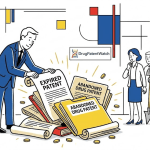
The pharmaceutical industry has a math problem. A blockbuster drug throws off cash at a rate that makes any other R&D bet look stupid by comparison. The expected return on a single additional year of exclusivity on a $10 billion product exceeds the expected return on most new drug discovery programs. This is not a moral observation. It is an arithmetic one, and it is the engine behind every strategic patenting decision made in the major pharmaceutical houses since at least the 1990s.
That math is now changing. The Federal Circuit has affirmed Teva’s loss in the asthma inhaler delisting case. The Federal Trade Commission has issued three rounds of warning letters challenging more than 600 Orange Book patent listings, with several hundred patents already removed [1]. The Inflation Reduction Act has begun to apply downward price pressure on drugs that exhaust their negotiation clock, regardless of how many secondary patents remain in force. Prosecution laches, a doctrine that spent decades essentially dormant, has been resurrected by district courts increasingly willing to scrutinize the timing of continuation filings. The classic playbook still works on many drugs. It is breaking on others. The companies that handle the next five years well will be the ones that figure out which is which.
This article looks at what strategic patenting actually involves today, where the legal exposure has migrated, and how IP teams can build patent estates that withstand both litigation and antitrust scrutiny. It draws on real cases, real settlements, and the patent data that practitioners use to forecast launch dates and assess competitor exposure. Where relevant, it points to how platforms like DrugPatentWatch compile the underlying patent, exclusivity, and litigation records that determine when a product actually faces generic or biosimilar competition rather than when its labels and SEC filings imply it will.
The Economic Stakes Of Pharmaceutical Patent Lifecycle Management
Before getting into the legal mechanics, it is worth being honest about what the numbers look like. The pharmaceutical sector is structurally unlike almost any other industry in the value gap between a patent-protected monopoly and a competitive commodity. A drug that sells for $1,000 per month under exclusivity often sells for under $30 per month two years after generic entry, and sometimes for less than $10. The brand company is not pricing the molecule. It is pricing the legal moat. When the moat goes, so does the price.
That dynamic explains why pharmaceutical companies invest so heavily in delay. A 2024 analysis of patent settlements estimated that extending exclusivity on a top-25 product by a single year generates more free cash flow, in many cases, than the discovery and approval of an average new molecular entity. Pay-for-delay settlements alone cost U.S. consumers an estimated $3.5 billion annually, according to FTC figures cited in congressional testimony [2]. The Humira franchise has generated over $114 billion in revenue for AbbVie since the end of 2016, much of it attributable to the company’s success in delaying U.S. biosimilar entry until 2023 despite the core compound patent expiring in 2016 [3].
What An Extra Year Of Exclusivity Is Actually Worth
The economic calculation is straightforward in concept and ugly in implication. Take a drug doing $5 billion in annual U.S. sales with 80% gross margins. An extra year of monopoly worth $4 billion in gross profit, minus a few hundred million in litigation and prosecution costs, is a return on capital that even the worst-managed pharma company would struggle to fumble. Compare this to the average R&D investment for a new chemical entity, which industry consensus puts somewhere between $1.3 billion and $2.6 billion per approved drug depending on the methodology and whose math you trust. The expected return on prosecuting a continuation application is, dollar for dollar, often higher than the expected return on funding a Phase II program.
This is why R&D leaders rarely set the patent strategy. The business development and legal teams do. The R&D function provides the scientific raw material, and the IP organization decides which inventions get filed, when, and in what jurisdictions. Recognizing this realignment is essential to understanding why drug patent portfolios have grown so much larger over the past two decades. The compound patent estate of a typical 1995 launch contained, on average, three to seven patents. The compound patent estate of a typical 2015 launch contains, on average, between fifteen and forty. For top biologics, the count routinely runs into the hundreds.
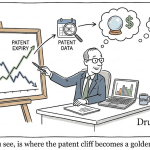
The Patent Cliff Has Become A Patent Slope
The classic patent cliff, where a brand drug loses 80% to 90% of its revenue within twelve months of generic entry, has not disappeared. It still applies to most small-molecule drugs where the compound patent is the only meaningful barrier. What has changed is the frequency of cliffs versus slopes. For the highest-revenue products, particularly biologics, the cliff has been replaced by a managed glide path in which the brand retains substantial market share for years after nominal loss of exclusivity. Humira lost its core patent protection in 2016 and continued to sell at full price until 2023. The strategy that produced this outcome was not an accident. It was the product of a deliberate, well-resourced legal effort that AbbVie spent roughly a decade constructing.
The Humira case is the ceiling, not the template. AbbVie’s 250-patent strategy required a specific combination of regulatory permissiveness under the Biologics Price Competition and Innovation Act, a particular set of biosimilar applicants with limited appetite for full litigation, and the willingness of those applicants to accept a five-year U.S. delay in exchange for early European entry. Reproducing this result on a small molecule, where the regulatory pathway is leaner and the generic challenger economics are more favorable, is much harder.
What Evergreening Actually Means (And Why The Word Is Contested)
The word ‘evergreening’ does a lot of rhetorical work in pharmaceutical policy debates. To critics, it describes any post-approval patent filing that has the effect of extending exclusivity beyond the original compound patent. To pharmaceutical industry defenders, the word itself is a loaded political term used to delegitimize legitimate incremental innovation. Both positions contain some truth, and the dispute over the term obscures more than it clarifies.
A more precise working definition: evergreening is the practice of obtaining secondary patents on a drug product, after the original compound patent has been filed, with the effect (intended or not) of extending the period during which generic or biosimilar competitors cannot enter the market without infringement risk. These secondary patents cover formulations, methods of use, polymorphs, salts, manufacturing processes, dosing regimens, delivery devices, combinations, and various administration techniques.
Secondary Patents Versus Incremental Innovation
Not all secondary patents are evergreening in any pejorative sense. Some reflect genuine clinical advances. Reformulating a drug from a three-times-daily regimen to a once-daily one is an actual improvement in patient adherence and outcomes, and the resulting patent is consistent with the policy goals of the patent system. The same applies to extended-release formulations that reduce dose-related toxicity, or to combination products that improve compliance for chronically ill patients. These inventions are statutorily patentable in the U.S. under 35 U.S.C. §§ 101, 102, and 103, and there is no serious legal argument that they should not be.
The harder cases involve secondary patents that produce no meaningful clinical benefit but happen to be drafted in ways that constrain generic entry. A formulation patent claiming a polymorphic form of a drug substance, where the polymorph was identified after approval and where the original formulation continues to be marketed, is the classic example. So is a method-of-use patent claiming an indication that was disclosed in the original drug label but not separately patented at the time. India’s Section 3(d) of the Patents Act, enacted in 2005, was designed to exclude precisely this category, requiring that new forms of known substances show ‘enhanced efficacy’ to be patentable. The Indian Supreme Court’s 2013 decision in Novartis v. Union of India, which denied a patent on the beta crystalline form of imatinib mesylate, was the most prominent application of Section 3(d) and remains a reference point for jurisdictions considering similar reforms [4].
The Legal Definition Versus The Political One
In the U.S., there is no legal category called ‘evergreening,’ and most secondary patents meet the statutory standards for patentability. The legal questions are narrower: are these patents valid under 35 U.S.C. § 103 obviousness analysis given the prior art? Are they properly listed in the Orange Book? Were they prosecuted in good faith, or was their issuance the result of inequitable conduct, late-filed continuations, or attempts to claim subject matter that was actually in public use? These are the questions that actually determine whether a secondary patent will hold up under challenge.
The political and economic framing is different. When the U.S. House Committee on Oversight and Accountability investigated AbbVie’s Humira patent estate in 2019 and 2020, the operative critique was not that any individual patent was invalid (most of them were never adjudicated on the merits). It was that the aggregate of 250 patent applications, 90% of which were filed after Humira’s 2003 approval, served the primary function of deterring biosimilar entry rather than capturing new inventive contributions [5]. That distinction (statutory validity versus aggregate market effect) is the central problem in modern pharmaceutical patent policy. The patent system rewards individual valid patents. The market effect of large patent portfolios is something the patent system does not, by design, consider.
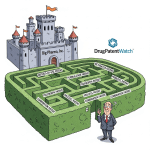
The Patent Thicket: Anatomy Of A Fortress
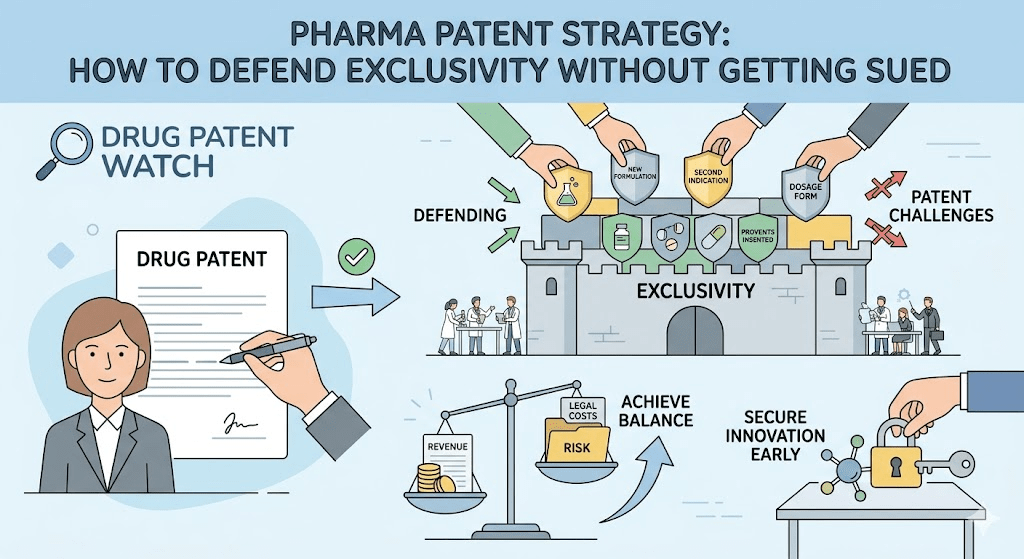
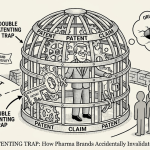
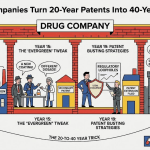
A patent thicket is a specific and aggressive evergreening strategy focused on volume and complexity. Where typical secondary patenting might involve filing one or two patents on a formulation or a method of use, a thicket involves filing dozens or hundreds of overlapping patents on a single product. The objective is not to win every patent challenge. It is to make the prospect of clearing the entire thicket so expensive, time-consuming, and uncertain that generic or biosimilar challengers either settle on the brand’s terms or stay out of the market entirely.
This is the strategy that produced the Humira outcome, the Revlimid outcome, the Lantus outcome, and several others. It is not foolproof. It does not work equally well on small molecules and biologics. It does not work equally well in the U.S. and abroad. But where it works, it works at industrial scale.
Humira: The 250-Patent Strategy
AbbVie filed or obtained more than 250 patents related to Humira (adalimumab) between the drug’s original 1994 invention and the mid-2020s. According to the U.S. House Oversight Committee investigation, 90% of the patent applications were filed after the drug’s 2003 FDA approval, and more than 50% were filed after 2013, a full decade into the product’s commercial life [6]. The composition-of-matter patent (‘382) expired in December 2016. Biosimilar competition in the U.S. did not arrive until January 2023, a delay of more than six years past the core patent expiration.
The mechanism of delay was specific. When biosimilar manufacturers began submitting Abbreviated Biologics License Applications under the BPCIA in 2015 and 2016, the statute’s ‘patent dance’ required them to exchange information with AbbVie about which patents they considered potentially infringed. AbbVie identified large numbers of patents covering manufacturing processes, formulations, dosing regimens, methods of use, and various device aspects of the prefilled syringe and auto-injector. The biosimilar applicants faced a choice: litigate each potentially asserted patent to invalidity or non-infringement, or settle on terms that included delayed U.S. entry. All six biosimilar applicants chose to settle. Under the terms of those settlements, the biosimilar manufacturers received licenses to launch in Europe in October 2018, but agreed to delay U.S. entry until 2023 [3]. Several of them also agreed to pay royalties to AbbVie on their future U.S. sales.
A 2022 academic analysis published in PLOS One found that Humira’s U.S. patent estate consisted of approximately 73 mostly duplicative patents linked by terminal disclaimers, while its European patent estate contained only eight non-duplicative patents. The U.S. portfolio allowed AbbVie to threaten to assert as many as 63 patents against a single biosimilar applicant; the European portfolio supported nothing remotely comparable [7]. The disparity is not an accident of patent law. It reflects deliberate differences in how the USPTO and the European Patent Office handle continuation practice, terminal disclaimers, and the threshold for non-obviousness.
Revlimid And The Volume Restriction Settlement
Celgene (acquired by Bristol Myers Squibb in 2019) constructed a comparable patent estate around lenalidomide (Revlimid). The compound patent expired in 2019, but the company filed more than 206 patents on the product, of which 117 were granted [8]. Beginning in 2015, Celgene reached a series of patent settlements with generic challengers (Natco, Dr. Reddy’s, Alvogen, Sun Pharma, and others) that included volume restrictions, an unusual settlement structure that effectively limited generic supply during the initial post-launch period.
Under the terms of these settlements, the earliest generic entry was authorized in March 2022, but the generic manufacturers were limited to selling no more than 7% of total market volume initially, with gradual increases over the subsequent years [9]. Unlimited generic sales were not authorized until January 31, 2026. The volume restrictions extended the brand company’s effective monopoly by roughly four years beyond the nominal generic entry date and added an estimated $40 billion in revenue that would otherwise have transitioned to lower-cost generics. The FTC, in a 2024 staff report on patent settlements, identified volume restrictions as an emerging category of anticompetitive conduct that may warrant further scrutiny under Section 5 of the FTC Act.
Tracking the actual launch dynamics for products like Revlimid is technically difficult because the settlement terms are often confidential or partially redacted in public filings. The patent listings in the Orange Book, the litigation dockets, and the press releases each tell part of the story. A patent intelligence platform like DrugPatentWatch synthesizes these data sources to produce a clearer picture of when generic competition will actually arrive, as opposed to when the Orange Book listings suggest it might.
Why Thickets Work Even When Individual Patents Are Weak
The economic logic of a patent thicket does not require that individual patents within it be strong. It requires only that some patents be plausibly assertable and that the cost of clearing all of them be high enough to deter challenge. The cost of an inter partes review at the PTAB is approximately $1 million per patent, fully loaded. The cost of full district court litigation on a single patent is several million dollars. When a brand company has 50 to 100 potentially assertable patents, even a generic with a strong overall case must absorb tens or hundreds of millions of dollars in litigation expense before reaching market, with no guarantee of success on every patent.
This is the leverage that drives settlements. The seventh circuit’s 2020 decision in In re Humira Antitrust Litigation made the point explicit: because ‘all it would have taken was one valid and infringed patent to preclude market entry,’ the plaintiffs’ antitrust challenge to the thicket-as-a-whole could not succeed without showing that every patent within the thicket was invalid or not infringed [10]. The court’s reasoning effectively validated the thicket strategy under current antitrust law. The legal cost of dismantling a thicket is borne entirely by the challenger, while the legal cost of constructing one is amortized across the brand company’s revenue stream over many years.
The Evergreening Toolkit
The set of secondary patenting techniques used by pharmaceutical companies has expanded considerably over the past two decades. Here are the four categories that account for most of the actual delay produced by evergreening strategies.
Formulation And Polymorph Patents
Formulation patents claim specific compositions of the active ingredient with excipients, particle sizes, or other physical properties. They are the most common form of secondary patent and the most variable in quality. A patent on a genuinely novel sustained-release formulation that produces measurable clinical improvement is defensible. A patent on a polymorphic form of an active ingredient identified during routine post-approval characterization, where the polymorph confers no clinical benefit, is much more vulnerable to obviousness and prior-use challenges.
The classic example of polymorph patent failure is the Plavix (clopidogrel) case, where Sanofi’s attempt to claim a specific polymorphic form was challenged by Apotex. After extensive litigation, the patent’s enforceability was undermined by evidence of pre-approval public disclosure. The classic example of polymorph patent success is the various patents around imatinib (Gleevec), where Novartis was able to extend effective exclusivity in some jurisdictions through formulation and salt patents, though it lost the polymorph case in India under Section 3(d).
Method-Of-Use Patents
Method-of-use patents claim a particular way of using the drug to treat a specific condition. They are particularly important because they interact with the FDA’s labeling requirements in ways that can produce significant delay even when generic versions of the compound are available. Under the Hatch-Waxman framework, a generic applicant who wants to launch on a drug with method-of-use patents listed in the Orange Book must either certify that those patents are invalid or not infringed (Paragraph IV), or carve out the patented indication from its label under Section viii (the so-called ‘skinny label’).
The skinny label was a workable solution for generics for most of the post-Hatch-Waxman period. The 2021 Federal Circuit decision in GlaxoSmithKline v. Teva Pharmaceuticals USA disrupted that equilibrium. The court affirmed a jury verdict that Teva had induced infringement of GSK’s method-of-use patent on carvedilol (Coreg) for the treatment of congestive heart failure, despite Teva’s having carved out that indication from its generic label. The court’s reasoning focused on Teva’s promotional materials, which the court found had encouraged use of the generic for the carved-out indication, but the practical effect of the decision was to expose all generic skinny-label launches to a degree of inducement risk they had not previously faced [11].
The Federal Circuit narrowed the GSK holding in a subsequent rehearing decision, and several district courts have since distinguished it on the facts (Amarin v. Hikma and Genentech v. Sandoz being the most notable). The net effect is that skinny labels remain viable, but the analysis is now fact-intensive and the litigation risk is materially higher than it was before 2021. Generic manufacturers contemplating skinny-label launches now spend significantly more on prelaunch labeling and promotional review than they did a decade ago.
Device And Delivery Patents
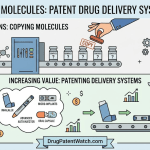
The most active battleground in pharmaceutical patent strategy over the past three years has been device and delivery patents on drug-device combination products. Inhalers, auto-injectors, nasal sprays, and prefilled syringes have all become the subjects of patent thickets that extend protection on the underlying drug well beyond the drug compound patent’s expiration. The strategic logic is straightforward: a generic version of the drug substance is useless to the market without a corresponding delivery device, and a patent on the device can therefore confer effective exclusivity on the drug.
The FTC has taken this category as its primary target. Beginning in September 2023, the agency issued a policy statement signaling that improper Orange Book listings could constitute unfair methods of competition under Section 5 of the FTC Act. In November 2023 and April 2024, the FTC challenged more than 400 device patent listings across 22 brand products. In May 2025, under the Trump administration, the FTC issued a third round of warning letters challenging an additional 200-plus patent listings on 17 brand products, including products from AstraZeneca, Boehringer Ingelheim, GlaxoSmithKline, and Teva [1]. The challenged patents primarily covered inhaler, auto-injector, and nasal spray devices for asthma, COPD, diabetes, and epinephrine emergency products.
The legal foundation for the FTC’s campaign was substantially strengthened by the Federal Circuit’s December 2024 decision in Teva Branded Pharmaceutical Products R&D, Inc. v. Amneal Pharmaceuticals, which affirmed a district court order requiring Teva to delist five inhaler device patents from the Orange Book. The Federal Circuit denied Teva’s request for en banc rehearing in March 2025, and Teva’s petition for Supreme Court review was pending as of mid-2025. The practical effect: the legal standard for what qualifies as a properly listed Orange Book patent has been clarified in a way that makes most device patents ineligible for listing [12].
Despite the legal clarification, compliance has been uneven. According to FDA’s July 2025 update on patent listing disputes, of the ten NDAs subject to FTC’s May 2025 warning letters, only one had its Orange Book listing modified. The other nine NDAs remained unchanged as of mid-2025 [13]. The pattern echoes the 2024 results, when similar FTC warning letters produced limited delisting. The brand companies appear to be calculating that the cost of maintaining the listings (and the resulting 30-month stays on generic approval) exceeds the antitrust and regulatory exposure of doing so, at least until the Federal Circuit’s ruling is binding precedent in their specific cases.
Combination And Pediatric Exclusivity Strategies
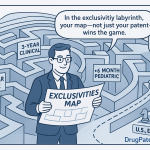
Two related categories deserve mention. Combination patents (claiming the brand drug in combination with another active ingredient) can extend protection by capturing the most common prescribing patterns. Pediatric exclusivity, granted under Section 505A of the Federal Food, Drug, and Cosmetic Act in exchange for conducting pediatric studies, adds six months of exclusivity to all forms of a drug that share an active moiety. The pediatric add-on, when stacked with other forms of exclusivity, can produce additional delay disproportionate to the actual research investment. AbbVie obtained pediatric exclusivity on Humira despite the drug being primarily used in adult populations, contributing to the overall delay of biosimilar entry.
The Legal Counterforces Gaining Traction
The pharmaceutical patent strategies described above worked, for the most part, throughout the 2000s and 2010s. They are now under sustained pressure from four legal and regulatory developments. None of these developments individually breaks the strategy. Together, they have changed the risk-return calculus enough that competent IP teams are revising their approach.
FTC Orange Book Challenges And The Teva Inhaler Ruling
The FTC’s Orange Book campaign is the most visible of the four. Three rounds of warning letters between November 2023 and May 2025 have challenged the propriety of patent listings covering device components, formulation properties, and manufacturing processes. The legal theory is that improperly listed patents trigger the 30-month stay on generic approval under Hatch-Waxman in cases where the patents do not actually ‘claim the drug’ as required by 21 U.S.C. § 355(b). The Federal Circuit’s Teva inhaler decision affirmed the basic legal framework: a patent that does not claim either the approved drug substance or the approved drug product (in a way that would be infringed by the drug) is not properly listed in the Orange Book [12].
The practical implications go beyond inhalers. The same legal reasoning applies to auto-injector patents on GLP-1 products like semaglutide and tirzepatide, to nasal spray patents on naloxone products, and potentially to manufacturing process patents listed under aggressive interpretations of the ‘claim the drug product’ standard. The FTC has indicated it intends to expand its scrutiny to additional categories of allegedly improper listings, including patents on dosing regimens and various forms of method-of-use patents that may not satisfy the statutory definition.
Prosecution Laches: A Sleeping Doctrine Wakes Up
Prosecution laches is an equitable doctrine that allows a court to render a patent unenforceable if the patent owner unreasonably and inexcusably delayed prosecution of the patent and the delay caused prejudice to the accused infringer. For decades, the doctrine was almost never successfully invoked. That changed with the Federal Circuit’s 2023 decision in Sonos v. Google, which affirmed a finding of prosecution laches against patents that had been kept pending for unusually long periods through continuation practice.
The application to pharmaceutical patents has been slower but is now appearing. In Corcept Therapeutics v. Teva, a district court expressed open exasperation with Corcept’s pattern of late-filed continuations covering Korlym (mifepristone), with one of the patents in suit (the ‘801 patent) issuing from a continuation filed more than six years earlier [14]. The Federal Circuit has not yet ruled on the case, but the district court’s willingness to entertain prosecution laches arguments against pharmaceutical patents represents a meaningful shift. Late-filed continuations have been a central feature of pharmaceutical patent thickets for decades, and the prospect that they might be subject to unenforceability findings adds a new dimension of risk to the strategy.
Skinny Labels And The GSK V. Teva Aftermath
The GSK v. Teva decision and its progeny have not eliminated skinny labels, but they have changed the operational risk profile for generic launches. A generic manufacturer launching on a drug with method-of-use patents listed in the Orange Book now needs to: review its label carefully for any text that could be construed as encouraging use for the carved-out indication; review its promotional materials with the same care; avoid press releases or marketing communications that emphasize ‘AB-rated’ equivalence in ways that might be read to encompass the patented indication; and document the absence of inducement clearly in case of subsequent litigation.
These steps are not impossible, but they add cost and risk. In some cases, they have caused generic manufacturers to delay launch until method-of-use patents expire rather than attempt a skinny-label launch with inducement exposure. The result, from the brand company’s perspective, is a small but meaningful extension of effective exclusivity even on drugs where the compound patent has expired.
Inter Partes Review And The PTAB
The Patent Trial and Appeal Board’s inter partes review process, established by the America Invents Act in 2011, remains the most cost-effective tool available to generic and biosimilar challengers for invalidating individual patents. The cost of an IPR is roughly $500,000 to $1.5 million per patent, compared to several million dollars for district court litigation. The success rate for petitioners has been substantial, with the PTAB invalidating challenged claims in approximately 60% to 70% of instituted proceedings.
The PTAB has been the venue where many secondary patents have actually been invalidated. The board’s procedures favor focused technical analysis over the broader evidentiary framework of district court litigation, which tends to advantage petitioners challenging the obviousness of incremental patents. The 2020 decision against Celgene’s Revlimid patents in IPR proceedings filed by Dr. Reddy’s, while not invalidating the core patent estate, did substantially weaken several secondary patents and contributed to the pressure that led to the eventual settlement structure.
The procedural rules around IPR have shifted under different USPTO directors. The Fintiv discretionary denial doctrine, which allows the PTAB to deny institution when parallel district court litigation is well underway, was tightened in 2022 and partially restored in 2024 under the current administration. The current state of IPR practice is more favorable to challengers than at any time since 2020, though the precise institution rate fluctuates with USPTO policy changes.
The Inflation Reduction Act Changes The Math
The Inflation Reduction Act of 2022 introduced a new variable into pharmaceutical patent strategy that may matter more, over time, than any of the patent-specific reforms discussed above. The IRA’s Medicare Drug Price Negotiation Program establishes a ‘maximum fair price’ for selected high-spend drugs, regardless of the strength of the underlying patent protection. The first ten drugs (which include Eliquis, Jardiance, Januvia, Farxiga, Entresto, Enbrel, Imbruvica, Stelara, Xarelto, and the Fiasp/NovoLog insulin products) saw negotiated prices take effect on January 1, 2026, with reductions averaging 38% to 60% off 2023 list prices [15].
The Centers for Medicare and Medicaid Services announced a second round of 15 drugs in January 2025, with negotiated prices effective in 2027, and a third round in January 2026, with prices effective in 2028. The program’s expansion to additional drugs each year, combined with its eventual extension to Part B (physician-administered) drugs starting in 2028, means that essentially every high-revenue brand drug in the U.S. market will eventually face mandatory price negotiation.
According to the Congressional Budget Office, the Medicare Drug Price Negotiation Program is projected to save the federal government approximately $98.5 billion over the 2026-2031 budget window, with the savings concentrated in drugs that have substantial Medicare utilization and limited generic or biosimilar competition during the negotiation window [16].
Why The Seven-Year Clock Undermines Secondary Patenting
The IRA’s eligibility criteria are the part of the statute that most directly intersects with patent strategy. A small-molecule drug becomes eligible for negotiation seven years after FDA approval, with prices taking effect two years later (so nine years after approval). A biologic becomes eligible eleven years after licensure, with prices taking effect thirteen years after licensure. These thresholds were chosen to align roughly with the periods during which the original compound patent and FDA exclusivities would normally protect the product.
Here is the strategic implication. Under the pre-IRA framework, a brand company could extend exclusivity through secondary patents indefinitely, and each additional year of exclusivity translated directly into additional revenue at the brand price. Under the IRA framework, secondary patents do not change the eligibility date for negotiation. A drug whose compound patent expires fifteen years after approval but whose method-of-use patents extend to year twenty is still subject to Medicare negotiation starting in year nine. The negotiated price applies whether or not generic or biosimilar entry has occurred.
This decoupling fundamentally changes the math on secondary patenting. The marginal value of an extra year of exclusivity is no longer the brand price minus the generic price. It is the brand price minus the negotiated maximum fair price, which for the first ten negotiated drugs is roughly 30% to 60% lower than the brand price. The IRA does not eliminate the incentive to extend exclusivity, but it materially reduces it.
The Biologic Eleven-Year Window And Biosimilar Timing
The IRA’s longer eligibility window for biologics (eleven years from licensure versus seven for small molecules) reflects a policy judgment that biosimilar entry takes longer to materialize, on average, than small-molecule generic entry. The differential has been criticized by industry advocates as creating a perverse incentive to favor biologic over small-molecule development, given that biologics receive a longer exclusivity grace period.
The CMS Secretary has discretion under the statute to delay negotiation of a qualifying biologic for up to two additional years if there is a high likelihood of biosimilar entry. The provision creates a strategic option for biologic manufacturers: settle biosimilar litigation in a way that produces credible imminent biosimilar entry, and the negotiation eligibility may be deferred. The provision has been invoked sparingly to date, but it represents a meaningful planning consideration for biologics approaching the eleven-year threshold.
For biosimilar manufacturers, the IRA creates a new strategic consideration. Launching a biosimilar before the originator’s IRA negotiation eligibility date may actually be less valuable than launching after, because the biosimilar price will need to compete against the negotiated maximum fair price rather than the original brand price. The economics of biosimilar development are sensitive to this differential, and at least one biosimilar company has restructured its launch timing in light of the IRA dynamics.
Building A Defensible Patent Strategy In 2026
Given the legal and regulatory shifts described above, what does a defensible patent strategy look like for a pharmaceutical company entering a new product launch or facing imminent loss of exclusivity on an existing one? The answer depends heavily on the specific product, indication, and competitive landscape, but four principles apply across most situations.
File For Innovation, Not Delay
The first principle is that secondary patents are most defensible when they reflect genuine clinical or technical innovation. A formulation patent that produces measurable clinical benefit (improved bioavailability, reduced dosing frequency, lower toxicity) is far more likely to withstand obviousness challenge than one that captures incremental physical properties without clinical significance. The same applies to method-of-use patents claiming genuinely novel indications, and to device patents that meaningfully change the user experience or therapeutic profile.
The implication for IP teams is that the patent strategy should be tightly aligned with the R&D and clinical development functions. The patents most worth filing are those that follow from actual clinical or technical findings, not those that are reverse-engineered from a desire to extend exclusivity. This is not just an ethical observation. It is a practical one: late-filed continuations covering subject matter that was actually disclosed years earlier are increasingly vulnerable to prosecution laches, written description, and obviousness attacks. The strategy that worked in 2010 carries materially more risk in 2026.
Documentation And Prosecution Discipline
The second principle is documentation. The cases that have produced the most damaging adverse rulings against pharmaceutical patent holders (Humira inequitable conduct allegations, Corcept prosecution laches findings, Teva Orange Book delisting) have often turned on procedural and documentary issues rather than substantive patent validity. IP teams that maintain rigorous prosecution histories, file continuations with clear technical justification, and document the inventive contribution of each claim are materially better positioned than those that take a more aggressive approach.
Specific practices that matter: maintaining contemporaneous records of when invention disclosures were made and when claims were drafted; avoiding terminal disclaimers across patent families when they are not strictly necessary, because terminal disclaimers can be evidence of duplicative claiming; ensuring that all material prior art is disclosed to the USPTO during prosecution; and being cautious about filing continuations more than three to five years after the original disclosure if the claim scope is meaningfully different.
Settlement Timing And Antitrust Exposure
The third principle concerns settlement strategy. Patent settlements with generic challengers have been a routine feature of Hatch-Waxman practice since the 1990s, and they remain legal in principle. But the antitrust scrutiny applied to them has intensified since the Supreme Court’s 2013 FTC v. Actavis decision, which held that ‘reverse payment’ settlements (where the patent holder pays the challenger to delay launch) can violate the antitrust laws under a rule-of-reason analysis.
The post-Actavis world is one in which patent settlements need to be structured carefully. Settlements that involve large reverse payments are presumptively suspect. Settlements that include ‘no authorized generic’ provisions (where the brand agrees not to launch its own authorized generic in exchange for the challenger’s delayed entry) face increasing scrutiny. Volume restrictions of the Revlimid type are a newer category that has not yet been definitively addressed by the courts but that the FTC has identified as a target of future enforcement. The general principle for IP and antitrust counsel: structure settlements to involve only licensing and entry-date terms, document the patent strength that justifies the entry date, and avoid value transfers that could be characterized as reverse payments.
The Two Strategic Questions
For any specific product, the strategic patenting questions reduce to two:
First, what is the marginal value of an additional year of exclusivity, given the IRA negotiation eligibility and the competitive landscape? On products subject to IRA negotiation, this value is substantially lower than it would have been pre-IRA. On products where the patent runway extends well past the IRA eligibility date, the marginal value is the difference between the brand price and the negotiated maximum fair price, which may not justify aggressive secondary patenting.
Second, what is the litigation risk associated with each additional secondary patent, considering FTC scrutiny, prosecution laches exposure, and the cost of defending the patent if challenged? Each additional secondary patent carries some baseline risk of contributing to an antitrust or inequitable conduct theory, and the marginal risk increases as the size of the portfolio grows. There is a point at which adding more patents to a thicket increases legal exposure faster than it increases expected exclusivity.
How Patent Intelligence Platforms Factor In
Patent strategy at the level of detail required to navigate the current landscape is data-intensive. An IP team responsible for either prosecuting a brand portfolio or challenging a competitor’s needs ongoing access to the patent filings, Orange Book listings, exclusivity records, litigation dockets, settlement disclosures, and biosimilar pipeline data for hundreds of products. This is the function that patent intelligence platforms like DrugPatentWatch provide.
The data infrastructure question matters more than it used to. Five years ago, an IP team could maintain reasonable situational awareness through a combination of FDA Orange Book queries, PACER litigation searches, and the company’s own legal database. Today, the velocity of FTC enforcement actions, the complexity of biosimilar BPCIA proceedings, the rate of new patent filings on existing products, and the IRA negotiation timelines have outpaced what a small IP team can reasonably maintain through manual processes. The companies that handle the current environment well are typically those that have invested in patent intelligence infrastructure that covers competitor activity in near real time.
For generic and biosimilar challengers, the intelligence question is equally critical. The decision to file an ANDA Paragraph IV certification or a biosimilar aBLA is driven in part by the analysis of the brand company’s patent estate: which patents are listed, when they expire, which have been challenged at the PTAB or in district court, and which the brand has shown willingness to assert. A platform that aggregates this data and surfaces patents likely to issue or be added to the Orange Book provides material advantages in pipeline planning and litigation budgeting.
The same logic applies to investors and consultants. Patent expiration dates listed in company SEC filings or analyst reports are often the simple compound patent dates, which can dramatically overstate the actual time to generic entry on products with substantial secondary patent estates. A forecasting framework that accounts for the full patent landscape, the FTC’s expected delisting activity, and the IRA’s negotiation timeline produces materially different estimates than one that relies on the headline patent expiration date.
Recent And Pending Cases That Will Shape The Next Five Years
Four litigation matters bear watching for IP teams and investors. Each of them will likely produce rulings between 2026 and 2028 that shape the future of pharmaceutical patent strategy.
Teva Inhaler Supreme Court Petition
Teva petitioned for Supreme Court review of the Federal Circuit’s December 2024 ruling requiring delisting of the five inhaler device patents. If certiorari is granted (which appeared unlikely as of mid-2025), the case could produce a ruling that either confirms or modifies the legal standard for Orange Book listings. If certiorari is denied, the Federal Circuit’s standard will be binding precedent, and the FTC will be in a strong position to compel additional delistings across the industry.
Corcept Prosecution Laches Appeal
The Corcept-Teva litigation over Korlym is making its way through the Federal Circuit on issues including prosecution laches. A ruling that affirms the district court’s prosecution laches reasoning would significantly raise the bar on late-filed continuations and would force a re-evaluation of many existing pharmaceutical patent estates that were built through continuation practice.
The Pending FTC Section 5 Actions
The FTC has indicated it may bring direct Section 5 enforcement actions against companies that fail to delist patents in response to its warning letters. The first such action, if it materializes, would establish the legal framework for pursuing Orange Book delisting outside the FDA’s administrative dispute process. The threat alone is changing behavior, but a concrete enforcement action would produce more decisive industry response.
The Avadel CNS Pharmaceuticals Permanent Injunction Question
The Federal Circuit’s May 2025 ruling in Jazz Pharmaceuticals v. Avadel CNS Pharmaceuticals raised, without resolving, the question of whether submitting a new drug application for a drug covered by an unlisted patent can constitute infringement under 35 U.S.C. § 271(e)(2) [17]. The case is significant because it touches on the scope of patent enforcement against new drug applicants outside the formal Hatch-Waxman framework. A definitive answer would have implications for non-listed patents and for the safe-harbor protections under Section 271(e)(3).
The Practical Strategy For 2026 And Beyond
The pharmaceutical patent practitioner working in 2026 is operating in an environment that is materially different from the one in 2020 and almost unrecognizable from the one in 2010. The classic playbook (file aggressively, list broadly, settle defensively, repeat) still works on some products, but its risk profile has changed substantially.
The teams that are likely to outperform in the current environment share several characteristics. They take a portfolio view that recognizes the IRA’s effect on the marginal value of exclusivity extensions. They maintain prosecution discipline that minimizes exposure to laches, inequitable conduct, and Orange Book delisting risks. They use settlement structures that withstand antitrust scrutiny. And they invest in patent intelligence infrastructure that lets them respond quickly to FTC actions, competitor filings, and court rulings.
For generic and biosimilar manufacturers, the picture is more favorable than it has been in over a decade. The FTC’s Orange Book campaign has removed barriers to entry on dozens of products. The Teva inhaler precedent has clarified the legal standard. The IRA has reduced the brand pricing premium that supports aggressive defensive patent strategies. The companies that move quickly on the resulting opportunities are likely to capture meaningful share before brand companies adapt.
For investors and analysts, the implication is that simple patent expiration dates have become substantially less reliable as predictors of generic entry. The actual loss of exclusivity for a given product depends on the full patent landscape, the FTC’s enforcement priorities, the IRA’s negotiation timeline, and the specific litigation posture of the brand and generic parties involved. Pricing in this complexity requires more granular data than was needed five years ago.
The pharmaceutical industry has always been an exercise in legal arbitrage as much as scientific discovery. The relative weight of those two activities is shifting, slowly, toward the scientific side. The companies that recognize that shift and adapt to it will produce better returns over the next five years than those that continue to optimize for the legal arbitrage that defined the previous fifteen.
Key Takeaways
The pharmaceutical patent landscape in 2026 looks different from the one that existed even three years ago, and the rate of change is accelerating. Four points stand out for IP teams, generic and biosimilar developers, and investors trying to assess actual loss-of-exclusivity timelines.
The economic incentive to extend exclusivity remains substantial but is materially smaller than it was pre-IRA. The negotiated maximum fair prices on the first ten Medicare-negotiated drugs averaged 38% to 60% below 2023 list prices, which reduces the brand-to-generic price gap that drives evergreening economics. For drugs subject to negotiation, the marginal value of an additional year of exclusivity is roughly half what it would have been in the pre-IRA environment.
The legal counterforces have moved from theoretical to operational. The Teva inhaler delisting decision, the FTC’s three rounds of warning letters covering 600-plus patents, the Corcept prosecution laches rulings, and the post-GSK skinny label landscape have each established concrete legal exposure for strategies that were essentially risk-free a decade ago. The cost of aggressive patent thicket construction now includes meaningful FTC, antitrust, and unenforceability risk.
Patent intelligence has become a meaningful competitive advantage. The Orange Book listings, litigation dockets, settlement disclosures, FTC actions, and IRA timelines that together determine actual generic entry dates are scattered across multiple data sources and changing rapidly. Platforms like DrugPatentWatch that aggregate this information let IP teams identify opportunities and risks faster than competitors who rely on manual processes.
The strategic patent practice of 2030 will reward genuine innovation more than incremental claim drafting. The combination of IRA price controls, FTC enforcement, and judicial willingness to scrutinize prosecution practice means that secondary patents covering real clinical advances will continue to provide meaningful exclusivity, while secondary patents covering minor technical variations will face increasing challenge. The IP teams that align closely with R&D will outperform those that operate as standalone legal functions.
Frequently Asked Questions
Is patent evergreening illegal in the United States?
Most forms of evergreening are legal under U.S. patent and pharmaceutical law. Filing secondary patents on new formulations, methods of use, or delivery devices is permitted if the patents meet the statutory standards of novelty, utility, and nonobviousness under 35 U.S.C. §§ 101, 102, and 103. What has changed is the legal exposure on specific tactics. Improperly listing patents in the Orange Book, structuring settlements as reverse payments, and pursuing late-filed continuations covering subject matter disclosed years earlier all carry significant legal risk under recent FTC enforcement and Federal Circuit rulings, even though the underlying patents themselves may be valid.
How long can a pharmaceutical company realistically extend exclusivity through a patent thicket?
The realistic extension varies dramatically by product type. For small-molecule drugs, well-designed thickets typically extend effective exclusivity by two to five years past the compound patent expiration. For biologics, the extension can be much longer; AbbVie’s Humira strategy produced six-plus years of additional U.S. exclusivity past the 2016 core patent expiration. The eventual cap is set by the willingness of generic or biosimilar challengers to litigate the full thicket, the cost of doing so, and now by the Medicare Drug Price Negotiation Program eligibility timing, which can reduce the brand price even while the thicket remains formally intact.
What is the difference between a patent thicket and ordinary patent lifecycle management?
Patent lifecycle management is the broader practice of filing follow-on patents that reflect ongoing research and development on a product. A patent thicket is the specific tactic of filing many overlapping patents primarily to deter challenge through litigation cost rather than to capture distinct inventive contributions. The legal distinction is not always clear, but the practical distinction is that lifecycle management patents tend to claim meaningful technical or clinical advances, while thicket patents tend to be characterized by high volume, terminal disclaimers, late prosecution timing, and substantial overlap among claims.
How does the Inflation Reduction Act affect biosimilar developers?
The IRA creates both opportunities and complications for biosimilar developers. On the opportunity side, the negotiated maximum fair prices on biologics will lower the brand price that biosimilars need to undercut, but this is partially offset by the reduced pricing headroom the biosimilar can claim. On the complication side, the CMS Secretary’s discretion to defer biologic negotiation by up to two years when biosimilar entry is imminent creates strategic interaction between settlement timing and IRA eligibility. Biosimilar developers approaching launch on an IRA-eligible biologic need to model these dynamics carefully, often using patent intelligence platforms to track the brand company’s likely settlement and litigation moves.
What should a small biotech do if it lacks resources to challenge a larger competitor’s patent thicket?
Smaller companies facing entrenched competitor patent estates have several practical options that do not require full-scale litigation budgets. The first is to focus development on indications, formulations, or delivery routes that the competitor’s patents do not cover, which often requires careful patent landscape analysis at the early development stage. The second is to use inter partes review at the PTAB, which is substantially cheaper than district court litigation and has produced meaningful invalidations of secondary patents in recent years. The third is to file petitions with the FDA’s Orange Book dispute process or with the FTC, both of which have been increasingly responsive to challenges to improper listings. The fourth is to use patent intelligence platforms to identify weak points in a competitor’s patent estate that can be challenged through narrow, cost-efficient proceedings rather than broad-front litigation.
References
[1] Federal Trade Commission. (2025, May 21). FTC renews challenge of more than 200 improper patent listings. https://www.ftc.gov/news-events/news/press-releases/2025/05/ftc-renews-challenge-more-200-improper-patent-listings
[2] Congressional Research Service. (2025). Patent listing in FDA’s Orange Book (Report IF12644). https://www.congress.gov/crs-product/IF12644
[3] DrugPatentWatch. (2025). The thicket maze: A strategic guide to navigating and dismantling drug patent fortresses. https://www.drugpatentwatch.com/blog/the-thicket-maze-a-strategic-guide-to-navigating-and-dismantling-drug-patent-fortresses/
[4] International Journal of Legal Science and Social Studies. (2025). Patent evergreening in the pharmaceutical industry: Legal loophole or strategic innovation? https://ijlsss.com/patent-evergreening-in-the-pharmaceutical-industry-legal-loophole-or-strategic-innovation/
[5] U.S. House Committee on Oversight and Reform. (2021). Drug pricing investigation: AbbVie – Humira and Imbruvica. Staff report.
[6] AJMC. (2025). Humira: The first $20 billion drug. American Journal of Managed Care. https://www.ajmc.com/view/humira-the-first-20-billion-drug
[7] Storz, U. (2022). Biological patent thickets and delayed access to biosimilars, an American problem. Journal of Law and the Biosciences. https://pmc.ncbi.nlm.nih.gov/articles/PMC9439849/
[8] Initiative for Medicines, Access & Knowledge (I-MAK). (2025, April 4). How Celgene and Bristol Myers Squibb used volume restrictions to delay Revlimid competition. https://www.i-mak.org/2025/04/04/how-celgene-and-bristol-myers-squibb-used-volume-restrictions-to-delay-revlimid-competition/
[9] Bristol Myers Squibb. (2020). Bristol Myers Squibb announces settlement of U.S. patent litigation for REVLIMID with Dr. Reddy’s. https://news.bms.com/news/details/2020/Bristol-Myers-Squibb-Announces-Settlement-of-U.S.-Patent-Litigation-for-REVLIMID-lenalidomide-With-Dr.-Reddys/default.aspx
[10] Mintz Levin. (2020). AbbVie’s enforcement of its ‘patent thicket’ for Humira under the BPCIA. https://www.mintz.com/insights-center/viewpoints/2231/2020-06-18-abbvies-enforcement-its-patent-thicket-humira-under
[11] Cooley LLP. (2021). GSK v. Teva: Federal Circuit opinion after rehearing confirms induced infringement liability despite skinny label. https://www.cooley.com/news/insight/2021/2021-08-17-gsk-v-teva-federal-circuit-opinion-rehearing-induced-infringement-liability-skinny-label
[12] McDermott Will & Emery. (2025, June 4). FTC revives Orange Book listing challenges. https://www.mwe.com/insights/ftc-revives-orange-book-listing-challenges/
[13] Polsinelli. (2025, July). Device patents in the Orange Book: May 21, 2025, FTC warning letters appear to have minimal impact. https://natlawreview.com/article/device-patents-orange-book-may-21-2025-ftc-warning-letters-appear-have-minimal
[14] Markman Advisors. (2025, June 30). Could prosecution laches threaten Big Pharma patent evergreening? https://www.markmanadvisors.com/blog/2025/6/27/could-prosecution-laches-threaten-big-pharma-patent-evergreening
[15] Centers for Medicare & Medicaid Services. (2024). Medicare Drug Price Negotiation Program: Negotiated prices for initial price applicability year 2026. https://www.cms.gov/newsroom/fact-sheets/medicare-drug-price-negotiation-program-negotiated-prices-initial-price-applicability-year-2026
[16] Congressional Research Service. (2024). Medicare drug price negotiation under the Inflation Reduction Act: Industry responses and potential effects (Report R47872). https://www.congress.gov/crs-product/R47872