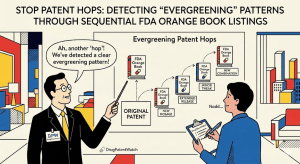
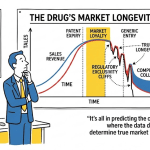
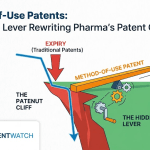
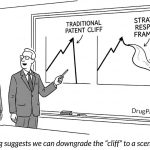
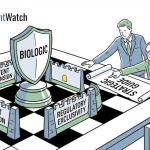
The pharmaceutical industry operates on a model where the expiration of a primary patent is no longer the end of a drug’s market dominance. For decades, the industry accepted the concept of a patent cliff, a sharp drop in revenue occurring the moment a chemical entity lost its 20-year protection. Modern legal and regulatory strategies have replaced this cliff with a managed slope. Pharmaceutical manufacturers now use sequential listings in the Food and Drug Administration (FDA) Orange Book to evergreen their products, extending market exclusivity far beyond the original intent of the Hatch-Waxman Act.
Evergreening is a deliberate business strategy to maintain high prices by obtaining additional patents on minor modifications of an existing drug. These modifications rarely involve a new therapeutic breakthrough. Instead, they focus on different salt forms, new dosages, or the mechanical parts of delivery devices like inhalers and auto-injectors. The objective is to use the regulatory machinery of the FDA to block generic competitors from entering the market, often for a decade or more after the original drug molecule has lost its primary patent protection.
The Economic Engine of Exclusivity Extension
The financial incentive to extend a drug’s life is clear. When a blockbuster drug loses exclusivity, its revenue often drops by 90% within months of generic entry. For a product generating $10 billion annually, every month of delayed competition is worth approximately $830 million. This creates a situation where the return on investment for legal maneuvering and secondary patenting far exceeds the return on discovering a new molecular entity.
The cost to develop a new drug is estimated at $2.6 billion, a process that takes 10 to 13 years. Because the 20-year patent term starts when the application is filed, a drug often has only 7 to 12 years of market life remaining by the time it reaches patients. Manufacturers argue that evergreening is a necessary response to this development deficit, providing the resources needed to fund future innovation. Critics and regulators see it as a manipulation of the patent system that prevents access to affordable medicine.
Strategic Anatomy of the Orange Book
The Orange Book, officially titled Approved Drug Products with Therapeutic Equivalence Evaluations, is the central database for pharmaceutical patents in the United States. It lists patents that the brand manufacturer claims cover the approved drug. Under the Hatch-Waxman Act, generic manufacturers must certify against every patent listed in the Orange Book for their chosen reference drug.
The 30-Month Stay as a Financial Instrument
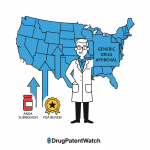
The most powerful tool in the evergreening arsenal is the 30-month stay. If a generic manufacturer files an Abbreviated New Drug Application (ANDA) and asserts that an Orange Book patent is invalid or will not be infringed (a Paragraph IV certification), the brand manufacturer can file a lawsuit within 45 days. This filing triggers an automatic, 30-month suspension of the FDA’s ability to approve the generic drug.
Mechanism
Trigger
Effect
Statutory Basis
Paragraph IV Certification
Generic ANDA filing
Notifies brand of patent challenge
21 U.S.C. § 355(j)
Infringement Suit
Suit filed within 45 days
Automatic 30-month approval stay
21 U.S.C. § 355(c)
Pediatric Exclusivity
FDA-requested studies
6-month extension to all barriers
21 U.S.C. § 355a
Orphan Exclusivity
Rare disease approval
7-year block on same-drug approval
21 U.S.C. § 360bb
The stay does not require the brand to prove its case or demonstrate the validity of the patent. The mere act of litigation purchases two and a half years of guaranteed market exclusivity. This period allows the brand to maintain its monopoly price and, more importantly, provides a window to execute a product hop, moving patients to a new version of the drug before the generic arrives.
The Mechanics of Sequential Listing
Sophisticated brand strategies involve timing the listing of patents to maximize these delays. Historically, manufacturers could stack 30-month stays by listing new patents just as an old stay was expiring. While regulatory changes in the early 2000s limited this practice, manufacturers still use sequential filings of secondary patents to create a rolling barrier of litigation.
A manufacturer might list a formulation patent shortly after approval, followed by a method of use patent several years later, and finally a device patent as the original molecule patent nears expiration. Each listing creates a new friction point for generic firms. According to DrugPatentWatch, tracking these filing dates and the resulting litigation timelines is essential for understanding when a generic will actually reach the market.
Taxonomy of Secondary Patents
A drug’s monopoly is rarely protected by one patent. It is guarded by a patent thicket, a dense web of overlapping intellectual property rights. These patents are categorized by what they protect, with each type serving a specific strategic purpose in the lifecycle management process.
Formulation and Polymorph Shields
Formulation patents cover the specific mixture of the active ingredient with inactive excipients. These often include extended-release coatings, specific salt forms, or new concentrations designed to reduce injection pain. These modifications are frequently timed to coincide with the expiration of the primary compound patent.
Polymorph patents protect specific crystalline structures of the drug molecule. A chemical entity can exist in multiple solid forms, and patenting a specific polymorph can block generics even if the molecule itself is off-patent. In the case of Revlimid, polymorph patents were the primary mechanism used to extend the monopoly until 2027.
Device Components as Competitive Moats
For drugs delivered via inhalers, injector pens, or patches, the delivery device is a significant barrier to entry. Manufacturers patent the mechanical components of these devices separately from the drug itself. A generic firm might have the right to produce the drug molecule but is blocked from the market because it cannot sell it without an infringing device.
Product Type
Average Device Patent Count
Median Exclusivity Extension
Key Examples
Respiratory Inhalers
10–20
4.7 Years
Advair, Spiriva, Symbicort
Insulin Pens
5–15
9.0 Years
Lantus SoloSTAR, Humalog KwikPen
Auto-Injectors
3–10
5.0 Years
EpiPen, Auvi-Q, Humira Pen
Transdermal Patches
2–5
3.5 Years
Fentanyl, Lidocaine
The strategic value of device patents is that they often expire decades after the drug molecule. Research indicates that device patents extended the market exclusivity of 14 combination products by a median of 9.0 years. The dose counter on an inhaler or the spring mechanism in an auto-injector becomes a legal moat that protects a multi-billion dollar drug.
Case Study: The Adalimumab Fortress
AbbVie’s Humira (adalimumab) is a textbook example of how a patent thicket prevents competition. Although the primary patent for the adalimumab molecule expired in 2016, biosimilar competition in the United States did not arrive until 2023. During this seven-year delay, Humira generated tens of billions of dollars in US sales, reaching $20.7 billion in 2021 alone.
US versus European Patent Density
The Humira case highlights the difference between the US and European patent systems. In the United States, AbbVie obtained or applied for over 250 patents for Humira. Of the 130 patents in its US portfolio, 80% were considered duplicative and were linked by terminal disclaimers. A terminal disclaimer is a tool that allows a company to get multiple patents for the same invention as long as they all expire on the same day.
Metric
Humira (United States)
Humira (European Union)
Total Patent Applications
250+
~20
Total Granted Patents
130+
8
Years of Post-API Exclusivity
7 Years
0 Years
Primary Strategy
Overlapping Thicket
Core Innovations
In Europe, the patent system does not allow for this level of duplication. The European Patent Office granted only eight non-duplicative patents for Humira, allowing biosimilars to enter the market in October 2018, immediately after the molecule protection lapsed. The US thicket forced biosimilar manufacturers into years of litigation, eventually resulting in settlements that delayed their launch until 2023.
Settlement Sequences and Market Erosion
AbbVie used its thicket to orchestrate a controlled entry of competitors. It reached settlements with several biosimilar companies, including Amgen, Samsung Bioepis, and Mylan, that permitted them to enter the US market in 2023. This staggered launch allowed AbbVie to manage its revenue decline and maintain its dominant market share for as long as possible. The lack of competition during the seven-year delay is estimated to have cost the US healthcare system over $7.6 billion.
Case Study: Revlimid and Volume Control
Celgene’s Revlimid (lenalidomide) provides another look at how companies avoid the patent cliff. Revlimid is used to treat multiple myeloma and other blood cancers, generating over $12 billion in annual sales at its peak. Celgene built a fortress of patents covering the chemical molecule, its various polymorphs, and the mandatory REMS (Risk Evaluation and Mitigation Strategy) program used to distribute the drug.
The Polymorph Defense
While the primary composition patent for lenalidomide expired in 2019, Celgene asserted secondary patents covering two specific crystalline forms, or polymorphs, of the drug. One of these patents does not expire until April 2027. These polymorph patents were the center of litigation against generic firms like Dr. Reddy’s and Natco Pharma. By asserting these patents, Celgene was able to force generics into settlements rather than facing a full market launch.
The Gradual Ramp Strategy
The settlements reached for Revlimid did not allow for immediate, unlimited generic competition. Instead, they created a volume-limited launch. Starting in March 2022, certain generic manufacturers were permitted to launch, but their sales were capped at a small percentage of the total market.
Time Period
Market Share for Generics
March 2022 – March 2023
Single-digit percentage
March 2023 – March 2024
Mid-teen percentage
March 2024 – March 2025
Approximately one-third
February 2026 Onward
Full, unlimited entry
This volume-limited approach is a compromise that avoids a total loss of revenue for the brand. It transforms the patent cliff into a slow, predictable decline, allowing the brand to maximize its remaining profits while technically permitting competition.
Case Study: Insulin Glargine and the SoloSTAR Device
The litigation over Sanofi’s Lantus (insulin glargine) reveals the legal risks associated with listing device patents in the Orange Book. Sanofi first received approval for Lantus in 2000 and listed the original insulin patent, which was set to expire in 2014. In 2006, Sanofi received approval to sell the drug in a disposable injector pen called SoloSTAR.
Sanofi listed several patents covering the SoloSTAR pen in the Orange Book, including U.S. Patent No. 8,556,864, which claims a drive mechanism used in the pen. Crucially, this patent does not mention insulin or any other drug in its claims. The listing of this patent allowed Sanofi to trigger a 30-month stay against generic competitors, extending its monopoly past the 2014 expiration of the drug’s primary patent.
In 2020, the U.S. Court of Appeals for the First Circuit ruled that Sanofi had improperly listed the ‘864 patent. The court found that a patent must claim the drug or a method of using the drug to be eligible for the Orange Book. A patent claiming only a mechanical component of a delivery device does not meet this standard. This ruling has become a foundation for recent FTC enforcement actions against other pharmaceutical manufacturers.
The Product Hop Playbook
Product hopping is a tactic where a manufacturer switches the market to a new, patent-protected version of a drug just as the original version is about to face competition. This strategy relies on the fact that once a patient is stabilized on a specific medication, doctors are often reluctant to switch them back to an older version, even if a cheaper generic becomes available.
Hard Switches and Market Foreclosure
A hard switch occurs when the manufacturer withdraws the original product from the market entirely. This forces patients and doctors to move to the newer version to continue treatment. By the time a generic version of the original drug is approved, the market has vanished because no one is prescribed the original version anymore.
Regulators use the no-economic-sense test to evaluate hard switches. If the withdrawal of a successful product makes no business sense other than to block competition, it is often found to be a violation of antitrust laws.
The Suboxone Case Study
In the case of Suboxone, the manufacturer (Indivior) faced competition for its tablet version. Shortly before the tablets lost exclusivity, the company launched a sublingual film version and began a marketing campaign claiming the tablets were a safety risk for children. The company then withdrew the tablets from the market. Courts found this to be a hard switch designed to force patients onto the patent-protected film, leading to a significant legal settlement.
Tactic
Mechanism
Objective
Soft Switch
Aggressive marketing of new version
Shift patient base before generic entry
Hard Switch
Withdrawal of original product
Foreclose the market for generics
Chiral Switch
Patenting a single isomer
Replace a mixture with a purified form
Combination Switch
Creating a fixed-dose combo
Move patients to a multi-drug pill
The chiral switch is another elegant maneuver. Many drugs are mixtures of two mirror-image molecules called isomers. Often, only one isomer is active. A company can patent the single active isomer as a new drug just as the original mixture’s patent expires. AstraZeneca’s move from Prilosec to Nexium is the most famous example of this strategy.
Regulatory Crackdown: The FTC vs. Junk Patents
The Federal Trade Commission (FTC) began a major enforcement campaign against improper Orange Book listings in 2023. Led by Chair Lina Khan, the agency argues that wrongfully listed patents drive up drug prices by blocking competition.
The 2024-2025 Warning Letter Campaign
In April 2024, the FTC challenged more than 300 patent listings across 20 different brand-name products. These included patents for blockbuster weight-loss and diabetes drugs like Ozempic, Victoza, and Saxenda, as well as several asthma and COPD inhalers. The FTC sent warning letters to 10 companies, including Novo Nordisk, AstraZeneca, and Teva Pharmaceuticals.
The FTC’s focus is on patents that claim mechanical device components rather than the drug itself. By disputing these listings through the FDA process, the FTC gives companies 30 days to either withdraw the patent or certify its accuracy under penalty of perjury.
Legal Precedents in Device Litigation
The FTC campaign follows the decision in Teva Branded Pharmaceutical Products R&D v. Amneal Pharmaceuticals. In this case, the Federal Circuit clarified that a patent must claim the specific drug substance or formulation to be listed. The court’s decision bolstered the FTC’s position that many device patents are junk listings that should be removed from the Orange Book.
Following this pressure, several companies have already begun to delist patents. In late 2025, Teva removed more than 200 listings for respiratory treatments. This delisting clears the path for generic firms to file ANDAs without facing the automatic 30-month stay triggered by those specific patents.
Economic Impact on the Healthcare System
The manipulation of the patent system imposes a staggering cost on the US economy. When generics are delayed, patients and payers must continue to pay monopoly prices for medications that should be available as cheap commodities.
Excess Spending and Per Capita Costs
Research has identified billions in excess spending tied to delayed generic entry. For just four drugs—Copaxone, Gleevec, Celebrex, and Lumigan—patent thickets resulted in $3.5 billion in additional costs over two years.
Spending Category (2024)
Percentage of Total Spending
Total Amount (Billions)
Hospitals
31.0%
$1,643
Physicians & Clinics
21.0%
$1,113
Retail Prescription Drugs
8.8%
$466
Private Health Insurance
31.2%
$1,653
Medicare
21.1%
$1,118
Out-of-Pocket
10.5%
$556
While prescription drugs account for about 9% of total spending, they are a primary driver of medical debt and insurance premium increases. The high cost of drugs like insulin, which has tripled in price over the last decade, has led many Americans to ration their medication.
Impact on Medicare and Commercial Payers
Commercial payers and government programs like Medicare Part D are particularly sensitive to delayed competition. In 2024, pharmacy spending increased by $50 billion, a massive jump from the $20 billion growth seen in 2023. Health plans rank the total cost of care as their top concern, with pharmacy costs trending 2.5 percentage points higher than general medical costs.
The uptake of biosimilars provides some relief. For example, private-label strategies boosted the market share of Humira biosimilars from 3% to 28% in 2024. However, these savings are only possible once the patent thickets have been cleared.
Detecting Patterns with Patent Intelligence
For professional analysts and generic drug developers, identifying evergreening patterns is a data-driven discipline. They use sophisticated platforms to map the intellectual property landscape and predict when a drug’s defenses will fail.
Citation Network Analysis
One of the most effective ways to detect a patent thicket is through citation network analysis. By treating patents as nodes and citations as connections, analysts can visualize the flow of ideas and the density of a company’s portfolio.
A high number of forward citations—subsequent patents that cite an original filing—indicates a core innovation. A cluster of patents that all cite each other in a narrow field, such as inhaler mechanics, is a roar that signals a defensive thicket. This density makes it difficult for a competitor to find a path to market without infringing on at least one patent.
Leveraging DrugPatentWatch Data
Platforms like DrugPatentWatch provide the raw data needed for these analyses. They track Orange Book listings, litigation records, and regulatory exclusivities across more than 130 countries. This information allows analysts to calculate the effective exclusivity period of a drug, which is the time from the first commercial sale to the date a generic reaches 20% market share.
Feature
Strategic Value
Orange Book Data
Identifies the patents that trigger 30-month stays
Litigation Dockets
Tracks the progress of Paragraph IV challenges
Drug Master Files
Signals which generic firms are preparing to launch
Citation Metrics
Measures the strength and density of an IP moat
Understanding these patterns allows investors to discount the value of a drug’s revenue tail if its patents are vulnerable to delisting or legal challenge. It also helps generic firms select targets where the patent thicket is most likely to be breached.
Future Outlook and Legislative Reform
The future of pharmaceutical competition will be shaped by the ongoing battle between brand manufacturers and regulators. Several legislative and regulatory proposals are currently under consideration to restore the balance intended by the Hatch-Waxman Act.
FDA FY 2025 Proposals
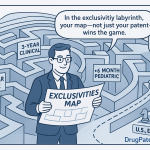
The FDA’s legislative proposals for 2025 include several reforms to curb patent abuse. These include amending the 3-year exclusivity rules to ensure they only reward genuine innovation and creating a safe harbor for skinny labeling. This safe harbor would protect generic firms from being sued for induced infringement when they carve out patented uses from their labels.
The FDA also seeks to reform the 180-day exclusivity forfeiture rules. Currently, a first generic applicant can park their exclusivity and block all other competitors. The proposed changes would trigger a forfeiture if the applicant fails to market the drug after patent litigation is resolved.
The End of the Patent Cliff
The pharmaceutical industry is moving toward a more transparent environment. The FTC’s crackdown on junk patents and the FDA’s proposed reforms suggest that the era of the 40-year monopoly is coming to an end. Manufacturers must now justify their Orange Book listings and prove that their secondary patents represent real technical advances rather than cosmetic tweaks.
For healthcare professionals and payers, these changes offer the hope of more predictable drug costs and faster access to affordable medicine. For the pharmaceutical industry, it marks a return to a model where profits must be driven by new breakthroughs rather than legal engineering.
Key Takeaways
The 30-month stay is a financial asset that brand manufacturers use to block competition and maintain monopoly pricing.
Device patents are a primary tool for evergreening, extending market exclusivity by a median of 4.7 to 9.0 years for combination products.
Patent thickets, particularly in the US, consist of hundreds of overlapping patents designed to make generic entry prohibitively expensive.
The FTC’s 2024-2025 campaign is actively forcing the delisting of junk patents for weight-loss, diabetes, and respiratory drugs.
Legislative reforms in 2025 target the misuse of 3-year exclusivity and 180-day generic parking to encourage faster competition.
FAQ
How does a Paragraph IV certification trigger a 30-month stay? When a generic manufacturer files an ANDA, it must certify that the patents listed in the Orange Book are invalid or not infringed. If the brand manufacturer sues within 45 days of this notice, the FDA is automatically barred from approving the generic for 30 months while the litigation proceeds.
What is the difference between a soft switch and a hard switch in product hopping? A soft switch uses marketing to persuade doctors to prescribe a new version of a drug. A hard switch involves withdrawing the original product from the market entirely, forcing patients onto the new, patent-protected version before generics can launch.
Why are polymorph patents so effective at extending drug monopolies? Polymorph patents cover specific crystalline structures of a molecule. Even if the chemical molecule is off-patent, a generic cannot launch if its manufacturing process produces the patented crystalline form, which is often the most stable or soluble version.
What is the significance of the 2024 FTC warning letters? The letters put 10 major pharmaceutical companies on notice that their device-related patent listings in the Orange Book may be illegal. This campaign has already led to the delisting of hundreds of patents, removing the 30-month stay barrier for those products.
How can citation network analysis help detect evergreening? By mapping the connections between patents, analysts can identify clusters of weak, overlapping patents that are used to build thickets. A high density of internal citations within a company’s portfolio is a strong indicator of an evergreening strategy.
Daubner-Bendes, R., et al. (2021). Pharmaceutical Evergreening: A Review of Strategies and Impacts. Journal of Medical Systems.
Beall, R., & Kesselheim, A. S. (2018). Trends in Drug-Device Combination Product Patents. Nature Biotechnology.
DrugPatentWatch. (2025). The Evergreening Gambit: A Strategic Guide to Pharmaceutical Patent Lifecycle Management.
Federal Trade Commission. (2024). Policy Statement on Improper Orange Book Listings.
I-MAK. (2023). Overpatented, Overpriced: How Excessive Pharmaceutical Patenting is Driving Up Drug Prices.
Knox, R., & Curfman, G. (2021). The Humira Patent Thicket and the Noerr-Pennington Doctrine. SSRN.
Ropes & Gray. (2024). The FTC’s Criticism of Junk Orange Book Filings.
U.S. Food and Drug Administration. (2025). FY 2025 Legislative Proposals: Hatch-Waxman Reforms.
Vernaz, N., et al. (2013). The Impact of Evergreening on Healthcare Spending. PLOS Medicine.
Yale Law & Policy Review. (2024). Patent Term Extensions and the Last Man Standing.
Christie, A. F., et al. (2021). The Relationship Between Patenting and Market Exclusivity. World Intellectual Property Organization.
Feldman, R. (2018). May Your Drug Price Be Evergreen. Journal of Law and the Biosciences.
Kesselheim, A. S. (2020). The High Cost of Prescription Drugs in the United States. JAMA.
Health System Tracker. (2024). How US Spending on Healthcare has Changed Over Time.
PwC Health Industries. (2025). Medical Cost Trend 2026.