The call came on a Tuesday morning. A general counsel at a mid-sized specialty pharma company had just received a Paragraph IV notification on the company’s lead oncology asset — a drug generating $1.4 billion in annual revenue. She had 45 days to respond. Her board had a scheduled meeting in six weeks. And the deck she would hand to directors that day included exactly zero slides on patent litigation exposure.
That gap — between the legal team’s grasp of IP risk and the board’s capacity to govern it — costs pharmaceutical companies billions of dollars every year in delayed decisions, inadequately reserved litigation budgets, and missed settlement windows. The problem is not that boards do not care. It is that nobody has given them a usable framework for thinking about patent risk in the same rigorous way they think about credit risk, market risk, or regulatory risk.
This article is for the people who need to build that framework: general counsel, chief financial officers, heads of investor relations, and the IP strategists who brief them. It covers how patent litigation risk accumulates across the pharmaceutical lifecycle, what metrics actually matter at board level, how to structure a patent risk dashboard that survives a skeptical audit committee, and how companies like Bristol-Myers Squibb, AbbVie, and Merck are navigating the largest patent cliff in industry history.
The $236 billion in branded revenue facing loss of exclusivity between 2025 and 2030 is not an abstraction. [1] It is a specific set of drugs, specific litigation timelines, and specific governance decisions that boards will be asked to ratify or reject in the next three years. The companies with the clearest internal metrics for managing that exposure will be structurally better positioned than those treating patent risk as a footnote to their 10-K.
Part I: Why Patent Risk Is a Board Problem, Not Just a Legal Problem
The Governance Gap in IP Management
Ask a pharmaceutical board member to describe the company’s gross margin trajectory, and they will tell you. Ask them to describe the company’s exposure-weighted patent risk profile, and most will pause. That asymmetry is not accidental. Financial metrics have decades of standardized reporting behind them. Patent risk metrics do not.
The result is a structural governance blind spot. Patent events — ANDA filings, IPR petitions, inter partes review institution decisions, Paragraph IV certifications — trigger decisions with multi-billion-dollar consequences. Those decisions often happen in the legal department, with limited board input, because the board has not been equipped with the conceptual vocabulary or the data infrastructure to engage meaningfully.
This is changing. The SEC’s 2020 guidance on key performance indicators in MD&A disclosures explicitly calls on management and audit committees to disclose material KPIs that management uses internally to run the business. [2] Patent revenue concentration and litigation exposure qualify as material for most pharmaceutical companies. Boards that are not reviewing these metrics are arguably failing their fiduciary duties under Caremark, which requires directors to exercise oversight over known and material corporate risks. [3]
Several large institutional investors have begun pressing pharmaceutical companies on this directly. During proxy season 2024, governance advisors at ISS and Glass Lewis flagged patent cliff exposure in their analyses of BMS, AbbVie, and Merck, noting that revenue concentration in products facing near-term LOE creates a material risk that boards should address with specificity, not generality. The standard “we face competition from generics” boilerplate in risk factors no longer satisfies informed investors who can calculate Keytruda’s 2028 LOE exposure on a spreadsheet.
The Scale of What Boards Are Being Asked to Govern
The numbers are worth stating plainly before we get to methodology. Between 2025 and 2030, nearly 200 branded drugs — including approximately 70 blockbusters each generating over $1 billion annually — will lose exclusivity. [4] The consensus estimate for total revenue at risk across the industry runs from $236 billion to $300 billion, depending on which biologics are included and how biosimilar penetration is modeled. [1][5]
That $300 billion figure represents roughly one-sixth of the entire pharmaceutical industry’s annual revenue. [5] The previous comparable patent cliff, in roughly 2011-2013, eroded about $100 billion in brand-name sales. The current one is three times that size. [6]
For individual companies, the exposure is concentrated enough to be existential. Bristol-Myers Squibb faces roughly 47% of its revenues at risk by 2030, primarily through Eliquis ($13B+ annually) and Opdivo ($9B+ annually). Merck’s Keytruda — the world’s best-selling drug at $25 billion in 2023 sales — faces patent expiration in 2028. AbbVie and Novartis each face 29% erosion across multiple biologics. [6]
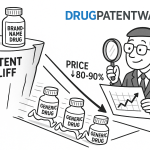
When revenues can decline by 80-90% within 12 to 18 months of generic entry — a figure demonstrated repeatedly, from Lipitor’s 71% drop within one year of expiry to Humira’s biosimilar challengers entering at 55% discounts — board-level awareness of exact timing is not a luxury. [7][8] It is risk management.
What Happens Without Board-Level Visibility
The failure modes are predictable. A legal team that manages patent defense in isolation from the finance function will systematically under-provision litigation reserves. Finance, working from historical averages rather than specific docket analysis, will over-discount the probability of adverse outcomes. Business development, without patent risk data integrated into its models, will pay acquisition premiums for assets whose exclusivity windows are shorter than the deal model assumed.
There is also a disclosure problem. SEC comment letters have increasingly targeted pharmaceutical companies on the adequacy of patent risk disclosure in MD&A sections. A company that has not built internal patent risk metrics cannot explain those risks to investors with specificity — and that creates both regulatory exposure and credibility risk when a Paragraph IV filing lands and analysts start asking questions the company cannot answer cleanly.
DrugPatentWatch, one of the most widely used pharmaceutical patent intelligence platforms in the industry, tracks thousands of active litigations, Orange Book listings, ANDA filings, and PTAB proceedings. The data it surfaces makes clear that patent events do not happen in isolation: they cascade. A single IPR petition that invalidates a key claim can change the calculus on four downstream litigation matters simultaneously. A board that receives only case-by-case legal updates cannot see those cascades coming.
Part II: The Architecture of Pharmaceutical Patent Risk
The Three-Layer Patent Stack
To build metrics that a board can act on, you first need a clear model of how pharmaceutical patent protection actually works. Most board members understand that drugs have patents. Fewer understand that a single drug typically sits beneath a layered architecture of patents with different expiration dates, different legal vulnerabilities, and different strategic functions.
Call it the three-layer patent stack:
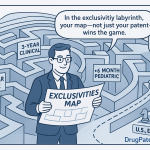
Layer 1: Composition-of-matter patents. These are the strongest and most valuable. They cover the active molecule itself. A composition-of-matter patent, if valid and enforceable, prevents anyone from making the compound for any purpose, not just the approved indication. These expire 20 years from the filing date, minus whatever time the compound spent in clinical development before approval — adjusted back up by patent term extensions of up to five years under Hatch-Waxman.
Layer 2: Formulation and method-of-use patents. These cover specific dosage forms, delivery mechanisms, dosing regimens, or therapeutic uses. They are easier to design around — a generic manufacturer can file an Paragraph IV carve-out for unlisted indications — but in practice they represent the bulk of the Orange Book listings that drive Hatch-Waxman litigation. When a drug has 15 patents listed in the Orange Book, most of them are in this layer.
Layer 3: Manufacturing and process patents. For biologics, these are the most practically significant barrier to biosimilar entry. Complex manufacturing processes, cell lines, and purification methods are covered by patents that generics cannot easily replicate even after the molecule itself goes off-patent. The Teva case in Europe in 2024, where the European Commission fined the company €462.6 million for filing staggered divisional patents around Copaxone’s manufacturing process to prevent generic competition, illustrates both the value and the regulatory risk embedded in this layer. [9]
Board risk metrics need to account for all three layers — not just the headline expiration date on the composition-of-matter patent, which is what most financial models use. A drug whose core patent expires in 2026 but whose formulation and process patents run to 2031 has a materially different risk profile than one whose entire patent stack expires simultaneously.
Hatch-Waxman: The Litigation Engine
The Hatch-Waxman Act of 1984 did not merely create a pathway for generic approval. It created a structured litigation framework that treats an ANDA filing with a Paragraph IV certification as a statutory act of patent infringement — before a single generic tablet has been manufactured. [10] Filing a Paragraph IV certification is the legal equivalent of suing the patent holder in advance. It is designed that way intentionally, to force early resolution of patent disputes rather than waiting for actual market entry.
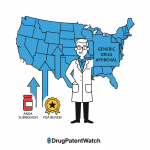
The practical consequence is that a pharmaceutical company’s litigation exposure begins the moment an ANDA is accepted by the FDA — a private event the company learns about only when the ANDA filer provides notice within 20 days of FDA acceptance. [10] The NDA holder then has 45 days to file suit, triggering a 30-month automatic stay of FDA approval. During those 30 months, the litigation either resolves, or the stay expires and the generic can launch at risk.
This timeline is not abstract. It is a governance clock. A company that does not monitor the landscape for imminent ANDA filings will be reactive rather than prepared. In 2024, 312 new Hatch-Waxman complaints were filed in U.S. federal courts — up from 259 in 2023, a 20% increase driven by the approaching patent cliff on high-value small-molecule drugs. [11] Of the 283 litigations resolved or terminated in 2024, 39% settled (down from 50% in 2023), with innovator companies prevailing on merits 20% of the time versus generic companies prevailing only 2% of the time in non-settlement outcomes. [11]
That asymmetry — generics settling when they think they will lose, innovators settling when they think the deal is better than the risk — is important context for board-level settlement authority frameworks. The fact that most Hatch-Waxman cases settle does not mean settlement is costless. The terms of those settlements, including the authorized generic entry dates they contain, are the mechanism by which companies actually extend or shorten their revenue exclusivity windows.
“Between 2025 and 2030, drugs collectively generating over $200 billion in annual revenue will lose market exclusivity, creating the largest single wave of generic and biosimilar development opportunity on record.” — DrugPatentWatch, 2025 [12]
PTAB: The Second Front
Inter partes review at the Patent Trial and Appeal Board represents the second major vector of patent attack. Unlike Hatch-Waxman litigation, which is conducted in district court and requires an ANDA filing as predicate, IPR proceedings are conducted at the USPTO and can be filed by any party — not just generic manufacturers preparing to launch.
The institution rate for IPR petitions ran at approximately 58% between 2022 and 2024. [13] When the PTAB does institute a trial, the invalidation rate is high: across all technologies, 70% of final written decisions found all challenged claims unpatentable in 2024, up from 55% in 2019. On a per-claim basis, 78% of claims reaching final decision were found invalid in 2024. [14]
For Orange Book-listed pharmaceutical patents specifically, the complete invalidation rate is lower — approximately 23% — roughly matching the 24% complete invalidation rate in parallel district court proceedings. [14] That equivalence is notable: pharmaceutical patents are not safer at PTAB than in district court. They are roughly as dangerous in both venues, which means a company facing simultaneous district court litigation and an IPR petition on the same patent is in materially worse shape than one facing either challenge alone.
The PTAB policy landscape in 2025 adds another dimension of uncertainty. In early 2025, the USPTO rescinded the Vidal memorandum and returned to the original Fintiv precedent for discretionary denials, making the timing of IPR petitions relative to district court proceedings more strategically complex than it has been in years. [14] This matters to board-level governance because the decision to file an IPR — or to offer a Sotera stipulation to avoid discretionary denial — is often made at general counsel level without explicit board input, even though the implications for litigation strategy can be significant.
The Biosimilar Dimension
Biologics sitting on the 2025-2030 expiration horizon face a structurally different risk profile than small molecules. The entry pathway is governed by the Biologics Price Competition and Innovation Act, which created a 12-year data exclusivity window and a patent dance mechanism for resolving IP disputes before biosimilar launch.
Biosimilar litigation has been notably different from Hatch-Waxman in one practical respect: preliminary injunctions are extraordinarily rare. Before 2024, only one preliminary injunction had ever been granted in a BPCIA lawsuit. In 2024 alone, five such decisions were issued — still a small number, but a notable shift that signals courts are becoming more willing to engage on interim patent questions in the biologics space. [9] Regeneron’s failed attempt to block Amgen’s biosimilar aflibercept, and Alexion’s failed PI against Samsung Bioepis over biosimilar eculizumab, illustrate that even successful innovators face an uphill battle getting preliminary relief. [9]
The global biosimilar market was valued at $26.5 billion in 2024 and is projected to reach $185.1 billion by 2033 — a seven-fold increase driven directly by the biologics patents expiring in this window. [14] For boards of companies with major biologic assets, that trajectory is not a market trend to note. It is a risk-weighted revenue forecast that should be embedded in every medium-term financial plan.
Part III: Building the Patent Risk Dashboard
What Boards Actually Need to See
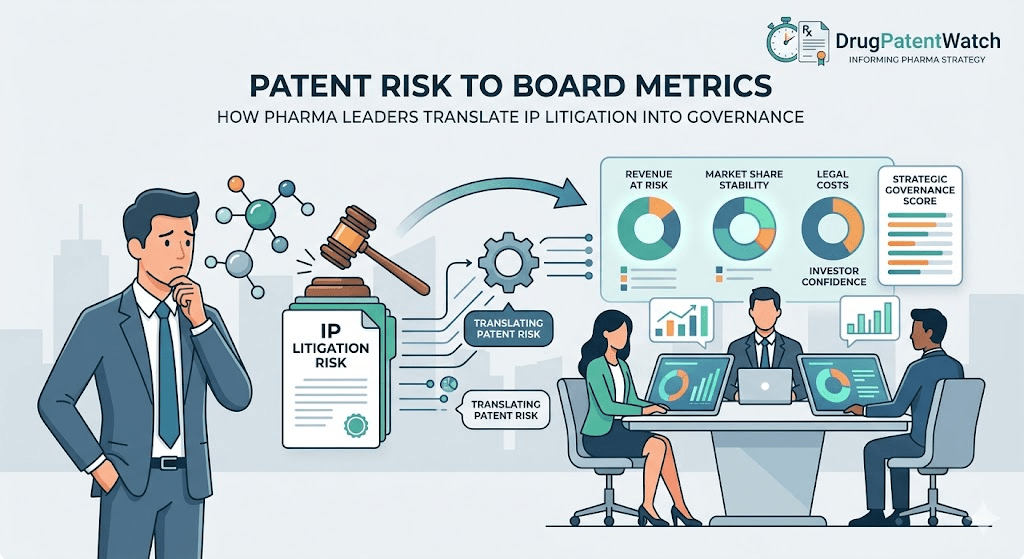
A board does not need a litigation update. It needs a risk framework. The distinction matters. A litigation update tells directors what happened last quarter. A risk framework tells them what the probability distribution of outcomes looks like over the next 24, 36, and 60 months — and what decisions they need to make now to influence those outcomes.
Based on how the most sophisticated pharmaceutical companies structure their IP governance, the patent risk dashboard presented to audit committees and full boards should cover four categories of information:
Revenue exposure mapping. Every dollar of currently protected revenue should be mapped against its effective exclusivity window — not just the nominal patent expiration, but the realistic date at which generic or biosimilar entry becomes possible given the full patent stack, the regulatory pathway, and the current litigation status. This produces a waterfall chart of revenue at risk by year that finance can model directly.
Litigation status and probability weighting. Active litigations should be summarized not just by case name and status but by probability-weighted outcome. This requires legal to develop a structured approach to assigning probability ranges to different case outcomes — not precise estimates, but calibrated ranges that allow finance to reserve appropriately. A case where counsel assigns 30-40% probability to a generic win should produce a materially different reserve than one where that probability is 5-10%.
Early warning indicators. The board should see the leading indicators of forthcoming litigation, not just active cases. These include: FDA Orange Book listing status for each major asset; ANDA filing activity detected through FDA databases; PTAB petition filings against company patents; and paragraph IV certification letters received but not yet resulting in filed complaints. Monitoring services like DrugPatentWatch surface many of these signals in real time, and the board dashboard should incorporate them.
Competitive patent intelligence. For companies with BD pipelines or active competitive concerns, the board should receive regular updates on the patent positions of key competitors — specifically, when those competitors will face their own exclusivity losses, what licensing opportunities those losses create, and what risks they pose if the competitor chooses to compete more aggressively in response to revenue pressure.
The Five Core Metrics
Across these four categories, five metrics consistently prove most useful at board level. Each one is specific, calculable, and actionable.
Metric 1: Patent-Protected Revenue Concentration Ratio (PPRCR)
The PPRCR measures what percentage of total revenue comes from products whose current period of exclusivity expires within a defined window — typically 36 months. Calculate it by summing the revenue from products whose effective exclusivity end date falls within the window and dividing by total company revenue.
A company with a PPRCR above 40% in the 36-month window has a board-level problem that requires explicit strategic response. BMS, with Eliquis and Opdivo together representing approximately 45% of total revenues, sits well above that threshold. [6] Merck’s PPRCR will spike dramatically in 2027-2028 as Keytruda’s exclusivity window approaches.
The PPRCR is useful because it converts patent data into a financial concentration metric that boards already understand. A company would never allow 45% of its revenue to depend on a single customer without a board-level risk discussion. The same logic applies to patent concentration — but the discipline to treat it that way has historically been absent.
Metric 2: Litigation-Adjusted Exclusivity Date (LAED)
Every major asset should have a nominal patent expiration date and a litigation-adjusted exclusivity date. The LAED incorporates the probability of adverse outcomes in active litigation to produce an expected value for how much of the nominal exclusivity window the company is likely to retain.
The calculation requires legal input. For each active Hatch-Waxman case, counsel assigns a probability to three outcomes: full win (complete exclusivity retained), partial loss (generic entry at a negotiated date before nominal expiration), or complete loss (immediate or near-term generic entry). Weight those outcomes by their probabilities to produce a probability-weighted expected entry date for each generic challenger. The LAED is the weighted average of expected generic entry dates across all challengers for a given drug.
For a drug with nominal patent expiration in 2028 but with two active ANDA litigations where counsel assigns 25% probability to early entry (defined as entry more than 12 months before expiration), the LAED might be 2027.3 — not 2028. That 8-9 month difference, on a drug generating $10 billion annually, represents $7-8 billion in probability-weighted revenue at risk. It should appear on the board dashboard.
Metric 3: PTAB Vulnerability Score (PVS)
Each key Orange Book-listed patent should receive a PTAB Vulnerability Score based on four factors: prior art density in the space (how many plausible invalidation arguments exist); citation analysis (how often the patent is cited by generic or competitor filings, a leading indicator of challenge interest); claim specificity (broader claims are more vulnerable to obviousness challenges); and prosecution history (were claims narrowed during prosecution in ways that create estoppel arguments?).
The PVS does not need to be a precise numerical score. It can be a structured qualitative assessment — high, medium, low — that legal counsel applies consistently across the portfolio. The purpose is to give the board a relative ranking of which patents are most likely to face IPR challenge and how those challenges would be likely to resolve.
Given that 78% of claims reaching final PTAB decision were found invalid in 2024, the default assumption for high-PVS patents should be vulnerability unless there are specific structural reasons for confidence. [14] That framing — patent protection as something that requires active defense, not a static asset — is one of the most important mental model shifts that boards need to make.
Metric 4: Competitive Entry Timeline (CET)
This metric tracks the number of ANDA applicants for each major product, their stage in the FDA review process, and the estimated timeline to market-ready status for each. It matters because the competitive impact of patent expiration is not determined by the expiration date alone — it is determined by how many competitors are ready to launch on day one and how quickly they can ramp to commercial scale.
A product with one ANDA applicant who is 18 months from approval behaves very differently commercially than one with 12 ANDA applicants, three of whom are already FDA-approved and manufacturing at scale. The Competitive Entry Timeline translates that distinction into a specific revenue erosion forecast. Historical data suggests that small-molecule drugs lose approximately 90% of market share within months when multiple generics enter simultaneously; drugs with one or two competitors initially may retain 50-60% of volume for 12-18 months. [7]
DrugPatentWatch tracks ANDA filing activity, FDA review status, and first-filer 180-day exclusivity rights in a format that can be directly integrated into CET analysis. The first-to-file advantage — the 180-day marketing exclusivity granted to the first successful Paragraph IV filer — transforms ANDA filing into an information race where timing data is competitive intelligence. [12]
Metric 5: Patent Defense Investment Ratio (PDIR)
The PDIR measures what the company is spending on patent defense — litigation, prosecution, monitoring, and IP strategy — as a percentage of revenue from patent-protected products. It serves as a check on whether IP defense investment is commensurate with the revenue it protects.
Industry norms vary by company size and patent portfolio complexity, but as a rough calibration: spending less than 0.5% of patent-protected revenue on IP defense for a major asset is probably under-investment; spending more than 2-3% may indicate either a highly contested portfolio or inefficient legal spend. For a $10 billion drug, that range implies $50 million to $300 million in annual IP defense investment — a range that spans the difference between a well-staffed legal team and an army of outside counsel.
The PDIR becomes particularly useful in budget discussions. When a CFO proposes cutting the IP litigation budget in a year where the PPRCR is elevated, the PDIR creates a structured basis for that conversation: here is what we spend, here is what it protects, here is what we lose if the cases go the wrong way.
Part IV: The Settlement Authority Framework
Why Settlement Decisions Need Board Protocols
One of the most material decisions in pharmaceutical patent governance is the settlement decision. In Hatch-Waxman litigation, settlement typically means agreeing to allow generic entry at a specified date before the nominal patent expiration — an authorized generic entry date that could represent the difference between two or five additional years of branded revenue.
Most pharmaceutical companies make these decisions at general counsel level, sometimes with CEO involvement, rarely with formal board ratification. That practice is defensible for routine litigation decisions. It is harder to defend for settlements that reset the revenue timeline on a billion-dollar asset.
Consider the arithmetic. A drug generating $3 billion annually in U.S. revenue, with nominal patent protection through 2029, might face a Hatch-Waxman settlement offer that grants generic entry in 2027 in exchange for the generic company dropping its invalidity claims. Two years of foregone exclusivity, at $3 billion per year, represents $6 billion in revenue the company will not collect — adjusted for the probability that the case resolves less favorably if litigated to conclusion.
That is a capital allocation decision. It is more financially consequential than many acquisitions that go through full board approval. The governance asymmetry — acquisitions at $500 million require board approval, but patent settlements with $6 billion in revenue implications do not — is a structural gap that the most thoughtful general counsel are now working to close.
Designing the Settlement Authority Matrix
A settlement authority matrix specifies what level of approval is required for patent settlements based on two variables: the annual revenue of the affected product and the magnitude of exclusivity conceded (measured in months).
A workable framework might look like this:
For products generating less than $200 million annually: general counsel has settlement authority up to 18 months of early entry; CEO approval required for more than 18 months early entry.
For products generating $200 million to $1 billion annually: CEO approval required for any early entry; board notification required for settlements conceding more than 12 months.
For products generating more than $1 billion annually: CEO and board notification for any settlement; formal board approval required for settlements conceding more than 6 months of early entry.
The specific thresholds matter less than the principle: revenue materiality should determine governance level, and the board should be involved in decisions that have material revenue implications.
This framework also clarifies what information the board needs before approving a settlement. At minimum: the probability-weighted outcome of continuing to litigate (from outside counsel); the NPV of the proposed settlement versus the expected value of litigation; the competitive context (how many other generic applicants are waiting, and what is the first-filer’s 180-day exclusivity status); and the revenue reserve implications (has finance already accounted for this entry date in guidance?).
The Authorized Generic Question
Patent settlements in the pharmaceutical industry often involve authorized generic arrangements — agreements under which the brand company itself launches or licenses a generic version of its own drug, often in conjunction with the first-filer’s exclusivity period. Authorized generics are controversial because they allow the brand company to capture some of the generic market share while simultaneously undermining the competitive value of the first-filer’s 180-day exclusivity window.
The FTC monitors these arrangements closely, and a board approving a settlement with authorized generic provisions needs to understand both the revenue implications and the antitrust exposure. The 2024 Hatch-Waxman data showing a decline in settlement rates to 39% (from 50% in 2023) may reflect increased FTC scrutiny of settlement terms, among other factors. [11] Any board authority framework should require antitrust review for settlements involving authorized generic or reverse payment provisions.
Part V: From Metrics to Disclosure Strategy
What the SEC Expects Now
SEC disclosure requirements for pharmaceutical patent risk have evolved significantly since the Commission’s 2020 KPI guidance. The core principle from that guidance: MD&A should include metrics and KPIs that management itself uses to run the business, when those metrics are material to investors. [2]
For pharmaceutical companies with concentrated patent exposure, this creates a disclosure obligation that goes beyond the standard “we face competition from generics” risk factor. The SEC’s increased comment letter activity — approximately 1,700 letters issued in fiscal year 2024, the highest volume in recent history, with MD&A cited in at least 34% of those letters — signals that the agency is actively looking at whether companies are disclosing material business metrics adequately. [15]
What does adequate patent risk disclosure look like in practice? It means: naming specific major assets and their effective exclusivity timelines, not just referring to “certain of our products”; disclosing the number and status of Paragraph IV certifications received; discussing PTAB proceedings and their potential impact with specificity rather than generality; and quantifying the revenue exposure from products with pending generic challenges.
Companies that have built the internal metrics described above are structurally better positioned to make this disclosure accurately. A company that has computed its LAED for each major product can disclose that figure — or a reasonable range around it — with specificity. A company that has not computed it will either omit the disclosure (creating regulatory risk) or disclose a figure that its own internal data cannot support (creating a different kind of risk).
The Analyst Relations Problem
Patent risk disclosure is not just a regulatory compliance issue. It is an investor relations management challenge. Sophisticated buy-side analysts model patent cliff exposure independently, using FDA Orange Book data, PTAB dockets, and commercial services including DrugPatentWatch to build their own views on each company’s effective exclusivity timeline. When a company’s public disclosures are less precise than what analysts can build independently, the company loses control of its own narrative.
The alternative is proactive patent risk disclosure that goes slightly further than what analysts can reverse-engineer from public sources. Companies that do this effectively — providing LAED ranges, discussing litigation probability scenarios, explaining their settlement authority framework — tend to have less earnings volatility around patent events because investors have already priced the relevant risk. Companies that resist specificity tend to experience sharper dislocations when litigation outcomes arrive.
The Regeneron-Amgen biosimilar aflibercept dispute illustrates this dynamic. Regeneron’s biosimilar defense strategy was publicly known. When Amgen’s biosimilar design-around appeared to circumvent the relevant patents, the market had already partially priced the risk, because Regeneron’s filings had disclosed the relevant patent claims and their vulnerability with unusual specificity. The stock did not react as if the outcome were a complete surprise. [9]
Building the Board Narrative
The board presentation on patent risk should not be a legal update. It should be a business update with a legal foundation. The organizing question is not “what is the status of our litigation?” but “what is the probability distribution of our revenue over the next five years, and what decisions do we need to make to improve that distribution?”
That framing produces a different presentation structure. Instead of organizing by litigation matter, organize by asset. For each major revenue-generating product: current revenue, effective exclusivity timeline, active legal challenges, probability-weighted LAED, and the one to three strategic decisions that could materially change the outcome. Legal counsel provides the inputs; the CFO’s office translates them into revenue scenario analysis; the board discusses the decisions.
The decisions the board needs to ratify — settlement authority, litigation budget, lifecycle management investment, authorized generic strategy — are consequential enough to deserve that structured presentation. Presenting them as the tail end of a quarterly legal update, buried behind routine litigation updates, is a governance failure of convention rather than intent.
Part VI: Real-World Case Studies in Patent Governance
AbbVie and Humira: The Authorized Generic Playbook
AbbVie’s handling of Humira’s biosimilar entry — after the drug generated over $18 billion in U.S. sales in 2022 — represents one of the most studied examples of proactive patent lifecycle management. [8] The company maintained an unusually dense patent portfolio around adalimumab, covering formulation, dosing regimen, device design, and manufacturing process, creating a thicket that delayed biosimilar entry in the U.S. significantly longer than in Europe.
When biosimilars did enter in January 2023, AbbVie had spent several years executing a patient conversion campaign to its own next-generation molecules — Skyrizi and Rinvoq — which carry their own independent patent protection extending well into the 2030s. The result was revenue erosion that was material but not catastrophic, and AbbVie was able to present its board with a multi-year transition model built on patent data it had been tracking for years before the event.
The lesson for governance is not that AbbVie’s patent thicket strategy is universally appropriate — the European Commission’s €462.6 million fine against Teva for a similar strategy with Copaxone suggests significant antitrust risk in this approach. [9] The lesson is that the transition model existed, was board-level knowledge, and informed capital allocation decisions (M&A, BD, R&D pipeline investment) for years before the actual revenue cliff arrived.
Merck and Keytruda: Managing the Approaching Cliff
Merck’s Keytruda situation illustrates a different governance challenge: managing the approach of a cliff on a drug so large that no successor product pipeline can fully offset the exposure. Keytruda’s $25 billion in 2023 sales — representing approximately 40% of Merck’s total pharmaceutical revenue — will face patent expiration in 2028, potentially creating the single largest branded revenue event in pharmaceutical history. [1]
Merck’s public response has been two-pronged: pursuing a subcutaneous formulation of Keytruda (approved by the FDA on September 19, 2025, as Keytruda Qlex) that carries its own independent patent protection, and investing aggressively in pipeline diversification through acquisition. [6] The subcutaneous formulation strategy — using new delivery routes and formulations to generate fresh IP around an existing compound — is a standard lifecycle management approach, but Merck’s execution illustrates the governance requirements: the decision to invest hundreds of millions in formulation development requires board confidence in both the scientific feasibility and the commercial durability of the reformulated product.
The PPRCR lens is stark for Merck: approximately 40% of total revenue from a single asset whose core exclusivity ends in 2028. Any board review of Merck’s patent governance should be anchored by that figure and the mitigation strategies designed to reduce it.
Bristol-Myers Squibb: Portfolio Concentration and the Growth Gap
BMS presents arguably the most acute patent governance challenge among large-cap pharmaceutical companies. With Eliquis ($13B+) and Opdivo ($9B+) together representing approximately 45% of total revenues, the company faces what analysts have called a “growth gap” — the difference between expiring revenue and the growth rate of new product revenue — estimated at $38 billion by 2030. [6]
The governance question for a BMS board is not whether this risk is real. It demonstrably is. The question is whether the company’s current acquisition and pipeline investment strategy is sufficient to close that gap, and how shareholders should think about dilutive M&A in that context. That is precisely the kind of question that the PPRCR and LAED metrics are designed to make precise enough for board-level discussion. Without those metrics, the discussion remains qualitative and inconclusive.
BMS has been among the more transparent major pharmaceutical companies in disclosing its patent exposure. Its annual reports since 2022 have included product-level LOE disclosure with escalating specificity — a response, in part, to institutional investor pressure for clearer cliff-related risk disclosure.
Cipla and Exelixis: The Generic Challenger’s View
Patent risk is not only a brand company concern. Generic and biosimilar manufacturers face their own governance challenges around patent exposure — specifically, the risk of launching at risk before litigation concludes, or of investing in ANDA development only to lose on invalidity arguments at PTAB.
Cipla’s litigation with Exelixis over Cabometyx (cabozantinib) illustrates the complexity. Cipla filed an ANDA for a 60 mg dosage in March 2023, triggering litigation; then filed a revised ANDA for 20 and 40 mg dosages in May 2024, triggering a second litigation. [3] Each ANDA represents a different strategic bet on which patent claims are vulnerable and which are defensible. The decision to file multiple ANDAs at different dose levels, rather than a single comprehensive ANDA, is an IP strategy decision with material capital implications — development cost, litigation cost, potential 180-day exclusivity on each dosage — that should be visible at board level.
Part VII: Building the Patent Governance Infrastructure
The IP Intelligence Stack
None of the metrics described above can be computed reliably without an underlying data infrastructure. That infrastructure has three components:
Patent portfolio management systems that maintain a current, accurate record of every patent in the company’s Orange Book listings, their nominal expiration dates, patent term extension status, and any pending inter partes review or reexamination proceedings. These systems range from basic spreadsheet-based approaches at smaller companies to enterprise IP management platforms at large-cap pharma.
Competitive intelligence services that monitor ANDA filing activity, PTAB petitions, competitor patent filings, and court dockets in real time. DrugPatentWatch is one of the most comprehensive sources in this space for pharmaceutical-specific patent data, aggregating Orange Book listings, litigation records, PTAB proceedings, and exclusivity information in a format designed for business intelligence use rather than legal research alone. The platform’s litigation tracking capability — spanning thousands of active Hatch-Waxman cases — makes the kind of board-level LAED calculation described above practically feasible for a company that would otherwise need to synthesize data from dozens of separate sources.
Financial modeling integration connecting patent data to revenue forecasting. This is the component most companies lack. Patent data exists in legal department systems. Revenue forecasts exist in finance systems. The PPRCR and LAED calculations require both data sets to speak to each other — a systems integration challenge that most pharmaceutical companies have not yet solved cleanly.
The Cross-Functional Patent Council
The organizational challenge is as important as the systems challenge. Patent risk sits at the intersection of legal, regulatory, commercial, and financial functions. No single function has complete visibility. The general counsel owns litigation. The regulatory affairs team owns FDA Orange Book strategy. Commercial owns revenue forecasts. Finance owns reserves and guidance.
The companies that manage patent risk most effectively tend to have a cross-functional patent council — a standing group that meets monthly or quarterly, chaired by the general counsel or chief IP officer, with regular participation from finance, regulatory, commercial, and BD. The council’s job is to maintain a unified view of the patent risk picture and surface decision points that require executive or board attention.
This council should produce two outputs: a monthly internal patent risk report for management, and a quarterly board-level summary using the metrics described above. The monthly report is operational — litigation updates, ANDA tracking, PTAB developments. The quarterly board summary is strategic — PPRCR, LAED, CET, PDIR, and the decisions those metrics require.
Integrating Patent Risk into Capital Allocation
The most sophisticated use of patent risk metrics is their integration into capital allocation decisions. When a CFO presents a $5 billion acquisition of a late-stage oncology asset, the patent risk analysis should be part of the deal materials: what is the LAED of the lead product? What is its PTAB Vulnerability Score? How many ANDA applicants are in the pipeline? What does the CET look like for each one?
These questions sound obvious. They are not yet standard in most pharmaceutical M&A processes. Deals are frequently closed based on revenue models that assume the nominal patent expiration date is the effective revenue protection date — a systematically optimistic assumption that can overvalue assets by hundreds of millions of dollars.
The correction is simple in principle: include a standard patent due diligence module in every deal process above a defined size threshold. That module produces a report covering all five core metrics for each major product in the target’s portfolio. The report does not replace valuation modeling — it informs it, providing the probability-weighted revenue timeline inputs that the financial model requires.
Business development teams that build this capability develop a genuine competitive advantage in deal evaluation. They will walk away from overpriced assets with deteriorating patent positions more readily and bid more confidently on assets with underappreciated patent durability. Over time, that discipline compounds into measurably better M&A returns — a direct ROI from governance infrastructure investment.
Part VIII: The Regulatory and Antitrust Overlay
Orange Book Listing Strategy and Its Governance Implications
The decision about which patents to list in the FDA Orange Book is an IP governance decision with direct legal and commercial consequences. An Orange Book listing triggers the 30-month litigation stay upon ANDA filing. It also triggers FTC scrutiny if the listed patents are arguably not properly listable under the applicable statutory standards.
The FTC has been increasingly aggressive since 2021 about challenging improper Orange Book listings — patents that do not properly claim the drug substance, drug product, or method of use for a condition of use listed in the approved labeling. Companies that overlist — adding patents to the Orange Book strategically rather than because they meet the statutory standard — expose themselves to FTC enforcement actions, delisting proceedings, and potential antitrust liability.
The governance question is who owns the Orange Book listing decision. In most companies, it lives somewhere between regulatory affairs and legal, without explicit executive oversight. Given the FTC’s current posture, that decision deserves a governance escalation protocol: any proposed listing of a patent that does not clearly meet the applicable standard should require sign-off at the general counsel level and, for major assets, board notification.
The Pay-for-Delay Problem
Reverse payment settlements — arrangements where a brand company pays a generic manufacturer to delay entry, rather than accepting early entry as the settlement consideration — remain legally permissible under the FTC v. Actavis framework but subject to antitrust scrutiny under a rule-of-reason standard. The FTC continues to challenge these arrangements aggressively, and the antitrust exposure from a reverse payment settlement that the agency views as anticompetitive can substantially exceed the value of the delayed generic entry the settlement secured.
Board-level approval for any settlement with reverse payment elements is not just good governance practice. It is risk management. A general counsel who approves a reverse payment settlement without board involvement is making a decision that the government might later characterize as evidence of anticompetitive intent — and doing so without the governance process that would demonstrate the company’s good-faith assessment of the antitrust risks.
International Patent Governance
Large pharmaceutical companies manage patent portfolios across dozens of jurisdictions simultaneously. The IP governance frameworks described in this article are written primarily in the U.S. context, but the board-level principles apply equally to European and Asian markets.
The European Commission’s action against Teva — a €462.6 million fine for using divisional patent filings in a staggered pattern to delay Copaxone generics — is the most significant recent example of the regulatory risk in patent lifecycle management strategies that would be considered standard practice in the U.S. [9] The European framework treats certain forms of patent portfolio management as potential abuse of dominance, which is a categorically different legal theory than the U.S. antitrust approach.
A pharmaceutical board’s patent governance framework should include a regular review of international patent enforcement strategies against the competition law standards of each major market. The legal analysis for the U.S. and the EU may lead to materially different conclusions about the same strategy.
Part IX: Patent Risk and M&A Strategy
Buying Your Way Past the Cliff
For companies facing severe PPRCR readings — BMS at 47%, Merck at roughly 40% — acquisition is the primary strategic response. The patent cliff forces a build-or-buy decision that is essentially permanent: there is no way to organically generate the pipeline necessary to offset $10-20 billion in annual revenue losses on a three-to-five-year horizon.
The governance challenge in acquisition-driven responses to patent cliff pressure is valuation discipline. When a company is under pressure to replace expiring revenue, the incentive to overpay for acquisitions increases substantially. The board’s role in that dynamic is to maintain the discipline that the strategic urgency may erode: requiring rigorous patent due diligence, insisting on probability-weighted revenue models rather than best-case scenarios, and approving the M&A budget through a framework that includes explicit patent risk assumptions.
Deloitte’s 15-year study of pharmaceutical R&D returns shows an average internal rate of return of 5.9% in 2024 after years of decline. [16] That figure represents the industry average; many acquisitions close with implicit return assumptions well above that level, assumptions that prove optimistic in part because the acquirer’s patent analysis was insufficiently rigorous. A board that requires the five patent risk metrics for every material acquisition will systematically improve the quality of its M&A decisions.
Patent Assets as Deal Currency
Patent rights are not only defensive assets. They are deal currency. Companies with strong patent positions in high-value therapeutic areas can monetize those positions through licensing, co-promotion agreements, and collaboration structures that generate revenue without the capital intensity of internal development.
The IPR challenge landscape creates licensing opportunities as well as threats. When a company holds a patent that a competitor has unsuccessfully challenged at PTAB, the patent’s market value for licensing has effectively increased — a PTAB institution and subsequent rejection of invalidity claims is, in effect, a market test of the patent’s durability. Companies that track their portfolio through this lens — using PTAB outcomes as signals of licensing value, not just litigation outcome — extract more value from their IP than those that treat litigation exclusively as a defensive cost center.
Part X: Building the Board Competency
What Directors Need to Know
The framework described in this article assumes boards that can engage with patent risk data in a reasonably sophisticated way. Many pharmaceutical boards currently lack that capability. Directors with strong financial or scientific backgrounds may understand revenue cliffs and product science respectively without understanding the legal mechanics of Hatch-Waxman litigation, IPR proceedings, or Orange Book strategy.
The solution is targeted director education, not the replacement of existing directors with IP lawyers. A two-hour annual board session on pharmaceutical patent fundamentals — covering the mechanics of Hatch-Waxman, PTAB, and the BPCIA; a case study on how a specific major litigation matter evolved; and a review of the company’s current patent risk metrics — is sufficient to bring most directors to the functional competency needed to govern these issues.
Several governance organizations have developed pharmaceutical IP literacy programs specifically for directors. The ability to ask the right questions — “What is our LAED for Keytruda?” or “How are we thinking about the Fintiv timing risk in the pending IPR?” — does not require legal expertise. It requires vocabulary and context, both of which can be transmitted efficiently through structured director education.
Nominating Committee Implications
As pharmaceutical boards increasingly confront patent cliff governance, the nominating and governance committee’s director selection criteria should explicitly include IP literacy or IP risk governance experience as a desired competency. Most pharmaceutical board skills matrices currently include categories for financial expertise, scientific or medical expertise, commercial or marketing experience, and regulatory expertise. IP governance expertise is rarely listed explicitly, even for companies whose entire commercial value rests on patent-protected assets.
That gap is beginning to close. Institutional shareholder advisors are noting it in governance analyses, and proxy season feedback from large institutional investors increasingly includes questions about the board’s capacity to oversee IP risk as a specific governance concern.
The Audit Committee’s Role
Patent risk has a natural home in the audit committee’s risk oversight function. The audit committee already owns financial risk oversight, internal controls, and the MD&A disclosure review process. Adding patent risk to the audit committee’s quarterly review — via the five core metrics and a brief litigation update — integrates IP governance into the existing risk oversight infrastructure without creating new committee structures.
The audit committee should specifically own two patent risk functions: reviewing the adequacy of litigation reserves (which requires the probability-weighted LAED analysis); and approving the adequacy of patent risk disclosure in the company’s annual and quarterly filings. Both functions are natural extensions of the audit committee’s existing responsibilities and do not require the committee to make legal or business strategy judgments beyond their appropriate scope.
Part XI: Practical Implementation Roadmap
Phase One: Baseline Assessment (0-90 Days)
The first step is a structured patent risk audit of the current portfolio. This audit should produce, for each major revenue-generating product: the nominal patent expiration date for each Orange Book-listed patent; the effective exclusivity timeline accounting for patent term extensions and regulatory exclusivity periods; the current litigation status (pending ANDA cases, PTAB proceedings, any patent challenges in other jurisdictions); and the number and status of ANDA applicants in the FDA pipeline.
This audit does not require new data collection. It synthesizes data that already exists in the legal department, the regulatory affairs database, and the competitive intelligence function. The synthesis is the work. For a large pharmaceutical company with 20-30 significant products, a thorough baseline audit takes 60-90 days. For a smaller company with 5-10 major products, it can be done in 30 days.
The audit should produce a single consolidated document — a Patent Risk Register — that becomes the living reference document for all subsequent patent governance. The Register is updated monthly and reviewed in the cross-functional patent council.
Phase Two: Metrics Implementation (90-180 Days)
With the baseline Patent Risk Register in place, the second phase implements the five core metrics. PPRCR and CET can be computed immediately from the baseline audit data. LAED requires legal input on probability assessments for active litigations — a 30-60 day exercise to work through with outside counsel. PTAB Vulnerability Scores require a structured assessment of each key patent’s prosecution history and prior art landscape. PDIR requires finance to provide current IP defense spend data organized by product.
By the end of phase two, the company has the metrics infrastructure needed to build the board dashboard. The dashboard template should be developed collaboratively by legal, finance, and the CEO’s office — not by the legal department alone — to ensure it addresses the questions that management and the board actually need answered.
Phase three integrates the patent risk framework into existing governance processes. This means: adding the patent risk dashboard to the quarterly board and audit committee agenda as a standing item; adopting the settlement authority matrix and ensuring general counsel and CEO are briefed on it; integrating patent due diligence into the M&A and BD deal process; and updating the MD&A disclosure approach to incorporate product-level patent risk metrics where material.
The phase three work is organizational and procedural rather than analytical. It requires champions at the general counsel and CFO levels to drive adoption and overcome the organizational inertia that typically resists changes to established reporting patterns. A board that explicitly requests the new framework — which can be accomplished through the audit committee chairman in a standard committee communication — provides the executive mandate that makes phase three adoption feasible.
Key Takeaways
The $300 billion patent cliff is a governance event, not just a commercial one. The scale of branded revenue facing loss of exclusivity between 2025 and 2030 is without precedent in pharmaceutical history. Boards that are not actively overseeing patent risk exposure are failing to govern a material and foreseeable corporate risk.
Five metrics provide the board-level visibility needed. The Patent-Protected Revenue Concentration Ratio, Litigation-Adjusted Exclusivity Date, PTAB Vulnerability Score, Competitive Entry Timeline, and Patent Defense Investment Ratio together give directors a quantified picture of patent risk that enables decisions rather than just reports.
Settlement authority needs a governance framework. Patent settlements that shift the revenue timeline on billion-dollar assets are capital allocation decisions and should be treated as such. A settlement authority matrix specifying board involvement based on revenue materiality and exclusivity conceded closes the most significant governance gap in most pharmaceutical companies today.
Disclosure drives credibility. Companies that disclose patent risk with specificity — LAED ranges, litigation probability scenarios, Orange Book status for major products — lose less value when adverse events arrive because investors have already priced the relevant risks. The companies that resist specificity create the largest stock dislocations when litigation outcomes land.
Cross-functional infrastructure is the foundation. No individual function — legal, finance, regulatory, or commercial — can manage patent risk alone. A cross-functional patent council, a unified Patent Risk Register, and data integration between legal and financial systems are prerequisites for board-ready metrics.
Director education is a near-term priority. Most pharmaceutical boards lack the IP vocabulary to ask the right questions about patent risk. Targeted education on Hatch-Waxman mechanics, PTAB proceedings, and Orange Book strategy — two hours annually — is sufficient to close that gap and fundamentally improve the quality of board governance over IP assets.
Frequently Asked Questions
Q1: How is the Litigation-Adjusted Exclusivity Date different from a standard patent expiration date, and why does the difference matter financially?
A: A nominal patent expiration date tells you when the patent runs out on paper. The Litigation-Adjusted Exclusivity Date is a probability-weighted estimate of when generic or biosimilar competition will actually arrive, given the current status of ANDA filings, Paragraph IV certifications, PTAB proceedings, and the historical settlement patterns in your specific litigation. The difference matters enormously: a drug whose patents expire in 2029 but whose LAED is 2027.3 has $3-4 billion in probability-weighted revenue exposure that the nominal expiration date completely conceals. Financial models built on nominal expiration dates will systematically overvalue patent-protected assets. Models built on LAEDs are less optimistic but more accurate, which means the capital allocation decisions they drive — settlement negotiation, M&A valuation, licensing terms — are better informed.
Q2: What should a board do when it discovers that the company’s largest product has a PPRCR above 40%?
A: A PPRCR above 40% in the 36-month window means the company is severely concentrated in revenue at risk of near-term disruption. The board’s response should be structured across three dimensions. First, verify the LAED analysis for the affected products — the PPRCR quantifies the exposure, but the LAED determines its timing, and timing precision matters enormously for planning. Second, demand a strategic response plan from management that addresses the growth gap with specificity: what pipeline assets, acquisitions, or partnerships are planned to replace the expiring revenue, on what timeline, and with what probability of success? Third, review disclosure adequacy — if the PPRCR is material, it may require more specific MD&A disclosure than the company currently provides, and the audit committee should ensure the disclosure catches up with the internal risk picture.
Q3: How does the rescission of the Vidal memorandum in early 2025 change the strategic calculus for companies defending Orange Book patents at PTAB?
A: The Vidal memorandum had limited PTAB’s discretion to deny IPR petitions based on parallel district court proceedings — the so-called Fintiv doctrine. Its rescission in 2025 restored broader PTAB discretion to deny petitions when parallel district court litigation is advanced. For patent owners (brand companies), this is a partial restoration of protective strategy: filing and pursuing district court litigation aggressively can now again provide some defense against PTAB challenges on the same patents, because advanced litigation posture increases the probability of Fintiv denial. For generic challengers filing IPR petitions, it means filing as early as possible to minimize the court litigation head start. For both sides, the timing calculus is now more complex than it was under Vidal’s more predictable framework. Boards should ask legal counsel to specifically address how this change affects the timing and sequencing of pending ANDA litigations and any potential IPR exposure.
Q4: What is the right way to think about biosimilar patent risk differently from small-molecule Hatch-Waxman risk?
A: The core difference is in the mechanism of competition and the pace of revenue erosion. Small-molecule generics are chemically identical to the reference product, face essentially no manufacturing complexity barrier, and tend to drive 80-90% revenue erosion within months of multi-generic entry. Biosimilar entry is slower — biologics typically lose 30-70% of market share in the first year — because biosimilars are not chemically identical, prescriber switching takes longer, and manufacturing complexity limits how quickly biosimilar suppliers can scale. The legal framework is also different: the BPCIA’s patent dance, 12-year data exclusivity, and the rarity of preliminary injunctions in biosimilar disputes all create a different litigation timeline than Hatch-Waxman. For board-level governance, this means the CET metric needs to be calibrated differently for biologics: the number of biosimilar applicants matters less than their manufacturing readiness and their commercial relationships with payers and prescribers.
Q5: Can a smaller specialty pharmaceutical company with limited IP staff realistically implement a board-ready patent risk framework?
A: Yes, and the case for doing so is stronger, not weaker, at smaller companies where a single patent event can be company-defining. The infrastructure requirements scale with portfolio size. A company with five major products and three active litigations can build a Patent Risk Register and compute all five core metrics with one experienced IP manager and access to a commercial patent intelligence platform like DrugPatentWatch. The cross-functional patent council at a smaller company might be a monthly 90-minute call rather than a formal governance structure. The board dashboard can be three slides rather than ten. The settlement authority matrix can cover two thresholds rather than four. The principles are identical; the implementation scales to the company’s size. The cost of not doing it scales to the company’s size too: for a company whose entire value proposition rests on one or two patent-protected assets, a patent governance blind spot is an existential risk, not a governance inconvenience.
Citations
GeneOnline News. (2025, March 7). Pharma faces $236 billion patent cliff by 2030: Key drugs and companies at risk. https://www.geneonline.com/pharma-faces-236-billion-patent-cliff-by-2030-key-drugs-and-companies-at-risk/
WilmerHale. (2020, February 3). SEC provides guidance on disclosure of key performance indicators and metrics. https://www.wilmerhale.com/en/insights/blogs/keeping-current-disclosure-and-governance-developments/20200203-sec-provides-guidance-on-disclosure-of-key-performance-indicators-and-metrics
GreyB. (2025, September 15). Patent litigation trends 2024: Companies and technologies. https://greyb.com/blog/patent-litigation-trends/
DeepCeutix. (2026, February 2). $300 billion in pharma revenue loses patent protection by 2030. https://deepceutix.com/insights/patent-cliff-reformulation
DeepCeutix. (2026, February 2). $300 billion in pharma revenue loses patent protection by 2030. https://deepceutix.com/insights/patent-cliff-reformulation
Alcimed. (2025, October 27). Patent cliff in pharma: What strategies can help biopharma stay competitive? https://www.alcimed.com/en/insights/patent-cliff/
Bailey Walsh. (2025). The impact of patent cliff on the pharmaceutical industry. https://bailey-walsh.com/news/patent-cliff-impact-on-pharmaceutical-industry/
IAM Media. (2024, December 20). The six most important life sciences IP stories of 2024. https://www.iam-media.com/article/the-six-most-important-life-sciences-ip-stories-of-2024
WIPO. (n.d.). An international guide to patent case management for judges: Hatch-Waxman litigation. https://www.wipo.int/patent-judicial-guide/en/full-guide/united-states/10.13.2
Womble Bond Dickinson. (2025, January 15). 2024 Hatch-Waxman year in review. https://www.womblebonddickinson.com/us/insights/articles-and-briefings/2024-hatch-waxman-year-review
DrugPatentWatch. (2025). The patent cliff playbook: Pharmaceutical IP valuation, generic entry timing, and biosimilar strategy. https://www.drugpatentwatch.com/blog/patent-expirations-seizing-opportunities-in-the-generic-drug-market/
DrugPatentWatch. (2025, November 19). How safe is your drug patent from PTAB challenges? A strategic guide for pharma leaders. https://www.drugpatentwatch.com/blog/how-safe-is-your-drug-patent-from-ptab-challenges-a-strategic-guide-for-pharma-leaders/
Financial Reporting Hub. (2025, September 29). Recent SEC emphasis on KPIs and other metrics. https://www.financialreportinghub.org/article/recent-sec-emphasis-on-kpis-and-other-metrics
IntuitionLabs. (2026, February 16). Pharmaceutical industry KPIs for quality & compliance. https://intuitionlabs.ai/articles/pharmaceutical-kpi-quality-compliance