Last Updated: May 10, 2026

Doxycycline - Generic Drug Details


✉ Email this page to a colleague

« Back to Dashboard


What are the generic drug sources for doxycycline and what is the scope of freedom to operate?

Doxycycline is the generic ingredient in eighteen branded drugs marketed by Aiping Pharm Inc, Alembic, Apotex, Cosette, Dr Reddys, Dr Reddys Labs Sa, Impax Labs Inc, Lupin, Lupin Ltd, Macleods Pharms Ltd, Prinston Inc, Rising, Sandoz Inc, Strides Pharma, Strides Pharma Intl, Sun Pharm Inds Ltd, Watson Labs, Zydus Pharms, Chartwell Rx, Galderma Labs Lp, Rachelle, Chartwell, Pfizer, Heritage, Lannett Co Inc, Sun Pharm Industries, Pliva, Mayne Pharma, Warner Chilcott, Bausch, Teva, Actavis Labs Fl Inc, Ajanta Pharma Ltd, Amneal Pharms, Bionpharma, Changzhou Pharm, Halsey, Heather, Hikma Intl Pharms, Interpharm, Mutual Pharm, Nesher Pharms, Par Pharm, Pvt Form, Ranbaxy, Superpharm, Zhejiang Yongtai, Zydus Lifesciences, Collagenex, Fresenius Kabi Usa, Hikma, Mylan Labs Ltd, Amneal, Aspiro, Avet Lifesciences, Gland, Kindos, Ph Health, Precision Dose Inc, Slate Run Pharma, Steriscience, West-ward Pharms Int, Den-mat, Actavis Elizabeth, Aurobindo Pharma Usa, Acella, Amneal Pharms Co, Chartwell Molecular, Epic Pharma Llc, Heritage Pharma, Mylan, Novel Labs Inc, Oryza, Pharmobedient, Praxgen, Torrent, and Chartwell Pharma, and is included in one hundred and forty-five NDAs. There are five patents protecting this compound and one Paragraph IV challenge. Additional information is available in the individual branded drug profile pages.

Doxycycline has eighteen patent family members in eight countries.

There are twenty-eight drug master file entries for doxycycline. Thirty-seven suppliers are listed for this compound. There are five tentative approvals for this compound.

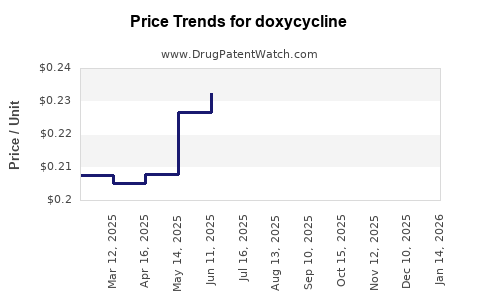
Drug Prices for doxycycline

See drug prices for doxycycline

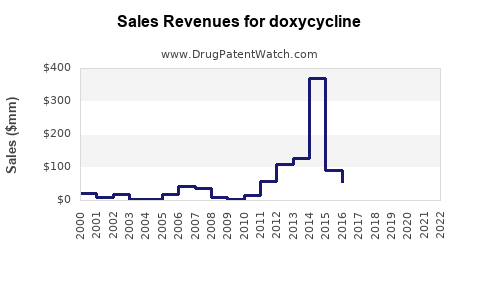
Drug Sales Revenue Trends for doxycycline

See drug sales revenues for doxycycline

Recent Clinical Trials for doxycycline

Identify potential brand extensions & 505(b)(2) entrants

SponsorPhase
Eunice Kennedy Shriver National Institute of Child Health and Human Development (NICHD)NA
University of WashingtonNA
National Institutes of Health (NIH)NA

See all doxycycline clinical trials

Generic filers with tentative approvals for DOXYCYCLINE
Applicant Application No. Strength Dosage Form
⤷  Start Trial⤷  Start Trial40MGCAPSULE;ORAL
⤷  Start Trial⤷  Start Trial40MGCAPSULE; ORAL
⤷  Start Trial⤷  Start Trial40MGCAPSULE;ORAL

The 'tentative' approval signifies that the product meets all FDA standards for marketing, and, but for the patents / regulatory protections, it would approved.

Pharmacology for doxycycline
Medical Subject Heading (MeSH) Categories for doxycycline
Paragraph IV (Patent) Challenges for DOXYCYCLINE
Tradename Dosage Ingredient Strength NDA ANDAs Submitted Submissiondate
ORACEA Delayed-release Capsules doxycycline 40 mg 050805 1 2008-12-12

US Patents and Regulatory Information for doxycycline

Applicant Tradename Generic Name Dosage NDA Approval Date TE Type RLD RS Patent No. Patent Expiration Product Substance Delist Req. Exclusivity Expiration
Chartwell DOXYCYCLINE doxycycline FOR SUSPENSION;ORAL 065454-001 Jul 16, 2008 AB RX No No ⤷  Start Trial ⤷  Start Trial ⤷  Start Trial
Gland DOXYCYCLINE HYCLATE doxycycline hyclate INJECTABLE;INJECTION 215583-001 Apr 12, 2023 AP RX No No ⤷  Start Trial ⤷  Start Trial ⤷  Start Trial
Zydus Pharms DOXYCYCLINE HYCLATE doxycycline hyclate TABLET, DELAYED RELEASE;ORAL 206772-001 Dec 21, 2018 DISCN No No ⤷  Start Trial ⤷  Start Trial ⤷  Start Trial
Mayne Pharma DORYX MPC doxycycline hyclate TABLET, DELAYED RELEASE;ORAL 050795-007 May 20, 2016 RX Yes No ⤷  Start Trial ⤷  Start Trial Y ⤷  Start Trial
Strides Pharma Intl DOXYCYCLINE doxycycline TABLET;ORAL 065070-004 Jul 14, 2005 AB RX No No ⤷  Start Trial ⤷  Start Trial ⤷  Start Trial
Lupin DOXYCYCLINE HYCLATE doxycycline hyclate TABLET, DELAYED RELEASE;ORAL 208741-005 Aug 11, 2023 DISCN No No ⤷  Start Trial ⤷  Start Trial ⤷  Start Trial
>Applicant >Tradename >Generic Name >Dosage >NDA >Approval Date >TE >Type >RLD >RS >Patent No. >Patent Expiration >Product >Substance >Delist Req. >Exclusivity Expiration

Expired US Patents for doxycycline

Applicant Tradename Generic Name Dosage NDA Approval Date Patent No. Patent Expiration
Galderma Labs Lp ORACEA doxycycline CAPSULE;ORAL 050805-001 May 26, 2006 ⤷  Start Trial ⤷  Start Trial
>Applicant >Tradename >Generic Name >Dosage >NDA >Approval Date >Patent No. >Patent Expiration

EU/EMA Drug Approvals for doxycycline

Company Drugname Inn Product Number / Indication Status Generic Biosimilar Orphan Marketing Authorisation Marketing Refusal
Pfizer Limited Doxirobe Doxycycline EMEA/V/C/000044Treatment of periodontal disease in dogs.Periodontal pocket probing depths >=4 mm are evidence of disease that may be responsive to treatment with the Doxirobe Gel. Use of this product as directed should result in attachment level gains, periodontal pocket depth reductions, local antimicrobial effect and improved gingival health. Noticeable improvements in these parameters should be evident within 2-4 weeks following treatment. The response in individual dogs is dependent on the severity of the condition and rigor of adjunctive therapy. Withdrawn no no no 1999-09-16
>Company >Drugname >Inn >Product Number / Indication >Status >Generic >Biosimilar >Orphan >Marketing Authorisation >Marketing Refusal

International Patents for doxycycline

Country Patent Number Title Estimated Expiration
European Patent Office 2204168 formulations de tetracyclines en dose quotidienne unique (Once daily formulations of tetracyclines) ⤷  Start Trial
Portugal 1615622 ⤷  Start Trial
Portugal 2204168 ⤷  Start Trial
World Intellectual Property Organization (WIPO) 2004091483 ⤷  Start Trial
Poland 1615622 ⤷  Start Trial
Spain 2534827 ⤷  Start Trial
>Country >Patent Number >Title >Estimated Expiration

Doxycycline Market Dynamics and Financial Trajectory: Pricing, Demand, Competitive Position, and Outlook

Last updated: April 24, 2026

Doxycycline is a high-volume, long-established antibiotic with broad generics penetration. Market dynamics are driven by (1) persistent demand for respiratory and skin infections, (2) cycling of guideline preferences between tetracyclines, beta-lactams, and macrolides, (3) specialty and non-infectious uses that sustain prescription and channel pull, and (4) generic pricing pressure that caps growth to volume-led expansion and premium formulations.

What is doxycycline’s demand base and why does it keep demand resilient?

Core infection demand

Doxycycline is widely used for community-acquired bacterial infections, with recurring use-cases that support stable prescribing across geographies:

  • Respiratory infections: bronchitis and other non-severe lower respiratory infections where tetracyclines remain guideline options.
  • Dermatologic infections: acne (notably via sub-antimicrobial strategies in specific formulations), rosacea subtypes, and other bacterial skin conditions.
  • Vector-borne and atypical pathogens: where doxycycline is a standard option for certain endemic risks and empiric therapy contexts.

Non-infectious and specialty-drug demand drivers

Doxycycline also sustains demand beyond routine acute infection treatment through:

  • Acne and inflammatory dermatology: doxycycline is used for acne control and other dermatology indications in multiple product formats.
  • Rosacea: doxycycline-based therapies are key in rosacea management pathways, supporting repeat demand even when acute antibiotic use softens.

Supply and channel structure

Doxycycline’s market has:

  • High generic coverage in most major markets
  • Multiple dosage forms (tablets, capsules, liquids, and delayed/modified release formats)
  • Large-scale manufacturing that keeps baseline supply strong, supporting patient access and limiting supply-driven pricing spikes

How does the pricing and margin profile typically evolve under generic dominance?

Generic-driven price compression

In a mature antibiotic with extensive patent expiration and broad generics competition, the commercial pattern typically looks like:

  • Initial brand pricing followed by step-down after generics entry
  • Continued price erosion as additional ANDA entrants and authorized generics increase buyer leverage
  • Margin stabilization only when a product has (a) formulation differentiation, (b) dosing convenience, or (c) payer preference in specific indications

What still supports revenue beyond pure commodity pricing

Revenue can hold up through mix shift, not headline price increases:

  • Premium and modified-release formulations: delayed/controlled-release products can sustain higher net pricing where payer formularies prefer them.
  • Formulation substitution: liquid/weight-based pediatric dosing or specific gastro-tolerability profiles can keep channel pull.
  • Dermatology chronic use: dermatology regimens can be more resistant to total category substitution than episodic acute antibiotics.

What market forces shape doxycycline’s financial trajectory over time?

1) Guideline and payer behavior

  • Antibiotic stewardship programs can reduce unnecessary antibiotic prescribing, but they also keep doxycycline in recommended lists for eligible indications.
  • Formulary decision-making favors low-cost therapeutics and consistent tolerability. This increases share for the lowest-cost clinically acceptable options and penalizes higher-cost branded products unless they maintain payer-preferred status.

2) Resistance patterns and clinical substitution

  • Doxycycline resistance has varied by pathogen and geography. When resistance data deteriorates for specific organisms, prescribers shift to other classes, reducing volumes in those niches.
  • When resistance remains manageable, doxycycline retains usage as a cost-effective option, which stabilizes volumes.

3) Safety and administration constraints

Tetracyclines are associated with known class-specific constraints (e.g., photosensitivity; gastrointestinal intolerance). Commercially, this creates demand for:

  • Improved tolerability formats
  • Dose regimens with better adherence
  • Patient counseling support through product labels

4) Competitive class dynamics

Doxycycline competes against:

  • Beta-lactams (penicillins/cephalosporins) in many empiric indications
  • Macrolides in certain respiratory indications
  • Other tetracyclines and newer agents in niche uses

Under stewardship and payer constraints, the market tends to reward the lowest total-treatment-cost option with sufficient clinical performance.

5) Specialty channel: dermatology and repeat dosing

Chronic dermatology use dampens volatility:

  • Acute antibiotic markets swing with seasonal infection patterns and prescribing restrictions.
  • Dermatology use patterns are more stable, which smooths revenue for products positioned for those indications.

Where does the growth potential actually come from in doxycycline?

For a generic-heavy molecule, growth typically comes from mix and lifecycle execution:

  • New formulations that improve tolerability or adherence
  • Indication expansion into dermatology pathways where doxycycline is used as a standard-of-care or preferred option
  • Geographic expansion in markets with evolving access and formularies
  • Channel optimization for institutional contracting (long-term care, ambulatory clinics, retail)

How does the financial trajectory usually present for a mature generic antibiotic?

Typical trajectory shape

Doxycycline’s financial trajectory in most markets follows a maturity curve:

  1. Revenue stabilizes as branded demand transitions to generics.
  2. Nominal revenue declines if payer net prices fall faster than volume increases.
  3. Volume can partially offset price through mix shift to preferred generics and specific formulations.
  4. Later-stage declines flatten when category demand is large and stable (respiratory and dermatology baseline).
  5. Periodic disruptions occur from formulation supply constraints or short-term shifts in guideline preference.

Investor and business implication

  • Upside is limited to share gains, premium mix, and formulation differentiation.
  • Downside is predictable through net price compression from additional generic entrants and increased buyer negotiation leverage.

What does competition look like and how does it affect revenue stability?

Competitive landscape structure

Doxycycline’s market is characterized by:

  • Multiple generic manufacturers across major dosage forms
  • Frequent substitution at the pharmacy level when cost-sharing drives switch behavior
  • Payer-driven formulary preference that locks in certain SKUs

Pricing power reality

Pure doxycycline generics have low pricing power. Revenue stability tends to depend on:

  • Contracting strength (ability to supply at target net prices)
  • Preferred formulary placement for certain SKUs
  • Therapeutic equivalence acceptance (no meaningful clinical differentiation)

How does formulation strategy change the revenue equation?

Differentiation levers

Revenue resilience improves when a product:

  • Provides gastrointestinal tolerance via formulation design
  • Enables simplified dosing or better adherence
  • Targets dermatology dosing patterns that align with chronic therapy schedules

Competitive effect

Even within generics, improved formulations can:

  • Reduce patient discontinuations
  • Keep higher utilization against lower-cost immediate-release alternatives
  • Support payer preference for tolerability-centered switches

What are the key risks to the financial trajectory?

The principal risks are structural and recurring:

  • Generic net price erosion through continued entry and contracting pressure
  • Guideline changes that move empiric treatment away from tetracyclines in certain pathogen settings
  • Resistance-driven shifts that reduce effective use in specific indications
  • Stewardship tightening that reduces total antibiotic prescribing (volume headwind)
  • Safety perception and adherence barriers that favor alternative drug classes

What is the likely outlook for doxycycline revenues and margins?

Revenue outlook

  • Demand remains durable due to established infection and dermatology use cases.
  • Total market growth is modest and largely volume-led.
  • Revenue is sensitive to payer net price due to generic dominance.

Margin outlook

  • Margins stay compressed relative to branded specialty drugs.
  • Execution wins come from mix (preferred SKUs), supply reliability, and contracting rather than pricing.

Lifecycle outlook

  • The molecule’s core economics are mature.
  • Near-term outcomes are determined by competitive intensity in specific SKUs and the sustained uptake of dermatology positioning for doxycycline formulations.

Market checkpoints that matter commercially

Business and investment decisions for doxycycline should track the same set of variables:

  • Generic entry intensity by SKU and dosage form (net price and share shifts)
  • Payer formulary changes (preferred listing and prior authorization behavior)
  • Dermatology growth and retention (repeat-use stability vs seasonal infection swings)
  • Guideline updates by geography (treatment pathway changes that shift volume)
  • Resistance reports by pathogen class (label-relevant clinical performance)

Key Takeaways

  • Doxycycline is a high-volume, mature antibiotic with generic-dominated economics and low pricing power.
  • Market stability is supported by persistent infection use and repeat-demand dermatology use, which can smooth volatility.
  • Financial trajectory is driven more by mix and contracting than by price growth, with revenue constrained by ongoing generic price pressure.
  • Upside is mainly tied to formulation differentiation (tolerability/adherence) and payer-preferred positioning in dermatology pathways.
  • Downside is predictable: net price compression, stewardship volume reduction, and guideline or resistance shifts that alter prescribing share.

FAQs

  1. Is doxycycline growth mainly price-led or volume-led?
    It is primarily volume-led with mix effects, because pricing power is limited under generic dominance.

  2. Which therapeutic areas stabilize doxycycline demand?
    Respiratory and dermatology use cases, especially chronic dermatology regimens, stabilize utilization.

  3. What determines net pricing for doxycycline in formularies?
    Generic contracting strength, preferred SKU placement, and payer cost-sharing dynamics.

  4. What is the biggest financial risk for doxycycline?
    Continued net price erosion from increased generic competition and formulary substitution.

  5. Do resistance trends materially change doxycycline’s commercial outlook?
    Yes, pathogen-specific resistance shifts can reduce effective use in certain indications and move share to alternative classes.


References

[1] U.S. Food and Drug Administration (FDA). National Drug Code (NDC) Directory. https://www.fda.gov/drugs/drug-approvals-and-databases/national-drug-code-directory
[2] FDA. Drug Shortages. https://www.accessdata.fda.gov/scripts/drugshortages/default.cfm
[3] Centers for Disease Control and Prevention (CDC). Antibiotic Use and Stewardship Resources. https://www.cdc.gov/antibiotic-use/
[4] Infectious Diseases Society of America (IDSA). Clinical practice guideline and stewardship-related publications. https://www.idsociety.org/guidelines/
[5] World Health Organization (WHO). Antimicrobial resistance and antibiotics use resources. https://www.who.int/health-topics/antimicrobial-resistance

More… ↓

⤷  Start Trial

Make Better Decisions: Try a trial or see plans & pricing

Drugs may be covered by multiple patents or regulatory protections. All trademarks and applicant names are the property of their respective owners or licensors. Although great care is taken in the proper and correct provision of this service, thinkBiotech LLC does not accept any responsibility for possible consequences of errors or omissions in the provided data. The data presented herein is for information purposes only. There is no warranty that the data contained herein is error free. We do not provide individual investment advice. This service is not registered with any financial regulatory agency. The information we publish is educational only and based on our opinions plus our models. By using DrugPatentWatch you acknowledge that we do not provide personalized recommendations or advice. thinkBiotech performs no independent verification of facts as provided by public sources nor are attempts made to provide legal or investing advice. Any reliance on data provided herein is done solely at the discretion of the user. Users of this service are advised to seek professional advice and independent confirmation before considering acting on any of the provided information. thinkBiotech LLC reserves the right to amend, extend or withdraw any part or all of the offered service without notice.