Last updated: April 24, 2026
Doxycycline hyclate is a long-established tetracycline antibiotic with a mature, price-competitive market dominated by generics and sustained demand across respiratory, dermatology, ophthalmology, and other infectious indications. Financial trajectory is shaped less by patent-driven monopoly economics and more by (1) generics penetration, (2) input-cost volatility and supply continuity, (3) reimbursement and tender dynamics in retail and hospital channels, and (4) periodic demand swings tied to public-health guidance, seasonal infection patterns, and competitor supply disruptions.
How big is doxycycline hyclate’s market and what drives demand?
Demand base
Doxycycline hyclate is used for bacterial infections and has broad prescriber familiarity. Usage patterns are influenced by:
- Indication breadth: respiratory tract infections and community-acquired bacterial infections; dermatologic uses such as acne and rosacea regimens; ophthalmic and sexually transmitted infection-related indications where appropriate.
- Route and formulation availability: oral capsules/tablets and other dosage forms that fit standard outpatient and inpatient workflows.
- Clinical positioning versus alternatives: tetracyclines remain common where cost and tolerability support first-line or step-down therapy.
Demand drivers specific to the branded-to-generic phase
In a mature molecule, market value typically tracks the interaction of:
- Generic substitution rates: high and relatively stable in many markets after initial brand exclusivity ends.
- Channel mix: hospital procurement often behaves like a “tender market,” where lowest acquisition cost wins, compressing realized prices.
- Antibiotic stewardship and guideline changes: can increase or reduce use by shifting empiric choices and duration recommendations.
What are the market dynamics that shape pricing and volume?
Generics economics
Doxycycline hyclate is widely available as generics, which drives:
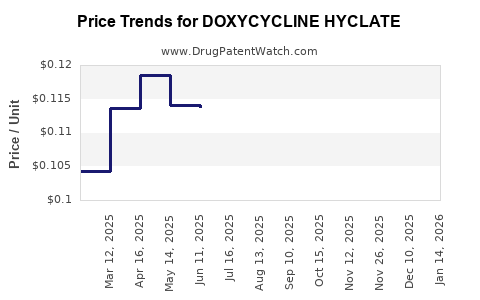
- Price compression: steady downward pressure on unit prices as additional manufacturers enter.
- Consolidation of supply: fewer plants or fewer stable suppliers can create temporary price spikes, but the long-run equilibrium tends back toward low-cost steady-state.
- Contracting discipline: hospital formularies and wholesaler contracts increasingly specify short lists and volume rebates.
Competitive set characteristics
The practical competitive set is “within-class and within-formulary”:
- Other doxycycline salts (where interchangeable in practice), plus
- Other broad-spectrum oral antibiotics (used as substitutes when clinical guidelines or local resistance patterns shift).
Even when clinical equivalence exists, payer preference and formulary placement can favor the lowest total cost of therapy.
Supply-chain dynamics
Pricing and availability can move with:
- API and excipient costs for tetracycline manufacturing,
- Regulatory and quality events (batch recalls, warning letters),
- Capacity constraints that affect fill-rate and lead times.
These create short-term financial volatility but not typically category-level growth.
How is doxycycline hyclate’s financial trajectory likely to look over time?
Mature-product profile
A mature antibiotic typically shows a financial shape like this:
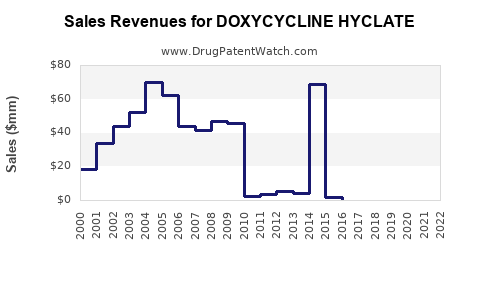
- Revenue stability with margin compression: volume remains supported by ongoing prescribing while realized price trends down.
- Upside events are usually supply-driven: shortages, temporary manufacturing interruptions, or quality issues at competitors can lift pricing and improve margins, often briefly.
- Long-run growth is modest: growth depends on population trends, local stewardship shifts that expand empiric use, and ongoing distribution expansion rather than new molecule adoption.
Key measurement points for investors and R&D strategists
For doxycycline hyclate, financial trajectory is best evaluated through:
- Net price per unit (or per defined course) in the relevant geography,
- Volume in prescriptions or DDDs by channel,
- Gross margin sensitivity to API cost and freight,
- Market share by manufacturer in tender-heavy hospital segments,
- Backlog risk linked to manufacturing compliance.
What role do patents and exclusivity play in the economics?
Doxycycline hyclate is not a contemporary “blockbuster” patent story; its economics are governed by generics and supply. As a result:
- Incremental revenue uplift from new entrants tends to be share-taking rather than category expansion.
- R&D differentiation is more about formulation lifecycle management (bioavailability, stability, dosing convenience) and regulatory resilience than monopoly pricing.
Where does value accrue across the manufacturing and distribution chain?
In a generics-heavy landscape:
- Manufacturers capture value when they maintain supply reliability and secure contracts at competitive acquisition costs.
- Distributors and pharmacy benefit dynamics determine final realized reimbursement, with competitive bidding and substitution rules shaping end-market pricing.
- Hospital procurement compresses pricing and shifts value toward manufacturers that can meet tender terms and quality requirements without disruptions.
How do reimbursement and regulation influence realized demand?
Reimbursement
In mature antibiotics:
- Payers increasingly drive utilization via formulary access and preferred-generic lists.
- Reimbursement rates often move within narrow bands, limiting upside even when wholesale pricing changes.
Stewardship and guidance
Antibiotic use is sensitive to:
- resistance surveillance updates,
- guidance changes on empiric therapy and recommended duration,
- institutional stewardship programs that can enforce narrower indications.
These factors usually reduce growth volatility by creating predictable prescribing guardrails, but they can also create episodic declines when guidelines tighten.
What financial outcomes follow from these dynamics?
Base-case outcome profile
The typical outcome for doxycycline hyclate in mature markets is:
- Revenue: stable to slowly declining in unit price terms, with modest offset from volume stabilization.
- Operating margin: pressured by price competition; improved only when supply constraints reduce effective competition or when a manufacturer’s cost position is favorable.
- Market share: shifts toward manufacturers with robust manufacturing and contracting execution rather than those with higher list prices.
Upside and downside triggers
Upside triggers
- Competitor manufacturing disruption reduces supply.
- Strengthened formulary position with large contract awards.
- Input-cost falls (API and excipients) enabling cost-led pricing.
Downside triggers
- Broad new generic entries or aggressive tender bidding.
- Quality failures causing supply stoppages.
- Guideline-driven shifts reducing empiric or prophylactic use.
Market trajectory by customer segment: retail, hospital, and institutional
Retail pharmacy
Retail is sensitive to substitution and price transparency. Financial impact tends to be:
- Lower price through dynamic substitution,
- Stable demand because doxycycline is a familiar antibiotic for common infections and dermatologic needs.
Hospital and procurement
Hospitals dominate realized price outcomes through:
- tender awards,
- formulary switching,
- contract volumes tied to budget cycles.
Financial trajectory in hospitals is typically more volatile with supply events, but the long-run trend stays price-compressed due to ongoing generic competition.
Institutional and long-term care
In institutional settings, prescribing can be driven by formulary protocols and infection management pathways. Revenue stability depends on:
- consistent supply,
- low stockout risk,
- pharmacist and stewardship protocol adherence.
What does this imply for planning R&D or commercial strategy?
For investors assessing financial trajectory
A doxycycline hyclate investment thesis is usually built around:
- manufacturer execution (compliance, capacity, supply reliability),
- cost competitiveness (API procurement and manufacturing yield),
- contracting strength in hospital procurement,
- ability to withstand low-price equilibrium.
For commercial and lifecycle strategy
The most durable differentiation in mature antibiotics is:
- formulation reliability and reduced variability,
- supply continuity,
- rapid regulatory responsiveness in batch approvals and quality systems.
Key Takeaways
- Market is mature and price-competitive: generics dominance keeps unit prices under sustained pressure.
- Financial trajectory is supply and cost-driven: stability depends on manufacturing reliability, API economics, and tender contracting execution.
- Demand growth is limited: category expansion is modest; stewardship and guidelines can shift utilization.
- Short-term swings are supply-side: competitor outages or quality events can lift realized pricing, usually temporarily.
- Value accrues to operational excellence: firms with lower landed cost and stronger supply reliability capture the most durable margins.
FAQs
1) Does doxycycline hyclate have patent-driven growth potential?
No. Its financial profile is primarily shaped by generic competition and supply-chain execution rather than patent exclusivity.
2) What most affects realized pricing for doxycycline hyclate?
Hospital and institutional contracting, wholesale purchasing dynamics, and generic competitive intensity determine realized prices more than list-price changes.
3) Can supply disruptions materially change the financial outcome?
Yes. Manufacturing interruptions at key competitors can create short-term pricing and margin improvement by reducing effective competition, then normalize as supply returns.
4) How sensitive is demand to antibiotic stewardship?
Meaningfully. Changes in clinical guidelines, resistance surveillance emphasis, and institutional stewardship protocols can alter prescribing volume and treatment duration.
5) Where can a manufacturer still find durable advantages?
Operational reliability, cost position, quality systems, and contracting execution in tender-heavy accounts.
References (APA)
[1] World Health Organization. (n.d.). Doxycycline and other antibiotics: information and guidance (as applicable). https://www.who.int/
[2] U.S. Food and Drug Administration. (n.d.). Drug approvals and labeling resources (as applicable). https://www.fda.gov/drugs
[3] EMA. (n.d.). European public assessment reports and regulatory resources (as applicable). https://www.ema.europa.eu/
[4] National Library of Medicine. (n.d.). DailyMed: Doxycycline hyclate labeling information (as applicable). https://dailymed.nlm.nih.gov/
[5] IQVIA Institute for Human Data Science. (n.d.). Antibiotics market and trends reports (as applicable). https://www.iqvia.com/insights/the-iqvia-institute