Last updated: June 13, 2026
Executive summary
Mayne Pharma sits in the specialty generics and branded generics space, with a portfolio weighted toward respiratory and CNS products (including historically marketed branded generics and contract manufacturing/licensing). Its competitive position depends on three levers: (1) exclusivity protection for complex generics (where present in legacy launches), (2) cost and regulatory execution in FDA/NDA and ANDA manufacturing networks, and (3) the scale of defensible licensing and follow-on line extensions. The company’s patent-driven moat is uneven by product, with most value exposed to post-launch generic entry once primary patents and exclusivities clear and as FDA approvals for competing ANDAs accumulate on the Orange Book. Strategic upside is tied to pipeline execution and securing defensible reformulations, line extensions, and manufacturing/process IP around API, dosage form, and device-like features (where relevant).
Mayne Pharma competitive landscape: where does it compete and what is its market position?
Answer: Mayne Pharma competes primarily in the US via specialty generics/legacy branded generics and, in parallel, via partnerships and licensing tied to product development and commercialization capabilities.
What therapeutic areas does Mayne Pharma emphasize?
Mayne Pharma has historically marketed products concentrated in:
- Respiratory (notably inhaled formulations and asthma/COPD-adjacent categories)
- CNS (including antipsychotic/neurologic-related legacy lines)
- Other specialty areas through licensing and partnered launches
How does Mayne Pharma’s go-to-market differ from full-line generic majors?
Compared with large generic incumbents (multi-product breadth, deep tower of Abbreviated New Drug Applications), Mayne’s model has leaned more on:
- Focused product baskets (fewer “must-win” SKUs at a time)
- Partnership-led and licensing-led growth
- Differentiation via dosage form, formulation, and manufacturing readiness rather than only price
Which competitive set best matches Mayne Pharma’s profile?
- Specialty generic companies with strong respiratory/CNS footprints (complex generics, formulations, and device-adjacent products)
- Branded generic manufacturers with line extensions
- Contract and licensing counterparties with development-to-commercialization bundling
What patents protect Mayne Pharma products, and how strong is the patent estate?
Answer: Patent strength is product-specific. Mayne Pharma’s competitive advantage typically rests on complex-generic barriers (formulation, method, and manufacturing-process claims) and on any Orange Book-listed composition/method-of-use claims tied to brand protection for earlier launches.
How to assess Mayne’s patent estate strength in a competitive landscape
Use a three-layer screen when benchmarking Mayne:
- Primary claims: active ingredient composition and/or polymorph/solid-state claims.
- Secondary claims: formulation composition, release profile, particle engineering, excipient systems, and manufacturing/process parameters.
- Use claims: method-of-use or regimen-related claims (where applicable to FDA labeling strategy).
Patent estate patterns that create real entry barriers
Entry barriers often depend on:
- Whether claims are listed in the Orange Book for the specific NDA/ANDA reference drug
- Whether the relevant patents were asserted in ANDA litigation
- Whether Mayne (or its license counterparties) holds strong, claim-narrowing exclusivity tied to submission timing and pediatric or other statutory exclusivities
When does Mayne Pharma lose exclusivity for key products?
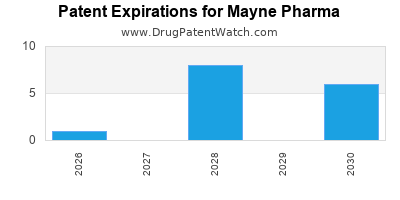
Answer: Exclusivity timing is driven by each product’s Orange Book expiration set plus any pediatric exclusivity extensions and 180-day exclusivity triggers tied to first generic approvals or paragraph IV settlements.
What drives exclusivity outcomes in US generic competition
- Patent expiration (composition/method/formulation)
- Statutory exclusivities (e.g., pediatric extensions, orphan-like exclusivity where relevant)
- 180-day exclusivity bars and forfeiture events tied to competitive ANDA filings
- Carve-outs in settlement agreements that allow earlier “authorized generic” ramps
Competitive consequence
As primary patents and listed exclusivities clear, Mayne faces rapid margin pressure from:
- Multiple ANDA approvals across generic competitors
- Wholesale price compression and payer-driven switching
How do Paragraph IV challenges affect Mayne Pharma’s competitiveness?
Answer: Paragraph IV challenges are a key driver of launch timing and settlement economics. For Mayne, competitive exposure spikes when its product is the reference for litigation or when its own launches become litigation targets.
What to track in ANDA litigation involving Mayne-type assets
- Whether Mayne is a claimant/defendant in district court litigation
- Whether settlements include:
- Launch date carve-outs
- Design-around permissions
- Authorized generic terms
- “Working” or supply covenants with other generic firms
- Whether the court’s decisions uphold method/formulation claims or invalidate key claims
Market impact mechanics
- If Mayne has an injunction or dismissal that blocks early entry, competitors’ launch dates shift.
- If the claims are narrowed or invalidated, Mayne’s pricing power can erode quickly, even if brand or reference drug remains on formulary.
What generic entry risks exist for Mayne Pharma products after approval?
Answer: Generic entry risk increases in three scenarios: (1) Orange Book patents fall, (2) design-around formulations avoid the protected claim set, or (3) multiple ANDAs gain approval with short label and formulation differentiation.
Key risk categories
- Claim overlap risk: competing ANDAs mirror Mayne’s protected formulation or dosing features.
- Manufacturing-process risk: if the process claims do not translate into enforceable, product-specific limitations.
- Regulatory labeling risk: if competitors can secure “skinny label” eligibility or broader interchangeability quickly.
What formulations are protected for Mayne Pharma, and what delivery systems create defensibility?
Answer: Defensibility typically clusters in:
- Solid oral dosage technologies (solid-state engineering, polymorph/process)
- Controlled release or absorption-modifying formulations
- Inhalation technologies where particle characteristics and device integration matter
Where formulation IP most often changes the competitive outcome
- Controlled-release profiles can drive label and bioequivalence differentiation.
- Particle engineering and excipient systems can create non-trivial design-around difficulty.
- Device integration (where applicable) can raise CMC complexity and slow generic readiness.
How does Mayne Pharma compare with other respiratory and CNS specialty generic companies?
Answer: Mayne’s competitive posture is strongest where it holds defensible CMC execution and product-level IP, and weaker against multi-SKU generic majors when exclusivity clears or when competitors can match bioequivalence with simpler manufacturing pathways.
Benchmark comparison framework
- Product overlap with major respiratory/CNS generics
- Depth of formulation/process IP (Orange Book coverage breadth)
- Manufacturing readiness speed (FDA approval-to-commercial launch timeline)
- Litigation record outcomes and settlement terms frequency
- Ability to fund line extensions and new dosage forms
What is the Orange Book status of Mayne Pharma products?
Answer: Orange Book status is decisive for entry timing. Products with multiple listed patents (composition plus formulation/method) usually face slower generic penetration; products with fewer listed patents or earlier expiries are exposed to rapid ANDA competition.
What Orange Book indicators matter most
- Count of listed patents per NDA/ANDA
- Patent types (composition vs method vs formulation vs use)
- Expiration calendar clustering (multiple patents expiring within the same window accelerates competitive pressure)
- Whether listed patents show history of paragraph IV challenges
What manufacturing and CMC/IP barriers protect Mayne Pharma from generic substitution?
Answer: Where the competitive set cannot match Mayne’s manufacturing controls, product quality and bioequivalence can become barriers. Many generic competitors can submit ANDAs, but fewer can achieve fast, stable, validated production at scale with low batch failure rates.
CMC/IP friction points
- Establishing consistent dissolution and release for modified-release products
- Holding particle-size distribution and solid-state attributes
- Demonstrating equivalence for formulation-specific excipient systems
- Validating manufacturing parameters if method-of-manufacture claims are enforced
What patent litigation affects Mayne Pharma’s commercialization timeline?
Answer: Patent litigation affects Mayne through injunctions, dismissal outcomes, settlement-driven launch dates, and authorized generic provisions that reshape realized market share.
Litigation-driven timeline levers
- Entry stays or injunctions that block FDA-authorized launches
- Court rulings that narrow claim scope
- Settlements that trade timing certainty for licensing or payment structures
- Appeals that delay final entry even after initial district court outcomes
Are there licensing deals that shape Mayne Pharma’s competitive advantage?
Answer: Licensing and partner-led commercialization can shift Mayne’s advantage from “owning every product asset” to “controlling rights and execution” for product-level defensibility.
Licensing advantage pathways
- Securing exclusive rights for a dosage form, strength, or formulation variant
- Bundling IP rights with CMC development and regulatory ownership
- Using partnerships to accelerate US market entry while retaining a defensible claim profile
Does Mayne Pharma face biosimilar risk like biologic developers?
Answer: Biosimilar risk is generally not the central competitive driver for Mayne’s traditional footprint unless Mayne has exposure to biologics or biologic-adjacent specialty assets via partnerships.
Competitive implication
In non-biologic specialty generics, the key analogous risks are:
- ANDA paragraph IV litigation
- Patent expiration and Orange Book clearing
- Formulation design-around
Revenue exposure: how much of Mayne Pharma’s growth depends on exclusivity-sensitive assets?
Answer: Revenue exposure tends to be concentrated in products with the longest hold time on exclusivity or the highest payer/formulary stickiness. As exclusivity lapses, revenue typically becomes more sensitive to:
- Wholesale pricing compression
- Payer formulary tier changes
- Increased competition from authorized and non-authorized generics
How to model exposure in a competitive landscape
Use a product cohort approach:
- “Exclusivity still active” cohort: limited near-term competitive entry
- “Patent cliff” cohort: expected multi-ANDA approvals
- “Post-entry” cohort: monitor share decline, gross-to-net pressure, and margin erosion
Key competitive insights for R&D and business development
Answer: Mayne’s highest-leverage strategies align with where competition is bottlenecked by defensibility: formulation/process IP, regulatory defensibility, and manufacturing speed.
Strategic insight #1: prioritize line extensions that change the claim set
Products remain competitive longer when they:
- Add strengths/dosage forms that carry separate Orange Book listings
- Shift to modified-release profiles that require distinct formulation/process validation
Strategic insight #2: target manufacturing/process differentiation that is hard to replicate
Generic competitors often match labeling quickly but can lag on:
- batch consistency
- stability and shelf-life
- dissolution/release reproducibility
Strategic insight #3: turn litigation into a planning tool
Track settlement structures and timing patterns to:
- time product launches around expected entry waves
- select which ANDAs to contest based on claim strength and enforceability
Key Takeaways
- Mayne Pharma competes most effectively where it can sustain product-level defenses tied to formulation/process complexity and defensible regulatory and IP status.
- Patent and Orange Book strength are product-specific; competitive pressure increases rapidly when key composition/method/formulation claims clear.
- Paragraph IV litigation and settlement structures materially shape realized market share by controlling launch timing and authorized generic dynamics.
- Highest-return strategy centers on line extensions and CMC-differentiated platforms that shift the protected claim set and slow generic design-around.
FAQs
-
What Orange Book indicators predict faster generic erosion for specialty generics?
Patent count clustering near the same expiration date, heavy reliance on a single patent type (e.g., only composition), and a history of paragraph IV approvals on closely related strengths.
-
How do paragraph IV settlements typically affect authorized generics for Mayne-type launches?
Settlements often allow earlier authorized generic entries outside the enjoined period, creating price compression even before full generic penetration.
-
What formulation characteristics most often create design-around difficulty in ANDA competition?
Controlled-release behavior, solid-state/polymorph control, particle-size distribution targets, and dissolution profile sensitivity to process parameters.
-
How does manufacturing readiness change the competitive outcome after FDA approval?
The first-to-market advantage after approval depends on CMC scale-up success, batch yield, stability performance, and the ability to ship consistently.
-
What’s the best way to assess patent strength for a specific product in Mayne’s portfolio?
Map Orange Book-listed patents to claim type, expiration calendar, and litigation history, then benchmark against known competitor design-around approaches.
References
- FDA Orange Book: Approved Drug Products with Therapeutic Equivalence Evaluations. (accessed via FDA).
- U.S. FDA ANDA Paragraph IV and Patent Litigation framework under the Hatch-Waxman Act (statutory basis).