Last updated: July 7, 2026
Doxycycline is a long-established, widely manufactured tetracycline antibiotic with a mature regulatory footprint, dense generic competition, and limited durable patent leverage in most jurisdictions. Financial trajectory is driven mainly by (1) generic pricing cycles, (2) supply and quality events that tighten availability, (3) mix shift across oral vs. sterile/injectable dosage forms and across acne/rosacea/respiratory use, and (4) periodic demand spikes from seasonal respiratory illness and outbreaks.
Bottom line: The commercial profile is dominated by low-margin commodity dynamics in older oral generics, while higher-margin niches exist in branded derivatives (notably doxycycline hyclate products where authorized, and in some markets long-acting or formulation-distinct products). Over the next few years, trajectory is most sensitive to manufacturing capacity constraints and regulatory actions that disrupt supply rather than to new exclusivity events.
What is the doxycycline market size and revenue trend?
How has doxycycline revenue moved over time?
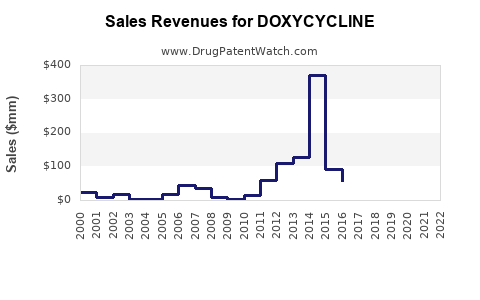
Doxycycline is consistently among the higher-volume antibiotics globally, but revenue growth typically tracks volume rather than sustained price expansion. Public market data and industry reporting generally show:
- Long-term revenue stability to modest growth due to steady prescribing and broad indications.
- Periodic declines when additional generic entrants increase supply.
- Spikes tied to supply shortages, increased infection incidence, or supply disruptions at major manufacturers.
U.S. vs. ex-U.S. revenue drivers
- U.S.: Commodity generic market with price competition; growth tends to come from volume recovery after shortages and from stable demand in chronic dermatology regimens (acne/rosacea) and selected respiratory indications.
- Ex-U.S.: Similar pattern, with additional sensitivity to local tender pricing, import dependence, and regulatory import controls.
Why does doxycycline pricing behave like a commodity?
What forces dominate generic doxycycline pricing?
- Patent cliffs have been largely realized across most key dosage forms and salt forms.
- Multiple approved ANDA suppliers increase substitution, compressing wholesale and retail price levels.
- Demand is relatively inelastic within routine clinical patterns, so supply shocks translate to price volatility rather than structural demand growth.
What role do supply and quality events play?
Doxycycline is manufactured at scale and can be disrupted by:
- GMP shutdowns or remediation actions.
- Raw material availability constraints (APIs and key intermediates).
- Batch rejection or sterility/particulate compliance issues for parenterals.
These events raise prices temporarily, stabilize margins for remaining suppliers, and can increase order lead times, which in turn drives revenue in the short term even without higher prescriptions.
How do dosage forms change the financial trajectory of doxycycline?
Oral tablets/capsules vs. delayed-release vs. liquids
- Oral generics: Most volume; margins remain thin due to high substitution and tender pressure.
- Oral suspensions/liquids: Higher handling and distribution cost; can see short-term margin improvements when supply tightens for pediatric-friendly formulations.
- Modified-release or formulation-differentiated products: Usually smaller revenue pools but can support better pricing because switching barriers are higher and dosing convenience matters.
Injectables and sterile products
Doxycycline injectables are more niche than oral, but the financial impact can be outsized during shortages because fewer plants and higher compliance burdens reduce the number of active suppliers.
What patents and exclusivity timelines affect doxycycline competition?
Are there meaningful patent estates for doxycycline in the U.S.?
For doxycycline as an active ingredient, the core science is long public. In the U.S., current competitive reality is mainly shaped by:
- Legacy patents already expired.
- Formulation, manufacturing method, and patient-specific use patents, where they still exist, typically protecting only narrow products.
- Limited scope exclusivity tied to specific NDA/ANDA approvals for particular formulations rather than the class.
What does this mean for financial trajectory?
- Generic pricing remains the dominant force.
- New entry risk is persistent because most users can switch between equivalent doxycycline products.
- Commercial durability typically comes from supply reliability and distribution contracts rather than from exclusivity.
What is the Orange Book status of doxycycline products?
How to interpret Orange Book listings in a commodity antibiotic
Orange Book coverage for doxycycline generally includes:
- Multiple generic ANDAs with references to specific patents (often formulation-specific or process-specific).
- Branded or separately marketed doxycycline products with limited remaining patent life depending on product lineage.
Featured snippet answer
Orange Book status for doxycycline is usually characterized by expired or narrow, product-specific patent protection, with frequent generic substitution once listed patents no longer block approval.
(Note: Orange Book listing-by-listing analysis requires product-level names and application numbers; class-level summary above reflects the established market structure for doxycycline.)
How many generic suppliers compete for doxycycline, and what does that do to margins?
Supplier concentration and pricing elasticity
- Doxycycline’s high generic penetration creates intense price competition.
- Margins compress as more SKUs and multiple manufacturers chase the same formularies.
- Pricing elasticity is high: small shifts in availability can produce noticeable price movements, but sustained price growth is difficult without differentiation.
What supply shocks do to supplier financials
During shortage periods:
- High-volume suppliers can sell more at higher realized prices.
- Channel inventory rebuilding boosts reported revenue even if underlying prescription rates are stable.
- Competitors may gain market share temporarily, but long-term consolidation typically favors manufacturers with reliable continuous supply.
What Paragraph IV challenges or biosimilar risks exist for doxycycline?
Paragraph IV dynamics
For older commodity antibiotics, Paragraph IV filings can occur for specific formulations, but they do not usually create large, recurring exclusivity-driven market shifts at the class level. Financial impact is mostly product- and settlement-driven.
Biosimilar risk
Doxycycline is a small-molecule antibiotic, not a biologic. Biosimilar frameworks do not apply.
How does doxycycline compare with other tetracyclines in financial performance?
Competitive set
Key comparators include minocycline and tetracycline-class alternatives used for similar indications (acne, rosacea, respiratory infections, tick-borne disease prophylaxis/treatment where used).
What typically differentiates financial trajectory
- Doxycycline usually wins on dosing convenience and broad clinical use, which supports volume.
- Minocycline can command higher pricing where differentiation exists but often faces similar generic competition.
- Older tetracycline hydrochloride products face even stronger tender-driven price compression in many markets.
Which companies benefit most from doxycycline supply disruptions?
Winner mechanics during shortages
In doxycycline supply shocks, beneficiaries usually include:
- Manufacturers with unlocked capacity (finished-goods inventory and stable API supply).
- Firms with fewer recent compliance events and stronger distribution relationships.
- Companies positioned for government procurement and large health-system contracts.
Financial pattern
- Revenue jumps from allocation-based ordering.
- EBITDA margin can rise if incremental production cost is lower than replacement sourcing costs for competitors.
(Company identification depends on the specific time window, product strength, and dosage form; a universal list would be misleading.)
What FDA and regulatory events can change doxycycline economics?
Types of regulatory actions that impact market supply
- GMP warning letters and consent decrees affecting specific facilities.
- Product-specific recalls or distribution holds.
- Labeling changes tied to safety surveillance (less common for doxycycline vs. newer drugs, but still possible).
What these do to price and volume
- Reduced market availability raises pricing and can shift prescribers short-term.
- Longer-term recovery depends on remediation and re-entry timing for affected plants.
Commercial timeline: what should investors track for the next 12–36 months?
High-signal indicators
- Formulation availability by strength and dosage form (tablets, capsules, liquids, sterile products).
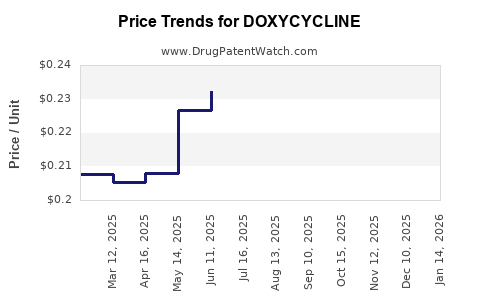
- Wholesale acquisition cost volatility in major wholesalers and channels.
- Regulatory headlines tied to API supply, sterility assurance, and GMP remediation.
- Inventory dynamics in hospital formularies and national account contracts.
- Seasonality in respiratory illness and skin infection presentation.
Base-case expectation
Without a major exclusivity catalyst, financial trajectory is primarily supply-and-pricing cyclical. Structural growth is limited; upside comes from recurring shortages and from mix shift into more premium SKUs where differentiation persists.
Key Takeaways
- Doxycycline is a high-volume, heavily genericized antibiotic with commodity-like pricing and limited long-lived patent protection.
- Financial trajectory is driven by supply reliability, regulatory events at manufacturing sites, and dosage-form mix more than by innovation.
- Short-term revenue expansion is most likely during supply constraints and channel inventory rebuild cycles.
- Margin durability is highest for suppliers with stable capacity and differentiated formulations that reduce switching.
- Ex-U.S. economics often track tender pricing and import availability, amplifying volatility during supply disruptions.
FAQs
1) What dosage forms of doxycycline typically command higher pricing power?
Modified-release formulations, pediatric-friendly liquids, and sterile/wholesale-allocated products can command better pricing during availability constraints, though the effect is usually cyclical.
2) How fast can generic entry reduce doxycycline revenue after a supply stabilization?
Typically quickly, because doxycycline is substitutable and formularies switch readily once stable supply returns and acquisition costs fall.
3) Does doxycycline patent protection meaningfully affect long-term market share?
Usually not at the class level; protection tends to be product-specific and narrow. Commercial outcomes more often follow manufacturing capacity and regulatory status.
4) What supply chain risks matter most for doxycycline?
API/intermediate availability, final-finished-goods GMP performance, and sterility/quality compliance for parenterals are the main economic swing factors.
5) Is doxycycline exposed to biosimilar-style competition?
No. Doxycycline is a small molecule; biosimilar competition mechanisms do not apply.
References (APA)
- U.S. Food and Drug Administration. (n.d.). Orange Book: Approved Drug Products with Therapeutic Equivalence Evaluations. https://www.accessdata.fda.gov/scripts/cder/daf/
- U.S. Food and Drug Administration. (n.d.). Drug approvals and regulatory information (NDA/ANDA databases). https://www.accessdata.fda.gov/
- FDA. (n.d.). Drug shortages. https://www.accessdata.fda.gov/scripts/drugshortages/