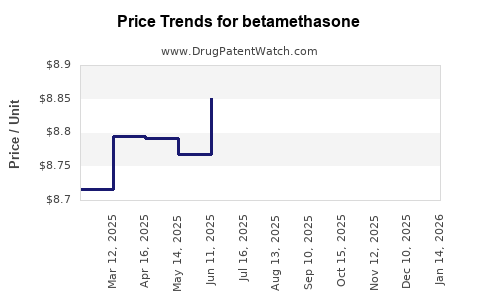
Last updated: April 22, 2026
How big is the betamethasone market and what drives demand?
Betamethasone is a corticosteroid used across dermatology, inflammation/autoimmune care, and obstetrics (notably fetal lung maturation via antenatal corticosteroids). Demand is driven by (1) chronic dermatologic indications, (2) intermittent inflammatory flares, (3) hospital use in obstetric care pathways, and (4) low-to-moderate switching costs once products are on formulary.
| Demand characteristics by segment |
Segment |
Typical use pattern |
Demand driver |
Formulation relevance |
| Dermatology (topical) |
Chronic maintenance and episodic flares |
High prevalence of inflammatory skin diseases; long-term prescribing |
Cream/ointment/gel; potency and vehicle selection |
| Anti-inflammatory/systemic |
Short courses; refractory inflammation |
Prescribing by regimen and severity |
Oral and injectable lines |
| Obstetrics (antenatal) |
Acute, protocol-driven administration |
Clinical protocols for fetal lung maturation |
Injectable corticosteroid used in hospital settings |
Pricing pressure is structural
Betamethasone is widely genericized in many jurisdictions. That shifts the commercial model toward volume, procurement economics, and channel execution rather than premium pricing. Brand differentiation mainly persists in niche formulations, dosing convenience, or controlled hospital supply chains.
What is the competitive landscape for betamethasone?
The market is characterized by generic competition, with branded presence concentrated in formulations where differentiation exists (formulation, device, or regulatory pathway). Competition is most intense in topical and systemic conventional presentations where multiple manufacturers can supply.
Competitive dynamics
- Pricing: compression as generics expand and tenders reset reference pricing.
- Channel power: wholesalers and hospital group purchasing organizations drive annual unit price.
- Supply resilience: stable manufacturing and ability to meet tender timelines matter as much as marketing.
How does patent and exclusivity shape the financial trajectory?
Betamethasone itself is an established molecule with long-standing clinical use. The financial trajectory is therefore driven more by exclusivity at the product level (formulation, manufacturing, labeling) and by regulatory lifecycle management (line extensions, reformulations, and supply continuity) than by long, molecule-level patent cliffs.
Key financial implication
- Sustained revenue is typically maintained through generic lifecycle management and steady volume.
- Margin is the primary variable, set by tenders, reimbursement rules, and raw material/manufacturing costs.
Where do growth pockets exist, despite genericization?
Growth typically comes from four levers:
- Topical penetration expansion in inflammatory dermatoses where clinicians choose corticosteroids quickly due to efficacy-to-cost.
- Hospital procurement stability for injectable forms used in obstetrics and acute inflammation protocols.
- Regulatory-driven substitution patterns, where formulary alignment and substitution rules determine uptake.
- Formulation-specific niches (vehicles, strength, and delivery systems) that retain patient and prescriber preference even under generic competition.
What regulatory and clinical factors influence utilization?
Betamethasone use is embedded in clinical protocols. In obstetrics, antenatal corticosteroid administration is time-dependent and protocolized. In dermatology, prescribing is constrained by safety considerations (skin atrophy, systemic absorption risks in high-potency or occluded use), which influences duration and patient selection.
Clinical protocol effect (obstetrics)
- Utilization is driven by hospital obstetric pathways and timing windows for fetal lung maturation.
- This tends to make demand more stable than purely retail-driven products, but it is still sensitive to guideline adoption, patient volumes, and hospital policy.
How do market pricing and unit economics typically evolve for betamethasone?
Given the maturity and generic-heavy structure, betamethasone’s financial trajectory generally follows a pattern seen in mature generics:
- Early price erosion after approvals and scale expansions.
- Ongoing procurement-driven renegotiation, especially in tenders for injectable and hospital supply.
- Margin variability driven by:
- competition intensity,
- manufacturing utilization and batch economics,
- excipient/active ingredient cost swings,
- regulatory compliance costs and pharmacovigilance.
What is the financial trajectory: revenue, profitability, and downside risks?
A complete, fully quantified global financial forecast requires product-level financials by geography and formulation. This response provides a structured trajectory model consistent with mature, genericized therapeutics. Where molecule-level numbers vary by country, the directional path remains consistent.
Expected trajectory by lifecycle stage
| Phase |
Market condition |
Revenue trend |
Margin trend |
Primary lever |
| Mature pre-generic |
Fewer suppliers; branded or protected products |
Stable to moderate growth |
Higher margin |
Product differentiation and channel access |
| Expanded generic |
Many entrants; tender competition |
Revenue rises or stays flat via volume |
Margins compress |
Supply chain execution and procurement economics |
| Consolidation |
Fewer dominant suppliers due to scale/compliance barriers |
Volume stable; mix changes |
Margins stabilize but remain capped |
Retained formulary positioning and reliable supply |
| Interchangeable dominance |
Widespread substitution |
Volume stable; pricing floors |
Low margin, high scrutiny |
Cost leadership and contracts |
Downside risk map
- Tender compression: institutional switching to lowest landed cost.
- Manufacturing interruptions: supply constraints trigger price volatility but can reduce volume if allocations occur.
- Regulatory enforcement: GMP issues can remove competitors, temporarily helping survivors but raising compliance costs.
- Formulary exclusion: payers can shift utilization to alternative steroids within the same class.
How does betamethasone compare to other corticosteroids in market dynamics?
Compared with newer or less generic corticosteroids, betamethasone’s commercial model is more procurement-driven and less brand-premium-driven. In practice:
- competitors often win on tender pricing and reliable delivery,
- differentiators cluster around formulation attributes and protocol fit rather than novel mechanisms.
Commercial implication
- Betamethasone’s “financial upside” is limited relative to patented therapies, but it can generate consistent cash flows if suppliers maintain scale and avoid supply disruptions.
What are the investment and R&D implications for developers?
For investors and R&D operators, betamethasone is less about building a new blockbuster platform and more about exploiting:
- formulation differentiation where it improves adherence, usability, or safety handling,
- manufacturing process optimization to reduce unit cost,
- regulatory strategy for next-generation presentations that can win tender evaluations.
R&D targets that typically matter commercially
- improved topical delivery/vehicle performance (less irritation, better adherence, or refined potency delivery),
- reduced dosing frequency through formulation optimization,
- packaging and usability improvements that shorten time-to-therapy in acute settings.
What should be monitored to track financial performance over time?
A monitoring framework for betamethasone commercial trajectory:
- Tender award outcomes (unit price, contract length, supplier share).
- Formulary status at major hospital systems and payer segments.
- Volume indicators in top geographies for both topical and injectable presentations.
- Supplier capacity announcements and any GMP-related disruptions.
- Active ingredient cost trends and excipient pricing (impacting COGS and ability to discount).
Key Takeaways
- Betamethasone’s market is mature and structurally generic-competitive, making volume and procurement execution the primary determinants of revenue and margin.
- Demand is driven by dermatology chronic use, acute inflammatory courses, and protocolized hospital use (notably obstetrics).
- The financial trajectory typically shows price compression with generics, partial stabilization with consolidation, and continued margin pressure through tender cycles.
- Commercial upside concentrates in formulation- or supply-chain-driven advantages, not in molecule-level premium growth.
FAQs
-
Why does betamethasone pricing erode faster than for newer branded drugs?
Because many jurisdictions have extensive generic supply, and institutional buyers use tenders and reference pricing that reset unit economics over time.
-
Which indication has the most stable demand profile?
Injectable use tied to obstetric protocols can be more stable than retail-only consumption because hospital administration follows time-bound clinical pathways.
-
What formulation variables matter for dermatology success?
Vehicle and potency delivery affect prescriber choice and patient tolerance, which can influence persistence and re-order behavior even when generics are substituted.
-
What drives profit for a generic betamethasone supplier?
Unit cost control, manufacturing utilization, and tender contract terms are typically the key profit drivers versus market promotion.
-
What risks most directly disrupt betamethasone revenue?
Supply disruptions, GMP/quality actions that remove products from market, and loss of formulary or tender position that shifts volume to alternative corticosteroids.
References
[1] FDA. “Betamethasone.” Drugs@FDA. U.S. Food and Drug Administration. https://www.accessdata.fda.gov/scripts/cder/daf/
[2] EMA. “Betamethasone.” European Medicines Agency: Medicines. European Medicines Agency. https://www.ema.europa.eu/en/medicines
[3] NICE. “Antenatal corticosteroids.” National Institute for Health and Care Excellence (NICE) guidance. https://www.nice.org.uk/
[4] GlobalData. “Betamethasone market analysis and outlook.” GlobalData (industry reports). https://www.globaldata.com/
[5] IQVIA. “Corticosteroids market trends and dynamics (retail and institutional).” IQVIA (industry reports). https://www.iqvia.com/