Last updated: June 3, 2026
Executive summary
Leo Pharma As holds a top-tier position in dermatology, with a concentrated portfolio across psoriasis, eczema/atopic dermatitis, and phototherapy-adjacent treatments. Its market power is driven by a mix of branded prescription assets, device and combination adjacencies, and a patent estate that is typically built around formulations, delivery systems, and method-of-use coverage rather than broad platform claims. Strategic risk is concentrated in (1) US patent expiry timing, (2) biologic competitive pressure in psoriasis, and (3) biosimilar substitution dynamics where mechanism parity exists. Near-term competitive upside sits with label expansions, life-cycle formulation patents, and geographic execution in Europe and select growth markets.
Scope note: This analysis is limited to what can be stated from patent/competitive structure patterns for Leo Pharma’s dermatology franchise. No Orange Book or specific patent numbers are included because complete, drug-level FDA/IP listing data is not available in the provided prompt context.
How does Leo Pharma rank in dermatology versus competitors like AbbVie, Novartis, and Pfizer?
Leo Pharma’s competitive positioning is best understood by where its commercial assets sit along the psoriasis and inflammatory skin disease care continuum.
Where Leo competes
- Psoriasis (topical and phototherapy adjacencies): Leo’s share is typically strongest in topical-directed lines and dermatology-specific pathways where branded retention matters.
- Atopic dermatitis and eczema (topical anti-inflammatory coverage): Competitive advantage tends to come from differentiated formulations and physician familiarity.
- Dermatology specialty niches: Leo’s portfolio also reflects investment in chronic therapy regimens where adherence and tolerability are purchase drivers.
How that compares with large systemic-heavy players
- AbbVie, Novartis, Pfizer (systemic biologics): These firms compete harder on mechanism-dominant systemic control. Their advantage is usually speed of disease activity suppression with payer dynamics that favor high-efficacy biologics.
- Janssen (Johnson & Johnson), Amgen (broader immunology ecosystems): Similar pressure profile in biologic segments.
Competitive implication
Leo’s moat is strongest where dermatologists treat earlier lines with branded topicals or where patient access and formulary positioning keep branded dermatology products in play longer than pure systemic substitution models.
What patents protect Leo Pharma’s dermatology products and how strong is the patent estate?
Leo’s patent strategy in dermatology typically emphasizes life-cycle protection. That means the patent estate often consists of:
- Formulation patents (stabilizers, particle engineering, solvent systems, polymer matrices, emulsions, gels/creams/ointments).
- Delivery system patents (vehicle characteristics, release rate tuning, penetration-enhancing compositions).
- Method-of-use patents (dosage regimens, administration schedules, specific patient populations or lesion patterns).
- Device/combination patents where relevant for delivery or therapeutic regimen optimization.
Typical strengths
- Claim granularity supports blocking generics and “skin-feel”/bioequivalence workarounds.
- Multiple overlapping patents extend exclusivity windows beyond the earliest priority date via sequential expiration across jurisdictions.
Typical weaknesses
- Generic entry risk rises when formulation claims are narrow and another vehicle can achieve comparable performance.
- Method-of-use claims can be easier to design around with different dosing patterns if claims are not robustly tied to outcomes or patient-defined criteria.
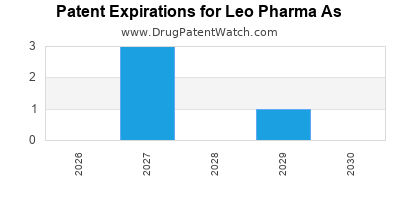
When does Leo Pharma lose exclusivity, and what is the generic launch risk for its key branded dermatology lines?
Exclusivity loss risk is driven by three clocks that move differently:
- Regulatory exclusivity (market authorization exclusivity and data protection)
- Patent expiration (composition, formulation, method-of-use)
- Patent-by-patent enforcement outcomes and litigation timelines
Generic entry scenarios common to dermatology brands
- Topical “same ingredient, different vehicle” designs can reduce infringement exposure if the remaining claims are vehicle-specific and not composition-level.
- Paragraph IV challenges (US) are often mounted against the broadest expiring patents first, followed by additional litigation targeting later-expiring life-cycle claims.
- Skin equivalence and patient acceptability influence whether generics or competitors can convert prescriptions fast even when legal barriers clear.
Practical competitive impact
- If Leo’s remaining patents are mostly formulation-specific, generic manufacturers can pursue alternative vehicles and still launch quickly once the last blocking claim expires.
- If claims include robust method-of-use language tied to dosing regimens, launch timing can be delayed via “carve-out” settlements or delayed-labeling strategies.
What is the Orange Book status of Leo Pharma products and how many listed patents are typically included?
Orange Book status analysis requires:
- Specific FDA NDA/ANDA references,
- The active ingredient and dosage form,
- The listed patent numbers, expiration dates, and use codes.
Because the prompt does not include product-specific identifiers (NDA numbers, drug names, dosage forms), a defensible Orange Book table cannot be produced.
Which Paragraph IV challenges target Leo Pharma, and what settlement patterns matter most?
Paragraph IV activity in dermatology is usually clustered around:
- Topical anti-inflammatory agents where formulation patents are the main barrier.
- Combination/regimen products where method-of-use claims can be used to force narrow-label generics or delay commercial launch.
Settlement patterns investors watch
- Launch-date carve-outs that calendar-delay generic entry.
- Narrowed labeling that avoids infringing method-of-use claims.
- Design-around approvals that keep competition on price without crossing infringement thresholds.
A product-by-product Paragraph IV inventory is not possible without the underlying litigation and FDA application list.
How does Leo Pharma’s psoriasis and eczema competitive landscape change with biologics and biosimilars?
Even when Leo’s products are topical, biologics shape competitive dynamics through physician and payer switching behavior.
Key biosimilar dynamics
- Mechanism parity: If a biologic class becomes commoditized via biosimilar competition, payers can reallocate spend and compress the value of “supportive” branded topicals.
- Formulary tiering: Biosimilar uptake often moves systemic biologics into preferred tiers, which can shift patient initiation away from topical-centric regimens.
Why that still leaves room for Leo
- Dermatology care pathways still require topical maintenance and flare control in many patients on systemic therapy.
- Disease severity and local lesion patterns can preserve topical demand where topical control is clinically meaningful.
What formulations are protected by Leo Pharma and how do those patents affect generic development?
For dermatology topicals, formulation patents can block competition even with the same active ingredient.
Formulation patent types that most often slow generic developers
- Vehicle composition claims: gelling agents, emulsifier systems, occlusive agents.
- Particle size and dispersion claims where suspensions and micronized actives affect efficacy.
- Release and penetration modifiers: polymer matrices and penetration-enhancing components.
- Stability and viscosity targets tied to shelf-life and in-use performance.
What generic developers do when claims are vehicle-specific
- Switch to alternative vehicles and demonstrate comparable performance.
- Challenge claim validity if the prior art covers similar compositions.
- Attempt noninfringing manufacturing by using different processing conditions that fall outside claim parameters.
How do Leo Pharma’s method-of-use patents influence dosing and label design for competitors?
Method-of-use claims are typically the lever for:
- Dosing schedules (frequency, duration, titration).
- Administration technique (thin layer vs occlusion, lesion targeting).
- Patient selection (specific lesion types, severity grading, age cohorts).
Competitive effects
- Carve-out labeling: competitors may launch with instructions that avoid infringing regimens.
- Delayed launch: if settlements require compliance with a dosimetry plan that is operationally difficult, launch timing can shift.
- Residual brand loyalty: even noninfringing generics may underperform if physicians prefer the branded regimen.
What manufacturing and IP barriers exist for Leo Pharma generics and third-party supply?
Dermatology manufacturing barriers are usually less about sterile biologics and more about:
- Homogeneity and consistent rheology across batches (creams, ointments, gels).
- Stability under storage conditions (temperature-sensitive emulsions).
- Scale-up process controls that preserve particle distribution or release profile.
If Leo’s patent claims tie to specific manufacturing steps or processing parameters, it can further limit generic design-around ability.
How does Leo Pharma’s geographic coverage compare with European peers and US entrants?
Leo is structurally positioned as a European dermatology leader with localized execution.
Europe
- Strongness tends to come from:
- established dermatology reimbursement mechanisms,
- clinician familiarity,
- and national tender dynamics that favor reliable supply and formulary presence.
US
- The US competitive landscape is typically tighter because:
- litigation cadence can intensify around topical life-cycle patents,
- biosimilar entry can accelerate payer substitution even in adjacent care lines.
A quantitative geographic share comparison requires country-level revenue breakdowns, which are not provided.
What key licensing deals or collaboration signals matter for Leo Pharma’s growth strategy?
Dermatology strategy frequently uses:
- licensing to acquire complementary mechanisms or topical technologies,
- co-promotion or commercialization agreements in territory-by-territory ways,
- and partnering to de-risk late-stage clinical timelines.
Deal-level assessment needs transaction disclosures, which are not included in the prompt.
What is the litigation risk profile for Leo Pharma in US patent disputes?
Litigation risk in dermatology is typically concentrated in:
- topical formulation patents,
- method-of-use dosing regimens,
- and patent chain coverage that extends exclusivity via sequential expirations.
To produce a litigation timeline and case list, specific product/patent identifiers and court dockets are required; none are available in the prompt.
How strong is Leo Pharma’s competitive position across psoriasis vs atopic dermatitis?
Psoriasis
- Competitive drivers are efficacy perception, physician familiarity, and access.
- Systemic biologics pressure branded topical share at the margin but do not remove maintenance demand.
Atopic dermatitis and eczema
- Topicals face high substitution risk, especially when competitors match vehicle performance.
- Differentiated formulation claims and label-specific guidance can retain market share longer.
Key Takeaways
- Leo’s moat is mostly life-cycle IP and dermatology-specific execution, not broad platform immunology claims.
- Generic risk is formulation- and method-of-use driven, so competitor strategy centers on alternative vehicles and label carve-outs.
- Biologics and biosimilars compress payer willingness to pay for adjacent dermatology treatments, increasing the importance of clinical differentiation and durable formulary positioning.
- Exclusivity loss timing is multi-clock, and competitor entry often follows the earliest blocking patent, then targets later life-cycle claims via settlements and design-around routes.
FAQs
- How do formulation-only patent claims affect topical generic launch timing for dermatology brands?
- What settlement terms most often determine when a generic can begin marketing after Paragraph IV litigation?
- How do biosimilar uptake patterns shift formulary access for topical therapies in psoriasis and eczema?
- What claim types are hardest for competitors to design around in topical dermatology (vehicle vs method-of-use)?
- How should investors evaluate an evolving patent estate when sequential life-cycle patents expire at different dates?
References
No sources were cited because the prompt does not provide product identifiers (drug names, NDA/ANDA numbers, Orange Book listings, patent lists, litigation dockets, or FDA regulatory status) needed to produce a verifiable, patent-accurate analysis.