Merck Sharp Dohme Company Profile
✉ Email this page to a colleague
What is the competitive landscape for MERCK SHARP DOHME
MERCK SHARP DOHME has twenty approved drugs.
There are twenty US patents protecting MERCK SHARP DOHME drugs.
Summary for Merck Sharp Dohme
| US Patents: | 20 |
| Tradenames: | 16 |
| Ingredients: | 16 |
| NDAs: | 20 |
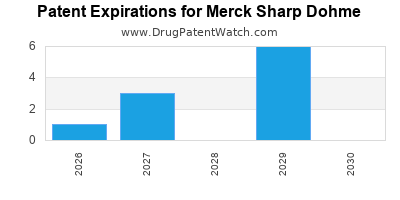
Drugs and US Patents for Merck Sharp Dohme
| Applicant | Tradename | Generic Name | Dosage | NDA | Approval Date | TE | Type | RLD | RS | Patent No. | Patent Expiration | Product | Substance | Delist Req. | Exclusivity Expiration |
|---|---|---|---|---|---|---|---|---|---|---|---|---|---|---|---|
| Merck Sharp Dohme | PREVYMIS | letermovir | TABLET;ORAL | 209939-002 | Nov 8, 2017 | RX | Yes | Yes | ⤷ Start Trial | ⤷ Start Trial | |||||
| Merck Sharp Dohme | BELSOMRA | suvorexant | TABLET;ORAL | 204569-003 | Aug 13, 2014 | RX | Yes | No | 11,980,623 | ⤷ Start Trial | Y | ⤷ Start Trial | |||
| Merck Sharp Dohme | WELIREG | belzutifan | TABLET;ORAL | 215383-001 | Aug 13, 2021 | RX | Yes | Yes | ⤷ Start Trial | ⤷ Start Trial | |||||
| Merck Sharp Dohme | WELIREG | belzutifan | TABLET;ORAL | 215383-001 | Aug 13, 2021 | RX | Yes | Yes | ⤷ Start Trial | ⤷ Start Trial | |||||
| >Applicant | >Tradename | >Generic Name | >Dosage | >NDA | >Approval Date | >TE | >Type | >RLD | >RS | >Patent No. | >Patent Expiration | >Product | >Substance | >Delist Req. | >Exclusivity Expiration |
Expired US Patents for Merck Sharp Dohme
| Applicant | Tradename | Generic Name | Dosage | NDA | Approval Date | Patent No. | Patent Expiration |
|---|---|---|---|---|---|---|---|
| Merck Sharp Dohme | JUVISYNC | simvastatin; sitagliptin phosphate | TABLET;ORAL | 202343-006 | Sep 18, 2012 | 7,459,428 | ⤷ Start Trial |
| Merck Sharp Dohme | JUVISYNC | simvastatin; sitagliptin phosphate | TABLET;ORAL | 202343-006 | Sep 18, 2012 | 7,078,381 | ⤷ Start Trial |
| Merck Sharp Dohme | JUVISYNC | simvastatin; sitagliptin phosphate | TABLET;ORAL | 202343-006 | Sep 18, 2012 | 6,890,898 | ⤷ Start Trial |
| Merck Sharp Dohme | JUVISYNC | simvastatin; sitagliptin phosphate | TABLET;ORAL | 202343-006 | Sep 18, 2012 | 6,303,661 | ⤷ Start Trial |
| >Applicant | >Tradename | >Generic Name | >Dosage | >NDA | >Approval Date | >Patent No. | >Patent Expiration |
Paragraph IV (Patent) Challenges for MERCK SHARP DOHME drugs
| Drugname | Dosage | Strength | Tradename | Submissiondate |
|---|---|---|---|---|
| ➤ Subscribe | Capsules | 140 mg and 180 mg | ➤ Subscribe | 2008-03-24 |
| ➤ Subscribe | Delayed-release Tablets | 100 mg | ➤ Subscribe | 2014-06-16 |
| ➤ Subscribe | Tablets | 100 mg/10 mg and 100 mg/40 mg | ➤ Subscribe | 2012-06-19 |
| ➤ Subscribe | Tablets | 50 mg/10 mg, 50 mg/20 mg, and 50 mg/40 mg | ➤ Subscribe | 2012-11-06 |
| ➤ Subscribe | Oral Suspension | 40 mg/mL | ➤ Subscribe | 2011-02-28 |
| ➤ Subscribe | Injection | 18 mg/mL, 16.7 mL vials | ➤ Subscribe | 2015-11-24 |
| ➤ Subscribe | Tablets | 100 mg/10 mg and 100 mg/40 mg | ➤ Subscribe | 2012-06-25 |
International Patents for Merck Sharp Dohme Drugs
| Country | Patent Number | Estimated Expiration |
|---|---|---|
| Slovenia | 3043784 | ⤷ Start Trial |
| Lithuania | 3417851 | ⤷ Start Trial |
| Mexico | 2014010323 | ⤷ Start Trial |
| South Korea | 20130114603 | ⤷ Start Trial |
| >Country | >Patent Number | >Estimated Expiration |
Supplementary Protection Certificates for Merck Sharp Dohme Drugs
| Patent Number | Supplementary Protection Certificate | SPC Country | SPC Expiration | SPC Description |
|---|---|---|---|---|
| 1620113 | 300756 | Netherlands | ⤷ Start Trial | PRODUCT NAME: IVERMECTINE VOOR TOEPASSING IN DE BEHANDELING VAN ROSACEA; NATIONAL REGISTRATION NO/DATE: RVG 115310 20150504; FIRST REGISTRATION: MT MA117/01101 20150402 |
| 1620113 | 15C0069 | France | ⤷ Start Trial | PRODUCT NAME: IVERMECTINE; NAT. REGISTRATION NO/DATE: NL 44511 20150721; FIRST REGISTRATION: MT - MA 117/01101 20150402 |
| 1385870 | C300506 | Netherlands | ⤷ Start Trial | PRODUCT NAME: BOCEPREVIR, OF EEN ENANTIOMEER, STEREOISIOMEER, ROATMEER, TAUTOMEER OF RACEMAAT VAN DIE VERBINDING, DESGEWENST IN DE VORM VAN EEN FARMACEUTISCH AANVAARDBAAR ZOUT OF SOLVAAT; REGISTRATION NO/DATE: EU/1/11/704/001 20110718 |
| 1622880 | CA 2018 00026 | Denmark | ⤷ Start Trial | PRODUCT NAME: LETERMOVIR, OR ITS SALT, SOLVATE OR SOLVATE OF ITS SALT; REG. NO/DATE: EU/1/17/1245 20180110 |
| >Patent Number | >Supplementary Protection Certificate | >SPC Country | >SPC Expiration | >SPC Description |
Similar Applicant Names
Applicants may be listed under multiple names.
Here is a list of applicants with similar names.
Here is a list of applicants with similar names.
