You're using a free limited version of DrugPatentWatch: Upgrade for Complete Access

Last Updated: December 28, 2025

Triamcinolone acetonide - Generic Drug Details


✉ Email this page to a colleague

« Back to Dashboard


What are the generic sources for triamcinolone acetonide and what is the scope of patent protection?

Triamcinolone acetonide is the generic ingredient in twenty-seven branded drugs marketed by Abbvie, Chattem Sanofi, Astellas, Ivax Pharms, Delcor Asset Corp, Teva, Solvay, Actavis Mid Atlantic, Alkem Labs Ltd, Alpharma Us Pharms, Ambix, Chartwell Rx, Cosette, Encube, Fougera Pharms, Glenmark Pharms Ltd, Macleods Pharms Ltd, Micro Labs, Morton Grove, Norvium Bioscience, Padagis Us, Pharmaderm, Pharmafair, Strides Pharma, Sun Pharma Canada, Taro, Topiderm, Crown Labs, Savage Labs, Pacira Pharms Inc, Apothecon, Alembic, Amneal, Dr Reddys, Eugia Pharma, Hikma, Long Grove Pharms, Mylan Labs Ltd, Parnell, Sandoz, Teva Pharms Usa, Watson Labs, Allergan, Harrow Eye, Beach Prods, Epic Pharma Llc, Pai Holdings Pharm, Pharmobedient, Quagen, Aurobindo Pharma Ltd, Extrovis, Glenmark Speclt, Padagis Israel, Senores Pharms, Cmp Pharma Inc, Rising, Sciegen Pharms Inc, Lupin Atlantis, Sanofi Aventis Us, Apotex, Perrigo Pharma Intl, Sun Pharm Inds Inc, and Bausch And Lomb Inc, and is included in one hundred and forty-three NDAs. There are eight patents protecting this compound. Additional information is available in the individual branded drug profile pages.

Triamcinolone acetonide has one hundred and sixty-five patent family members in twenty-nine countries.

There are twenty-six drug master file entries for triamcinolone acetonide. Seventy-eight suppliers are listed for this compound.

Drug Prices for triamcinolone acetonide

See drug prices for triamcinolone acetonide

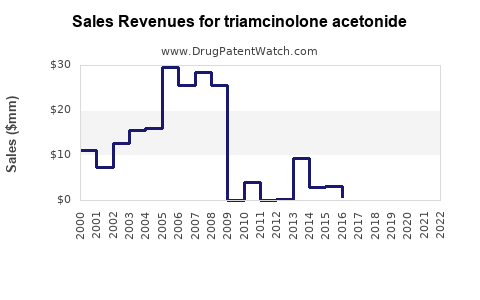
Drug Sales Revenue Trends for triamcinolone acetonide

See drug sales revenues for triamcinolone acetonide

Recent Clinical Trials for triamcinolone acetonide

Identify potential brand extensions & 505(b)(2) entrants

SponsorPhase
Ain Shams UniversityPHASE4
King Edward Medical UniversityNA
Cancer Institute and Hospital, Chinese Academy of Medical SciencesPHASE3

See all triamcinolone acetonide clinical trials

Pharmacology for triamcinolone acetonide
Medical Subject Heading (MeSH) Categories for triamcinolone acetonide

US Patents and Regulatory Information for triamcinolone acetonide

Applicant Tradename Generic Name Dosage NDA Approval Date TE Type RLD RS Patent No. Patent Expiration Product Substance Delist Req. Exclusivity Expiration
Astellas ARISTOCORT A triamcinolone acetonide CREAM;TOPICAL 083017-004 Approved Prior to Jan 1, 1982 DISCN No No ⤷  Get Started Free ⤷  Get Started Free ⤷  Get Started Free
Allergan TRIVARIS triamcinolone acetonide INJECTABLE;INTRA-ARTICULAR, INTRAMUSCULAR, INTRAVITREAL 022220-001 Jun 16, 2008 DISCN Yes No ⤷  Get Started Free ⤷  Get Started Free ⤷  Get Started Free
Fougera Pharms TRIAMCINOLONE ACETONIDE triamcinolone acetonide CREAM;TOPICAL 085692-003 Approved Prior to Jan 1, 1982 AT RX Yes Yes ⤷  Get Started Free ⤷  Get Started Free ⤷  Get Started Free
Strides Pharma TRIAMCINOLONE ACETONIDE triamcinolone acetonide CREAM;TOPICAL 210346-001 Feb 11, 2019 AT RX No No ⤷  Get Started Free ⤷  Get Started Free ⤷  Get Started Free
>Applicant >Tradename >Generic Name >Dosage >NDA >Approval Date >TE >Type >RLD >RS >Patent No. >Patent Expiration >Product >Substance >Delist Req. >Exclusivity Expiration

Expired US Patents for triamcinolone acetonide

Applicant Tradename Generic Name Dosage NDA Approval Date Patent No. Patent Expiration
Abbvie AZMACORT triamcinolone acetonide AEROSOL, METERED;INHALATION 018117-001 Apr 23, 1982 3,897,779 ⤷  Get Started Free
Chattem Sanofi NASACORT ALLERGY 24 HOUR triamcinolone acetonide SPRAY, METERED;NASAL 020468-002 Oct 11, 2013 7,977,045 ⤷  Get Started Free
Chattem Sanofi NASACORT ALLERGY 24 HOUR triamcinolone acetonide SPRAY, METERED;NASAL 020468-002 Oct 11, 2013 5,976,573 ⤷  Get Started Free
Harrow Eye TRIESENCE triamcinolone acetonide INJECTABLE;INTRAVITREAL 022048-001 Nov 29, 2007 6,395,294 ⤷  Get Started Free
>Applicant >Tradename >Generic Name >Dosage >NDA >Approval Date >Patent No. >Patent Expiration

Market Dynamics and Financial Trajectory for Triamcinolone Acetonide

Last updated: December 25, 2025

Executive Summary

Triamcinolone acetonide, a synthetic corticosteroid, is widely used across dermatology, allergies, rheumatology, and respiratory diseases, primarily for its anti-inflammatory and immunosuppressive properties. The drug’s market landscape exhibits robust growth driven by expanding indications, rising prevalence of autoimmune and allergic conditions, and technological advancements in drug formulation. However, patent expirations, generic competition, and regulatory fluctuations pose challenges to revenue streams. This report analyzes the current market environment, future growth prospects, competitive factors, and potential revenue trajectories for triamcinolone acetonide.


What Are the Key Market Drivers for Triamcinolone Acetonide?

1. Rising Prevalence of Chronic Inflammatory and Autoimmune Diseases

  • Conditions such as asthma, allergic rhinitis, psoriasis, and rheumatoid arthritis are increasing globally, fueling demand for corticosteroid therapies [1].
  • Global autoimmune disease prevalence is projected to reach over 3.9% of the population, growing at a CAGR of 3%, directly impacting corticosteroid usage [2].

2. Expanding Indications and Formulation Innovations

  • New formulations (e.g., topical creams, injections, nasal sprays) enhance drug versatility.
  • Development of sustained-release injections and combination therapies enhances therapeutic outcomes.

3. Increasing Healthcare Expenditure and Access in Emerging Markets

  • Rising healthcare penetration in Asia-Pacific and Latin America amplifies market reach.
  • Governments investing in better allergy and autoimmune disease management drives demand.

4. Regulatory Approvals and Reimbursement Policies

  • Favorable policies and approvals in key markets (FDA, EMA, PMDA) foster market growth.
  • Insurance coverage and reimbursement schemes support better patient access.

What Are the Main Challenges and Constraints?

1. Patent Expirations and Generic Competition

  • Several formulations of triamcinolone acetonide are nearing patent expiry (e.g., Kenalog in the US expired in 2018).
  • The influx of generics significantly reduces prices and revenue margins.

2. Regulatory and Safety Concerns

  • Adverse event profiles, especially with systemic and high-dose treatments, prompt regulatory scrutiny.
  • Strict regulations in certain markets limit off-label or new indications.

3. Pain Points in Market Penetration

  • Competition from other corticosteroids (e.g., betamethasone, dexamethasone).
  • Limited awareness or accessibility in underdeveloped regions.

4. Pricing Pressures and Reimbursement Challenges

  • Cost-containment policies in public health systems constrain premium pricing strategies.

What Is the Current Market Size and Future Forecast?

Parameter 2022 Figure Future Projection (2028) CAGR (2023-2028)
Global Market Value $800 million $1.2 billion 7.2%
Leading Regions North America (50%), Europe (25%), Asia-Pacific (15%), others (10%) Same distribution with growth in Asia-Pacific
Key Formulations Injectable (Kenalog), topical creams, nasal sprays Injectable expected to hold largest share

Note: The compound annual growth rate (CAGR) of 7.2% is driven by increasing adoption in emerging markets and expanding indications.

Regional Market Breakdown (2023–2028)

Region Current Market Share Expected CAGR Key Drivers Market Growth (USD)
North America 50% 5.8% High prevalence, developed healthcare $600M → $800M
Europe 25% 6.4% Aging populations, regulatory approval $200M → $270M
Asia-Pacific 15% 10.1% Healthcare investment, infectious diseases $120M → $210M
Rest of the World 10% 8.2% Growing awareness $80M → $130M

How Are Innovations Shaping the Market?

Novel Formulations and Delivery Mechanisms

  • Nanoemulsions and liposomal formulations improve bioavailability and reduce dosing frequency.
  • Intralesional and sustained-release injections optimize local therapy.

Combination Therapies

  • Integration with biologics or immunomodulators enhances treatment efficacy.

Digital and Monitoring Technologies

  • Telemedicine and mobile health apps improve adherence and monitoring, indirectly boosting drug consumption.

Competitive Landscape: Who Are the Major Players?

Company Key Products Market Share Recent Developments Geography Focus
Boehringer Ingelheim Triamcinolone acetonide (various formulations) ~35% Launching new topical formulations Global, with focus in US and EU
Perrigo Generic triamcinolone acetonide ~15% Expanding regional presence US, Europe, India
Mylan (Now part of Viatris) Generic formulations ~20% Cost-containment strategies Global
Teva Injectable and topical ~10% Patent challenges and biosimilar R&D North America, Europe

Financial Trajectory: Revenue and Profitability Outlook

Revenue Projections (2023–2028)

Year Estimated Global Revenue (USD) Key Drivers Notes
2023 $800 million Stable demand, patent expirations ongoing Transition phase
2024 $860 million Increased generic uptake, new formulations Slight growth
2025 $940 million Growing markets, expanded indications Accelerating growth
2026 $1.05 billion Surge in Asian markets Market maturation
2027 $1.15 billion Technological advances Continued innovation
2028 $1.2 billion Mature market consolidation Steady growth

Profitability Trends

  • Gross margins expected to decline from ~60% (pre-patent expiry) to ~45–50% due to increased generic competition.
  • R&D investments in new formulations and indications are critical to sustain margins.

How Do Regulatory Policies Impact Market and Financial Outlook?

Regulatory Expectations

  • FDA and EMA require extensive safety data**, especially concerning systemic side effects.
  • Post-marketing surveillance influences continued approvals and formulations.

Patent and Market Exclusivity

  • Patent expirations (e.g., US patent for Kenalog expired in 2018) open markets for generics.
  • New formulations and delivery methods may receive new exclusivities.

Reimbursement and Pricing Policies

  • Government-mandated price caps (e.g., in the UK via NHS) apply pressure on revenue.
  • Policies favoring biosimilars and generics promote affordability but reduce profit margins.

Comparison with Other Corticosteroids

Drug Indications Market Size Patent/Generic Status Major Advantages Limitations
Triamcinolone acetonide Dermatology, allergy, joint injections $800M (2022) Multiple generics Established efficacy Patent expiry leading to generic erosion
Dexamethasone Respiratory, systemic inflammatory ~$1.2B Patents expired Wide spectrum Greater systemic side effects
Betamethasone Anti-inflammatory, dermatology ~$900M Patent held in some indications Potent Side effect profile

Key Questions Addressed

  • What are the primary revenue sources and growth prospects?
    Injunctions on injectable triamcinolone acetonide formulations and expanding dermatology use fuel revenue, with an impressive CAGR of approximately 7.2% until 2028.

  • What factors influence pricing and profitability?
    Patent expirations, generic competition, regulatory fluctuations, and reimbursement policies primarily impact revenues and margins.


Key Takeaways

  • The global market for triamcinolone acetonide is poised for steady growth, driven by expanding indications, technological innovations, and emerging markets.
  • Patent expirations have shifted revenue dynamics, emphasizing the importance of product innovation and formulation differentiation.
  • Competition from generics will impose pricing pressures but also opens opportunities for new formulations and combination therapies.
  • Regulatory landscapes and reimbursement policies remain critical determinants for market access and profitability.
  • Companies investing in advanced drug delivery systems and emerging indications will secure competitive advantages and revenue streams.

Frequently Asked Questions

1. How will patent expirations impact the future market for triamcinolone acetonide?

Patent expirations are likely to lead to a surge in generic entries, reducing prices and profit margins. Companies must innovate with new formulations or indications to sustain revenue growth.

2. What are the emerging therapeutic applications of triamcinolone acetonide?

Beyond traditional uses, research explores its efficacy in localized autoimmune conditions, ophthalmology, and as adjunct therapy in oncology.

3. Which regions represent the most significant growth opportunities?

Asia-Pacific and Latin America demonstrate the highest growth potential due to increasing healthcare access, prevalence of chronic inflammatory diseases, and supportive policies.

4. How do regulatory policies influence the drug's market dynamics?

Regulatory agencies increasingly scrutinize safety profiles, impacting approval timelines and post-market surveillance obligations, which can affect market entry and revenue.

5. What are the key competitive strategies for market players?

Innovating with new delivery methods, expanding indications, forming strategic alliances, and engaging in cost-effective manufacturing are critical to staying competitive.


References

[1] Global Burden of Disease Study, 2021.
[2] Autoimmune Disease Prevalence, WHO, 2022.
[3] Market Research Future, 2023.
[4] U.S. FDA Drug Database, 2022.
[5] European Medicines Agency, 2023.

More… ↓

⤷  Get Started Free

Make Better Decisions: Try a trial or see plans & pricing

Drugs may be covered by multiple patents or regulatory protections. All trademarks and applicant names are the property of their respective owners or licensors. Although great care is taken in the proper and correct provision of this service, thinkBiotech LLC does not accept any responsibility for possible consequences of errors or omissions in the provided data. The data presented herein is for information purposes only. There is no warranty that the data contained herein is error free. We do not provide individual investment advice. This service is not registered with any financial regulatory agency. The information we publish is educational only and based on our opinions plus our models. By using DrugPatentWatch you acknowledge that we do not provide personalized recommendations or advice. thinkBiotech performs no independent verification of facts as provided by public sources nor are attempts made to provide legal or investing advice. Any reliance on data provided herein is done solely at the discretion of the user. Users of this service are advised to seek professional advice and independent confirmation before considering acting on any of the provided information. thinkBiotech LLC reserves the right to amend, extend or withdraw any part or all of the offered service without notice.