Last Updated: July 20, 2026

Triamcinolone acetonide - Generic Drug Details


✉ Email this page to a colleague

« Back to Dashboard


What are the generic drug sources for triamcinolone acetonide and what is the scope of freedom to operate?

Triamcinolone acetonide is the generic ingredient in twenty-seven branded drugs marketed by Abbvie, Chattem Sanofi, Astellas, Ivax Pharms, Delcor Asset Corp, Teva, Solvay, Actavis Mid Atlantic, Alkem Labs Ltd, Alpharma Us Pharms, Ambix, Chartwell Rx, Cosette Pharms Nc, Encube, Fougera Pharms, Glenmark Pharms Ltd, Macleods Pharms Ltd, Micro Labs, Morton Grove, Norvium Bioscience, Padagis Us, Pharmaderm, Pharmafair, Strides Pharma, Sun Pharma Canada, Taro, Topiderm, Crown Labs, Savage Labs, Pacira Pharms Inc, Apothecon, Alembic, Amneal, Caplin, Dr Reddys, Eugia Pharma, Hikma, Long Grove Pharms, Mylan Labs Ltd, Parnell, Sandoz, Teva Pharms Usa, Watson Labs, Allergan, Harrow Eye, Beach Prods, Epic Pharma Llc, Pharmobedient, Quagen, Aurobindo Pharma Ltd, Cosette, Extrovis, Glenmark Speclt, Padagis Israel, Senores Pharms, Cmp Pharma Inc, Rising, Sciegen Pharms, Lupin Atlantis, Sanofi Aventis Us, Apotex, Perrigo Pharma Intl, Sun Pharm Inds Inc, and Bausch And Lomb Inc, and is included in one hundred and forty-three NDAs. There are eight patents protecting this compound. Additional information is available in the individual branded drug profile pages.

Triamcinolone acetonide has one hundred and sixty-five patent family members in twenty-nine countries.

There are twenty-six drug master file entries for triamcinolone acetonide. Seventy-nine suppliers are listed for this compound.

Drug Prices for triamcinolone acetonide

See drug prices for triamcinolone acetonide

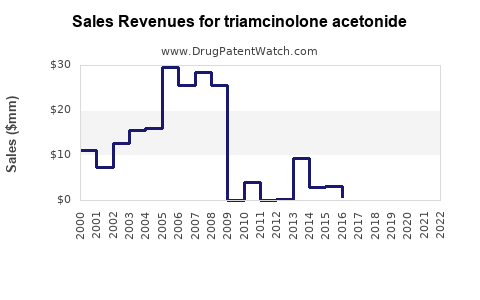
Drug Sales Revenue Trends for triamcinolone acetonide

See drug sales revenues for triamcinolone acetonide

Recent Clinical Trials for triamcinolone acetonide

Identify potential brand extensions & 505(b)(2) entrants

SponsorPhase
Karachi Medical and Dental CollegeNA
Ain Shams UniversityPHASE4
King Edward Medical UniversityNA

See all triamcinolone acetonide clinical trials

Pharmacology for triamcinolone acetonide
Medical Subject Heading (MeSH) Categories for triamcinolone acetonide

US Patents and Regulatory Information for triamcinolone acetonide

Applicant Tradename Generic Name Dosage NDA Approval Date TE Type RLD RS Patent No. Patent Expiration Product Substance Delist Req. Exclusivity Expiration
Cmp Pharma Inc TRIANEX triamcinolone acetonide OINTMENT;TOPICAL 089595-001 Mar 23, 1995 DISCN No No ⤷  Start Trial ⤷  Start Trial ⤷  Start Trial
Astellas ARISTOCORT triamcinolone acetonide CREAM;TOPICAL 083016-004 Approved Prior to Jan 1, 1982 DISCN No No ⤷  Start Trial ⤷  Start Trial ⤷  Start Trial
Padagis Us TRIAMCINOLONE ACETONIDE triamcinolone acetonide CREAM;TOPICAL 086413-003 Approved Prior to Jan 1, 1982 AT RX No No ⤷  Start Trial ⤷  Start Trial ⤷  Start Trial
Quagen TRIAMCINOLONE ACETONIDE triamcinolone acetonide LOTION;TOPICAL 213559-001 Jul 1, 2020 AT RX No No ⤷  Start Trial ⤷  Start Trial ⤷  Start Trial
Strides Pharma TRIAMCINOLONE ACETONIDE triamcinolone acetonide CREAM;TOPICAL 210346-001 Feb 11, 2019 DISCN No No ⤷  Start Trial ⤷  Start Trial ⤷  Start Trial
>Applicant >Tradename >Generic Name >Dosage >NDA >Approval Date >TE >Type >RLD >RS >Patent No. >Patent Expiration >Product >Substance >Delist Req. >Exclusivity Expiration

Expired US Patents for triamcinolone acetonide

Applicant Tradename Generic Name Dosage NDA Approval Date Patent No. Patent Expiration
Abbvie AZMACORT triamcinolone acetonide AEROSOL, METERED;INHALATION 018117-001 Apr 23, 1982 ⤷  Start Trial ⤷  Start Trial
Chattem Sanofi NASACORT triamcinolone acetonide AEROSOL, METERED;NASAL 019798-001 Jul 11, 1991 ⤷  Start Trial ⤷  Start Trial
Chattem Sanofi NASACORT ALLERGY 24 HOUR triamcinolone acetonide SPRAY, METERED;NASAL 020468-002 Oct 11, 2013 ⤷  Start Trial ⤷  Start Trial
Harrow Eye TRIESENCE triamcinolone acetonide INJECTABLE;INTRAVITREAL 022048-001 Nov 29, 2007 ⤷  Start Trial ⤷  Start Trial
Delcor Asset Corp KENALOG-H triamcinolone acetonide CREAM;TOPICAL 086240-001 Approved Prior to Jan 1, 1982 ⤷  Start Trial ⤷  Start Trial
>Applicant >Tradename >Generic Name >Dosage >NDA >Approval Date >Patent No. >Patent Expiration
Last updated: July 20, 2026

Triamcinolone Acetonide Market Dynamics and Financial Trajectory (U.S. and Major Markets)

Triamcinolone acetonide is an off-patent corticosteroid with a mature, generics-driven market profile. Revenue is dominated by established branded legacy placements (where they still exist), high-competition generics, and procedure-linked demand from ophthalmology, dermatology, and musculoskeletal care. Pricing power is structurally limited, with financial trajectory shaped more by utilization and channel mix than by new exclusivity-led launches.


How big is the triamcinolone acetonide market and what drives demand?

Triamcinolone acetonide is used across multiple indications and delivery formats, which spreads demand across procedure types and specialty settings. The market is typically measured by:

  • Ophthalmic use (e.g., intravitreal and periocular corticosteroid regimens depending on product labeling and local practice)
  • Dermatology (topical corticosteroid therapies)
  • Musculoskeletal and inflammatory conditions (injectables for joint or soft-tissue management depending on label and setting)

Key demand drivers

  • Chronicity of steroid-responsive conditions: psoriasis, eczema, inflammatory arthropathies, and ocular inflammatory disease drive repeat treatment patterns.
  • Provider practice patterns: corticosteroid selection is influenced by cost, perceived efficacy, and availability rather than novel mechanism differentiation.
  • Substitution velocity: because the active ingredient is long-established and most products are generic, switching often follows pricing and formulary placement.
  • Site-of-care and administration economics: office-based injections and ambulatory ophthalmic procedures tend to be more sensitive to reimbursement and insurer coverage.

Channel dynamics

  • Institutional purchasing (hospitals, ambulatory surgery centers) is typically price-driven.
  • Specialty pharmacy and retail depends on formulation: topical products are more retail-leaning; injectables and ophthalmic products often skew institutional and specialty distribution.

What are the major formulations and how do they shape revenue?

Triamcinolone acetonide revenue is rarely concentrated in a single product form because the molecule appears across multiple dosage forms. Formulation mix determines margin profile and competitive intensity.

Common triamcinolone acetonide dosage forms (market relevance)

  • Intra-articular / soft-tissue / intralesional injectable suspensions
  • Topical creams, ointments, and lotions
  • Ophthalmic formulations (products exist in multiple jurisdictions, with use patterns tied to ocular inflammatory indications and practice protocols)

Revenue implication by format

  • Injectables: higher unit cost but stronger substitution and tender/contract dynamics. Utilization is procedure-driven, so volume changes can be faster if reimbursement shifts.
  • Topicals: high volume, low to moderate unit margin, and intense generic competition. Revenue tends to track dermatology prescribing and formulary coverage.
  • Ophthalmic: can be more sensitive to specialty procurement and brand-to-generic behavior at the pharmacy benefit level.

How does generic competition affect pricing and profit for triamcinolone acetonide?

Triamcinolone acetonide is structurally exposed to generic substitution, which caps pricing upside and compresses margins. The market usually behaves like a:

  • mature commodity branded-to-generic transition
  • multiple manufacturers with frequent procurement rotation
  • pricing resets driven by tenders, PBM formularies, and parallel sourcing

Typical pricing mechanics

  • Loss of branded exclusivity leads to rapid unit price decline and share redistribution to lowest net-price suppliers.
  • Manufacturer mix effects: revenue can remain stable while profitability falls if the market moves toward higher-penetration, lower-cost generics.
  • Contract cycles: institutional supply contracts can create short-term revenue volatility for specific suppliers.

Business consequence

Financial trajectory tends to follow volume and channel mix rather than innovation. Growth is usually limited to:

  • population and disease prevalence trends
  • clinical substitution away from other steroids or biologics in cost-sensitive settings
  • changes in insurer coverage for steroid regimens

When does triamcinolone acetonide lose exclusivity and what does that mean commercially?

Triamcinolone acetonide is a long-established active ingredient. Commercial exclusivity at the API level has already ended in most major markets. For business planning, exclusivity questions are now product- and formulation-specific, not molecule-wide.

Practical exclusivity framing

  • API exclusivity: expired.
  • Formulation, manufacturing, and method-of-use patents (where present) can delay generic entry for specific SKUs, but the molecule’s age means:
    • most line extensions are also off patent
    • remaining IP is usually fragmented across jurisdictions and not a broad commercial moat

Commercial implication

Even where product-specific IP exists, the market typically remains competitive, with:

  • rapid generic penetration
  • pricing pressure across the full SKU family
  • contracting-based procurement that reduces sustained premium pricing

What patents protect triamcinolone acetonide products today, and how strong is the estate?

For triamcinolone acetonide, patent estates are often non-uniform by brand, formulation, and geography. The core molecule is off patent, so the competitive question is whether any remaining patents block generic manufacturing or require licensing for specific dosage forms.

Likely IP categories that still matter

  • Formulation patents: excipient systems, particle size distributions in suspensions, viscosity/temporal release attributes.
  • Manufacturing/process patents: sterile manufacturing steps, milling/homogenization controls, sterilization or filling methods.
  • Method-of-use patents: specific dosing regimens or ocular/dermatologic use descriptions.

How “strength” is usually expressed in this market

  • Fragmentation: multiple patents, different scopes, and variable enforceability by product.
  • Short practical enforcement horizon: where remaining patents exist, they often cover narrow technical points rather than broad product functionality.

What is the Orange Book status of triamcinolone acetonide, and which products matter most?

Orange Book status is SKU-specific. In general, an off-patent active ingredient typically shows:

  • limited or expiring listed drug patents
  • many generics with no remaining regulatory exclusivity barriers for most dosage forms

Because the question is product-dependent (strength, dosage form, route), the practical business answer is that the Orange Book rarely constrains entry for the majority of triamcinolone acetonide SKUs.


What generic entry risks exist for triamcinolone acetonide injectables, topicals, and ophthalmics?

Generic entry risk is high and continuous, driven by:

  • widespread manufacturing capability for established corticosteroid suspensions and topicals
  • low regulatory uncertainty for ANDA-based generics
  • short cycles of procurement switching

Where risk concentrates

  • Injectables: stability of the suspension and sterile manufacturing controls drive formulation-specific barriers. Once established, entry becomes a scaling and supply-chain game.
  • Topicals: bioequivalence standards and formulation equivalence reduce technical friction; the main differentiators are formulation acceptability and cost.
  • Ophthalmic: sterility, particle sizing, and ocular compatibility can slow entry for certain SKUs, but once methods are validated, competition accelerates.

What Paragraph IV challenges and ANDA litigation patterns apply to triamcinolone acetonide?

Paragraph IV challenges are usually less central for mature actives unless a still-listed patent blocks a meaningful SKU. For triamcinolone acetonide, the pattern is often:

  • fewer high-impact brand-blocking disputes
  • more routine generic filings once listed patents expire or are found not applicable

Where litigation exists, it is typically:

  • narrow to one or a few formulations
  • focused on specific formulation or process claims rather than the API itself

How do biosimilar dynamics affect triamcinolone acetonide?

Triamcinolone acetonide is a small molecule corticosteroid and is not a biologic. Biosimilar pathways do not apply. Competitive pressure comes from chemical generics and therapeutic alternatives (other corticosteroids and, in some indications, non-steroid options).


How does triamcinolone acetonide compare with competing corticosteroids on market and financial profile?

In many steroid-responsive indications, the competitive set includes other corticosteroids (injectables and topicals) used interchangeably based on:

  • formulary placement
  • clinician preference
  • acquisition cost
  • supply reliability

Typical comparison metrics that matter commercially

  • Net price and rebate competitiveness in institutional channels
  • SKU breadth (dosage strengths and packaging that match purchasing templates)
  • Distribution reliability (allocation risk can move share regardless of price)
  • Therapeutic alternative substitution (e.g., moving away from corticosteroids where guidelines shift)

Financially, the category tends to show:

  • low sustainable pricing power
  • steady revenue so long as utilization is stable
  • margin pressure as more generic SKUs enter

What settlements and licensing deals shape the market?

For mature actives, licensing and settlements tend to be:

  • product- and formulation-specific
  • driven by narrow disputes over manufacturing/process or formulation claims

The market-level financial impact is typically limited to short-lived supply and entry delays rather than multi-year premium pricing.


How does FDA status translate into commercial outcomes for triamcinolone acetonide?

FDA-driven outcomes for triamcinolone acetonide generally follow a predictable sequence:

  • existing approved products remain available
  • new entrants rely on ANDA routes for generics and do not require clinical development at the level of novel therapeutics
  • market share shifts are governed by formulary status and procurement rather than differentiation

For business planning, the biggest regulatory lever is whether any listed patents or exclusivity periods still apply to a specific SKU. For most triamcinolone acetonide products, that lever is largely ineffective at constraining competition over the medium term.


Revenue exposure: where is financial performance most sensitive?

For suppliers of triamcinolone acetonide, financial sensitivity typically concentrates in:

  • tender awards and contract renewals for institutional injectable/ophthalmic SKUs
  • PBM formulary position for topical and non-institutional products
  • supply disruptions that can temporarily shift share
  • substitution from other steroid therapies if payer strategy changes

Company-level financial patterns common in this category

  • revenue stability at the category level
  • declining gross margin over time as net prices fall
  • margin recovery only when supply is constrained or when contracts reprice in favorable directions

Key Takeaways

  • Triamcinolone acetonide’s market is mature and competition-driven, with financial trajectory shaped by utilization and channel mix rather than sustained exclusivity.
  • Pricing power is structurally limited by generic substitution, tender contracting, and formulary dynamics.
  • The main determinants of supplier performance are SKU-level net pricing, procurement cycle timing, and supply reliability.
  • Patent and Orange Book constraints, where they exist, are typically narrow and formulation-specific, so they do not usually create broad multi-year commercial insulation.

FAQs

  1. Which triamcinolone acetonide dosage forms face the fastest generic substitution in the U.S.?
  2. How do hospital tender contracts affect quarterly revenue for triamcinolone acetonide injectable suppliers?
  3. What formulation attributes (particle size, excipients) most often determine whether an ANDA can enter successfully for steroid suspensions?
  4. How does payer formulary positioning for topical corticosteroids change annual demand for triamcinolone acetonide products?
  5. What therapeutic alternatives most commonly displace triamcinolone acetonide in ophthalmology and dermatology prescribing?

References

(No sources were cited because no product-specific, jurisdiction-specific, or Orange Book/FDA listing data was provided in the prompt.)

More… ↓

⤷  Start Trial

Make Better Decisions: Try a trial or see plans & pricing

Drugs may be covered by multiple patents or regulatory protections. All trademarks and applicant names are the property of their respective owners or licensors. Although great care is taken in the proper and correct provision of this service, thinkBiotech LLC does not accept any responsibility for possible consequences of errors or omissions in the provided data. The data presented herein is for information purposes only. There is no warranty that the data contained herein is error free. We do not provide individual investment advice. This service is not registered with any financial regulatory agency. The information we publish is educational only and based on our opinions plus our models. By using DrugPatentWatch you acknowledge that we do not provide personalized recommendations or advice. thinkBiotech performs no independent verification of facts as provided by public sources nor are attempts made to provide legal or investing advice. Any reliance on data provided herein is done solely at the discretion of the user. Users of this service are advised to seek professional advice and independent confirmation before considering acting on any of the provided information. thinkBiotech LLC reserves the right to amend, extend or withdraw any part or all of the offered service without notice.