Last Updated: May 10, 2026

SUMATRIPTAN SUCCINATE - Generic Drug Details


✉ Email this page to a colleague

« Back to Dashboard


What are the generic sources for sumatriptan succinate and what is the scope of patent protection?

Sumatriptan succinate is the generic ingredient in eight branded drugs marketed by Meridian Medcl, Glaxosmithkline, Alembic, Antares Pharma Inc, Baxter Hlthcare Corp, Caplin, Dr Reddys, Eugia Pharma, Fresenius Kabi Usa, Hikma, Norvium Bioscience, Onesource Specialty, Ph Health, Sandoz, Sun Pharm, Teva Parenteral, Teva Pharms Usa, Wockhardt Bio Ag, Zydus, Endo Operations, Currax, Tonix Meds, Teva Branded Pharm, Aurobindo Pharma, Dr Reddys Labs Inc, Fosun Pharma, Hikma Pharms, Ipca Labs Ltd, Mylan, Orbion Pharms, Roxane, Sun Pharm Inds, Sun Pharm Inds Ltd, Teva, Vkt Pharma, Watson Labs, and Zhejiang, and is included in forty-five NDAs. There are twenty-seven patents protecting this compound and two Paragraph IV challenges. Additional information is available in the individual branded drug profile pages.

Sumatriptan succinate has two hundred and twenty-five patent family members in twenty-five countries.

There are seventeen drug master file entries for sumatriptan succinate. Thirty-seven suppliers are listed for this compound. There are four tentative approvals for this compound.

Drug Prices for SUMATRIPTAN SUCCINATE

See drug prices for SUMATRIPTAN SUCCINATE

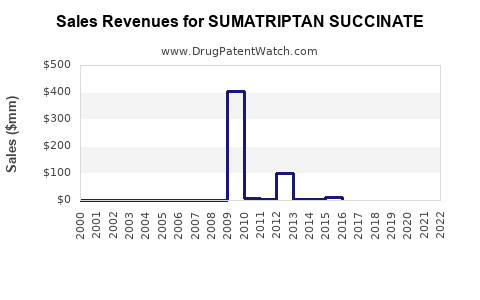
Drug Sales Revenue Trends for SUMATRIPTAN SUCCINATE

See drug sales revenues for SUMATRIPTAN SUCCINATE

Recent Clinical Trials for SUMATRIPTAN SUCCINATE

Identify potential brand extensions & 505(b)(2) entrants

SponsorPhase
Second Hospital of Jilin UniversityPhase 3
Beijing Friendship HospitalPhase 3
The Third Xiangya Hospital of Central South UniversityPhase 3

See all SUMATRIPTAN SUCCINATE clinical trials

Generic filers with tentative approvals for SUMATRIPTAN SUCCINATE
Applicant Application No. Strength Dosage Form
⤷  Start Trial⤷  Start TrialEQ 100MG BASETABLET;ORAL
⤷  Start Trial⤷  Start TrialEQ 50MG BASETABLET;ORAL
⤷  Start Trial⤷  Start TrialEQ 25MG BASETABLET;ORAL

The 'tentative' approval signifies that the product meets all FDA standards for marketing, and, but for the patents / regulatory protections, it would approved.

Pharmacology for SUMATRIPTAN SUCCINATE
Anatomical Therapeutic Chemical (ATC) Classes for SUMATRIPTAN SUCCINATE

US Patents and Regulatory Information for SUMATRIPTAN SUCCINATE

Applicant Tradename Generic Name Dosage NDA Approval Date TE Type RLD RS Patent No. Patent Expiration Product Substance Delist Req. Exclusivity Expiration
Glaxosmithkline IMITREX sumatriptan succinate TABLET;ORAL 020132-002 Jun 1, 1995 AB RX Yes No ⤷  Start Trial ⤷  Start Trial ⤷  Start Trial
Eugia Pharma SUMATRIPTAN SUCCINATE sumatriptan succinate INJECTABLE;SUBCUTANEOUS 202758-001 Apr 23, 2013 AP RX No Yes ⤷  Start Trial ⤷  Start Trial ⤷  Start Trial
Teva SUMATRIPTAN SUCCINATE sumatriptan succinate TABLET;ORAL 076840-001 Feb 9, 2009 DISCN No No ⤷  Start Trial ⤷  Start Trial ⤷  Start Trial
Ph Health SUMATRIPTAN SUCCINATE sumatriptan succinate INJECTABLE;SUBCUTANEOUS 077332-001 Oct 9, 2009 DISCN No No ⤷  Start Trial ⤷  Start Trial ⤷  Start Trial
Vkt Pharma SUMATRIPTAN SUCCINATE sumatriptan succinate TABLET;ORAL 219036-003 Dec 31, 2024 AB RX No No ⤷  Start Trial ⤷  Start Trial ⤷  Start Trial
Ph Health SUMATRIPTAN SUCCINATE sumatriptan succinate INJECTABLE;SUBCUTANEOUS 077871-001 Jul 9, 2009 DISCN No No ⤷  Start Trial ⤷  Start Trial ⤷  Start Trial
Glaxosmithkline IMITREX sumatriptan succinate TABLET;ORAL 020132-003 Jun 1, 1995 AB RX Yes No ⤷  Start Trial ⤷  Start Trial ⤷  Start Trial
>Applicant >Tradename >Generic Name >Dosage >NDA >Approval Date >TE >Type >RLD >RS >Patent No. >Patent Expiration >Product >Substance >Delist Req. >Exclusivity Expiration

Expired US Patents for SUMATRIPTAN SUCCINATE

Applicant Tradename Generic Name Dosage NDA Approval Date Patent No. Patent Expiration
Teva Branded Pharm ZECUITY sumatriptan succinate SYSTEM;IONTOPHORESIS 202278-001 Jan 17, 2013 ⤷  Start Trial ⤷  Start Trial
Currax ONZETRA XSAIL sumatriptan succinate POWDER;NASAL 206099-001 Jan 27, 2016 ⤷  Start Trial ⤷  Start Trial
Endo Operations SUMAVEL DOSEPRO sumatriptan succinate INJECTABLE;SUBCUTANEOUS 022239-001 Jul 15, 2009 ⤷  Start Trial ⤷  Start Trial
Currax ONZETRA XSAIL sumatriptan succinate POWDER;NASAL 206099-001 Jan 27, 2016 ⤷  Start Trial ⤷  Start Trial
Endo Operations SUMAVEL DOSEPRO sumatriptan succinate INJECTABLE;SUBCUTANEOUS 022239-001 Jul 15, 2009 ⤷  Start Trial ⤷  Start Trial
>Applicant >Tradename >Generic Name >Dosage >NDA >Approval Date >Patent No. >Patent Expiration

International Patents for SUMATRIPTAN SUCCINATE

Country Patent Number Title Estimated Expiration
United Kingdom 0604444 ⤷  Start Trial
Hong Kong 1202083 離子透入給藥系統 (IONTOPHORETIC DRUG DELIVERY SYSTEM) ⤷  Start Trial
United Kingdom 2424587 Nasal delivery device with temperature modifier ⤷  Start Trial
Brazil PI0923808 ⤷  Start Trial
China 104138634 Transdermal methods and systems for the delivery of anti-migraine compounds ⤷  Start Trial
Denmark 2462972 ⤷  Start Trial
World Intellectual Property Organization (WIPO) 03077973 ⤷  Start Trial
>Country >Patent Number >Title >Estimated Expiration

Sumatriptan Succinate: Market Dynamics and Financial Trajectory

Last updated: April 24, 2026

Where is sumatriptan succinate in the product lifecycle?

Sumatriptan succinate is a mature, long-established prescription migraine therapy with multiple dosage forms and strong historical brand penetration. The commercial landscape is dominated by generic competition in many markets, while branded and specialty-delivery variants (notably subcutaneous and transdermal/nasal formulations where available) maintain differentiated pricing in specific geographies and channels.

Lifecycle signal from supply structure and pricing reality

  • Core active ingredient is off-patent in many jurisdictions, driving widespread generic penetration.
  • Margin durability is linked to:
    • formulation differentiation (delivery route, device/packaging, patient preference),
    • label scope (acute migraine vs. other headache indications),
    • distribution contracts and pharmacy reimbursement dynamics,
    • local regulatory and patent-exclusivity remnants (where they exist for specific formulations).

Commercial implication: Broad-based generic substitution limits sustained revenue growth for the base compound in most countries. Financial trajectory therefore tracks incremental share shifts across brands, route-specific products, and price erosion cycles rather than new-molecule adoption.

What drives market demand for sumatriptan succinate?

Demand for sumatriptan is anchored to migraine incidence and the need for rapid acute symptom relief. Key market drivers operate through patient, prescriber, and payer pathways.

Patient and prescriber pull

  • Migraine prevalence supports steady baseline demand for acute treatments.
  • Triptans remain central acute therapy options; sumatriptan is frequently treated as a “default” triptan due to broad clinical familiarity.
  • Rapid onset formulations increase attractiveness in patients with high disability from pain and nausea.

Payer and formulary dynamics

  • Generics pressure net price.
  • Formularies favor cost-effective triptan options, which typically leads to:
    • switching to the lowest cost covered product,
    • limiting branded use to specific criteria (step edits, prior authorization) in some markets.

Channel effects

  • Pharmacy distribution favors availability and contracted wholesaler terms.
  • Institutional tendering for hospitals can increase uptake of particular delivery routes (for example, injectable for emergency/acute settings).

How has competitive pressure shaped pricing and margins?

Generic competition is the central market force. Once the molecule and most formulations lose exclusivity, the market re-prices toward acquisition cost and contracted reimbursement ceilings.

Competitive pattern

  • Price compression after generic entries tends to be steep initially, then stabilizes as supply consolidates among fewer manufacturers.
  • Differentiated formulations can slow decline but usually cannot fully prevent margin compression if they also face generic substitution or if payer policies place them in the same therapeutic class with interchangeable switching.

Brand vs generic roles (typical structure)

  • Branded originators: maintain higher net prices where exclusivity or route differentiation persists.
  • Generics: expand share rapidly post-launch and establish price floors through competitive bidding.
  • Route differentiation: can preserve relative pricing for delivery systems that require patient/clinician adoption of a specific regimen.

What are the main product and regulatory levers affecting revenues?

Revenue is driven by how route-specific products land within reimbursement and how regulatory labeling supports switching.

Dosage forms and route strategy

Sumatriptan is sold across multiple routes in different markets, commonly including:

  • oral tablets,
  • nasal sprays,
  • subcutaneous injections,
  • and other formulation variants depending on country approvals and market presence.

Route mix matters because:

  • subcutaneous products tend to serve patients with faster onset needs and emergency/acute administration contexts,
  • nasal products target patients who cannot tolerate oral intake,
  • oral products face the strongest generic substitution pressure and class-level price competition.

Patent and exclusivity structure (what it does to the P&L)

Because the molecule is old, the “financial trajectory” primarily reflects:

  • expiry of patents on specific formulations,
  • any remaining exclusivity for newer variants,
  • and the speed of generic market entry in each geography.

Net outcome:

  • revenue growth is usually flat-to-declining at the base level,
  • stability occurs when brand variants retain differentiated reimbursement positions longer than generics in core channels.

What does the long-run financial trajectory typically look like for sumatriptan succinate?

Sumatriptan’s financial trajectory follows a mature-drug curve:

  1. Early growth phase driven by brand launch and neurologist/primary care adoption.
  2. Plateau as competitors enter within the triptan class and as prescribers stabilize.
  3. Multi-year decline from generic substitution and payer price resets.
  4. Periodic stabilization when formulation mix, contracted supply, and route-specific demand offset some erosion.

Expected revenue shape over time (mature pattern)

  • Net sales: generally declines after generic entry; any growth is modest and tied to route-specific brand resilience or incremental patient share.
  • Gross margin: compresses due to lower net price; manufacturers that compete on cost and scale can partially defend margin.
  • Operating income: tends to track sales declines unless cost structure scales down or the portfolio shifts to higher-margin variants.

Where does sumatriptan succinate sit versus other migraine therapies in market dynamics?

Sumatriptan competes in a class where newer preventive and acute therapies have expanded. However, for many payers and patients, triptans continue to be the default acute choice due to:

  • long clinical familiarity,
  • broad accessibility,
  • oral simplicity and established prescribing workflows.

Class dynamics

  • CGRP-targeting therapies (preventive and acute) have carved share in some settings, especially where payers cover them with fewer barriers or where patients prefer non-triptan options.
  • In cost-sensitive segments, triptans retain strong relevance due to lower cost relative to newer branded agents.

Net effect: Newer acute options pressure share in selective payer pockets, but generic availability keeps sumatriptan anchored as an economic standard therapy.

How do safety, tolerability, and label coverage influence commercial outcomes?

Clinical positioning is stable: sumatriptan is established for acute migraine. Commercial outcomes track prescriber confidence and patient willingness to use triptans.

Safety profile as a commercial constant

  • The safety profile drives long-term trust and steady prescribing patterns.
  • Switching behavior occurs mainly when patients experience inadequate efficacy or intolerance, or when prescribers move patients to alternative triptans or newer non-triptan acute therapies.

Label and substitution behavior

  • Where label supports interchangeability and payers treat triptans as class substitutes, switching accelerates.
  • Where route-specific labeling or tolerability considerations matter, route-level differentiation can preserve revenue longer.

What are the practical market metrics to monitor going forward?

Because the drug is mature, the key to forecasting is not breakthrough clinical value but operational and reimbursement signals.

Market metrics (high-signal indicators)

  • Number and timing of generic launches by route and geography.
  • Average net price and discount intensity in contracted pharmacy channels.
  • Formulary status and prior authorization criteria changes.
  • Share movement across route types (oral vs nasal vs injection).
  • Patient adherence and repeat prescription patterns in migraine populations.

Business implications for forecasting

  • Expect recurring pricing pressure tied to generic supply updates and reimbursement resets.
  • Monitor route-mix shifts; injectable and nasal routes can provide temporary stabilization even under generics if patient switching is slower.

What is the investment-relevant view of financial trajectory and risk?

Revenue resilience

  • Base compound faces structural headwinds from generic substitution.
  • Resilience comes from:
    • route differentiation,
    • channel contracting,
    • and any lingering formulation exclusivity in specific markets.

Major risks

  • Faster-than-expected generic penetration.
  • Payer formulary tightening that pushes more switching.
  • Contract losses that re-route volume to lower-cost alternatives.

Upside vectors

  • Stronger adoption of route variants that avoid immediate class-based substitution.
  • Consolidation among generic suppliers that can raise effective pricing.
  • Market-specific reimbursement changes that favor specific presentations.

Key Takeaways

  • Sumatriptan succinate is a mature migraine acute therapy with revenue dominated by generic-driven pricing cycles and route-level differentiation rather than new clinical uptake.
  • Demand stays structurally supported by migraine incidence, but net sales trend is typically flat-to-declining at the base level as generics replace branded supply.
  • Financial trajectory is largely a function of (1) timing and intensity of generic entry, (2) reimbursement and formulary position, and (3) product route mix (oral vs nasal vs injection).
  • Newer CGRP acute and preventive options may shift some acute demand, but generic affordability keeps sumatriptan anchored in cost-sensitive segments.
  • Forecasting should prioritize generic launch calendars, net price trends, formulary constraints, and route-mix movements.

FAQs

1. What most strongly determines sumatriptan succinate revenue in mature markets?
Generic entry timing, net price compression from payer reimbursement resets, and route mix across oral, nasal, and injectable presentations.

2. Does sumatriptan face competition primarily from within the triptan class or from newer non-triptan therapies?
Both. Within-class competition is intensified by generic substitution across triptans; non-triptan therapies can take share where payers cover them broadly and where clinicians/patients prefer alternatives.

3. Which dosage route typically offers the best revenue resilience?
In many markets, route-specific differentiated products (often nasal and injectable) can show more durability than oral tablets because switching can be slower and channel demand can be more segment-specific.

4. What is the typical long-run financial pattern for an old migraine active ingredient once generics dominate?
Sales decline or stagnation after generic launches, with periodic stabilization driven by contract dynamics, supply consolidation, and any remaining presentation-level advantages.

5. What business indicators best predict the next revenue turning point?
Upcoming generic launches by route and geography, changes to formulary status and prior authorization requirements, and observed net price trends in contracted pharmacy channels.

References

[1] European Medicines Agency. Sumatriptan: EPAR product information and assessment materials. EMA. https://www.ema.europa.eu/ (accessed via relevant product page for sumatriptan-containing medicinal products).

More… ↓

⤷  Start Trial

Make Better Decisions: Try a trial or see plans & pricing

Drugs may be covered by multiple patents or regulatory protections. All trademarks and applicant names are the property of their respective owners or licensors. Although great care is taken in the proper and correct provision of this service, thinkBiotech LLC does not accept any responsibility for possible consequences of errors or omissions in the provided data. The data presented herein is for information purposes only. There is no warranty that the data contained herein is error free. We do not provide individual investment advice. This service is not registered with any financial regulatory agency. The information we publish is educational only and based on our opinions plus our models. By using DrugPatentWatch you acknowledge that we do not provide personalized recommendations or advice. thinkBiotech performs no independent verification of facts as provided by public sources nor are attempts made to provide legal or investing advice. Any reliance on data provided herein is done solely at the discretion of the user. Users of this service are advised to seek professional advice and independent confirmation before considering acting on any of the provided information. thinkBiotech LLC reserves the right to amend, extend or withdraw any part or all of the offered service without notice.