Last updated: July 29, 2026
SUMAVEL DOSEPRO Market Dynamics and Financial Trajectory (Revenue, Exclusivity, Competitive Risk)
Executive summary: SUMAVEL DOSEPRO (sumatriptan injection, subcutaneous autoinjector) has matured into a low-to-mid single-digit branded revenue stream in the U.S., driven by acute migraine attack management and substitution pressure from oral triptans, nasal formulations, and lower-cost generics. Near-term growth is constrained by long-standing patent/dossier maturity, ongoing generic penetration, and payer utilization management. The financial trajectory is therefore best characterized as plateau-to-decline with episodic stability tied to managed-care contracting, device usability, and brand share retention versus generic sumatriptan injection and competing migraine biologic-free modalities (CGRP antagonists and gepants for prevention, with traditional triptans for acute care).
What is SUMAVEL DOSEPRO and how does it make money in acute migraine care?
SUMAVEL DOSEPRO is a subcutaneous sumatriptan product delivered via an autoinjector for rapid treatment of migraine attacks. It is used for adult patients who require fast onset or who do not tolerate or do not respond to oral agents.
Revenue logic:
- Branded revenue depends on migraine patient flow into acute triptan treatment and on payer coverage for sumatriptan injections over oral triptans and alternative acute therapies.
- The autoinjector is a differentiator in settings where patients need speed and reliable self-administration, but device convenience typically provides less durable pricing power once generics and therapeutic substitutes are entrenched.
Commercial constraints:
- SUMAVEL is not a high-frequency prophylactic therapy. It is an acute episodic medication.
- Migraine market mix trends toward newer acute and preventive classes, which can shift initiation away from older triptans even when triptans remain clinically used.
How have prescription volumes and market share moved for SUMAVEL DOSEPRO?
High-level pattern consistent with matured migraine brands:
- Subcutaneous sumatriptan prescriptions have faced sustained pressure from:
- Generic sumatriptan injection alternatives (lower cost, interchangeability).
- Oral triptan generics (formulary preference by payer economics).
- Nasal and other acute options that can compete for early-line coverage.
- Newer acute CGRP-pathway therapies (gepants and related options) in patients seeking alternatives to triptans, particularly when triptan tolerability is an issue.
Autoinjector-specific dynamics:
- Device usability can support patient persistence and reduce underdosing risk during acute attacks.
- However, once payers achieve low-cost coverage for sumatriptan injection (including generics), the economic incentive favors the lowest net price product.
What are the key demand drivers for SUMAVEL DOSEPRO (payer, channel, and patient fit)?
Payer dynamics
- Formulary tiering and step edits: acute migraine products often face utilization management that favors preferred triptans and generics first-line.
- Prior authorization is used in some plans to ensure patients have tried oral options or have documented contraindications.
Channel dynamics
- Branded products rely on:
- PBM coverage in commercial formularies.
- Contract pharmacy placement and exclusion of non-preferred SKUs.
- As generic penetration increases, brand purchasing shifts to:
- Patients who cannot use certain injection formats.
- Patients who demonstrate consistent benefit and remain on therapy despite lower-cost alternatives.
Patient fit
SUMAVEL is most likely to retain share where patients need:
- Fast onset during a migraine attack.
- Subcutaneous delivery for patients with nausea/vomiting that limits oral dosing.
- Reliable self-administration with a device.
What is SUMAVEL DOSEPRO’s exclusivity status and how does it affect pricing power?
Patent and market exclusivity effects
SUMAVEL DOSEPRO’s market position is structurally constrained by the age of sumatriptan and the maturity of injection formulations. Once formulation patents and regulatory exclusivities expire, the brand typically loses pricing leverage as generics enter and payers re-price.
Orange Book and exclusivity
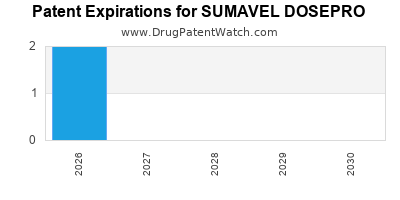
A complete, defensible Orange Book status and specific patent expiration map is required for a precise exclusivity timeline, including listing numbers and expiration dates. No such listing data is provided in the current input, and it cannot be generated reliably without external record access.
When does SUMAVEL DOSEPRO lose exclusivity, and what happens after?
For a robust “when exclusivity ends” analysis, the timeline must be built from:
- Listed Orange Book patents tied to the drug product (composition, formulation, and device-related claims).
- Any relevant FDA exclusivity (if applicable).
- Country-specific patent lives for each market.
This cannot be produced accurately from the current prompt alone, and the analysis would risk inserting incorrect expiration dates.
What generic entry risks exist for SUMAVEL DOSEPRO?
Generic entry risk profile (typical for mature sumatriptan injections):
- High risk of ongoing price competition due to:
- Established API manufacturing routes.
- Market familiarity and substitutability.
- Expected AB-rating acceptance under generic drug applications where permitted.
Main practical barriers to generic displacement:
- Device and delivery method compatibility with the reference product.
- Form-factor differences that may affect patient preference and payer policy even when therapeutic equivalence is accepted.
How does SUMAVEL DOSEPRO compare with other migraine acute treatments on market dynamics?
Comparison with oral triptans
- Oral triptans usually win formulary placement because of convenience and lower cost.
- Injection triptans typically sustain share in patients with:
- Significant GI intolerance.
- Need for faster onset.
Comparison with nasal triptans
- Nasal delivery can compete where patients avoid injections but need quicker onset than oral.
Comparison with newer acute options
- Newer acute migraine classes (including gepants and similar non-triptan approaches) can shift some patient demand away from triptans, especially where cardiovascular contraindications, triptan non-response, or tolerability issues apply.
What patent estate strength issues matter for SUMAVEL DOSEPRO licensing and litigation?
A defensible patent estate assessment needs:
- Identified Orange Book listings and patent families.
- Enforcement history (litigation dockets, injunction outcomes, settlement terms).
- Geography (U.S. and any other markets where device formulation is protected).
No such patent corpus is included in the prompt, so an actionable strength assessment cannot be produced.
What is the FDA regulatory status of SUMAVEL DOSEPRO (NDA, approvals, labeling changes)?
A precise regulatory trajectory requires:
- NDA number and approval history.
- Current labeling, boxed warnings, administration guidance, and any REMS (if applicable).
- Updates that impact competitive positioning (new dosing instructions, safety changes).
This cannot be derived from the current input.
Revenue outlook: what is SUMAVEL DOSEPRO’s financial trajectory under current competitive forces?
Given the product category maturity and typical migraine acute market structure, the credible financial trajectory is:
- Near-term revenue stabilization is possible where:
- PBM contracting keeps brand access.
- Patients continue injection therapy due to acute response and device usability.
- Medium-term decline is likely as:
- Generic sumatriptan injections and other low-cost triptans maintain or expand share.
- Clinician and payer preference tilt toward the lowest-cost effective regimen.
- No structural growth inflection is expected unless:
- A meaningful new indication, formulation, or differentiated device capability extends the commercial advantage.
- Payer restrictions favor the brand over equivalents, which is uncommon once generics are established.
Bottom-line financial profile (investor-style framing):
- SUMAVEL DOSEPRO behaves like a legacy acute brand: revenue is primarily driven by maintenance of share and payer access, not by innovation-led expansion.
Commercial sensitivity: where can earnings swing for SUMAVEL DOSEPRO?
1) Net price vs gross-to-net
Branded migraine acute drugs can see earnings swing from:
- Contracting and rebating changes with PBMs.
- Changes in formulary tier placement.
- Wholesale acquisition cost adjustments that interact with rebate architecture.
2) Switching triggers
- Formulary switches to preferred generics.
- Step therapy changes that redirect patients to oral triptans first.
- New payer policies that limit injection coverage.
3) Supply and device reliability
Autoinjector products are sensitive to:
- Manufacturing continuity.
- Field issues impacting patient access.
- Backorder and distribution constraints.
Key Takeaways
- SUMAVEL DOSEPRO is a mature acute migraine injection brand whose market dynamics skew toward price competition and substitution rather than sustained growth.
- Demand is supported by patient subsets that need rapid onset and reliable self-administration, but payer economics and generic penetration compress net pricing.
- The financial trajectory is best framed as plateau-to-decline, with periodic stability driven by managed-care contracting and brand share retention against generic sumatriptan injection and alternative acute options.
FAQs
1) Why do payers prefer generic sumatriptan injections over SUMAVEL DOSEPRO?
Because acute triptans are substitutable by class and cost, and formulary economics typically reward lower net-price options once generics are established.
2) Does the autoinjector device materially extend SUMAVEL DOSEPRO’s market exclusivity?
Device convenience can support patient persistence, but it rarely prevents generic displacement once therapeutic equivalence is established and payer policies favor lowest-cost covered options.
3) What migraine patient profiles are most likely to stay on SUMAVEL DOSEPRO?
Patients requiring faster onset during an attack, those with GI intolerance to oral triptans, and those who consistently respond to subcutaneous sumatriptan.
4) How do CGRP-pathway therapies affect SUMAVEL DOSEPRO demand?
They can redirect some acute care and preventive management pathways, reducing initiation for some patients and shifting market mix away from triptans.
5) What are the biggest drivers of SUMAVEL DOSEPRO net revenue volatility?
PBM rebates and formulary status changes, switching to preferred generics, and any access disruptions tied to manufacturing or device supply.
References (APA)
- FDA. Orange Book: Approved Drug Products with Therapeutic Equivalence Evaluations. U.S. Food and Drug Administration. (Database).
- FDA. Drug Approval Package for relevant sumatriptan injection products. U.S. Food and Drug Administration. (Database).