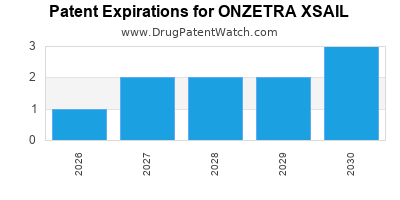
Last updated: August 3, 2026
ONZETRA XSAIL was a differentiated acute migraine product based on 11 mg sumatriptan delivered as a breath-powered nasal powder. Avanir Pharmaceuticals launched it in the United States in 2016 after FDA approval, but the product remained a niche competitor in a crowded triptan market. Its commercial trajectory was constrained by generic sumatriptan competition, high substitution from established oral and injectable products, limited payer differentiation, and the later emergence of CGRP therapies.
Public filings do not disclose standalone ONZETRA XSAIL revenue. Avanir was privately held before Otsuka Pharmaceutical acquired it for approximately $3.5 billion in 2015, and Otsuka has not reported product-level sales for ONZETRA XSAIL in its public financial disclosures. FDA records identify the product as discontinued from marketing, but not withdrawn for safety or efficacy reasons.[1-3]
What is ONZETRA XSAIL and how does it work?
ONZETRA XSAIL is a prescription acute migraine treatment containing sumatriptan nasal powder. Each device delivers an 11 mg dose through a breath-powered nasal delivery system. The patient exhales into the device, which disperses the powder into the nasal cavity.
The product was designed to address limitations associated with oral migraine medicines, particularly nausea, vomiting, delayed gastric emptying, and difficulty swallowing during an attack. Its principal product claims were:
- Non-oral administration
- Rapid delivery through the nasal cavity
- Breath-powered powder dispersion
- Use in migraine with or without aura
- An alternative to sumatriptan tablets, nasal liquid spray, and injection
FDA approved ONZETRA XSAIL on January 28, 2016, under New Drug Application 207190. The active ingredient, sumatriptan, was already established through IMITREX and generic products. The commercial differentiation therefore depended on the delivery device and nasal powder formulation rather than on a new molecular entity.[1]
FDA regulatory status
| Regulatory item |
Status |
| Active ingredient |
Sumatriptan |
| Dosage form |
Nasal powder |
| Dose |
11 mg per device |
| FDA application |
NDA 207190 |
| Initial FDA approval |
January 2016 |
| Therapeutic category |
Acute treatment of migraine |
| Product type |
Small-molecule drug-device combination |
| Biologic status |
Not applicable |
| Current FDA marketing status |
Listed as discontinued from marketing |
| Safety withdrawal |
No public FDA indication of withdrawal for safety or efficacy |
The discontinued status matters commercially. It indicates that the product is no longer actively marketed under its approved application, but it does not establish that FDA revoked approval or determined the product to be unsafe.
When did ONZETRA XSAIL lose market exclusivity?
ONZETRA XSAIL did not have biologic exclusivity and was not protected by new chemical entity exclusivity. Sumatriptan had been approved decades earlier. The product’s commercial protection depended primarily on formulation, device, and method-of-use patents, together with the practical difficulty of developing an equivalent nasal powder product.
The relevant exclusivity structure was therefore different from that of a new molecular entity:
| Protection category |
Relevance to ONZETRA XSAIL |
| New chemical entity exclusivity |
Not available |
| Orphan-drug exclusivity |
Not applicable |
| Biologic exclusivity |
Not applicable |
| Pediatric exclusivity |
No material standalone protection identified |
| Formulation patents |
Potentially relevant |
| Device patents |
Potentially relevant |
| Method-of-use patents |
Potentially relevant |
| Regulatory exclusivity |
Limited compared with a new active ingredient |
| Generic substitution risk |
High because sumatriptan was widely genericized |
The practical loss of exclusivity occurred before a commercially meaningful generic nasal-powder market developed. Oral sumatriptan, sumatriptan nasal spray, and sumatriptan injection already created a low-cost competitive environment. ONZETRA XSAIL’s differentiated delivery system could support patent protection, but it did not receive the market protection associated with a novel active ingredient.
What patents protect ONZETRA XSAIL?
ONZETRA XSAIL’s intellectual-property position centered on the nasal delivery system, powder formulation, and method of administering migraine medication. The product was associated with Avanir’s development program and breath-powered nasal delivery technology. Public patent records and product materials identify patents covering nasal powder delivery and related device configurations, but patent protection should be analyzed at the claim level rather than by counting every family member.
The primary patent risks were:
- Device-design patents. These could cover the exhalation-driven mechanism, airflow path, dispersion chamber, and related components.
- Formulation patents. These could cover the physical characteristics of the sumatriptan powder, particle size, excipients, and delivery performance.
- Method-of-use patents. These could cover treatment of acute migraine using the nasal powder system.
- Combination-product patents. Claims could cover the device used with a specific pharmaceutical composition.
A key limitation was that device and formulation patents generally do not prevent competition from all sumatriptan products. They target the specific delivery platform. A competitor could avoid infringement by commercializing an oral product, liquid nasal spray, injectable product, or a different nasal powder device.
How strong was the ONZETRA XSAIL patent estate?
The patent estate was commercially meaningful but narrower than the estate for a novel chemical entity. Its strength depended on four factors:
- Whether claims covered the complete commercial device rather than optional design elements
- Whether formulation claims were broad enough to prevent design-around
- Whether the patents survived validity challenges
- Whether FDA approval requirements created a practical barrier to substitution
The estate’s main weakness was product substitutability. Generic manufacturers did not need to reproduce ONZETRA XSAIL to compete for migraine prescriptions. They could offer lower-priced sumatriptan tablets or other approved dosage forms.
Which companies challenged ONZETRA XSAIL?
No major public Paragraph IV litigation campaign against ONZETRA XSAIL is widely identified in the principal FDA and federal court sources. That is consistent with the product’s limited commercial scale and the absence of a large generic market specifically targeting its nasal-powder device.
The competitive threat came primarily from:
- Generic oral sumatriptan manufacturers
- Generic sumatriptan nasal-spray manufacturers
- Teva Pharmaceuticals and other manufacturers of established triptan products
- Eli Lilly’s ZOMIG and generic zolmitriptan products
- GlaxoSmithKline’s IMITREX franchise and generic competitors
- Newer CGRP products, including Ubrelvy, Nurtec ODT, QULIPTA, and Zavzpret
What was the Paragraph IV risk?
Paragraph IV risk existed in principle because patents could be listed against the NDA. The commercial case for a Paragraph IV filing was less attractive than for a high-revenue oral product because:
- ONZETRA XSAIL had limited market penetration
- Sumatriptan alternatives were already inexpensive
- The device created technical development costs
- A successful challenger would face a narrow addressable market
- The reference product’s commercial availability became uncertain
No material 30-month stay or major public Paragraph IV settlement is clearly associated with ONZETRA XSAIL in the principal public record.
What was the market position of ONZETRA XSAIL?
ONZETRA XSAIL entered a mature migraine market rather than a newly created category. Sumatriptan was widely prescribed, but most prescriptions were directed toward tablets and established nasal or injectable products.
Its commercial value proposition was strongest for patients with:
- Migraine-associated nausea or vomiting
- Poor absorption during an acute attack
- Difficulty swallowing
- A need for non-oral therapy
- A preference against injections
Its commercial disadvantages included:
- Higher expected cost than generic tablets
- Device-use complexity
- Need for patient training
- Limited physician familiarity
- Payer pressure against branded triptans
- Competition from fast-acting injectable and nasal products
- Increasing interest in CGRP medicines without vasoconstrictive triptan effects
The product was also exposed to a structural market problem: its active ingredient was not differentiated. Sumatriptan’s efficacy was well established, but prescribers and payers could often obtain adequate migraine treatment at a much lower cost through generic formulations.
How did ONZETRA XSAIL compare with competing migraine drugs?
| Product |
Active ingredient |
Delivery |
Main commercial advantage |
Main competitive weakness |
| ONZETRA XSAIL |
Sumatriptan |
Breath-powered nasal powder |
Non-oral, device-based delivery |
Price and device complexity |
| Generic sumatriptan tablets |
Sumatriptan |
Oral |
Low cost and broad availability |
Poor fit for vomiting or delayed absorption |
| IMITREX nasal spray |
Sumatriptan |
Nasal liquid |
Established brand and non-oral use |
Generic competition |
| Sumatriptan injection |
Sumatriptan |
Subcutaneous |
Rapid and reliable systemic delivery |
Injection burden |
| ZOMIG nasal spray |
Zolmitriptan |
Nasal liquid |
Alternative triptan |
Generic and class competition |
| Ubrelvy |
Ubrogepant |
Oral tablet |
CGRP mechanism without triptan vasoconstriction |
Higher cost |
| Nurtec ODT |
Rimegepant |
Orally disintegrating tablet |
Acute and preventive utility |
Payer controls and higher price |
| Zavzpret |
Zavegepant |
Nasal spray |
CGRP nasal delivery |
Newer market access and reimbursement barriers |
ONZETRA XSAIL competed more directly with non-oral triptans than with CGRP medicines at launch. CGRP products later changed prescribing economics by offering a different mechanism and positioning for patients who did not respond to, tolerate, or qualify for triptans.
What was the financial trajectory of ONZETRA XSAIL?
No audited, standalone revenue series is publicly available. The financial trajectory must therefore be inferred from corporate ownership, product status, and market structure rather than from reported product sales.
Commercial timeline
| Date |
Event |
Financial significance |
| 2015 |
Otsuka agreed to acquire Avanir for approximately $3.5 billion |
Provided Avanir with a large-parent commercialization platform |
| January 2016 |
FDA approved ONZETRA XSAIL |
Opened U.S. commercial launch |
| 2016 onward |
Product competed in mature sumatriptan market |
Limited pricing power |
| Subsequent years |
Generic triptan and CGRP competition expanded |
Reduced differentiation and payer leverage |
| Later FDA records |
Product listed as discontinued from marketing |
Indicates loss of active commercial presence |
| Current public disclosures |
No standalone product revenue reported |
Prevents precise sales, margin, or peak-revenue calculation |
The product likely followed a limited-launch trajectory rather than a blockbuster trajectory. Its revenue ceiling was constrained by the size of the nasal-powder niche, the availability of inexpensive sumatriptan, and the need to secure favorable reimbursement for a branded delivery system.
The Otsuka acquisition also reduced the strategic need to maintain a marginal product if manufacturing, device supply, sales support, or reimbursement economics were unattractive. A large parent company can retain a product for portfolio completeness, but it can also discontinue a low-scale product without relying on external financing.
What manufacturing and IP barriers affected ONZETRA XSAIL?
The principal manufacturing barrier was the integrated drug-device system. A competitor would need to reproduce or design around:
- Powder particle engineering
- Dose uniformity
- Device airflow performance
- Nasal deposition
- Packaging stability
- Human-factors requirements
- Combination-product manufacturing controls
These requirements are more demanding than those for a conventional tablet. They can reduce the number of potential generic entrants. The barrier, however, does not guarantee commercial success. A technically difficult product may still have limited value if the reference product has low sales and competing dosage forms are inexpensive.
FDA approval would likely require an abbreviated or hybrid regulatory strategy depending on the product and the degree of formulation and device similarity. A manufacturer seeking approval for an equivalent nasal powder would face both pharmaceutical equivalence and device-performance issues.
What litigation and settlement agreements affected the product?
No major public patent settlement involving a Paragraph IV challenger is identified as a primary driver of ONZETRA XSAIL’s commercial trajectory. The absence of a prominent litigation record suggests that market contraction was driven more by economics and portfolio decisions than by a high-profile patent settlement.
The key legal distinction is between:
- Patent enforcement against a directly competing nasal-powder product
- Ordinary generic competition against sumatriptan in other dosage forms
- Product discontinuation unrelated to patent validity
ONZETRA XSAIL’s commercial erosion could occur without a direct patent loss because prescriptions could shift to legally distinct, lower-priced sumatriptan formulations.
What generic launch scenarios exist for ONZETRA XSAIL?
Three scenarios are commercially relevant:
Direct nasal-powder generic
This would create the highest substitution risk but requires device and formulation development. The addressable market would be limited to patients and payers specifically seeking the ONZETRA XSAIL delivery format.
Device-design-around product
A competitor could develop a different breath-powered or nasal powder system. This would reduce dependence on ONZETRA XSAIL patents but increase development and regulatory costs.
Therapeutic substitution
This is the most important scenario. Generic tablets, nasal sprays, injections, and CGRP therapies can capture patients without copying the ONZETRA XSAIL device. Therapeutic substitution has probably been more commercially significant than a direct generic launch.
What is the geographic coverage of ONZETRA XSAIL?
The principal commercial and regulatory relevance was in the United States. The product’s FDA approval and Orange Book-related analysis concern the U.S. NDA. Publicly visible commercial activity outside the United States was limited compared with major migraine brands.
The U.S. market was also the most exposed to generic substitution because of established generic dispensing, formulary controls, and pharmacy benefit manager pressure. Any foreign rights, licensing arrangements, or country-specific patent positions would require separate jurisdictional analysis and are not reflected in the U.S. FDA record.
Key Takeaways
- ONZETRA XSAIL was an 11 mg sumatriptan nasal-powder product approved by FDA in January 2016.
- Its differentiation came from the breath-powered XSAIL device, not from a new active ingredient.
- The product lacked new chemical entity or biologic exclusivity.
- Patent value centered on the device, formulation, and delivery method.
- Generic sumatriptan in other dosage forms created substantial substitution risk without infringing ONZETRA XSAIL patents.
- No major public Paragraph IV litigation or settlement is clearly associated with the product.
- Otsuka’s approximately $3.5 billion acquisition of Avanir provided the corporate ownership structure, but Otsuka did not disclose standalone ONZETRA XSAIL revenue.
- FDA records identify the product as discontinued from marketing, with no public indication of a safety-related withdrawal.
- The product’s financial trajectory was likely limited by mature triptan competition, payer resistance, device complexity, and the rise of CGRP therapies.
- A direct generic nasal-powder launch would be less important than therapeutic substitution by low-cost sumatriptan and newer CGRP drugs.
FAQs About ONZETRA XSAIL
Is ONZETRA XSAIL still available?
FDA records identify ONZETRA XSAIL as discontinued from marketing. Its availability through pharmacies and specialty distributors may therefore be limited or absent.
Is ONZETRA XSAIL a generic sumatriptan product?
No. It is a branded sumatriptan nasal-powder product. Its delivery device and formulation differentiate it from generic sumatriptan tablets and conventional nasal sprays.
Did ONZETRA XSAIL have blockbuster sales?
There is no public evidence of blockbuster sales. Otsuka did not report standalone ONZETRA XSAIL revenue, and the product operated in a mature, highly price-sensitive migraine market.
Can a generic company copy the ONZETRA XSAIL device?
A generic or follow-on manufacturer would need to address device patents, formulation claims, regulatory requirements, and human-factors testing. It could also pursue a design-around product rather than copy the commercial device.
Was ONZETRA XSAIL replaced by a CGRP migraine drug?
Not directly. CGRP therapies competed with ONZETRA XSAIL at the treatment-category level by offering alternatives for patients who did not respond to or tolerate triptans. The products use different mechanisms and regulatory pathways.
References
- U.S. Food and Drug Administration. (2016). FDA approves new drug for acute treatment of migraine headaches.
- U.S. Food and Drug Administration. (n.d.). Drugs@FDA: ONZETRA XSAIL, NDA 207190.
- Otsuka Pharmaceutical Co., Ltd. (2015). Otsuka Pharmaceutical to acquire Avanir Pharmaceuticals.
- U.S. Food and Drug Administration. (n.d.). Orange Book: Approved drug products with therapeutic equivalence evaluations.
- DailyMed. (n.d.). ONZETRA XSAIL: Sumatriptan nasal powder prescribing information.
- U.S. Patent and Trademark Office. (n.d.). Patent Center and Patent Public Search records for nasal powder delivery systems and breath-powered nasal devices.