Share This Page
Drug Sales Trends for SUMATRIPTAN SUCCINATE
✉ Email this page to a colleague
Payment Methods and Pharmacy Types for SUMATRIPTAN SUCCINATE (2022)
Revenues by Pharmacy Type
Units Sold by Pharmacy Type
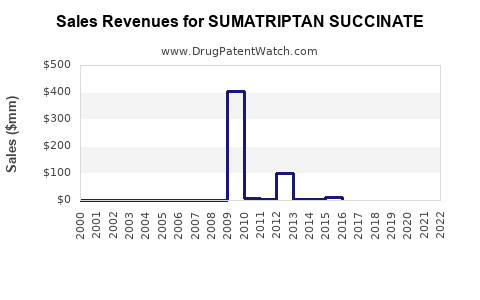
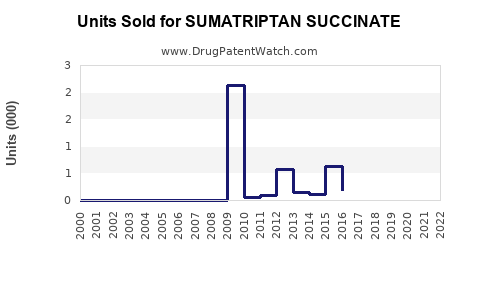
Annual Sales Revenues and Units Sold for SUMATRIPTAN SUCCINATE
| Drug Name | Revenues (USD) | Units | Year |
|---|---|---|---|
| SUMATRIPTAN SUCCINATE | ⤷ Start Trial | ⤷ Start Trial | 2022 |
| SUMATRIPTAN SUCCINATE | ⤷ Start Trial | ⤷ Start Trial | 2021 |
| SUMATRIPTAN SUCCINATE | ⤷ Start Trial | ⤷ Start Trial | 2020 |
| SUMATRIPTAN SUCCINATE | ⤷ Start Trial | ⤷ Start Trial | 2019 |
| SUMATRIPTAN SUCCINATE | ⤷ Start Trial | ⤷ Start Trial | 2018 |
| SUMATRIPTAN SUCCINATE | ⤷ Start Trial | ⤷ Start Trial | 2017 |
| >Drug Name | >Revenues (USD) | >Units | >Year |
Sumatriptan Succinate Market Analysis, Sales Forecast, Patent Status, and Competitive Outlook
Sumatriptan succinate is a mature, globally marketed migraine medicine with substantial prescription volume but limited pricing power. Generic tablets account for most demand. The commercial opportunity is concentrated in high-volume supply contracts, differentiated nasal and injectable delivery systems, and selected international markets. A base-case model projects global sumatriptan succinate sales declining modestly from approximately $340 million in 2025 to $315 million in 2029, with unit demand broadly stable and net pricing continuing to fall.
What is the current market position of sumatriptan succinate?
Sumatriptan succinate is a selective 5-HT1B/1D serotonin receptor agonist used for the acute treatment of migraine, with or without aura, and cluster headache in certain formulations. The original branded product, Imitrex, was developed by GlaxoSmithKline. Generic versions are widely available in tablets, nasal spray and subcutaneous injection.
The market has four principal product segments:
| Segment | Common strengths or format | Market position |
|---|---|---|
| Oral tablets | 25 mg, 50 mg, 100 mg | Largest volume segment; heavily commoditized |
| Nasal spray | 5 mg and 20 mg | Smaller segment; differentiated by speed and convenience |
| Subcutaneous injection | 6 mg/0.5 mL | Higher-value segment; used when rapid onset or oral intolerance matters |
| Branded delivery systems | Device-based injection and enhanced nasal systems | Niche products with limited pricing power |
The FDA originally approved Imitrex tablets in 1992, followed by injectable and nasal formulations. Generic competition has been established for many years, and the active ingredient is no longer protected by meaningful United States composition-of-matter exclusivity.[1][2]
How large is the sumatriptan succinate market?
Public companies generally do not report current sumatriptan sales as a separate line item. The original Imitrex franchise was a multibillion-dollar global product before generic erosion, but current revenue is distributed across multiple generic manufacturers, specialty-product companies and regional distributors.
The following market estimate is an analytical model rather than reported manufacturer revenue.
| Year | Global market value | Unit demand trend | Value trend |
|---|---|---|---|
| 2024 | $345 million-$435 million | Stable | Declining |
| 2025 | $325 million-$415 million | Stable to slightly higher | Declining |
| 2026 | $315 million-$405 million | Stable | Declining |
| 2027 | $305 million-$390 million | Stable to slightly higher | Declining |
| 2028 | $295 million-$375 million | Stable | Declining |
| 2029 | $285 million-$365 million | Stable | Declining |
The base case is approximately $340 million in 2025 and $315 million in 2029, equivalent to a compound annual decline of about 1.9%.
The market remains commercially relevant because migraine prevalence is high, treatment is often recurring, and sumatriptan is inexpensive relative to newer CGRP medicines. The principal constraint is price erosion, not a collapse in patient demand.
Estimated geographic split
| Region | Estimated share of 2025 value | Market characteristics |
|---|---|---|
| United States | 40%-50% | High generic penetration; meaningful injectable and branded-device demand |
| Europe | 20%-30% | Strong generic substitution and national price controls |
| Japan and other developed Asia-Pacific markets | 8%-12% | Established triptan use and regulated pricing |
| Latin America | 7%-10% | Variable branded and generic participation |
| Middle East, Africa and other markets | 10%-15% | Uneven access and distributor-led sales |
The United States is the most attractive market for differentiated formulations but one of the least attractive markets for undifferentiated 50 mg or 100 mg tablets.
What are the sales projections for sumatriptan succinate?
Base-case projection
The base case assumes stable migraine prevalence, modest growth in treated patients, continued generic price compression, and gradual substitution by gepants and other newer therapies.
| Product type | 2025 estimated value | 2029 projected value | 2025-2029 outlook |
|---|---|---|---|
| Generic tablets | $210 million-$260 million | $185 million-$225 million | Low-single-digit annual decline |
| Nasal spray | $35 million-$55 million | $38 million-$58 million | Flat to modest growth |
| Subcutaneous injection | $55 million-$75 million | $52 million-$72 million | Broadly stable |
| Branded or specialty delivery systems | $20 million-$35 million | $18 million-$30 million | Mixed |
| Total | $325 million-$415 million | $285 million-$365 million | Low-single-digit decline |
Scenario analysis
| Scenario | 2029 global sales | Key assumptions |
|---|---|---|
| Downside | $240 million-$285 million | Faster CGRP adoption, aggressive generic bidding, lower reimbursement |
| Base case | $285 million-$365 million | Stable volume, continued price erosion, specialty formats retain niches |
| Upside | $380 million-$450 million | Growth in treated migraine patients, supply disruptions, stronger injectable and nasal demand |
The most likely volume pattern is flat to modestly positive. Generic prices are likely to continue declining, producing lower market value even if prescription or unit demand increases.
Which formulations are commercially strongest?
Oral tablets
Tablets account for most sumatriptan prescriptions because they are inexpensive, familiar to prescribers and widely reimbursed. The 50 mg and 100 mg strengths are the core products. The 25 mg strength has a smaller role and is used where lower dosing is preferred.
Tablet sales are difficult to grow through conventional commercialization. Manufacturers compete on:
- Contract pricing
- Supply reliability
- Wholesaler availability
- State and health-plan formulary access
- Regulatory compliance
- Manufacturing cost
A new tablet entrant without a cost or supply advantage is likely to capture limited share and face rapid price compression.
Nasal spray
Nasal spray has a stronger commercial profile than standard tablets because it addresses nausea, vomiting and the need for faster administration. The segment is still constrained by generic alternatives, device costs and patient adherence.
Branded products such as Tosymra and other sumatriptan nasal systems have attempted to defend pricing through delivery technology and convenience. The commercial ceiling remains limited because many payers prefer lower-cost generic nasal spray or oral triptans.
Subcutaneous injection
Subcutaneous sumatriptan remains the most clinically differentiated conventional formulation. It can provide rapid relief and is useful for patients with severe attacks, vomiting or poor oral absorption.
The injection segment has higher revenue per treated patient than tablets but requires device manufacturing, combination-product quality systems and more complex supply management. Autoinjector products can command higher prices than vial or syringe products, although reimbursement and competition limit expansion.
How does sumatriptan compare with newer migraine drugs?
Sumatriptan competes with older triptans, newer gepants and nonpharmacologic devices.
| Product class | Examples | Main advantage over sumatriptan | Main disadvantage |
|---|---|---|---|
| Older triptans | Rizatriptan, eletriptan, naratriptan, zolmitriptan | Different onset, duration or tolerability profiles | Generic competition |
| Gepants | Ubrogepant, rimegepant, zavegepant | No vasoconstrictive mechanism; useful for some patients who cannot take triptans | Higher price and access restrictions |
| Dihydroergotamine | Nasal and injectable products | Alternative mechanism and formulations | Tolerability and administration limits |
| Neuromodulation devices | Several prescription devices | Non-drug option | Cost, access and variable adoption |
| OTC analgesics | Aspirin, acetaminophen and combination products | Low cost and easy access | Less suitable for severe or recurrent migraine |
Triptans remain an important first-line option because they are clinically established and inexpensive. Gepants are more likely to displace sumatriptan in patients with cardiovascular contraindications, inadequate response, poor tolerability or a preference to avoid vasoconstrictive agents.
What is the FDA regulatory status of sumatriptan succinate?
Sumatriptan succinate is an FDA-approved prescription drug available in several dosage forms. Regulatory status differs by product and manufacturer because each formulation may have a separate abbreviated new drug application or new drug application.
Key regulatory points include:
- Generic tablets are approved through the ANDA pathway.
- Generic nasal sprays and injections require formulation and device comparability appropriate to the dosage form.
- Certain branded injectable and nasal products are approved under full NDA pathways.
- The product is not a biologic and has no biosimilar pathway.
- Manufacturing sites must comply with current good manufacturing practice requirements.
- Combination products and autoinjectors face additional device, usability and quality-control requirements.
FDA labeling identifies contraindications involving certain cardiovascular and cerebrovascular conditions, uncontrolled hypertension and coadministration with specific ergot or serotonergic medicines.[3]
What is the Orange Book status of sumatriptan succinate?
The Orange Book contains listings for approved branded and generic sumatriptan products, with the relevant listing depending on dosage form, strength and sponsor. Original Imitrex exclusivity has expired, and standard generic tablets have long been subject to abbreviated approval pathways.[2]
The commercial significance of Orange Book listings is now limited for conventional products. The principal barriers are no longer basic compound patents. They are:
- Product-specific formulation claims
- Device patents
- Manufacturing process know-how
- Regulatory exclusivity for a particular specialty product
- Commercial contracts and formulary position
- Supply capacity
A manufacturer evaluating entry must review the current Orange Book for each specific reference-listed drug and formulation because tablet, nasal and injectable products may have different patent and exclusivity records.
What patents protect sumatriptan succinate?
The core sumatriptan compound patents expired years ago. The original patent estate included patents covering the chemical compound and related pharmaceutical uses, but those rights do not create a current blocking barrier for ordinary generic tablets.
Patent exposure is more relevant in three areas:
Formulation patents
Nasal delivery systems, injectable compositions, stabilizers, dose volumes and device configurations may have had later-filed patents. Their commercial value depends on claim scope and whether a generic can design around them.
Method-of-use patents
Method-of-use protection may address particular migraine treatment regimens, delivery timing or patient subgroups. These patents generally create narrower exposure than compound patents and may be addressed through a Paragraph IV certification or a section viii carve-out, depending on the listed use.
Manufacturing and device rights
Manufacturing know-how may be more important than patent rights. Control of sterile filling, injector assembly, nasal-pump performance and validated supply processes can delay entry even where patent risk is low.
When does sumatriptan lose exclusivity?
Sumatriptan has already lost practical market exclusivity in the United States and most major markets. Generic entry occurred many years ago for the principal tablet, nasal and injectable dosage forms.
There is no forward-looking loss-of-exclusivity event comparable to a current blockbuster patent cliff. Future erosion will arise from:
- New generic approvals
- Additional contract manufacturers
- Formulary substitution
- Price negotiations
- Physician migration to gepants
- Loss of branded-device differentiation
Paragraph IV challenges are primarily historical for the original sumatriptan products. A current entrant would generally face product-specific patent review rather than a single core patent barrier.
Which companies compete in the sumatriptan market?
Competition is fragmented. Generic suppliers have included large multinational and specialty manufacturers such as Teva, Dr. Reddy's Laboratories, Hikma and other FDA-approved sponsors, subject to product and market-specific authorization.
Branded or specialty competition has included:
- GlaxoSmithKline through the historical Imitrex franchise
- Currax Pharmaceuticals and other specialty companies associated with branded sumatriptan delivery products
- Upsher-Smith and other companies involved in nasal delivery products
- Regional manufacturers and distributors outside the United States
The relevant competitive set changes by dosage form. A tablet supplier competes primarily on price and availability. An autoinjector supplier competes on device performance, reimbursement and patient convenience.
What generic launch risks exist?
A generic tablet launch has low patent risk but high commercial risk. The main risks are price competition, limited formulary differentiation and difficulty reaching scale.
A nasal or injectable launch has a better opportunity for value capture but higher technical risk. Potential barriers include:
- Device equivalence
- Dose-delivery consistency
- Sterility and container-closure validation
- Human-factors testing
- Manufacturing-site inspection
- Limited reimbursement for premium products
- Litigation over formulation or device patents
The most attractive entry strategy is usually a reliable, low-cost product with a differentiated supply position or a delivery system addressing a clear clinical problem.
How strong is the sumatriptan patent estate?
The overall patent estate is weak for conventional sumatriptan tablets and moderate for selected delivery systems. Patent strength should be assessed by product rather than by active ingredient.
| Product area | Patent strength | Commercial implication |
|---|---|---|
| Standard tablets | Low | Generic entry is established |
| Standard nasal spray | Low to moderate | Product-specific formulation and device review required |
| Autoinjector | Moderate | Device and combination-product rights may matter |
| New administration technology | Moderate to high if claims are narrow and enforceable | Potential for premium pricing, but market size is limited |
| Manufacturing process | Usually confidential rather than blocking | Operational barrier may exceed patent barrier |
What is the revenue exposure for manufacturers?
For a generic manufacturer, sumatriptan is unlikely to be a major standalone revenue driver unless included in a broad migraine or CNS portfolio. The product can support portfolio breadth, hospital and retail contracts, and manufacturing utilization.
Revenue potential varies sharply by formulation:
- Tablets: high unit volume, low margin
- Nasal spray: lower volume, higher technical value
- Injection: lower volume, higher revenue per unit
- Branded device: potentially higher gross margin, but greater commercialization expense
A company relying on sumatriptan alone would face concentration risk and persistent pricing pressure. A company pairing it with newer migraine therapies can use the product as a lower-cost option across the treatment pathway.
Key Takeaways
- Sumatriptan succinate is a mature generic migraine market with stable demand and declining value.
- Global market value is estimated at approximately $325 million-$415 million in 2025.
- Base-case sales are projected to decline to approximately $285 million-$365 million by 2029.
- Tablets represent the largest segment but have the weakest pricing and patent position.
- Nasal and injectable products offer better differentiation and revenue per patient.
- The original compound and core product exclusivity have expired.
- Current commercial barriers are manufacturing, device performance, reimbursement and supply reliability.
- Gepants will continue to take share from triptans in selected patients, but low-cost sumatriptan should remain widely used.
- A differentiated nasal or injectable product has better investment potential than another standard tablet entrant.
- There is no biosimilar risk because sumatriptan is a small-molecule drug, not a biologic.
FAQs
Is sumatriptan succinate still a profitable drug?
Yes, but profitability depends on formulation and manufacturing scale. Standard tablets have limited margins, while nasal and injectable products can support higher revenue per unit.
Is sumatriptan succinate generic?
Yes. Generic sumatriptan succinate is widely available in tablet, nasal spray and injectable formats. Imitrex is the original branded product.
Can a company still patent a new sumatriptan product?
A company may obtain patents on a genuinely novel formulation, device, manufacturing process or treatment method. It cannot obtain a new composition-of-matter patent on the long-known sumatriptan molecule.
Are gepants likely to replace sumatriptan?
Gepants will displace sumatriptan in selected patients, especially those with cardiovascular restrictions, poor triptan response or tolerability concerns. Their higher cost limits full replacement.
What is the best commercial opportunity in sumatriptan?
The strongest opportunity is a reliable, differentiated nasal or subcutaneous delivery product supported by manufacturing capacity and reimbursement access. Standard oral tablets are primarily a scale and cost-management business.
References
-
U.S. Food and Drug Administration. (n.d.). Imitrex (sumatriptan succinate) prescribing information. FDA Drugs@FDA.
-
U.S. Food and Drug Administration. (n.d.). Approved drug products with therapeutic equivalence evaluations: Orange Book. FDA.
-
U.S. Food and Drug Administration. (n.d.). Sumatriptan succinate prescribing information and product labeling. FDA Drugs@FDA.
-
GlaxoSmithKline plc. (2001-2008). Annual reports and financial statements. GSK.
-
U.S. Food and Drug Administration. (n.d.). Approved drug product labeling for generic sumatriptan tablets, nasal spray and injection. FDA.
More… ↓
