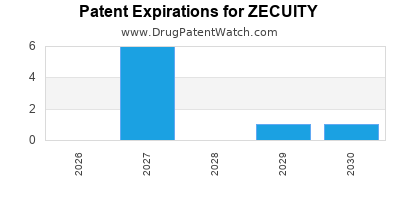
Last updated: August 2, 2026
Zecuity, Teva Pharmaceutical Industries’ sumatriptan iontophoretic transdermal patch, has no current commercial market. The FDA approved Zecuity in January 2013, but Teva suspended shipments in June 2016 after reports of burns, blisters, pain, discoloration and scarring at the application site. Teva later discontinued the product permanently. Its commercial trajectory was therefore short: regulatory approval, limited launch, safety-driven suspension and withdrawal. No standalone Zecuity revenue, current sales base or active generic market remains publicly reported.
What was Zecuity and how did its delivery system work?
Zecuity delivered 6.5 mg of sumatriptan through the skin using an iontophoretic patch. The system was designed for adults with acute migraine who could not tolerate oral medication or experienced nausea and vomiting.
| Product attribute |
Zecuity profile |
| Active ingredient |
Sumatriptan |
| Dosage form |
Iontophoretic transdermal patch |
| Strength |
6.5 mg |
| Sponsor at approval |
NuPathe |
| Commercial owner |
Teva |
| FDA application |
NDA 022569 |
| FDA approval |
January 2013 |
| Therapeutic category |
Acute migraine treatment |
| Commercial status |
Permanently discontinued |
| Current FDA market status |
Not marketed |
The product attempted to differentiate sumatriptan from low-cost oral tablets, nasal sprays and injectable formulations. Its value proposition was delivery convenience during migraine-related nausea. That advantage depended on reliable skin tolerability and consistent patch operation.
When did Zecuity lose market exclusivity and commercial viability?
Zecuity lost commercial viability before patent expiry became the primary market issue. The product was withdrawn because of safety complaints, not because a generic competitor successfully entered the market.
Zecuity exclusivity timeline
| Date |
Event |
Commercial effect |
| January 17, 2013 |
FDA approved Zecuity |
Authorized U.S. launch |
| 2013-2014 |
Commercial rollout under Teva ownership |
Product entered a crowded triptan market |
| February 2014 |
Teva completed acquisition of NuPathe |
Teva assumed control of Zecuity and related assets |
| June 2016 |
Teva suspended shipments after adverse-event reports |
Distribution stopped |
| 2016 |
FDA issued safety communication concerning application-site reactions |
Prescribing and patient use declined |
| 2016 |
Teva permanently discontinued Zecuity |
U.S. commercial market ended |
The relevant exclusivity question is therefore not simply when Zecuity patents expired. The product was removed from the market roughly a decade before a conventional patent-based generic launch would have been commercially important.
What caused Zecuity’s withdrawal?
Skin-related adverse events caused the withdrawal. The FDA reported postmarketing cases involving burns, blisters, pain, erythema, hyperpigmentation and scarring associated with the patch site. The FDA advised patients to stop using Zecuity and instructed health-care professionals not to prescribe it during the suspension period.[1]
The safety issue weakened all major commercial drivers:
- Patient retention fell because the patch could cause visible and painful skin reactions.
- Prescriber confidence declined after the FDA warning.
- Reimbursement value deteriorated relative to generic sumatriptan.
- Teva faced increased product-liability, regulatory and remediation exposure.
- Retail and specialty distribution became impractical during the suspension.
- A relaunch would have required a credible device or formulation correction, new safety evidence and renewed physician adoption.
The product’s problem was structural. Zecuity was a drug-device combination whose delivery mechanism created the tolerability risk. A conventional oral sumatriptan generic did not carry the same patch-site liability.
How did Teva’s acquisition of NuPathe affect Zecuity’s financial trajectory?
Teva agreed to acquire NuPathe in 2014 for approximately $144 million in cash, with potential additional consideration of up to approximately $55 million tied to specified milestones.[2] Zecuity was the principal commercial asset associated with the transaction, alongside NuPathe’s broader migraine portfolio and pipeline.
The transaction thesis depended on several assumptions:
- Zecuity could establish a differentiated premium position in acute migraine.
- Teva’s global commercial infrastructure could expand adoption.
- The patch could reach patients with oral-treatment limitations.
- The acquired assets could contribute growth beyond Teva’s mature generic portfolio.
The withdrawal invalidated the central commercial assumption. Teva did not report Zecuity as a separately material revenue category in its public financial statements. The company’s filings report products and business segments at a level that does not provide a reliable standalone Zecuity sales series.[3] As a result, the public record supports a directional financial conclusion rather than a precise product-level revenue curve:
| Financial phase |
Direction |
| Preapproval and launch preparation |
R&D and commercialization spending |
| Early postapproval period |
Revenue generation, but limited public product-level disclosure |
| 2014 acquisition period |
Strategic asset consolidation under Teva |
| 2016 suspension |
Revenue interruption and inventory disruption |
| Post-discontinuation |
No recurring commercial revenue |
| Long-term effect |
Asset value impairment, sunk acquisition and development costs, and potential liability exposure |
There is no basis in public filings to assign a precise cumulative revenue loss or product-specific impairment amount to Zecuity. Teva’s reported financial data does not isolate those figures.
How did Zecuity compare with competing migraine treatments?
Zecuity entered a market with established low-cost generic alternatives and newer branded delivery systems. Its commercial differentiation was narrow: nonoral delivery without an injection.
| Treatment category |
Main advantage over Zecuity |
Main limitation |
| Generic oral sumatriptan |
Low price, broad availability |
Oral administration may be difficult during severe nausea |
| Sumatriptan nasal spray |
Faster nonoral delivery |
Nasal tolerability and administration issues |
| Sumatriptan injection |
Rapid and reliable systemic exposure |
Needle use and higher administration burden |
| Other triptans |
Multiple efficacy and tolerability options |
Generic competition and class similarity |
| CGRP receptor antagonists |
Non-vasoconstrictive positioning and newer mechanisms |
Higher cost and evolving reimbursement |
| Dihydroergotamine products |
Alternative rescue option |
Administration burden and tolerability concerns |
Zecuity’s pricing power was constrained by the availability of generic sumatriptan. The patch needed to demonstrate either superior adherence, faster relief, better patient outcomes or strong convenience benefits to justify a premium. The skin-safety profile removed that differentiation.
What was the FDA regulatory status of Zecuity?
Zecuity received FDA approval through a new drug application for acute treatment of migraine with or without aura in adults.[4] Its regulatory status later changed from marketed to discontinued after Teva suspended and then ended distribution.
The product was not a biologic, so biosimilar regulation does not apply. Any future competitor would have been evaluated as a small-molecule drug, likely through an abbreviated new drug application if the reference product remained legally and commercially relevant. Because Zecuity was discontinued and its delivery technology presented device-specific risks, a competitor would still have faced formulation, device-performance and clinical comparability questions.
What patents and formulation rights protected Zecuity?
Zecuity’s defensibility depended on more than the sumatriptan molecule. Sumatriptan itself was an established active ingredient with extensive generic competition. The potentially valuable intellectual property covered the transdermal iontophoretic system, patch construction, electrode configuration, drug formulation, dosing and methods of treating migraine.
The practical patent estate can be divided into four categories:
Drug-device and delivery patents
These covered the iontophoretic mechanism used to move sumatriptan across the skin. Such patents were central to product differentiation because an oral sumatriptan manufacturer could not automatically practice the same patch technology.
Formulation patents
Formulation protection could cover the sumatriptan-containing reservoir, excipients, pH conditions, adhesives and stability characteristics. These rights were relevant to manufacturing but did not eliminate the fundamental safety risk associated with repeated skin exposure.
Method-of-use patents
Method claims could cover use of the patch for acute migraine treatment, including dosing and patient administration. These claims could support enforcement against a labeled competing patch but would have limited value after the reference product left the market.
Device and manufacturing know-how
Manufacturing controls, electrode assembly, adhesive selection, drug loading and quality specifications could create practical barriers even where patent protection was incomplete. These barriers matter commercially only if the product is safe, reimbursed and accepted by prescribers.
No active Zecuity commercial patent dispute or successful Paragraph IV-driven generic launch is a central part of the product’s market history. The commercial failure occurred before generic competition became the decisive threat.
Were there Paragraph IV challenges or generic entrants for Zecuity?
No publicly established generic Zecuity market emerged before the product was discontinued. The principal competitive pressure came from existing generic sumatriptan products and alternative migraine therapies, not from an ANDA entrant duplicating the patch.
A Paragraph IV challenge would have required a prospective generic applicant to certify that relevant listed patents were invalid, unenforceable or not infringed. Zecuity’s withdrawal reduced the commercial incentive to undertake that litigation. A generic company would have had to reproduce a discontinued drug-device product while assuming the same skin-tolerability concerns.
What litigation and settlement issues affected Zecuity?
The major legal exposure was product liability associated with skin injuries and the adequacy of warnings, rather than a widely reported patent litigation campaign. The FDA safety communication and Teva’s withdrawal created potential claims involving patients who experienced burns, blistering, discoloration or scarring.
No major publicly reported patent settlement established a delayed generic entry date for Zecuity. The absence of a settlement-driven entry schedule reflects the product’s withdrawal and limited commercial value, not necessarily the absence of underlying intellectual-property rights.
How strong was the Zecuity patent estate?
The estate was technically differentiated but commercially fragile. Its strongest elements were the iontophoretic delivery system and drug-device integration. Its weakest element was the lack of durable market acceptance after safety reports.
| Patent-estate factor |
Assessment |
| Active-ingredient exclusivity |
Weak; sumatriptan was already established and generically available |
| Delivery technology |
Stronger; iontophoretic transdermal delivery was differentiated |
| Formulation protection |
Potentially meaningful for product replication |
| Method-of-use protection |
Useful against a directly competing labeled patch |
| Manufacturing barriers |
Moderate; device assembly and quality controls increased complexity |
| Litigation value after withdrawal |
Low |
| Commercial value after safety signal |
Low |
Patent strength cannot be separated from product safety. A broad or technically difficult patent estate does not preserve value when the product cannot be commercialized.
What is the current market and revenue outlook for Zecuity?
Zecuity has no current commercial revenue outlook as a marketed product. It has no active branded sales base, no meaningful U.S. prescription trajectory and no established generic replacement market under the Zecuity brand.
The remaining economic value is limited to:
- Historical acquisition and development learnings.
- Potentially reusable iontophoretic or transdermal technology.
- Patent rights, if any remain unexpired and commercially relevant.
- Product-liability resolution.
- Internal portfolio analysis by Teva or successor rights holders.
Zecuity is therefore best classified as a discontinued pharmaceutical asset, not a growth product. Its financial trajectory ended with asset write-down risk and liability management rather than revenue expansion.
Key Takeaways
- Zecuity was FDA-approved in January 2013 as a 6.5 mg sumatriptan iontophoretic patch.
- Teva acquired NuPathe in 2014 in a transaction valued at approximately $144 million upfront, with potential milestone payments.
- The FDA and Teva identified serious application-site reactions, including burns, blisters, pain and scarring.
- Teva suspended shipments in June 2016 and permanently discontinued the product.
- No standalone Zecuity revenue series is disclosed in Teva’s public filings.
- No biosimilar pathway applies because Zecuity is a small-molecule drug.
- No meaningful generic Zecuity market or publicly established Paragraph IV launch followed the withdrawal.
- The product’s delivery and formulation IP was more differentiated than its active ingredient, but the patent estate could not offset safety-driven commercial failure.
- Zecuity has no current marketed-product revenue outlook.
FAQs
Could Zecuity return to the U.S. market?
A return would require a new commercial and regulatory strategy addressing the patch-related skin injuries. Teva discontinued the product, and no relaunch has been publicly established.
Is Zecuity the same as generic sumatriptan?
No. Zecuity contains sumatriptan but uses a proprietary iontophoretic transdermal patch. Generic sumatriptan is primarily available in oral, nasal and injectable forms.
Does Zecuity have biosimilar competition?
No. Biosimilars apply to biologic products. Zecuity is a small-molecule sumatriptan drug-device combination.
What was the main commercial weakness of Zecuity?
The primary weakness was the risk of painful and sometimes persistent application-site reactions. The risk undermined the product’s nonoral-delivery advantage.
Did Teva disclose Zecuity’s exact acquisition return?
No separate product-level return, cumulative Zecuity revenue, impairment amount or net present value is identified in the cited public filings. Teva reported financial information at broader segment and portfolio levels.
References
-
U.S. Food and Drug Administration. (2016, June 2). FDA warns of burns, scars and skin discoloration with use of Zecuity migraine patch. https://www.fda.gov/
-
Teva Pharmaceutical Industries Ltd. (2014, February 20). Teva announces completion of acquisition of NuPathe Inc. https://www.tevapharm.com/
-
Teva Pharmaceutical Industries Ltd. (2016). Annual report on Form 20-F for the year ended December 31, 2016. U.S. Securities and Exchange Commission. https://www.sec.gov/
-
U.S. Food and Drug Administration. (2013). Zecuity: NDA 022569 approval information. Drugs@FDA. https://www.accessdata.fda.gov/scripts/cder/daf/