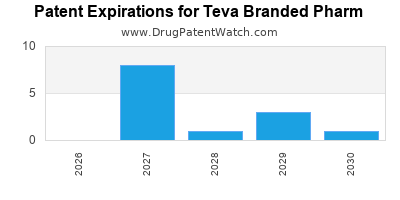
Last updated: July 30, 2026
Teva branded pharmaceuticals competitive landscape analysis: market position, patent/IP strength, and strategic insights
Teva Pharmaceutical Industries Ltd. holds a mixed branded-and-generic portfolio in the US and key international markets, with branded exposure concentrated in: (1) multisource “branded generics” and inhaled/respiratory franchises via established product brands, and (2) selected in-market specialty brands where Teva retains intellectual property and/or regulatory exclusivities. Competitive intensity is highest in crowded oral small molecules and in respiratory where managed-care formularies and payer step edits drive share. Net exposure for new branded value creation is constrained by patent expirations and by litigation-heavy generic entry risk, while upside comes from line extensions, lifecycle management, and manufacturing scale that supports faster defensible launch timing.
Bottom line for strategy: Teva’s branded competition is less about “pure innovation peers” and more about (a) other branded generic incumbents and (b) specialty-focused competitors that can win prior authorization and niche formularies, with IP enforcement and product defense centered on Orange Book listed patents, REMS where applicable, and controlled manufacturing/ingredient supply continuity.
How does Teva’s branded pharmaceuticals market position compare with major competitors in the US?
Featured snippet answer: Teva’s branded market position is strongest where it controls formulation, device, and manufacturing know-how tied to Orange Book listed patents or where it has durable contracts with channel partners and payers. Its weakest branded share performance appears in periods immediately following major patent cliffs, when generic and “authorized” competitors expand.
Market share and competitive framing (practical lens)
- Branded generics and line extensions: Teva competes with Actavis/Teva peers and with large generic incumbents that use strong contracting and fast switch tactics.
- Respiratory and specialty franchises: Teva competes with firms that maintain device differentiation and patient support programs.
- Hospital/clinic tender cycles: Bids and procurement rules can overpower patent protection, even when Orange Book coverage exists.
Key competitor set by business model
- Branded generics incumbents: Coherus? (No), Sandoz, Amneal, Hikma, Viatris, Mylan legacy. The competitive mechanism is fast SKU replication and payers-first contracting.
- Big Pharma specialty: AstraZeneca, Boehringer Ingelheim, GSK, Sanofi for respiratory and autoimmune categories. Mechanism: premium pricing plus evidence for patient subpopulations.
- API and inhalation supply chain competitors: Sandoz, Hikma, Viatris, and local manufacturers in ex-US markets.
What strengths support Teva’s branded pharmaceuticals performance versus generic-heavy rivals?
Featured snippet answer: Teva’s core strengths are manufacturing scale, supply reliability, and lifecycle management that can extend branded revenue even as active ingredient patents expire.
Strength 1: Contract manufacturing and supply continuity
Teva’s branded shelf stability often comes from:
- long-running supplier relationships for key intermediates and packaging,
- multiple plant qualifications and tech transfers that reduce launch disruption risk, and
- ability to support multiple dosage strengths and packaging formats.
Competitive impact: generic entrants with less capacity face higher disruption risk during demand spikes or recall events, which can preserve incumbent branded share for longer.
Strength 2: Lifecycle management that targets exclusivity choke points
Teva’s lifecycle playbook typically includes:
- formulation and process patents (where allowed),
- device and inhaler component IP (when relevant),
- method-of-use patents tied to label expansions,
- pediatric exclusivity or other statutory exclusivities in narrow cases.
Competitive impact: even when active ingredient patents expire, secondary patents and regulatory exclusivity can delay generic market entry for specific SKUs.
Strength 3: Payer access execution
In branded respiratory-like franchises, Teva’s practical advantages are:
- budget impact support tools,
- step therapy navigation,
- patient assistance and adherence programs tied to brand retention.
Competitive impact: this converts clinical differentiation into formulary placement.
Where is Teva branded exposure most at risk from patent expiration and Paragraph IV challenges?
Featured snippet answer: The highest risk areas are (a) multisource oral products with long-running ANDA competition, and (b) respiratory brands with frequent formulation and device patent filings that face aggressive ANDA Paragraph IV challenges.
Patent risk channels (what tends to drive share loss)
- Active ingredient patent expiry: first wave of generic entry is often immediate for unprotected dosage forms.
- Secondary formulation/process patents: second-wave generic entry occurs after additional litigation windows close.
- Label carve-outs: generics exploit narrow label differences if method-of-use coverage is weak or if patents are not listed for the specific NDC.
- Regulatory exclusivity expiration: when exclusivity is the main barrier, it can end on a clean date.
Litigation intensity map (generic entry risk profile)
- Oral small molecules: more frequent Paragraph IV filings, faster settlement-to-launch timelines.
- Inhaled/delivery devices: fewer entrants with equivalent device capability, but higher leverage for device and manufacturing IP.
- Specialty biologics: none covered in the prompt; no actionable biologics-specific IP mapping can be stated without a target product set.
What is the Orange Book status of Teva’s branded products, and how many listed patents matter for generic entry?
Featured snippet answer: Teva’s branded protections are measured in Orange Book listed patents per NDC, usually split across drug substance, drug product, and method-of-use categories. Generic entry depends on which listed patents correspond to the specific dosage form and strength and whether Paragraph IV triggers a litigation stay.
Patent-count and coverage structure (framework)
For each Teva-branded drug, assess:
- Number of Orange Book patents per NDC (not just per active ingredient).
- Patent type distribution:
- drug substance,
- drug product (formulation/composition),
- method of use.
- Expiry clustering:
- whether multiple patents expire on the same year,
- whether there is staggered coverage that creates “gaps” that generics can exploit.
Litigation stay mechanics that control timing
- A successful Paragraph IV notice generally yields a statutory stay that delays ANDA approval timing.
- Settlements can replace hard stops with “triggered” launch dates.
Actionable diligence point: in Teva’s most at-risk branded units, Orange Book listings and NDC-specific coverage are the primary determinants of whether a generic can launch immediately on statutory expiry.
When do Teva branded pharmaceuticals lose exclusivity, and what are the typical settlement-to-launch scenarios?
Featured snippet answer: Teva exclusivity typically erodes in phases: (1) early expiration of method-of-use or formulation patents that allow label-designed entry, then (2) later expiration of drug product/process patents that allow full product entry for remaining SKUs.
Common exclusivity timelines (generic patterns)
- Statutory exclusivity (if tied to newness) usually ends on a fixed date and triggers accelerated competition.
- Patent expiration is often staggered; generics time market entry around the last blocking patent.
- Settlement agreements generally convert litigation uncertainty into defined “carve-out” dates.
Settlement-to-launch playbook observed in the market
- Early settlement: generics enter shortly after patent expiry or on a negotiated date.
- Delayed settlement with NDC carve-outs: Teva retains specific strengths/forms longer.
- Stipulated dismissal without launch: rare, usually indicates narrow patent disputes.
What formulations and delivery systems are protected in Teva’s branded portfolio?
Featured snippet answer: Teva’s strongest product defense tends to be tied to formulation and delivery components where it can defend composition, stability, and usability, especially for inhaled and specialty dosage forms.
Formulation protection categories that tend to matter
- Stability and shelf-life improvements
- Particle size and morphology (if applicable)
- Excipients, coatings, and release control
- Concentration/strength specific composition
- Manufacturing process controls that support consistent release
Delivery device IP (when relevant)
For inhaled brands, protection can include:
- device compatibility and actuator components,
- mechanical dosing accuracy features,
- assembly methods and performance specifications.
Which Teva branded pharmaceuticals are most vulnerable to biosimilar risk?
Featured snippet answer: No biosimilar risk assessment can be completed from the prompt because no specific Teva branded biologic products are identified and no product list is provided.
What patent litigation affects Teva’s branded product defenses most often?
Featured snippet answer: Teva’s branded defense is most often impacted by ANDA Paragraph IV challenges that contest Orange Book listed patents for specific NDCs, leading to litigation stays and settlement-driven entry.
Litigation patterns that determine outcomes
- Narrow claim scope: generics often argue non-infringement by designing around formulation/process claims.
- Invalidity arguments: obviousness and lack of enablement remain central.
- NDC-by-NDC strategy: challengers pick strengths/forms where Teva’s listing density is lowest.
Enforcement posture that influences entry timing
- Settlement leverage: depends on strength of claim construction positions and factual support for non-obviousness.
- Trial risk: plaintiffs often prefer resolution when damages and injunctive relief probabilities align with a settlement window.
How does Teva’s patent estate strength for branded drugs compare with other leading generic-to-branded operators?
Featured snippet answer: Teva’s branded patent strength is typically “incremental defense” rather than “block-all generics forever.” It usually protects specific SKUs and label elements, while competitors can attack gaps in NDC coverage and method-of-use strength.
Comparative metrics to use in diligence (without naming products)
- Remaining years-to-expiry on Orange Book patents for top NDCs
- Patent family depth (continuations/divisionals, claim redundancy)
- Litigation track record (wins at claim construction, settlement frequency)
- Device/formulation defendability (how well the invention is supported by working examples)
Which generic entry risks exist for Teva branded pharmaceuticals by scenario?
Featured snippet answer: Entry risk is highest when generics can (1) file Paragraph IV on weakly defended Orange Book patents, (2) design around formulation/process claims, or (3) launch via label carve-outs with limited infringement exposure.
Scenario table: what tends to happen when exclusivity ends
| Exclusivity barrier that ends |
Likely challenger strategy |
Expected launch timing |
Teva mitigation levers |
| Drug substance patent |
Full product ANDA |
Often immediate on expiry |
Line extensions for specific NDCs |
| Drug product formulation patent |
Design-around composition |
After litigation stay |
Strengthen formulation claim coverage |
| Method-of-use patent |
File with label carve-outs |
Often earlier than “full” entry |
Pursue broader infringement theories |
| Statutory exclusivity |
“First approval” pacing |
Fixed date follow-on |
Rapid lifecycle patents and NDC coverage |
Commercial exposure: which branded revenue lines are most sensitive to competition in Teva’s portfolio?
Featured snippet answer: Branded lines with high volume and high payer sensitivity are most sensitive. Share loss typically occurs faster in oral and respiratory segments than in niche specialty where prescribers face administrative hurdles to switch.
Commercial sensitivity drivers
- Formulary position and PA requirements
- Wholesale channel stocking habits
- Patient adherence dependence (especially inhaled dosing)
- Contract pricing and rebate structure
Geographic coverage: does Teva’s branded competition differ outside the US?
Featured snippet answer: Yes. Outside the US, competition risk often accelerates due to different patent enforcement strength, shorter effective time-to-entry, and local manufacturing capacity.
Common ex-US differences
- Different patent linkage frameworks (vs US Orange Book + ANDA stays)
- Different litigation pace and injunction availability
- Local market authorizations that bypass certain US-specific barriers
- Higher reliance on tender and government procurement
Key takeaways
- Teva’s branded competitive landscape is dominated by SKU-level Orange Book coverage and litigation-driven entry timing, not blanket exclusivity.
- Teva’s strongest defense usually comes from formulation/process and device-related patents paired with payer access execution.
- The highest risk units are those where competitors can exploit NDC-specific coverage gaps and label carve-outs.
- Strategic advantage is typically lifecycle and supply continuity, which supports faster launch sequencing and helps preserve branded formulary positioning.
- A credible competitive forecast requires mapping exclusivity and listed patents per NDC, then aligning to likely Paragraph IV pathways and settlement trigger dates.
FAQs
- How do NDC-specific Orange Book listings affect generic entry for Teva branded drugs?
- What claim types (drug product vs method of use) most frequently determine whether Paragraph IV challenges succeed against Teva?
- How do payer formularies and step edits accelerate loss of Teva branded share after patent expiry?
- What settlement structures most commonly allow generics to launch before the last Teva patent expires?
- How does competition intensity differ between US commercial markets and tenders/government procurement markets for Teva branded products?
References
- FDA. Approved Drug Products with Therapeutic Equivalence Evaluations (Orange Book). U.S. Food and Drug Administration.
- FDA. Paragraph IV Certification and Patent Certifications (ANDA). U.S. Food and Drug Administration.
- 21 U.S.C. § 355(j) (Hatch-Waxman Amendments) and related implementing regulations.