Last updated: October 28, 2026
Sumatriptan succinate is a mature, largely generic migraine medicine with durable demand but limited pricing power. GlaxoSmithKline’s branded Imitrex franchise created the market and generated blockbuster-level sales before U.S. patent protection ended. The product now competes primarily on price, availability, formulation, and payer access rather than molecular differentiation.
The commercial outlook is stable in volume and weak in value. Oral tablets, nasal spray, and injection products remain FDA-approved, while newer calcitonin gene-related peptide, or CGRP, therapies are capturing premium migraine spending. Sumatriptan retains a role because of low cost, extensive clinical use, multiple delivery systems, and strong physician familiarity.
What is the current market position of sumatriptan succinate?
Sumatriptan succinate is the succinate salt of sumatriptan, a selective 5-HT1B/1D serotonin receptor agonist used for acute treatment of migraine, with or without aura, and cluster headache in selected formulations. The reference product is Imitrex, marketed by GlaxoSmithKline.
The product is available in several dosage forms:
| Formulation |
Reference product |
Primary commercial role |
Current competitive position |
| Oral tablets |
Imitrex tablets |
Acute migraine treatment |
High-volume, low-price generic market |
| Nasal spray |
Imitrex nasal spray |
Patients needing faster absorption or unable to swallow |
Smaller, differentiated niche |
| Subcutaneous injection |
Imitrex injection and generic products |
Rapid treatment; useful for severe attacks or nausea |
Higher-value niche, but generic competition exists |
| Prefilled syringe or autoinjector systems |
Imitrex STATdose and generic equivalents |
Convenience and rapid administration |
Device and usability influence market share |
FDA labeling identifies approved strengths including 25 mg, 50 mg, and 100 mg tablets; 5 mg and 20 mg nasal spray products; and 6 mg subcutaneous injection products, although specific strengths and presentations vary by manufacturer and approval [1-3].
Sumatriptan is no longer a protected premium product in the United States. Its commercial value comes from prescription volume, low manufacturing cost, broad distribution, and continued use in treatment algorithms.
When did sumatriptan lose U.S. exclusivity?
The foundational U.S. patent covering sumatriptan expired in the mid-2000s, with generic oral competition becoming commercially significant around 2009. The exact launch timing reflected patent settlements, pediatric exclusivity, formulation rights, and individual generic approvals rather than a single uniform loss-of-exclusivity date.
Key exclusivity milestones
| Event |
Approximate timing |
Commercial effect |
| First U.S. Imitrex approvals |
1991-1992 |
Established the branded triptan category |
| U.S. compound-patent protection |
Through approximately 2007 |
Delayed broad generic entry |
| Generic oral-tablet entry |
Approximately 2009 |
Rapid erosion of branded tablet value |
| Generic nasal and injectable competition |
Late 2000s onward |
Reduced branded share across delivery systems |
| Current status |
Mature generic market |
Volume remains; price and revenue have compressed |
The original compound patent is generally identified as U.S. Patent No. 4,816,463, assigned to the Glaxo group. It covered the sumatriptan chemical entity and was central to the original Imitrex franchise. Later patents and regulatory exclusivities addressed formulations, devices, and manufacturing issues, but they did not preserve long-term monopoly economics for the active ingredient.
What patents protect sumatriptan succinate products today?
No active U.S. compound patent provides broad exclusivity for sumatriptan succinate. The relevant intellectual-property landscape is now fragmented across formulation, device, process, and method-of-use claims.
Compound patents
The core compound patent, U.S. Patent No. 4,816,463, expired after providing the principal period of Imitrex market protection. Its expiration opened the market to ANDA applicants for conventional oral products.
Formulation patents
Formulation patents historically covered:
- Nasal delivery systems and spray compositions
- Injectable solutions and stability characteristics
- Salt forms and pharmaceutical compositions
- Device configurations for subcutaneous delivery
- Packaging and dose-delivery systems
These patents could delay or complicate entry for a specific presentation without blocking all sumatriptan products. A generic tablet manufacturer could enter while a device or nasal-spray patent remained relevant to another dosage form.
Method-of-use patents
Method-of-use protection has been commercially narrower than compound protection. Sumatriptan labels cover acute treatment of migraine and, for some products, cluster headache. Patent claims directed to dosing, patient populations, or specific treatment methods may affect labeling and litigation risk, but they do not recreate the original broad chemical monopoly.
Orange Book status
FDA Orange Book listings historically included patents associated with Imitrex tablets, nasal spray, injection, and delivery systems. Because Orange Book entries change with product approvals, patent delistings, and FDA updates, the relevant analysis must be performed by dosage form and NDA rather than at the active-ingredient level. The presence of a patent in the Orange Book does not establish that every sumatriptan product remains blocked from launch [4].
How many patents cover sumatriptan succinate?
The practical answer depends on the product presentation and jurisdiction. The original U.S. molecule was protected by a small number of foundational patent families, while later rights expanded across formulations, devices, and manufacturing processes.
For commercial analysis, the patent estate should be separated into four layers:
- Active-ingredient patents, now expired in the United States.
- Formulation patents, relevant mainly to nasal and injectable products.
- Device patents, relevant to autoinjectors, syringes, and dose delivery.
- Method and process patents, relevant to specific uses or manufacturing routes.
A patent count without claim-level analysis can overstate risk. Most commercial exposure now arises from product quality, regulatory approval, manufacturing scale, and device execution rather than from a blocking composition-of-matter claim.
What is the FDA regulatory status of sumatriptan succinate?
Sumatriptan succinate is an FDA-approved prescription drug marketed through both reference NDAs and generic ANDAs. It is regulated as a small-molecule drug, not a biologic, so biosimilar regulations do not apply.
FDA-approved product categories include:
- Immediate-release oral tablets
- Nasal spray
- Subcutaneous injection
- Device-assisted subcutaneous delivery
Generic applicants must demonstrate pharmaceutical equivalence and bioequivalence for the relevant dosage form. Injectable and nasal products generally require more extensive product-development capabilities than tablets because of formulation, container-closure, device, sterility, dose uniformity, and performance requirements.
The approval pathway is therefore commercially uneven. Tablet entry is relatively accessible for established generic manufacturers. Nasal and injectable products create higher technical and regulatory barriers, which can support better margins for suppliers that obtain approval and maintain reliable manufacturing.
Which companies are challenging or competing with Imitrex?
The primary competitive group includes generic manufacturers and branded migraine companies.
Generic manufacturers
Generic sumatriptan has been marketed by multiple companies, including large multinational generic suppliers and specialty manufacturers. The competitive field has included companies such as Teva Pharmaceuticals, Mylan, Sandoz, Dr. Reddy’s Laboratories, Lupin, and other ANDA holders, depending on the dosage form and market.
Competition is strongest in tablets. Nasal spray and injectable products typically have fewer qualified suppliers because of technical and manufacturing requirements.
Branded triptan competitors
Sumatriptan competes with:
| Drug |
Brand example |
Differentiating factor |
| Rizatriptan |
Maxalt |
Rapid oral or orally disintegrating administration |
| Zolmitriptan |
Zomig |
Oral and nasal options |
| Naratriptan |
Amerge |
Longer duration and lower recurrence in some patients |
| Eletriptan |
Relpax |
Triptan efficacy and tolerability profile |
| Frovatriptan |
Frova |
Longer half-life |
| Almotriptan |
Axert |
Alternative tolerability and interaction profile |
Most triptans are mature products with generic competition. Their principal advantages over sumatriptan are product-specific tolerability, duration, route of administration, and patient response.
CGRP-targeted therapies
Newer competitors include:
- Ubrogepant, marketed as Ubrelvy
- Rimegepant, marketed as Nurtec ODT
- Zavegepant nasal spray, marketed as Zavzpret
- Atogepant and rimegepant for preventive treatment
- Erenumab, fremanezumab, galcanezumab, and eptinezumab for prevention
- Lasmiditan, marketed as Reyvow
CGRP antagonists generally carry substantially higher prices than generic sumatriptan. They compete for patients with inadequate response, cardiovascular contraindications to triptans, intolerance, high attack frequency, or commercial insurance coverage for newer therapies [5-8].
How does sumatriptan compare with newer migraine drugs?
Sumatriptan has the lowest acquisition cost among commonly used prescription migraine-specific therapies. Newer agents offer clinical or practical advantages but face reimbursement controls and substantially higher net costs.
| Attribute |
Sumatriptan |
CGRP antagonists |
Lasmiditan |
| Drug class |
Triptan |
CGRP receptor or ligand antagonist |
5-HT1F agonist |
| Generic availability |
Yes |
Limited or absent for newer products |
No broad generic market |
| Typical price position |
Low |
High |
High |
| Vasoconstrictive activity |
Yes |
No |
No |
| Main use |
Acute treatment |
Acute or preventive treatment, depending on product |
Acute treatment |
| Payer access |
Broad |
Often prior authorization |
Often restricted |
| Commercial growth |
Mature or declining value |
Growing |
Specialty niche |
Sumatriptan remains attractive as first-line therapy when there are no cardiovascular contraindications. Its low cost also makes it useful in formularies and in markets where patients pay directly.
What patent litigation and Paragraph IV risks affect sumatriptan?
The major Paragraph IV risk period occurred before and around generic entry for Imitrex dosage forms. ANDA applicants could challenge listed patents by asserting invalidity, unenforceability, or non-infringement under the Hatch-Waxman framework.
Current litigation risk is lower for the active ingredient because the principal compound patent has expired. Residual risks can arise from:
- Nasal-spray formulation patents
- Injection formulation or stability patents
- Autoinjector and delivery-device claims
- Manufacturing-process patents
- Labeling and method-of-use disputes
- Patent-listing and regulatory-status disagreements
A generic applicant may avoid some claims through a Paragraph IV certification or a section viii statement that omits a patented indication. The commercial result depends on the specific NDA, listed patents, dosage form, and settlement terms.
Publicly reported disputes involving Imitrex and generic applicants helped define entry timing, but no current patent dispute appears capable of restoring broad U.S. exclusivity for sumatriptan as a molecule. The principal risk for investors is product-specific litigation, not a return to branded monopoly economics.
What licensing deals shaped the sumatriptan market?
The central commercial transaction was the development and commercialization of sumatriptan by the Glaxo group, which launched Imitrex and built the global triptan franchise. The product is associated with Glaxo Wellcome and later GlaxoSmithKline following corporate consolidation.
The more important licensing issue today is distribution and commercialization by generic suppliers rather than originator licensing. Generic companies may use contract manufacturing, regional marketing rights, or supply agreements. These arrangements can affect shortages, tender wins, and retail availability without changing the underlying patent position.
The product has limited licensing appeal as a stand-alone molecule because:
- The U.S. composition-of-matter patent has expired.
- Multiple generic sources exist.
- Price competition is entrenched.
- Newer migraine drugs capture premium economics.
- Clinical differentiation is limited unless tied to a device or formulation.
The most valuable remaining commercial rights are likely to involve differentiated delivery systems, combination products, geographic markets with weaker generic penetration, or supply reliability.
What is the financial trajectory of sumatriptan succinate?
Sumatriptan followed the standard blockbuster-to-generic trajectory.
Phase 1: Branded growth
Imitrex became one of the first widely adopted migraine-specific therapies. Revenue benefited from:
- Large migraine prevalence
- Limited pre-existing disease-specific options
- Strong physician recognition
- Multiple delivery systems
- Expansion into cluster headache treatment
- High branded pricing before generic entry
Phase 2: Peak branded sales
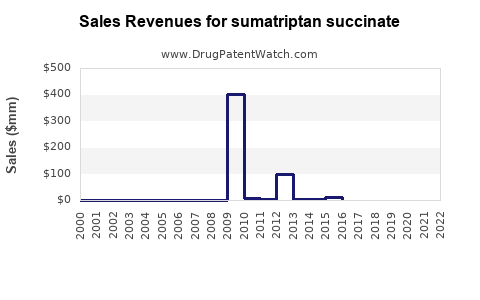
The Imitrex franchise reached blockbuster scale before loss of exclusivity. Public company reporting generally presented Imitrex within broader prescription-product portfolios, and product-level revenue figures varied by reporting period and geography. After patent expiry, branded revenue declined rapidly.
Phase 3: Generic erosion
Generic tablets caused the steepest price compression. Brand retention remained possible through insurance preference, patient familiarity, or authorized-generic arrangements, but the market shifted from brand economics to high-volume, low-margin supply.
Phase 4: Mature market
The present market is characterized by:
- Stable underlying migraine demand
- Low generic prices
- Moderate prescription volume
- Formulation-specific supply constraints
- Limited pricing power
- Substitution by CGRP therapies in selected patients
A precise global sumatriptan revenue figure is difficult to establish because sales are split across many generic manufacturers, dosage forms, countries, wholesalers, and private-label products. Public company filings rarely disclose sumatriptan revenue separately.
What revenue exposure remains for manufacturers?
Revenue exposure differs sharply by product type.
| Product type |
Revenue outlook |
Margin outlook |
Main risk |
| Generic tablets |
High unit volume |
Low |
Price erosion and tender competition |
| Nasal spray |
Lower volume |
Moderate if differentiated |
Device, formulation, and supply complexity |
| Subcutaneous injection |
Lower volume |
Moderate to higher |
Sterile manufacturing and device competition |
| Branded Imitrex |
Declining or stable niche |
Limited |
Generic substitution and CGRP migration |
| Contract manufacturing |
Volume-dependent |
Low to moderate |
Customer concentration and price pressure |
For generic manufacturers, sumatriptan is usually a portfolio product rather than a major growth driver. It can contribute recurring revenue and manufacturing utilization, but it is unlikely to materially expand enterprise value without a differentiated presentation or a supply shortage.
What generic launch scenarios exist for sumatriptan?
Three scenarios are commercially relevant.
Tablet market
The tablet market is mature and heavily competed. New entrants generally win share through lower pricing, wholesaler relationships, reliable supply, or channel access. A late entrant is unlikely to achieve strong margins absent a shortage or a differentiated commercial arrangement.
Nasal spray market
A new nasal product can gain value through ease of use, rapid onset, patient preference, or device performance. Regulatory and manufacturing barriers are higher than for tablets, reducing the number of credible competitors.
Injection market
Subcutaneous injection products can retain better economics because of sterile manufacturing and delivery-device requirements. Hospital, specialty-pharmacy, and retail distribution channels can produce different pricing outcomes. Device reliability and patient training are central commercial factors.
How strong is the sumatriptan patent estate by geography?
| Geography |
Patent and market position |
Commercial implication |
| United States |
Core patents expired; mature generic market |
Low molecule-level barrier |
| European Union |
Broad generic availability; country-level launch timing varies |
Price competition and national reimbursement effects |
| Japan |
Mature market with local regulatory and reimbursement dynamics |
Generic access varies by presentation |
| Emerging markets |
Patent status and enforcement vary substantially |
Potentially stronger brand or local-supply positions |
| Developing markets |
Low-cost access is central |
Volume may exceed value |
Geographic patent exposure must be evaluated country by country. A product can be commercially mature in the United States while retaining temporary protection, regulatory delay, or limited generic competition in another jurisdiction.
What manufacturing and intellectual-property barriers remain?
The active ingredient is not the primary barrier. The remaining barriers are operational:
- Consistent active pharmaceutical ingredient supply
- Control of impurities and salt-form quality
- Bioequivalence for oral products
- Nasal-spray performance and dose uniformity
- Sterility and stability for injections
- Device validation and human-factors requirements
- Reliable packaging and cold-chain or storage controls where applicable
- Regulatory maintenance across multiple markets
These barriers can create temporary shortages and support pricing, but they do not produce durable exclusivity comparable to a valid composition-of-matter patent.
What is the long-term commercial outlook for sumatriptan succinate?
The long-term outlook is stable in demand and declining in economic value per prescription. Sumatriptan is likely to remain a core low-cost acute migraine therapy because it is familiar, effective for many patients, widely approved, and available in several delivery systems.
Growth will be limited by:
- Generic price erosion
- Substitution by CGRP antagonists
- Cardiovascular contraindications
- Patient preference for non-vasoconstrictive therapies
- Payer strategies favoring lowest-cost triptan options
The strongest commercial opportunities are in injectable and nasal products, supply-constrained markets, private-label distribution, and countries where generic penetration remains incomplete. The weakest opportunity is undifferentiated U.S. oral-tablet entry.
Key Takeaways
- Sumatriptan succinate is a mature generic migraine medicine, not a protected branded growth asset.
- Imitrex created blockbuster economics, but U.S. compound-patent protection ended in the mid-2000s.
- Generic oral tablets are highly commoditized and carry limited margin potential.
- Nasal spray and injectable products retain higher technical and commercial barriers.
- No biosimilar pathway applies because sumatriptan is a small-molecule drug.
- CGRP antagonists are the main premium competitors, while other triptans remain direct low-cost substitutes.
- Current patent risk is formulation-, device-, process-, and method-specific rather than molecule-wide.
- Revenue is difficult to quantify at the global active-ingredient level because sales are fragmented among generic suppliers.
- The most credible growth cases involve differentiated delivery, reliable supply, and underpenetrated geographic markets.
- The financial trajectory is mature-volume, declining-price, and low-to-moderate-margin.
FAQs About Sumatriptan Succinate Market and Patents
Is sumatriptan succinate still profitable for pharmaceutical companies?
Yes, but usually as a portfolio product. Generic tablets provide volume with low margins, while nasal and injectable presentations can provide better economics because of formulation, device, and manufacturing requirements.
Can a company obtain a new patent on a sumatriptan formulation?
Yes. A novel formulation, delivery device, manufacturing process, or fixed-dose combination may qualify for patent protection if it satisfies statutory novelty, non-obviousness, and written-description requirements. Such a patent would not restore exclusivity for the underlying sumatriptan molecule.
Does sumatriptan have biosimilar competition?
No. Sumatriptan is a chemically synthesized small molecule. Competition proceeds through generic-drug pathways, including ANDAs, rather than through the biosimilar framework.
Why do injectable sumatriptan products face fewer competitors than tablets?
Injectables require sterile manufacturing, validated container-closure systems, stability data, device compatibility, and more complex quality controls. Those requirements reduce the number of manufacturers able to enter and maintain commercial supply.
Will CGRP drugs eliminate sumatriptan demand?
No. CGRP drugs will continue to capture premium and treatment-resistant segments, but sumatriptan is likely to remain widely used because of its low price, clinical familiarity, availability, and role as an early-line acute treatment.
References
- U.S. Food and Drug Administration. (2023). Imitrex (sumatriptan succinate) tablets prescribing information.
- U.S. Food and Drug Administration. (2023). Imitrex (sumatriptan succinate) injection prescribing information.
- U.S. Food and Drug Administration. (2023). Imitrex (sumatriptan) nasal spray prescribing information.
- U.S. Food and Drug Administration. (2024). Approved drug products with therapeutic equivalence evaluations: Orange Book.
- American Headache Society. (2021). The American Headache Society consensus statement: Update on integrating new migraine treatments into clinical practice. Headache, 61(7), 1021-1039.
- Dodick, D. W. (2018). Migraine. The Lancet, 391(10127), 1315-1330.
- GlaxoSmithKline plc. (2007). Annual report 2006.
- U.S. Patent No. 4,816,463. (1989). N-substituted indole derivatives. U.S. Patent and Trademark Office.