Last updated: April 24, 2026
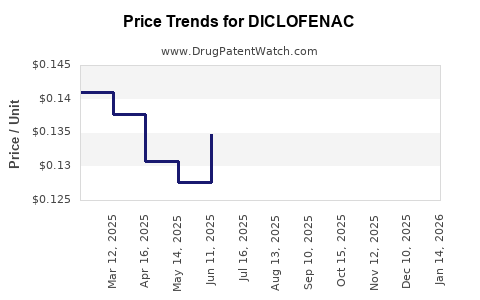
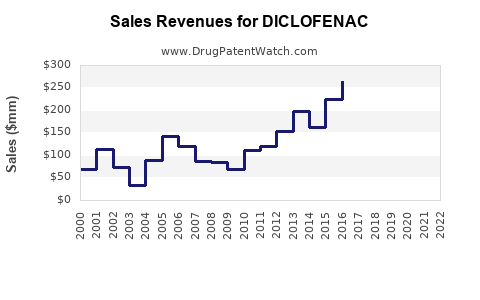
Diclofenac is a widely used nonsteroidal anti-inflammatory drug (NSAID) across prescription and over-the-counter (OTC) settings in major markets, with a price-and-volume profile shaped by patent expiries, generic penetration, ongoing safety-driven label restrictions, and shifting formulation demand (topical vs oral). Financial trajectory is typically defined by (1) erosion of brand pricing in mature geographies, (2) steady share gains for generics, and (3) product mix shifts toward topical products and combination formats in markets where oral exposure limits tighten.
How big is diclofenac’s addressable market?
The addressable market for diclofenac is best understood as a set of lanes rather than a single “drug” market, because formulations, routes, and access rules drive demand:
- Oral NSAIDs lane: diclofenac tablets/capsules/powders used for osteoarthritis, rheumatoid arthritis, ankylosing spondylitis, and acute pain.
- Topical NSAIDs lane: diclofenac gel used primarily for localized osteoarthritis (and related musculoskeletal indications depending on jurisdiction).
- Injectable and other lanes: short-course use for acute pain/inflammatory conditions in some markets, generally smaller than oral and topical.
- OTC lane (varies by country): in jurisdictions with OTC availability for some diclofenac strengths/forms, unit demand tends to be less sensitive to prescriber behavior and more sensitive to local substitution and pharmacy dynamics.
Market size and growth rates are consistently reported as “mature, low-to-mid single digit” in mainstream industry sources for NSAIDs broadly, but diclofenac-specific growth tends to track two drivers: (1) generic volume, (2) topical mix. In practice, investors model diclofenac as a generic-heavy, formulation-tilted business rather than a high-growth specialty asset.
What market dynamics drive demand and share?
1) Patent expiry and generic substitution
Diclofenac is long off patent in most major markets. Generic entry is usually completed at scale, and retail and institutional formularies favor low-cost options. This makes pricing leverage limited and pushes growth into:
- higher-volume channels (pharmacies and substitution),
- new dosage-form adoption (where permitted),
- and incremental mix shifts (topical vs oral).
2) Safety and regulatory friction
Regulators have sustained long-running safety actions for oral NSAIDs, and diclofenac has repeatedly appeared in communications tied to cardiovascular risk considerations. Net effect on demand is not uniform:
- Oral: demand is typically more exposed to prescriber behavior changes and label restrictions.
- Topical: demand can be more resilient because exposure is lower versus oral in many regulatory frameworks, and localized use fits common musculoskeletal treatment pathways.
A practical market implication is that diclofenac’s “financial trajectory” often improves when portfolios lean into topical formulations, even when oral volume is flat.
3) Formulation and switching economics
Diclofenac’s commercial reality depends on product-specific economics:
- Topical products compete on patient adherence, perceived efficacy, and local guideline adoption.
- Oral products compete mainly on price, safety positioning, and formulary placement.
- Combination formats or branded generics can defend margins longer than plain generics, but those defenses erode as substitution intensifies.
4) Channel structure
Where diclofenac sits in payor and channel mechanics:
- Institutional formularies and tendering tend to push rapid generic switching.
- Pharmacy shelf dynamics can support OTC and “switch at dispense” behavior if local rules allow diclofenac strengths for self-care.
How does the formulation mix affect pricing and margins?
For most mature NSAIDs, topical products tend to hold pricing better than plain oral tablets because:
- they are harder for payors to substitute at the same “unit of therapy” level,
- they face different prescriber expectations,
- and they carry a distinct compliance story (localized application).
However, topical margins can still compress as multiple generics enter with pricing pressure.
A typical financial pattern is:
- Oral diclofenac: volume holds but average selling prices fall faster, with margin compression driven by generic competition.
- Topical diclofenac: slower price erosion than oral, with improved contribution as brands and select generic SKUs compete on product differentiation.
What does the financial trajectory look like across the lifecycle?
Stage 1: Brand consolidation (historically)
Early years of diclofenac brands delivered premium pricing before generic saturation. That phase is no longer a main driver in most large markets.
Stage 2: Generic-led volume growth (current baseline)
Most current growth comes from:
- expanding generic volume share,
- continued replacement of branded SKUs at the pharmacy counter,
- channel penetration by low-cost manufacturers.
Financial implication: revenue growth is often supply- and volume-led, not price-led. For companies with generic exposure, the trajectory follows manufacturing scale, procurement, and distribution leverage.
Stage 3: Mix shift and margin management
The ongoing shift toward topical use and alternative NSAID choices affects diclofenac’s mix and profitability. In this stage, the key financial determinants are:
- proportion of topical vs oral revenue,
- ability to defend SKU-level pricing against local competitors,
- and manufacturing cost curves.
How do regulatory signals translate into revenue impacts?
Diclofenac has been repeatedly mentioned in regulatory communications about NSAID cardiovascular risk and safer-use messaging. A consistent commercial translation is:
- oral diclofenac faces more prescriber caution and potential substitution to other NSAIDs or non-NSAID options,
- topical diclofenac faces fewer direct constraints and can retain localized demand.
These are not “ban-type” shocks in most markets; they work through guidance, label language, and prescriber preference. Financial trajectory therefore tends to show gradual erosion in oral demand or pricing, and relative stabilization where topical use remains guideline-aligned.
What competitive landscape shapes diclofenac pricing?
The competitive set is broader than diclofenac alone:
- Other NSAIDs (ibuprofen, naproxen, celecoxib in some lanes, meloxicam where permitted).
- Within diclofenac: topical vs oral competition across molecules is less direct, but oral diclofenac competes with multiple generics and branded generics.
Pricing pressure comes from:
- generic multi-source intensity,
- tendering and reimbursement preferences,
- and pharmacy discounting regimes.
Where payors enforce step therapy or prefer lower-risk options, diclofenac’s net pricing can soften further.
What are the investment-relevant financial drivers?
For diclofenac, financial performance is typically driven by these levers:
-
SKU mix (topical vs oral)
Topical mix tends to stabilize contribution margin versus oral generics.
-
Geographic exposure to substitution intensity
Markets with higher generic penetration usually show faster price erosion.
-
Manufacturing efficiency and supply reliability
Low-cost manufacturing and distribution scale determine margin in a commoditized category.
-
Regulatory and label stability
Sustained safety communications can alter prescriber behavior and shift demand toward other NSAIDs or topical formulations.
-
Portfolio breadth
Many players treat diclofenac as a “platform” in NSAID portfolios; cross-product demand can offset category headwinds.
Where does diclofenac sit in the revenue waterfall for generic manufacturers?
Generic economics typically follow:
- Gross-to-net compression from payer and channel pricing,
- price erosion with additional entrants,
- volume stability when molecules remain standard-of-care for localized pain and inflammation,
- and margin discipline as procurement and competition intensify.
Diclofenac revenue tends to be:
- resilient on volume, and
- volatile on margins (driven by pricing auctions, tender cycles, and manufacturing input costs).
Bottom-line trajectory: does diclofenac grow or shrink financially?
Across mature geographies, diclofenac usually shows:
- low growth in nominal revenue due to price compression,
- volume-led steadiness from generic substitution,
- profitability dependence on mix, manufacturing scale, and topical strategy.
Financial trajectory is therefore best described as commoditized and mix-sensitive. Growth exists but it typically comes from share capture and formulation mix, not from price expansion.
How do safety communications and label restrictions affect long-term outlook?
The longer-term trajectory depends on whether regulators:
- tighten oral usage limitations further,
- reinforce cardiovascular risk messaging for oral NSAIDs,
- or shift clinical practice toward topical options or non-NSAID alternatives.
For diclofenac, the likely direction in mature markets is:
- continued headwinds for oral exposure,
- continued relative support for topical diclofenac where localized osteoarthritis treatment is common.
Key regulatory context supporting the market narrative
-
Diclofenac is an NSAID with a cardiovascular risk signal that has been part of regulatory safety messaging over time in multiple jurisdictions, contributing to caution in prescribing and use. This is reflected in EU-level safety communications and coordinated risk assessments for NSAIDs. (European Commission communications on NSAID safety and risk management; see references [1]-[2].)
-
Topical diclofenac’s localized exposure profile is a core reason it retains clinical and commercial relevance relative to oral NSAIDs in many settings. (EMA product information for diclofenac-containing topical medicines; see references [3]-[4].)
Key Takeaways
- Diclofenac is a mature, generic-dominated NSAID with financial trajectory driven by mix (topical vs oral), generic substitution, and manufacturing economics.
- Oral revenue typically faces faster price erosion and safety-driven prescriber caution, while topical tends to hold up better as demand shifts toward localized treatment.
- Long-term growth is share and formulation-led, not price-led, in most major markets.
- For market participants, the investment-relevant focus is SKU mix, tender-driven pricing resilience, and regulatory trajectory affecting oral NSAID usage.
FAQs
1) Is diclofenac still commercially viable in mature markets?
Yes, because it remains a standard NSAID with high generic availability and persistent localized pain and osteoarthritis demand, especially where topical use is guideline-supported.
2) Why does topical diclofenac often outperform oral in margin resilience?
Topical products compete on differentiated patient use and localized indication pathways, which can slow down unit-price erosion compared with plain oral tablets.
3) What is the main threat to diclofenac revenue?
Continued safety-driven prescriber and payor substitution away from oral NSAIDs and toward alternatives, including other NSAIDs or non-NSAID options.
4) What drives revenue for generic suppliers of diclofenac?
Volume from substitution and channel placement, plus margin control based on manufacturing cost and SKU mix, not premium pricing.
5) Does diclofenac face existential regulatory risk in major markets?
The pattern is typically incremental label and risk communications rather than blanket bans, so market access usually persists, but prescribing behavior shifts gradually.
References
[1] European Commission. (2005). Assessment report on the risks and benefits of non-selective NSAIDs and COX-2 inhibitors in relation to cardiovascular risk.
[2] European Medicines Agency (EMA). (2015). PRAC recommendations on the safety of NSAIDs, including diclofenac.
[3] European Medicines Agency (EMA). (n.d.). Product information for topical diclofenac-containing medicines (SmPC).
[4] European Medicines Agency (EMA). (n.d.). Product information for diclofenac-containing medicines (SmPC).