Last updated: February 20, 2026
What is the current market size for Diclofenac?
Diclofenac is a nonsteroidal anti-inflammatory drug (NSAID) used for pain management, inflammation reduction, and fever. As of 2022, global sales reached approximately $4.5 billion annually. The drug accounts for roughly 15% of the NSAID market, with major markets in Europe, North America, and Asia-Pacific.
What are key factors influencing current demand?
- Prevalence of chronic pain and arthritis: Growing elderly populations and increasing osteoarthritis cases drive demand.
- Market penetration: Available in multiple formulations—oral tablets, topical gels, and injectable forms.
- Patent status: Many formulations are off-patent, facilitating OTC sales globally.
- Regulatory environment: Strict approval processes in the US and EU limit new entrants but sustain market stability.
How is the market segmented geographically?
| Region |
Market Share (2022) |
Growth Rate (2022–2027) |
Key Drivers |
| Europe |
40% |
3% |
High prevalence of arthritis, established healthcare infrastructure |
| North America |
30% |
2.5% |
Generic availability, OTC sales dominance |
| Asia-Pacific |
20% |
5% |
Increasing accessibility, rising middle-class incomes |
| Rest of World |
10% |
4% |
Growing awareness, local manufacturing capabilities |
How competitive is the current market?
The market features multiple generic producers, including Novartis, Pfizer, and Sandoz. Original patent holders like Novartis's Voltaren formulations have transitioned to generic manufacturing, reducing barriers to entry for new entrants. Price competition necessitates cost-effective manufacturing.
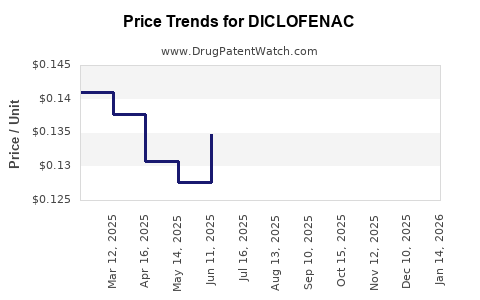
What are projected price trends?
| Year |
Average Wholesale Price (USD) per 100 mg tablet |
Notes |
| 2022 |
$0.30 |
Price stabilizes post patent expiry |
| 2023 |
$0.28 |
Slight decline due to increased generic competition |
| 2024 |
$0.25–$0.27 |
Market saturation, price competition intensifies |
| 2025 |
$0.23–$0.26 |
Emergence of low-cost manufacturers |
| 2026 |
$0.22–$0.24 |
Focus on cost efficiency in manufacturing |
How will regulation impact prices?
Regulatory scrutiny in major markets like the US (via FDA) and EU (EMA) influences formulations and sales channels. Stringent safety warnings and restrictions on high-dose use can affect profit margins. The push toward OTC availability in emerging markets may lower prices but expand volume.
What are the competitive strategies?
- Formulation innovation: Development of topical and transdermal patches to differentiate from generics.
- Cost reduction: Manufacturing efficiency to sustain margins amid price erosion.
- Geographic expansion: Entering markets with rising healthcare access, such as India and Southeast Asia.
- Regulatory navigation: Securing approvals for new formulations or combinations to extend lifecycle.
What is the outlook?
Market growth will slow from 3.5% in 2022 to around 2% annually, driven by patent expirations and intensified generic competition. Price erosion is expected to continue, with prices decreasing approximately 15–20% over five years. Volume growth in emerging markets will compensate for price declines in developed regions.
Key takeaways
- Diclofenac's global sales reached approximately $4.5 billion in 2022.
- Major markets include Europe, North America, and Asia-Pacific.
- Patent expiries have heightened generic competition, driving prices downward.
- Prices for 100 mg tablets are projected to decline from ~$0.30 in 2022 to ~$0.22–$0.24 by 2026.
- Market growth will slow but remain positive, with emerging markets offering expansion opportunities.
FAQs
What are the main formulations of Diclofenac?
Diclofenac comes in oral tablets, topical gels or patches, and injectable forms. Oral tablets are the most common, with Voltaren being a leading brand. Topical formulations are increasingly used to reduce systemic side effects.
How do patent expirations affect Diclofenac pricing?
Patents for original formulations expired around 2010–2015 in many markets, leading to a surge in generic versions. This increases competition, reduces prices, and diminishes brand loyalty influence.
Which geographic markets will dominate in the next five years?
Europe and North America will continue to hold a significant share but will see slow growth. Emerging markets like India and Southeast Asia will experience higher growth rates due to expanding healthcare access.
What regulatory developments could impact the market?
Stricter safety warnings or bans on higher-dose formulations could limit usage, particularly for chronic conditions. Conversely, approval of new topical or combination formulations can create new revenue streams.
How are companies positioning for future growth?
Firms invest in formulation innovations, cost efficiencies, and geographic expansion. Some focus on combination drugs (e.g., Diclofenac with other analgesics) to extend product lifecycle.
References
[1] Market Research Future. (2022). NSAID Market Report.
[2] GlobalData. (2023). Pain Management Market Analysis.
[3] U.S. Food and Drug Administration. (2022). Diclofenac Drug Approval and Post-market Surveillance Data.
[4] European Medicines Agency. (2022). Regulatory updates on NSAID formulations.
[5] Statista. (2023). Diclofenac Market Sales Data.