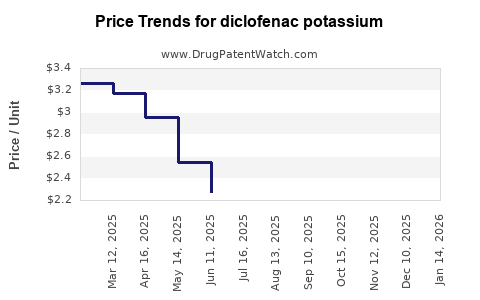
Last updated: September 23, 2026
Diclofenac potassium is a mature, low-cost NSAID with broad global use and limited remaining exclusivity. Its market is driven by prescription volume, OTC availability outside the United States, regional brand strength, and differentiated formulations rather than molecule-level innovation. Standard tablets face intense generic competition. Commercially valuable niches remain in rapid-release products, oral powders, liquid-filled capsules, and regulated prescription brands such as Cambia and Zipsor.
The product’s financial trajectory is structurally flat to declining in mature markets. Price erosion affects standard tablets, while branded formulations can preserve higher margins through formulation, delivery, and trademark protection. Public companies generally do not report diclofenac potassium revenue separately, so drug-level market size and profitability must be inferred from product sales, prescription data, and broader NSAID markets.
What is the current market position of diclofenac potassium?
Diclofenac potassium is an immediate-release form of diclofenac used for acute pain, musculoskeletal conditions, dysmenorrhea, migraine, and inflammatory disorders. It competes with diclofenac sodium, ibuprofen, naproxen, ketoprofen, celecoxib, and topical NSAIDs.
The commercial position differs by jurisdiction:
| Market segment |
Commercial status |
Main competitive pressure |
| Generic diclofenac potassium tablets |
Mature and widely available |
Low prices, multiple manufacturers |
| Prescription branded tablets |
Narrower branded presence |
Generic substitution |
| Oral powder for solution |
Differentiated prescription niche |
Alternative acute migraine products |
| Liquid-filled capsules |
Specialty formulation niche |
Generic tablets and branded NSAIDs |
| OTC products outside the U.S. |
High-volume regional market |
Ibuprofen, paracetamol, diclofenac sodium |
| Hospital and institutional supply |
Tender-driven |
Price and supply reliability |
The molecule benefits from physician familiarity and extensive clinical experience. Its limitations are the class-wide cardiovascular, gastrointestinal, renal, and hepatic risks associated with systemic NSAIDs. Regulatory agencies have maintained warnings concerning the lowest effective dose and shortest practical treatment duration.[1][2]
How large is the diclofenac potassium market?
No authoritative global revenue figure exists for diclofenac potassium as a standalone active ingredient. Public market databases usually combine diclofenac potassium with diclofenac sodium, topical diclofenac, combination products, or the broader NSAID market.
The economic profile is clear:
- Standard generic diclofenac potassium has low average selling prices.
- Revenue is concentrated in high-volume countries and branded specialty products.
- Formulation-specific products can generate substantially higher revenue per prescription.
- Generic entry limits long-term pricing power.
- Growth is linked to population, access to analgesics, and prescription volume rather than premium pricing.
In the United States, standard diclofenac potassium tablets are primarily an abbreviated new drug application, or ANDA, market. Products such as Cambia and Zipsor occupy smaller branded segments with differentiated dosage forms and approved indications. Outside the United States, diclofenac products are commonly sold through pharmacies, hospitals, and OTC channels, depending on national regulation.
What drives diclofenac potassium demand?
Demand is supported by:
- Acute musculoskeletal pain
- Dental and postoperative pain
- Primary dysmenorrhea
- Migraine treatment
- Arthritis and inflammatory disorders
- Broad physician familiarity
- Low cost relative to newer prescription analgesics
Demand is constrained by:
- NSAID safety warnings
- Substitution by ibuprofen and naproxen
- Growth of topical diclofenac
- Increased use of acetaminophen and nonpharmacological treatments
- Preference for COX-2 selective agents in some patients
- Generic price competition
The strongest commercial opportunity is usually not the basic tablet. It is a formulation that improves onset, convenience, tolerability, or indication-specific positioning.
When did diclofenac potassium lose exclusivity?
Diclofenac potassium lost meaningful molecule-level exclusivity decades ago. The active ingredient is a mature small molecule, and standard tablet products are exposed to generic competition in major markets.
The relevant exclusivity structure is:
| Exclusivity type |
Current position |
| Active-ingredient exclusivity |
Expired |
| Original composition-of-matter patent |
Expired |
| Standard tablet formulation exclusivity |
Generally expired |
| Prescription brand trademark |
May remain active |
| Product-specific formulation patents |
May exist for selected brands |
| Regulatory exclusivity for new indications |
Product- and jurisdiction-specific |
| Orphan exclusivity |
Not generally relevant |
| Biologic exclusivity |
Not applicable |
The commercial question is therefore product-specific. A company cannot rely on diclofenac potassium itself to prevent competition. Protection must come from a proprietary formulation, delivery system, approved indication, manufacturing process, trademark, distribution arrangement, or regulatory barrier.
What patents protect diclofenac potassium products?
The core active ingredient is not protected by an enforceable modern patent estate in the United States or other major pharmaceutical markets. The remaining rights, where present, are more likely to cover formulation, dosage form, manufacturing, or use.
Formulation patents
Specialty products can have patent claims directed to:
- Liquid-filled capsules
- Rapid dissolution
- Buffered formulations
- Powder-for-solution dosage forms
- Specific excipient combinations
- Particle-size control
- Improved bioavailability
- Manufacturing processes
- Packaging that stabilizes the product
These claims are narrower than composition-of-matter claims and are easier for generic manufacturers to design around. Their commercial value depends on whether the FDA Orange Book lists them and whether they cover the marketed product rather than an unused formulation.
Method-of-use patents
Method-of-use protection can cover treatment of:
- Acute migraine
- Primary dysmenorrhea
- Specific inflammatory conditions
- Particular dosing regimens
- Administration with a defined onset or patient population
A method patent does not necessarily block all generic sales. Under the U.S. skinny-label system, an ANDA applicant can omit patented indications from its labeling. Enforcement then depends on the patent claims, product labeling, prescribing behavior, and inducement evidence.
Manufacturing and process rights
Manufacturing patents can protect a production route, crystallization process, polymorph, impurity profile, or scale-up method. These rights can raise entry costs but rarely prevent all generic competition when alternative processes are available.
What is the Orange Book status of diclofenac potassium?
The FDA Orange Book separates standard generic diclofenac potassium products from branded prescription formulations. The relevant FDA categories include:
- Diclofenac potassium tablets
- Cambia, diclofenac potassium for oral solution
- Zipsor, diclofenac potassium liquid-filled capsules
- Other dosage forms and strengths listed under separate applications
Cambia and Zipsor are materially different from conventional immediate-release tablets. Their commercial protection depends on the combination of:
- NDA-listed patents
- Product-specific labeling
- Dosage-form differentiation
- Brand recognition
- Prescriber and payer positioning
Orange Book status can change through patent expiration, delisting, product discontinuation, or changes in FDA listing. A current diligence review should use the FDA’s live Orange Book rather than historical patent summaries.[3]
Which companies are challenging diclofenac potassium products?
The standard tablet market has already been challenged by multiple generic manufacturers. In the United States, generic NSAID suppliers commonly include large ANDA manufacturers such as Teva, Endo/Par Pharmaceutical, Hikma, Amneal, Lupin, Dr. Reddy’s, and other regional suppliers, depending on product strength and current approvals.
For specialty formulations, competition is more limited. Potential challengers include:
- Generic manufacturers seeking ANDA approval
- Authorized generic suppliers
- Contract development and manufacturing organizations
- Branded NSAID companies with alternative delivery systems
- Regional manufacturers in markets where the product is not patent-blocked
The most important competitive distinction is between a generic tablet challenge and a formulation-specific challenge. A tablet competitor can enter at a low price without reproducing the commercial attributes of a liquid-filled capsule or oral powder.
What patent litigation affects diclofenac potassium?
Diclofenac potassium does not have the litigation profile of a recently launched specialty drug. Core-molecule patent litigation is not a material current barrier. Any meaningful dispute is more likely to involve:
- Orange Book-listed formulation patents
- Paragraph IV certifications
- Labeling and indication carve-outs
- Patent listing disputes
- Trade dress or trademark rights
- Manufacturing know-how
- Contractual supply or licensing rights
Publicly visible litigation risk is concentrated in branded formulation products rather than generic diclofenac potassium tablets. Litigation exposure also depends on whether the product has an active NDA patent listing and whether a generic applicant has submitted a Paragraph IV certification.
Are there Paragraph IV challenges to diclofenac potassium?
Paragraph IV risk is relevant mainly to branded or formulation-specific products with unexpired Orange Book patents. It is much less relevant to ordinary diclofenac potassium tablets because their core exclusivity has expired.
A Paragraph IV challenge can produce four commercial outcomes:
| Outcome |
Effect on incumbent |
| Patent owner does not sue |
Generic may proceed after FDA approval and applicable review requirements |
| Patent litigation begins |
Launch may be delayed by the statutory stay |
| Generic wins or patent is narrowed |
Early entry risk increases |
| Settlement permits a later launch |
Market entry occurs on a negotiated date |
The practical exposure for a branded formulation depends on the number of listed patents, remaining patent term, patent quality, and the applicant’s ability to design around the claims. Product-specific patent protection is generally weaker than a composition-of-matter patent.
How does diclofenac potassium compare with diclofenac sodium?
Diclofenac potassium and diclofenac sodium contain the same active moiety but use different salt forms and product designs.
| Attribute |
Diclofenac potassium |
Diclofenac sodium |
| Typical positioning |
Faster-acting oral products and acute pain |
Broad oral, topical, and extended-release use |
| Common dosage forms |
Immediate-release tablets, oral powder, liquid-filled capsules |
Tablets, extended-release tablets, capsules, gels, patches, solutions |
| Commercial maturity |
Mature generic market |
Mature and broader product market |
| Differentiation |
Onset and formulation |
Dosage-form breadth and topical delivery |
| Generic pricing power |
Low for standard tablets |
Low for standard products |
| Specialty opportunities |
Oral solution and rapid-release products |
Topical and modified-release products |
| Safety profile |
Systemic NSAID class risks |
Same active-moiety risks when systemic |
Diclofenac sodium has a broader commercial footprint because of its extensive topical market. Diclofenac potassium can command higher value in acute-use formulations, but its total addressable market is generally narrower.
What is the financial trajectory for diclofenac potassium?
The financial trajectory is best described as volume-stable but price-compressed for generic products, with selective growth in branded formulations.
Generic tablet trajectory
Generic tablets usually experience:
- Falling prices after multiple entrants
- Stable or rising unit volume
- Limited marketing investment
- Low gross margin for undifferentiated suppliers
- Procurement pressure from wholesalers and public tenders
- Periodic price increases during shortages or supply disruptions
Revenue growth in this segment depends on manufacturing scale, low-cost active pharmaceutical ingredient supply, and reliable regulatory compliance.
Branded formulation trajectory
Branded products can retain higher revenue per prescription through:
- Migraine-specific positioning
- Faster perceived onset
- Convenience of oral solution
- Liquid-filled capsule technology
- Commercial contracting
- Specialty pharmacy distribution
- Physician promotion
The risk is that branded products face payer substitution and eventual generic or authorized-generic entry. Their revenue curve often declines sharply when a competing formulation secures approval, even if the brand remains clinically differentiated.
Manufacturing economics
The principal manufacturing variables are:
- API cost
- Salt-form control
- Dissolution performance
- Stability and impurity control
- Packaging
- Batch size
- Regulatory testing
- Supplier concentration
- Freight and regional registration costs
Diclofenac potassium is not generally an expensive API. The more significant cost differences arise from formulation complexity, quality-control requirements, packaging, and market authorization.
What generic launch scenarios exist for diclofenac potassium?
Three launch scenarios are commercially relevant.
Scenario 1: Standard tablet erosion
This is the baseline market. Multiple generic suppliers compete, prices decline, and the product becomes a procurement-driven commodity. The incumbent’s only durable advantages are manufacturing cost, supply reliability, regulatory history, and distribution.
Scenario 2: Specialty-formulation entry
A generic company targets Cambia, Zipsor, or a comparable branded product. Entry may require bioequivalence work, formulation development, device or packaging validation, and an ANDA or other regulatory filing. The entrant may launch at a discount while retaining a meaningful margin.
Scenario 3: Regional expansion
A manufacturer enters markets where diclofenac potassium is widely prescribed or sold OTC. The opportunity depends on registration requirements, local pricing controls, tender access, pharmacovigilance obligations, and national rules governing prescription status.
Does diclofenac potassium have biosimilar risk?
No. Diclofenac potassium is a small-molecule chemical drug, not a biologic. Biosimilar competition does not apply. The relevant threats are generic substitution, authorized generics, formulation copies, therapeutic alternatives, and OTC competition.
What licensing deals affect diclofenac potassium?
Licensing value is limited for the unprotected active ingredient. Commercially meaningful transactions are more likely to involve:
- Regional rights to branded formulations
- Licensing of rapid-release technology
- Contract manufacturing
- Distribution rights
- Authorized-generic arrangements
- Co-promotion of migraine or acute-pain products
A license covering ordinary diclofenac potassium tablets has limited strategic value unless it includes market access, a differentiated formulation, regulatory approvals, or a protected brand.
How strong is the diclofenac potassium patent estate?
The patent estate is weak for the active ingredient and standard tablets but can be moderate for selected formulations.
| Asset type |
Patent strength |
Commercial assessment |
| Core molecule |
Very low |
Expired |
| Standard tablet |
Low |
Generic competition established |
| Oral powder formulation |
Moderate at product level |
Depends on listed patents and claim scope |
| Liquid-filled capsule |
Moderate at product level |
Design-around and generic substitution risk |
| Method of use |
Low to moderate |
Vulnerable to skinny-label strategies |
| Manufacturing process |
Low to moderate |
Alternative processes may be available |
| Trademark and brand |
Moderate |
Supports differentiation but not exclusivity |
What is the FDA regulatory status of diclofenac potassium?
The FDA has approved diclofenac potassium products for prescription use, including immediate-release tablets and specialty formulations. FDA labeling emphasizes NSAID risks, including cardiovascular thrombotic events, gastrointestinal bleeding, renal effects, and hepatic concerns.[1]
The regulatory environment favors established generic products because:
- The active ingredient has extensive clinical history.
- Standard formulations have defined bioequivalence pathways.
- FDA review focuses on quality, bioequivalence, labeling, and manufacturing compliance.
- New formulations require additional development evidence.
- Product-specific claims require supporting clinical or pharmacokinetic data.
Key Takeaways
- Diclofenac potassium is a mature, genericized NSAID with no meaningful active-ingredient exclusivity.
- Standard tablets are low-margin, price-sensitive products.
- Commercial value is concentrated in formulation-specific products such as oral powders and liquid-filled capsules.
- Cambia and Zipsor face greater formulation and labeling risk than ordinary generic tablets.
- Paragraph IV litigation is relevant mainly to products with active Orange Book-listed patents.
- Diclofenac potassium has no biosimilar risk.
- Diclofenac sodium is the broader commercial competitor because of its topical and modified-release product range.
- Financial performance is driven by volume, manufacturing efficiency, distribution, and formulation differentiation.
- The strongest barriers are regulatory execution, supply reliability, and formulation know-how rather than molecule patents.
FAQs About Diclofenac Potassium Market and Exclusivity
Is diclofenac potassium still profitable for generic manufacturers?
Yes, but profitability depends on manufacturing scale, procurement access, supply reliability, and the number of competing suppliers. Standard tablets usually have limited pricing power.
Can a generic manufacturer copy Cambia?
A company may seek approval for a comparable diclofenac potassium oral-solution product, but it must satisfy FDA requirements for formulation quality, bioequivalence or applicable clinical standards, labeling, manufacturing, and any remaining patent obligations.
Is diclofenac potassium stronger than ibuprofen?
Clinical effect depends on dose, condition, patient response, and safety factors. Diclofenac is often considered an effective NSAID, but higher perceived potency does not eliminate cardiovascular, gastrointestinal, renal, or hepatic risks.
Can diclofenac potassium be sold over the counter?
Regulatory status varies by country. Some markets permit OTC diclofenac products, while the United States generally regulates oral diclofenac potassium as prescription medicine.
What is the main investment risk in diclofenac potassium?
The main risk is commoditization. Generic price erosion, payer substitution, regulatory compliance costs, and competition from topical diclofenac, ibuprofen, naproxen, and branded acute-pain products constrain revenue growth.
References
- U.S. Food and Drug Administration. (2023). Diclofenac potassium prescribing information. FDA.
- European Medicines Agency. (2013). CMDh confirms recommendations on limiting use of high-dose diclofenac. EMA.
- U.S. Food and Drug Administration. (2025). Approved drug products with therapeutic equivalence evaluations: Orange Book. FDA.
- U.S. Food and Drug Administration. (2009). Cambia prescribing information. FDA.
- U.S. Food and Drug Administration. (2009). Zipsor prescribing information. FDA.