Twi Pharms Company Profile
✉ Email this page to a colleague
What is the competitive landscape for TWI PHARMS
TWI PHARMS has thirty-one approved drugs.
There is one US patent protecting TWI PHARMS drugs. There is one tentative approval on TWI PHARMS drugs.
Summary for Twi Pharms
| US Patents: | 1 |
| Tradenames: | 28 |
| Ingredients: | 26 |
| NDAs: | 31 |
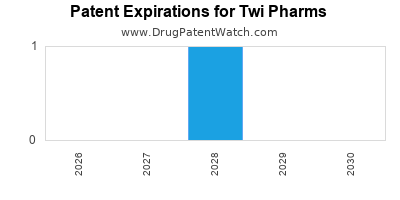
Drugs and US Patents for Twi Pharms
| Applicant | Tradename | Generic Name | Dosage | NDA | Approval Date | TE | Type | RLD | RS | Patent No. | Patent Expiration | Product | Substance | Delist Req. | Exclusivity Expiration |
|---|---|---|---|---|---|---|---|---|---|---|---|---|---|---|---|
| Twi Pharms | METFORMIN HYDROCHLORIDE | metformin hydrochloride | TABLET, EXTENDED RELEASE;ORAL | 213247-001 | Sep 29, 2021 | DISCN | No | No | ⤷ Start Trial | ⤷ Start Trial | |||||
| Twi Pharms | DILTIAZEM HYDROCHLORIDE | diltiazem hydrochloride | CAPSULE, EXTENDED RELEASE;ORAL | 217377-003 | Mar 1, 2023 | AB1 | RX | No | No | ⤷ Start Trial | ⤷ Start Trial | ||||
| Twi Pharms | TERBUTALINE SULFATE | terbutaline sulfate | TABLET;ORAL | 211832-002 | Jun 19, 2020 | AB | RX | No | No | ⤷ Start Trial | ⤷ Start Trial | ||||
| Twi Pharms | TENORETIC 100 | atenolol; chlorthalidone | TABLET;ORAL | 018760-001 | Jun 8, 1984 | DISCN | Yes | No | ⤷ Start Trial | ⤷ Start Trial | |||||
| >Applicant | >Tradename | >Generic Name | >Dosage | >NDA | >Approval Date | >TE | >Type | >RLD | >RS | >Patent No. | >Patent Expiration | >Product | >Substance | >Delist Req. | >Exclusivity Expiration |
Expired US Patents for Twi Pharms
| Applicant | Tradename | Generic Name | Dosage | NDA | Approval Date | Patent No. | Patent Expiration |
|---|---|---|---|---|---|---|---|
| Twi Pharms | TENORMIN | atenolol | TABLET;ORAL | 018240-001 | Approved Prior to Jan 1, 1982 | 3,934,032 | ⤷ Start Trial |
| Twi Pharms | NAPRELAN | naproxen sodium | TABLET, EXTENDED RELEASE;ORAL | 020353-001 | Jan 5, 1996 | 5,637,320 | ⤷ Start Trial |
| Twi Pharms | TENORETIC 50 | atenolol; chlorthalidone | TABLET;ORAL | 018760-002 | Jun 8, 1984 | 3,836,671 | ⤷ Start Trial |
| Twi Pharms | TENORETIC 50 | atenolol; chlorthalidone | TABLET;ORAL | 018760-002 | Jun 8, 1984 | 3,934,032 | ⤷ Start Trial |
| >Applicant | >Tradename | >Generic Name | >Dosage | >NDA | >Approval Date | >Patent No. | >Patent Expiration |
Paragraph IV (Patent) Challenges for TWI PHARMS drugs
| Drugname | Dosage | Strength | Tradename | Submissiondate |
|---|---|---|---|---|
| ➤ Subscribe | Extended-release Tablets | 450 mg | ➤ Subscribe | 2013-02-28 |
International Patents for Twi Pharms Drugs
| Country | Patent Number | Estimated Expiration |
|---|---|---|
| World Intellectual Property Organization (WIPO) | 2008038155 | ⤷ Start Trial |
| >Country | >Patent Number | >Estimated Expiration |
Supplementary Protection Certificates for Twi Pharms Drugs
| Patent Number | Supplementary Protection Certificate | SPC Country | SPC Expiration | SPC Description |
|---|---|---|---|---|
| 1506211 | 300677 | Netherlands | ⤷ Start Trial | PRODUCT NAME: COMBINATIE VAN DAPAGLIFLOZINE OF EEN FARMACEUTISCH AANVAARDBAAR ZOUT DAARVAN EN METFORMINE OF EEN FARMACEITISCH AANVAARDBAAR ZOUT DAARVAN, ZOALS BESCHERMD DOOR HET BASISOCTROOI EP 1506211B1; REGISTRATION NO/DATE: EU/1/13/900 20140121 |
| 2137537 | CA 2014 00035 | Denmark | ⤷ Start Trial | PRODUCT NAME: DIMETHYL FUMARAT (DIMETHYLFUMARAT); REG. NO/DATE: EU/1/13/837/001-002 20140203 |
| 2316456 | 65/2017 | Austria | ⤷ Start Trial | PRODUCT NAME: NALTREXON ODER EIN PHARMAZEUTISCH ANNEHMBARES SALZ DAVON, INSBESONDERE NALTREXONHYDROCHLORID, UND BUPROPION ODER EIN PHARMAZEUTISCH ANNEHMBARES SALZ DAVON, INSBESONDERE BUPROPIONHYDROCHLORID; REGISTRATION NO/DATE: EU/1/14/988 (MITTEILUNG) 20150330 |
| 0733366 | SPC/GB98/031 | United Kingdom | ⤷ Start Trial | PRODUCT NAME: 2-BUTYL-4-CHLORO-1-((2'-(1H-TETRAZOL-5-YL) BIPHENYL-4-YL)-METHYL)-5-(HYDROXYMETHYL)IMIDAZOLE (LOSARTAN),OPTIONALLY IN THE FORM OF A PHARMACEUTICALLY ACCEPTABLE SALT, IN PARTICULAR A POTASSIUM SALT( LOSARTAN POTASSIUM) AND HYDROCHLOROTHIAZIDE,; REGISTERED: FR 338520.7 19950215; FR 558453.7 19950215; UK 00025/0338 19960412 |
| >Patent Number | >Supplementary Protection Certificate | >SPC Country | >SPC Expiration | >SPC Description |
Similar Applicant Names
Applicants may be listed under multiple names.
Here is a list of applicants with similar names.
Here is a list of applicants with similar names.
