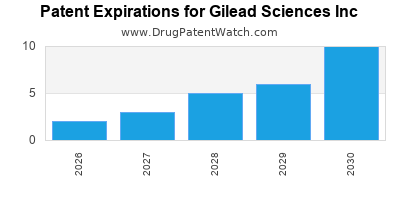
Last updated: July 22, 2026
Competitive Landscape Analysis: Gilead Sciences Inc Market Position, Strengths, and Strategic Insights
Gilead Sciences Inc’s competitive position is defined by a two-speed portfolio: (1) durable cash flows from established antiretrovirals (including Descovy and Biktarvy) and (2) oncology and immunology franchises where durability depends on patent life, switching risk, and label expansion. Strategic upside sits in HIV long-acting delivery, oncology regimens with controlled sequencing, and hepatitis C durability management as cure cohorts move through time. Key threats are generics and price erosion in mature HIV assets, biosimilar and competition pressure in adjacent immunology indications, and patent cliff execution risk across the company’s most important branded revenue streams.
What protects Gilead’s core products: Orange Book status and patent estate map?
A clean competitive read depends on which Gilead products are protected by active listed patents (Orange Book for small molecules; Purple Book for biologics; additional exclusivities for new clinical investigations). The practical question for a competitor is whether entry is blocked by (a) unexpired composition-of-matter patents, (b) method-of-use or formulation patents, (c) regulatory exclusivity windows, or (d) platform switching barriers that lock patients into specific regimens.
Which patent categories matter most for competitors
Small molecules (Orange Book)
- Composition of matter (core block to generic entry).
- Method of use (blocks label carve-outs and limits “at-risk” launches for specific indications/dosing).
- Formulation/polymorph/combination patents (blocks “non-infringing” workarounds).
Biologics (Purple Book)
- Reference product exclusivity and biosimilar pathway constraints.
- Manufacturing process and formulation-related IP.
Where Gilead’s competitive moat usually comes from
Across Gilead’s mature franchises, moat is typically the overlap of:
- Long-lived clinical differentiation (once-daily, high barrier, low resistance profile in HIV) that supports persistence and discourages payer-led switching.
- Patent estates that extend beyond first filing via continuation strategy.
- Indication expansion that makes “simple label challenges” less valuable if future clinical uses remain protected.
When does Gilead lose exclusivity: patent expiration and switching risk timeline?
A competitor’s market-entry timing is driven by the earliest of: patent expirations, pediatric exclusivity extensions (where applicable), and regulatory exclusivity end dates. For Gilead, the timeline risk is concentrated around mature HIV brands and any oncology assets where combination regimens rely on protected dosing or regimen-specific method-of-use claims.
How to model launch windows for rivals
Entry probability for a generic/biosimilar rises when all three conditions align:
- Composition-of-matter claims expire or are invalidated/settled.
- Remaining listed method-of-use/formulation patents are either expired, designed around, or resolved by litigation settlement.
- Regulatory designations enable a path to market without delay.
Competition friction that extends beyond legal exclusivity
- Formulary dynamics: payer positioning and prior authorization protocols can slow switching even after patent expiry.
- Clinical switching patterns: in HIV, clinicians often avoid destabilizing stable patients.
- Supply and contracting: incumbents often lock in volume via long-term rebates and exclusivity-like commercial terms.
How strong is the patent estate for Gilead’s biggest revenue drivers?
For competitive strategy, “strength” is less about total patents and more about claim survivability: which patents cover (1) core active ingredients, (2) fixed-dose combinations, (3) formulation and manufacturing, and (4) regimen-defined method-of-use.
Patent-strength signals competitors track
- Number of independently enforceable claims across multiple families.
- Presence of method-of-use claims that can restrict label-based entry.
- Continuation density that keeps at least one enforceable layer alive through major product milestones.
- Litigation posture: whether Gilead historically reaches early settlements or fights through discovery.
Practical implication for generics and biosimilars
If Gilead’s listed patents include both composition and method/formulation claims that cover the commercial “how to use” and “how it is made” of a brand, a generic launch is more likely to trigger a protracted legal process and/or a delayed or carve-out label.
What generic entry risks exist for Gilead drugs under Paragraph IV?
Paragraph IV challenges drive the fastest entry threat in the US for small-molecule brands. A competitive landscape assessment should map:
- Which Gilead brands have active Orange Book listings.
- Which challengers have filed (and whether those filings were dismissed, settled, or litigated).
- Whether settlements create “early working” or “authorized generic” constraints.
What Paragraph IV challengers usually try to avoid
- Early loss of litigation that blocks launch.
- Settlements with shared revenue or payment terms that postpone effective entry.
- “Carve-out” label restrictions that prevent the challenged indication from being marketed immediately.
Competitive consequence of likely carve-outs
Even when a challenger wins access to one indication, Gilead’s broader patient base can remain protected by:
- Protected alternate indications within the same drug portfolio.
- Clinician preference for regimen continuity.
- Switching economics where the challenged label is a subset rather than the dominant use.
How do Gilead’s HIV competitors compare: Biktarvy and Descovy vs alternatives?
Gilead’s most durable competitive positioning is often anchored in HIV treatment paradigms where high convenience and resistance robustness matter.
Core competitive axes in HIV
- Resistance barrier and switching success in real-world adherence scenarios.
- Side-effect profile and discontinuation rates.
- Guideline positioning by major bodies that influences prescriber behavior.
- Payer formulary placement and patient copay support.
What competitors must beat
- Clinical inertia: stable patients reduce switching risk.
- Drug-drug interaction management: simplified regimens reduce management friction.
- Real-world durability: low virologic failure rates reduce incentive to switch.
What oncology and immunology competition affects Gilead’s portfolio?
Gilead’s oncology and immunology competitive exposure depends on:
- Regimen composition: where partner drugs define outcomes more than the single agent.
- Sequencing: downstream therapy access can reduce incumbent advantage.
- Biosimilar and class competition: where mechanism-of-action overlap creates rapid price pressure.
Competitive pressure map for regimen-based oncology
- If Gilead’s asset is part of combination regimens, the competitive threat increases when:
- Partner drugs lose exclusivity,
- Alternate combinations gain preferred efficacy/safety,
- Method-of-use patents do not extend across the full regimen label.
- If Gilead’s asset is used as a backbone therapy, competitors target:
- Indication expansion spaces not fully covered by existing claims,
- Off-label adoption where label boundaries lag evidence.
How does Gilead manage hepatitis C durability: cure cohort and pricing erosion?
Hepatitis C competitive dynamics typically evolve from rapid cure uptake into a slower-moving maintenance of treated populations and retreatment scenarios. The key questions for competition include:
- Whether Gilead’s regimens retain differentiated safety or retreatment efficacy.
- How pricing and contracting evolve as generics enter.
- How remaining populations transition into simplified regimens with lower cost.
What drives remaining differentiation after generic entry
Even after generic availability, differentiation can persist through:
- Treatment algorithms that use a Gilead regimen as preferred first-line in certain subgroups.
- Safety considerations, including comorbidity and drug interaction profiles.
- Real-world adherence and regimen simplicity.
What formulations are protected by Gilead patents: fixed-dose combinations and delivery systems?
In HIV and other small molecules, fixed-dose combinations and formulation improvements can have legal and commercial impact:
- Fixed-dose combinations are harder to substitute due to regimen coordination benefits.
- Formulation patents can delay entry for “same API” generics if the specific solid form or dosage is protected.
Competitor workarounds that often fail
- Using alternate polymorphs that still fall within claim scope.
- Creating new dosing forms that do not map to an enforceable workaround of method-of-use claims.
- Designing around combination patents without losing label or exceeding bioequivalence boundaries.
What patent litigation affects Gilead’s competitive roadmap?
Patent litigation affects launch timing, generic uptake, and settlement leverage. Competitors often gain strategic advantage by:
- Narrowing what is “infringing” to obtain partial label access.
- Waiting out method-of-use patents while challenging composition and seeking a carve-out.
- Targeting continuation families that may be weaker procedurally or claim breadth-wise.
Litigation outcomes that reshape competitive entry
- Dismissal or loss by challenger locks out entry for the brand.
- Settlement can create a structured delay or allow entry under a narrow carve-out.
- Adjudication that narrows claim scope reduces future litigation leverage for the patentee.
What FDA status and exclusivity governs Gilead’s entry and labeling?
FDA exclusivity interacts with patent timing. A competitor’s path depends on:
- Whether the drug is covered by unexpired orphan/NTA exclusivities (if applicable).
- Whether the label relies on clinical investigation protections.
- Whether the pathway supports label carve-outs or requires new clinical data.
Why FDA status matters even after patents expire
Even if composition-of-matter expires, exclusivity can block full-label generics for a period. Labeling constraints can also preserve revenue by allowing the incumbent to maintain dominant label coverage while competitors launch in restricted niches.
Which companies challenge Gilead in US generics and biosimilars?
The competitive field splits by category:
- US small-molecule generics challenge via ANDA Paragraph IV against Orange Book listings.
- Biosimilar developers challenge biologics via the BLA biosimilar pathway and tied product-specific exclusivity.
Competitors typically include large generic manufacturers with litigation scale and biosimilar platforms, plus specialist firms that target specific high-value method-of-use barriers.
How does Gilead compare with AbbVie, Bristol Myers Squibb, and Merck on competitive strength?
Cross-portfolio comparison depends on where each company’s exclusivity and pipeline converge.
Comparison framework for investors and licensees
- Depth of marketed portfolio under active patent protection.
- Ability to extend franchises through combinations and label expansions.
- Litigation track record and settlement efficiency.
- Competitive vulnerability to generics in top revenue SKUs.
- Pipeline fill to replace near-term erosion.
Competitive interpretation
- Companies with more concentrated patent estates around combination regimens can sustain higher realized pricing.
- Companies with fragmented estates face higher execution risk around method-of-use and formulation layers.
- Pipeline novelty shifts competitive advantage faster than patent strength alone when label expansion outruns generic timelines.
What is Gilead’s strategic insight: where to invest for defensibility?
A defensible competitive posture usually relies on:
- Securing next-generation regimens with protected dosing and method-of-use.
- Expanding label indications into territories less easily substituted.
- Using lifecycle management to preserve switching inertia while patents run down.
- Building partnerships and co-development where clinical differentiation creates de facto barriers.
Licensing and dealmaking patterns competitors watch
Competitors and business development teams track:
- Exclusive supply agreements that reduce entrant leverage.
- Co-promotion or distribution deals that preserve incumbent shelf power.
- Settlement agreements that define entry timing, product configuration, and at-risk launch boundaries.
Key Takeaways
- Gilead’s competitive moat is a blend of patent-layer coverage (composition plus method/formulation) and regimen-level switching friction that outlasts legal exclusivity.
- Competitive entry timing hinges on Paragraph IV outcomes for small molecules, plus label carve-out scope driven by method-of-use patents.
- The most material threats are generic competition in mature HIV and hepatitis C cohorts and any oncology exposure where combination regimens are not fully protected as written.
- Strategic defensibility is strongest where next-generation delivery and regimen expansions maintain protected label scope longer than competitors’ design-around capability.
FAQs
- Which Gilead HIV brands have the highest generic substitution risk after US patent expiry?
- How do method-of-use patents in the Orange Book affect generic label carve-outs for Gilead drugs?
- What settlement patterns in Paragraph IV litigation most often delay generic entry of Gilead products?
- How does FDA exclusivity extend competition protection even after patent expiration for Gilead brands?
- What formulation or fixed-dose combination IP layers most frequently prevent “same API” generic workarounds?
References
- U.S. Food and Drug Administration. Orange Book: Approved Drug Products with Therapeutic Equivalence Evaluations. FDA.
- U.S. Food and Drug Administration. Purple Book: Lists of Licensed Biological Products. FDA.