COMPLERA Drug Patent Profile
✉ Email this page to a colleague
When do Complera patents expire, and what generic alternatives are available?
Complera is a drug marketed by Gilead Sciences Inc and is included in one NDA. There is one patent protecting this drug and one Paragraph IV challenge.
The generic ingredient in COMPLERA is emtricitabine; rilpivirine hydrochloride; tenofovir disoproxil fumarate. There is one drug master file entry for this compound. Three suppliers are listed for this compound. Additional details are available on the emtricitabine; rilpivirine hydrochloride; tenofovir disoproxil fumarate profile page.
DrugPatentWatch® Generic Entry Outlook for Complera
Complera was eligible for patent challenges on May 20, 2015.
There have been sixteen patent litigation cases involving the patents protecting this drug, indicating strong interest in generic launch. Recent data indicate that 63% of patent challenges are decided in favor of the generic patent challenger and that 54% of successful patent challengers promptly launch generic drugs.
Indicators of Generic Entry
AI Deep Research
Questions you can ask:
- What is the 5 year forecast for COMPLERA?
- What are the global sales for COMPLERA?
- What is Average Wholesale Price for COMPLERA?
Summary for COMPLERA
| US Patents: | 1 |
| Applicants: | 1 |
| NDAs: | 1 |
| Finished Product Suppliers / Packagers: | 1 |
| Raw Ingredient (Bulk) Api Vendors: | 2 |
| Clinical Trials: | 6 |
| Patent Applications: | 406 |
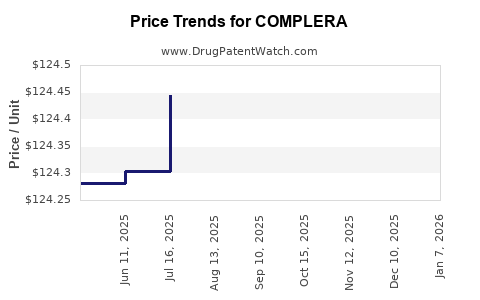
| Drug Prices: | Drug price information for COMPLERA |
| Patent Litigation and PTAB cases: | See patent lawsuits and PTAB cases for COMPLERA |
| What excipients (inactive ingredients) are in COMPLERA? | COMPLERA excipients list |
| DailyMed Link: | COMPLERA at DailyMed |
Recent Clinical Trials for COMPLERA
Identify potential brand extensions & 505(b)(2) entrants
| Sponsor | Phase |
|---|---|
| Gilead Sciences | Phase 3 |
| CIHR Canadian HIV Trials Network | Phase 3 |
| Ottawa Hospital Research Institute | Phase 3 |
Pharmacology for COMPLERA
Paragraph IV (Patent) Challenges for COMPLERA
| Tradename | Dosage | Ingredient | Strength | NDA | ANDAs Submitted | Submissiondate |
|---|---|---|---|---|---|---|
| COMPLERA | Tablets | emtricitabine; rilpivirine hydrochloride; tenofovir disoproxil fumarate | 200 mg/25 mg/ 300 mg | 202123 | 1 | 2015-05-20 |
US Patents and Regulatory Information for COMPLERA
COMPLERA is protected by one US patents.
| Applicant | Tradename | Generic Name | Dosage | NDA | Approval Date | TE | Type | RLD | RS | Patent No. | Patent Expiration | Product | Substance | Delist Req. | Exclusivity Expiration |
|---|---|---|---|---|---|---|---|---|---|---|---|---|---|---|---|
| Gilead Sciences Inc | COMPLERA | emtricitabine; rilpivirine hydrochloride; tenofovir disoproxil fumarate | TABLET;ORAL | 202123-001 | Aug 10, 2011 | AB | RX | Yes | Yes | 10,857,102 | ⤷ Start Trial | Y | ⤷ Start Trial | ||
| >Applicant | >Tradename | >Generic Name | >Dosage | >NDA | >Approval Date | >TE | >Type | >RLD | >RS | >Patent No. | >Patent Expiration | >Product | >Substance | >Delist Req. | >Exclusivity Expiration |
Expired US Patents for COMPLERA
International Patents for COMPLERA
When does loss-of-exclusivity occur for COMPLERA?
Based on analysis by DrugPatentWatch, the following patents block generic entry in the countries listed below:
African Regional IP Organization (ARIPO)
Patent: 16
Estimated Expiration: ⤷ Start Trial
Argentina
Patent: 4500
Estimated Expiration: ⤷ Start Trial
Patent: 3409
Estimated Expiration: ⤷ Start Trial
Australia
Patent: 11329642
Estimated Expiration: ⤷ Start Trial
Patent: 16208417
Estimated Expiration: ⤷ Start Trial
Patent: 18202635
Estimated Expiration: ⤷ Start Trial
Brazil
Patent: 2013012245
Estimated Expiration: ⤷ Start Trial
Canada
Patent: 18097
Estimated Expiration: ⤷ Start Trial
Chile
Patent: 13001402
Estimated Expiration: ⤷ Start Trial
China
Patent: 3491948
Estimated Expiration: ⤷ Start Trial
Patent: 6511357
Estimated Expiration: ⤷ Start Trial
Colombia
Patent: 61300
Estimated Expiration: ⤷ Start Trial
Costa Rica
Patent: 130293
Estimated Expiration: ⤷ Start Trial
Croatia
Patent: 0140946
Estimated Expiration: ⤷ Start Trial
Cyprus
Patent: 16115
Estimated Expiration: ⤷ Start Trial
Denmark
Patent: 40362
Estimated Expiration: ⤷ Start Trial
Ecuador
Patent: 13012700
Estimated Expiration: ⤷ Start Trial
Patent: 19078196
Estimated Expiration: ⤷ Start Trial
Eurasian Patent Organization
Patent: 5852
Estimated Expiration: ⤷ Start Trial
Patent: 1390651
Estimated Expiration: ⤷ Start Trial
Patent: 1691695
Estimated Expiration: ⤷ Start Trial
European Patent Office
Patent: 40362
Estimated Expiration: ⤷ Start Trial
Patent: 26466
Estimated Expiration: ⤷ Start Trial
Hong Kong
Patent: 90064
Estimated Expiration: ⤷ Start Trial
Patent: 06592
Estimated Expiration: ⤷ Start Trial
Israel
Patent: 6300
Estimated Expiration: ⤷ Start Trial
Japan
Patent: 38851
Estimated Expiration: ⤷ Start Trial
Patent: 14500261
Estimated Expiration: ⤷ Start Trial
Patent: 15131853
Estimated Expiration: ⤷ Start Trial
Malaysia
Patent: 5604
Patent: THERAPEUTIC COMPOSITIONS COMPRISING RILPIVIRINE HCL AND TENOFOVIR DISOPROXIL FUMARATE
Estimated Expiration: ⤷ Start Trial
Mexico
Patent: 7512
Estimated Expiration: ⤷ Start Trial
Patent: 13005669
Estimated Expiration: ⤷ Start Trial
Montenegro
Patent: 980
Estimated Expiration: ⤷ Start Trial
Morocco
Patent: 735
Estimated Expiration: ⤷ Start Trial
New Zealand
Patent: 0729
Patent: Therapeutic compositions comprising rilpivirine hcl and tenofovir disoproxil fumarate
Estimated Expiration: ⤷ Start Trial
Peru
Patent: 140163
Patent: COMPOSICIONES TERAPEUTICAS QUE COMPRENDEN RILPIVIRINA HCL Y TENOFOVIR DISOPROXIL FUMARATO
Estimated Expiration: ⤷ Start Trial
Patent: 170521
Patent: COMBINACION FARMACEUTICA QUE COMPRENDE RILPIVIRINA HCL, TENOFOVIR DISOPROXIL FUMARATO Y EMTRICITABINA
Estimated Expiration: ⤷ Start Trial
Patent: 211657
Patent: COMPOSICIONES TERAPEUTICAS QUE COMPRENDEN RILPIVIRINA HCL Y TENOFOVIR DISOPROXIL FUMARATO
Estimated Expiration: ⤷ Start Trial
Philippines
Patent: 013501002
Patent: THERAPEUTIC COMPOSITIONS COMPRISING RILPIVIRINE HCL AND TENOFOVIR DISOPROXIL FUMARATE
Estimated Expiration: ⤷ Start Trial
Poland
Patent: 40362
Estimated Expiration: ⤷ Start Trial
Portugal
Patent: 40362
Estimated Expiration: ⤷ Start Trial
San Marino
Patent: 01400150
Patent: Composizioni terapeutiche comprendenti rilpivirinacloridrato e tenofovir disoproxil fumarato
Estimated Expiration: ⤷ Start Trial
Serbia
Patent: 691
Patent: TERAPEUTSKE KOMPOZICIJE KOJE SADRŽE RILPIVIRIN HCL I TENOVOFIR DIZOPROKSIL FUMARAT (THERAPEUTIC COMPOSITIONS COMPRISING RILPIVIRIN HCL AND TENOVOFIR DISOPROXIL FUMARATE)
Estimated Expiration: ⤷ Start Trial
Singapore
Patent: 201509521W
Patent: THERAPEUTIC COMPOSITIONS COMPRISING RILPIVIRINE HCL AND TENOFOVIR DISOPROXIL FUMARATE
Estimated Expiration: ⤷ Start Trial
Patent: 201912527X
Patent: THERAPEUTIC COMPOSITIONS COMPRISING RILPIVIRINE HCL AND TENOFOVIR DISOPROXIL FUMARATE
Estimated Expiration: ⤷ Start Trial
Patent: 0333
Patent: THERAPEUTIC COMPOSITIONS COMPRISING RILPIVIRINE HCL AND TENOFOVIR DISOPROXIL FUMARATE
Estimated Expiration: ⤷ Start Trial
Slovenia
Patent: 40362
Estimated Expiration: ⤷ Start Trial
South Africa
Patent: 1304481
Patent: THERAPEUTIC COMPOSITIONS COMPRISING RILPIVIRINE HCL AND TENOFOVIR DISOPROXIL FUMARATE
Estimated Expiration: ⤷ Start Trial
South Korea
Patent: 1923103
Estimated Expiration: ⤷ Start Trial
Patent: 140037799
Estimated Expiration: ⤷ Start Trial
Spain
Patent: 24408
Estimated Expiration: ⤷ Start Trial
Taiwan
Patent: 1238612
Patent: Therapeutic compositions
Estimated Expiration: ⤷ Start Trial
Patent: 56840
Estimated Expiration: ⤷ Start Trial
Ukraine
Patent: 4075
Estimated Expiration: ⤷ Start Trial
Generics may enter earlier, or later, based on new patent filings, patent extensions, patent invalidation, early generic licensing, generic entry preferences, and other factors.
See the table below for additional patents covering COMPLERA around the world.
| Country | Patent Number | Title | Estimated Expiration |
|---|---|---|---|
| African Regional IP Organization (ARIPO) | 3816 | ⤷ Start Trial | |
| Argentina | 084500 | ⤷ Start Trial | |
| Argentina | 123409 | ⤷ Start Trial | |
| Australia | 2011329642 | ⤷ Start Trial | |
| Australia | 2016208417 | ⤷ Start Trial | |
| Australia | 2018202635 | ⤷ Start Trial | |
| Brazil | 112013012245 | ⤷ Start Trial | |
| >Country | >Patent Number | >Title | >Estimated Expiration |
Supplementary Protection Certificates for COMPLERA
| Patent Number | Supplementary Protection Certificate | SPC Country | SPC Expiration | SPC Description |
|---|---|---|---|---|
| 1419152 | C300529 | Netherlands | ⤷ Start Trial | PRODUCT NAME: RILPIVIRINE, DESGEWENST IN DE VORM VAN EEN FARMACEUTISCH AANVAARDBAAR ADDITIEZOUT, IN HET BIJZONDER HET HYDROCHLORIDEZOUT; REGISTRATION NO/DATE: EU/1/11/736/001 20111128 |
| 1419152 | C300532 | Netherlands | ⤷ Start Trial | PRODUCT NAME: EEN COMBINATIE VAN RILPIVIRINE EN ELKE DOOR HET BASISOCTROOI BESCHERMDE THERAPEUTISCH EQUIVALENTE VORM DAARVAN,; REGISTRATION NO/DATE: EU/1/11/737/001-002 20111128 |
| 1419152 | PA2012008 | Lithuania | ⤷ Start Trial | PRODUCT NAME: RILPIVIRINUM; REGISTRATION NO/DATE: EU/1/11/736/001 20111128 |
| 1419152 | PA2012009 | Lithuania | ⤷ Start Trial | PRODUCT NAME: EMTRICITABINUM + RILPIVIRINUM + TENOFOVIRUM DISOPROXILUM; REGISTRATION NO/DATE: EU/1/11/737/001, 2011 11 28 EU/1/11/737/002 20111128 |
| 1419152 | CA 2012 00021 | Denmark | ⤷ Start Trial | |
| 1419152 | CA 2012 00019 | Denmark | ⤷ Start Trial | |
| 1419152 | 92001 | Luxembourg | ⤷ Start Trial | 92001, EXPIRES: 20261128 |
| >Patent Number | >Supplementary Protection Certificate | >SPC Country | >SPC Expiration | >SPC Description |
COMPLERA (emtricitabine/rilpivirine/tenofovir disoproxil fumarate) market dynamics and financial trajectory
More… ↓
DrugChatter Q&A for COMPLERA
Make Better Decisions: Try a trial or see plans & pricing
Drugs may be covered by multiple patents or regulatory protections. All trademarks and applicant names are the property of their respective owners or licensors. Although great care is taken in the proper and correct provision of this service, thinkBiotech LLC does not accept any responsibility for possible consequences of errors or omissions in the provided data. The data presented herein is for information purposes only. There is no warranty that the data contained herein is error free. We do not provide individual investment advice. This service is not registered with any financial regulatory agency. The information we publish is educational only and based on our opinions plus our models. By using DrugPatentWatch you acknowledge that we do not provide personalized recommendations or advice. thinkBiotech performs no independent verification of facts as provided by public sources nor are attempts made to provide legal or investing advice. Any reliance on data provided herein is done solely at the discretion of the user. Users of this service are advised to seek professional advice and independent confirmation before considering acting on any of the provided information. thinkBiotech LLC reserves the right to amend, extend or withdraw any part or all of the offered service without notice.
ISSN: 2162-2639

Privacy and Cookies
Terms & Conditions
Site Map
DrugPatentWatch Alternatives
LOE / Major Patent Expirations 2026 - 2027
NCE-1 Patent Challenge Dates 2026 - 2027
Friedman, Yali. "DrugPatentWatch" DrugPatentWatch, thinkBiotech, 2026, www.DrugPatentWatch.com.
See Primary Research Papers Citing DrugPatentWatch